Disclosure: As an Amazon Associate, UMT Smart Tool earns from qualifying purchases. This guide is built from product listings and maker specifications, not from our own hands-on testing. Prices are approximate and can change, so check the current price before you buy. Last updated: November 10, 2026.
A small bathroom vanity has to do two jobs in very little floor space: give you a usable sink and counter, and swallow the toiletries that otherwise end up balanced on the toilet tank. “Best” here depends mostly on width. An 18-inch unit is a powder-room fix, a 24-inch vanity is the standard small-bathroom compromise, and a 30- or 36-inch model starts to feel like a real vanity with real storage. This guide is organized by size and mounting style, so you can start with the space you have, then compare the strongest option in that footprint.
In this guide
Quick Picks
The short version: six compact vanities we would look at first, from 18 inches up to 36.
| Pick | Type | Best for |
|---|---|---|
| ARIEL Hepburn 30″ | Solid oak freestanding vanity | Best overall quality in a small footprint |
| Modway Render 30″ | Mid-century freestanding vanity | Warm walnut style at 30 inches |
| Little Tulip Iris 24″ | Floating wall-mounted vanity | Small bathrooms that need visible floor space |
| eclife 24″ Combo | Freestanding vanity set | Budget all-in-one with faucet included |
| LUCKWIND 18″ | Compact freestanding vanity | Tiny powder rooms and half baths |
| chartustriable 36″ Farmhouse | Farmhouse vanity set | Most storage in the small-size range |
Our Picks
1. ARIEL Hepburn 30″ — Best Overall
The Hepburn is the quality outlier in this size range. Where most compact vanities are MDF or particleboard, ARIEL builds the Hepburn cabinet (model ARL1-T030SCQRVOWOA) from solid oak with plywood panels and no MDF. It pairs the 30-inch cabinet with a 1.5-inch Carrara white quartz countertop and backsplash, a rectangular porcelain undermount sink, two soft-closing doors and one full-extension dovetail drawer. The top is pre-drilled for an 8-inch widespread faucet, and the cabinet arrives fully assembled.
The trade-offs are price and depth. This is a premium-tier purchase, and at about 22 inches deep it needs a genuinely 30-inch-wide alcove with standard plumbing depth — it will not squeeze into the shallowest powder rooms. The faucet and mirror are not included, so budget for those separately. For a small main bathroom you plan to keep for years, it is the safest long-term buy here.

2. Modway Render 30″ — Best Mid-Century Style
The Render (model EEI-5422-WAL-WHI) brings a mid-century look to the 30-inch size: a walnut-grain finish over an 18-inch-deep frame, a slatted door front, splayed tapered legs and a white ceramic basin with an integrated countertop. Inside, soft-close doors hide an adjustable shelf — one open, bin-friendly volume. The shallower 18-inch depth is a real advantage where a standard 21- or 22-inch vanity would crowd the door swing or toilet clearance.
The compromises are materials and extras. The frame is particleboard with a laminate finish, so it will not shrug off standing water the way solid wood does — wipe up splashes rather than letting them pool at the base. There are no drawers, and the faucet, drain and mirror are separate purchases. Choose the Render if the look matters as much as storage and your bathroom is narrow front-to-back.

3. Little Tulip Iris 24″ — Best Floating Vanity
A floating vanity is the oldest trick for making a small bathroom feel bigger, and the Iris executes it well. The 24-inch walnut cabinet (24″W x 18.3″D x 21.1″H) hangs on a wall bracket, keeps the floor fully visible, and — unusually at this tier — arrives fully assembled. Storage is two soft-closing drawers rather than a door cabinet, which suits toiletries better: drawers bring small items to you instead of hiding them at the back. The glossy white ceramic top has an integrated basin, an overflow, and one pre-drilled faucet hole.
Read the installation note before ordering: the maker specifies solid concrete or brick walls, not hollow drywall, so renters and stud-wall bathrooms should look at the freestanding picks instead. The faucet, drain and mirror are sold separately, and the cabinet ships separately from the top. For a solid wall and a modern look, it is the strongest 24-inch option here.

4. eclife 24″ Combo — Best Budget All-in-One
Most vanities in this guide are a cabinet and a top; the faucet is on you. The eclife 24-inch combo is the opposite approach: a freestanding MDF cabinet with an undermount sink, a matte black faucet and a drain in the box, in a painted black finish. The sink is wider than the tiny basins on many 24-inch units, and the same design is sold in 18, 30 and 36-inch widths. For a budget refresh, having every component in one order is the whole point.
The compromises are the usual budget ones. MDF is less forgiving of water than plywood or solid wood, so keep the painted edges sealed and dry. Assembly is required, the mirror is not included, and the bundled faucet is a basic unit you may eventually upgrade. At a budget-friendly tier with the faucet included, it is still the easiest complete swap for a worn-out small vanity.

5. LUCKWIND 18″ — Best for Tiny Powder Rooms
At 17.7 inches wide and 17.7 inches deep, the LUCKWIND 18-inch vanity (model LW-22) fits the rooms the other picks cannot: converted closets, under-stair half baths and powder rooms where a standard-depth vanity would block the door. It still manages a ceramic sink top, a small drawer and cabinet storage below, and the faucet is included.
Be realistic about what 18 inches means in daily use. The basin is a hand-washing and tooth-brushing sink, not a place to fill a bucket, and counter space is effectively the rim of the sink. Measure your rough-in carefully, because at this width the cabinet leaves little room for off-center plumbing. For a true half bath, it gives you enclosed storage and a finished look a pedestal sink never will.
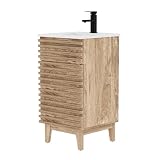
6. chartustriable 36″ Farmhouse — Best Farmhouse Style and Storage
Thirty-six inches is the top of the “small” range, and this farmhouse set (model CHAXST0753-A) uses the width properly: a sliding barn door, three drawers, and a layout mixing concealed cabinet space with drawer storage. At 18.3 inches deep it stays shallower than a standard vanity while roughly doubling the storage of the 24-inch picks. It is also a complete set — ceramic sink, faucet and mirror in the box — which keeps the total project cost predictable.
The barn-door style is a commitment: the sliding door needs its full travel width clear, and the grey farmhouse finish pushes the room toward one look. Construction is engineered wood rather than solid hardwood, and assembly is required. If your small bathroom does daily duty for a family, the extra six inches and drawer storage are worth more than any styling detail on this list.
Best Picks by Category
- Best overall: ARIEL Hepburn 30″ — solid oak, quartz top and dovetail drawer.
- Mid-century style: Modway Render 30″ — walnut finish, slatted doors, shallower 18-inch depth.
- Floating vanity: Little Tulip Iris 24″ — fully assembled, two drawers, floor kept clear.
- Budget all-in-one: eclife 24″ Combo — cabinet, sink, faucet and drain in one box.
- Tiny powder rooms: LUCKWIND 18″ — a full vanity under 18 inches wide and deep.
- Farmhouse style and storage: chartustriable 36″ — barn door, three drawers, mirror and faucet included.
Width decides the category first; construction decides how long the vanity looks good doing it.
How to Choose
Measure width, depth and door swing
Measure the alcove wall-to-wall, then measure again for depth and clearances. Building practice wants about 15 inches from the sink centerline to a side wall and roughly 21 inches of clear floor in front of the fixture. Check, too, that the bathroom door and the vanity doors or drawers can open without hitting each other or the toilet. In small rooms, a shallower 18-inch-deep vanity often fits life better than a standard 21- or 22-inch unit.
Freestanding vs floating
Freestanding vanities install anywhere, hide more plumbing variation, and usually hold more. Floating vanities make the room read larger and mopping easier, but they need a wall that can take the load: some makers specify solid masonry, otherwise the cabinet must anchor into studs or blocking. If you are not sure what is behind your wall, freestanding is the safer default.
Materials: solid wood, plywood and MDF
Bathrooms are wet, steamy rooms, and vanity cabinets fail from water long before they fail from weight. Solid wood and plywood resist swelling and hold screws best. MDF and particleboard are fine at budget tiers if the finish is intact, but once water reaches a cut edge or drilled hole, the material swells and does not recover. Keep caulk lines maintained and dry the base after splashes.
Storage layout: drawers vs doors
Drawers are the better storage for most toiletries — nothing gets lost at the back — but they need a U-shaped cutout around the drain, which reduces volume. Door cabinets swallow tall bottles and cleaning supplies more easily and cost less. At 24 inches and under, one format dominates the cabinet; at 30 to 36 inches, a drawer-plus-doors mix like the Hepburn’s is the most flexible layout.
Sinks, tops and faucet drilling
Integrated ceramic tops are the easiest to clean, undermount sinks on stone tops look the most finished, and vessel sinks trade counter space for style. Match the faucet to the drilling before you buy: single-hole, 4-inch centerset and 8-inch widespread tops are not interchangeable. Also check whether the faucet and drain are included — on several picks above they are separate purchases, which changes the real project price.
Plumbing fit and installation
Small vanities leave little room for error behind the cabinet. Check where your water supplies and drain exit the wall or floor, and whether the cabinet back is open, notched or closed. Assembled cabinets still need the top set and sealed; flat-pack units trade your time for a lower price. If the drain has to move, that is a plumbing job — factor it in before ordering.
Making a Tiny Bathroom Feel Larger
The vanity you pick is only part of a small bathroom. Visual choices can make a cramped room feel more open, and a few of them cost little.
Light colors reflect more light and make walls and cabinets recede. A white or pale vanity blends into the room, while a dark one becomes a focal point and can shrink a narrow space visually. Floating or legged vanities show more floor, and the visible floor area makes the room look bigger. A mirror is one of the strongest tools you have: a large mirror, or one that extends nearly to the ceiling, doubles the sense of depth and bounces light around.
Lighting should be bright and even. A single ceiling fixture casts shadows on the face, so add sconces on both sides of the mirror when possible. Keep the vanity top as clear as you can. A small tray for daily items, a wall-mounted soap dispenser and a hook for hand towels free up the counter and keep clutter from making the room feel crowded.
Storage Strategies When the Cabinet Is Small
Compact vanities store less, so the room around them has to share the load. Think vertically before you think wider.
- Over-the-toilet shelves or a slim cabinet use dead space above the tank without taking floor area.
- Wall-mounted shelves above the vanity hold towels and baskets at eye level.
- Drawer dividers keep small items sorted, so a drawer a few inches deep can hold more than an open cabinet.
- Door-mounted organizers inside the vanity doors store hair tools and cleaning supplies, if the doors have enough clearance.
- Slim rolling carts fit gaps between fixtures and can move out of the way.
Before buying extra organizers, empty the bathroom drawers and cabinets, discard expired products, and keep only what you use weekly. Most small bathrooms feel tight because of too many half-used products, not because the cabinet is too small.
Door Swing, Clearances and Code-Minded Layout
A vanity that looks perfect in an image can fail in your room if doors collide. Check how the bathroom door swings, how far the vanity door or drawer opens, and whether the toilet or shower door gets in the way. Corner placements, narrow alcoves and walls with radiators or windows all complicate positioning.
Plumbing codes and building rules generally call for minimum clearance in front of fixtures, and the specific numbers differ by jurisdiction. Confirm local requirements with your building department or a licensed plumber before finalizing a layout, especially if you are moving fixtures. As a rough comfort guide, you want enough room to stand at the sink without pressing against the toilet or tub.
For very narrow spaces, consider a corner vanity, a wall-mounted sink with a small shelf, or a narrow-depth model. These designs trade storage for floor room, which is often the right choice in a half bath or a guest bathroom.
Finishing Touches: Faucets, Hardware and Moisture Control
Small bathrooms trap humidity, so moisture control extends the life of the vanity. Run the exhaust fan during showers and for a while afterward. A fan that is too weak or vents into an attic can leave surfaces damp and encourage mildew. Wipe splashes from the cabinet top and edges, and fix drips promptly.
Faucet choice affects clearance. A tall faucet looks elegant but can splash in a shallow basin, while a short one might not leave room for your hands in a very small bowl. Match the faucet to the number of holes in the top, usually single hole or centerset on small units.
Hardware is a low-cost upgrade. Replacing basic knobs with better pulls changes the look and feel, as long as the hole spacing matches. Add a small dab of clear silicone where the top meets the wall to block water. Use a level during installation so the basin drains toward the drain opening instead of pooling.
Choosing Between Two Close Options
If two vanities seem equally good, the tiebreakers are door and drawer clearance, the weight of the cabinet, and the ease of getting it through your door. A slightly smaller unit that opens fully often beats a larger one that blocks the doorway. Also check whether the faucet and drain are included, how the sink is mounted, and whether the manufacturer provides clear assembly instructions. Read the return terms in case measurements prove off by an inch.
Measure twice, tape the footprint on the floor with painter tape, and stand in the space with the door open and closed. That ten-minute test reveals problems that dimensions on a page cannot.
Frequently Asked Questions
What is the smallest size for a bathroom vanity?
Vanity cabinets start around 16 to 18 inches wide. Eighteen inches is the smallest size that still gives you an enclosed cabinet, a drawer and a usable sink, as on the LUCKWIND pick above. Below that you are looking at wall-hung basins and pedestals, which give up storage entirely.
How much space should be in front of a small vanity?
Plan on roughly 21 inches of clear floor space in front of the fixture, and at least 15 inches from the sink’s centerline to any side wall. In very tight powder rooms a shallow-depth vanity (around 18 inches) is the usual way to recover that standing room.
Are floating vanities sturdy enough for daily use?
Yes, when they are anchored the way the maker specifies — into studs, blocking or solid masonry. The cabinet itself rarely fails; failures come from hanging a heavy vanity on drywall anchors alone. If your wall cannot be verified, choose a freestanding model.
Do small vanities come with the faucet included?
Some do, some do not. The eclife, LUCKWIND and chartustriable picks above include a faucet; the ARIEL, Modway and Little Tulip picks do not. Check the drilling pattern on the top before ordering a faucet separately.
Can a 24-inch vanity work in a full bathroom?
Yes, and it is the most common small-bathroom size for a reason: one person can brush, wash and shave comfortably, and a drawer-based model holds daily toiletries well. What it will not do is give two people counter space at once — that starts at 48 inches and up.
Is MDF a problem in a bathroom vanity?
Not automatically. Sealed, painted MDF performs fine for years in a ventilated bathroom. It becomes a problem when water sits on damaged edges or at the floor line. If your bathroom has no fan and heavy shower steam, plywood or solid wood is the safer spend.
What color vanity makes a small bathroom look bigger?
Light, neutral tones such as white, pale gray or light wood blend into the room and reflect light. Pair them with a large mirror and good lighting. A dark vanity can still work, but it tends to anchor the space and make it feel smaller.
Can I replace a vanity top without replacing the cabinet?
Often yes, if the cabinet is in good shape and the new top matches its width and depth. Check the sink cutout, faucet holes and plumbing alignment. If the cabinet shows water damage, replacing the whole unit is usually the better option.
How do I stop my small vanity from getting water damage?
Use the exhaust fan, wipe up splashes, and caulk the joint between the top and wall. Fix leaks quickly and check under the sink occasionally. A sealed finish and a cabinet back designed for plumbing help, but regular upkeep matters most.
Is a corner vanity a good idea for a half bath?
It can be, because it frees up the center of the room and fits tight layouts. Storage is usually limited, and not every plumbing layout supports a corner position. Measure carefully and check that the door can still open fully.
Bottom Line
Start with the Hepburn 30″ if space and budget allow it — solid oak and quartz will outlast every engineered-wood cabinet here. Tight on floor space, choose the Little Tulip Iris 24″; working to a budget, the eclife 24″ combo covers the whole fixture in one order. The LUCKWIND 18″ solves genuine powder rooms, and the chartustriable 36″ is the pick when storage matters more than footprint. Whatever you choose, measure the alcove, door swing and drain position twice before ordering — in small bathrooms, fit is the feature everything else depends on.