Disclosure: As an Amazon Associate, umtsmarttool.com earns from qualifying purchases. Links to Amazon on this page are affiliate links; they cost you nothing extra. Prices and availability change often, so check the current Amazon listing before you buy.
Where to buy
All six picks in this guide to the best stainless steel french presses are sold on Amazon. Start with the shortlist, then read the full reviews before you decide which press fits your routine.
- Frieling Double-Wall French Press 36 oz — Best Classic Steel Press. Check on Amazon — check price on Amazon.
- MuellerLiving French Press 34 oz — Best Value. Check price on Amazon.
- Secura French Press 34 oz — Best Overall. Check price on Amazon.
- Bodum Columbia Thermal French Press 34 oz — Best Insulated Value. Check price on Amazon.
- ESPRO P7 French Press 32 oz — Best Premium. Check price on Amazon.
- Frieling Double-Wall French Press 44 oz — Best Large Steel Press. Check price on Amazon.
Read the full guide ↓
The best stainless steel french presses trade the view for two practical virtues: they do not break, and they keep coffee hot. A double-wall steel press survives the drop that ends a glass beaker, travels to cabins and camps without ceremony, and holds a second cup at drinking temperature while breakfast happens. What you give up is visibility — no watching the bloom — and, in cheaper models, filtration finesse. This guide exists to find the steel presses that give up the least.
Six presses are compared, spanning the category’s real range: Frieling’s German-engineered double-wall presses in two sizes, the value-engineered MuellerLiving and Secura 34-ounce models that dominate family kitchens, Bodum’s Columbia with its silicone-rimmed plunger, and ESPRO’s vacuum-insulated P7, which pairs steel durability with the cleanest filtration in the category. Every capacity, steel grade, filter, and model detail comes from maker listings and expert roundups we actually opened, recorded in the sources file. If you are still deciding between materials, read this alongside best glass french presses; if the press will travel, best french presses for camping covers the camp-specific designs.
A note on steel grades, because listings shout about them: 18/8 and 18/10 describe the chromium and nickel proportions in the stainless alloy (304 grade in both cases here), and 18/10 is the marginally more corrosion-resistant, premium formulation. In daily kitchen use the difference is subtle; wall construction — single, double, or vacuum-insulated — and filter design change your coffee far more than the last digit of the alloy.
In this guide
Quick Picks
The table below sums up the six best stainless steel french presses in this guide. Badges here match the badges in the detailed reviews, so you can jump straight to the model that fits your situation.
| Pick | Badge | Key spec |
|---|---|---|
| Frieling Double-Wall French Press 36 oz | Best Classic Steel Press | 36 oz (1 L), 18/10 steel, double-wall, dual screen |
| MuellerLiving French Press 34 oz | Best Value | 34 oz, double-wall stainless, 4-level filtration |
| Secura French Press 34 oz | Best Overall | 34 oz, 304 steel inside and out, 3-layer filter + 2 spare screens |
| Bodum Columbia Thermal French Press 34 oz | Best Insulated Value | 34 oz, double-wall stainless, silicone-rim plunger |
| ESPRO P7 French Press 32 oz | Best Premium | 32 oz, vacuum-insulated steel, double micro-filter |
| Frieling Double-Wall French Press 44 oz | Best Large Steel Press | 44 oz, 18/10 steel, double-wall, dual screen |
How These Picks Were Chosen
We selected from maker specifications and expert roundups, weighting filter design first (it decides sediment), wall construction second (it decides heat retention and durability), and steel specification third. Only double-wall or vacuum-insulated models were included, because a single-wall steel press combines steel’s opacity with glass-like heat loss and is dominated by both categories; camp-style single-wall presses are covered in the camping guide instead.
Capacities and filter claims were cross-checked across at least the maker listing and one independent source for the four lead picks; the two Frieling sizes are documented through retailer specification listings that state ASIN, model number, capacity, and material together, and they are flagged as retailer-sourced in the sources file. Heat-retention language is kept to maker claims stated as claims, not converted into invented test results.
All six picks carry verified Amazon listings tied to the exact model in sources we opened. No prices or fixed rating figures appear anywhere in this guide, because they change constantly and should not decide a purchase anyway; the live listing is the place for current pricing.
The 6 Best Stainless Steel French Presses
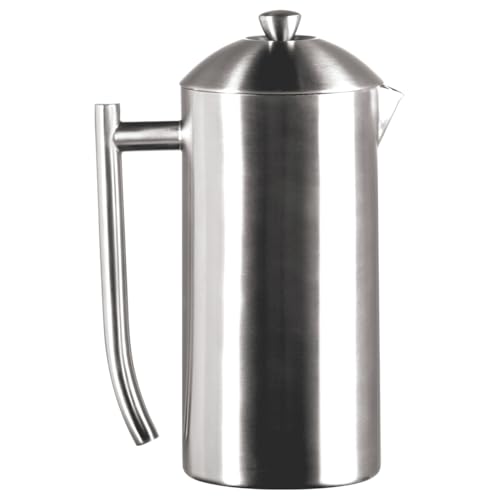
Frieling Double-Wall French Press 36 oz — Best Classic Steel Press
Choose the Frieling 36 oz if you want the traditional European steel press done properly: family-size capacity, a brushed finish that hides wear, and filtration a cut above standard mesh.
- Capacity: 36 oz (1 litre)
- Material: 18/10 stainless steel, brushed finish
- Walls: double-wall insulated construction
- Filter: two-stage dual-screen filter system
- Model: 0144 (brushed, 36 oz)
Strengths
- Dual-screen system catches more fines than a single mesh
- 18/10 steel in a double wall keeps coffee hot and shrugs off years of use
- Brushed finish hides fingerprints and minor scratches gracefully
Trade-offs
- Premium positioning beside value rivals of the same capacity
- Heavier than glass — a full pour is a two-handed habit for some
- Retailer-sourced specification in our research; verify model 0144 on the live listing
Frieling’s reputation rests on details other makers treat as decoration. The two-stage filter — a pre-screen plus a fine Italian mesh, in the maker’s design — presses with noticeably less grit than a single-screen rival, and the all-steel construction extends to the plunger assembly, with no plastic parts in contact with the brew. The double wall is not vacuum insulation, so heat retention is measured in a comfortable hour rather than a morning, but the coffee also stays honest press coffee: hot, heavy, and unhurried.
The brushed 36-ounce size is the family format: roughly three home mugs, in a finish that tolerates daily dishwasher-and-drawer life without showing every touch. Owners graduating from a broken best glass french presses beaker tend to land here and stay; the Frieling is the steel press that feels like an heirloom rather than an appliance, and its decade-scale durability is the core of its value case.
One honest limitation: double-wall is not vacuum-wall: expect good heat retention for a long breakfast, not Stanley-class hours, and decant if your household sips across a whole morning.
Best for: families wanting a durable, low-sediment classic steel press / Not suited for: buyers needing multi-hour heat retention or the lowest possible cost
Check on Amazon — check price on Amazon.
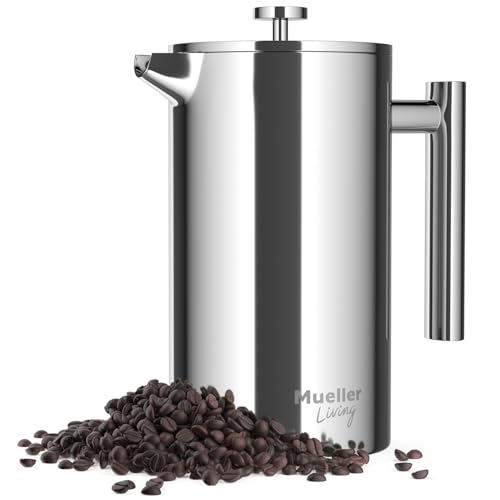
MuellerLiving French Press 34 oz — Best Value
Pick the MuellerLiving if you want the double-wall steel formula — insulation, durability, multi-layer filtration — at the value end of the category, for a family kitchen that brews daily.
- Capacity: 34 oz
- Material: stainless steel, double-wall insulated, rust-free food-grade build per maker listing
- Filter: 4-filter (4-level) filtration system per maker description
- Model: MU-SSHYDPRESS
- Care: dishwasher safe per maker listing
Strengths
- Multi-layer filtration delivers a smooth cup for the tier
- Double-wall steel keeps a second cup hot through breakfast
- Dishwasher-safe, rust-free positioning suits hard daily use
Trade-offs
- Finish and tolerances trail Frieling and ESPRO
- Maker filtration language (4-level) is marketing-layered — the cup is good, not magical
- Single size: no smaller or larger sibling in the line as listed
The MuellerLiving is the press that made double-wall steel a mainstream purchase: 34 ounces, insulated steel inside and out, and a stacked multi-screen filter that produces a genuinely smooth cup for its tier. In family service — daily brewing, dishwasher cycles, the occasional sink knock — it covers every fundamental without asking its owner to care about it, which is the highest compliment a weekday appliance can earn.
Its limits are the usual value-tier limits. The polish is thinner, the plunger feel less machined, and the brand’s 4-level filtration phrasing describes a stack of screens rather than a new technology. None of that reaches the cup in a way a breakfast drinker will notice. If your alternative is replacing a glass beaker every year or two, the MuellerLiving’s arithmetic is compelling; if you buy objects for decades, the Frieling and ESPRO above and below it make the longer case.
One honest limitation: value engineering shows in the details over years — expect a workhorse that ages functionally rather than a finish that stays showroom-bright.
Best for: daily family brewing on a sensible budget / Not suited for: buyers seeking premium finish or heirloom tolerances
Check on Amazon — check price on Amazon.
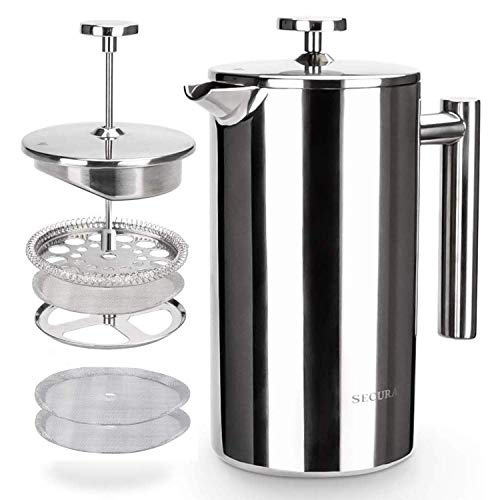
Secura French Press 34 oz — Best Overall
This is the steel press for most households: properly specified steel inside and out, a three-layer filter with spares in the box, and family capacity, without a premium-brand surcharge.
- Capacity: 34 oz (1 litre)
- Material: 304 grade (18/8) stainless steel, interior and exterior
- Walls: double-wall insulated construction
- Filter: 3-layer stainless filter system; two extra screens included
- Model: SFP-34DS; weight 2.4 lb; dimensions about 6.7 x 6.1 x 9.8 in
Strengths
- 304 steel on both interior and exterior — no lesser inner alloy
- Three-layer filter plus two spare screens covers years of wear
- Cool-touch handle and dishwasher-safe parts suit daily family use
Trade-offs
- At 2.4 lb empty, a full press is a committed pour
- Brushed-plain looks divide opinion beside polished rivals
- Double-wall retention is breakfast-length, not all-morning
The Secura wins this guide on specification honesty. Many steel presses use premium steel outside and a lesser grade inside, where the coffee actually lives; Secura specifies 304 stainless on both faces, wraps it in a double wall, and filters through three stainless layers — then includes two spare screens, acknowledging that the screen is the wear part and pre-solving it. Roundup sources we opened rank it at or near the top of the steel category, and the spec sheet explains why.
In the kitchen it behaves like the category’s sensible default: a smooth, low-grit cup, a handle that stays cool, parts that go in the dishwasher, and enough insulation for a family breakfast’s second round. It lacks the Frieling’s finish and the ESPRO P7’s vacuum-sealed filtration trick, and it costs accordingly less than both. For a household buying one steel press to use daily for years, that balance of specification, filtration, and restraint is exactly right — especially paired with the best electric kettles habit of water just off the boil.
One honest limitation: like every double-wall (non-vacuum) press here, heat retention is finite: brew for the meal in front of you, not for the whole morning.
Best for: most households wanting one durable, low-sediment steel press / Not suited for: all-morning sippers who need vacuum-level heat retention
Check on Amazon — check price on Amazon.

Bodum Columbia Thermal French Press 34 oz — Best Insulated Value
Choose the Columbia if you broke a Chambord, loved its simplicity, and want the same Bodum ritual in an insulated steel body that keeps the second cup hot.
- Capacity: 34 oz
- Body: double-wall stainless steel
- Filter: mesh plunger with silicone rim
- Insulation: double wall; maker positions up to two hours hot
- Model: 1308-16; dishwasher safe per listing
Strengths
- Silicone-rimmed plunger seals better than wire-rim mesh and catches more fines
- Lid closes off the spout between pours to hold heat
- Dishwasher-safe steel ends the breakage cycle of glass Bodums
Trade-offs
- Single mesh still passes some sediment beside multi-layer rivals
- Opaque body hides brew level and strength
- Heavier than the glass press it replaces
America’s Test Kitchen made the Columbia a co-winner in its testing, per the roundup we opened, praising exactly the details that separate it from generic steel presses: a silicone-edged plunger that hugs the wall and holds back fines a wire rim would pass, and a lid that seals the spout so the double wall’s heat stays in the pot. Tasters in that coverage described the coffee as rich, rounded, and full-bodied — Bodum flavour, without Bodum fragility.
Think of it as the Chambord’s pragmatic sibling. The ritual is identical, the parts go in the dishwasher, and the pot doubles as its own serving vessel for a long breakfast in a way no best glass french presses model can. Households loyal to Bodum’s ecosystem of spares will find screens and parts as available as ever; households chasing the absolute cleanest cup should look at the ESPRO P7’s sealed double filter instead.
One honest limitation: filtration remains single-mesh at heart: the silicone rim improves the seal, but a determined sediment-hater will still find a light silt in the last pour.
Best for: Bodum loyalists wanting insulation and durability without relearning the ritual / Not suited for: clarity-first drinkers who want grounds fully sealed after plunging
Check on Amazon — check price on Amazon.

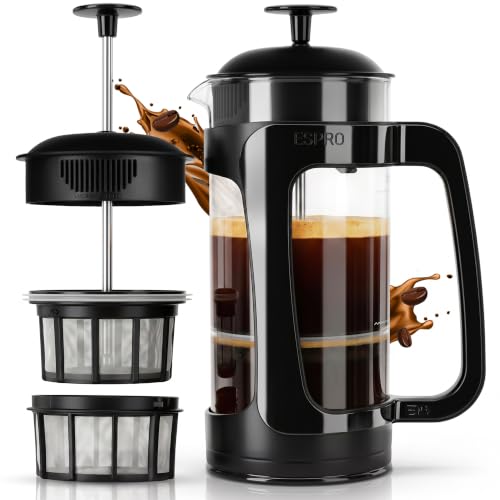
ESPRO P7 French Press 32 oz — Best Premium
Pick the P7 if you want the cleanest possible press cup, served slowly from an unbreakable insulated pot — and you accept that the best costs the most.
- Capacity: 32 oz brew (minimum about 24 oz); 18 oz size also sold
- Body: double-wall vacuum-insulated stainless steel, brushed
- Filter: dual micro-filter; paper-filter compatible (paper filters included per listing)
- Model: 1132C2; weight 2.6 lb; dimensions about 6.7 x 4.6 x 10.1 in
- Sizes: 32 oz reviewed; smaller size in the same line
Strengths
- Double micro-filter plus vacuum insulation is a combination no rival here matches
- Grounds seal off after plunging, so an insulated pot does not over-extract
- Optional paper filters produce an almost pour-over-clean cup
Trade-offs
- The premium price of this guide by a wide margin
- Heavy at 2.6 lb before coffee
- If you drink immediately, its advantages over the glass P3 narrow sharply
Every steel press faces the same trap: insulation invites slow drinking, and slow drinking on the grounds means bitterness. The P7 is the only design here that escapes it mechanically — ESPRO’s double micro-filter seals the grounds below the brew after plunging, so the vacuum-insulated body can hold coffee hot without continuing to extract it. America’s Test Kitchen recommends it for low-grit press coffee and Bon Appétit names it a best overall press, per the roundup sources we opened.
The honest counter-argument comes from Wirecutter’s coverage in the same sources: the P7 makes essentially the same coffee as the far cheaper glass P3 when both are poured promptly. You are paying for insulation, indestructibility, and the sealed-filter system — real virtues for slow drinkers, households with children and elbows, and anyone who has buried a glass beaker. Judge it on those terms and it is fairly priced; judge it on first-cup flavour alone and the best glass french presses P3 wins the value argument.
One honest limitation: minimum brew volume matters: the filter system is designed around near-full brews, so a household that mostly makes one small cup should buy the smaller size or a different press.
Best for: slow drinkers wanting a grit-free cup from an unbreakable insulated pot / Not suited for: value buyers or drinkers who always pour immediately
Check on Amazon — check price on Amazon.

Frieling Double-Wall French Press 44 oz — Best Large Steel Press
This is the large-household Frieling: the same steel, filtration, and finish as the 36-ounce model, scaled for families and hosts who brew for four or more.
- Capacity: 44 oz
- Material: 18/10 stainless steel
- Walls: double-wall insulated construction
- Filter: dual-screen filter system (Frieling two-stage design)
- Model: 131 (44 oz)
Strengths
- 44 ounces serves a table in one brew
- 18/10 steel and dual screens match the smaller Frieling’s quality
- Double wall keeps a large batch at temperature through a meal
Trade-offs
- A full 44 oz steel press is the heaviest pour in this guide
- Retailer-sourced specification in our research; verify model 131 live
- Oversized for couples — daily half-brews waste its design
Large steel presses are rarer than large glass ones, because the market assumes big-batch brewers will buy a machine. The 44-ounce Frieling serves the household that proves the assumption wrong: four or more press drinkers, one brew, no second round, in a vessel that will still be in service when a drip machine has been replaced twice. Its dual-screen filtration matters more at this scale, not less — a large bed of grounds sheds more fines, and the two-stage system keeps the last pour respectable.
Buy it at the right scale and it is a joy; buy it aspirationally and it is a heavy, half-filled pot that brews mediocre small batches. Couples should take the 36-ounce Frieling or the 34-ounce Secura and brew fresh twice on guest days. Genuinely large coffee households — including the brunch hosts who considered the big glass Chambord in best glass french presses and feared the beaker — should take this one without hesitation.
One honest limitation: weight is the tax on scale: full, this press demands a confident two-handed pour, and anyone with limited wrist strength should choose a smaller model and brew twice.
Best for: large households and hosts brewing for four or more / Not suited for: couples or anyone who finds a full large press hard to pour
Check on Amazon — check price on Amazon.
Comparison Table
Use this side-by-side view to compare the six best stainless steel french presses on the specs that actually change day-to-day use. There are no prices or ratings here on purpose, because both change constantly; the live Amazon listing is the only reliable place for either.
| Pick | Capacity | Steel / walls | Filter | Insulation |
|---|---|---|---|---|
| Frieling Double-Wall French Press 36 oz | 36 oz | 18/10 steel, double-wall | Dual screen, two-stage | Double-wall |
| MuellerLiving French Press 34 oz | 34 oz | Stainless steel, double-wall | Multi-layer (4-filter) | Double-wall |
| Secura French Press 34 oz | 34 oz | 304 steel, double-wall | 3-layer + 2 spare screens | Double-wall |
| Bodum Columbia Thermal French Press 34 oz | 34 oz | Stainless steel, double-wall | Mesh + silicone rim | Double-wall |
| ESPRO P7 French Press 32 oz | 32 oz | Stainless steel, vacuum-insulated | Double micro-filter | Vacuum |
| Frieling Double-Wall French Press 44 oz | 44 oz | 18/10 steel, double-wall | Dual screen, two-stage | Double-wall |
Filtration divides this table more than steel does. Multi-layer and dual-screen systems (Secura, both Frielings, MuellerLiving) and ESPRO’s sealed double micro-filter all chase the same goal — less sediment — by different mechanics, while Bodum’s silicone-rim mesh improves the classic single screen rather than replacing it. Insulation divides it the other way: one vacuum press (P7) for all-morning heat, five double-wall presses for breakfast-length heat. Choose your filter philosophy and your drinking pace, and the table narrows itself.
How to Choose the Right Stainless Steel French Press
Steel grades without the marketing fog
Listings compete on numbers — 18/8, 18/10, 304 — that describe the same family of stainless steel. Grade 304 with 8 percent nickel is 18/8; with 10 percent nickel it is 18/10, marginally more corrosion-resistant and typically finished to a higher standard. What matters practically: steel on the interior as well as the exterior (the Secura’s explicit specification), a plunger assembly without plastic in the brew path, and welds and rims finished smoothly enough to wash clean. A well-made 304 press will outlast its owner’s interest in press coffee; a poorly finished 18/10 press will annoy daily. Buy construction, not digits.
Double-wall versus vacuum insulation
A double wall is two steel layers with air between: it meaningfully slows cooling, keeps the exterior comfortable to handle, and suits a brew consumed within the hour. Vacuum insulation removes the air, slowing heat loss far more dramatically — the difference between a second cup that is hot and a third cup, hours later, that still is. Only the ESPRO P7 here is vacuum-insulated, and only it pairs insulation with a filter that seals grounds away, which is why it alone can promise slow drinking without bitterness.
If your household pours promptly, double-wall is not a compromise — it is the correct, cheaper specification. Pay for vacuum only when the pot genuinely doubles as a serving carafe across a morning.
Filtration systems, honestly ranked by job
Single mesh with a good seal (Bodum Columbia) makes classic press coffee with light sediment. Stacked multi-layer screens (Secura’s three layers, MuellerLiving’s multi-filter stack) catch progressively more fines and are the value route to a cleaner cup. Dual-screen two-stage systems (Frieling) refine the same idea with premium execution. Sealed double micro-filters (ESPRO P7) change the category: finest filtration, grounds isolated after plunging, optional paper for near-pour-over clarity. Rank your own sediment tolerance first; the filter hierarchy only matters relative to it.
Whichever system you choose, spare screens are a longevity feature. Mesh fatigues and frays over years; a maker who includes spares (Secura) or sells them widely (Bodum, Frieling, ESPRO) is selling you a decade, not a season.
Capacity and the weight of a full press
Steel presses run 32 to 44 ounces in this guide, pouring two to four home mugs. Add the press’s own weight — 2.4 to 2.6 lb for the documented models — to a full load of coffee, and pouring is a genuine ergonomic consideration, especially for the 44-ounce Frieling. Households with any wrist or grip limitation should favour the 34-ounce class and brew twice for guests.
Minimum volumes apply here too: insulated presses are designed around near-full brews, and a daily half-pot in a 44-ounce press will taste thinner and cool faster than the same coffee from a correctly sized 34-ounce model. Size to the daily brew, as with every category in this batch of guides.
What steel presses do to a morning routine
The practical difference between glass and steel shows up at 7 a.m., not in a tasting. A steel press can be filled, carried, knocked, and left standing through the chaos of a family breakfast without a single protective thought; it can travel to a cabin in a duffel; and its second cup is hot when the school run is done. Households rarely switch to steel for flavour — they switch after the second broken beaker, and then they rarely switch back.
That durability also changes who can brew. Children old enough to make coffee can be trusted with a steel press in a way no parent extends to glass, and guests can be handed the pot without a warning speech. If your household’s coffee is a shared, slightly chaotic institution rather than a solo ritual, the steel category’s virtues compound daily in a way a spec sheet cannot capture.
Reading a steel press listing like an engineer
Strip a listing to five verifiable facts and ignore the rest of the prose: capacity in ounces, wall type (double or vacuum), steel location (interior and exterior, or exterior only), filter construction (layers, screens, spares), and model number. The six picks in this guide were chosen because those five facts could be confirmed for each of them from sources we opened; a listing that hides any of the five — especially interior steel — is asking you to buy the two you cannot see on faith.
Two phrases deserve translation. “Heat resistant” in steel-press marketing usually describes the handle, not insulation; only wall construction retains heat. And “4-level filtration” and similar counts describe a stack of screens — effective, but a stack, not a technology generation. Judge the stack by whether spares exist and whether the cup it makes matches your sediment tolerance, using the filtration section above as the map.
Steel press or insulated carafe and glass press?
A legitimate alternative architecture deserves a hearing: brew in an inexpensive glass press, decant immediately into a vacuum carafe, and serve from that. It pours as cleanly as your filter allows, holds heat for hours, and replaces the cheapest component when accidents happen. Its costs are a second vessel to wash, a second object to store, and the loss of the sealed-filter trick — decanted coffee stops extracting, which is good, but the transfer itself is one more hot pour to manage at breakfast.
The integrated steel press wins on simplicity and counter space; the two-vessel system wins on modularity and replacement cost. Households that already own a good carafe should honestly price the glass-plus-carafe route — starting from best glass french presses — before assuming a premium steel press is the only path to hot second cups.
Travel, cabins, and second homes: where steel quietly wins
The steel press’s least advertised virtue is logistics. It travels in a duffel without wrapping, survives a cabin kitchen stocked by other people, tolerates being loaned, and asks for no electricity in a rental with an unfamiliar machine. Households with a second home, a boat, a caravan, or a regular cabin habit often find the steel press displaces the home glass press entirely — not on flavour, where they are peers, but on the simple fact that the steel one is always where the coffee is needed and never in pieces.
For those duties the mid-size double-wall models — Secura, MuellerLiving, Columbia — are the sweet spot: large enough for a household morning, light enough to pack without thinking, and priced so that a second one for the cabin is a shrug rather than a decision. The camping guide in this batch, best french presses for camping, covers the presses designed specifically for tents and tailgates; the steel kitchen presses here are their better-insulated, better-filtering cousins for roofs and walls.
Key Takeaways
- Steel buys durability and heat retention; it costs you the view of the brew.
- Filter design decides sediment: sealed double micro-filter, then multi-layer stacks, then single mesh.
- Double-wall suits prompt pouring; vacuum (ESPRO P7) suits all-morning sipping without bitterness.
- Interior steel grade and spare-screen availability predict lifespan better than headline alloy numbers.
- Count the full pour weight — press plus coffee — before choosing the largest size.
How to Brew with a Stainless Steel French Press
Steel hides the brew, so method replaces eyesight: measure, time, and trust the routine.
- Preheat the press with hot water for a minute, then discard the water — a cold steel wall steals degrees from the brew.
- Add coarse, even grounds, measured by weight with best digital kitchen scales if you want repeatability, or a heaped tablespoon per 4 oz of water.
- Pour water just off the boil over the grounds in a slow circle; start a timer.
- Stir gently, lid on with the plunger up, and steep for about four minutes.
- Press slowly and steadily, stopping just above the grounds bed.
- Serve promptly from double-wall presses; from the vacuum-insulated, sealed-filter P7 you may pour at leisure, because extraction has stopped.
- Disassemble the filter stack periodically for a full wash — oils collect between screens and stale flavours begin there.
Because you cannot see the brew, keep a simple log for the first week — dose, grind, time, verdict — and your steel press will become as predictable as any glass one.
Troubleshooting: Problems and Fixes
Problem: coffee cools before the second cup. → Fix: preheat the press, brew nearer to full capacity, and keep the lid’s pour spout closed between servings; if the pattern persists, your household is a vacuum-insulation household.
Problem: metallic taste. → Fix: wash new presses thoroughly before first use, descale if your water is hard, and check that no cleaning residue remains in the filter stack — true stainless steel in this guide is flavour-neutral once clean.
Problem: sediment is increasing over time. → Fix: your screen is fatiguing or mis-seated. Disassemble, flatten, and reseat the mesh; replace it when edges fray — this is why spare screens matter.
Problem: the plunger squeaks or drags. → Fix: grounds are trapped in the filter stack or the rod is misaligned. Strip, rinse each layer separately, and reassemble in order with the mesh seated flat.
Problem: bitter coffee from an insulated press. → Fix: it steeped on the grounds. Pour promptly from double-wall models; reserve slow serving for sealed-filter designs, and shorten the steep if the problem persists.
Descaling and Deep-Cleaning a Steel Press
Steel hides neglect better than glass, which is precisely why it needs a schedule. Coffee oils polymerise inside the filter stack and hard-water scale dulls the interior, and both flavour the brew long before they are visible.
- Monthly, disassemble the plunger fully: cross plate, screens, and spiral or retaining parts laid out in order.
- Soak the filter parts and the pot in hot water with a coffee-equipment cleaner or a spoon of bicarbonate of soda for twenty minutes.
- Scrub screens gently with a soft brush — never a scourer, which frays mesh edges and worsens sediment.
- For visible scale, fill the pot with equal parts water and white vinegar, stand for thirty minutes, then wash and rinse thoroughly.
- Reassemble with screens flat and in the original order; a reversed or buckled screen is the commonest cause of a sudden gritty cup.
- Dry fully before storing, with the lid ajar, so no stale moisture seasons the steel between uses.
A press maintained this way tastes neutral for years, which is the entire promise of stainless steel. Pair the routine with fresh beans and water from a decent best electric kettles habit — just off the boil, poured promptly — and a steel press becomes the most forgiving brewer in the kitchen.
Common Buying Mistakes
Paying for vacuum insulation you never use
If every brew is poured within fifteen minutes, vacuum insulation adds cost and weight and returns nothing. Match the wall to the drinking pace: prompt households should buy double-wall and spend the saving on better coffee.
Ignoring the interior steel specification
A polished exterior tells you nothing about the metal touching your coffee. Check that the interior is the same food-grade stainless as the exterior — the lead picks here specify it explicitly, and the ones that hide it should be asked why.
Forcing the plunger
Steel’s strength tempts force, but a clogged plunge means the grind is too fine or the dose too high, and force only sprays grounds past the screen. Ease up, re-press slowly, and fix the grind next brew.
Never stripping the filter stack
Coffee oils trapped between screens go stale and flavour every subsequent brew, and no amount of fresh beans fixes it. A monthly full disassembly and wash is the entire maintenance contract for a steel press.
Buying the largest size for occasional guests
A 44-ounce press used daily at half capacity brews worse coffee than a 34-ounce press used full — and weighs more doing it. Own the daily size; brew twice, fresh, when the table fills.
Final Recommendation
The Secura 34 oz is the recommendation for most households: 304 steel inside and out, a three-layer filter with spares included, family capacity, and breakfast-length insulation, in a press specified like a premium product without a premium-brand price. It is the steel press we would hand to a glass-press refugee and expect never to hear about again.
The runner-up is the Frieling 36 oz, for buyers who value finish and filtration refinement over outright value — 18/10 steel, a dual-screen system, and a brushed surface that ages beautifully. And if your household drinks a pot slowly across the morning, skip both finalists and take the ESPRO P7: it is the only press here engineered for exactly that habit.
Start with the Secura French Press 34 oz if you want one recommendation and no second-guessing. If its trade-offs do not fit your situation, the Frieling Double-Wall French Press 36 oz is the runner-up we would buy instead, for the reasons covered in its review above.
Frequently Asked Questions
Does stainless steel affect the taste of French press coffee?
Quality stainless steel is flavour-neutral once washed; new presses should be washed thoroughly before first use to remove manufacturing residue. Persistent metallic notes usually trace to detergent residue in the filter stack, hard-water scale, or a non-steel component in the brew path — all fixable, none inherent to the steel presses in this guide.
How long does coffee stay hot in a stainless steel French press?
Double-wall presses hold a comfortable drinking temperature across a breakfast — roughly an hour of useful heat. The vacuum-insulated ESPRO P7 holds heat far longer, and its sealed filter prevents the over-extraction that ruins slow drinking in other insulated presses. Maker heat claims for camp-style vacuum presses in our companion guide run to several hours; treat all such figures as best-case.
18/8, 18/10, or 304 — which steel is best?
They overlap: 304 is the grade, 18/8 and 18/10 are its nickel variants, with 18/10 marginally more corrosion-resistant. In practice, wall construction, interior specification, and filter design matter far more than the variant. Buy the press whose whole specification — inside, outside, filter, spares — is stated plainly.
Can a stainless steel French press go in the dishwasher?
Secura and Bodum rate their presses here as dishwasher-safe in listing material, and steel generally tolerates dishwashing well. The filter stack still deserves periodic hand disassembly and washing, because dishwashers do not clean between screens where stale oils collect.
Stainless steel or glass French press — which should I buy?
Glass for visibility, neutrality, and ritual at a lower cost, accepting fragility and no insulation; steel for durability, heat retention, and travel between kitchen and cabin, accepting opacity. The full glass comparison lives in best glass french presses; many households ultimately own one of each.
Why does my steel press coffee have sediment?
All mesh filtration passes some fines; multi-layer and dual-screen systems pass fewer, and ESPRO’s sealed double micro-filter passes fewest. Coarse, even grinding, a slow press, and a gentle pour minimise sediment in any model — and a fatigued screen should be replaced, which is why included spares are a real feature.
Can I use a stainless steel French press on the stove to keep coffee warm?
No — not the double-wall or vacuum-insulated presses in this guide. Direct heat damages insulation and finishes, and reheating brewed coffee ruins its flavour regardless of vessel. If coffee must wait, brew it fresh in smaller batches, or decant into a preheated insulated carafe. Single-wall camp presses that are designed to sit on a stove are covered separately in best french presses for camping.
Do stainless steel French presses rust?
Food-grade 304 and 18/10 stainless in this guide is highly rust-resistant in kitchen service. Surface discolouration is almost always dried coffee residue or hard-water deposit, not rust, and the deep-clean routine above removes it. True rust pitting suggests a damaged or misdescribed product and is grounds for a warranty conversation, not a scrubbing session.
How do I stop my steel press coffee tasting stale?
Stale flavour in a steel press is housekeeping, not metallurgy: strip and wash the filter stack, descale the pot, store the press dry and open, and check your beans and water before blaming the vessel. Nine times in ten, the culprit is oil trapped between screens that a rinse never reaches.
Can I make cold brew in a stainless steel French press?
Yes, and steel is arguably the better cold-brew vessel: coarse grounds and cold water, steeped in the refrigerator for twelve hours or more, then plunged slowly. The opaque body blocks the light that degrades flavour during a long steep, and the filter stack handles the gentle extraction cleanly. Dilute the resulting concentrate to taste, keep it refrigerated in a separate sealed jug rather than on the grounds, and wash the filter stack thoroughly afterwards — cold brew oils cling quietly and announce themselves in the next hot brew if they are left. The same method suits tea drinkers brewing a large iced batch, with the same thorough wash afterwards. Served over ice with a little of the steeping liquid’s patience still in it, press cold brew is smoother and sweeter than most hot brews ever manage.
Will a stainless steel French press stain or discolour inside?
Tea and coffee can leave a brown film and hard water a pale scale, both of which read as staining and neither of which is damage. The deep-clean routine in the how-to section — a soak with bicarbonate of soda, vinegar for scale, a soft brush only — restores the interior fully. What steel does not do is absorb odours the way plastic components can, which is one reason an all-steel brew path is worth specifying.