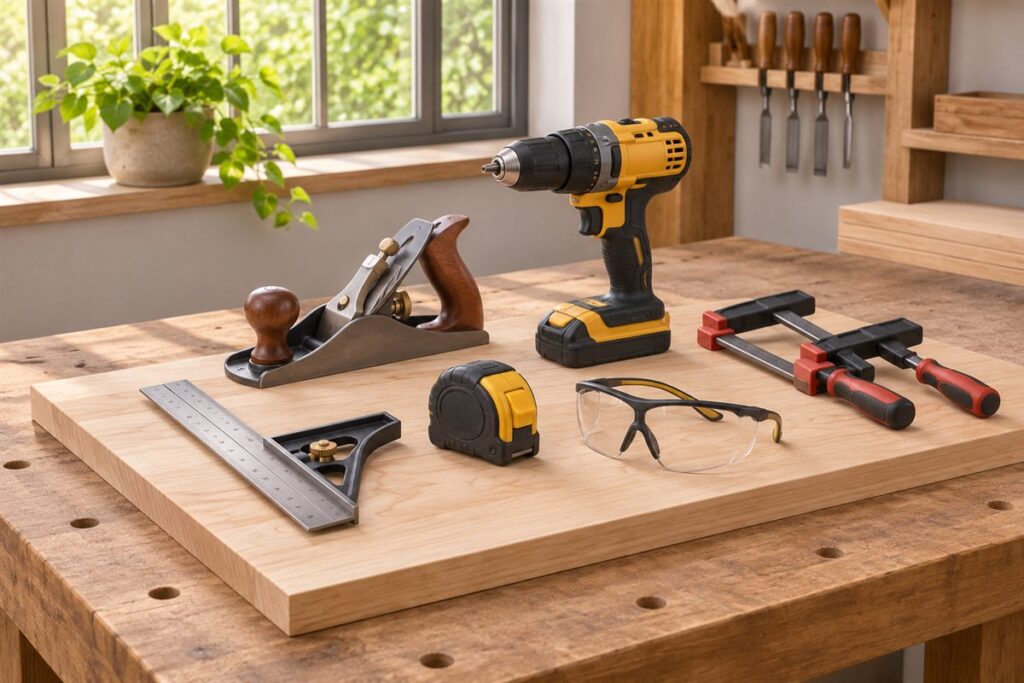
Corded tools give steady runtime for as long as they are plugged in, while cordless tools give you freedom to work anywhere. Neither wins every time, so the right choice depends on how long you work, where you work and how much power the job demands. This guide compares the two so you can match them to your own projects, with a worked decision method, common scenarios and a troubleshooting table.
What Each Type Is Good At
Corded tools draw power from an outlet, so they keep going as long as the cord reaches. They suit long, demanding tasks such as sustained cutting, sanding or grinding at a fixed bench.
Cordless tools run on a removable battery pack. They shine for quick jobs, ladder work, outdoor tasks and any spot where an outlet or extension cord is awkward.
Key Differences at a Glance
| Factor | Corded | Cordless |
|---|---|---|
| Runtime | Continuous while plugged in | Limited by battery capacity |
| Mobility | Tied to cord length | Move freely |
| Weight in hand | Often lighter | Battery adds weight |
| Upkeep | Check cord and plug | Charge and store batteries |
| Power under load | Steady | Depends on battery and tool design |
Who Should Choose Which
Think about your typical session, not your biggest one-off job.
- Choose corded if you work mostly at a bench, run tools for long stretches, or want one less thing to charge.
- Choose cordless if you move between rooms, work on ladders, or often have no outlet nearby.
- Choose a mix if you do both. Many workshops keep a corded saw or sander for heavy work and cordless drills for everything quick.
How to Decide for Your Shop
- List the five jobs you do most often.
- Note how far those jobs are from a wall outlet.
- Estimate how long each job runs without a break.
- Check whether you already own batteries from one maker, since that tips the balance toward cordless.
- Read the maker’s guide for runtime and capacity figures for the models you are considering.
Whatever you choose, follow the maker’s manual and safety instructions. Keep cords clear of the cutting path, and remove the battery or unplug the tool before changing accessories.
Cost of Ownership
Think beyond the tool itself. Corded tools need only the tool and a cord, while cordless tools need batteries and a charger, and batteries eventually wear out and need replacing. On the other hand, a shared battery system spreads that cost across many tools. Also consider storage: batteries prefer a dry place away from extreme heat or cold, as the maker describes.
Worked Walkthrough: Scoring Your Own Jobs
A simple scoring sheet keeps the choice grounded in how you actually work. The jobs and marks below are invented for illustration.
- Draw a table with your jobs down the left side and three columns: distance from an outlet, length of session and weight of the task.
- Fill in a rough note for each job. For example: hanging shelves, far from an outlet, short, light. Cutting a stack of boards, near a bench outlet, long, heavy.
- Mark each row with “corded”, “cordless” or “either” depending on which column dominates. Far and short leans cordless. Near and long leans corded.
- Count the marks. If most rows say cordless, a cordless system with a spare pack is a good base. If most say corded, a corded tool serves you well.
- Check the leftovers. A few rows pointing the other way suggest adding one tool of the other type later, not switching everything.
- Read the manuals for models you are considering, especially the sections on duty cycle, runtime and recommended use.
Common Scenarios
Hanging a door or fitting hinges
You will move around the door and may work on a ladder. Cordless suits it, and a compact drill driver is easier to handle.
Cutting a pile of lumber for a fence
Long cutting sessions favor a corded saw near a power source, or several charged packs for a cordless one. Follow the saw maker’s instructions and local building rules.
Sanding a large surface
Sanders run for long periods. A corded sander avoids running out mid-pass, while cordless suits spot work.
Working in a garden or outbuilding with no power
Cordless is the clear fit. Extension cords outdoors need to be suited to the location, so follow the cord maker’s instructions and local electrical rules.
Quick Troubleshooting
| Symptom | Likely cause | What to try |
|---|---|---|
| Corded tool loses power | Plug, cord or outlet fault, or tool overload protection | Check the outlet with another device, inspect the cord, and let the tool cool |
| Cordless tool dies mid-job | Pack empty or cut out by protection | Swap to a charged pack, ease the load |
| Tool slows when cutting | Dull accessory or overload | Replace the blade or bit, reduce pressure |
| Extension cord gets warm | Cord too thin or too long for the load | Stop, unplug and check the cord and tool manuals for suitable types |
| Charger does not respond | Pack too hot or cold, or contacts dirty | Let the pack reach room conditions and clean contacts |
Mistakes to Avoid
- Choosing by the biggest job. A rare heavy task should not drive a choice that affects every smaller one. Rent or borrow for rare heavy tasks.
- Using a damaged cord. Frayed or cut insulation is a hazard. Replace the cord with the help of the maker or a qualified repairer.
- Running a long cord coiled. Coils can trap heat in some conditions, so unwind cords as the manual advises.
- Forgetting a spare pack. A single cordless pack means stopping to charge.
- Leaving packs in a hot vehicle. Heat shortens pack life.
Care and Upkeep Over Time
For corded tools, look over the cord and plug before each session, keep vents clear of dust and store the tool dry. For cordless tools, store packs as the maker describes, rotate them and clean the contacts. For both, replace worn accessories and follow the manual for any servicing. Electrical repairs belong with the maker or a qualified repairer.
Glossary
- Duty cycle: how long a tool should run before it needs to rest, as the maker states.
- Extension cord: a lead that extends the reach of a corded tool.
- Pack: the removable battery of a cordless tool.
- Bare tool: a cordless tool sold without battery or charger.
- Overload protection: a feature that cuts power to guard against strain or heat.
FAQ
Are cordless tools as powerful as corded ones?
Many cordless tools handle everyday work well, but heavy, continuous jobs are where corded tools often keep an edge. Power depends on the specific model, so check the maker’s guide.
Do cordless batteries wear out?
Yes, all rechargeable batteries lose capacity with age and use. Storing and charging them as the maker describes helps them last longer.
Can I use an extension cord with a corded tool?
Often yes, but the cord must suit the tool and the location. Check the tool manual for guidance on cord type and length, and follow local electrical rules.
Which is better for a beginner?
A cordless drill driver is a common first tool because it is easy to handle and needs no outlet. A beginner with mostly bench work might do well with corded tools. Choose according to where you work.
Is it worth owning both?
For many people, yes. A cordless set covers quick jobs, and one or two corded tools handle long or heavy work.
The Short Version
Choose corded for long, heavy, stationary work and cordless for mobility and quick jobs. If your shop does both, owning a small mix of each is often the most practical answer. Follow the maker’s manual, and use a qualified professional for electrical repairs.