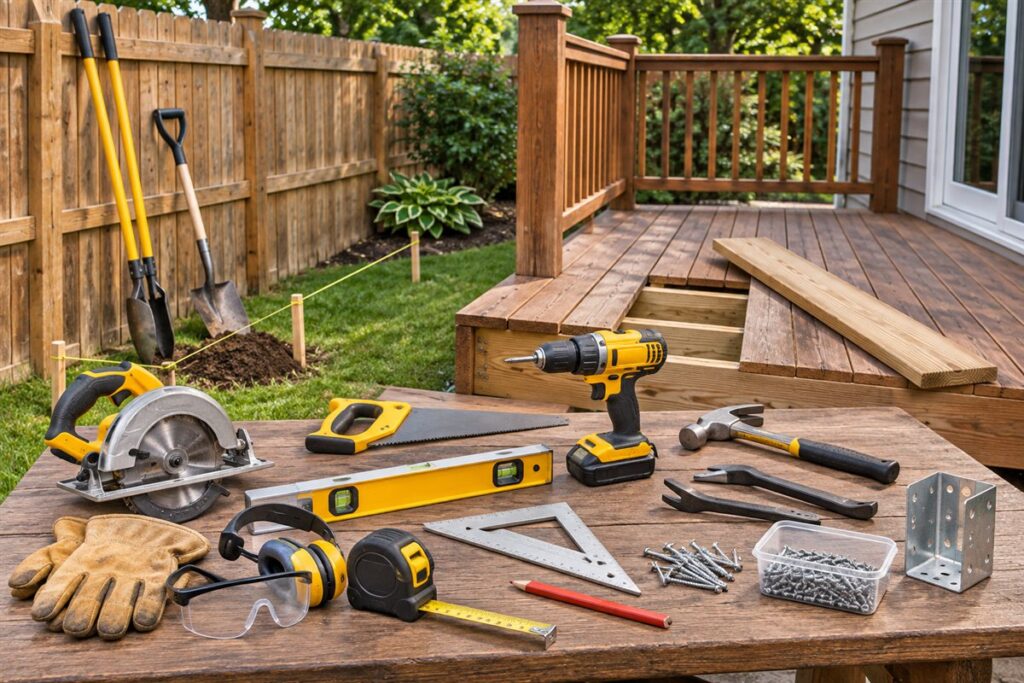
Fence and deck work calls for digging tools, measuring gear, a saw, a drill and plenty of fasteners. Small repairs such as replacing a board or a rail are within reach of many homeowners, but new decks, tall fences and anything structural often need permits and a qualified professional. This guide covers the rules to check, the tools for small repairs, and the habits that keep outdoor structures in good order.
Check the Rules First
Local rules may set limits on fence height, boundary distances and deck construction, and many areas require permits for new structures. Ask your local authority before you begin. Also find out where buried pipes and cables run before you dig, using your local utility locating service.
If the fence sits on a shared boundary, talk to your neighbour before changing it. Ownership and responsibility for boundary structures differ from place to place, so check your property documents or ask a local authority or legal professional rather than assuming.
Core Tools for Small Repairs
- A tape measure, a long level and a string line.
- A post-hole digger or spade.
- A hammer, a claw bar and a pry bar for removing damaged boards.
- A cordless drill and driver with bits for deck screws.
- A hand saw or circular saw, used according to the maker’s manual.
- A square for marking cuts.
- Work gloves, eye protection and ear protection.
Choose fasteners and treated timber intended for outdoor use, and follow the maker’s guidance on type and spacing.
A Simple Board Replacement
- Inspect the surrounding boards and framing for rot or movement.
- Remove fasteners from the damaged board with a driver or a pry bar.
- Lift it out and use it as a template for the new piece.
- Cut the new board to length, sealing cut ends as the timber maker advises.
- Pre-drill near the ends to reduce splitting, then fasten into the framing.
If the framing underneath is soft or damaged, stop and call a qualified professional, because structural problems affect the whole deck.
Worked Walkthrough: Replacing a Fence Panel or Rail
This sequence suits a like-for-like repair on a fence that is otherwise sound. Adapt it to the style of fence you have and to local rules.
- Walk the whole fence line first. Push gently on each post to see whether it moves, and look at the base for soft or crumbling timber. A rotten post is a bigger job than a panel.
- Photograph the damaged section and measure its length and height so you can buy matching material.
- Wear gloves and eye protection. Release the old fasteners with a driver where you can, and use the claw bar carefully on stubborn ones, keeping your face out of the line of the bar.
- Take the damaged panel or rail out and check for protruding nails. Bend them over or remove them so no one is scratched.
- Use the old piece as a template, mark the new one with a square and cut it according to the saw maker’s instructions.
- Hold the new piece in position, check it with the level, then fasten it with outdoor fixings of the type the timber maker recommends.
- Seal any cut ends as the product maker advises, and clean up offcuts and loose nails before finishing.
Working at Height and Heavy Loads
Raised decks, stairs and railings carry people, so errors matter. Follow local building rules and ask a professional for rails, stairs and anything high off the ground. Use ladders and platforms as the maker directs, and do not work alone on tall jobs.
Common Scenarios
- A single cracked deck board: lift it, check the joists beneath and replace it with a matching piece. If the joists are soft, stop and call a professional.
- A leaning fence post: a post that moves at ground level may have rotted or lost its support. Discuss repair methods with a local professional, particularly if the fence is tall or exposed to wind.
- A gate that sags: check the hinge screws and the post first. Tightening or replacing fixings can restore alignment, but a movable post needs attention.
- Squeaks from the deck: usually movement between a board and the framing. Check fasteners and replace any that are loose, rusty or missing.
- Planning a new deck: this is a permit, design and structural matter. Contact your local authority and a qualified professional before buying material.
Mistakes to Avoid
- Digging without locating services. Buried cables and pipes can be dangerous and expensive to repair, so use the locating service first.
- Using indoor fasteners outdoors. They corrode and stain the timber, and failure can follow. Choose fixings made for exterior use.
- Skipping pilot holes near board ends. The wood can split, which weakens the joint.
- Working on wet or icy surfaces. Slips from decks and ladders cause serious injuries, so wait for better conditions.
- Burying untreated timber in soil. It rots quickly. Follow the timber maker’s guidance for ground contact.
Quick Troubleshooting
| Symptom | Likely cause | What to try |
|---|---|---|
| Screws strip in new boards | Wrong bit or too much pressure | Match the bit exactly and slow the drill as the head seats |
| Boards split at ends | No pilot hole or fasteners too close to the edge | Pre-drill and keep fixings back from the end |
| Board sits higher than its neighbours | Warped timber or uneven framing | Check the framing with the level and replace a warped piece |
| Fence section leans after a repair | A loose post or poor support | Recheck the post; ask a professional if it moves |
Tools by Task
| Task | Tools |
|---|---|
| Setting posts | Digger, level, string line |
| Cutting boards | Saw, square, pencil |
| Fastening | Drill and driver, screws |
| Removing boards | Pry bar, hammer |
Care and Upkeep Over Time
Weather matters for outdoor work. Avoid working when surfaces are wet or icy, and allow treated timber to dry before sealing it, as the maker advises. Keep an eye on fasteners over time, since movement and moisture can loosen them, and replace any that show rust. Regular checks help you notice small problems early, before they become jobs for a professional. Sweep leaves and debris off the deck, because trapped moisture speeds up decay, and keep soil and plants from piling against boards. Once a year, walk the fence and deck and look for loose parts, splits, soft spots and protruding nails.
Glossary
- Joist
- A horizontal beam under the deck boards that carries the load.
- Rail
- A horizontal member on a fence, running between posts.
- Pilot hole
- A small guide hole drilled before a screw to reduce splitting.
- String line
- A taut cord used to keep posts or boards in a straight line.
- Treated timber
- Wood prepared to resist decay and insects, to be handled as its maker directs.
FAQ
Do I need a permit to repair a fence?
Like-for-like repairs often do not, but rules vary. Ask your local authority. New fences, changes in height and decks usually have stricter requirements.
How should I dispose of old treated timber?
Follow local collection rules. Do not burn treated timber unless your area explicitly allows it. Your waste service or local authority can tell you where it may go.
What fasteners should I use outdoors?
Use products made for exterior use and suited to your timber. Check the timber and fastener makers’ guidance, because some treatments and fixings do not work well together.
Can I build a small deck myself?
Some people do, but rules often apply to height, footings and railings. Check local requirements and talk to a qualified professional about structure and safety before you begin.
How can I tell if a post is rotten?
Look for soft, crumbling or darkened wood near the ground and check whether the post moves when pushed. If you cannot tell, a professional can assess it.
The Short Version
Check local rules, locate buried services, and use basic digging, measuring and fastening tools for small repairs. Inspect fixings and framing each year. Leave structural, raised or high work to qualified professionals.