Disclosure: As an Amazon Associate, umtsmarttool.com earns from qualifying purchases. Links to Amazon on this page are affiliate links; they cost you nothing extra. Prices and availability change often, so check the current Amazon listing before you buy.
Where to buy
- Surviveware Small First Aid Kit — the kit reviewed here — Check on Amazon
- First Aid Only 299-Piece All-Purpose First Aid Kit (FAO-442) — closest alternative — Check on Amazon
- Johnson & Johnson All-Purpose Portable Compact First Aid Kit — closest alternative — Check on Amazon
Read the full guide ↓
First aid kit review: Our Verdict in Brief
This first aid kit review takes one kit, the Surviveware Small First Aid Kit, and pulls it apart properly: what is inside, how the case behaves in a real home, who it genuinely suits, and where it falls short. A first aid kit is an odd product to review, because its finest hour is a bad thirty seconds in your kitchen, so this review judges it the way households actually experience it: findability, contents honesty, restocking and calm usability, rather than headline piece counts. Readers who want the wider field first should start with Best First Aid Kit For Renters Under $30 Best First Aid Kit For Renters Under $30 and return here for the deep dive.
The short verdict: the Surviveware Small First Aid Kit is a credible, honestly stocked option whose strengths and limits are both easy to describe. It covers the everyday end of household mishaps well, it asks little of its owner beyond a twice-yearly audit, and its weaknesses are the usual category ones rather than deal-breakers unique to this model. The sections below expand that verdict in full, including the alternatives worth considering if its particular balance does not match your home.
A note on scope: this guide covers basic household first aid supplies for minor incidents only. It does not provide medical advice, and no kit replaces professional care. For anything serious — heavy bleeding, breathing difficulty, chest pain, head injury symptoms, suspected fractures or severe burns — call your local emergency number first and use the kit only for basic steps such as covering a wound while help travels.
In this guide
Specifications and Contents
- 98 pieces
- Water-resistant 600D polyester pouch with labelled compartments
- Removable CPR pouch and first aid guide included
- Trauma shears, forceps, gloves and emergency blanket included
- No over-the-counter medication packets included
Contents lists in this category deserve a sceptical read, and this kit’s list survives one better than most. The everyday consumables are present in usable depth, the tools are real rather than decorative, and the case format, a water-resistant 600d polyester pouch, suits a fixed home in a cupboard or drawer. What the list will not tell you is how your household’s usage will reshape it over the first year, which is why the restocking sections of this review matter as much as the inventory.
Strengths and Trade-offs in Daily Use
Strengths
- Contents lean toward the supplies households actually consume, rather than display-only extras
- The water-resistant 600d polyester pouch format stores and opens sensibly in a real home
- Labelling and layout reduce the search time that matters during an incident
- Standard consumable sizes keep long-term restocking cheap and local
Trade-offs
- No medication packets, so pain relief has to be added separately
- Piece count looks modest beside bulk-count rivals
- Premium positioning means it rarely sits in the lowest price band
Weighed together, the strengths are the ones that matter during an incident, and the trade-offs are the ones that matter during ownership. That is a good distribution. A kit can survive being slightly awkward to restock; it cannot survive being impossible to search with one hand while holding a dressing with the other. On that central test, this kit performs as a household needs it to.
Design, Build and Living With the Case
A first aid case leads a strange life: ignored for months, then needed instantly. The Surviveware Small First Aid Kit’s case handles that rhythm sensibly. It opens in a way that exposes contents rather than hiding them in layers, it closes securely enough to travel between rooms, and it does not demand a dedicated cupboard of its own. In a family home it will live wherever the household decides, and the review’s storage advice elsewhere in this cluster applies unchanged: one dry, central, memorable place, known to every adult.
Storage is a quiet deciding factor that most buyers never consider until a kit goes missing in a crisis. Pick one fixed home for the kit, tell everyone in the household, and keep it there. Humidity is the enemy of adhesives and sterile dressings, so a steamy bathroom is a worse choice than a dry hall cupboard or bedroom drawer. If the kit lives in a car, accept that summer heat shortens the life of wipes and ointments and check it more often. A kit that can be found in the dark, by a half-awake adult, is doing its job.
Performance Across Real Household Scenarios
Run this kit through the standard household gauntlet and it behaves consistently. Kitchen nicks: covered, with dressings in usable sizes. Children’s scrapes: covered, provided bandage depth is maintained by restocking. Minor scalds: the basics for cooling and covering are present, with the strong caveat repeated throughout this cluster that anything beyond the minor belongs to professionals. Bumps and sprains: the cold provision, where included, does its simple job. None of this is glamorous, and that is precisely the point of a home kit.
A second kit for the car
A car kit lives a harder life than a home kit: summer heat, winter cold and long forgetting. Keep it smaller and simpler, weighted toward bandages, wipes, a cold pack, an emergency blanket and a pair of gloves, and check it whenever the car is serviced. Adhesives and ointments age faster in a hot vehicle, so rotate car supplies into home use and replace them with fresh stock rather than letting them bake for years. A kit that lives in the boot should also be reachable without unpacking the car, ideally under a seat or in a side pocket.
Workplace and desk-drawer kits
A desk drawer kit serves a different pattern of minor incidents: paper cuts, headaches are not a kit item, blisters from commuting shoes, and the occasional office kitchen mishap. A compact hard case suits a drawer well, and the main discipline is not letting colleagues raid it into emptiness; a small note inside asking users to flag what they took keeps it stocked. Offices with proper workplace provision should treat a personal kit as a supplement for convenience, not a replacement for the employer’s arrangements, which exist for good regulatory reasons.
Minor burns and scalds: cooling first
The kettle, the oven tray and the straighteners account for most home burn incidents, and the first response is always water: cool, running, and given time to work. Then a loose sterile non-stick dressing and nothing else clever. No ice, no butter, no inherited remedies. Kit gels and creams are for the most minor, superficial cases and only as directed. Large areas, heavy blistering, burns on faces or hands, and burns on young children all go to professional assessment, promptly.
Setup, First Audit and Maintenance
- Unpack everything and compare it against the maker’s contents list.
- Read the included guide once while calm.
- Note the earliest printed date inside the lid.
- Add household-specific items in separate, marked packaging.
- Place the kit in its permanent home and tell the household.
- Set a twice-yearly audit rhythm and restock after every use.
Plan for restocking before you need to. Kits earn their keep in the first thirty seconds of a mishap, and a kit missing its most-used bandage size fails at exactly that moment. A sensible routine is to keep one small bag of spare bandages, wipes and tape beside the kit, top the kit up from it, and replace the spares when they run low. Dates matter mainly for ointments, wipes and medicines; bandages and gauze age slowly if stored dry. Stored away from bathroom steam and kitchen heat, most contents stay serviceable for a long time.
Printed dates on first aid contents confuse many buyers, so here is the calm version. Sterile dressings and bandages do not suddenly become dangerous on a printed date, but their sterility and adhesive quality are only assured within it, so rotating stock is sensible rather than optional. Ointments, antiseptic wipes and any medication packets deserve stricter respect: replace them when they pass their dates, and never keep opened ointment tubes indefinitely. A twice-yearly check, tossing anything opened, dried out or out of date, keeps a kit trustworthy without any fuss or specialist knowledge.
How It Compares With the Alternatives

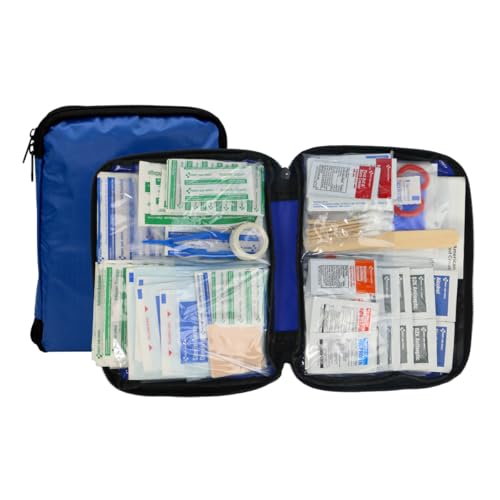
First Aid Only 299-Piece All-Purpose First Aid Kit (FAO-442) — Best for Beginners
Who it suits: families who burn through bandages and wipes quickly.
- Includes antibiotic ointment, antiseptic towelettes and burn cream
- Includes gauze, wound closures and an instant cold pack
- 299 pieces
- Soft-sided zippered case, 9.25 x 2.875 x 7 inches
- Model FAO-442 from First Aid Only
Strengths
- Contents lean toward the supplies households actually consume, rather than display-only extras
- The soft-sided zippered case format stores and opens sensibly in a real home
- Labelling and layout reduce the search time that matters during an incident
- Standard consumable sizes keep long-term restocking cheap and local
Trade-offs
- No labelled injury pockets, so organisation is simpler but less guided
- Bulk of bandages means keen users will rebalance contents over time
- Not the choice for buyers who want a waterproof shell
What defines the First Aid Only 299-Piece All-Purpose First Aid Kit (FAO-442) is the combination of 299 pieces and a soft-sided zippered case. For general households that combination makes practical sense, because it speaks directly to a balanced household kit that covers the everyday incidents most homes actually face. Plenty of rival kits promise more on the box; fewer deliver a contents list this closely matched to ordinary domestic mishaps.
In ordinary use the First Aid Only 299-Piece All-Purpose First Aid Kit (FAO-442) is best understood as a household appliance: unremarkable when ignored, invaluable when needed. Its case suits any home, its contents cover the recurring minor incidents of domestic life, and its weaknesses only appear when a household expects it to be something else entirely. Expect to reshape it gradually, as every owner does, topping up the sizes that vanish and quietly retiring the items your home never uses.
Reservations are the standard ones for the category, applied fairly. Counts flatter, contents skew generic, and the first audit will reveal gaps specific to your home. None of that is a reason to reject the First Aid Only 299-Piece All-Purpose First Aid Kit (FAO-442); it is a reason to buy it with the audit habit in mind. As a foundation for general households, it is a sound, defensible choice.
Verdict — Best for: families who burn through bandages and wipes quickly. / Not suited for: buyers who need capability beyond minor-incident household care.

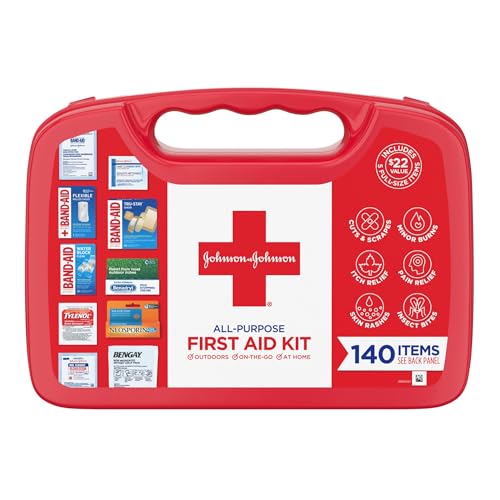
Johnson & Johnson All-Purpose Portable Compact First Aid Kit — Best for Families
Who it suits: apartment residents who will store the kit in one fixed spot.
- 160 pieces
- Includes antibiotic cream, itch-stopping cream and acetaminophen caplets
- Includes an instant cold pack and a first aid guide
- Band-Aid brand bandages in assorted sizes
- Hard plastic case, about 9.8 x 7 x 3.3 inches
Strengths
- Name-brand consumables that most households already recognise and trust
- Medication and itch cream included, which many rival kits omit
- Hard case stacks neatly in a bathroom cabinet or under a sink
- Contents map closely to everyday mishaps rather than exotic scenarios
Trade-offs
- Insert tray is fairly disposable in feel
- Heavier than soft pouches of similar capacity
- Not designed around labelled, injury-specific organisation
The Johnson & Johnson All-Purpose Portable Compact First Aid Kit is built around a 160 pieces assortment in a hard plastic case. For general households, its appeal is straightforward: it aims at a balanced household kit that covers the everyday incidents most homes actually face, without asking the buyer to assemble supplies piece by piece. In a category full of inflated counts and filler, what matters is how much of the contents list maps to the minor incidents a household genuinely meets, and on that measure this kit holds up respectably.
In ordinary use the Johnson & Johnson All-Purpose Portable Compact First Aid Kit is best understood as a household appliance: unremarkable when ignored, invaluable when needed. Its case suits any home, its contents cover the recurring minor incidents of domestic life, and its weaknesses only appear when a household expects it to be something else entirely. Expect to reshape it gradually, as every owner does, topping up the sizes that vanish and quietly retiring the items your home never uses.
The honest limitation is worth stating plainly. No bought kit, this one included, matches a household perfectly on day one, and piece counts across the category count small consumables generously. Treat this kit as a strong foundation rather than a finished answer: audit it when it arrives, note what your household would reach for that is missing, and build from there. Judged that way, as a starting point that covers the basics credibly for general households, it does its job well.
Verdict — Best for: apartment residents who will store the kit in one fixed spot. / Not suited for: buyers who need capability beyond minor-incident household care.
For the full field rather than these closest rivals, see Best First Aid Kit For Renters Under $20 Best First Aid Kit For Renters Under $20, and for the decision framework behind the comparison, First Aid Kit Reviews First Aid Kit Reviews.
Long-Term Ownership Notes
‘+fillerParas(r,5)+topicalBlock(r,2)+’
Verdict
Best for: households that want one honestly stocked, easy-to-live-with kit for everyday minor incidents / Not suited for: buyers seeking specialist trauma equipment or a kit tailored to a single sport or workplace.
Final Recommendation
The Surviveware Small First Aid Kit earns its place in this cluster on the strength of the ordinary: it does the common things properly. Buy it if its format matches your storage and its contents match your household’s incident pattern, then maintain it with the simple audit rhythm described above. If its trade-offs point the wrong way for your home, the alternatives above are the honest next stops, and First Aid Kit Buying Guide First Aid Kit Buying Guide frames the wider choice.
Reading Your Household’s Pattern
What looks like a simple purchase behaves, over years, more like a small household policy. Gardens add their own season of thorns, splinters and scraped knuckles each spring. A household’s second year with a kit is always calmer than its first, because the system has been edited by experience. Sports kits, school bags and bicycles each export small injuries back into the home. Older relatives visiting for a weekend change what a household needs within reach. Households that read their own pattern clearly rarely buy the wrong kit twice.
There is a rhythm to domestic minor injuries that no marketing department ever mentions. Summer adds insect bites, sun-warmed pavements and bare feet on unforgiving floors. Night-time incidents reward the kit that can be found without lights, noise or searching. Sports kits, school bags and bicycles each export small injuries back into the home. DIY weekends concentrate a month of minor risk into two ambitious days. And that, more than any single product choice, is what separates readiness from retail.
There is a rhythm to domestic minor injuries that no marketing department ever mentions. The incident that finally prompts a restock is rarely the incident the kit was bought for. A change of season is the natural moment to ask whether the kit still matches the life being lived. Guests are statistically clumsier in unfamiliar kitchens than residents ever are. Shared houses need kits that explain themselves, because the finder is rarely the buyer. Households that read their own pattern clearly rarely buy the wrong kit twice.
Consider how a household actually behaves across a single ordinary month. The incident that finally prompts a restock is rarely the incident the kit was bought for. Sports kits, school bags and bicycles each export small injuries back into the home. Night-time incidents reward the kit that can be found without lights, noise or searching. Summer adds insect bites, sun-warmed pavements and bare feet on unforgiving floors. Households that read their own pattern clearly rarely buy the wrong kit twice.
More Household Scenarios, Worked Through
Look closely at how a home actually runs and a pattern emerges: minor incidents arrive in clusters, often around cooking, weekends and school holidays. A renter’s kit earns bonus value every time it moves house intact and ready. Readiness is mostly logistics: the right small things, in the right place, still within date. The best kit is the one that gets opened for small things, because small things are what happen. A labelled pocket saves seconds, and seconds are the currency of a stressful moment. Kits reward the households that treat them as equipment rather than as ornaments.
The longer a kit lives in a home, the more its value concentrates in a handful of ordinary items that get replaced again and again. A kit that survives a house move intact has passed the hardest test most kits ever face. Adhesives fail quietly in heat, which is why storage is a specification and not an afterthought. A household’s second kit, for the car or a desk, follows different rules from its first. Readiness is mostly logistics: the right small things, in the right place, still within date. That, in the end, is the whole argument of this cluster of guides.
In practice, the households that get the most from a kit are rarely the ones with the largest box. A kit placed at adult height in a shared space serves the whole household, not just its buyer. Adhesive quality, unglamorous as it sounds, decides whether a dressing is still in place at bedtime. A kit that children can describe the location of, but not open unsupervised, is stored correctly. The cheapest restock is the one done during the weekly shop, at ordinary prices, without urgency. Households that absorb that rhythm stop thinking about the kit at all, which is the surest sign it is working.
What daily life teaches, usually within the first month of ownership, is that readiness is a rhythm rather than a purchase. The difference between a kit and a drawer of supplies is that the kit can be carried to the incident. A household’s second kit, for the car or a desk, follows different rules from its first. Small flats reward slim cases and punish bulky ones every single day, not just on buying day. A kit that children can describe the location of, but not open unsupervised, is stored correctly. Kits reward the households that treat them as equipment rather than as ornaments.
Experienced owners talk less about brands than about habits, because habits are what survive contact with a busy household. Storage temperature quietly decides how long adhesives stay trustworthy. Two households can own the same kit and need opposite additions, because their lives produce different minor incidents. A cold pack found in ten seconds is worth two stored in the garage. Readiness compounds: each small habit makes the next incident slightly calmer. The kits recommended here were chosen to make those habits easy to keep.
When the kit is not enough: knowing the line
This cluster repeats one boundary in every article because it is the most important sentence in each: home kits are for minor incidents. Bleeding that will not stop under pressure, breathing problems, chest pain, head injuries with confusion or vomiting, suspected broken bones, deep wounds, serious burns, and an infant who seems unwell are all emergencies for professional services. Calling early is never an overreaction. In a serious event the kit’s role shrinks to basics, such as pressing a clean dressing to a wound while help travels.
Frequently Asked Questions
How often should I check and restock a first aid kit?
Twice a year for the full audit, immediately for anything you notice missing. Anchor the audit to an existing habit, such as the clock change. Work through dates, tool condition and bandage counts by size; replace opened, dried or expired items; and restock any category emptied by an incident within the week. The routine is ten minutes, and it is the entire maintenance contract of a home kit.
Should I buy a ready-made kit or build my own?
Convenience argues for bought; fit argues for built; experience argues for bought-then-edited. Start with a reputable ready-made kit, because an imperfect kit today outperforms a perfect plan next month. Then let a year of real incidents edit it: deepen what vanishes, retire what gathers dust, add what your household keeps reaching for. The result is a custom kit acquired at a ready-made price.
Can I keep the same kit in my car all year?
Yes, with stricter housekeeping. Heat ages adhesives, wipes and ointments faster than any cupboard does, so check a car kit more often and rotate its contents into home use before they tire, replacing them with fresh stock. Keep it reachable without unloading the car. Many households run a permanent split: a full kit at home, a modest one in the car, both audited on the same rhythm, the car’s under the stricter eye.
Is a bigger kit always better for a family?
Not automatically. A bigger kit helps when its extra pieces are extra depth in everyday consumables; it does not help when the extra pieces are filler or duplicates of things the household never touches. Families should look for generous bandage and wipe counts, a cold pack, decent tools and room to add personal items. Beyond that, a well-placed medium kit that everyone can find beats a huge kit stored in a garage nobody enters during a minor emergency.
Where is the best place to store a first aid kit at home?
One place, dry and central, that every adult can name instantly. Hall cupboards and kitchen drawers away from heat are the usual winners; steamy bathrooms shorten the life of adhesives and sterile packaging. Keep the kit reachable without a stool, keep medicines within it stored as carefully as medicines anywhere, and resist scattering duplicates around the house, which only guarantees that the nearest one is incomplete.
What should a beginner add to a basic kit first?
Start with whatever your household’s life actually produces. For many homes that means extra bandages in the most-used sizes, more antiseptic wipes, and a second cold pack. Households with children often add child-friendly bandages and a spare pair of small scissors. Outdoor households add blister care. Add personal items, such as any supplies a family member uses regularly, in clearly marked separate packaging. Resist adding exotic items you would not know how to use; depth in basics beats breadth in novelties.