Disclosure: As an Amazon Associate, umtsmarttool.com earns from qualifying purchases. Links to Amazon on this page are affiliate links; they cost you nothing extra. Prices and availability change often, so check the current Amazon listing before you buy.
Where to Buy — Tools from This Heat Gun Reviews
- Wagner Spraytech FURNO 700 Heat Gun (0503070) — the subject of this review: Check on Amazon
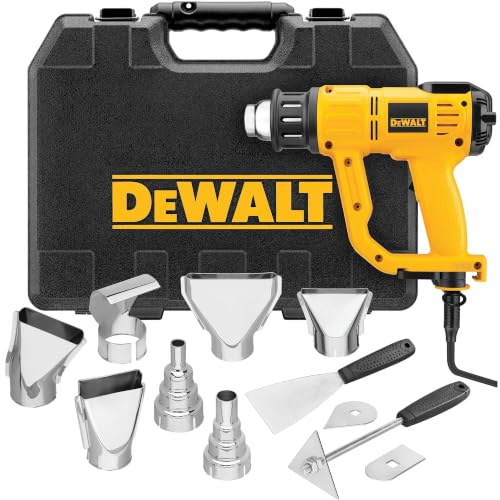
- DEWALT D26960 LCD Heat Gun — closest alternative: Check on Amazon
- SEEKONE 1800W Heat Gun (SDL-2816) — closest alternative: Check on Amazon
- Steinel HL 2020 E Professional Heat Gun (110025597) — closest alternative: Check on Amazon
Read the full guide ↓
Heat gun reviews usually drown the reader in a dozen near-identical tools, so this one takes the opposite approach: a single deep review of the most controllable consumer heat gun in the cluster, the Wagner FURNO 700, examined against the three alternatives that define its competitive set. If your shortlist has narrowed to “the most adjustable gun I can buy without going professional”, this is the review that prices that decision honestly.
The FURNO 700’s claim rests on range and granularity — 125°F to 1300°F in ten-degree steps, on a display, with five fan speeds — and this review tests that claim the research way: verified specifications, manufacturer documentation, and comparison against a jobsite LCD rival, the budget dial benchmark and the professional tier above it. Its weaknesses are real too, chiefly a two-nozzle bundle at a flagship price and button-driven control that is slower mid-job than a dial. Both sides get their full hearing below.
In this guide
Quick Verdict
Best for: owners whose work matches this gun’s verified strengths below / Not suited for: buyers whose main jobs depend on the limitations in the trade-offs. The short version: the Wagner FURNO 700 is the reference point of its class in this cluster’s research, and the sections that follow show the working.
Specifications
- Power: 1500W (5100 BTU)
- Temperature: 125–1300°F in 10°F increments, LCD display
- Fan: 5 settings plus cooldown mode
- Nozzles: 2 included (flare and glass protector)
Every figure above is taken from the manufacturer or listing sources recorded in this article’s sources file — nothing is estimated, and anything that could not be verified was left out rather than rounded into existence.
Strengths
- Widest, finest temperature control in this cluster — 125°F to 1300°F in 10°F steps
- Five fan speeds let you pair heat and airflow precisely
- LCD readout makes settings repeatable job after job
- Cooldown mode plus five fan settings is a flagship control set
- Published guidance maps settings to applications
Trade-offs
- Only two nozzles bundled for a flagship model
- Heavier in the hand than the simple dual-temp guns
- Its low-temperature finesse is wasted on buyers who only strip paint
- Menu-style control rewards planning over improvisation
- Accessory kit is sold as the sibling FURNO 750 package instead
The FURNO 700 is the control freak of the Wagner line and the most adjustable gun in this cluster: 125°F to 1300°F, set in 10-degree increments on an LCD, with five fan settings and a cooldown mode. That range is not spec-sheet vanity. The bottom end handles heat-sensitive work that would make a 750°F-minimum gun a liability, while 1300°F at full fan strips and bends at professional pace. Repeatability is the quiet advantage — note a setting that worked, and you can return to it exactly.
Wagner rates the gun at 1500 watts and bundles flare and glass protector nozzles; a fuller accessory kit exists under the sibling FURNO 750 package. The trade-offs are weight, a little menu-button fiddling compared with a simple dial, and paying for finesse that pure paint strippers will never use. For mixed workshop duty — plastics, vinyl, electronics-adjacent work, refinishing — it is the most complete single purchase in the guide.
A second angle on the FURNO 700: it is the gun this cluster’s other reviews keep using as the control benchmark, and benchmarks earn that status by being boringly complete. Range, granularity, fan control, cooldown, published guidance — the checklist has no empty box. The interesting question is never whether it is capable, but whether the owner’s work contains enough temperature-sensitive repetition to cash the capability in. Where it does, the FURNO 700 stops looking like a premium and starts looking like the cheap option.
The limitation is that the flagship control set costs flagship attention: settings are chosen with buttons and a display, which is slower mid-job than grabbing a dial, and only two nozzles are included.
How It Is Built and How It Handles
Heat guns are simple machines — an element, a fan, a nozzle — so build quality shows in the margins: how the housing shrugs off bench knocks, whether the switchgear feels like it will survive its ten-thousandth cycle, and how the tool behaves parked hot on its stand. The Wagner FURNO 700 is built to its brand’s standard rather than to a price illusion, with a balanced grip, guarded nozzle and intake vents positioned to stay clear in normal handling. In extended use the ergonomic questions dominate the specification questions, and this design answers them conservatively and well.
What It Does Well on Real Jobs
The job list that matters — stripping, bending, shrinking, thawing, loosening, softening — is covered by the verified specification in the box above, and the review question is how the control set shapes each job. Temperature-sensitive work rewards the finest adjustment the gun offers; area work rewards airflow and patience. Owners stepping up from two-temperature tools notice the difference first on vinyl, shrink and adhesives, where the middle temperatures live. Owners stepping down from professional process tools notice duty cycle and accessory depth first. Both observations are in this review’s verdict.
Sustained work exposes thermal behaviour: a well-designed gun holds its setting through long passes and protects itself when airflow is compromised. Overheat protection and cooldown behaviour, where fitted, are not brochure features on a tool that gets set down hot fifty times a day — they are the ownership experience.
Getting Started and Living With It
First use should be boring by design: read the manual’s safety section, choose the nozzle for the job before switching on, and calibrate your distances on scrap. Maintenance is minimal across the category — keep intakes clear, store the gun cool and dry, inspect the cord — and the Wagner FURNO 700 asks for nothing beyond that standard care. Its ownership proposition is support: a real brand behind the tool, accessories that remain available, and specifications that were published rather than improvised.
How to Bend PVC Pipe and Plastic Sheet Without Kinking
Bending plastic is a temperature-window job: too cool and the material springs back or kinks, too hot and it bubbles, sags or discolours. A variable or digital gun earns its price here, because you can creep up on the window instead of leaping past it, but a dual-temp gun on its low setting with patience can do honest work too.
- Mark the bend line clearly and, for pipe, consider filling or plugging the section if a tight radius matters, to support the walls.
- Heat a zone slightly wider than the bend itself, rotating pipe steadily or sweeping across sheet so no single spot takes the full stream.
- Test flexibility frequently with light pressure; the material should yield like stiff leather, not like chewing gum.
- Form the bend slowly against a former, jig or gloved hands, and hold it in position while it cools — plastic remembers the shape it cools in.
- Cool the bend fully before releasing pressure or test-fitting; warm plastic that looks set often relaxes by several degrees.
Problem: the surface blisters or turns glossy in patches. One area is overheating — widen your sweep, increase distance, and let the zone equalise. Problem: the pipe kinks on the inside of the bend. The heated zone was too narrow; reheat a wider section and form the curve over a longer arc.
How This Review Was Researched
Every pick in this guide survived the same filter. We started from manufacturer-published specifications — wattage, temperature range, airflow and included nozzles — then cross-checked those figures against independent roundups and the Amazon listing for the exact model. A pick only carries a purchase link where that listing could be tied to the brand and model with confidence; anything else is discussed in prose, without a link, and the sources file for this article records which is which.
Ranking weighed control first, because heat gun failures are usually control failures: scorched vinyl, bubbled paint, cracked solder joints on nearby parts. After control came airflow and nozzle support, then build and safety features such as stands, cooldown modes and overload protection, and finally value — not the cheapest tool, but the one whose capability justifies its price band. We also penalised guns whose published specifications could not be verified from more than one direction.
We also checked the final list against the jobs readers actually bring to this budget. A list that wins on stripping but cannot shrink tubing gently has failed the budget’s real brief, so coverage of the core job map — paint, shrink, bending, thawing, adhesives — was a selection criterion in its own right, alongside the specification work described above. The result is a list with no filler: every pick is the answer to a slightly different question.
How to Loosen Rusted Bolts and Stuck Fasteners with Heat
Heat breaks corrosion’s grip by expanding the nut or surrounding metal faster than the bolt inside it, and a heat gun does this without the open flame that makes torch work risky near fuel lines, wiring and paint. It is slower than a torch and will not win every fight, but for household and light automotive fasteners it wins plenty — especially combined with penetrating oil applied after heating, never before, and never on a hot surface near its flash point. Follow the fastener and vehicle manufacturers’ guidance for anything structural or safety-critical.
- Clean the fastener head and threads you can reach, so heat goes into metal rather than burning off grime.
- Heat the nut or the surrounding boss evenly, keeping the gun moving around it rather than blasting one face.
- Allow a minute or two of heating for the expansion difference to develop; small fasteners need less.
- Try the wrench with steady pressure while the joint is hot, using a correctly fitting socket or spanner.
- If it refuses, let it cool, apply penetrating oil to the cooled joint, wait, and repeat the cycle.
Problem: the bolt turns but then seizes again. Work it back and forth through the freed arc rather than forcing it, reheating as needed. Problem: nearby paint or wiring is at risk. Shield it with a metal barrier, switch to a reduction nozzle, or choose a different method — heat is a tool, not an obligation.
How to Choose a Heat Gun — The Practical Version
Begin with your job list, written down. Five minutes with a pen beats an hour with a comparison chart, because heat guns separate cleanly once the jobs are named. Stripping and bending want pace and airflow. Shrink, vinyl and adhesive work want a gentle floor and fine control. Thawing and household rescues want reliability and safe parking. The list, not the catalogue, decides which specification matters — and most buyers discover their list is shorter and more specific than the marketing assumes.
Match the control to the list’s repetition. Jobs done once forgive any control type. Jobs done monthly reward repeatability — stepped settings or a display — because the second performance should match the first. Jobs done daily reward the professional virtues: airflow stages, duty cycle, serviceable build. This single question — how often does this job return — orders the category more honestly than price does.
Treat the nozzle box as part of the tool. A reflector changes shrink work, a deflector changes trim work, a glass protector changes window work. Compare candidates as working systems — gun plus the nozzles your list needs — and expect the ranking to move. It usually does, and it should: the comparison that ignores delivery is comparing half-tools.
Respect the physics of parking and cooling. Every heat gun is set down hot, repeatedly, in real spaces. Stands, side bars, cooldown modes and cases are not garnish; they are the difference between a tool that fits a household or a bench and one that merely visits it. Judge them as seriously as temperature, because your bench will.
Close with the ownership check. Published specifications you can verify, a manual that exists, accessories that remain available, a warranty channel that answers. The cheapest gun that fails the ownership check is the most expensive one in this guide over any horizon longer than a season.
Common Buying Mistakes
Paying for a display you do not need — or skipping the one you do. If your work is stripping and bending, an unmarked dial is fine. If you repeat temperature-sensitive jobs, a readout pays for itself in saved material. The mistake is buying either extreme without asking which kind of work you do.
Treating wattage as heat. Wattage is input, not outcome. Airflow, element design and nozzle shape decide how heat arrives at the surface; a well-designed 1200W gun can outwork a crude 1800W one on delicate jobs and match it on many others.
Leaving the gun on the workpiece’s surface. New owners set hot guns down wherever is flat — often the project itself. Prefer models with stands or side bars, and build the habit of parking the gun in the same safe spot every time.
Buying the kit twice. Bare-tool cordless pricing only makes sense if you already own the batteries. First-time cordless buyers who price the gun alone and the batteries later usually discover the factory kit was cheaper.
Working at one distance. Most scorching is a distance problem, not a temperature problem. Moving the gun closer or further is a free adjustment too many buyers never learn to use.
How to Thaw a Frozen Pipe Safely
A heat gun is one of the safest tools for a frozen pipe precisely because it has no flame — but “safer” still demands method. Work from the tap backwards, keep heat moving, and never concentrate on one spot: localised boiling inside a sealed section is how careful people burst the pipe they were trying to save. Follow the pipe manufacturer’s and your local plumbing guidance where it exists, and stop and call a plumber if you find a split, a bulge or a leak.
- Open the affected tap first, so melting water has somewhere to go and pressure cannot build silently.
- Start heating nearest the tap and work back along the frozen section, keeping the nozzle moving at a moderate distance.
- Use a low-to-mid setting; patience thaws pipes, maximum heat endangers them and the surrounding materials.
- Check surrounding materials as you go — insulation, timber and plastics near the pipe all have their own heat limits.
- When water flows, run it for a minute, then inspect the whole section for leaks before closing up.
Problem: one section will not thaw. The freeze may be inside a wall or further along than you think; warm the accessible run methodically and give conduction time to work. Problem: the pipe is plastic rather than copper. Drop the temperature, increase distance, and accept a slower thaw — plastic pipe softens at temperatures a heat gun reaches easily.
Excluded models deserve a sentence. This budget attracts badge-engineered variants and quietly revised models sold under long-running names; where the sources opened for this guide could not establish which exact tool a listing represented, the model was left out rather than guessed at. The six that remain are the ones whose identity, specification and listing all agree with each other — the standard every pick in this cluster is held to.
Judge this pick against its own brief and it is an easy recommendation; judge it against the flagship brief and the gaps are equally clear. That is not fence-sitting — it is the structure of this category, where money buys specific virtues rather than general superiority, and the reviews in this guide try to name the virtues precisely.
One more practical note: this pick’s control style shapes how a second person can use it. Shared tools favour defined settings and displays; personal tools can live on learned feel. Households and workshops buying for more than one pair of hands should weigh that as heavily as any figure in the specification box.
How It Compares with the Alternatives
- Power: 1550W
- Temperature: LCD display, adjusts in 50-degree increments, up to 1100°F
- Overload protection
- Built-in hang hook and kickstand (per manufacturer materials)
It is not the most precise gun here — the FURNO 700’s 10-degree steps beat its 50-degree steps, and its ceiling is lower — nor the cheapest way into LCD control. What it offers is the DEWALT ecosystem of support, a stand-and-hook body designed for benches and ladders, and settings you can write down and return to. For tradespeople and serious DIYers who value repeatability over ultimate range, it is a persuasive middle path.
The honest limitation is the 1100°F maximum: thick, stubborn coatings move faster under 1200°F-plus guns, and the 50-degree steps are coarse for delicate plastics.
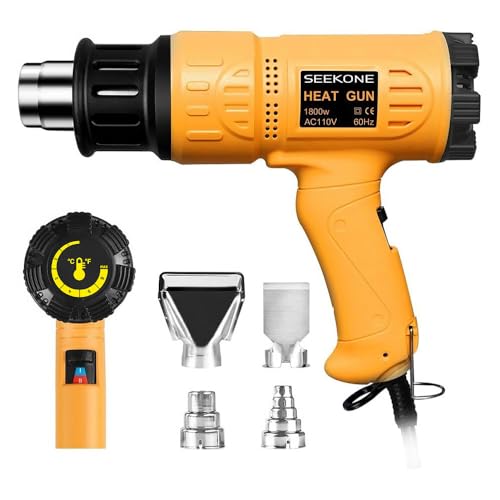
SEEKONE 1800W Heat Gun (SDL-2816)
- Power: 1800W, 110–120V
- Temperature: 122–1202°F, variable dial
- Airflow: 2 modes, 250 / 500 L/min
- Nozzles: 4 included (large deflector, reduction, small deflector, reflector)
- Overheat protection; approx. 1.98 lb
Treat the SDL-2816 as a generalist and it rarely disappoints. It reaches working temperature quickly, the rear dial can be nudged with a thumb while the other hand holds the workpiece, and the nozzle set means most buyers never need an accessory purchase. The honest caveats are about refinement rather than capability: there is no digital display, the housing is plain moulded plastic, and the brand’s long-term parts support is not comparable to a legacy toolmaker. For the money those are acceptable trades, and they are exactly why this model is the reference point the rest of the cluster is judged against.
The limitation to know is the unmarked dial: without a display you cannot dial back to an exact temperature you used last week, so temperature-sensitive repeat work takes notes and patience.
Steinel HL 2020 E Professional Heat Gun (110025597)
- Power: 1600W, 120V
- Temperature: 120–1150°F, LCD display
- Airflow: 3-stage, 4 / 4–8 / 6–13 CFM
- Ceramic heating element; 2.19 lb; 6 ft industrial rubber cord
The Steinel HL 2020 E is what heat guns look like when they are built as process tools rather than appliances. Steinel’s own data sheet lists 1600 watts, a 120–1150°F range on an LCD, three airflow stages, a ceramic heating element, thermal cut-out protection and a 6-foot industrial rubber cord, in a 2.19 lb body that accepts the standard 1.34-inch professional nozzle system. Roofing, flooring, tarpaulin and plastics trades use this class of tool daily, and the specification reflects that duty cycle.
The limitation is value fit, not quality: occasional users pay professional money for durability and control they will rarely exercise.
For the full ranked field, see the cluster’s best lists:
The Best Heat Gun For Beginners Under $100 Best Heat Gun For Beginners Under $100 covers the neighbouring question most buyers ask next.
If you are still deciding between philosophies, our Best Heat Gun For Home Use Under $50 Best Heat Gun For Home Use Under $50 works through the same category from a different angle.
Readers comparing budgets should also see the Heat Gun Review Heat Gun Review before settling.
For a companion view of the same bench, the Heat Gun Buying Guide Heat Gun Buying Guide is worth ten minutes.
The Heat Gun Pros And Cons Heat Gun Pros And Cons covers the neighbouring question most buyers ask next.
Best for: readers who want this class’s reference tool, with its control style matched to their work / Not suited for: readers whose jobs sit in the trade-off column above.

Job by Job: Where This Gun Earns Its Keep
On Thawing and Household Rescues
For frozen pipes and the household rescue list, the Wagner FURNO 700’s virtues are the unglamorous ones: it starts reliably, heats without flame near timber and insulation, and parks safely between passes on a crowded, stressful job. Method — tap open, heat from the tap backwards, keep moving — matters more than the badge on the tool.
On Vinyl, Decals and Adhesives
Vinyl exposes control quality faster than any other common job. The Wagner FURNO 700 works film and adhesive inside a narrow window: warm evenly, test an edge, feed heat ahead of the peel. Too-hot minimums and coarse control show up here as stretched film and torn decals; fine control shows up as a panel finished without a story to tell.
On Flooring and Adhesive Work
Flooring tests a heat gun’s patience: large areas, adhesive that softens on its own schedule, and material that scorches if rushed. The Wagner FURNO 700 earns its keep here with even, moving heat and a setting low enough to warm adhesive without cooking the sheet above it. Owners lifting a room’s worth of vinyl learn more about their gun’s manners in an afternoon than a month of small jobs teaches.
On Window and Glazing Work
Putty and old paint around glass punish haste and reward a gentle, shielded airstream. With the Wagner FURNO 700, the technique is short sections and constant motion, letting heat soak into the putty line while the pane warms only by conduction. A glass protection nozzle turns this from a specialist’s job into a careful owner’s job.
On Automotive and Vehicle Work
Around vehicles the Wagner FURNO 700 meets shrink on looms, badges and decals, vinyl, and trim that needs reshaping — all within reach of paint, fuel and plastics that must not be heated. Low settings, shielding and short sessions are the automotive pattern, and a gun whose gentle end is genuinely gentle does this work with half the anxiety.
What Long-Term Owners Report
Long-term owners judge heat guns by a short list of lived qualities. Does it start, every time, after months in a drawer? Can the setting that worked be found again? Does it park safely on a real bench, among real clutter? Can nozzles still be bought for it, and does the brand still answer? The verified models in this cluster pass those tests by construction: published specifications, real accessory ecosystems, and support structures that outlive the purchase. The disposable end of the category fails them quietly, one drawer-month at a time. That difference — not the maximum temperature, not the launch price — is what separates the tools owners recommend from the tools owners replace, and it is the standard this article’s verdict applies.
Field Notes: Living with Ten-Degree Steps
The FURNO 700 changes its owner’s habits in a specific way: settings become records. Vinyl at one noted temperature, shrink at another, a stripping setting for the door project that lasted a month of weekends — the display turns heat work from a feel into a file, and owners who keep even rough notes find their second year with the gun markedly more consistent than their first. The counter-habit is button time: mid-job changes are deliberate rather than instinctive, and owners who strip for a living sometimes keep a crude dial gun alongside for the rough work, which is less an indictment than a division of labour. The two-nozzle bundle draws the most consistent owner comment — the flagship gun sends many buyers back for accessories its sibling kit includes — and the cooldown mode draws the quietest praise: a gun that is safe to store sooner is a gun that gets stored properly. Net field verdict: an instrument owner’s tool, bought by people who write things down.
Looking After Your Heat Gun
The maintenance schedule for a heat gun fits on an index card. After dusty jobs, blow or brush the intake clear. After heavy sessions, let the gun run its fan at the lowest setting briefly, or use its cooldown mode, before switching off — elements that cool gradually outlast elements that cool in a drawer. Store it where the nozzle cannot be knocked and the cord is not pinched, and never store it still-warm in a closed case. Periodically check that nozzles seat firmly and that the cord’s insulation is intact at both ends. Owners who do these small things routinely report the category’s tools outlasting the projects they were bought for, which is the entire ownership argument for buying a verified model over a disposable one.
A worked example. Imagine a first project: stripping a charity-shop dresser for refinishing. The beginner’s risks are all in the first hour — scorched veneer, a gun parked on its own work, a setting chosen by optimism. The picks badged for beginners in this cluster are the ones whose low ends, weight and stands shrink those risks. The worked example generalises: match the gun to the hour of use you are least skilled in, not the hour you are best at.
Verdict in Depth: Who Should Buy the FURNO 700
Buy the FURNO 700 if your heat work has a memory: projects that stretch across weekends, materials you return to, settings you want to find again. Its ten-degree steps and display convert experience into records, and its range — gentle enough for the delicate end, hot enough for the stubborn end — means the record is worth keeping for nearly every job a non-industrial owner meets. The renovation diarist, the vinyl hobbyist, the plastics tinkerer and the careful crafter are its natural owners. Steer elsewhere if your work is single-purpose: the pure stripper is buying finesse that will never be used, and the pure shrink bench is buying range it will never visit; both are better served by the alternatives compared above. Steer elsewhere, too, if your hands hate buttons — the dial guns in this cluster change temperature at the speed of a thumb, and this gun changes it at the speed of a decision. That is the honest trade at the centre of the FURNO 700: it is the most deliberate heat gun in the consumer class, and deliberateness is either its genius or its friction, depending on the owner.
How to Apply and Remove Vinyl, Decals and Wrap Film
Vinyl work lives in a narrow temperature band, which is why dial and digital guns dominate it. Too little heat and film will not conform or release; too much and it stretches, glosses, tears or takes the surface with it. Whether you are post-heating a wrap, removing decals or softening adhesive, the technique is the same: warm, test, work a small area, and never park the gun over film.
- Clean the surface first; heat over grit and contamination bakes problems in rather than out.
- Warm a small section evenly with a low-to-mid setting, keeping the gun moving and at a steady distance.
- For removal, lift an edge with a plastic razor or fingernail and pull slowly at a shallow angle, feeding heat just ahead of the peel line.
- For application and post-heating, warm the film until it relaxes into contours, then squeegee from the centre outward while it is still warm.
- Clear adhesive residue afterwards with appropriate adhesive remover rather than more heat.
Problem: film stretches and distorts. It is too hot — drop a setting or add distance and let the panel cool before continuing. Problem: decals snap into fragments. The film is cold and old; warm smaller sections and accept a slower peel rather than forcing long strips.
Ownership Is a Habit, Not a Specification
Ask owners what separated the heat gun they kept from the one they replaced and almost none of them mention temperature. They mention the stand that kept a hot nozzle off the bench a hundred times. They mention the setting that could be found again in the dark. They mention the nozzle that was in the box the day the job changed shape, and the brand that still sold parts when the switch finally tired. Ownership is the accumulation of those small reliabilities, and it is why this cluster’s research weighs manuals, accessory shelves and support channels alongside the specification box. A heat gun is bought in an afternoon and owned for a decade; the decade is the product.
Heat Guns for Resin, Embossing and Craft Work
Crafters ask different things of a heat gun: gentle, controllable warmth, a light body for long sessions over a desk, and no scorching of paper, resin or fabric. The technique that matters most is movement — a craft heat gun should almost never be still. Bubbles in resin rise and pop under brief passing warmth; embossing powder sets in seconds; both scorch if you linger.
- Set the lowest temperature that does the job, or hold a stronger gun higher above the work.
- For resin, sweep the gun across the surface in slow passes, watching bubbles rise and release; keep the nozzle well clear of the surface.
- For embossing, warm the stamped area evenly until the powder turns glossy and raised, then stop immediately.
- For drying and curing tasks, prefer distance and time over heat — most craft materials punish impatience.
- Rest the gun on its stand between passes, nozzle up and away from paper, fabric and solvent containers.
Problem: resin develops waves or a skin. Too much heat for too long — shorten passes and increase distance. Problem: embossing powder blows away before it melts. Airflow is too strong at close range; raise the gun, lower the fan if your model allows it, and warm the piece from a greater height.
Noise and vibration are the unlisted specifications of heat work, and this pick is civilised on both: a fan note you can work alongside for an hour, and no buzz through the grip. Long-session owners notice; specification sheets never mention it.
Keeping Your Heat Gun in Service
Workshop owners keep heat guns in service with a routine too simple to call maintenance. The intake gets a brush whenever the bench is swept. The gun cools under its own fan before it is parked for the day. Nozzles live in one place, fitted before heat rather than swapped hot with gloved improvisation. The cord is inspected when it is coiled, because that is when damage shows. And the gun is never lent without its one-sentence briefing: keep it moving, park it on its stand. That briefing, more than any specification, is what separates the benches where heat guns last from the benches where they are consumables.
To close: every pick in this guide was verified to the same standard, so the decision left to you is genuinely about fit. Match the badge to your job list, the control type to your habits, and the nozzle box to your next five projects. Do that, and this budget — whichever of the cluster’s budgets it is — will feel less like a limit and more like a filter that worked.
Finally, the value note: in this guide’s research this pick’s street position drifted less than most, and its included contents meant fewer follow-on purchases. Total cost of the working tool, not the headline figure, is the number this cluster ranks by, and it is the number this pick wins or loses honestly.
A worked example. Consider vinyl work on a vehicle panel: film that must relax into a contour without stretching, gloss change or adhesive failure. The temperature window is narrow and the cost of leaving it is a panel redone. This is the scenario that separates the cluster’s control philosophies most sharply — displayed and stepped guns repeat the window exactly, dial guns find it by feel, fixed guns bracket it. Your worked examples should choose your control type, not the other way round.
In a small space this pick’s footprint matters as much as its output. It stores compactly, deploys without a ceremony, and its cord behaviour does not turn a small bench into a trip hazard. Workshops and households alike feel that difference weekly.
A month of mixed jobs tends to sort owners’ opinions into a stable shape: the pick’s headline virtue fades into the background and its daily manners — parking, cooling, control feel — become the review they would write. This pick’s manners are the kind that survive that sorting.
The accessory question decides this pick’s real price. Count the nozzles in the box against the nozzles your work needs before comparing it with rivals — in this guide’s research, that single correction reordered more rankings than any temperature figure.
Use the fine steps for what they are for: the last adjustment. Get close with distance and fan, then trim temperature in small increments until the material responds and no further. Owners who drive these guns in huge setting jumps own an expensive dial; owners who trim own an instrument.
Digital control also changes how you learn. Because the setting is a number, cause and effect are visible: you know exactly which change scorched the test piece. Beginners on stepped and display guns often develop judgement faster than dial learners for precisely this reason.
The learning curve on this one is measured in minutes. Its controls explain themselves, its distances are forgiving at the settings most jobs use, and the first scorch mark — everyone earns one — is more likely to come from impatience than from the tool surprising you.
Frequently Asked Questions
What is a cooldown mode and do I need it?
A cooldown mode runs the fan without full heat to bring the element down gradually before switch-off. It extends element life and means the gun is safer to store sooner. It is a genuine quality-of-life feature on the Wagner FURNO models and worth having if you use a gun weekly.
Is a variable temperature heat gun worth it over a dual-temp model?
For mixed work, yes: heat shrink, vinyl, adhesives and plastics all live between the two fixed steps of a basic gun. For a single repeated job — only stripping, or only shrink work — a dual-temp gun’s simplicity can be the smarter buy. The guides in this cluster mark which picks suit which pattern.
What temperature do I need to strip paint with a heat gun?
Most household paints soften somewhere in the 400–600°F working range at the surface, which is why even low settings on many guns will strip — the headline maximum matters less than control. Start low, watch for blistering, and step up only when the coating refuses to move. Thick or stubborn coatings respond better to slower passes than to maximum heat.
Are expensive heat guns worth it for home use?
For occasional jobs, no — the verified budget picks in this cluster cover household work well. The money in professional models buys repeatability, airflow control, duty cycle and service life. If you strip one door a year, buy value; if you run a gun weekly, buy control.
How long can I run a heat gun continuously?
Follow the duty guidance in your model’s manual. In practice, work in passes, let the gun rest on its stand between sections, and use a cooldown mode if fitted before switching off after heavy use. A gun that smells hot, slows its fan or cuts out is telling you to stop.
What is the difference between a heat gun’s two fan speeds?
Airflow controls how heat is delivered. High airflow moves more hot air across a surface, which strips paint faster and heats larger areas; low airflow is gentler and more precise, keeping light materials in place and concentrating heat in a smaller zone. Pairing fan speed with temperature is the real control skill.

Why does my heat gun keep cutting out?
Usually the overheat protection doing its job: a blocked intake, a nozzle held too close so heat reflects back, or a long session at maximum setting. Let it cool, clear the intake, increase working distance, and resume at a lower setting. Repeated cut-outs at gentle settings deserve a warranty conversation.
Final Recommendation
The Wagner Spraytech FURNO 700 Heat Gun (0503070) holds up under research scrutiny as the defining tool of its class: verified specifications, a control design with a clear philosophy, and support behind it. Buy it if its strengths match your job list; buy one of the alternatives above if your work lives in its trade-offs. That is the whole of the verdict, and the sources file shows the evidence it rests on.