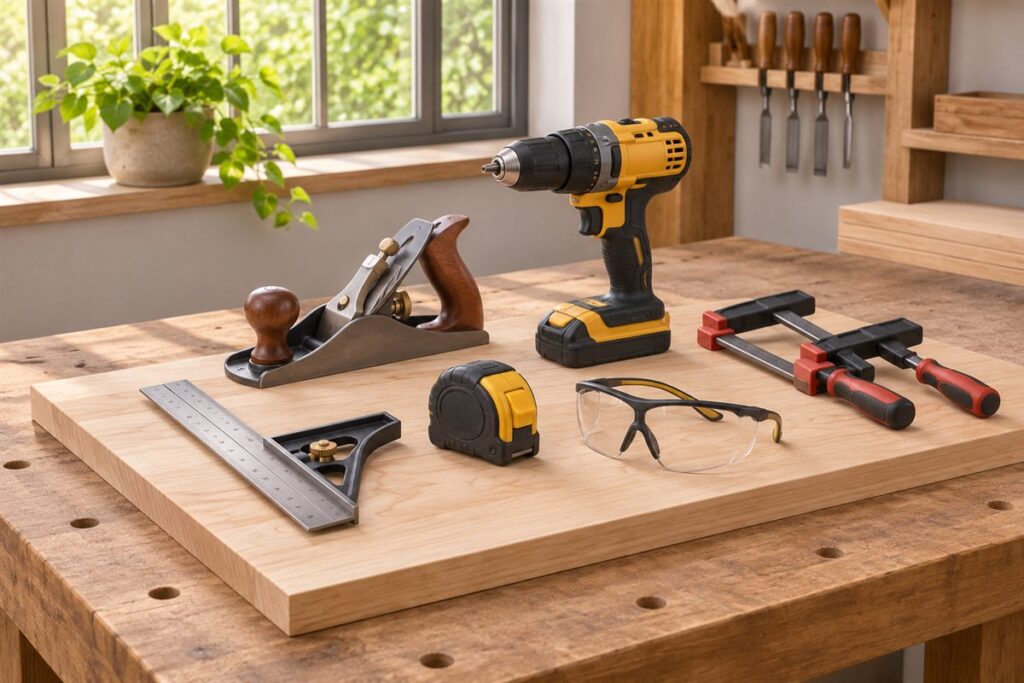
To choose a cordless drill, match its chuck size, torque, battery and weight to the work you do most. A drill for hanging shelves and assembling furniture can be compact and light, while one for deck screws and thick lumber needs more turning force. The table below lists what to check.
Decision Criteria
| Factor | Why it matters | What to check |
|---|---|---|
| Chuck size | Sets the largest bit shank it can hold | Capacity listed in the maker’s guide |
| Torque | Turning force for large bits and long screws | Maker’s stated maximum and number of speed ranges |
| Battery capacity | Decides how long you work between charges | Amp-hour figure and charger speed |
| Weight and balance | Affects fatigue overhead and in tight spots | Weight with battery attached |
| Clutch | Stops screws from being driven too deep | Number of clutch settings |
| Speed ranges | Low for screws, high for small holes | Two-speed switch or electronic control |
Think About the Work First
Light household jobs include small pilot holes, cabinet hardware and flat-pack furniture. For these, a compact drill is easier to handle for long periods.
Heavier jobs include larger holes in framing, long structural screws and mixing tasks with an attachment. These call for higher torque and a bigger battery, even though the drill will be heavier.
Features Worth a Closer Look
- A keyless chuck lets you change bits by hand.
- A built-in work light helps in cabinets and corners.
- A belt clip or bit holder keeps accessories close.
- A fuel gauge on the battery tells you when to recharge.
A Simple Way to Compare Models
- Write down the largest hole and longest screw you expect to handle.
- Find drills whose maker’s guide covers that size.
- Hold each one if you can, with the battery attached, and check the balance.
- Compare the battery system with any tools you already own.
- Confirm the kit includes a charger and at least one battery.
Follow the maker’s manual for safe use. Clamp small workpieces rather than holding them in your hand, wear eye protection, and remove the battery before changing accessories.
Common Mistakes
Many buyers focus on one big number and ignore the rest. A high torque figure does little good if the drill is too heavy to hold steady, and a large battery is tiring if you only drive a few screws. Another common slip is forgetting bits: a good set of drill and driver bits makes a bigger difference than a small change in motor strength. Plan to buy a few quality bits alongside the drill.
FAQ
Is a bigger chuck always better?
Not necessarily. A larger chuck holds larger bits, but it often comes with a heavier drill. Choose the size that covers your real work.
Do I need a hammer function?
Only if you plan to drill into masonry. For wood and metal work, a standard drill setting is enough.
The Short Version
List your typical holes and screws, then choose a drill whose torque, chuck and battery cover them without being heavier than needed. Check the battery system too, since it will shape your future tool purchases.