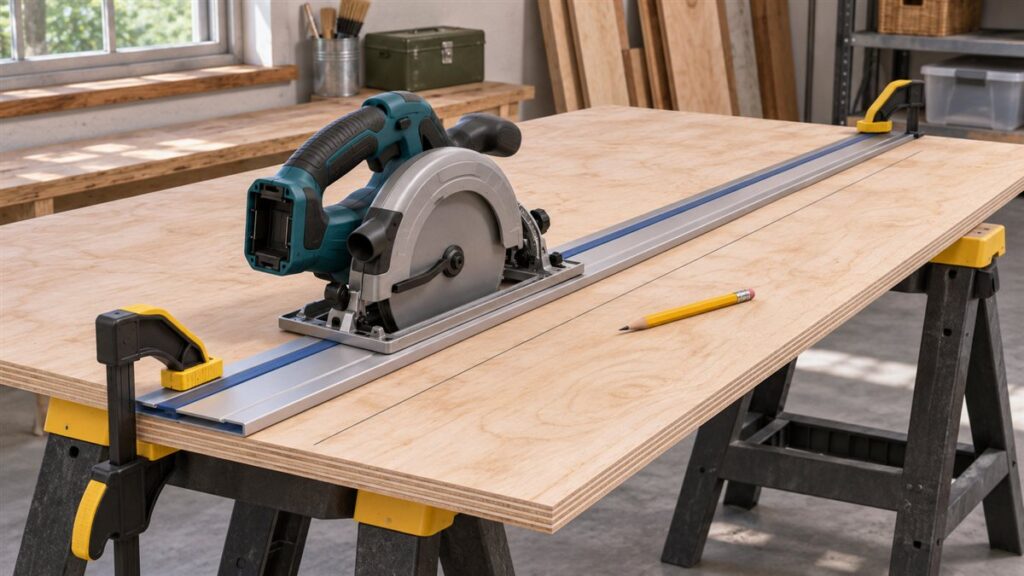
Straight cuts with a circular saw come from three things: a firm guide, good support under the board and a steady, unhurried push. Free-hand cutting along a pencil line can work for rough jobs, but a guide gives more repeatable results. Read your saw’s manual before use and follow its safety instructions.
Set Up the Cut
- Mark the cut line clearly on the board, on the good face, using a square.
- Support the board on sawhorses or a bench so the offcut will not drop and pinch the blade. Keep the saw clear of whatever is beneath.
- Set the blade depth so it extends only a little beyond the underside of the board. Many manuals suggest about one tooth depth below.
- Check the blade is clean and sharp and that the base plate is flat and firmly attached.
- Find the offset between the blade and the edge of the saw’s shoe. You will need it to position a guide.
Choose a Guide
| Guide | Best for | Notes |
|---|---|---|
| Clamped straight board | Long cuts in sheets | Needs an offset measurement; check the clamps clear the saw |
| Speed square | Short crosscuts on narrow boards | Hold firmly against the board edge |
| Track system | Repeated precise cuts | Follow the maker’s set-up instructions |
| Rip fence on the saw | Narrow strips along an edge | Limited reach |
To place a clamped board, measure from the blade’s edge to the saw’s shoe edge, then offset the guide from your line by that amount. Make sure the clamps will not be hit by the saw.
Make the Cut
- Rest the front of the shoe on the board with the blade clear of the wood and the guide touching the base plate.
- Check your stance. Stand slightly to the side of the saw so you are not in line if it kicks back.
- Squeeze the trigger and let the blade reach full speed before it touches the wood.
- Push forward steadily, keeping the shoe pressed against the guide. Let the blade do the work and do not force it.
- Keep both hands on the saw, away from the blade path, and hold the board down with clamps where you can.
- Finish the cut, release the trigger and wait for the blade to stop before lifting the saw. Wait to set it down until it has stopped.
Habits That Help
- Wear eye and ear protection and a dust mask as suited to the material.
- Support both sides of the cut so the kerf stays open.
- Avoid cutting into clamps, nails or screws.
- Test on scrap if the set-up is new.
FAQ
Why does my saw wander off the line?
Common causes are a dull blade, a worn shoe, pushing sideways and a guide that moved. Check each and slow down.
Which side of the board splinters?
Most hand-held circular saws cut upward through the board, so the top face often shows more tear-out. Cut with the better face down, if the manual says that applies.
The Short Version
Clamp a guide, support the work well, set a shallow blade depth and push steadily. Follow your saw’s manual and keep control of the tool throughout.