Disclosure: As an Amazon Associate, umtsmarttool.com earns from qualifying purchases. Links to Amazon on this page are affiliate links; they cost you nothing extra. Prices and availability change often, so check the current Amazon listing before you buy.
Where to buy
This guide explains how to install an above ground pool step by step; these are the verified pools used as its worked examples.
- Intex Prism Frame 12 ft x 30 in Pool Set — The Reference Framed Set. Check on Amazon
- Bestway Steel Pro MAX 14 ft x 33 in Pool Set — The Wide Framed Set. Check on Amazon
- Intex Metal Frame 10 ft x 30 in Pool Set — The Compact Framed Set. Check on Amazon
This guide to how to install an above ground pool uses the cluster’s verified pools as its worked examples. Read the full guide ↓
Key Takeaways
- Match the pool to the pad: level ground first, diameter second, everything else after.
- Capacity is the running-cost figure: it sets fill time, chemical doses and pump hours.
- The bundled pump decides your workload; cartridge size decides how often you rinse.
- Ring pools are fastest to set up; framed pools are the multi-season, older-children choice.
- Compare box contents, not model names: pool-only listings are not bargains by default.
In this guide
how to install an above ground pool: the method
How to install an above ground pool, in the framed sense this guide uses, means preparing the pad, building the frame true, and filling without locking in a lean. The steps below follow the order experienced owners use, with the checks that catch problems while they are still cheap. For the ring-pool and general version, see How To Set Up An Above Ground Pool; for choosing the pool itself, How To Choose An Above Ground Pool.
Step by step: how to install an above ground pool
- Prepare and level the pad. Clear the full diameter plus a margin of stones, roots and debris. Level by digging the high side down to firm ground, checking across the diameter in several directions. On soft soil, set flat pavers flush under each leg position to spread the load.
- Lay the ground cloth. Spread the cloth smooth and centred, with the liner on top of it, and let the liner warm in the sun so it is supple before assembly. A cold, stiff liner fights every later step.
- Build the frame loosely. Slot the top rails through the liner sleeves and connect the legs and joints without forcing anything fully home. Framed pools (Intex pin-and-sleeve, Bestway FrameLink and click systems) are designed to be tensioned by the fill, so a slightly loose start is correct, not sloppy.
- Square and level the structure. Walk the circle checking that legs are vertical, joints seated and the diameter equal in several directions. Small corrections are free now and expensive at half-full.
- Add the first inches of water and smooth the floor. With an inch or two of water covering the floor, work wrinkles outward from the centre by hand or with a soft brush, and confirm the legs are taking even load as the weight arrives.
- Fit the pump and hoses before filling further. Connect the filter pump to the liner’s inlet and outlet fittings, with hoses routed without kinks and the pump on firm, level ground near a grounded outdoor outlet. Prime and test it briefly so any fitting leak is found at low volume.
- Fill to the line, then commission the water. Fill to the manufacturer’s stated level (typically 90 percent of wall height), watching the frame stay true as you go. Run the pump, add the starting sanitiser dose for the pool’s stated gallons, fit the ladder and cover, and record the model and cartridge type somewhere durable.
Filling without regrets
Fill with a garden hose and patience, and stay nearby for the first fill of the season. Watch the wall or frame as the level rises: a ring pool should rise evenly all round, and a framed pool’s legs should stay vertical and evenly loaded. If one side is visibly lower, stop early, while draining is still a small job, and fix the pad rather than hoping the pool will settle into place. It will not; it will settle into a lean.
Stop at the manufacturer’s fill line rather than the brim. Above-ground pools are rated at a stated fill level (typically 80 or 90 percent of wall height), and the capacities quoted in this guide are at those levels. Overfilling removes the freeboard that keeps water in when swimmers get in, and it stresses seams and rings. Once filled, fit the pump, prime it as its manual directs, and run it before the first swim so the water starts its life filtered.
The weekly water-care rhythm
Key Takeaways: test, sanitise, filter, skim, in that order, on a schedule rather than on a hunch.
Test the water with strips or a liquid kit several times a week in the season: sanitiser level and pH are the two numbers that matter daily. Keep sanitiser steady rather than heroic; a small daily dose beats a huge weekly shock for both water quality and swimmer comfort. Run the pump long enough each day to turn the full volume over, longer in heatwaves and after parties, and rinse the cartridge whenever flow drops or the gauge (where fitted) says so, with a spare cartridge rotating in while the rinsed one dries.
Skim the surface daily, brush the walls weekly to disturb the film where algae starts, and keep the cover on whenever the pool is idle for more than a day. For the deeper method, see Pool Filter Buying Guide and How To Choose A Pool Cleaning Kit. The owners with clear water in August are not doing anything clever; they are doing these ordinary things on time.
Troubleshooting
Problem: one leg sinks or tilts during the fill: Stop filling, drain to a manageable level, and re-seat that leg on firm ground or a flush paver. A tilted leg under full load stresses the joint and the liner seam.
Problem: the waterline is visibly uneven: The pad is out of level. At a small difference on a framed pool, monitor it; at anything pronounced, drain and re-level rather than accepting a permanent lean and uneven seam stress.
Problem: a fitting weeps at the pump hoses: Power off, reseat the hose and clamp, and check the sealing washer is present and flat. Most installation leaks are a missing or pinched washer, not a failed part.
Gear That Makes This Easier
The pools below are the worked examples for this guide: verified specifications, honest trade-offs, and links where a listing could be tied to the exact model.

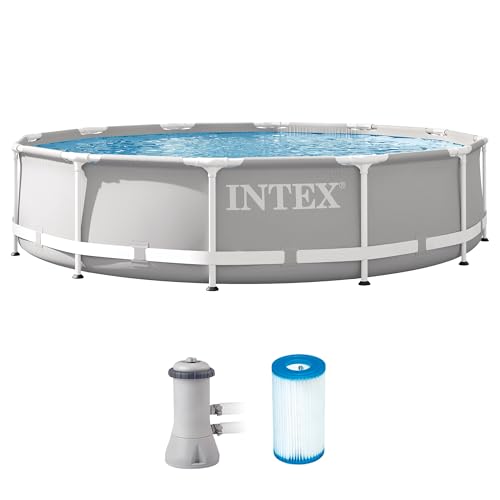
Intex Prism Frame 12 ft x 30 in Pool Set — The Reference Framed Set
Who it suits: families who want the sweet spot of the framed range: real swimming room for children, manageable water volume for the owner.
Key specifications
- Round pool, 12 ft diameter x 30 in wall height (model 26711EH)
- Water capacity: 1,718 gallons at 90% full
- Krystal Clear C530 cartridge pump: 530 GPH, Type A cartridge
- Powder-coated steel frame with composite T-joints
- Puncture-resistant 3-ply liner; repair patch included
Strengths
- The 12 ft circle is the first size where children can genuinely swim a few strokes
- The 530 GPH pump is a step up from the 330 GPH starters and keeps 1,718 gallons honestly
- Prism frame hardware is the sturdier Intex design, built for repeat seasons
Trade-offs
- No ladder in the standard set, though at 30 in most families manage without
- The pump still rewards an upgrade path if the pool sees daily heavy use
- A 12 ft level pad is a real piece of yard to commit
If this guide has a centre of gravity, it is the 12 ft by 30 in framed set, and the Prism Frame version is the strongest expression of it. The diameter gives children a pool they can actually move in (a few real strokes across, proper floating room, games that work) while the 1,718-gallon volume stays within what a cartridge pump and a sensible chemical routine can keep sparkling.
The included C530 pump moves 530 GPH through a Type A cartridge, a meaningful step above the 330 GPH units in the 10 ft sets, and the pump uses Intex’s Hydro Aeration fittings. The frame is the Prism design: powder-coated steel with composite T-joints intended to keep water out of the tube ends, which is where framed pools usually start to rust.
Ownership at this size becomes a light version of real pool ownership: test the water, keep chlorine steady, rinse the cartridge, run the pump daily. Owners who enjoy that rhythm describe this size as the perfect pool; owners who wanted a giant paddling pool should stay with the ring pools and their drain-and-refill honesty.
The honest limitation is that this size exposes weak water care fastest: 1,718 gallons is too much to dump casually and too little to forgive neglect.
Best for: families who want the sweet spot of the framed range: real swimming room for children, manageable water volume for the owner. / Not suited for: buyers whose needs contradict that profile — read the trade-offs above before ordering.
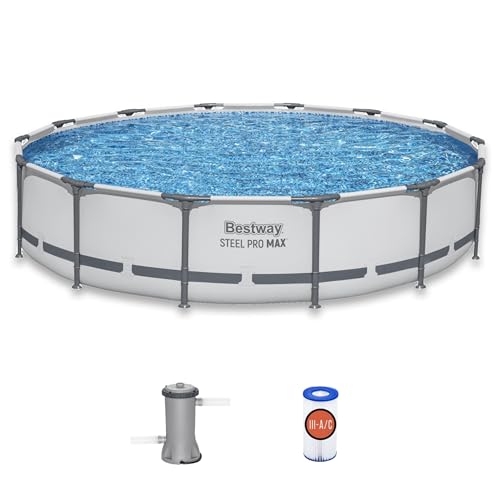
Bestway Steel Pro MAX 14 ft x 33 in Pool Set — The Wide Framed Set
Who it suits: families who need a wider pool for more swimmers but want a shallower wall that fills faster and suits younger children.
Key specifications
- Round pool, 14 ft diameter x 33 in wall height (model 56597E)
- Water capacity: 2,700 gallons
- Filter pump: 530 GPH, with Type III cartridge
- DuraPlus liner; corrosion-resistant steel frame
- No-tool setup with quick-click connectors
Strengths
- Fourteen feet across is a social pool: room for several children and floating adults at once
- The 33 in wall keeps water volume (and fill time, and chemical use) below the 42 and 48 in models
- Type III cartridges are larger and need less frequent rinsing than the small Type I
Trade-offs
- The 530 GPH pump works hard on 2,700 gallons; long run times are essential
- No ladder or cover in the standard set
- Shallower water warms fast but also tires fast in a heatwave without a cover
The 14 ft by 33 in Steel Pro MAX is the wide-but-shallow option, and it exists for a specific household: many swimmers, younger children, and an owner who would rather manage 2,700 gallons well than 4,000 gallons badly. The extra diameter over the 12 ft sets is immediately obvious in use: the pool stops being a queue and becomes a space, with room for a floating adult to coexist with playing children.
The set pairs that volume with a 530 GPH pump and a Type III cartridge. The cartridge is a genuinely larger filter than the small types in the 10 ft sets, but the arithmetic still asks for commitment: run the pump for long hours daily, keep the cartridge rinsed, and use a cover to keep debris (and therefore filter load) down. Owners who do this report clear water; owners who run the pump like a kitchen timer do not.
Assembly is the tool-free FrameLink-style routine, and the DuraPlus liner shrugs off the heavier traffic a pool this size invites. As a family-throughput purchase (most swimmers per unit of owner effort) it is one of the smartest shapes in the catalogue.
The honest limitation is filtration margin: this is the largest volume in the guide paired with a mid-size pump, so pump discipline makes or breaks it.
Best for: families who need a wider pool for more swimmers but want a shallower wall that fills faster and suits younger children. / Not suited for: buyers whose needs contradict that profile — read the trade-offs above before ordering.

Intex Metal Frame 10 ft x 30 in Pool Set — The Compact Framed Set
Who it suits: first-time frame-pool buyers who want the smallest, cheapest framed set that still filters its water.
Key specifications
- Round pool, 10 ft diameter x 30 in wall height (model 28201EH)
- Krystal Clear cartridge filter pump: 330 GPH
- Type H filter cartridge included
- Powder-coated steel frame with laminated PVC sidewalls
- Drain plug connects to a garden hose
Strengths
- A real steel frame at the smallest sensible size: no ring to keep inflated
- The included pump and cartridge make it a complete, treatable pool out of the box
- Frame pools forgive slightly imperfect ground better than ring pools do
Trade-offs
- The 330 GPH pump is the minimum viable size; long daily runs are the routine
- At 30 in of wall, older children outgrow the depth quickly
- Frame pins and joints need a dry, organised storage habit over winter
The 10 ft Metal Frame set is the entry point to framed pools, and the frame changes the ownership experience more than the size suggests. There is no top ring to inflate and keep firm; a powder-coated steel skeleton holds the laminated liner, the pool keeps its shape on ground that is merely good rather than perfect, and the whole structure feels planted rather than floated.
The set is complete in the ways that matter at this tier: a 330 GPH Krystal Clear cartridge pump with a Type H cartridge, so the water can be treated and kept rather than dumped. That single inclusion separates framed sets from the ring pools above them in this guide. Chemical maintenance becomes worthwhile, the water lasts, and the cost per swim drops across the season.
Assembly is a two-person, no-tools job of slotting tubes through the liner sleeves and pinning the joints, and takedown reverses it. Buyers stepping up from inflatables should budget the same care for the frame as for the liner: dry everything before storage, touch up paint chips, and the set will start each season as it finished the last.
The honest limitation is filtration headroom: the pump maintains a lightly used pool, but a hot week with many swimmers will push it hard.
Best for: first-time frame-pool buyers who want the smallest, cheapest framed set that still filters its water. / Not suited for: buyers whose needs contradict that profile — read the trade-offs above before ordering.
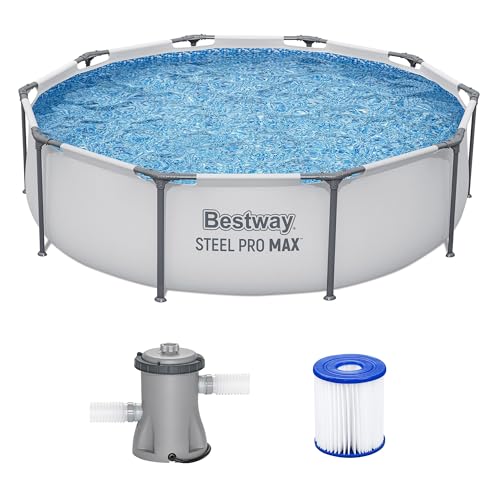
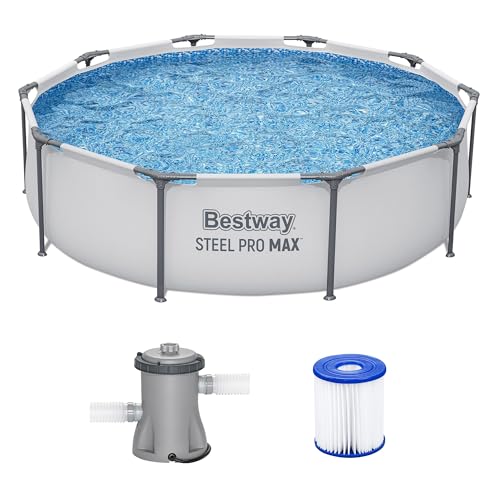
Bestway Steel Pro MAX 10 ft x 30 in Pool Set — Also Worth a Look
Who it suits: small-yard families who want a complete framed set from the Bestway ecosystem, with the easiest joint system in the class.
Key specifications
- Round pool, 10 ft diameter x 30 in wall height (model 56407)
- Water capacity: 1,236 gallons at 90% full
- Filter pump: 330 GPH, with Type I cartridge included
- DuraPlus 3-layer reinforced liner
- FrameLink system joints; corrosion-resistant steel frame
Strengths
- FrameLink joints click together securely and come apart without a fight at takedown
- The DuraPlus liner is genuinely tough for the class
- A complete set: pump and cartridge included, nothing else required to start
Trade-offs
- The 330 GPH pump is a maintenance pump, not a heavy-use pump
- Type I cartridges are small and need frequent rinsing in busy weeks
- Bestway and Intex fittings differ, so cross-brand spares need adapters
The Steel Pro MAX 10 is Bestway’s answer to the Intex Metal Frame 10, and its signature is the FrameLink joint system: connectors designed so metal does not grind on metal, which both speeds assembly and removes the rust-starting scratches that plague cheaper frames. Two people can have this pool standing quickly, and, just as valuably, can have it apart again in autumn without seized joints.
The liner is DuraPlus, Bestway’s three-layer reinforced material, and the set is complete: a 330 GPH pump with a Type I cartridge, so the water is treatable from day one. At 1,236 gallons the volume is a touch above the Intex ring pools, with the framed pool’s advantage that the full circle is usable: no ring intruding at the waterline, and vertical walls rather than a slope.
Run the pump for long daily hours, rinse the small cartridge often, and keep a spare cartridge in rotation. Do that and this is the most polished small framed set in the guide; the ownership experience is closer to a big pool in miniature than to an inflatable with ambitions.
The honest limitation is ecosystem lock-in: hoses, cartridges and fittings are Bestway-pattern, so future spares shopping stays in brand.
Best for: small-yard families who want a complete framed set from the Bestway ecosystem, with the easiest joint system in the class. / Not suited for: buyers whose needs contradict that profile — read the trade-offs above before ordering.

Intex Prism Frame 10 ft x 30 in Pool — Also Worth a Look
Who it suits: buyers who already own a suitable pump, or who prefer to choose filtration separately rather than accept a bundled starter unit.
Key specifications
- Round pool, 10 ft diameter x 30 in wall height (model 26700EH)
- Pool only: filter pump not included
- Reinforced, powder-coated steel frame
- Puncture-resistant 3-ply liner material
Strengths
- The Prism frame is the sturdier Intex design, with stronger tubing and T-joints than the basic Metal Frame line
- Buying the pool alone avoids paying for a starter pump you would replace anyway
- The grey Prism liner looks tidier in a landscaped yard than bright blue liners
Trade-offs
- You must budget and buy a pump separately before the water stays clear
- No ladder, cover or ground cloth in the box: the accessory list is yours to build
- Total cost of ownership is easy to underestimate at checkout
The Prism Frame line is Intex’s step up from the basic Metal Frame range: stronger powder-coated tubing, reinforced T-joints and a more finished liner. At 10 ft by 30 in it is the compact version of that idea, and this particular listing is the pool on its own, with no pump in the box. That is either a flaw or a feature depending entirely on what is already in your shed.
For owners replacing a worn pool while keeping a working pump, or for buyers who already know they want stronger filtration than any starter bundle includes, pool-only is the honest way to buy. The frame assembles without tools, the liner is the same puncture-resistant 3-ply material as the bigger Prism sets, and the structure shrugs off the bumps of family use better than any inflatable.
The discipline is accounting. Price the finished installation (pool, pump, cover, ground cloth, chemicals) before comparing it with complete sets, and the Prism 10 becomes what it should be: a deliberate, quality-first compact frame pool, not a bargain that quietly invoices you later.
The honest limitation is that pool-only pricing flatters it: priced with a decent pump, cover and cloth, it competes with complete sets, not beneath them.
Best for: buyers who already own a suitable pump, or who prefer to choose filtration separately rather than accept a bundled starter unit. / Not suited for: buyers whose needs contradict that profile — read the trade-offs above before ordering.
The full ranked lists live at Best Above Ground Pool Under $150 and Best Above Ground Pool Under $300, and the decision framework at Above Ground Pool Buying Guide.
Common Buying Mistakes
Letting children treat the wall as furniture
Sitting on ring-pool rings and framed-pool top rails is the fastest route to a spill, a bent rail or a torn liner, and it is how most above-ground pool accidents at home begin. The rule is simple and worth stating before the first fill: nothing and nobody sits on the wall, ever.
Skipping the cover to save a small amount of money
An uncovered pool collects leaves, insects and dust all day, every day, and all of it becomes filter load, chemical demand and skimming labour. A cover is the cheapest labour-saving device in the category, and on small pools a fitted sheet or tarp does most of the same work.
Comparing listings by model name instead of box contents
A pool-only listing and a complete set can share a name and differ by a pump, ladder, cover and cloth. The cheaper listing is often just the emptier box. Compare contents lists, and price the finished installation, before deciding which offer is really cheaper.
Practical Detail: Setting up on a level pad, step by step
Key Takeaways: the pad decides everything. Level, firm, clear of sharp objects, and slightly larger than the pool’s diameter.
Choose the spot first: level ground, away from overhanging branches if you can manage it, within hose reach and within safe reach of a grounded outdoor outlet for the pump. Clear the area of stones, roots and sharp debris, and check level across the full diameter in several directions, not just across the middle. For framed pools, the legs need firm support; on soft soil, flat pavers under each leg spread the load, set flush so they cannot tilt or press into the liner.
Lay the ground cloth, then the liner, and let the sun warm it for a while: a warm liner is supple and far easier to smooth. For ring pools, inflate the ring before adding more than an inch or two of water. For framed pools, build the frame loosely first, then tension it as the liner fills and settles. In both cases, the first few inches of water are your last easy chance to pull floor wrinkles outward from the centre, so take them slowly.
Practical Detail: Takedown and storage that protect next season
Drain through the pool’s drain valve with a hose to a suitable outlet, well away from the pool’s own base and from neighbours’ boundaries; thousands of gallons need a destination planned in advance. As the level drops, scrub the walls and floor so the liner goes away clean, then let everything (liner, frame, hoses, pump) dry completely before storage. Mould in a folded liner is the most common self-inflicted loss in this category.
Store the liner loosely folded with a little talc or as the manufacturer directs, in a dry, rodent-safe place; mice find stored liners as attractive as owners find the damage unforgivable. Keep frame parts together, touch up paint chips on steel, and store cartridges and the pump indoors. Label the box with the model number and cartridge type, and next spring’s setup becomes an hour of assembly instead of a weekend of archaeology.
Buying Detail: Liner construction decides lifespan
Liners fail from punctures, seam stress and sun, in that order, and construction is your defence against the first two. Single-layer vinyl belongs to the cheapest inflatables and should be bought as a short-life product. The three-layer materials in this guide (Intex’s 3-ply and SuperTough laminated PVC, Bestway’s Tritech and DuraPlus, Funsicle’s ToughMesh) sandwich a polyester mesh core between PVC skins, which resists tears spreading and shrugs off the scuffs of feet, toys and pool-side grit. Whichever you choose, the owner’s part is a ground cloth underneath, a no-shoes habit on the pool floor’s surroundings, and a repair patch used early. A patched three-layer liner commonly outlasts an abused premium one.
Buying Detail: Check what is actually in the box
The same model name can hide three different products: a complete set, a pool-only package, and a retailer bundle with extras. The differences are worth real money: a pump, a ladder, a cover and a ground cloth can together approach the price of a small pool. Before comparing any two listings, list their contents side by side. Ladders matter once walls reach 42 inches; covers matter on any pool you intend to keep filled for more than a few days, because they keep debris (and therefore filter load and chemical demand) down; ground cloths matter everywhere. This guide notes bundle contents for every pick, and where contents vary between listings for the same model, it says so rather than guessing.
Buying Detail: Frame versus ring is a lifestyle choice
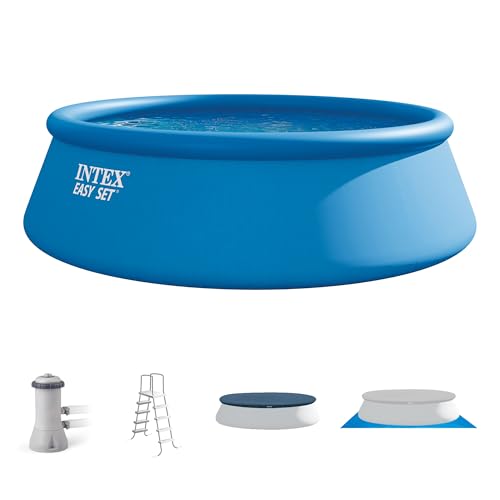
Ring pools (Easy Set, Fast Set, Quick Set) replace structure with air and water: fastest setup, fewest parts, soft walls, and an absolute dependence on level ground and an intact top ring. Framed pools (Metal Frame, Prism Frame, Steel Pro MAX) replace air with steel: slower setup, a parts inventory to store, and in exchange a rigid wall, a full usable diameter, and tolerance for the leaning and launching of older children. Neither is better in the abstract. Households that set up and take down often, or store everything in a small shed, often prefer rings. Households that install once for the whole season and host older children usually end up framed. Many families own both across the years, graduating from ring to frame as the children grow.
Buying Detail: Diameter is the honest size figure
Manufacturers headline diameter and wall height, and both matter, but diameter is the one that decides how the pool feels in use. An 8 ft circle is a sit-in pool. A 10 ft circle lets children move. A 12 ft circle allows a few genuine strokes and separates playing children from a supervising adult. At 14 and 15 ft, the pool becomes a social space where floats, games and swimmers coexist. Wall height decides depth, and depth decides who the pool suits: 30-inch walls give roughly two feet of water, which younger children can stand in; 42 and 48-inch walls give water that adults can actually immerse in, and which therefore demands ladders, covers and stricter supervision. Choose diameter for the crowd and height for the swimmers, in that order.
Buying Detail: Plan the water routine before the water arrives
A filled pool is a small ecosystem with a daily appetite: skimming, a sanitiser level to hold, a pump to run, a cartridge to rinse. The routine scales with volume and bather load, not with price. Before buying, walk the routine honestly: who tests the water, who rinses the cartridge, where the cover lives, where the pump plugs in (a grounded outdoor outlet, never a lightweight indoor extension lead), and where four thousand gallons go when the pool drains. Owners who answer those questions in April have clear water in July. Owners who improvise them in July have a green pool and a story. The guides linked from this article, including How To Set Up An Above Ground Pool, walk each step in order.
Buying Detail: The included pump matters more than the liner pattern
Ask any experienced owner what they would upgrade first and the answer is filtration. The pump bundled with a set decides how hard you work: small 330 GPH cartridge units maintain lightly used 10 ft pools, 530 GPH units suit the 12 ft class, and the 15 ft sets need their 1,000 GPH pumps run daily. Two figures matter: the pump’s flow rate, and the cartridge type it uses, because cartridge size decides how often you rinse. Type H and Type I cartridges are small and need frequent attention; Type A is the mid-size standard; Type III and Type C cartridges are larger and more forgiving. When a listing hides the pump specification or sells the pool without one, treat that as a cost to add, not a detail to ignore.
Buying Detail: Start with the ground, not the pool
Every above-ground pool in this guide sits on your ground, and the ground decides more about your summer than the brand does. Ring pools need a surface that is level within a very small tolerance across the whole diameter, because the water itself becomes the structure’s level reference: a slope becomes a lean, a lean becomes a spill, and a spill at a few thousand gallons is a garden event. Framed pools forgive a little more, since the frame holds the shape, but their legs still need firm, even support or they settle unevenly and stress the joints. Before choosing a size, stand where the pool will go with a long straight edge and a level, and be honest about the work needed. A pool that fits the yard you actually have beats a bigger pool on a pad you never quite finished.
Buying Detail: Water volume is the running-cost figure
Capacity, in gallons, is the number that quietly runs your summer. It sets the fill time from a garden hose, the amount of sanitiser the pool needs, the pump hours required to turn the water over, and the size of the job when something goes wrong and the pool must be drained. As a working rule from the sets in this guide, volumes run from under two hundred gallons for lounge inflatables, through about a thousand for 10 ft sets, seventeen hundred or so for 12 ft framed sets, and up to a little over four thousand for the 15 ft flagships. None of those numbers is good or bad in itself; the mistake is buying a volume your routine cannot maintain. Clear water is a habit applied to a volume, and smaller volumes forgive beginners while bigger volumes reward them.
A Mistake Worth Avoiding: Buying the diameter you want on ground you have not checked
The classic first-pool error. The pool arrives, the yard turns out to slope by several inches across the diameter, and the owner spends the season fighting a lean that no amount of filling adjusts. Check and prepare the pad before ordering, or order the size your prepared pad can honestly hold.
A Mistake Worth Avoiding: Running the pump like a kitchen timer
Twenty minutes a day does not filter a pool. The water must turn over: divide the pool’s gallons by the pump’s gallons-per-hour to get the bare minimum run time, then add margin for heat and swimmers. Short-running the pump is the single most common cause of cloudy water blamed on chemicals.
A Mistake Worth Avoiding: Dosing chemicals from a neighbour’s pool size
Chemical doses scale with gallons. A dose that is right for a 1,200-gallon set is a third of what a 3,700-gallon set needs, and three times what a lounge pool needs. Work from your own pool’s stated capacity (printed for every pick in this guide) and the product’s label, never from habit.
A Mistake Worth Avoiding: Storing a damp liner in autumn
A liner folded wet in September is a mould farm by May, and mould stains and weakens vinyl in ways cleaning never fully reverses. Dry everything completely, store it dry and rodent-safe, and the pool starts each season as an asset rather than an apology.
Another Common Question
Are above ground pools safe for children?
They are water, and water demands the standard disciplines: constant adult supervision, no swimming alone, a ladder removed or secured when the pool is not in use on taller models, and clear rules about the walls and diving (never dive into an above-ground pool). Local rules on fencing and barriers may also apply to larger pools; check them before installing a 42 or 48-inch model. Depth cuts both ways: shallower pools suit younger children, deeper pools suit stronger swimmers, and neither supervises itself.
Another Common Question
Can I leave an above ground pool up all winter?
In mild climates, some framed pools are winterised in place following the manufacturer’s instructions, with the water level lowered, plumbing drained and a winter cover fitted. In freezing climates, takedown is the safer default for the soft-sided pools in this guide: ice expansion damages liners, rings and pump housings. When in doubt, take it down, dry it thoroughly and store it as described in this guide; the labour is repaid in seasons of life.
Another Common Question
How long does an above ground pool last?
It depends on the construction and the care, in that order. Simple inflatable and lounge pools are realistically one-to-three-season products. Three-layer framed sets, dried and stored properly each autumn, commonly serve several seasons, with the liner usually ageing out before the frame. Sun exposure, ground preparation and storage conditions move those figures more than brand does.
Another Common Question
How much does it cost to run an above ground pool?
Beyond the purchase, the running costs are water for the fill and top-ups, electricity for the pump, sanitiser and test supplies, and replacement cartridges. All scale with volume, which is why this guide treats capacity as a headline figure. There are no honest fixed figures to print (local water and power prices vary widely), but the ranking is reliable: a lounge inflatable costs almost nothing to run, a 12 ft set is modest, and the 15 ft flagships are the most expensive seats in this class while remaining far below permanent-pool costs.
Another Common Question
Do I need a ladder for an above ground pool?
At 30-inch walls, most families step over or use a small step, and sets usually omit the ladder. At 42 and 48 inches, a ladder stops being an accessory and becomes the way in and out, and the better sets include one. Whatever the height, climbing the wall itself is the habit to forbid: it damages liners and rings and it is how people fall.
Another Common Question
Do I need a pump for a small above ground pool?
For the smallest lounge and paddling pools, no: the water volume is small enough to dump and refill on a short cycle, which is the honest maintenance method at that size. From around a thousand gallons upward, a pump and sanitiser become the practical route, because dumping a thousand gallons every few days wastes water and money. Every framed set in this guide includes or expects a pump for exactly that reason.
Another Common Question
What size above ground pool suits a family of four?
For two adults and two children, the 12 ft framed class is the usual sweet spot: enough diameter for play, a manageable volume for the owner, and water deep enough to be satisfying without ladder-and-supervision escalation. Families with older or more children, or who host friends, step up to 14 or 15 ft. Families with toddlers often do better with a 10 ft set or even a lounge inflatable for a season or two first.
Frequently Asked Questions
Why does my pool water go cloudy or green?
Cloudiness is usually filtration: too few pump hours, a clogged cartridge, or debris overwhelming the system. Green is algae, which means sanitiser fell behind, usually in hot weather or after heavy use. The fix is methodical rather than mysterious: clean or swap the cartridge, run the pump continuously until the water clears, restore and hold the sanitiser level, and brush the walls. If it keeps happening, the pump is undersized for the volume or the routine is slipping; the water is reporting, not misbehaving.
What is the difference between a pool set and a pool-only listing?
A set bundles the pool with some combination of pump, ladder, cover and ground cloth; a pool-only listing is the liner and frame (or the inflatable alone). Pool-only listings suit owners replacing a pool while keeping a working pump and accessories. Everyone else should compare the finished cost of the installation, not the headline cost of the box.
Can I put an above ground pool on grass, concrete or decking?
Grass is fine if it is level and cleared, though the grass beneath will die and the ground must still be prepared and cloth-protected. Concrete and paving work if they are level and the liner is protected from abrasion with a ground cloth or padding, but check for slopes toward drains. Decking is the risky one: a modest pool holds tonnes of water, so never place one on a deck unless the structure has been assessed for the load.
How do I drain an above ground pool at the end of the season?
Use the drain plug or flow-control valve with a garden hose, and send the water to a suitable drain or dispersing area away from the pool base, buildings and boundaries. Chlorinated water should be dechlorinated or left to stand as local rules require before discharge to gardens or storm drains. As the level falls, scrub the liner so it stores clean, and never drag a partly filled pool to a new spot: tonnes of water do not forgive improvisation.
How level does the ground really need to be?
Level enough that the waterline sits evenly, which in practice means within an inch or so across the diameter for framed pools and closer than that for ring pools. Ring pools are the least forgiving because the water itself holds the wall up. If the site slopes more than that, dig the high side down rather than building the low side up: built-up ground compacts under tonnes of water and lets go unevenly.
Wrap-Up
How to install an above ground pool rewards order and patience over effort: every expensive mistake in this category is a skipped early step discovered at full volume. Work the sequence, check at low water, and the pool will repay a single careful day with a whole season of easy ones.