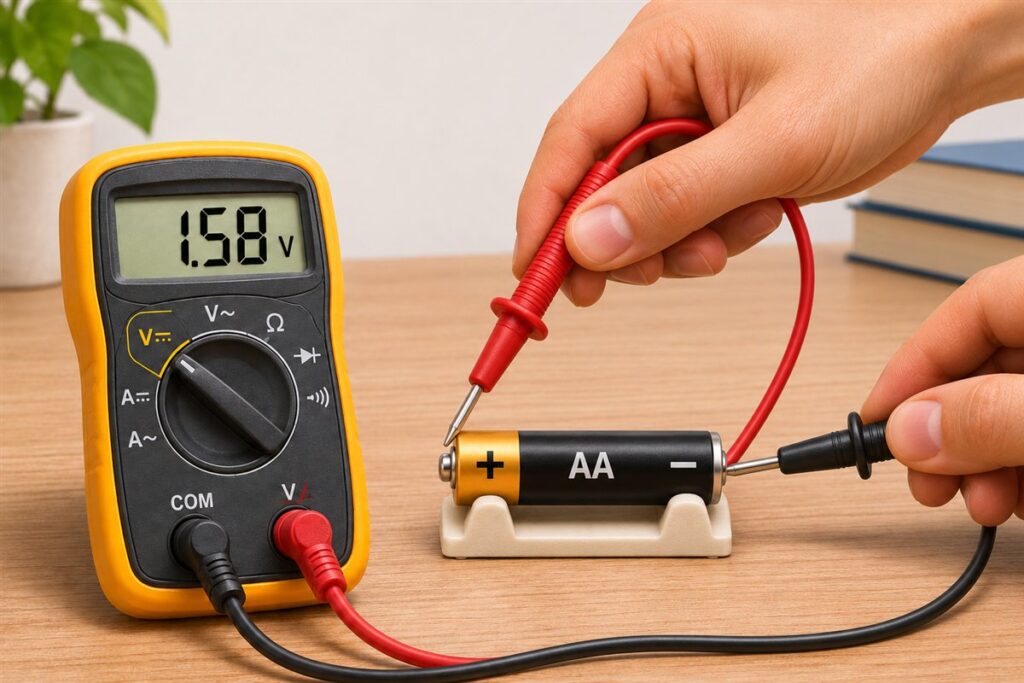
A multimeter measures electrical quantities such as voltage, resistance and continuity, and beginners can learn it safely on low-voltage items like batteries and simple circuits. Mains electricity can be dangerous, so do not work on household wiring unless you are qualified and your local rules allow it. Always read the meter’s manual before you use it.
Know Your Meter
Most meters have a dial, a display, a black lead, a red lead and several sockets. The black lead normally goes in the socket marked COM. The red lead goes in the socket for voltage and resistance, and often in a separate one for higher current. Check the manual for the exact layout and for the meter’s category marking, which tells you where it is meant to be used.
| Dial setting | What it measures | Everyday example |
|---|---|---|
| V with a straight line | Direct current voltage | Batteries, low-voltage adapters |
| V with a wave | Alternating current voltage | Mains work, only for qualified people |
| Ohm symbol | Resistance | Resistors, heating elements, switches |
| Sound or diode symbol | Continuity | Fuses, wires, switches |
| A setting | Current | Advanced use; follow the manual closely |
Measuring Battery Voltage
- Insert the black lead into COM and the red lead into the voltage socket.
- Turn the dial to the direct current voltage range suited to the battery, or auto-range if the meter has it.
- Touch the red probe to the positive end and the black probe to the negative end.
- Read the display. A fresh AA cell usually reads a little above one and a half volts, though results vary by type.
- Remove the probes and switch the meter off when you finish.
Checking Continuity
Continuity tells you whether a path is complete, which helps with fuses, cables and switches.
- Make sure the item is disconnected from any power source and any stored charge is gone.
- Set the dial to the continuity symbol and touch the probes together. The meter should beep.
- Touch one probe to each end of the item. A beep or near-zero reading means a complete path.
- No beep suggests a break, though always check the manual or the item’s data.
Good Habits
- Check the leads for cracks or exposed metal before every use.
- Never measure resistance or continuity on a live circuit.
- Choose the right range, beginning high if the meter is manual-ranging.
- Keep fingers behind the guards on the probes.
- Do not exceed the limits printed near the sockets.
FAQ
Why does my meter show a different battery reading from the label?
Battery voltage changes with charge, load and chemistry. A reading with no load does not show how a battery performs under use.
Can I test a wall socket?
That involves mains voltage and should be left to qualified people following local rules. A dedicated tester made for the purpose, used as its manual says, is a different tool.
The Short Version
Learn the leads and dial first, practise on batteries and unpowered parts, and keep away from mains work unless qualified. Follow the multimeter’s manual and your local rules.