Disclosure: As an Amazon Associate, umtsmarttool.com earns from qualifying purchases. Links on this page are affiliate links; they cost you nothing extra. Prices and availability change often, so check the current Amazon listing before you buy.
So, is a desk footrest worth it? The honest short answer is: worth it if your feet do not currently rest flat, relaxed, and supported when your chair is set properly for your desk — or if they rest flat but will not keep still — and not worth it if your setup already fits you and your feet are content. That answer is conditional because a footrest is a fit product: it returns value in direct proportion to the size of the problem it solves, and for some desks that problem is an hourly discomfort while for others it does not exist. There is no shame in either outcome — a workstation that needs nothing is a success, not a missed sale — and the purpose of the pages that follow is to sort one outcome from the other with measurements and profiles rather than with enthusiasm. This article exists to help you find out which desk is yours before you spend anything. It lays out what you actually get, what it really costs beyond money, who it pays off for and who should skip it, what the alternatives do better, and a closing checklist that converts all of it into a decision. It also gives you a free experiment that settles the question more reliably than any article can, because the most trustworthy verdict on a fit product is always written by your own working week. No hype in either direction: a footrest is a small, honest product, and it deserves a small, honest verdict.
Key Takeaways
- Worth it if: your feet dangle or perch when your chair is set for your desk; you sit for long stretches at a time; you fidget and re-cross your legs all day; or your chair must sit high for a tall desk or counter.
- Not worth it if: your feet already rest flat and comfortable, your under-desk space is genuinely cramped, or you are hoping a small accessory will fix a chair and desk that do not fit you — fix those first, properly, and then reassess.
- What you are buying is settled feet: a supported resting place at the right height and angle, whose value compounds quietly across hundreds of working afternoons and asks almost nothing of you in return.
- The real costs are mostly not money at all: floor space, a little upkeep, foam that ages, and the discipline of still taking proper breaks. All are manageable; none should be a surprise.
- A footrest is a comfort product, and should be judged as one. It supports a more comfortable sitting posture; it does not treat or prevent back pain or any other condition, and persistent pain deserves a professional, not a purchase.
In this guide
Is a Desk Footrest Worth It? What You Actually Get
Strip away the marketing and a footrest delivers four concrete things. The first is a resting place at the right height. When your chair is set for your desk — as it should be — your feet are frequently left at the wrong distance from the floor, and everything uncomfortable follows from that single mismatch: dangling, toe-perching, hooking feet around the chair base, tucking a leg underneath you. A footrest closes that distance with a surface chosen for the gap, and the immediate result is that your feet stop being a problem you manage subconsciously all day. Owners rarely describe this dramatically. They say the afternoon feels easier, that they stopped perching, that they noticed the difference most when they worked one day without it. Quiet, cumulative, daily: that is the texture of the value here, and it is real.
The second thing you get is a more settled sitting position overall. With your feet supported, many people find they sit back in the chair as it was designed to be sat in, rather than camping on its front edge; the whole arrangement — chair, desk, screen — starts working as a system instead of as three separate compromises. To be precise, and this guide will stay precise: supported feet help your posture feel more comfortable. That is a worthwhile outcome on its own terms, and it is the only posture claim a footrest is entitled to make.
The third delivery is an outlet for restlessness, if you choose a design that offers one. Rocking and tilting footrests give fidgety feet a smooth, silent occupation that stays under the desk and out of everyone’s way, and for the substantial minority of people who concentrate better with some low-level movement available, this is not a bonus feature — it is the entire reason the product earns its floor space. Even static designs deliver a milder version: a defined place for your feet to shift, stretch, and rearrange themselves without hunting for the chair base.
The fourth thing is flexibility across your life as it changes. An adjustable footrest follows you to a taller desk, a different chair, a partner’s shifts at the same desk, a standing-desk frame’s seated hours. It works in the spare room this year and the garden office next year, at the craft table and the gaming desk. Few workstation purchases are this portable across setups, and that portability is part of the value calculation: you are not buying a solution to one desk’s geometry, you are buying the adjustable end of a problem that recurs wherever you sit to work. Weighed together, these four deliveries explain the product’s devoted following — and also its limits, because every one of them is worthless to a person whose feet were never unsupported, restless, or mismatched in the first place. Which brings us to the costs, stated with the same plainness. If you want the advantage-and-drawback ledger in full before deciding, our desk footrest pros and cons keeps it.
The Real Costs Beyond Money
A footrest’s price tag is the least interesting part of what it costs, and since listings change constantly, this article discusses tiers rather than figures. The real costs are these. Floor space, permanently. A footrest moves into the most contested square of your home — under the desk, among the chair base, the cables, and your own legs’ need to stretch and swivel — and it stays there. In a generous setup this costs nothing you notice. In a compact one it can cost you the feeling of roominess every time you sit down, and that tax is charged daily. Measure before you romanticise.
A place in your cleaning and upkeep routine. Footrests live in the dust zone, in contact with feet and shoes. Washable covers need washing; textured platforms need vacuuming; wooden runners need the occasional wipe and check. None of this is heavy — minutes a month — but it is not zero, and the buyers who pretend it is zero end up, a year later, quietly disgusted by an object they otherwise liked. An ageing curve, if you choose foam. Cushions are consumables with long lives: they soften gradually where your heels rest, and one day the support you bought is a mat you own. Rigid designs postpone this cost almost indefinitely, which is part of what their tiers buy, but they charge it instead as firmness your bare feet must accept.
A small, real risk of buying wrong. This category punishes guessing more than most: the wrong height is not a slightly worse experience, it is a product you will not use. The cost of that mistake is capped by return policies and by the measuring routine in our how to choose a desk footrest guide — but it is a cost in hassle even when it is not a cost in money. There is also a quieter cost worth naming: decision effort. Five types, dozens of models, and a commentariat that disagrees about all of them can consume more of your attention than a small comfort purchase deserves. The defence is the structure of this article — decide by profile and checklist, not by browsing — and the willingness to let a return window, rather than a fifteenth comparison page, settle the remaining doubt. And finally, the subtlest cost: comfort can extend sitting. A footrest makes seated hours feel better, and better-feeling hours are easier to string together without a break. The product cannot take your walks for you. Buy it as one position in a varied day, and this cost stays theoretical; buy it as a licence to sit forever, and it becomes the most expensive item on this list.
Who It Pays Off For
The Dangling-Feet Home Worker
If your desk is tall, your chair rides high, or your legs are simply on the shorter side of your torso’s proportions, you are the person this product category exists for. Your feet currently spend the workday unsupported, and you have built a repertoire of compensations — perching, hooking, tucking — so gradually that you may not even register them as discomfort anymore. For you the footrest is not an upgrade; it is the missing piece of furniture, and its value shows up in the first week and compounds for as long as you work at that desk. Buy adjustable, measure the gap, and expect this to be one of the highest-value small purchases in your home office.
The Long-Hours Sitter
If your work arrives in long, unbroken seated blocks — writing, analysis, design, support queues, study — small comforts compound for you in a way they never do for people who move between meetings and rooms. A supported, settled foot position is a minor thing at minute ten and a significant thing at hour six, and your days are made of hour sixes. For you the footrest pays off provided the rest of your setup is sound: it is the finishing adjustment on a workstation you already spend your life in, and finishing adjustments are exactly where long-hours value hides. Pair it with break habits you already trust, and let it make the seated stretches themselves easier.
The Restless Concentrator
If your feet tap, bounce, wander, and re-cross through every call — if stillness itself is what makes long sitting feel long — a rocking or tilting footrest can pay off out of proportion to its simplicity. It converts a habit you may currently apologise for into a silent, private, under-desk rhythm that many people find genuinely helps them stay with a task. Your version of “worth it” hinges on motion quality, so your money belongs in smooth runners and quiet mechanisms rather than in height features you do not need. If you have never tried a rocker, even a flip-over cushion that offers a gentle roll will tell you within a week whether you are this person.
The Standing-Desk Owner, During Seated Hours
Owners of height-adjustable desks sometimes assume the footrest question has been designed away for them. It has not — it has been scheduled. The seated portion of a sit-stand day reproduces the exact geometry this article is about, often at a chair height chosen for quick transitions rather than for the desk. A footrest that lives under the desk serves those seated hours without interfering with the standing ones, and an adjustable one follows the setup when a second person raises or lowers the whole arrangement. If your standing desk was bought to vary your day, a footrest is the small purchase that makes the seated part of that variation as considered as the standing part.
Who Should Skip It
The Already-Comfortable Sitter
If your feet rest flat and relaxed on the floor with your chair set correctly, if you sit without fidgeting and stand without stiffness, then the honest verdict for you is: skip it. A footrest solves a problem you do not have, and its costs — floor space, upkeep, one more object — would be paid for a benefit you cannot feel. The home office industry will happily sell you completeness, but a workstation is finished when its occupant is comfortable, not when every accessory category is represented. Keep your floor clear and your money for the first problem that actually announces itself.
The Cramped-Desk Worker
If your under-desk space is a negotiation already — tower, storage, chair base, and legs in daily competition — a footrest may cost you more in crowding than it returns in support, especially in its wider and rocking forms. A compact static cushion is the only version worth trialling, and even that deserves a measured look at the genuinely free floor first. Sometimes the right ergonomic purchase for a cramped desk is not an addition but a rearrangement, and no verdict article should pretend otherwise.
Anyone Shopping for a Cure
If what brings you here is persistent pain, numbness, swelling, or a diagnosed condition you hope a footrest will improve, skip the purchase for now and talk to a qualified professional first. A footrest is a comfort product with a comfort product’s honest limits: it supports a more comfortable sitting posture, nothing more. Spending on accessories in place of assessment helps no one, and a good professional can also tell you whether a footrest belongs in your setup at all, and if so, what kind. That advice is worth more than any verdict this article can give you.
The Strengths and Trade-Offs of Owning One
Strengths of owning
- Daily, cumulative comfort. The benefit is small per hour and enormous per year — few purchases touch your working life as many hours as the surface under your feet.
- Simplicity that cannot break down. No power, no software, no assembly worth the name, and in the rigid designs, almost nothing to wear out.
- Compatibility with the furniture you own. It upgrades the chair and desk you already have instead of demanding their replacement, and moves with you when they change.
Trade-offs of owning
- It only pays when the fit is right. The value is conditional in a way a lamp’s or a monitor’s is not: wrong height, wrong surface, or wrong temperament match, and the return on the purchase collapses.
- It spends scarce floor space. Under-desk room is finite, and the footrest’s claim on it is permanent for as long as you own it.
- It improves sitting; it does not reduce it. The discipline of breaks and movement remains entirely yours, and the product’s comfort can quietly work against it if you let it.
Alternatives to Consider
A verdict is only trustworthy if it names what else your money and floor space could do. Three alternatives cover most of the same ground, and each beats the footrest for somebody.
Fix the setup itself. If your desk height is adjustable, or your chair is due for replacement anyway, solving the mismatch at its root — a chair that fits, a desk at a workable height — can remove the gap a footrest would have filled. This is the best alternative when the rest of the workstation is also wrong, because a footrest layered over a bad chair and a wrong-height desk is decoration on a problem. It is also the most disruptive and usually the most expensive route, which is why the footrest exists: most homes have fixed furniture and a small, specific gap.
Improvise first. A sturdy box, a stack of books, a low stool: the improvised footrest is the finest research tool in this category, because a week of working with supported feet tells you whether the support itself is worth money to you, and roughly what height you need. Its limits are real — fixed angles, sliding, an improvised look — but as a trial it is unbeatable, and this article happily recommends it as everyone’s first step. If the box annoys you by sliding, imagine it stable, angled, and surfaced properly: that imagined object is the product, and if you want it, the category has earned your purchase.
Go active instead. At the far end of the spectrum sit the active options — most notably the under-desk treadmill, which replaces supported stillness with slow walking through the workday. For people whose real dissatisfaction is sitting itself rather than foot support, that is the more honest purchase, and our look at under-desk treadmills for a home office weighs it properly. It asks far more of your space, budget, and habits than any footrest, which is precisely why the footrest remains the right answer for the larger group whose problem is smaller and more specific.
And if the footrest does win your decision, the two purchase routes worth naming are these:

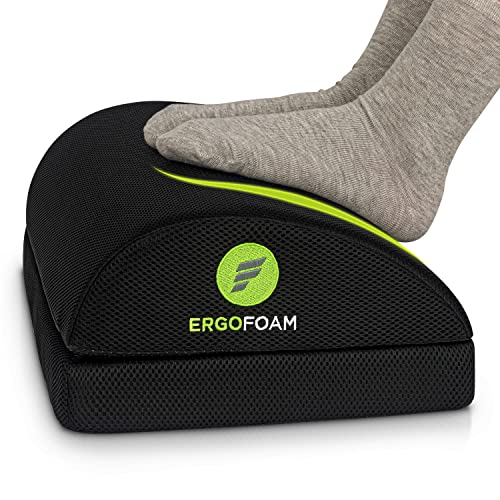
If You Buy One: ErgoFoam Adjustable Foot Rest
The default route: a firm foam cushion with a second attachable height piece, so it serves both the gentle-support and the genuine-lift cases, with a washable cover and a grippy base. In worth-it terms it is the purchase with the widest margin for error — the design most likely to still be earning its floor space after your chair, desk, or household changes around it. Mid-tier, silent, and the one we would hand to a friend who had decided yes and wanted the deciding to be over.

If You Buy for a Shared Desk: Mind Reader Adjustable Foot Rest
The pragmatic route: an entry-tier platform with several height settings and a tilting board, bought when the desk serves two people or when shoes and settings matter more than surface softness. Its worth-it case is arithmetic — one adjustable product serving two different bodies beats two fixed products or one daily compromise — and its basic mechanism is an acceptable price for that arithmetic.
How to Get the Most Value If You Buy
Deciding yes is only half the verdict; the other half is extracting the value you paid for. Measure before you order — chair set for the desk, gap observed honestly, book stack if in doubt — because value in this category is fit, and fit is decided before the box arrives. Choose adjustability when anything in your situation varies: two heights, real settings, a flip to rock. Variation is the tax collector of fixed products. Set it up like you mean it: chair first, footrest where your feet land, one change at a time across the first week, and the alternative configuration trialled even if the first one feels fine. Use the return window as part of the purchase. A decisive return inside the window is value protected, not value lost. Keep it clean and keep it placed — wash the cover, vacuum the texture, park the chair off it — because the slow decline of an unkempt footrest is the most common way a good purchase quietly stops being one. And revisit the arrangement whenever the workstation changes. New chair, new desk, new room: re-run the two-minute ritual, and the footrest’s value survives the move instead of expiring in it. Follow those six habits and the question this article’s title asks tends to answer itself, in the affirmative, somewhere around the third week — the week the footrest disappears from your attention entirely, which is the surest sign it is working. For the product-by-product view of what your money buys at each tier, our desk footrest reviews compares the leading designs head to head.
One value habit deserves separation from the list because owners mention it so consistently: defend the footrest’s spot. Under-desk space attracts refugees — the bag that lands there on Friday, the box that is “temporarily” stored, the shoes that migrate. Each incursion displaces the footrest a little, and displaced footrests deliver displaced value: a centimetre off is a habit weakened, a habit weakened is an afternoon less settled, and the product gets blamed for a geography problem. The owners who still love theirs at year two are, disproportionately, the ones who treated its square of floor as assigned rather than available. Small product, small territory, real consequences — guard the square.
The Value Equation: What a Settled Afternoon Is Worth
Since this article avoids prices, it owes you another way to think about value, and the honest unit is not money at all — it is afternoons. A footrest that fits is used every working day, for most of the hours in that day, for years. Almost nothing else in a home office has that contact profile except the chair itself and the floor. Against that denominator, even a premium-tier purchase divides down to a trivial cost per settled afternoon, and an entry-tier one divides down to nearly nothing. This is the arithmetic behind the category’s loyal following: the per-use cost of a well-matched footrest is among the lowest of any object you own, because the uses number in the thousands.
But the same arithmetic runs in reverse, and a verdict article must show both directions. A mismatched footrest is not used for thousands of afternoons; it is used for eleven, and then it occupies floor space as a monument. Its cost per settled afternoon is therefore enormous — not because it was expensive, but because the denominator collapsed. This is why every section of this article keeps returning to fit, measurement, and the trial week: in a category where value is total benefit divided by days actually used, the entire game is keeping the denominator high. It also explains the otherwise puzzling pattern in owner satisfaction, where cheap cushions are loved and premium platforms are regretted — the loved ones matched, the regretted ones did not, and the tiers had almost nothing to do with it. Buy the match, and the value equation solves itself at any tier. Buy the mismatch, and no tier can save you.
One more term belongs in the equation: the option value of adjustability. A fixed footrest’s value is hostage to your current desk, chair, and body. An adjustable one’s value survives changes in all three, which is why, across a working life of moves and upgrades, the adjustable designs keep re-earning their purchase while fixed ones must be re-bought or abandoned at each change. When the checklist below leaves you genuinely torn between a fixed design you love and an adjustable one you merely like, this term is the tiebreaker we would use.
Six Months In: The Patterns Owners Report
Verdicts written at purchase time are guesses; verdicts at six months are data. Across the owners we have spoken to and the long-term reports that accumulate around these products, the six-month picture sorts into three consistent patterns, and recognising yours in advance is the closest thing to a crystal ball this category offers.
The invisible success. The largest group barely thinks about their footrest at all by month six, and considers that the highest possible praise. The perching and tucking habits are gone and unmissed; the product is vacuumed around, occasionally washed, and otherwise ignored. When these owners change desks, the footrest is packed with the chair, not with the clutter — it has been promoted, in their minds, from accessory to furniture. If your checklist answers point to a genuine gap or genuine restlessness, this is the future you are buying, and it is worth the modest money and the measured week it costs to get there.
The quiet abandonment. The second group’s footrest is, by month six, against the wall, under a shelf, or listed for sale. Interviewed honestly, these owners almost never blame build quality. They blame the gap that was not what they guessed, the rocker bought for a still temperament, the plush cushion bought for a lift problem, the platform that crowded a small desk. Abandonment is a matching failure with a six-month fuse, which is why this article spends so much of its length before the purchase and so little on the products themselves. The products are fine. The guesses were not.
The pleasant surprise. The smallest and happiest group bought a footrest for one reason and kept it for another: the cushion bought for lift that turned out to be loved for its flip-over roll during calls; the rocker bought for fidgeting that turned out to matter most in the evening reading chair; the shared-desk platform whose settings ended a small daily negotiation nobody had counted as a cost. These surprises share a shape — they come from designs with more than one register, bought by people whose needs had more than one layer. If your situation is similarly layered, let that nudge you toward the adaptable end of the category, where the pleasant surprises live.
The Trial That Settles It: One Week, Two Experiments
If this entire article still leaves you undecided, stop reading verdicts and run the experiment — it is cheaper than certainty and more reliable. Experiment one, this week: build the book stack. Measure the height at which your feet feel fully supported with your chair set properly, work three full days on it, and keep a one-line note each evening: did you notice your feet, and in what way? Experiment two, next week: remove the stack and work three days on the bare floor. The comparison between the two sets of notes is your personal verdict, written in your own afternoons, and it outranks every generalisation on this page — including ours. People who run both experiments almost never buy wrong, because they are no longer buying a category; they are buying a measured improvement they have already felt and then felt the absence of. And if experiment two feels exactly like experiment one, you have your answer too, and it cost you nothing but honesty. That is the deepest sense in which a desk footrest is “worth it”: it is one of the very few purchases whose value you can fully test before spending anything at all.
Objections, Answered Honestly
Every verdict attracts the same handful of objections, and they deserve direct answers rather than dismissal — two of them are half right.
“It is just a cushion. The markups in this category are absurd.” Half right. The materials in any footrest are humble, and entry-tier designs prove the basic job can be done simply. What the higher tiers buy is not mystery technology but density that lasts, mechanisms that stay quiet, motion that stays smooth, and construction that survives years — differences invisible in a photograph and obvious in month fourteen. Judge tiers by ageing, not by ingredient lists, and the pricing structure of the category makes sense: you are paying for the fifth year, not the first week.
“I can use a box for free.” Entirely right, as far as it goes — this article recommends the box as everyone’s first step. The box’s limits are a fixed, lumpy height, a surface that slides, and no angle worth the name. If a week on the box leaves you fully content, the verdict for you is genuinely “not worth it,” and you have saved the money with our blessing. If the week leaves you wanting the box to be better in specific ways, those specific ways are the product description of the footrest you should buy.
“Ergonomic accessories are a fad; people worked without them for decades.” People also worked at desks designed for paper, in chairs designed for shorter days, for decades — and complained about their backs, legs, and afternoons throughout, in letters and memoirs and sick notes. The modern home office asks more seated hours of less suitable furniture than the offices of the past did. A footrest is not a wellness ritual; it is a small piece of furniture answering a measurable gap. Where the gap exists, it earns its place. Where it does not, this article has told you to skip it, which is not how fads talk.
“My feet will just end up on it wrong anyway.” The most human objection, and the easiest to test: there is barely a “wrong” available. Feet on a footrest can rest flat, angled, crossed at the ankle, one up and one down — the product’s job is to be a good surface wherever they land, and the better designs are shaped to forgive exactly this variety. If your worry is really that you will not use it at all, that is the temperament question from the checklist, and the book-stack week answers it for free.
The Verdict by Desk Type
| Your desk situation | Verdict | Why, in one line |
|---|---|---|
| Tall desk or counter, chair rides high, feet dangle | Worth it — strongly | The gap is real, daily, and exactly what the product exists to close |
| Standard desk, long seated hours, feet mostly fine | Worth it — probably | Small comforts compound across your hours; trial with a book stack first |
| Standard desk, restless feet | Worth it — as a rocker | Motion is your version of the benefit; static designs would miss it |
| Shared desk, two different bodies | Worth it — as an adjustable | Settings turn a daily compromise into a ten-second routine |
| Compact desk, crowded floor | Borderline | Only a compact cushion, and only after measuring the free space honestly |
| Feet flat, sitter content, setup sound | Not worth it | There is no problem here for a product to solve |
| Chair or desk fundamentally wrong; or shopping for pain relief | Not worth it — yet | Fix the foundation, or see a professional, before accessories |
Find your row and you have this article’s answer in its most compressed form. Everything else on this page exists to help you be sure you have found the right row — because, as the six-month patterns show, the difference between the delighted majority and the quiet abandoners was never the product they chose. It was the honesty of the row they chose it from.
The Decision Checklist
Answer honestly; the pattern decides.
- With my chair set for my desk, do my feet dangle, perch, or tuck instead of resting flat? Yes = a point for buying.
- Do I sit at this desk in long, unbroken stretches most days? Yes = a point for buying.
- Do I fidget, tap, or re-cross my legs through the day? Yes = a point for buying — and for a rocker.
- Is there genuinely free floor space under my desk for one more object? No = a strong point against.
- Is my chair basically right for me, so the footrest is a finishing adjustment rather than a rescue? No = fix the chair first.
- Am I hoping this will treat pain or a medical issue? Yes = stop; see a professional instead.
- Would I run a week with a book stack first to confirm the idea? Yes = do that; its verdict outranks this page.
The rule: two or more buying points, no strong points against, and a book-stack week that you miss when it ends — buy, and buy adjustable. Any strong point against — fix that first and re-run the list. Zero buying points — skip it with a clear conscience; your setup already fits you, and that is the outcome every workstation purchase is ultimately for. Readers still torn can weigh the single most recommended design in depth in our desk footrest review.
Final word. A desk footrest is worth it the way a good doormat is worth it: not as an event, but as a thousand small, unremarked improvements that add up to a home that fits the people in it. If your feet have a problem — a gap, a hardness, a restlessness — this small product solves it completely, cheaply in effort if not always in tier, and goes on solving it every day you work. If your feet have no problem, no article should talk you into buying a solution. That is the whole verdict, and it fits in the space under your desk: solve real gaps, skip imaginary ones, and let your own measured week have the final say. Your feet carry every working day you have; giving them a proper place to rest, when they need one, is among the smallest and most durable kindnesses a home office can offer.
The Usage Audit: Does a Desk footrest Earn Its Place in Your Routine?
Worth-it questions are really usage questions. A desk footrest earns its place through the hours it is used, the annoyances it removes and the problems it quietly prevents, so the honest way to answer is an audit of your own routine rather than a verdict in the abstract. Run the audit below against your last month, not your best intentions, and the answer usually becomes obvious.
Judge a desk footrest by your body and your desk together: the height range it offers, whether its surface stays put or rocks, and whether your feet rest on it with knees and hips in a comfortable, natural position. Material and grip matter too, because a footrest that slides away or feels unpleasant underfoot will end up pushed aside. Measure the space under your desk, the height of your chair at its working setting and the clearance for your legs, then check the footrest’s footprint against the floor space your chair’s base already claims. Decide whether you want a still platform, a rocking surface or an adjustable design before comparing models.
For long desk sessions, a footrest that lets you shift foot position through the day keeps the setup feeling fresh rather than fixed. For a shorter seated height where feet do not rest flat on the floor, a footrest closes the gap so the chair can stay at the right height for the desk. In a shared or hot-desking setup, a light footrest that moves easily between desks and wipes clean earns its place over a heavier fixed design. Be strict about the difference between use you can point to and use you merely intend. A desk footrest bought for a routine you do not have will not create the routine; it will join the cupboard of good intentions.
Apply all of this to the listings in front of you. When a listing such as the ErgoFoam Adjustable Foot Rest and Mind Reader Adjustable Foot Rest catches your eye, resist judging it by its headline claim and instead run the checks above against it: does its stated role match the room you measured, does its control path suit your household, and does the maker’s own guidance support the job you have in mind. A model that answers those questions cleanly on paper usually answers them cleanly in the home, and one that dodges them in the listing will dodge them on your wall, shelf or desk as well.
A footrest that is too high pushes knees up and changes your whole seated posture for the worse; more height is not automatically better. On hard floors, a light footrest can travel during the day until it is out of reach, which quietly ends its usefulness. If the footrest keeps sliding, add grip beneath it or place it against the desk’s modesty panel or a wall so it has a stop. If your feet ache on a textured surface, try it with different footwear or socks before rejecting the design; surface feel changes completely with what you wear.
- Count the days in the last month this product would genuinely have been used for your desk footrest.
- Name the annoyance it removes and how often that annoyance occurs for your desk footrest.
- Check whether something you own already covers the same job for your desk footrest.
- Decide the chore you accept in exchange and who will do it.
- Set a review date a month after purchase to judge it on evidence for your desk footrest.
- Be honest about the difference between your routine and your intentions for your desk footrest.
If a rocking model feels unstable, start with it locked or on its lowest setting and build up as the movement becomes familiar. Wipe or vacuum the surface weekly since footrests collect dust and grit, check adjustable joints and locking knobs for tightness, keep rocking mechanisms free of debris, and air out foam designs so they stay fresh.
If the audit shows steady use and removed annoyances, the desk footrest has already answered the worth-it question in the only currency that counts. If it shows good intentions and an empty routine, the honest answer is to wait until the routine exists.
It also helps to think in seasons rather than in days. A desk footrest that seems ideal in the week it arrives may face different light, different temperatures, different routines and different demands a few months later, and the models that age well are the ones chosen with that longer view in mind.
Keep the household in the loop as you decide. The person who did not choose the desk footrest is usually the person who discovers its most annoying habit first, and a two-minute conversation before buying can surface the objection that saves a return.
Documentation is an underrated feature of ownership. Keep the manual, the receipt and a note of your settings together, because the day something needs adjusting is never the day you want to reconstruct how it was set up.
When two models seem equal, prefer the one whose maker publishes clearer guidance, steadier updates and easier access to spares or support. That difference is invisible in a feature table and decisive in the third year of ownership.
Finally, resist upgrading the whole room around a single purchase. Live with the desk footrest as it is for a few weeks, learn what it actually changed, and only then decide what else, if anything, the room still needs.
Frequently Asked Questions
Is a desk footrest worth it for short people?
Often, yes — this is one of the groups the category serves best. Standard desk and chair heights are built around average proportions, so shorter legs are the most likely to be left dangling when the chair is set correctly for the desk. If that is your daily experience, a footrest with genuine height — a two-piece cushion or an adjustable platform — closes a gap you did not create and should not have to compensate for. Measure the gap first, because the right amount of lift is the whole purchase.
Is a desk footrest worth it if I already have a good chair?
It can be, because the chair and the footrest solve different halves of the same geometry. A good chair set for your desk can still leave your feet at the wrong distance from the floor — the chair was set for your arms and back, and your feet inherited the result. If your feet rest flat and relaxed, the chair has quietly solved the footrest’s job too, and you can skip it. If they dangle or perch despite the good chair, the footrest is the missing piece, not a duplicate.
Is a rocking footrest worth the extra over a static one?
Only if you are a mover. For restless sitters, the gentle motion is the main value in the entire purchase, and a quality rocker’s smoothness is worth prioritising over other features. For still sitters, the premium buys a capability you will not use and may actively dislike, and a static cushion or platform serves you better for less commitment. If you do not know your temperament yet, a flip-over design that offers a mild roll lets you find out before spending on a dedicated rocker.
Can a desk footrest replace an ergonomic chair?
No, and the order of operations matters. The chair supports your back, arms, and working height; the footrest supports your feet within the arrangement the chair and desk create. If your chair does not fit you, a footrest will not rescue the setup — it will simply be a comfortable surface inside an uncomfortable workstation. Buy in the right order: desk and chair first, footrest as the finishing adjustment. The good news is that, bought in that order, the footrest is usually the smallest and most satisfying purchase of the three.
How long before I know if it was worth it?
About a week of real use. Day one is novelty and proves nothing; by day five, the long afternoon has given its verdict on height, surface, and whether your feet have adopted the rest as home. The cleanest test arrives if you then work a day without it: if your feet hunt for the missing surface and the day feels less settled, the purchase has proven itself. If the day feels identical, it has not — and that is exactly why the trial belongs inside the return window.
Is a desk footrest worth it for gaming?
Frequently, yes, for the same reasons as for work — gaming chairs and desks reproduce the same geometry, sessions run long, and feet brace and shift during play in ways a stable, grippy surface handles well. Firm cushions and platforms suit bracing better than plush ones, and a rocker gives restless feet somewhere to go during cutscenes and queues. The worth-it logic is unchanged: if your feet are unsupported or restless at your gaming desk, the product earns its place there just as it does at a work desk.
Related reading: the best footrest options for a home office · desk footrest buying guide · standing desks for a home office