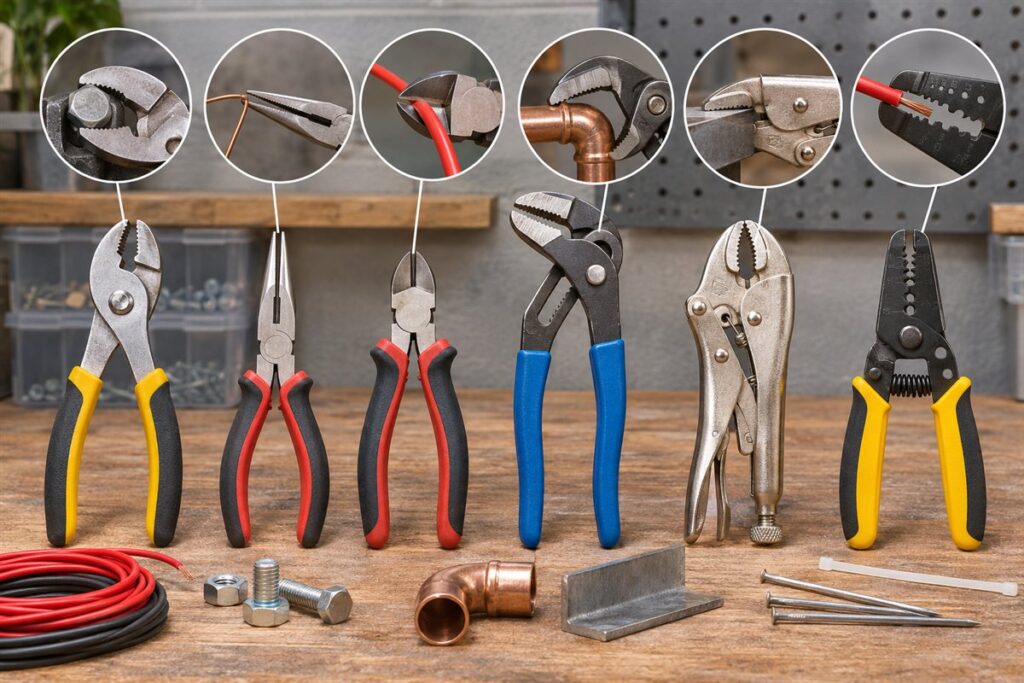
Pliers grip, bend, twist and cut, but no single pair does all of those jobs well. Slip-joint pliers are the general-purpose option, needle-nose pliers reach into tight spots, and locking pliers clamp like a small vice. Here is what each type is for.
Gripping Pliers
Slip-joint pliers have an adjustable pivot with two positions, so they open wide for larger objects. They suit light household tasks. Tongue-and-groove pliers (often called water pump pliers) have a row of notches that let the jaws open much wider and stay parallel, which helps with round objects.
Locking pliers clamp onto a part and stay shut until you release them. People use them to hold work, grip a damaged fastener or act as a temporary clamp. They should not be used as a substitute for the correct wrench on a good fastener, because they can mark the surface.
Precision and Cutting Pliers
- Needle-nose (long-nose) pliers: slim jaws for tight spaces, small parts and bending wire.
- Diagonal cutters: angled cutting edges for snipping wire close to a surface.
- Lineman or combination pliers: flat jaws, a gripping section and a cutter in one tool.
- Wire strippers: sized holes that remove insulation without cutting the wire.
- End-cutting (nipper) pliers: cut flush, often used to remove nails and tacks.
Which Plier for Which Job
| Task | Suitable type |
|---|---|
| Holding a small part in a tight spot | Needle-nose |
| Cutting thin wire | Diagonal cutters |
| Gripping a round pipe fitting | Tongue-and-groove |
| Holding work while you file it | Locking pliers |
| General household gripping | Slip-joint |
Electrical Work Warning
Pliers with insulated handles are not a licence to work on live wiring. Mains electrical work belongs to a qualified electrician, and local codes govern what a householder may do. If you are ever unsure, switch off at the supply, confirm with a proper tester, and call a professional. Handle coverings can be damaged, so inspect them and follow the maker’s guidance.
Using Pliers Well
- Choose the plier whose jaw shape fits the object.
- Keep the object deep in the jaws rather than at the tip.
- Do not extend the handles with pipe to gain leverage.
- Cut only the material the pliers are made for; hardened wire can chip the edges.
- Wipe them dry and add a drop of oil to the pivot now and then.
Building a Starter Set of Pliers
You do not need every kind of plier to handle most household work. A sensible starting set covers gripping, reaching and cutting. A pair of slip-joint pliers or combination pliers takes care of general gripping, needle-nose pliers reach small and tight spaces, and diagonal cutters snip wire and small fasteners cleanly. Adding locking pliers gives you a hand-free clamp for holding parts.
Think about what you actually do. Someone who does light plumbing or garden jobs may value tongue-and-groove pliers, while a person who crafts or repairs small electronics will use fine needle-nose and flush cutters more. Buy for your real tasks, and expand the set as needs appear.
It is better to have a few well-made pliers than a large set of poor ones. Look at how the jaws meet, how the pivot feels and whether the handles are comfortable. A kit can be good value if it contains tools you will use, but check each item before assuming the kit is worth it.
- General gripping: slip-joint or combination pliers.
- Tight spaces: needle-nose pliers.
- Cutting: diagonal cutters.
- Holding and clamping: locking pliers.
Judging Build Quality Before You Buy
The quality of pliers shows in details. Close the jaws and check that they meet evenly, without a gap or sideways wobble. For needle-nose and cutters, the tips and edges should line up precisely, since misalignment makes the tool hard to use. The pivot should move smoothly, without grinding or looseness.
Check the material and finish. Many pliers are made from forged steel, which the maker may describe in the listing. Handles may be plastic, dipped coatings or rubber-like grips. Look at how well the grips are attached and whether they feel comfortable. A good grip reduces hand fatigue on long jobs.
Consider the teeth and cutting edges. Gripping jaws should have teeth that bite without crushing too much. Cutting edges should be sharp and hardened, but check what materials they are meant to cut. Cutting hard wire with pliers not made for it can nick the edges, so read the description or manual.
Spring-loaded handles, wire-cutting notches and adjustable pivots are optional features that may help your work. Look at warranty terms and reputation for service, and remember that a higher price does not always guarantee better performance for your needs.
Locking Pliers and Specialty Types
Locking pliers deserve a closer look, since they come in several shapes. Standard curved-jaw types grip round and irregular objects, long-nose versions reach into tight spaces, and C-clamp styles hold flat work like a small clamp. They have an adjustment screw that sets the opening, and a release lever frees the jaws. Practice setting them so that they lock firmly with a firm squeeze.
Other specialty pliers address particular jobs. Snap-ring pliers fit retaining rings, hose clamp pliers handle spring clamps, and crimping tools squeeze connectors. Fencing pliers and bolt-cutter style tools are for outdoor and heavy work. If a job needs a specialty tool, using a general plier risks damaging the part or the tool.
Needle-nose pliers come in bent-nose forms for working around obstacles, and in flat-nose or round-nose forms for jewelry and craft wire. Check the shape suits your task before buying.
Specialty tools vary in size and fit, so check compatibility with the parts you work on. When in doubt, refer to the repair manual for the item, which may name the tool required.
Handle Comfort and Safe Technique
How you hold and use pliers matters. Grip near the end of the handles for leverage, and use smooth pressure rather than jerking. Keep wrists straight where possible, and avoid forcing pliers beyond their capacity. If a job requires heavy force, a longer tool or a different type, such as a wrench or a bolt cutter, is a better choice.
Pay attention to size. Large pliers on small work are clumsy, while small pliers on heavy work can bend or slip. Match the tool to the task, and use both hands to steady the work where it helps. Wear eye protection when cutting wire or small parts, since pieces can fly off.
Do not use pliers as a hammer or pry bar. This can damage the jaws and the pivot and may lead to injuries. If a fastener resists, apply the correct tool, and consider penetrating oil or heat only when the manual allows and when it is safe.
- Cut at a right angle to the wire for a clean snip.
- Do not cut hardened wire or screws with ordinary cutters.
- Do not extend the handles with pipes unless the maker permits it.
- Keep fingers out of the pivot and between handles.
Keeping Pliers in Working Order
Pliers last a long time with modest care. Wipe off dirt and moisture after use, and apply a drop of light oil to the pivot now and then if it stiffens. Keep them dry to avoid rust, and store them where jaws and cutting edges will not be knocked against other tools.
Clean the teeth with a brush if they are clogged with debris, which reduces grip. Check that screws and rivets at the pivot are secure, and do not loosen them unless the maker describes how. Do not grind or file the jaws unless you know the right method for the tool, since the shape and hardness matter.
Signs that it is time to replace include jaws that no longer meet, cutting edges that are chipped or crushed, a pivot with too much play, or handles that are cracked or loose. For insulated pliers, damaged insulation is a safety problem, and the tool should not be relied on for electrical protection if the coating is cut or cracked.
Sharpening is possible for some cutters, but results depend on skill and the tool. Often replacement is simpler and safer. Dispose of old tools through metal recycling where available.
FAQ
Can I use pliers instead of a wrench?
For rough or damaged fasteners in a pinch, yes, but pliers round off edges and leave marks. A correctly sized wrench or socket is the better choice for good fasteners.
What is the most useful first pair?
Many beginners find a pair of combination or slip-joint pliers plus needle-nose pliers covers most small household tasks.
What is the difference between combination pliers and slip-joint pliers?
Slip-joint pliers have an adjustable pivot for two opening sizes, while combination pliers add a cutting section and flat jaws. Names vary by region, so check the product description.
Can I cut screws or nails with diagonal cutters?
Only if the maker says the tool can cut that material. Cutting hardened wire, screws or nails with ordinary cutters can damage the edges.
Are insulated pliers safe for live wires?
Do not rely on them to make live work safe. Insulation can be damaged, and mains work should be left to a qualified electrician.
What size pliers should I buy?
Choose a size that matches your tasks and your hand. Larger pliers give leverage, while smaller ones offer precision in tight places.
How do I release locking pliers?
Use the release lever on the handle, and use the adjustment screw to set the jaw opening. If it will not release, check the manual rather than forcing it.
Why do my pliers slip on a nut?
Pliers grip on points rather than flats, so they can slip and round off the nut. A wrench or socket of the right size is better for fasteners.
How should I store pliers?
Keep them clean and dry, in a toolbox, rack or roll where the jaws are protected. A light film of oil on bare metal can help against rust.
The Short Version
Choose slip-joint or combination pliers for general work, needle-nose for tight spaces, cutters for wire and locking pliers for holding. Treat electrical work with care, and follow the maker’s instructions and local rules.