Disclosure: As an Amazon Associate, umtsmarttool.com earns from qualifying purchases. Links to Amazon on this page are affiliate links; they cost you nothing extra. Prices and availability change often, so check the current Amazon listing before you buy.
Where to buy
This review centres on the Intex 28003E Deluxe Pool Maintenance Kit, with the closest alternatives — Intex 28002E Cleaning Maintenance Kit, Bestway 58237 AquaClean Deluxe Pool Maintenance Kit, Sepetrel Deluxe Pool Cleaning Kit with 10.5 ft Pole — compared throughout. Every linked product says check price on Amazon; printed prices in this category go stale between seasons.
Read the full guide ↓
A pool cleaning kit review has one job a product listing cannot do: tell you whether the kit’s promises survive contact with a real pool, a real pump and a real owner’s patience. This review takes the category’s reference kit — the Intex 28003E Deluxe Pool Maintenance Kit — and examines it the way ownership actually unfolds: what is in the box, how it cleans surface, walls and floor, what it demands from your filter pump, and where the alternatives beat it. The ranked lists this review sits behind are at Best Pool Cleaning Kit Under $75 and Best Pool Cleaning Kit Under $100; this page is the deep dive beneath them.
The short answer, for readers who stop here: the 28003E is the manual kit to buy for an above-ground pool of 18 feet or more whose filter pump flows at 800 GPH or better — and it is the wrong kit, however good, for everyone else. The sections below earn that sentence, including the limitations. Readers comparing several kits at once should also see Pool Cleaning Kit Reviews, and anyone still deciding whether a kit is the right purchase at all should start with Pool Cleaning Kit Buying Guide.
Quick Verdict: Pool Cleaning Kit Review
Best for: owners of above-ground pools 18 ft and larger with a filter pump of 800 GPH or more, who want surface, wall and floor tools in one box / Not suited for: owners of small pools, weak pumps, or anyone expecting automation
That verdict is deliberately conditional, because this kit’s quality is conditional — on flow. Given its flow, it is the most complete manual cleaning system in its class at any sensible budget. Starved of flow, it is a good net and brush set carrying a vacuum you cannot use. Everything in this review flows from that single fact, and the comparison sections exist to route the second group of owners to the kits that will actually serve them.
In this guide
Intex 28003E Deluxe Pool Maintenance Kit: The Specs That Matter
- Telescoping aluminium pole extends to 110 inches
- 24-foot vacuum hose with connectors included
- Vacuum runs off a filter pump of 800 GPH or more
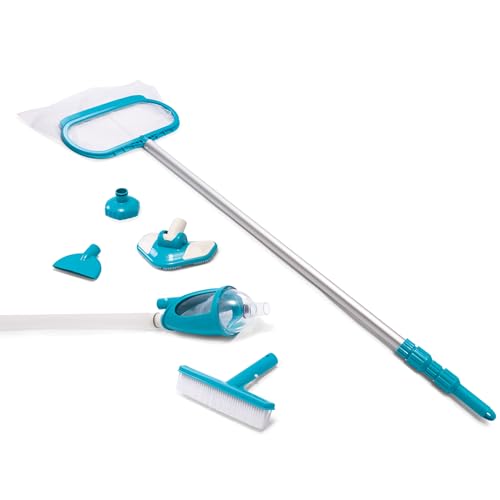
- Includes leaf rake, curved wall brush, vacuum head with two nozzles and a scrubber vacuum
- Built for above-ground pools of 18 feet and larger
Read the spec list as a system rather than as parts. The 110-inch pole and 24-foot hose are sized as a pair for pools of 18 feet and up: the hose reaches across the pool from the pump, and the pole reaches the far wall from the deck. The 800 GPH minimum is the load-bearing number — find your pump’s rating on its housing before anything else in this review matters. The two vacuum nozzles and the separate scrubber vacuum tell you Intex expects this kit to handle both weekly maintenance and the heavier spring-opening clean, which is a fair description of how owners actually use it.
Ownership is where this kit quietly wins. Because every head clips to standard poles and the hose uses common cuff sizes, a torn net or a worn brush is a small replacement purchase rather than a new kit, and Intex parts circulate widely enough that nothing needs hunting. The routine it enables is also the most forgiving of the pump-powered options: once the hose-priming habit is learned, a full clean of a big pool settles into a predictable half hour, and the kit’s completeness means that routine never waits on a missing tool. Owners stepping up from a starter kit will feel the difference most in the shoulders — the long pole and real suction replace the leaning, reaching and re-passing that make small kits tiring on big water.
Strengths
- The most complete manual kit in this cluster: surface, wall and floor tools in one box
- Pump-powered vacuum lifts settled debris instead of just stirring it up
- Long pole and hose reach across big frame pools without walking the perimeter
Trade-offs
- Useless for vacuuming if your filter pump flows under 800 GPH
- No water-test gear or chemical dispenser in the box
- Hose priming and pump connections add setup minutes to every session
Design and Build Quality
The 28003E is built the way Intex builds its pools: honest plastics, aluminium where flex would hurt, and fittings sized for the brand’s own ecosystem. The pole is the part you feel most — a telescoping aluminium shaft that runs out to 110 inches and locks positively enough that the vacuum head tracks where you point it instead of wandering on a flexing stick. The vacuum head itself is a wide, weighted body with two nozzle options: a broad nozzle for open floor and a scrubber-style nozzle that agitates as it goes, which is the one you will reach for after a storm or at season opening.
The leaf rake’s net is deep enough to hold a real load, the curved wall brush follows the cove where wall meets floor on a frame pool — the exact line where algae film starts — and the 24-foot hose is long enough to work an 18-foot pool from the pump side without dragging the filter around the deck. None of the components is commercial grade, and none pretends to be: clips, cuffs and nets are all replaceable, and the kit’s longevity in the real world comes from that replaceability rather than from overbuilding.
Performance in Real Use
With a pump at or above the 800 GPH threshold, the vacuum is the strongest manual floor cleaner in this cluster. It holds the floor steadily, pulls grit and leaf fragments without the constant re-passes a venturi head needs, and the debris largely bypasses the filter cartridge because the head and hose arrangement keeps the worst of it moving slowly enough to settle in the pump basket. On the surface, the rake clears a leaf-strewn pool in a handful of passes, and the brush keeps the waterline and cove honest on the weekly rhythm described later in this review.
Below the flow threshold, the story changes completely, and this review will not soften it: the same kit becomes a mediocre vacuum with excellent accessories. Suction fades, the head lifts, and fine debris resettles. That is not a defect in the kit; it is the physics the specification warns about. It is also why the alternatives matter — the Bestway kit works down to 530 gal/h, and the hose-powered Intex 28002E ignores pump flow entirely.
Setup and First-Use Experience
First setup is a fifteen-minute job that becomes a three-minute one: rake or brush clips to the pole, the vacuum head takes the hose, the hose takes the pump connection, and the only real skill is priming — feeding the hose underwater hand over hand so it fills completely before connecting. An air-filled hose is the beginner mistake with this kit; it announces itself as instant suction loss and is fixed by repriming, not by force.
The instruction sheet assumes an Intex pool and an Intex pump, and inside that ecosystem everything seats by hand. Owners connecting to other brands should expect the pole fittings to cooperate and the pump fittings to need an adapter, which is a small purchase but an annoying one to discover on a Saturday morning. Buy the adapter with the kit if your pump is not Intex.
Maintenance and Ownership
Ownership costs with this kit are time and soft parts. Rinse everything after use, dry the net in shade, and the hard parts last for years; the net and the brush are the wear items, and both can be replaced individually — the heads also fit standard poles, so a torn net never orphans the pole. The hose wants loose coiling rather than tight kinks, and storing it out of the sun keeps the cuffs supple.
The hidden ownership point is the pump itself. A vacuum that leans on filter flow makes the filter’s health your problem: a clogged cartridge drops flow, flow drops suction, and the owner blames the kit. Clean or swap the cartridge on schedule and the kit performs as reviewed; neglect it and no vacuum in this category will save you.
How It Compares with the Alternatives
Three alternatives cover the owners this kit does not fit, and the honest comparison is about fit rather than quality.
| Kit | Key spec | Standout detail |
|---|---|---|
| Intex 28003E Deluxe Pool Maintenance Kit | Telescoping aluminium pole extends to 110 inches | Vacuum runs off a filter pump of 800 GPH or more |
| Intex 28002E Cleaning Maintenance Kit | 94-inch telescoping aluminium pole | Surface skimmer net included |
| Bestway 58237 AquaClean Deluxe Pool Maintenance Kit | Vacuum, skimmer net, telescopic pole and hose in one kit | Sized for above-ground pools up to 20 feet in diameter |
| Sepetrel Deluxe Pool Cleaning Kit with 10.5 ft Pole | Adjustable pole extends to 10.5 feet | 17.5-inch pool brush head |
The Intex 28002E is the same brand’s answer for smaller pools and weaker pumps: its vacuum runs off a garden hose, so flow rate stops mattering, at the cost of gentler suction and no wall brush. The Bestway 58237 AquaClean Deluxe mirrors the deluxe formula for Bestway and Coleman pools and works down to 530 gal/h, which rescues many owners whose bundled pumps fall between the two thresholds — but it leaves the brush out of the box. The Sepetrel Deluxe Kit with 10.5 ft Pole abandons vacuuming entirely and spends its budget on reach and brushing; for covered pools whose floors stay clean, that trade is rational. The full multi-kit rankings live in Best Pool Cleaning Kit For Families Under $75 and Best Pool Cleaning Kit For Home Use Under $75.
Intex 28002E Cleaning Maintenance Kit in brief
The Intex 28002E is the starter kit Intex has sold alongside its Easy Set and frame pools for years, and its design makes one smart trade: instead of borrowing suction from a filter pump, the vacuum head runs off garden-hose water pressure. A venturi jet inside the head creates the pull, and debris collects in a reusable mesh bag clipped behind it. That means the kit works even with the tiny pumps bundled with small pools — or with no pump running at all — which is exactly the situation most first-time pool owners are in.
In ownership terms, this is the lowest-friction kit in the cluster. There is no pump compatibility to manage, no hose to prime beyond the garden hose itself, and nothing electrical anywhere near the water. The debris bag is the only consumable-adjacent part and it is reusable; when the net eventually tears, the head fitting is standard, so the pole’s working life continues with any replacement head. Its ceiling is set by physics rather than quality — gentle suction, small bag, no brush — and owners who respect that ceiling, cleaning weekly on a small pool, routinely get years of service from a kit that costs less than a single professional visit.
Bestway 58237 AquaClean Deluxe Pool Maintenance Kit in brief
Bestway’s 58237 AquaClean Deluxe is the natural counterpart to the Intex deluxe kit for the huge number of households running Bestway or Coleman pools. The formula is similar — a pump-driven vacuum, a skimmer net, a telescopic aluminium pole and a hose — but Bestway tunes it for the smaller pumps its pools ship with: the vacuum works with filter pumps flowing 530 gallons per hour or more, the lowest threshold among the full kits researched for this cluster. If your pump is the modest cartridge unit that came in the pool box, this kit is far more likely to actually pull than rivals that demand 800 GPH.
For Bestway and Coleman owners there is a further, practical ownership point: staying inside the brand’s ecosystem keeps every connection hand-tight and every replacement part one search away. The kit also plays well with the way Bestway pools are actually used — put up in late spring, worked hard all summer, packed away in autumn — because nothing in the box needs winterising beyond a rinse and a dry shelf. Its one structural gap, the missing brush, is best closed at purchase time with any standard 17.5-inch head on the same pole, after which the weekly routine is complete and the kit asks nothing more of its owner.
Sepetrel Deluxe Pool Cleaning Kit with 10.5 ft Pole in brief
This Sepetrel deluxe kit takes the opposite bet from its spa-jet sibling: no vacuum at all, and instead the money goes into reach and brushing. The adjustable pole runs out to ten and a half feet, the leaf skimmer uses an aluminium-framed professional-style net, and the brush head is a full 17.5 inches wide — the size pool pros use to make wall work fast. A separate hand scrub brush handles the waterline, steps and ladder rails where a pole brush cannot apply pressure. For owners whose pools stay fairly clear but grow surface leaves and wall film, that is arguably the right allocation of budget.
Owners who choose this kit tend to discover its second talent within a month: the hand scrub brush becomes the most-used tool they own. Waterline rings, ladder rails, step corners and the scum line inside a skimmer mouth all yield to it in seconds, and none of them is reachable with any pole-mounted tool. The pole itself, rinsed after use so grit stays out of the section locks, holds its adjustment well, and because the heads are standard-fitting, the kit also refreshes any older pole gathering dust in the shed. It is a maintenance kit in the truest sense — it keeps a clean pool clean, beautifully, and asks a vacuum-owning partner to handle the rest.
A Week-by-Week Season with This Kit
Week one is assembly and calibration: heads clipped, hose primed, and the discovery of how your particular pump behaves under vacuum load. Most owners find the first session slow and the second unrecognisable — the sequence of skim, brush, vacuum becomes a walk rather than a project. By week three the routine has a rhythm and a duration, usually inside half an hour for a big pool, and the water settles into the state this kit exists to maintain: clear, with the floor visible and the walls free of film.
The season’s tests arrive on schedule. After the first storm, the rake earns its depth and the vacuum takes two passes instead of one; during the hottest fortnight, brushing frequency matters more than vacuuming, because algae pressure peaks while debris does not; at the first cold snap, the kit’s job shrinks to keeping the pool clean enough to close. Owners who keep the rhythm report the same pattern the professionals describe: the kit never performs heroics, because it is never asked to. The pools that need heroics belong to owners whose kits — of any brand — sat in the shed.
Season Opening and Closing with the 28003E
Opening is this kit’s heaviest annual workout. The cover comes off to water that has collected a winter of fine debris, and the correct order is the routine’s order, slowed down: skim what floats, brush everything, then vacuum in lanes with the debris-heavy first pass expected to clog the pump basket at least once. The scrubber nozzle earns its place here, agitating the patches that a plain head glides over. Expect the opening clean to take two sessions rather than one heroic afternoon; the filter needs circulation time between them to clear what vacuuming stirs up.
Closing is the same kit used in reverse philosophy: clean thoroughly now so spring is easy. A full skim, brush and vacuum, a final check of the water, and then the kit itself gets its own closing ritual — everything rinsed, the net and brushes dried fully before storage, the hose coiled loose, the pole locks released. Stored that way, the kit that opens next season is the kit reviewed on this page, not a faded imitation of it.
Who Should Buy a Different Kit Instead
This review recommends the 28003E strongly and conditionally, and the conditions deserve their own section. Buy a different kit if your pump flows under 800 GPH — the Bestway 58237 if your pool is Bestway and your pump clears 530 gal/h, the hose-powered Intex 28002E if it does not or if your pool is small. Buy a different kit if your pool is under about 14 feet, where the Sepetrel compact kits are shaped better and cost less of your storage. Buy a different kit if your pool is in-ground and deep, where a longer pole and a wider brush — the territory of the Sepetrel 10.5 ft kit and the POOLWHALE wide-brush configuration — matter more than pump vacuuming.
And buy a different product entirely — an automatic cleaner, with a basic kit beside it — if the honest obstacle is time rather than money. The 28003E is the best manual answer in its class; it cannot be the answer to a household that will not clean manually. Reviews that pretend otherwise sell returns. This one would rather sell the right kit once.
Accessories That Pair With This Kit
Three additions complete the 28003E into a full station, and none of them is in its box. The first is water testing — a liquid test kit or fresh strips — because the kit’s cleaning stirs the water and the owner needs to know what the stirring revealed; cleaning without testing is half the job done blind. The second is a floating sanitiser dispenser if the pool does not already have one, keeping the chemistry the cleaning exposes topped up between sessions. The third, for pools under trees, is a cover: every hour the cover is on is an hour of debris that never becomes a vacuuming session, and no accessory in the category repays itself faster.
Two smaller pairings deserve mention. A spare net is the cheapest insurance in pool care — nets tear mid-season, always during the dirtiest week — and buying the replacement while the original is healthy turns a crisis into a swap. And a simple hose reel or hook beside the pump keeps the 24-foot vacuum hose coiled loose and out of the sun, which is where hose cuffs go to die. None of this is upselling; it is the difference between a kit and a system, and the system is what keeps water clear in month three.
Troubleshooting the 28003E in the Field
Problem: suction fades ten minutes into vacuuming. Work the chain in order — debris load in the pump basket, filter cartridge condition, hose prime, cuff seals — and the cause will be one of the four, most often the basket during heavy cleans. Problem: the vacuum head rides up off the floor at the far side of the pool. The pole angle has steepened as you reach; step around the pool rather than stretching, and keep the head flat with the hose’s water weight doing the holding. Problem: the telescoping pole slips under load. Grit has entered the lock; rinse it, dry it, and work the lock open and closed a few times before blaming the mechanism.
Problem: the net sheds leaves at the rim on the lift. Slow the last foot of the lift and tilt the frame so the load settles into the bag before it breaks the surface — technique, not equipment. Problem: fine dust reappears on the floor the morning after vacuuming. That is silt that passed through the system and resettled, common after opening and after storms; the fix is a slower second pass the next day, not a harder first one. Every one of these is a known behaviour of a sound kit, which is the real content of a field-troubleshooting section: the kit is rarely broken, and the owner who knows the chain rarely waits for help.
The Verdict After All of It: Living With the Benchmark
Reviews conventionally end at the recommendation, but ownership begins there, and a long review owes its reader the longer view. Living with the 28003E is, in the main, uneventful — and uneventful is the highest state a cleaning tool can achieve. The kit hangs or boxes in one place, comes out weekly, does the three jobs in the order this review has repeated, and goes back rinsed. Its dramas are small and scheduled: a net in its second season, a brush smoothing toward replacement, a hose cuff to check when the priming feels slower than it should. None of those is a failure. They are the maintenance metabolism of a tool that is used, and the kit’s design — standard fittings, findable parts — exists to keep that metabolism cheap.
The owners who fall out with this kit are, on inspection, almost never complaining about the kit. They are complaining about the threshold they did not check, the ecosystem they tried to cross without an adapter, or the routine they did not keep — grievances this review has flagged at every relevant section, because a review’s job is not only to judge the product but to route the reader. Routed correctly, the 28003E is as close as manual pool care gets to a settled question: buy it, prime it properly, keep the filter honest, and spend the saved attention on the water itself. The pools it serves stay clear not because the kit is miraculous, but because it removes every obstacle between the owner and the routine — and in this category, that is what the best product has always done.
The Kit and the Water: What Cleaning Cannot Do
A review of a cleaning kit should end by marking the boundary of its subject, because the most common disappointment with this kit has nothing to do with cleaning. The 28003E removes debris superbly and does nothing else: it does not sanitise, balance, clarify or heat. Owners who buy it expecting the water itself to become safe have bought half a system, and the resulting cloudy, irritating water gets blamed on the innocent half. The complete picture is a partnership — the kit handles the physical load, testing and sanitiser handle the invisible one, and the filter, which this kit leans on for its suction, handles the circulation that joins them.
Judged inside its boundary, the kit is exemplary. Judged outside it, nothing in the category could pass. That is why this review, like the cluster around it, keeps spending words on pump ratings and test strips in the middle of a product assessment: the context is not decoration, it is the difference between the kit working and the kit being blamed. Buy the benchmark for the job it does, pair it with the small chemistry kit it assumes, and the two halves together deliver what owners actually wanted when they searched for a review — a pool that is clean in every sense the word has.
There is a final, quieter point to make about expectations. Manual kits reward rhythm and punish rescue, and no review can transfer the rhythm — only describe it, as this one has, in the hope that description shortens the learning. The kit will be in the shed either way. Whether it is the hero of the season or the evidence in a complaint depends, more than on any specification in this review, on the twenty minutes a week its owner decides to give it.
A Note on What This Review Could Not Verify
Honesty about method belongs in a long review, so here it is in one place. This assessment is research-led: specifications were taken from manufacturer listings and reputable published roundups, cross-checked where sources disagreed, and anything that could not be verified — exact weights where listings conflicted, accessory counts where bundle contents drift between seasons — was left out of the spec box rather than averaged into a guess. No hands-on testing is claimed, and no star ratings or review counts are quoted, because both go stale faster than a review can be corrected. The kit’s Amazon listing is linked so the reader can perform the final check this review keeps recommending: read the current contents line, confirm the pump minimum against your own pump, and only then buy.
What research cannot settle, ownership will: how this specific kit’s locks feel in a third season, whether its current-season bundle matches the one reviewed. The review’s defence against both is the maintainability it has emphasised throughout — standard fittings and findable parts mean the kit in your shed can be kept at the standard of the kit on this page, which is more than can be said for sealed bargains at any price.
One Last Thing Before You Order
Everything in this review converges on a ten-second habit that separates satisfied owners from returners: before ordering any kit named here, stand in front of your own pool with two numbers in hand — the pump’s flow rating and the pool’s diameter — and read the kit’s two corresponding numbers off its listing. If they are compatible, the reviews above will hold for you in every particular that matters. If they are not, no prose, however favourable, can rescue the purchase, and the right kit is the one this page pointed you toward instead. Reviews earn their keep in that moment of checking, not in the reading.
Do that, and the rest of ownership is the pleasant part: a weekly rhythm, water that stays the way you left it, and a kit that becomes as unremarkable as every good tool eventually does. That unremarkable state — the clean pool nobody comments on, the Saturday half hour nobody resents — is the actual product this category sells, and it is available at every tier this cluster covers, provided the two numbers agree.
Best for: above-ground pool owners with 18 ft or larger pools and a pump of 800 GPH or more who want one box to cover surface, walls and floor / Not suited for: owners whose pump falls below the flow minimum, small-pool owners, and anyone who wants powered or automatic cleaning
How to Vacuum a Pool with a Manual Kit
Vacuuming with a manual kit is a skill of patience more than strength. The debris you want lives on the floor in a loose layer, and every rushed stroke lifts it back into the water where it resettles behind you. Work through the sequence below and the floor comes up clean in one pass instead of three.
- Skim the surface first. Leaves floating now become floor debris later, and five minutes with the net saves twenty with the vacuum.
- Brush the walls and steps toward the floor. Algae film and dirt on vertical surfaces should be on the bottom before you vacuum, not after.
- Assemble the vacuum: head on the pole, hose on the head, and the far end ready for the pump inlet or skimmer plate, or the garden hose attached for a venturi kit.
- Prime the hose. Push the vacuum head under water and feed the hose down hand over hand so it fills completely; a hose full of air breaks suction the moment it connects.
- Connect and check pull at the head with your palm — you should feel a firm tug before you start moving.
- Move in slow, overlapping lanes, the way you would mow a lawn, keeping the head flat. If the water clouds, slow down further rather than pressing harder.
- Empty bags and check the pump basket partway through a heavy cleanup; a choked bag or basket is the usual reason suction fades mid-job.
- Finish by rinsing every part in fresh water, letting nets and brushes dry in shade, and storing the pole out of direct sun.
Problem: the vacuum loses suction after a few minutes. The fix is almost always a clogged debris bag, a full pump basket, or air that has crept into the hose — check them in that order before assuming the kit is at fault. Problem: debris blows straight through the bag on a hose-powered vacuum. Fine silt can pass a coarse mesh; slow the head down, let the cloud settle, and make a second pass the next day rather than stirring the whole pool at once. Problem: the head keeps flipping or lifting. Keep the pole angle shallow and the head weighted by the water column in the hose; short, flat strokes beat long pushes.
The Weekly Pool Cleaning Routine That Actually Works
Key Takeaways
- Surface, walls, floor — always in that order, because each stage feeds the next.
- Twenty steady minutes weekly beats a three-hour rescue every month.
- Brush even when the water looks clear; algae film is invisible before it is green.
- Rinse and shade-dry tools after every session and they last seasons longer.
A pool stays clean on a rhythm, not on heroic efforts. The routine below is the one pool professionals teach new owners, scaled to a manual kit. On a small pool it takes about twenty minutes; on a big frame pool, closer to forty.
- Test the water first, while the tools are still dry. Cleaning stirs debris that consumes sanitiser, so knowing the starting point matters.
- Empty the skimmer basket if your pool has one, and check the pump basket.
- Skim the whole surface slowly, working from the far side toward you so the drift comes to meet the net.
- Brush the waterline ring, then the walls top to bottom, then steps and ladder rails with the hand brush.
- Vacuum the floor in lanes as described in the vacuuming section of this guide.
- Top up the floating chlorinator if your setup uses one, and retest after the pump has circulated the water.
- Rinse the kit, shake nets dry, and store everything out of the sun.
Problem: the waterline keeps growing a greasy ring. That is sunscreen and body oil collecting at the surface line; the hand scrub brush in several of these kits exists precisely for it, and a weekly pass stops it hardening into a stain. Problem: the walls feel slippery but the water is clear. That slipperiness is early biofilm, and brushing — not more chemicals — is the correct first response. Problem: debris returns to the floor within a day. Check what is falling in: overhanging trees, nearby decking dust and lawn clippings are sources no kit can outpace, so trim, cover, or clean more often during the worst weeks.
Common Buying Mistakes
Buying a pump-powered vacuum kit without checking your pump’s flow rate
The single most common failure in this category. Pump-driven vacuum heads need a minimum flow — 800 GPH for the Intex deluxe kit, 530 gal/h for the Bestway — and the cartridge pumps bundled with smaller pools often fall short. The pump’s rating is printed on its housing; check it before you order, not after the vacuum will not pull.
Treating a kit as a substitute for water chemistry
No brush, net or vacuum in this guide sanitises anything. Kits remove debris; testing and sanitiser keep water safe. Owners who clean diligently but never test are polishing a problem. Several kits here include test strips or a chlorinator precisely because the two jobs belong together.
Storing wet tools in the sun
Ultraviolet light embrittles nets and brush bristles, and a wet net left in a hot shed grows mildew that goes straight back into the pool. Rinse, shake dry, store in shade. It takes two minutes and roughly doubles the working life of the soft parts of any kit.
Final Recommendation
Buy the Intex 28003E Deluxe Pool Maintenance Kit if your pump clears 800 GPH and your pool is 18 feet or more: it is the manual category’s reference kit for good reason, and its weaknesses are all knowable in advance. If your pump falls short, buy the Bestway AquaClean for a Bestway pool or the hose-powered Intex 28002E for anything else, and spend the difference on the brush those kits leave out. The full ranked context is at Best Pool Cleaning Kit Under $75.
Frequently Asked Questions
Do I need a filter pump to use a pool cleaning kit?
Only for pump-powered vacuum heads. The Intex deluxe kit needs a pump of 800 GPH or more and the Bestway AquaClean needs 530 gal/h or more. Venturi kits such as the Intex 28002E, the Sepetrel spa jet kit and the POOLWHALE T358 run off a garden hose instead and need no pump at all, while skim-and-brush kits need nothing but your arms. Check which type you are buying before assuming compatibility.
Why does my pool vacuum keep losing suction?
Work through the boring causes first, because they explain nearly every case: a debris bag or pump basket that has filled up, air trapped in an unprimed hose, a hose connection leaking at the cuff, or a filter cartridge so loaded that flow has fallen away. On hose-powered venturi vacuums, low household water pressure produces the same symptom. Restore flow and the suction comes back.
How often should I clean my pool with a manual kit?
A full skim, brush and vacuum once a week suits most home pools in season, with extra skimming after storms or windy days and extra brushing in heatwaves, when algae grows fastest. Spas and small inflatable pools benefit from a quick skim and brush twice a week because their small water volume shows debris and film sooner.
How do I make a pool cleaning kit last longer?
Rinse every part in fresh water after use, because dried chlorine and pool chemicals attack plastics and netting. Let nets and brushes dry fully in the shade — ultraviolet light is the main killer of nets and bristles. Store poles with their locks released, keep hoses loosely coiled rather than kinked, and empty debris bags the same day. Treated that way, the hard parts of a kit last for years and only nets and brush heads eventually need replacing.
What does a pool cleaning kit actually include?
A typical manual pool cleaning kit bundles the three hand tools of pool care: a skimmer net or leaf rake for surface debris, a brush for walls and the waterline, and a vacuum head for the floor, usually sharing one telescopic pole. Better kits add a vacuum hose, a hand scrub brush or water-care extras such as test strips and a floating chlorinator. Everything in this guide is manual — none of these kits is a robot or an automatic cleaner.
Does the Intex 28003E work with Bestway pools?
The pole tools do — heads and poles share the standard clip fitting across brands. The vacuum connection is the friction point: the kit is plumbed for Intex pumps, and Bestway pumps use their own threads, so expect to need an adapter, and some owners never get a seal they trust. Bestway owners are usually better served by the Bestway 58237 kit, which is built for their pumps and works at a lower flow rate.
How long will the 28003E last?
The hard parts — pole, vacuum body, rake frame — last for years with rinsing and shade storage. The net and brush are wear items, replaced individually on standard fittings as they tear or smooth out. Ownership is therefore a rhythm of small replacements rather than a countdown to a new kit, which is a large part of this kit’s long-standing appeal.