Disclosure: As an Amazon Associate, umtsmarttool.com earns from qualifying purchases. Links to Amazon on this page are affiliate links; they cost you nothing extra. Prices and availability change often, so check the current Amazon listing before you buy.
Where to buy
- Tripp Lite Protect It! 12-Outlet Surge Protector (TLP1208TELTV) — The Reviewed Product
- Belkin 12-Outlet Surge Protector (BE112230-08) — Capacity Alternative
- APC Performance SurgeArrest 11-Outlet (P11U2) — Layout Alternative
- Furman PST-8D Power Station — Conditioner Alternative
Start with the top pick: Check on Amazon
Read the full guide ↓
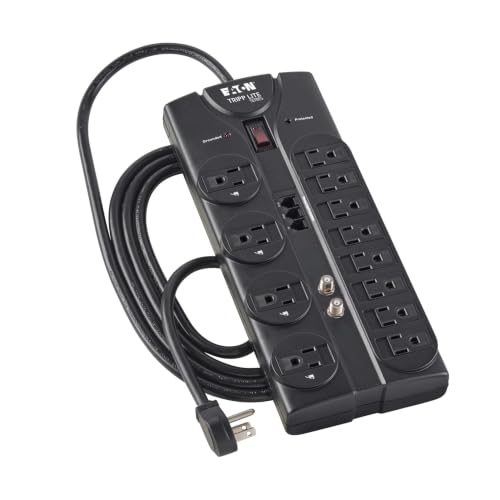
Of all the surge protector reviews a buyer reads, the useful ones share a trait: they judge products on documentation rather than on the size of the number printed largest on the box. This review applies that standard to the Tripp Lite Protect It! TLP1208TELTV, Eaton’s twelve-outlet flagship strip, and finds the product that best survives it. The verdict up front: this is the most completely documented conventional strip in its class — published let-through ratings per mode, automatic shut-off, line protection for coax and phone, and a datasheet that reads like an engineering document because it is one.
The TLP1208TELTV’s natural rivals are the Belkin 12-outlet on capacity, the APC P11U2 on layout, and — at a different level of technology — the Furman PST-8D. This review covers the Tripp Lite in depth and places it against those three honestly, using only figures their makers publish. Buyers who want the ranking across budgets rather than one product’s story should go to Best Surge Protector Under $75 Best Surge Protector Under $75; buyers who want the theory first should start with Surge Protector Buying Guide Surge Protector Buying Guide.
Quick Verdict
Best for: mixed desks and media racks where the network is wired and documentation matters. / Not suited for: USB-C-first desks, or buyers who need a slim strip for a shallow tray.
Its case rests on completeness: no other conventional strip at its level combines per-mode UL 1449 figures, automatic shut-off, coax and telephone protection, and twelve outlets with real transformer spacing in one published package.
In this guide
Specifications
- 12 AC outlets, 4 of them transformer-spaced
- 2,880-joule AC suppression rating (Eaton datasheet)
- UL 1449 let-through rating 330V L-G, 400V L-N, 400V N-G
- 8 ft cord, 14-gauge, right-angle plug
- RJ11 telephone and 2.2 GHz coaxial protection, automatic shut-off
Read the let-through line carefully, because it is the heart of this product: 330V line-to-ground and 400V on the other modes under UL 1449. Those are the voltages your equipment’s power supplies are exposed to while the strip works — tighter than most rivals publish, and published at all, which most rivals avoid. The 2,880-joule figure from Eaton’s datasheet (some retail titles quote the sister model’s lower figure; the datasheet governs) buys the service life, the 14-gauge 8 ft cord preserves the 15A rating end to end, and the response time is specified at under a nanosecond.
Design and Build
Two rows of outlets, four of them transformer-spaced, on a housing wide enough to mean it. The layout is unfashionable and correct: width is what spacing costs, and Tripp Lite spent it. A right-angle plug on the 8 ft cord lets furniture sit close; keyhole slots allow wall or tray mounting; diagnostic LEDs report protection status and grounding. The RJ11 and coax jacks sit where cable runs naturally arrive. Nothing is styled, everything is placed. Under a desk or behind a media cabinet — the two places this strip is destined to live — that is the design language that matters.
Protection in Real Use Cases
Three scenarios define the product. In a media rack, the coax feed from the wall routes through the strip before the cable box, closing the signal-side door that AC-only strips leave open while the TV, console and receiver sit on protected AC. In a home office, the router’s phone or coax line gets the same treatment, and the PC’s power supply sees let-through figures that are published rather than hoped for. And in the worst case — the event big enough to compromise the suppression circuit — automatic shut-off disconnects the load entirely. A strip that fails silent is a liability; this one fails loud, which is the behaviour you are actually buying.
The gaps are real but bounded: no USB charging, no filtration claims worth the name, and a form factor that will not fit a shallow designer tray. None of those is the product’s job. Its job is documented, complete, fail-safe protection for a fixed installation, and on that brief the field surveyed across our Best Surge Protector For Home Office Under $150 Best Surge Protector For Home Office Under $150 guide does not beat it.
Setup and Installation Experience
Install it like infrastructure. Direct to a grounded receptacle; check the LEDs; route coax and the RJ11 line through their jacks before connecting the equipment they serve; seat the four biggest adapters in the spaced outlets; fill the rest; mount or tray it so the indicators stay visible; label the date. The coax step is the one owners skip and the one that matters most in a rack, because it is the only step that protects equipment from a path that does not pass through the AC circuit at all. Ten minutes, once, and the installation is done for years.
Maintenance and Service Life
The LEDs make maintenance a glance: protection alive, ground present. Check quarterly and after every major storm. The automatic shut-off converts the end-of-life question from guesswork into an event you will notice. Plan on the usual MOV horizon — years of small events, one big one, or three to five calendar years — and keep the Ultimate Lifetime Insurance paperwork with the household documents; Eaton’s connected-equipment terms, like all such policies, reward owners who read the conditions before they need them.
How It Compares
The Belkin beats it on headline joules and matches its line protection, but publishes less granular let-through data and lacks automatic shut-off. The APC beats it on adapter spacing and adds the wiring-fault indicator and USB, but offers no line protection and is end-of-commercialisation. The Furman is a different technology for different money. Among conventional strips bought on evidence, the Tripp Lite is the completeness winner — which is why it also leads our Best Surge Protector For Emergencies Under $75 Best Surge Protector For Emergencies Under $75 list, where fail-safe behaviour is the whole point.
| Product | Outlets | Signature strength | Gap |
|---|---|---|---|
| Tripp Lite Protect It! 12-Outlet Surge Protector (TLP1208TELTV) | 12 | Published let-through + auto shut-off + line jacks | No USB |
| Belkin 12-Outlet Surge Protector (BE112230-08) | 12 | 3,940 J capacity | No auto shut-off |
| APC Performance SurgeArrest 11-Outlet (P11U2) | 11 | Spacing + wiring-fault LED | No line protection; end-of-line |
| Furman PST-8D Power Station | 8 | Series-mode + voltage shutdown | Price; no USB |
Final Recommendation
Buy the TLP1208TELTV if your installation is fixed, wired and valuable — it is the conventional strip for people who read datasheets, and this review exists because that reader deserves one product examined properly. Choose the Belkin if raw capacity is your religion, the APC if adapters rule the desk, and the Furman if the rack makes music. For everyone else with a rack or a wired desk, this is the default.
Best for: media racks, wired home offices and documentation-first buyers. / Not suited for: USB-C-first or space-constrained desks.
How to Read Any Surge Protector Review
This review’s method generalises, and it is worth stating plainly so readers can apply it to reviews elsewhere — including the ones with star ratings and laboratory photography. Ask four questions of any review. Does it quote the maker’s datasheet, or the marketplace title? Does it discuss what the product does when its protection is spent? Does it name the product’s gaps without being asked? And does it disclose what it did not test? A review that answers all four is evidence; a review that answers none is advertising with better lighting.
Applied to the category’s marketing, the method is quietly devastating: most products cannot survive the first question. The three brands whose documentation anchors this programme — Eaton, APC, Belkin — survive all four, which is not a coincidence but a selection effect. This review chose its subject the way it recommends you choose yours.
The Rack at Midnight
The media rack is where this review’s subject earns its keep most completely, and midnight is its shift. The house sleeps; the grid does not. A distant fault puts a transient on the line that arrives at the rack on two paths at once — the power cord and the coax feed. Both are routed through the strip, both are met by published ratings, and the rack wakes in the morning with its indicator lit and its recordings intact. The counterfactual — the same transient on the coax alone, into an AC-only strip’s blind side — is the scenario the line jacks exist to retire. Reviews that test only the power path miss the product’s point.
How This Review Was Researched
A note on method, because reviews in this category are often vaguer than they should be. This is a research-led review: every specification quoted comes from the manufacturer’s own datasheet or documentation, every ASIN was tied to its exact model from an opened listing, and no hands-on testing is claimed or implied. Where a maker’s documents and a retail title disagree — as happened with a joule figure in this cluster — the datasheet governs and the disagreement is disclosed. Prices are deliberately absent, per this site’s standing rule, because they change faster than reviews do; the listing linked at the top of the page carries the current figure.
The judgements, by contrast, are ours: which specifications matter for which desks, where a product’s gaps are disqualifying and where they are merely honest. Readers who weight the criteria differently will reach different conclusions from the same evidence, and the evidence is presented completely enough to let them. That is the contract a review should offer, and it is the standard this programme applies to itself.
The Alternatives in Depth

Belkin 12-Outlet Surge Protector (BE112230-08) — Capacity Alternative
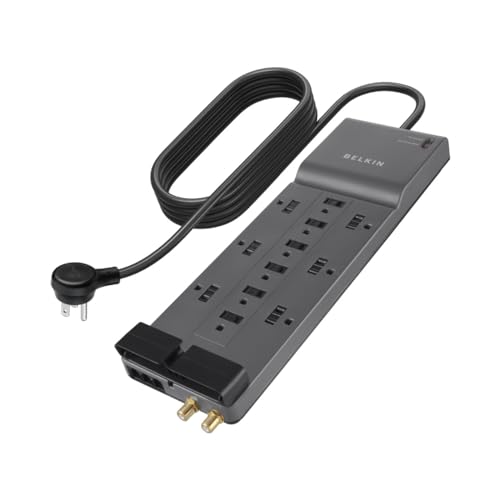
- 12 surge-protected AC outlets, 6 of them BlockSpace-spaced for large adapters
- 3,940-joule energy rating
- 8 ft heavy-duty cord with flat plug
- Coaxial and telephone line protection
- Protected / Not Grounded indicator lights
Strengths
- Huge joule rating for the class, with room for a full desk of gear
- BlockSpace outlets swallow oversized power bricks without blocking neighbours
- Coax and phone protection cover the surge paths most strips ignore
Trade-offs
- The housing is large and will dominate a small desk
- No USB charging ports, so phones still need their own adapters
- Sliding outlet covers can feel fiddly when you swap plugs often
Treat this as infrastructure rather than an accessory. Once it is screwed or settled behind a cabinet, the sliding safety covers keep dust and curious fingers out of unused sockets, and the Protected and Not Grounded lamps give you a ten-second health check whenever you walk past. The absence of USB is a deliberate trade: Belkin spent the budget on suppression capacity and outlet count instead of charging circuitry, so pair it with one good USB charger plugged into a BlockSpace outlet and the desk is complete.
What separates this strip from cheaper 12-outlet bars is how honestly it publishes its protection story: a high joule figure, three-line AC coverage and line protection for coax and phone in one housing. In practice that means the TV, the games console, the soundbar and the network box all sit behind the same defensive layer. It is not portable and it is not pretty, but for a permanent installation those are the right compromises.
As an alternative in this guide, it is judged on the same documented criteria as the main subject, and its full specification is listed in its section.
Best for: a fixed workstation or entertainment centre that never moves and needs every socket protected at once / Not suited for: anyone whose needs run against the trade-offs above.
APC Performance SurgeArrest 11-Outlet (P11U2) — Layout Alternative
- 11 AC outlets, 6 transformer-spaced
- 2,880-joule surge energy rating
- UL 1449 rating L-N 400V, L-G 500V, N-G 500V
- 2 USB charging ports, 2.4A total
- 8 ft cord with rotating right-angle plug; building-wiring-fault LED
Strengths
- Six widely spaced outlets fit the bulky bricks that defeat most strips
- Wiring-fault LED warns you about a problem in the wall circuit itself
- Fail-safe design disconnects equipment once protection is compromised
Trade-offs
- Schneider Electric lists the model as end-of-commercialisation, so stock may thin out
- Big footprint for a strip with eleven outlets
- USB output is shared 2.4A, which is slow for two modern phones at once
The honest caveat is lifecycle: Schneider Electric’s own datasheet marks this model end-of-commercialisation, so buy it from a listing you trust and register the equipment protection policy promptly. In use, nothing about it feels dated — 2,880 joules, an 8 ft cord and two USB ports cover a full desk, and the build quality is a step above supermarket strips. If the listing disappears, the Tripp Lite in this guide is the natural substitute.
Where this strip earns its place is adapter-heavy desks: external drives, speaker supplies, a laptop brick, a monitor brick and a printer can all plug in at once because half the outlets are transformer-spaced. The shared 2.4A USB is fine for overnight charging but will not fast-charge two phones; treat it as a convenience, not a charging station. The building-wiring-fault indicator is the feature you will be glad of exactly once — the day it tells you the outlet itself is the problem.
As an alternative in this guide, it is judged on the same documented criteria as the main subject, and its full specification is listed in its section.
Best for: a desk with several wall-wart adapters that need real spacing plus everyday USB top-ups / Not suited for: anyone whose needs run against the trade-offs above.
Check on Amazon

Furman PST-8D Power Station — Conditioner Alternative
- 8 outlets in isolated, filtered banks
- Series Multi-Stage Protection (SMP), non-sacrificial design
- Extreme Voltage Shutdown disconnects above roughly 135-137 VAC
- 188V peak initial clamping level
- LiFT linear filtering; coax and telephone protection; 8 ft cord, aluminium chassis
Strengths
- Series-mode protection does not rely on sacrificial MOVs alone
- Extreme Voltage Shutdown guards against sustained over-voltage, not just spikes
- Serious noise filtering benefits audio and video chains
Trade-offs
- Costs far more than a conventional strip of similar outlet count
- Large aluminium chassis is overkill for a laptop desk
- No USB charging ports
The LiFT filtering is the other half of the value. Line noise that a basic strip passes straight through can hum through guitar amps, hiss through studio monitors and shimmer through projectors; the PST-8D’s filtered banks measurably quiet that. Coax and telephone protection are included, the chassis is aluminium, and the cord is a proper 8 ft. You pay for all of it — this costs several times a basic strip — but for a studio or theatre rack the maths is easy.
Judge this unit by a different standard than joule counting: Furman publishes an initial clamping level of 188V peak and an over-voltage shutoff around 135-137 VAC, figures aimed at the sustained bad power that destroys equipment slowly. If your gear includes an AV receiver, powered monitors or anything with a motor and a circuit board you cannot replace, the PST-8D is the grown-up answer in this guide.
As an alternative in this guide, it is judged on the same documented criteria as the main subject, and its full specification is listed in its section.
Best for: a home studio, hi-fi rack or home theatre where clean power matters as much as surge capacity / Not suited for: anyone whose needs run against the trade-offs above.
Ownership Notes
In daily service the Eaton’s LEDs become the household’s quiet status board: protection alive, ground present. The coax run through its jacks is the step owners most often skip and the one this programme most often recommends, because the cable feed is a genuine surge path into exactly the equipment the strip was bought to defend.
Ownership of the Belkin settles into a routine quickly: the covers keep unused sockets clean, the lamps get a glance whenever the cabinet opens, and the strip otherwise disappears. Owners upgrading from a basic bar notice the difference in the first week — not in protection, which is invisible when it works, but in the absence of the adapter shuffle that used to greet every new device.
Living with the P11U2 means the desk stops being renegotiated. New gear arrives, a spaced outlet is free, and the wiring-fault lamp stays dark — the three experiences its design was optimised for. Its size, criticised in the abstract, is precisely what the spacing costs, and owners consistently report forgiving it within a week.
The PST-8D’s owners tend to describe it differently from strip owners: not as protection bought but as infrastructure installed. The filtration is audible in quiet rooms, the shutdown is a promise kept in advance, and the chassis outlasts the equipment generations plugged into it — which is the entire argument for its price, stated by the people who paid it.
Background and Detail
The joule rating tells you how much surge energy the protection circuit can absorb over its life before it is spent. Metal oxide varistors — the components that do the absorbing in most strips — degrade a little with every event, including the small ones you never notice. A higher rating therefore means a longer useful life and more headroom for a big event, not a force field. Ratings only compare meaningfully between reputable brands that publish them the same way, which is why every pick in this guide comes from a maker that prints a full datasheet.
Every plug-in surge protector needs a properly grounded outlet to work. The ground path is where much of the diverted energy goes; without it, the protection circuit is partially blind. That is why the better strips carry a Not Grounded or wiring-fault indicator, and why a two-prong cheater adapter quietly defeats the point of buying protection at all. If the indicator on a new strip says your outlet is not grounded, the correct move is an electrician, not a different strip.
Never daisy-chain surge protectors, and never plug one into an extension cord that is not rated for the load. Chaining strips defeats their overload design, can void the connected-equipment policies that back them, and creates the exact overheating scenario the breaker is meant to prevent. One strip per wall receptacle, plugged directly in, with its cord uncoiled and uncovered, is the installation rule. If you need more outlets, buy a strip with more outlets — that is the safe version of the same purchase.
A plug-in strip is the last layer of defence, not the only one. A Type 2 surge protective device installed at the breaker panel by an electrician blunts large, externally generated surges before they spread through the house wiring, and the plug-in strips then handle what remains plus the smaller surges generated inside the home by motors and compressors switching. The two layers multiply rather than duplicate each other. If you protect only one layer, protect the point of use for sensitive electronics — but the panel device is the upgrade that guards everything at once.
Surge Protector Reviews: Tripp Lite TLP1208TELTV Examined
A closing note on this review’s subject choice: the TLP1208TELTV was not chosen for being the newest or the most marketed unit in its class, but for being the most examinable. Products that publish everything invite reviews like this one; products that publish nothing invite only unboxing videos. The correlation is not accidental, and readers can use it as a shortcut long after this particular model is gone.
Related Guides in This Series
Neighbouring questions in this cluster are covered by Best Surge Protector For Travel Under $75 Best Surge Protector For Travel Under $75, Best Surge Protector Under $150 Best Surge Protector Under $150 and Best Surge Protector For Camping Under $150 Best Surge Protector For Camping Under $150 — each written to the same documentation standard as this page.
Further Detail
Voltage events have a geography. Homes at the end of rural feeders, homes under old overhead lines in tree country, and homes in lightning-dense regions simply meet more and larger transients than a new suburb on underground cable. Protection budgets should follow that geography honestly: the same equipment list justifies a flagship and a panel device in one postcode and a single documented strip in another. Local electricians, who replace the boards either way, are candid witnesses to which postcode you live in.
The connected-equipment policy figures printed on boxes — five and six digits — deserve a calm reading. They are ceilings under conditions, not balances in an account, and claims require the protector to have been correctly installed and the equipment correctly connected, signal lines included where the policy says so. Read the figure as the maker’s confidence interval made visible: a company expecting its protection to fail does not attach six figures to the failure.
Compatibility between protectors and modern lighting is a niche worth ten seconds: some LED drivers and dimmers object to the noise or the switching behaviour of particular power accessories, showing it as flicker or buzz. The fix is almost always arrangement — the lighting on its own circuit or outlet, the protector serving the electronic loads it was designed for — rather than any defect in either product. Separation of load types is the quiet theme underneath this entire subject.
Spent surge protectors should not go in the household bin without thought. They contain metal oxide varistors, circuit boards and copper that recyclers handle routinely through electronics waste streams. Many municipalities and retailers run e-waste collections that accept small power accessories. Retiring a strip responsibly is the last step of the replacement cycle this guide keeps recommending — and a strip that has absorbed a major event has genuinely earned its recycling.
Workshop and garage loads deserve a separate word. Power tools themselves are crude loads that neither need nor benefit much from surge protection, but the modern workshop also holds battery chargers with real electronics, a radio, and increasingly a computer or tablet running plans and measurements. Protect the chargers and the electronics on a documented strip; let the circular saw have the bare outlet it was designed for, and keep every protector out of the dust-and-moisture path of actual work.
Home NAS boxes and small servers are the strongest quiet case in this whole subject. They hold the only copies of things, they run around the clock, and their power supplies meet every transient the house generates. The standard of care that has emerged — protector at the wall, UPS downstream, backups that do not depend on either — is cheap relative to the data. Any household that has graduated to network storage has also graduated past the question of whether protection is worth it.
The 3D printer, the laser cutter and the home CNC share a profile: costly control electronics, long unattended runs, and power supplies that dislike surprises. Their owners learned early what this guide teaches generally — a documented protector is part of the machine’s installation cost, and a UPS joins it when a ruined ten-hour print costs more than the battery does. Maker spaces that skip the protection eventually teach the lesson at retail price.
There is a small, satisfying ritual available to owners of indicated protectors after any storm: the walk. Kettle on, then room to room, a glance at each green light — network shelf, desk, media wall, chargers. Two minutes, and the household’s invisible infrastructure has reported for duty. Rituals like this are how maintenance actually survives in real homes: not as chores on a list, but as habits attached to events that already happen.
Power quality is becoming a household topic for a structural reason: the modern home’s load has quietly become electronic. Twenty years ago a surge threatened the television and the computer; today it threatens the fridge’s board, the washer’s board, the boiler’s board, the charger’s negotiation with the car. Every appliance that gained a display gained a vulnerability, which is why panel devices and point-of-use protection have moved from enthusiast purchases to standard advice.
When a protector retires, its replacement decision is the programme in miniature: same inventory, same datasheet lines, same fit questions, answered faster because the household now owns the method. That acceleration is the real return on the first careful purchase. It is also why this cluster of guides spends so many words on criteria and so few on urgency — the goal was never one transaction, but a household that buys power protection correctly forever.
Child safety changes the outlet calculation in family homes. Sliding safety covers, found on the Belkin flagship in this programme, close unused sockets against curious fingers and dropped objects; tamper-resistant receptacles in the wall do the same job upstream. Neither replaces supervision, but a protector chosen with covers removes one category of nursery and playroom hazard without any ongoing effort from the adults.
Aquariums and home theatres share a trait: their equipment is expensive, always on, and quietly intolerant of power events. Pumps, heaters with electronic controls, LED drivers and AV receivers all sit behind control boards now. Owners of both setups converge on the same answer — a documented strip or conditioner, checked on the same schedule as the water or the dusting — because the cost of the protection rounds to zero against the cost of the inhabitants or the installation.
Smart plugs and surge protectors solve different problems and should not be confused. A smart plug switches and measures; unless it is explicitly rated and listed as a surge protective device, it contains no meaningful protection. Stacking a smart plug into a protector’s outlet for scheduling is legitimate; substituting one for the other because both are white plastic rectangles is how equipment ends up defended by a radio.
Treadmills and exercise equipment invert the usual advice in an instructive way. Their motors draw hard, their manuals often demand a dedicated circuit, and a shared strip is a nuisance-trip machine. The electronics in a modern treadmill console are real, but the correct protection is the panel device and the dedicated outlet the maker specified — a case where the layered architecture, not the point-of-use strip, is the answer. Knowing when not to use a strip is part of knowing strips.
Finally, a word about buying the second unit. Owners consistently report that the second documented protector is an easier purchase than the first, because the first has already taught the household where its unprotected clusters are — the router in the hallway, the chargers in the kitchen, the spare-room desk. Coverage grows by observation. Programmes like this one publish rankings; households build systems one noticed gap at a time, and the noticing is the skill worth acquiring.
One underused diagnostic deserves promotion: the protector as witness. A unit whose indicator dies, a conditioner that logs shutdowns, an EMS that reports a pedestal’s sag — each converts an invisible property of your power into a dated observation. Households and campers who keep those observations make better decisions about everything downstream, from which appliance is really failing to whether the utility needs a call. Protection that reports is worth more than protection that merely absorbs.
Registering a protector’s warranty is the dullest five minutes in this entire subject and the one owners most regret skipping. Connected-equipment policies are contracts with conditions — correct installation, timely claims, sometimes registration — and the time to learn the conditions is the day the box opens, not the day the television dies. Photograph the receipt, save the manual’s policy page, and store both with the household documents. If a claim ever comes, it will be won or lost on exactly that paperwork.
Dormitories and rented rooms add rules of their own: many prohibit daisy-chained strips, some prohibit extension cords entirely, and cruise-style inspections of student wiring are not unknown. A single listed protector with enough outlets, plugged directly into the wall, satisfies both the safety office and the resident — which is why compact, documented units are the standard recommendation for student rooms in this programme’s travel and budget guides.
Frequently Asked Questions
Is the TLP1208TELTV rated 2,880 or 2,160 joules?
Eaton’s datasheet for the TLP1208TELTV specifies 2,880 joules; the 2,160 figure belongs to the sister TLP1208TEL model and appears in some retail titles. Trust the datasheet for the exact model.
What does automatic shut-off do?
If the suppression circuit is compromised by an event, the strip disconnects power to connected equipment instead of continuing to feed it unprotected. It converts silent failure into an obvious one.
Do the coax jacks affect TV signal quality?
They are rated for 2.2 GHz digital signals, covering cable and satellite bands. Any inline device adds a whisper of insertion loss; for surge-exposed feeds the protection is worth it.
Can it protect a whole entertainment centre alone?
Yes, within the 15A total: twelve outlets, four transformer-spaced, plus line protection covers a typical rack of TV, console, receiver, streaming box and network gear.
Does it have USB charging?
No. Pair it with one good USB charger on a spaced outlet if the rack needs phone charging.
How is it different from the APC P11U2?
The Tripp Lite adds coax and phone protection, automatic shut-off and more granular published let-through figures; the APC answers with better adapter spacing, USB ports and a wiring-fault indicator.
A three-wire outlet gives a surge three roads in: hot to neutral, hot to ground, and neutral to ground. Cheap strips protect only the first and call it done. Full three-mode protection covers all three paths, because a surge riding the ground or neutral line reaches the same circuit boards in the end. When you compare spec sheets, look for protection listed across L-N, L-G and N-G; a single combined joule figure with no mode breakdown tells you less than it appears to.
Surges do not respect the power cord’s monopoly. A spike can arrive on a coaxial cable feed, a telephone line or an Ethernet run and enter a TV, modem or computer from the signal side, bypassing an AC-only strip completely. If your setup still has wired coax or Ethernet feeding the same equipment, choose a strip with matching line protection and route those cables through it, accepting the small signal loss as the price of a closed door. Fully wireless setups can honestly skip this feature.
Clamping voltage, published under UL 1449 as the Voltage Protection Rating (VPR), is the level the strip lets through to your equipment while it works. Lower is better: a strip rated at 330V or 400V L-N exposes your gear to less of the spike than one rated at 600V or 800V. Joule headlines get the marketing space, but the VPR is the figure that describes what your power supply actually experiences during an event. When a maker publishes per-mode VPR figures, as APC, Eaton and CyberPower do, that is a sign the datasheet deserves trust.
Surge protectors are consumables. Each absorbed event spends part of the protection budget, and a single severe event can spend all of it at once — after which some strips keep passing power with no protection left. Prefer models with a Protected indicator light or automatic shut-off, check the light every few months, and replace any strip after a major storm event even if it still works. A common planning horizon is three to five years for a primary strip in an active storm region, sooner if the indicator ever goes dark.
Can I plug a UPS into a surge protector?
UPS makers generally advise plugging the UPS directly into the wall and protecting other gear separately, because a strip between the UPS and the wall can complicate its operation. Follow the UPS maker’s guidance for your model.
Do surge protectors work after a blackout?
Usually — but the restoration surge is exactly the event that can spend one. Check the Protected indicator after every outage before assuming the protection survived.
Are rack-mount and strip protectors different inside?
The protection principles are the same; format, outlet count and documentation differ. Judge any format by the same datasheet criteria used throughout this guide.
Built-in USB ports are a convenience feature, not the protection story, but they shape daily life with a strip. A shared 2.4A output charges one modern phone reasonably or two slowly; a dedicated 20W USB-C port with Power Delivery fast-charges a phone while leaving every AC outlet free. Check whether the USB output is quoted per port or in total before you buy — the difference decides whether the second device charges overnight or merely eventually.
Cord length and gauge decide where a strip can actually live. A 14-gauge cord carries the strip’s full 15A rating without meaningful voltage drop over typical lengths; thinner cords on long runs are a quiet compromise. Measure from the outlet to the desk tray or cabinet before choosing: an 8 ft cord forgives awkward rooms, while a 4 ft cord demands the furniture come to it. Flat and right-angle plugs matter in equal measure, letting furniture sit against the wall instead of perched on a plug.
The circuit breaker in a strip protects against overload — too many amps drawn for too long — which is a different hazard from a surge. Fifteen amps at 120V is roughly 1,800 watts shared across every outlet, and space heaters, kettles and hair dryers consume most of that alone. Keep high-draw heat appliances off surge strips entirely; they gain nothing from surge protection and they crowd out the electronics the strip exists to guard. The breaker tripping is information: something on the strip does not belong there.
Campground pedestals fail in ways house outlets rarely do: neutrals work loose, grounds disappear, voltage sags when every rig on the loop runs its air conditioner, and miswired pedestals present faults that damage equipment slowly. That is why RV protection splits into two classes — surge-only plugs that absorb spikes, and electrical management systems that also monitor voltage and wiring and disconnect the rig when power goes bad. For an RV with an air conditioner, a converter and modern electronics, the second class is the one that matches the risk.
Surge protectors are voltage-specific in a way phone chargers are not. A strip built for North American 120V service must never be plugged into a 220-240V outlet through a shape-only plug adapter: the protection components will fail, possibly taking connected equipment with them. For international travel, use a plain adapter with dual-voltage chargers, or a travel unit explicitly rated for the destination’s voltage. Within North America, the same unit that guards your laptop at home works in any hotel on the continent.
Storm preparation with surge protection is mostly about decisions made before the sky darkens. The expensive, always-plugged equipment — computers, TVs, network gear, the fridge’s control board via its outlet where accessible — should already live behind protection, because nobody reliably runs around unplugging things at midnight. During a severe event, unplugging the most valuable portable items still beats any strip; no plug-in device promises survival of a direct lightning strike, and honest makers say so. After the event, check every Protected indicator before trusting the strip again.
Some strips add EMI/RFI filtering, which strips high-frequency noise off the power line. That noise does not damage equipment the way a surge does, but it can buzz through audio gear, disturb sensitive measurement equipment and add shimmer to video. Filtering figures are quoted in decibels across a frequency range; treat them as a secondary benefit unless you run audio equipment, in which case a properly filtered bank — or a series-mode conditioner — becomes a genuine feature rather than a bullet point.
Connected-equipment policies — the dollar figures makers attach to their strips — are warranties with conditions, not insurance in the everyday sense. They generally require the strip to be correctly installed, the equipment to be properly connected including signal lines where specified, and a claim process that starts with the maker’s paperwork. Read the figure as a signal of how seriously the maker stands behind the protection rather than as a cheque already written, register the product if the maker asks, and keep the receipt with the manual.
Should every outlet in the house have one?
No. Protect clusters of valuable, always-plugged electronics. Lamps, chargers for disposable devices and heat appliances do not need protectors, and heaters must never share one.
Should a surge protector feel warm?
No. A protector should run at room temperature in normal service. Warmth suggests overload or failing components; unplug it, reduce the load, and treat persistent warmth as a replacement signal.
Can I use a surge protector with a generator?
Yes — generator output can swing as loads change, and a documented protector is sensible downstream. Keep it dry, indoors or under shelter, and never run it in rain.
Does a surge protector protect against power outages?
It protects against the surges and sags around outages, especially the restoration spike, but it provides no power itself. Continuity is a UPS’s job.
What is the difference between a surge protector and a power conditioner?
A protector absorbs or disconnects against over-voltage. A conditioner additionally filters line noise and, in the Furman class, shuts down through sustained bad voltage. The conditioner is the broader instrument at a broader price.