Disclosure: As an Amazon Associate, umtsmarttool.com earns from qualifying purchases. Links to Amazon on this page are affiliate links; they cost you nothing extra. Prices and availability change often, so check the current Amazon listing before you buy.
Where to buy
Shop the best hunting knives in one place — the Benchmade Steep Country 15006-01 leads the list. Linked picks go straight to their Amazon listing; unlinked picks are listed by name so you can search the exact model.
- Benchmade Steep Country 15006-01 — Check on Amazon
- Buck 119 Special — Check on Amazon
- Outdoor Edge RazorPro (search the exact model name on Amazon)
- Buck Alpha Hunter — Check on Amazon
- Buck 110 Folding Hunter — Check on Amazon
- ESEE 4 — Check on Amazon
Read the full guide ↓
The best hunting knives are field-dressing tools before they are anything else. A hunting knife must open a body cavity without puncturing organs, work around joints, separate hide from meat with controlled slicing, and keep doing it with hands that are cold, wet and slippery — then clean up easily enough that hygiene is never the reason a hunter rushes. Blade shape matters more here than in almost any other knife category: a drop point with a gentle belly is the field standard because it slices without a point that digs where it should not, and a blade of roughly three and a half to four inches gives control that longer blades trade away.
The six knives below cover the ways hunters actually work. There is a featherweight premium fixed blade designed exactly for field dressing, a replaceable-blade system for hunters who never want to sharpen in the field, two American classics in fixed and folding form, a premium-steel fixed blade for hunters who process several animals a season, and a hard-use crossover for hunters whose knife also does camp duty. We compared manufacturer and retailer specifications — steel, blade length and shape, weight, handle and sheath — and mapped them to dressing, skinning and camp tasks. We did not field-test these knives ourselves, and we invented no performance claims: verify the exact variant on the current listing before buying.
Hygiene and safety frame this whole guide, in line with standard manufacturer and game-care guidance: a sharp knife is safer than a dull one because it cuts where it is pointed without force; blades and hands are washed between animals and before food handling; and a knife used for dressing is cleaned thoroughly before it ever touches camp food. Hunters who also split kindling and build camp should read this alongside best bushcraft knives, and those who want a dedicated skinning shape should see best skinning knives.
In this guide
Quick Picks
| Knife | Badge | Key spec |
|---|---|---|
| Benchmade Steep Country 15006-01 | Best Overall | Blade length: 3.54 inches; Blade steel: CPM-S30V stainless steel (58-60 HRC) |
| Buck 119 Special | Best Classic Fixed Blade | Blade length: 6 inches; Blade steel: 420HC stainless steel |
| Outdoor Edge RazorPro | Best Replaceable Blade | Blade length: 3.5 inches (replaceable blades); Blade steel: Japanese 420J2 stainless replacement blades |
| Buck Alpha Hunter | Best Premium Fixed Blade | Blade length: 3.63 inches; Blade steel: S35VN stainless steel |
| Buck 110 Folding Hunter | Best Classic Folder | Blade length: 3.75 inches; Blade steel: 420HC stainless steel |
| ESEE 4 | Best Hunting and Camp Crossover | Blade length: 4.5 inches; Blade steel: 1095 high-carbon steel |
How These Picks Were Chosen
A hunting candidate had to be a knife a hunter would trust at the least convenient moment of the season. We weighted five criteria. Blade shape came first: drop points and controlled clip points that dress and skin without an aggressive tip. Second was grip security when wet, favouring textured synthetics and shaped handles over smooth dress materials. Third was steel behaviour across a whole animal — edge life long enough to finish the job, with field resharpening or blade replacement honestly accounted for. Fourth was cleaning: fixed blades with simple construction score best, folders and replaceable systems had to justify their hygiene burden. Fifth was carry — a sheath or system that keeps the knife secure, accessible and protected in a pack or on a belt. Specifications come from manufacturer and established retailer listings, cross-checked where models are widely documented.
Two rules governed every judgement below. First, specifications beat stories: where a marketing claim and a published spec disagreed, the spec won. Second, honesty about limits: every pick in this guide has a stated trade-off section, because a knife with no downside is a knife whose reviewer was not paying attention. If a pick is listed without an Amazon link, that means our research verified the product and its specifications from manufacturer or retailer sources but did not tie a verified listing identifier to the exact model — we would rather send you to search the exact model name than print a link we could not verify.
The 6 Best Hunting Knives

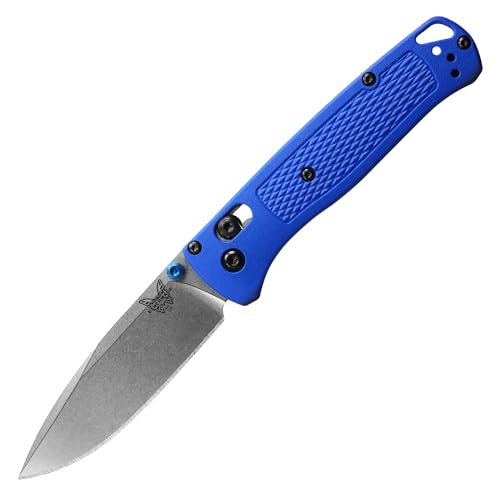
Benchmade Steep Country 15006-01 — Best Overall
Who it suits: Backcountry and mobile hunters who dress game far from the truck and count every ounce.
- Blade length: 3.54 inches
- Blade steel: CPM-S30V stainless steel (58-60 HRC)
- Blade shape: drop point
- Weight: 2.95 oz
- Handle: Santoprene
Strengths
- Purpose-built drop point dresses and skins with control
- S30V edge lasts through large game without field sharpening
- Santoprene grip stays secure with wet, cold hands
Trade-offs
- Short handle may crowd the largest hands with gloves
- Premium steel wants a diamond abrasive back home
- Too light and short for camp wood duties — pair it, don’t stretch it
The Steep Country is what a hunting knife looks like when every decision serves field dressing: a 3.54-inch drop point that opens and skins without drama, premium stainless that finishes the animal on the edge it started with, and a handle textured and shaped for exactly the grip conditions hunting creates. At under three ounces it disappears on a belt or in a kill kit until the moment it is the only tool that matters. It is a specialist, proudly — camp chores belong to a second knife.
Consider how the Benchmade Steep Country 15006-01 behaves across a full day of the work it was chosen for. Its defining specification — blade length: 3.54 inches — sets the rhythm: it determines how the knife carries between tasks, how it feels on the tenth repetition of a cut rather than the first, and how much attention it asks for in return. The headline strength, purpose-built drop point dresses and skins with control, is not a laboratory virtue; it is the thing owners notice when conditions are poor and time is short, which is exactly when a knife earns or loses its place in a kit.
It also helps to place this pick against the rest of the table before deciding. Every guide like this one contains a knife that is cheaper, one that is lighter or stronger, and one that is more specialised; the Benchmade Steep Country 15006-01 survives that comparison when its particular balance — summarised in the verdict line below — matches the way you actually spend your time outdoors. If it does not, the honest move is to choose the pick whose badge names your real priority, not the pick with the most impressive single specification.
Best for: Backcountry and mobile hunters who dress game far from the truck and count every ounce. / Not suited for: buyers whose main work contradicts the trade-offs above.

Buck 119 Special — Best Classic Fixed Blade
Who it suits: Hunters who want one proven, larger fixed blade for camp and game, in the classic American pattern.
- Blade length: 6 inches
- Blade steel: 420HC stainless steel
- Blade shape: clip point
- Construction: full tang
- Weight: 7.5 oz
Strengths
- Six decades of production behind a proven field design
- 420HC is corrosion-resistant and very easy to resharpen
- Generous blade handles camp and larger game work alike
Trade-offs
- Six inches is more blade than fine dressing work needs
- Clip point demands care around organs compared with a drop point
- Heavier and longer to pack than the dedicated dressing knives
The 119 Special is the fixed-blade counterpart to the 110’s legend: a big, honest, American-made hunting knife that generations have carried for deer camp and everything around it. Its length and clip point make it more versatile at camp than the dedicated dressing knives here, and less precise inside a body cavity — experienced hunters manage that with technique, beginners should note it. As a one-knife deer-camp solution with a leather sheath and a lifetime of parts and knowledge behind it, it remains very hard to argue with.
What separates the Buck 119 Special from near-neighbours in this guide is the combination, not any single line of its specification box. Blade steel: 420HC stainless steel works together with blade length: 6 inches to produce a tool with a clear personality: it rewards the user it was designed for and quietly penalises everyone else. That is why the badge matters — Best Classic Fixed Blade is a statement about fit, not a rank — and why reading the trade-off list matters more than reading the strength list twice.
It also helps to place this pick against the rest of the table before deciding. Every guide like this one contains a knife that is cheaper, one that is lighter or stronger, and one that is more specialised; the Buck 119 Special survives that comparison when its particular balance — summarised in the verdict line below — matches the way you actually spend your time outdoors. If it does not, the honest move is to choose the pick whose badge names your real priority, not the pick with the most impressive single specification.
Best for: Hunters who want one proven, larger fixed blade for camp and game, in the classic American pattern. / Not suited for: buyers whose main work contradicts the trade-offs above.
Outdoor Edge RazorPro — Best Replaceable Blade
Who it suits: Hunters who process game efficiently and prefer swapping a blade to sharpening one, in the field or at home.
- Blade length: 3.5 inches (replaceable blades)
- Blade steel: Japanese 420J2 stainless replacement blades
- System: drop-point blade plus gutting blade
- Weight: 8.3 oz (system, per retailer listing)
- Carry: sheath with spare blades
Strengths
- A fresh edge is always seconds away — no field sharpening at all
- Dedicated gutting blade opens hide without puncturing organs
- Replaceable system keeps performance identical animal after animal
Trade-offs
- Ongoing cost and waste of replacement blades
- More parts to clean thoroughly between animals
- Replacement blades are thin — cutting only, never prying
The RazorPro answers the oldest hunting-knife problem — the edge that fades halfway through an animal — by abolishing it. When a blade dulls, you replace it, and the included gutting blade handles the riskiest cut of field dressing with a guarded design. The compromises are systemic rather than sharp: you must stock blades, clean a more complex tool carefully, and accept thin replaceable edges that cut beautifully and tolerate no abuse. For high-volume hunters and guided operations, that trade is often the most practical on this page.
Ownership of the Outdoor Edge RazorPro is mostly a story about its first-listed trade-off: ongoing cost and waste of replacement blades. Buyers who accept that cost up front tend to keep this knife for years, because nothing about it surprises them later. Buyers who discover it in the field tend to blame the knife for a mismatch that was printed in its specifications all along. Read the box above as a contract: the knife promises a fresh edge is always seconds away — no field sharpening at all, and in exchange asks you to live with the compromises listed honestly beside it.
It also helps to place this pick against the rest of the table before deciding. Every guide like this one contains a knife that is cheaper, one that is lighter or stronger, and one that is more specialised; the Outdoor Edge RazorPro survives that comparison when its particular balance — summarised in the verdict line below — matches the way you actually spend your time outdoors. If it does not, the honest move is to choose the pick whose badge names your real priority, not the pick with the most impressive single specification.
Best for: Hunters who process game efficiently and prefer swapping a blade to sharpening one, in the field or at home. / Not suited for: buyers whose main work contradicts the trade-offs above.
Check price on Amazon

Buck Alpha Hunter — Best Premium Fixed Blade
Who it suits: Serious hunters who dress several animals a season and want premium edge life in a right-sized blade.
- Blade length: 3.63 inches
- Blade steel: S35VN stainless steel
- Blade shape: drop point
- Weight: 4.59 oz
- Type: fixed blade
Strengths
- S35VN holds a working edge through repeated field use
- Right-sized drop point for controlled dressing and skinning
- Fixed-blade simplicity cleans up fast and thoroughly
Trade-offs
- Premium tier cost
- S35VN needs proper abrasives when home sharpening day comes
- Verify the exact Alpha variant — the line includes folders and different steels
The Alpha Hunter takes the Steep Country’s formula — right-sized drop point, premium stainless — in a slightly larger, more hand-filling fixed blade from America’s oldest hunting-knife maker. S35VN’s balance of edge retention and toughness suits the hunter who dresses deer in November and elk when lucky, and wants one edge to trust across all of it. Check the listing carefully: the Alpha name covers several configurations, and the fixed-blade S35VN version is the one described here.
Consider how the Buck Alpha Hunter behaves across a full day of the work it was chosen for. Its defining specification — blade length: 3.63 inches — sets the rhythm: it determines how the knife carries between tasks, how it feels on the tenth repetition of a cut rather than the first, and how much attention it asks for in return. The headline strength, s35vn holds a working edge through repeated field use, is not a laboratory virtue; it is the thing owners notice when conditions are poor and time is short, which is exactly when a knife earns or loses its place in a kit.
It also helps to place this pick against the rest of the table before deciding. Every guide like this one contains a knife that is cheaper, one that is lighter or stronger, and one that is more specialised; the Buck Alpha Hunter survives that comparison when its particular balance — summarised in the verdict line below — matches the way you actually spend your time outdoors. If it does not, the honest move is to choose the pick whose badge names your real priority, not the pick with the most impressive single specification.
Best for: Serious hunters who dress several animals a season and want premium edge life in a right-sized blade. / Not suited for: buyers whose main work contradicts the trade-offs above.

Buck 110 Folding Hunter — Best Classic Folder
Who it suits: Traditional hunters who carry on the belt and have dressed game with a folder for decades — or want to start.
- Blade length: 3.75 inches
- Blade steel: 420HC stainless steel
- Lock: lockback
- Closed length: 4.875 inches
- Weight: 7.2 oz
Strengths
- The most proven folding hunting design ever made
- Clip-point blade dresses, skins and handles camp food
- 420HC sharpens easily in the field on a pocket stone
Trade-offs
- Folder pivots demand meticulous cleaning after dressing
- Heavy — a belt-sheath carry, not a pocket carry
- Two-handed operation is slow with cold hands
More deer have been dressed with a Buck 110 than with any knife on this page, which is both its credential and its caveat. The credential: the blade shape, lock and steel simply work, and the knife is maintainable anywhere. The caveat: a folder used on game must be cleaned with unusual thoroughness — blood and fat in a pivot are a hygiene problem, not a cosmetic one. Hunters who accept that routine get a classic that will outlive them; hunters who will not should choose a fixed blade and never look back.
What separates the Buck 110 Folding Hunter from near-neighbours in this guide is the combination, not any single line of its specification box. Blade steel: 420HC stainless steel works together with blade length: 3.75 inches to produce a tool with a clear personality: it rewards the user it was designed for and quietly penalises everyone else. That is why the badge matters — Best Classic Folder is a statement about fit, not a rank — and why reading the trade-off list matters more than reading the strength list twice.
It also helps to place this pick against the rest of the table before deciding. Every guide like this one contains a knife that is cheaper, one that is lighter or stronger, and one that is more specialised; the Buck 110 Folding Hunter survives that comparison when its particular balance — summarised in the verdict line below — matches the way you actually spend your time outdoors. If it does not, the honest move is to choose the pick whose badge names your real priority, not the pick with the most impressive single specification.
Best for: Traditional hunters who carry on the belt and have dressed game with a folder for decades / Not suited for: buyers whose main work contradicts the trade-offs above.
ESEE 4 — Best Hunting and Camp Crossover
Who it suits: Hunters whose knife must also build camp, split kindling and survive being the only blade on a remote trip.
- Blade length: 4.5 inches
- Blade steel: 1095 high-carbon steel
- Grind: flat
- Construction: full tang
- Handle: Micarta scales
Strengths
- Toughest construction here — genuine hard-use camp capability
- Flat grind slices hide and meat better than its toughness suggests
- 1095 resharpens in the field in minutes
Trade-offs
- Carbon steel and game fluids demand prompt, thorough cleaning
- Larger and heavier than a dedicated dressing knife
- Coating and Micarta need drying to stay hygienic and rust-free
The ESEE 4 is the pick for the hunter whose trip is also a camp: the same full-tang toughness that anchors our best bushcraft knives guide, in a size that still dresses game competently with its flat-ground blade. It asks more of its owner than the stainless specialists — carbon steel plus field dressing means immediate, careful cleaning and drying — and returns a knife that can handle everything else the backcountry invents. Choose it when the hunt is remote and the knife budget is one knife deep.
Ownership of the ESEE 4 is mostly a story about its first-listed trade-off: carbon steel and game fluids demand prompt, thorough cleaning. Buyers who accept that cost up front tend to keep this knife for years, because nothing about it surprises them later. Buyers who discover it in the field tend to blame the knife for a mismatch that was printed in its specifications all along. Read the box above as a contract: the knife promises toughest construction here — genuine hard-use camp capability, and in exchange asks you to live with the compromises listed honestly beside it.
It also helps to place this pick against the rest of the table before deciding. Every guide like this one contains a knife that is cheaper, one that is lighter or stronger, and one that is more specialised; the ESEE 4 survives that comparison when its particular balance — summarised in the verdict line below — matches the way you actually spend your time outdoors. If it does not, the honest move is to choose the pick whose badge names your real priority, not the pick with the most impressive single specification.
Best for: Hunters whose knife must also build camp, split kindling and survive being the only blade on a remote trip. / Not suited for: buyers whose main work contradicts the trade-offs above.
Check on Amazon
Comparison Table
| Knife | Blade | Steel | Badge |
|---|---|---|---|
| Benchmade Steep Country 15006-01 | 3.54 inches | CPM-S30V stainless steel (58-60 HRC) | Best Overall |
| Buck 119 Special | 6 inches | 420HC stainless steel | Best Classic Fixed Blade |
| Outdoor Edge RazorPro | 3.5 inches (replaceable blades) | Japanese 420J2 stainless replacement blades | Best Replaceable Blade |
| Buck Alpha Hunter | 3.63 inches | S35VN stainless steel | Best Premium Fixed Blade |
| Buck 110 Folding Hunter | 3.75 inches | 420HC stainless steel | Best Classic Folder |
| ESEE 4 | 4.5 inches | 1095 high-carbon steel | Best Hunting and Camp Crossover |
Read the table as a map, not a ranking: the rows differ because the jobs differ. The badge column tells you the job each knife won; the blade and steel columns tell you the physical reason it won it. If your main task is not represented by any badge, the buying guide below will help you judge which compromise is cheapest for the work you actually do — and whether a neighbouring category, linked throughout this guide, fits you better than any pick here.
How to Choose Hunting Knives
Blade shape: drop point, clip point and the gutting question
The drop point — spine curving down to meet the edge — is the modern field standard because the lowered, controlled tip opens a cavity and works under hide without the point digging into meat or organs. A clip point, as on the Buck classics, adds a finer tip for detail work and caping, at the cost of demanding more care on opening cuts. A dedicated gutting blade or hook, as in the RazorPro system, guards the riskiest cut entirely. Skinning rewards belly — the curved part of the edge that separates hide in long strokes — which is why our best skinning knives guide treats shape even more strictly. Whichever shape you choose, technique dominates: cut with the edge up under hide, keep the tip visible or guarded, and let a sharp edge do the work without force.
Steel and the whole-animal test
A hunting edge faces hide, hair, fat, cartilage and occasional bone contact — a combination that dulls blades faster than almost any camp work. Premium stainless steels such as S30V and S35VN are popular precisely because they finish a large animal on their starting edge. Buck’s 420HC gives up some of that life for very easy resharpening and excellent corrosion resistance. Carbon 1095 sharpens fastest of all and demands the most cleaning discipline around game fluids. Replaceable-blade systems sidestep the question entirely. The honest test is your season: one deer a year forgives almost any steel; a full season of game rewards premium steel or replaceable blades.
Hygiene: cleaning between animals and before food
Follow standard game-care and manufacturer guidance. Wash hands and knife with soap and clean water between animals where facilities allow, and always before handling food. Fixed blades clean fastest: wash the whole knife, dry it fully, and oil carbon steel lightly. Folders need the pivot flushed, worked open and closed under clean water, dried and inspected — residue left in a pivot is the strongest argument for a fixed blade. Replaceable blades should be disposed of safely in a rigid container, never loose in a pack. A knife used for dressing should be thoroughly cleaned before any camp-food use; many hunters simply carry a separate small food knife, such as a folder from best folding knives for camping, and keep the roles apart.
Finally, buy from a listing that states the exact model, steel and configuration in writing, from a seller who accepts returns. Knife categories are full of variants that share a name and differ in the one specification that made you choose the knife. The few minutes spent confirming the listing are the cheapest insurance in this entire guide, and they are the difference between the knife reviewed here and a near-namesake that merely looks like it in photographs.
Key Takeaways
- Match the knife to your dominant task first; every pick here is the best answer to a different question.
- Specifications — steel, blade length, thickness, tang or lock — predict field behaviour better than brand or price.
- Maintenance is part of the purchase: choose the steel and materials whose care routine you will actually keep.
- Safety is technique, not equipment: follow manufacturer-style guidance on grips, carry and storage every time.
- Verify the exact variant on the listing before buying; model names cover more configurations than ever.
How to Choose and Set Up a Hunting Knife Kit
- Start with the game you actually hunt: deer-sized game suits a 3.5 to 4-inch drop point; larger game rewards the same shape with premium steel rather than a much longer blade.
- Add the second tool your style needs: a gutting blade or hook for opening cuts, a saw for pelvic and sternum work per your local practice, or a dedicated skinning shape.
- Choose carry before the season: belt sheath for mobile hunting, pack kill-kit for backcountry — and confirm the sheath retention with the knife you will actually carry.
- Sharpen or stock blades before opening day, not the night before: home-sharpen fixed blades to a clean working edge, and count replaceable blades against the animals you realistically expect.
- Pack the hygiene kit with the knife: soap, clean water capacity, gloves, wipes and a rigid container for used replaceable blades and safe disposal.
- Practise the cleaning routine at home — wash, dry, oil, inspect — until it is automatic; in the field, tired and cold, you will do what you have practised.
- After each animal, clean the knife before it returns to the sheath; a dirty knife sheathed is a contaminated sheath for the rest of the season.
- At season’s end, deep-clean, sharpen, oil and store the knife dry and out of reach of children, ready for next year.
Edge Care for Hunting Knives
Problem: the edge fades mid-animal. Fix: a few light strokes on a pocket stone or strop, following the original bevel, usually restores a working edge; replaceable-blade users swap the blade and keep working.
Problem: blood and fat dried on the blade. Fix: soak briefly in warm soapy water, wash fully, dry completely and oil carbon steel; never put a hunting knife away ‘to clean later’ — later is how corrosion and contamination start.
Problem: a folder’s pivot feels stiff after dressing. Fix: flush with clean water while working the blade, dry thoroughly, and lubricate per the maker’s guidance; stiffness that persists after cleaning means a deeper service clean at home.
Problem: nicks from bone contact. Fix: work them out on a coarser stone at home, re-establishing the bevel evenly on both sides rather than grinding one spot.
Keep the kit together between seasons: knife, stone or spare blades, and the sharpening help in best knife sharpeners for pocket knives. A protective sheath from best leather knife sheaths suits home storage for the fixed blades, while replaceable blades are stored only in their rigid dispenser.
From Field to Freezer: Where the Knife Fits in Game Care
A hunting knife does its famous work in the first hour, but game care is a chain — dressing, skinning, quartering, transporting, butchering — and the knife’s role changes at every link. Field dressing rewards the short, controlled drop point this guide leads with. Skinning rewards belly and a blade that can be guided by fingertips along the hide. Quartering and joint work reward an edge that survives cartilage and the occasional bone contact, plus the discipline never to pry with a tip. Home butchering is a different discipline entirely, better served by dedicated butcher shapes than by any field knife here. Hunters who understand the chain buy for the link where failure is costliest — usually the field work, far from help, light and warmth — and let simpler tools cover the kitchen end. That is why this guide’s premium picks concentrate their cost on steel and grip for field dressing rather than on size.
Knives, Ethics and the Clean Harvest
Hunting writing rarely connects knife choice to ethics, but the connection is direct. A sharp, well-matched knife shortens field dressing, which protects meat quality in warm weather and reduces the time a hunter spends working tired, cold and rushed — the conditions under which both meat and hunters get hurt. A knife that is cleaned properly between animals protects the people who will eat them. Even the choice to carry a knife you have practised with, rather than a new purchase unboxed at the trailhead, is an ethical choice about competence. None of this requires expensive gear: the budget end of hunting knives, kept sharp and clean, serves the harvest honourably. It requires only that the knife be treated as what it is — the tool that stands between an animal’s death and its use — and maintained with the seriousness that role deserves.
Carrying a Hunting Knife: Belts, Packs and Kill Kits
How a hunting knife travels decides whether it is present at the one moment that matters. Belt carry is fastest and traditional, and suits mobile hunting where the shot may come anywhere; its costs are snagging in brush and a sheath that must be guarded when sitting, climbing and driving. Pack carry — the kill-kit approach, with knife, gloves, game bags and licence together — suits backcountry and stand hunting, keeps the knife clean and organised, and costs the seconds needed to open a pack, which is why kill-kit hunters practise the layout until it is automatic. Vehicle-based hunters often split the difference: a belt knife for the field and a fuller processing kit in the truck. Whichever system you choose, apply the same tests as any carry in this batch of guides: retention that survives a fall, a draw that never crosses your own body with an edge, and a re-sheathing routine you can perform cold, tired and in the dark — because that is precisely when you will perform it.
Which Pick Fits Which Buyer?
If this sounds like you — Backcountry and mobile hunters who dress game far from the truck and count every ounce. — then the Benchmade Steep Country 15006-01 is your pick. Its badge, Best Overall, was assigned for exactly that profile, and its trade-offs were written with your use in mind. If the description nearly fits but one trade-off touches the work you do most, move one row up or down the comparison table rather than abandoning the category: the neighbouring picks in this guide were chosen to cover the adjacent profiles, and the distance between a good knife and the right knife is usually a single honest sentence about your own habits.
If this sounds like you — Hunters who want one proven, larger fixed blade for camp and game, in the classic American pattern. — then the Buck 119 Special is your pick. Its badge, Best Classic Fixed Blade, was assigned for exactly that profile, and its trade-offs were written with your use in mind. If the description nearly fits but one trade-off touches the work you do most, move one row up or down the comparison table rather than abandoning the category: the neighbouring picks in this guide were chosen to cover the adjacent profiles, and the distance between a good knife and the right knife is usually a single honest sentence about your own habits.
If this sounds like you — Hunters who process game efficiently and prefer swapping a blade to sharpening one, in the field or at home. — then the Outdoor Edge RazorPro is your pick. Its badge, Best Replaceable Blade, was assigned for exactly that profile, and its trade-offs were written with your use in mind. If the description nearly fits but one trade-off touches the work you do most, move one row up or down the comparison table rather than abandoning the category: the neighbouring picks in this guide were chosen to cover the adjacent profiles, and the distance between a good knife and the right knife is usually a single honest sentence about your own habits.
If this sounds like you — Serious hunters who dress several animals a season and want premium edge life in a right-sized blade. — then the Buck Alpha Hunter is your pick. Its badge, Best Premium Fixed Blade, was assigned for exactly that profile, and its trade-offs were written with your use in mind. If the description nearly fits but one trade-off touches the work you do most, move one row up or down the comparison table rather than abandoning the category: the neighbouring picks in this guide were chosen to cover the adjacent profiles, and the distance between a good knife and the right knife is usually a single honest sentence about your own habits.
If this sounds like you — Traditional hunters who carry on the belt and have dressed game with a folder for decades — or want to start. — then the Buck 110 Folding Hunter is your pick. Its badge, Best Classic Folder, was assigned for exactly that profile, and its trade-offs were written with your use in mind. If the description nearly fits but one trade-off touches the work you do most, move one row up or down the comparison table rather than abandoning the category: the neighbouring picks in this guide were chosen to cover the adjacent profiles, and the distance between a good knife and the right knife is usually a single honest sentence about your own habits.
If this sounds like you — Hunters whose knife must also build camp, split kindling and survive being the only blade on a remote trip. — then the ESEE 4 is your pick. Its badge, Best Hunting and Camp Crossover, was assigned for exactly that profile, and its trade-offs were written with your use in mind. If the description nearly fits but one trade-off touches the work you do most, move one row up or down the comparison table rather than abandoning the category: the neighbouring picks in this guide were chosen to cover the adjacent profiles, and the distance between a good knife and the right knife is usually a single honest sentence about your own habits.
Common Buying Mistakes
Using a dull knife because sharpening feels like a chore
Dull blades force cuts, slip on hide and puncture what should not be punctured. Sharpen before the season and touch up between animals — or carry replaceable blades.
Choosing blade length over blade shape
A long blade with the wrong tip causes more field problems than a short blade with the right one. Shape and control dress game; length mostly gets in the way.
Neglecting folder hygiene
A folder used on game and dropped back on the belt unwashed is a contamination delivery system. Clean the pivot properly or carry a fixed blade.
Prying joints apart with the tip
Tips snap on joint leverage. Use the edge, a saw, or your hands and body position — never the last half-inch of a blade as a lever.
One knife for game and dinner, unwashed
Keep roles separate or clean thoroughly between them. Many hunters carry a small separate food knife from best folding knives for camping for exactly this reason.
Forgetting local regulations
Game processing, blade carry and transport rules vary by jurisdiction and season. Check your local rules before the hunt, not during it.
Final Recommendation
Start with the Benchmade Steep Country 15006-01 (Best Overall). It earned the lead because its specification set answers the most common version of the question this guide’s title asks, with the fewest compromises a buyer has to manage. Its strengths are the ones most users feel every time they use it, and its trade-offs are the kind that good technique and honest expectations fully cover.
The runner-up is the Buck 119 Special (Best Classic Fixed Blade) — the better answer when your priorities tilt toward its speciality, and close enough overall that choosing it instead is a preference, not a mistake. Whichever you choose, confirm the exact variant on the listing, keep the maintenance routine your steel asks for, and let the knife’s stated limits, not enthusiasm, set the work you ask of it. A well-matched knife in this category is a decade-long tool, not a season’s experiment.
Frequently Asked Questions
What is the best blade shape for field dressing?
A drop point of about 3.5 to 4 inches is the consensus choice: the controlled tip opens cavities safely and the belly skins well. Clip points work in experienced hands, and a guarded gutting blade removes the riskiest cut’s difficulty entirely.
Fixed blade or folding knife for hunting?
Fixed blades are stronger, faster to clean and preferred for serious field work. Folders like the Buck 110 have dressed game for generations but demand meticulous pivot cleaning. Replaceable-blade systems are a third answer: fixed-blade simplicity with a perpetually fresh edge.
How sharp does a hunting knife need to be?
Sharp enough to cut hide and separate tissue with light pressure and no sawing force. If you are pushing hard, the edge needs work — force is what turns a controlled cut into a puncture or a slip.
What steel is best for a hunting knife?
Premium stainless such as S30V or S35VN for edge life across a whole animal; 420HC for easy maintenance and corrosion resistance; 1095 carbon for the fastest field sharpening with the strictest cleaning discipline. Match the steel to your season’s volume and your habits.
Do I need a separate skinning knife?
Not for occasional game — a good drop point skins competently. Hunters who process several animals, or who want the fastest, cleanest hide work, benefit from the dedicated shapes in best skinning knives.
How do I clean a hunting knife in the field?
Wash with soap and clean water as facilities allow, rinse, dry fully and keep the knife out of its sheath until dry where practical. At home, repeat thoroughly, oil carbon steel, and store dry. Replaceable blades go into a rigid container for safe disposal.