Disclosure: As an Amazon Associate, umtsmarttool.com earns from qualifying purchases. Links to Amazon on this page are affiliate links; they cost you nothing extra. Prices and availability change often, so check the current Amazon listing before you buy.
Where to buy
Start here for emergency radio pros and cons: check the latest price, availability and delivery on Amazon. Orders are placed on Amazon. We may earn a commission from qualifying purchases.
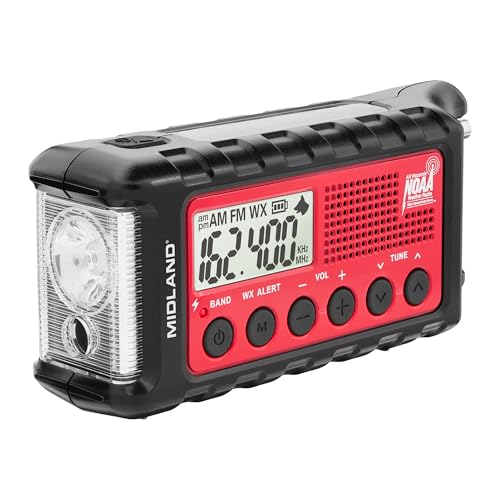
- Best Overall: Midland ER310 Emergency Crank Weather Radio — Check on Amazon
- Most Capable: Kaito KA500 Voyager Emergency Radio — Check on Amazon
- Best Budget: FosPower Emergency Weather Radio A1 — Check on Amazon
Read the full guide ↓
The emergency radio pros and cons question is really two questions: what does the category do better than any alternative, and where does it quietly disappoint the people who bought it with the wrong picture in mind? This page answers both at category level — the strengths and trade-offs of emergency radios as a class — and then names the specific models that sit on each side of every point, so the trade-offs stop being abstract.
Emergency Radio Pros and Cons: The Strengths, Expanded
It works when the networks do not. Broadcast is the most failure-resistant information system ever built. NOAA transmitters and local stations run on backup power, their signals pass through weather that grounds drones and congests towers, and a receiver needs nothing but a charged battery and an antenna. Every other information layer in a modern home — apps, streaming, social feeds, even text alerts — depends on infrastructure that emergencies are specifically good at breaking.
It wakes you, specifically, for danger. Alert standby is the feature no phone replicates reliably. A weather radio sits silently for months and then, at full volume, speaks the warning the moment it is issued — no notification settings, no do-not-disturb exceptions to configure, no battery-saver quietly killing the app that was supposed to warn you.
Its power story has no single point of failure. Crank, solar, rechargeable pack, disposable cells, wall power: the category’s whole design philosophy is layered energy. A radio with three or more independent power paths is close to unkillable by an outage, and the layers are cheap because the device sips power by design.
It is bought once and lasts for years. No subscription, no software expiry, no planned obsolescence. The broadcast standards these radios receive have been stable for decades, and long-term owner reports of radios serving six, eight, ten years are routine rather than remarkable.
It consolidates the small tools of an outage. Radio, flashlight, reading lamp, SOS beacon and a ration of phone charging in one findable object. Each function is a compromise against a dedicated tool — and the consolidation is still worth it at 2 a.m., when one object in a known place beats five objects in five forgotten places.
In this guide
The Trade-offs, Expanded
Phone charging is a ration, not a refill — on most models. The maths of small batteries is unforgiving, and buyers who picture a power bank with a radio attached will be disappointed by every model under the flagship class. Treat the USB output as emergency communication money and the disappointment disappears; the one genuine exception is ranked in our Best Emergency Radio Under $200 guide.
Alert does not always mean filtered. Most portables wake for the whole transmitter area. Buyers in multi-county coverage who expected surgical precision need SAME decoding, which lives mainly in desktop sets and a handful of portables — a distinction the Emergency Radio Buying Guide explains in full.
Solar and crank are oversold by the category’s marketing. Panels maintain; cranks bridge. Neither refills a large battery in useful time, and the buyer who believes otherwise will meet the truth during the first long outage. The honest designs publish their ratios; read them.
It is receive-only, and deliberately so. An emergency radio cannot call for help, send a message or ask a question. It is one layer — the information layer — and households that need two-way capability must add it separately rather than expecting it here.
It punishes neglect completely. No category of product is more binary about maintenance. Charged and tested, it is close to perfectly reliable; stored flat and forgotten, it is a brick. The discipline required is minutes per year, but it is genuinely required.
Specifications in Context
- Bands: AM, FM and all 7 NOAA weather channels (162.400–162.550 MHz)
- Battery: 2,600 mAh rechargeable lithium-ion, rated for up to 32 hours of normal use
- Backup power: also runs on 6 AA batteries (not included), selected by a switch
- Charging: hand crank, solar panel or micro-USB cable
- Extras: Cree LED flashlight with SOS beacon, ultrasonic dog whistle, headphone jack, USB output for emergency phone charging
Those are the benchmark portable’s numbers, and they frame the category: multi-thousand-milliamp-hour storage, three-plus power paths, all seven weather channels, and lighting as a secondary system. Compare any model against that frame — as the Emergency Radio Review does in depth — and its position in the class becomes obvious.
Who Should Buy, and Who Should Skip
Best for: households in weather country, outage-prone and rural households, and anyone building a first serious kit / Not suited for: buyers seeking two-way communication, heavy phone charging, or a zero-maintenance talisman
Within the category, the choice is about emphasis: the Midland ER310 Emergency Crank Weather Radio for the balanced benchmark, the Kaito KA500 Voyager Emergency Radio for bands and power paths, the FosPower Emergency Weather Radio A1 for the honest budget floor. The ranked lists by budget and household type — start with Best Emergency Radio Under $100 — make the final call.
Crank and Solar: What the Numbers Actually Buy You
Hand cranks and solar panels are the features that sell emergency radios, and the two most misunderstood. A crank is a sprinter: a minute or two of steady turning buys minutes of listening — makers publish ratios in the range of one minute of cranking for five to fifteen minutes of radio, depending on volume. That is exactly enough to catch a forecast update or a warning repeat, and nowhere near enough to refill a battery. Treat the crank as a bridge between charges, never as the charge itself, and turn it at the steady pace the manual suggests rather than in frantic bursts that stress the handle.
A solar panel is a maintainer. Sized to fit a radio’s case, it can offset the slow self-discharge of a stored battery and stretch listening time on a sunny porch, but filling an empty multi-thousand-milliamp-hour battery from panel alone takes days of good sun. The practical routine is boring and effective: charge fully by cable, store the radio where the panel sees daylight if possible, and top up by cable every few months. Radios that also accept ordinary AA or AAA cells add the outage-proof layer no rechargeable can match — a drawer of fresh alkalines is a power station that never needs charging.
Storing an Emergency Radio So It Works in Year Three
Emergency radios rarely die in emergencies; they die in drawers. The failure pattern is almost always the same: a rechargeable battery left flat for a year loses capacity or refuses charge, alkaline cells left installed leak and corrode the contacts, and the radio is discovered dead at the moment it is needed. The fixes are a calendar habit, not a purchase. Charge the radio fully, note the date, and set a repeating reminder — every three to six months is the rhythm makers suggest — to top it up and run it for ten minutes.
Store backup AA or AAA cells beside the radio, not inside it, in their packaging with the date visible. Keep the radio somewhere it will be found in the dark: the same shelf, the same drawer, every time, with its cable coiled alongside. If your household has a go-bag, the radio lives in the bag and the calendar reminder includes checking it there. This unglamorous routine is the difference between the radios in long-term owner reports that ‘still work after six years’ and the ones that do not, and it costs nothing but attention.
How the Balance Lands, Household by Household
For the storm-country household, the strengths win outright: alert standby and broadcast independence address the exact failure — a warning unheard at 3 a.m. — that defines their risk, and the trade-offs barely register. For the outage-prone rural household, the balance also favours buying, with the power-layering strength doing the work; the one trade-off to engineer around is phone charging, solved by pairing the radio with a dedicated bank. For the apartment household in a mild-weather city, the case is thinner but still positive: the radio is inexpensive insurance whose most-used features will honestly be the flashlight and the FM tuner, and there is nothing wrong with buying it on those terms with open eyes.
For the committed minimalist, the trade-offs deserve their full weight. A household that already maintains a SAME desktop, owns good lights and banks, and tracks its gear on a calendar has genuinely covered the layer; a fifth device adds storage burden, not safety. And for the buyer who knows they will never test or top up anything, the honest recommendation is to fix the habit with the gear already in the house before adding a radio to the list of neglected objects. Pros and cons are not a verdict machine — they are a way of seeing which side of the ledger your own household actually lives on.
A Note on the Numbers You Will See Elsewhere
Shoppers comparing this page with retailer listings will meet figures we have deliberately excluded: star averages, review totals, discount percentages and prices that change by the week. Their absence here is a methodological choice, not an oversight. A rating printed in an article is a photograph of a moving crowd — accurate for a day, misleading for a year — and a price printed beside a recommendation quietly turns a guide into a snapshot that ages in dog years. What does not age is the structure this page is built on: what the radio receives, how it is powered, how it alerts, and what its makers publish about its own endurance.
Use the live listing for the moving numbers, at the moment of purchase, where they belong — and use this page for the questions the listing will never answer: whether tone alerting fits your county, whether the battery is replaceable in year five, and whether the radio’s compromises point toward your household or away from it. That division of labour between a stable guide and a live listing is the honest way to buy anything in this category.
Understanding NOAA Weather Radio and the Seven Channels
Every radio in this guide receives the same public service: NOAA Weather Radio, a nationwide network of transmitters broadcasting forecasts, watches and warnings around the clock on seven channels between 162.400 and 162.550 MHz. The broadcasts are free, require no subscription and no licence to receive, and they keep transmitting when mobile networks are congested or down — which is precisely when you need them. Your first setup task with any emergency radio is finding which of the seven channels comes in strongest at your address; radios with automatic weather scan do this for you, while manual models ask you to step through the channels and pick the clearest voice.
Reception follows terrain, not hope. A transmitter’s useful range is typically a few dozen miles, shortened by hills, valleys and the steel and concrete of large buildings. Raising the telescopic antenna fully, placing the radio near an exterior wall or window, and keeping it away from interference sources like LED power supplies and computer chargers all make a measurable difference. Test reception on a calm day, at the spot where the radio will live, rather than during the storm — the weekly NOAA test, usually on Wednesday late morning, confirms your alert setup end to end.
Tone Alerts vs SAME: The Difference That Decides Your Sleep
Two alert systems hide behind the single word ‘alert’ on emergency radio boxes, and they behave very differently at 3 a.m. A tone-alert radio stands by silently on a weather channel and wakes when it hears the 1050 Hz attention tone that opens every watch and warning broadcast. It is simple, reliable and completely unselective: you hear every warning for the transmitter’s whole coverage area, which can span several counties. A SAME radio decodes the digital header in the broadcast and compares the county codes inside it with the codes you programmed, waking you only for your own area.
Neither is strictly better. Tone alerting can never be mis-programmed, never misses because of a typo in a county code, and suits portable radios that travel between places. SAME filtering suits a fixed bedside radio in a large coverage area, where tone alerting would otherwise mean several false wake-ups a month. Many households end up with both: a SAME desktop in the bedroom and a tone-alert crank radio for the rest of the house. Our dedicated explainer, Emergency Radio Buying Guide, walks through programming a SAME code step by step.
How Much Phone Charging to Expect — Honestly
Almost every radio here offers a USB output, and almost every buyer overestimates it. The maths is unforgiving: a phone battery today holds roughly as much energy as the radio’s own pack, and conversion losses take their share of whatever moves. A 2,000 mAh radio can therefore return a modern phone from flat to perhaps a third charged; a 5,000 mAh model can do meaningfully better; the 10,000 mAh flagship class can refill a phone outright. On the smallest radios, think of the output as call-and-text money — enough for the essential messages — not as a power bank replacement.
Two habits make the feature work better. First, charge the phone in short sessions with the phone in airplane mode and its screen off, which dramatically improves how much of the transferred energy stays in the phone. Second, decide the priority before the outage: the radio’s first job is information, so keep a reserve for listening and spend only the surplus on the phone. Households that expect multi-day outages should pair the radio with a dedicated power bank — our roundup of the Best Power Bank For Emergencies Under $50 covers that layer — and let each tool do the job it is sized for.
Antennas, Placement and Reception Troubleshooting
When a weather radio sounds scratchy, the antenna and the address are usually both innocent — the placement is guilty. Weather-band signals at 162 MHz behave like light in some respects: they pass through wood and drywall, struggle with metal siding, foil-backed insulation and below-grade rooms, and improve dramatically with height and a window line. Start by fully extending the telescopic antenna vertically, then move the radio in a slow grid around the room while a broadcast plays; most rooms contain one or two spots where the signal turns clear, often near an exterior window.
Problem: the broadcast fades in and out as people move around the room. That is multipath interference, and the fix is relocation, not volume — shift the radio a foot or two and re-extend the antenna. Problem: a buzzing or pulsing interference under the voice. Move the radio away from LED bulbs, dimmers, chargers and computers, which radiate exactly this noise. Problem: no channel comes in clearly anywhere in the house. Check the NOAA coverage map for your county — fringe addresses exist, and the cure is a radio with an external antenna jack, mounted as high as the cable allows. These steps solve the overwhelming majority of ‘bad radio’ reports without spending anything.
Building the Two-Radio Household Setup
One radio is a tool; two radios are a system. The pattern that experienced households converge on pairs a plugged-in alerting radio where people sleep with a portable crank radio where people live. The bedroom set — ideally SAME-filtered — has one job: wake the household for the warning that matters, at full volume, without depending on anyone remembering to charge it. The portable’s job is everything after the wake-up: news and official information during the outage, light for moving around, and a ration of phone charging, wherever in the house or yard it is needed.
The pairing also solves the battery dilemma. The plugged-in radio’s backup cells are changed on a schedule, and the portable is the one that travels — to the car for a road trip, to the porch for a storm watch, into the go-bag for an evacuation — while the bedroom sentinel never moves. Total cost of the system can stay inside a single premium radio’s budget if the portable is a budget pick, and our Best Emergency Radio For Home Use Under $100 guide assembles exactly this pairing at that level. Add a dedicated flashlight per person — see the Best Emergency Flashlight Under $50 roundup — and the information-and-light layer of the household kit is complete.
What Shortwave Adds, and What It Does Not
Shortwave is the band that confuses emergency-radio shoppers most, because its value is real but narrow. Shortwave broadcasts travel by bouncing between the ionosphere and the ground, so a listener can hear stations from other continents with no infrastructure in between — in a regional disaster, that means news and official broadcasts from entirely outside the affected area. International broadcasters, time-signal stations and amateur traffic still populate the bands, and the two radios in this guide with shortwave coverage open that window for the price of an analog dial.
What shortwave does not provide is local information. It will not tell you which bridge is closed, which shelter is open or when your utility expects power back; that lives on local AM and FM and on the NOAA channels. Reception also varies with time of day — bands that are busy at night can be quiet at noon — and a telescopic whip hears only the stronger signals. Buy shortwave as a supplement for wide-area events and for the genuine pleasure of distant listening, never as a substitute for the weather band, and manage expectations accordingly.
Emergency Radios for Kids, Guests and Older Relatives
The best emergency radio for someone else is the one they can operate half-asleep, in the dark, possibly frightened. That argues for big buttons over clever menus, digital tuning over analog dials, and a display that can be read without glasses. It also argues for rehearsing: five calm minutes showing a parent or a teenager how to turn the radio on, find the weather channel and work the flashlight is worth more than any feature list, because in the event itself nobody reads manuals.
Consider the listener’s specifics. A headphone jack lets an older relative listen at their own volume without filling the house, and lets a light sleeper monitor a storm without waking a partner. An alarm-clock format earns a permanent nightstand spot in a guest room, where a strange black box would be unplugged and drawer-bound. For children, the flashlight and the reading lamp are the features that build familiarity — a radio they use on ordinary sleepovers is a radio they will use correctly on the one night it matters. Our beginner-focused guide, Best Emergency Radio For Beginners Under $50, ranks the current models by exactly this ease-of-use standard.
Weather Radio vs Weather Apps and Phone Alerts
Phones already receive wireless emergency alerts, so why own a radio at all? Because the phone system and the radio system fail in different ways. Phone alerts depend on charged batteries, intact towers and uncongested networks; they also arrive on a device that is simultaneously the household’s torch, map, camera and link to family — a device whose battery everyone is trying to save. A weather radio depends on a broadcast transmitter with its own backup power and a signal that reaches a cheap receiver with days of standby in it. In event after event, the broadcast keeps working through the exact hours when networks are busiest.
The radio also hears more. Wireless alerts carry the most urgent warnings in a short text burst; the NOAA broadcast carries the full discussion — the forecaster’s own words about timing, uncertainty and what happens next — plus the all-clear and the follow-up statements that phones never send. The sensible household treats the systems as layers: phone alerts for the first tap on the shoulder, the radio for understanding, and local AM/FM for recovery information. The question our worth-it analysis — Is An Emergency Radio Worth It — examines is not whether the radio beats the phone, but whether the layer is worth its modest shelf space. For most homes, it is.
Reading a Spec Sheet: Which Numbers Are Load-Bearing
An emergency radio listing can carry thirty specifications, of which perhaps six decide whether the radio serves you. Load-bearing: the bands received, the alert type, the power paths, the battery capacity together with a runtime figure, whether that battery is replaceable, and the charging connector. Everything else — flashlight lumens beyond a basic threshold, siren decibels, the count of LED modes — is garnish that costs little and decides less. Train yourself to read a listing in that order and the category’s marketing loses its power to confuse.
Two numbers deserve special suspicion. Battery capacity quoted without a runtime figure invites you to imagine the runtime; insist on the maker’s own hours-at-a-volume figure before comparing models. And any ingress rating should name its standard — IPX3 shrugs off splashes, IPX4 handles rain from any direction, and neither means the radio can be submerged, whatever the listing’s photography implies. Where a figure in this guide could not be verified against a maker or a reputable retailer’s record, we left it out rather than repeat it, and the sources file for each article shows the working.
The Weekly Test: Your Radio’s Standing Appointment
NOAA Weather Radio stations broadcast a test alert every week, typically on Wednesday between late morning and noon local time, weather permitting. That test is the most underused feature in the entire emergency-radio system: it proves, end to end, that your radio is on the right channel, in a working spot, with its alert mode armed and its volume sufficient — the four things that decide whether a real warning reaches you. Radios with SAME decoding treat the test like any other alert for your county; tone-alert radios wake for it too.
Build the household habit around it. The first time the test sounds, gather whoever is home and let them hear what a warning will sound like at night; familiarity in daylight is what prevents panic-fumbling in the dark. If the test does not arrive, troubleshoot in order — channel, placement, alert mode, power — before concluding anything about the radio itself. And when the test is postponed for real weather, as stations do, that fact alone is a useful reminder that the system you are relying on is staffed, live and paying attention.
Emergency Radios in Cars, Cabins and Second Homes
A radio that lives away from home faces a harder life than the kitchen-counter set: temperature swings in a parked car, months of neglect in a cabin, and an owner who arrives to find whatever state it was left in. The designs that survive this duty share three traits — a replaceable battery you can pull and store separately in extreme climates, a disposable-cell path that does not care how long it has sat, and a body without delicate protrusions. Compact sets earn their keep here precisely because they fit the glovebox or the cabin’s single drawer.
Set expectations for the arrival ritual: check the radio before the bags are unpacked, top it up while the kettle boils, and run the weather band to learn the local channel, which may differ from home. In a second home, leave the setup written on a card inside the radio’s bag — channel, alert mode, where the spare cells live — because the person who needs it may be a guest, a renter or a relative who has never seen the place in an emergency. The radio’s job in these settings is not daily service; it is being certainly alive on the one weekend it is needed.
Power Banks, Solar Generators and Radios: Dividing the Jobs
Preparedness marketing loves the all-in-one device, but energy jobs divide cleanly once you look at the loads. Information — radio listening — costs very little power and runs for days on a small battery. Light costs more. Phone charging costs the most of the three by an order of magnitude. An emergency radio is engineered for the first job and borrows against it for the other two; a power bank is engineered for the third; a solar generator serves household loads a radio never touches. Trouble starts when one device is silently expected to do all three jobs for days.
The sane division: let the radio be the information appliance, with its light and its phone ration treated as bonuses; let a dedicated power bank own phone duty; and let anything larger wait until your outage history justifies it. This is why our guides keep steering heavy phone users toward a separate bank — see the Best Power Bank For Emergencies Under $50 roundup — rather than toward ever-bigger radios. Each tool sized to its job is cheaper, lighter and more reliable than one tool stretched across all of them.
What to Do in the First Hour of a Warning
A warning is not information to consume; it is a clock that starts. The first hour divides naturally. In the first minutes, the radio’s job is comprehension: which hazard, which areas, what timing, and what the forecaster’s discussion says about uncertainty — the broadcast carries all of it, in the forecaster’s own words, and repeats it on a cycle short enough to catch what you missed. Move people, not objects: get the household to the safe room or the agreed spot first, with the radio in hand.
Then the radio becomes the household’s anchor while phones stay dark to save their batteries. Note the warning’s expiry and the update rhythm, and let one person own the listening so everyone else can work, rest or reassure children. When the all-clear or the follow-up statement comes, it will come on the broadcast before it trends anywhere else. None of this requires heroics; it requires a radio that was charged, a channel that was found in advance, and a household that has heard the test alert on a calm Wednesday and knows what the sound means.
AM Radio’s Quiet Second Career in Emergencies
Buyers fixate on the weather band, but in the long tail of an outage — day two, day three — the AM dial does much of the work. Big AM stations run on serious backup power, their signals travel hundreds of miles at night, and local talk and news formats become rolling briefings: utility restoration estimates, water and shelter information, road reopenings, school decisions. An emergency radio with a weak AM section is half-equipped for the recovery phase even if its weather band is flawless.
AM reception has its own physics worth knowing. The ferrite antenna inside every set is directional: rotating the radio itself, not its telescopic whip, is how you peak an AM station and null out interference. Night brings distant stations crowding the dial — a curiosity in normal times, and in a regional disaster a genuine asset, because the station carrying your county’s news may be audible from a transmitter towns away when nearer ones are silent. When you compare radios, weight AM sensitivity and audio clarity accordingly; they are recovery tools, not nostalgia.
Flashlights, Lamps and Beacons: The Lighting Layer
Every radio in this guide carries light, and the three kinds do different work. The main flashlight is a movement tool — directional, bright, and hungry; its highest mode is for minutes, not hours. The reading lamp is a living tool — diffuse, gentle, and the one that makes an outage evening bearable at a fraction of the power; the best designs put it on a timer or a motion sensor so it spends nothing on an empty room. The red beacon and SOS modes are signalling tools, for being found rather than for seeing, and their value is measured in the one night they are needed rather than in nightly use.
Judge a radio’s lighting as a system with its battery, not as a lumens contest. A bright light on a small battery is a short light. Households that expect long outages should still own dedicated lights per person — the Best Emergency Flashlight Under $50 roundup covers that layer — and treat the radio’s lamp as the shared area light. That division keeps the radio’s reservoir pointed at its first job: information.
Hearing the Warning: Volume, Jacks and Accessibility
An alert nobody hears is a tree falling in an empty forest, and households differ enormously in hearing. Start with raw output: an alerting radio should be able to fill a bedroom at full volume, and its siren should be the kind of sound that ends sleep rather than decorating it. Then look at the outputs beyond the speaker. A headphone jack serves the light sleeper who monitors storms solo and the older listener who needs volume without filling the house. Desktop sets with alert-output jacks go further, driving strobes and bed-shakers for deaf and hard-of-hearing sleepers — a capability worth requiring explicitly if anyone in the home needs it.
Visual alerting matters too: colour-coded indicators that distinguish warning from watch at a glance, displays that stay lit or light on alert, and beacons that flash in peripheral vision. When you shop for a parent or a relative, shop this section of the specification first and the bands second. The best radio for another person is the one whose warning they will actually perceive, at 3 a.m., through a closed door and a lifetime of hearing loss.
Evacuation Kits: Where the Radio Ranks
In an evacuation, the radio competes for bag space with water, food, documents and medication, and it earns its place on a specific ground: it is the only information source that works in a traffic jam of dead phones, in a shelter with no spare outlets, and on a route where the local stations change every hour. Pack it where a hand finds it without unpacking — top pocket, its own pouch — with its cable, and with the spare cells in a separate small bag so a leak cannot reach it.
Before any season that might send you out, run the kit check: radio charged within the last few months, weather band tested at home, a note of the NOAA channels for your likely destinations, since the strongest channel changes with geography. In the car, the radio’s flashlight and beacon cover the breakdown case, and its phone ration covers the ‘we are safe’ messages. It is not the heaviest item in the bag or the most precious, but it is the one whose absence is felt first when the plan changes at midnight.
The History in the Room: Why Weather Radio Works
NOAA Weather Radio is one of the oldest continuously running alert systems in the country, and its age is its strength. The network was built transmitter by transmitter across the twentieth century precisely because broadcast has a property no networked system has matched: one transmitter serves every receiver in range simultaneously, with no congestion, no accounts, no updates and no failure mode in which too many people listening makes the signal worse. During the largest events on record, that property has kept official information flowing to anyone with a working receiver and a battery.
The SAME encoding layer added county precision in the 1990s, and the receiver standards that followed — including the Public Alert certification several picks in this guide carry — turned a hobbyist device into a household appliance with tested wake-up behaviour. Understanding that lineage explains the category’s conservatism: the designs change slowly because the system they serve is a public utility, and reliability there is measured in decades. When you buy a weather radio you are not buying into a product cycle; you are buying a terminal for infrastructure that intends to outlive us all.
Field Notes: The Patterns in Long-Term Owner Reports
Read enough years of owner reporting on any model in this guide and the same patterns surface, independent of brand. The radios praised at year five share a biography: they were set up once, properly; they live somewhere visible; their batteries are topped up on a rhythm; and their owners can describe the weekly test from memory. The radios condemned at year one share the opposite biography — bought during a scare, never set up, stored flat, discovered dead. The product in the middle of those stories is usually identical; the ownership is what differed.
Two smaller patterns are worth a buyer’s attention. First, reception complaints cluster around placement, not models: the same radio is ‘deaf’ in a basement and ‘excellent’ by a window, and the fix travels with the radio rather than the brand. Second, crank handles and telescopic antennas account for most physical failures, and both fail from storage and handling — crushed in bags, bent in drawers — far more often than from use. Store the radio like the instrument it is, and the long-term reports suggest it will repay you in the only currency that matters here: working, every time it is asked.
Frequently Asked Questions
What is the difference between a weather radio and an emergency radio?
A weather radio is any receiver that picks up the NOAA weather band. An emergency radio is a weather radio built for outages: it adds self-charging (crank, solar or both), a flashlight, and usually a USB output for a phone. A plugged-in SAME desktop set is a weather radio but not really an emergency radio; every portable pick in this guide is both.
What does SAME mean and do I need it?
SAME — Specific Area Message Encoding — is the digital code at the start of NOAA alert broadcasts that names the counties affected. A SAME radio compares those codes with the counties you entered and only alarms for yours. You need it if your transmitter covers several counties and you are tired of irrelevant wake-ups; you can skip it in a portable that travels, where tone alerting’s simplicity wins.
How long does hand cranking take to charge the battery?
Longer than the box implies. Cranking is designed to buy listening time directly — makers quote ratios from about five to about fifteen minutes of listening per minute of cranking — rather than to refill a battery, which would take hours of continuous turning. Charge by cable whenever a cable is available and save your arm for the outage.
Should I buy one radio or two?
Two, if the budget allows — and the pair can cost less than one premium radio. A plugged-in alerting set in the bedroom guarantees the wake-up; a portable crank radio covers information, light and phone top-ups everywhere else. If only one fits the budget, choose the portable with alert standby and keep it where the household sleeps during storm season.
Do emergency radios need a licence or subscription?
No. Receiving AM, FM, NOAA weather broadcasts and shortwave is free and licence-free everywhere in the United States. The radios in this guide are receivers only — they cannot transmit — so there is nothing to register and nothing to renew. Costs begin and end with the purchase and the occasional set of backup batteries.
Do these radios receive local news during an outage?
Yes — that is the AM/FM tuner’s job. Local stations carry utility updates, shelter information, road closures and official briefings long after the weather itself has passed, and they broadcast from generators when other media are dark. It is the strongest argument for choosing a full emergency radio over a weather-band-only desktop set as your portable.
Bottom Line
The strengths of the emergency radio are structural — broadcast independence, alert standby, layered power, decade-long service — and its trade-offs are mostly expectation errors that a careful buyer can delete before ordering. Read the trade-offs twice, buy for the strengths, and maintain the radio like the appliance it is.