Disclosure: As an Amazon Associate, umtsmarttool.com earns from qualifying purchases. Links to Amazon on this page are affiliate links; they cost you nothing extra. Prices and availability change often, so check the current Amazon listing before you buy.
Where to buy
This review centres on the Intex 28003E Deluxe Pool Maintenance Kit, with the closest alternatives — Bestway 58237 AquaClean Deluxe Pool Maintenance Kit, Intex 28002E Cleaning Maintenance Kit, Sepetrel Deluxe Pool Cleaning Kit with Spa Jet Vacuum — compared throughout. Every linked product says check price on Amazon; printed prices in this category go stale between seasons.
Read the full guide ↓
Plural matters: pool cleaning kit reviews exist because no single kit review can answer the question most buyers actually have, which is which type of kit their pool needs. This page reviews the category’s main contenders side by side — the pump-powered deluxe kits, the hose-powered starter kits and the compact spa kits — and is organised by the decisions that separate them: your pump’s flow rate, your pool’s size, and which of the three cleaning jobs your pool actually struggles with. The ranked, budget-by-budget version of this comparison runs through Best Pool Cleaning Kit Under $50, Best Pool Cleaning Kit Under $75 and Best Pool Cleaning Kit Under $100.
The reference kit for the category, reviewed in depth, is the Intex 28003E Deluxe; the single-product deep dive is at Pool Cleaning Kit Review, and the newest-season update is at Pool Cleaning Kit Review 2026. This page is the comparative one: shorter on any single kit, longer on the differences that decide between them, and blunt about the tier where each type stops working.
Quick Verdict: Pool Cleaning Kit Reviews
Best for: buyers comparing kit types before committing — the deluxe pump-powered kits win for large pools with strong pumps, hose-powered kits win for small pools and weak pumps, compact kits win for spas and inflatables / Not suited for: readers who want a single unqualified winner
Comparative reviewing has to resist the single-winner format, because in this category the winner genuinely changes with the pump and the pool. What can be said without qualification: the Intex 28003E is the most complete manual kit for big above-ground pools, the Bestway 58237 is its equal for Bestway pools with smaller pumps, the Intex 28002E is the safest first kit ever sold, and the Sepetrel spa jet kit owns the small-water niche. The sections below review each on the same terms.
In this guide
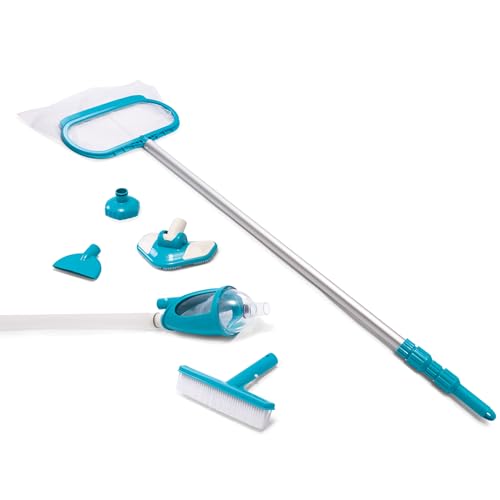
Intex 28003E Deluxe Pool Maintenance Kit: The Specs That Matter
- Telescoping aluminium pole extends to 110 inches
- 24-foot vacuum hose with connectors included
- Vacuum runs off a filter pump of 800 GPH or more
- Includes leaf rake, curved wall brush, vacuum head with two nozzles and a scrubber vacuum
- Built for above-ground pools of 18 feet and larger
The reference specs belong to the 28003E because it defines the full-kit template the others are measured against: pump-powered vacuum, 110-inch pole, 24-foot hose, tools for all three surfaces. Against that template, every rival is a deliberate subtraction — the Bestway lowers the flow threshold and drops the brush, the 28002E swaps pump power for hose power and drops the brush too, the Sepetrel drops size itself. Reviewing this category means reviewing subtractions and asking whether what was dropped is what your pool needed least.
Ownership is where this kit quietly wins. Because every head clips to standard poles and the hose uses common cuff sizes, a torn net or a worn brush is a small replacement purchase rather than a new kit, and Intex parts circulate widely enough that nothing needs hunting. The routine it enables is also the most forgiving of the pump-powered options: once the hose-priming habit is learned, a full clean of a big pool settles into a predictable half hour, and the kit’s completeness means that routine never waits on a missing tool. Owners stepping up from a starter kit will feel the difference most in the shoulders — the long pole and real suction replace the leaning, reaching and re-passing that make small kits tiring on big water.
Strengths
- The most complete manual kit in this cluster: surface, wall and floor tools in one box
- Pump-powered vacuum lifts settled debris instead of just stirring it up
- Long pole and hose reach across big frame pools without walking the perimeter
Trade-offs
- Useless for vacuuming if your filter pump flows under 800 GPH
- No water-test gear or chemical dispenser in the box
- Hose priming and pump connections add setup minutes to every session
The Pump-Powered Deluxe Kits, Reviewed
The Intex 28003E and Bestway 58237 are the same idea executed by the two brands that own the above-ground market: borrow the filter pump’s suction, include every hand tool, and let the owner run a complete weekly routine from one box. Reviewed on cleaning performance, they are the strongest manual option in the category — real floor suction, not stirred debris — and on convenience they are mid-pack, because priming a hose and connecting to a pump is a ritual the hose-powered kits skip. Their shared weakness is the threshold: 800 GPH for Intex, 530 gal/h for Bestway, and a pool whose pump falls below its kit’s line owns a vacuum that will not vacuum.
Between the two, brand loyalty is actually rational: each is plumbed for its own pumps. Cross-brand owners face adapters and seals. Within brand, the choice is the threshold and the brush — Intex includes one, Bestway does not — which is why Bestway owners should budget a brush alongside, a point the Bestway-focused lists in this cluster repeat because it is so often missed.
The Hose-Powered Starter Kits, Reviewed
The Intex 28002E and its venturi cousins replace pump suction with garden-hose pressure, and the review verdict is that the trade is better than it sounds for the pools they target. Suction is gentler and fine silt can blow through the bag, but the kits work with any pool, any pump, or no pump at all — which describes most first pools exactly. The 28002E adds a surface skimmer on a 94-inch pole and skips the brush; the Sepetrel spa jet kit adds the brush and shrinks everything for small water.
Reviewed on their own terms — small pools, weekly rhythm, light debris — these kits finish the job. Reviewed as rescue tools for a neglected green pool, they fail, and so does every manual kit; that job belongs to shock treatment, filtration time and patience, with the kit in a supporting role.
The Compact and Specialist Kits, Reviewed
Compact kits — the Sepetrel spa jet, the POOLWHALE T358, the TidyMister three-piece — review well precisely because they refuse to be generalists. Their poles are short because their water is small; their bags are small because their debris is little and often; their storage footprint is a feature the big kits cannot copy. The surface-and-walls specialists, such as the Sepetrel 10.5 ft kit, make the opposite refusal: no vacuum, money spent on reach and brush width instead.
The reviewing mistake to avoid is scoring specialists on the generalist rubric. A spa kit that cannot clean an 18-foot pool is not a bad kit; it is a kit whose box tells the truth. The failures in this category are the kits whose marketing claims every pool and serves most of them badly — and none of those is recommended anywhere in this cluster.
Durability and Ownership, Reviewed Across the Category
Across all types, ownership patterns repeat. Nets and brush heads are wear items everywhere; poles and vacuum bodies are durable everywhere; hoses fail at cuffs when stored kinked and sun-baked. The kits that age best are the ones whose soft parts can be reordered individually and whose heads fit standard poles, because a torn net then costs a net, not a kit. Intex and Sepetrel both score well on that measure; the prose-only kits in this cluster’s lists are the ones where replacement-part reality could not be verified, which is part of why they are prose-only.
Cost of ownership beyond parts is the pump relationship: pump-powered kits make filter maintenance part of cleaning performance, while hose-powered kits trade that dependency for a small ongoing water addition. Neither is a defect. Both are worth knowing before the purchase rather than after.
How It Compares with the Alternatives
The table below lines the reference kit up against the three alternatives this page reviews most closely.
| Kit | Key spec | Standout detail |
|---|---|---|
| Intex 28003E Deluxe Pool Maintenance Kit | Telescoping aluminium pole extends to 110 inches | Vacuum runs off a filter pump of 800 GPH or more |
| Bestway 58237 AquaClean Deluxe Pool Maintenance Kit | Vacuum, skimmer net, telescopic pole and hose in one kit | Sized for above-ground pools up to 20 feet in diameter |
| Intex 28002E Cleaning Maintenance Kit | 94-inch telescoping aluminium pole | Surface skimmer net included |
| Sepetrel Deluxe Pool Cleaning Kit with Spa Jet Vacuum | Spa jet vacuum powered by garden-hose pressure — no pump or electricity | Semi-deep skimmer net for surface debris |
The pattern to take from the table is that the differences are thresholds and subtractions, not quality tiers. A buyer whose pump flows 600 gal/h should not read the 28003E’s higher threshold as superiority; for that buyer the Bestway is simply the better kit. A buyer with a covered pool and a clean floor should not read the Sepetrel pole kit’s missing vacuum as a flaw. Reviews that rank these kits on one ladder mislead; this cluster’s budget lists — Best Pool Cleaning Kit For Beginners Under $75 among them — rank within a stated pool and pump context for exactly that reason.
Bestway 58237 AquaClean Deluxe Pool Maintenance Kit in brief
Bestway’s 58237 AquaClean Deluxe is the natural counterpart to the Intex deluxe kit for the huge number of households running Bestway or Coleman pools. The formula is similar — a pump-driven vacuum, a skimmer net, a telescopic aluminium pole and a hose — but Bestway tunes it for the smaller pumps its pools ship with: the vacuum works with filter pumps flowing 530 gallons per hour or more, the lowest threshold among the full kits researched for this cluster. If your pump is the modest cartridge unit that came in the pool box, this kit is far more likely to actually pull than rivals that demand 800 GPH.
For Bestway and Coleman owners there is a further, practical ownership point: staying inside the brand’s ecosystem keeps every connection hand-tight and every replacement part one search away. The kit also plays well with the way Bestway pools are actually used — put up in late spring, worked hard all summer, packed away in autumn — because nothing in the box needs winterising beyond a rinse and a dry shelf. Its one structural gap, the missing brush, is best closed at purchase time with any standard 17.5-inch head on the same pole, after which the weekly routine is complete and the kit asks nothing more of its owner.
Intex 28002E Cleaning Maintenance Kit in brief
The Intex 28002E is the starter kit Intex has sold alongside its Easy Set and frame pools for years, and its design makes one smart trade: instead of borrowing suction from a filter pump, the vacuum head runs off garden-hose water pressure. A venturi jet inside the head creates the pull, and debris collects in a reusable mesh bag clipped behind it. That means the kit works even with the tiny pumps bundled with small pools — or with no pump running at all — which is exactly the situation most first-time pool owners are in.
In ownership terms, this is the lowest-friction kit in the cluster. There is no pump compatibility to manage, no hose to prime beyond the garden hose itself, and nothing electrical anywhere near the water. The debris bag is the only consumable-adjacent part and it is reusable; when the net eventually tears, the head fitting is standard, so the pole’s working life continues with any replacement head. Its ceiling is set by physics rather than quality — gentle suction, small bag, no brush — and owners who respect that ceiling, cleaning weekly on a small pool, routinely get years of service from a kit that costs less than a single professional visit.
Sepetrel Deluxe Pool Cleaning Kit with Spa Jet Vacuum in brief
Sepetrel’s spa jet kit is built for the pools that full-size kits serve badly: inflatable pools, small above-ground rings, spas and hot tubs. The vacuum is a venturi jet head that runs off a garden hose, so it needs no filter pump and no power, and the pole tops out at 57.5 inches — short by design, because in a ten-foot pool a nine-foot pole is a liability that bangs the far wall every time you turn. The semi-deep skimmer net splits the difference between a flat skimmer and a deep leaf bag, which suits small water where debris arrives in handfuls rather than drifts.
Living with the spa jet kit is mostly a story of storage and spontaneity. It lives in a small bag or a deck box, comes out for a ten-minute tidy that bigger kits would make into an event, and goes away again without a hose to coil or a pump to shut down. That low friction is exactly what small water needs, because small volumes show debris immediately and reward little-and-often cleaning. The brush-on-the-same-pole design means the algae film that plagues warm inflatable pools gets dealt with in the same visit as the leaves, which is the combination that keeps small pools clear without chemical heroics.
How the Types Age: A Durability Comparison
Reviewed across seasons rather than weekends, the types separate in an order that surprises buyers. The pump-powered deluxe kits age best in their hard parts — poles, heads, hoses are built for the largest pools and the heaviest use — but they carry the most connections, and connections are where age shows first: cuffs loosen, seals flatten, adapters crack. The hose-powered starters age simplest: a venturi head has almost nothing to wear, a pole is a pole, and the bag is the only regular replacement. The compact kits age fastest in their poles, whose short sections and small locks work hardest relative to their size, and best in their brushes, which see the lightest water.
The practical conclusion is not that one type wins, but that replacement-part access is the durability spec that matters. Every kit type in this comparison can be kept alive indefinitely if its nets, brushes and cuffs can be reordered; every type becomes disposable if they cannot. That is a researchable fact before purchase — search the kit’s name plus “replacement net” — and it is one of the checks this cluster applies before any kit earns a link.
The Category’s Shared Blind Spot: Water Care
Every kit reviewed on this page shares one omission, and a comparative review should name it as plainly as any single-kit flaw: none of them manages water chemistry. One bundle in the wider cluster includes test strips and a chlorinator, and that exception proves the rule — the category sells debris removal and lets owners discover testing and sanitising as a separate, unadvertised curriculum. The discovery usually arrives as cloudy water in a visibly clean pool, which is chemistry announcing itself.
The fair judgement is that this is a category boundary rather than a deception: kits are tool sets, and tools do not test water. But buyers comparing kits should budget and plan for the other half of pool care from the same day — strips or a liquid kit, sanitiser, and the two minutes per session that testing takes. Reviews that rank kits without mentioning it are reviewing half the job of owning a pool.
Matching the Review to Your Household
Comparative reviews end with a matching exercise, and this one is deliberately mechanical. If your pump flows 800 GPH or more and your pool is 18 feet or larger, the deluxe Intex is your kit and the comparison is over. If your pool is Bestway with a mid-range pump, the Bestway kit wins on its threshold and its fittings. If your pool is small, your pump is weak or absent, or this is your first season, the hose-powered Intex 28002E is the safest purchase in the category. If your water is a spa, an inflatable or a plunge pool, the Sepetrel spa jet kit is the shaped answer.
Households that match two rows — a family pool and a spa, a big pool and a paddling pool — should buy two kits rather than one compromise, a pairing the under-$100 lists in this cluster are built around. The worst outcome in this category is not buying the second-best kit; it is buying one kit to serve two kinds of water and serving both badly.
How to Read Kit Listings Like a Reviewer
Comparative reviewing teaches a listing-reading skill worth passing on, because kit listings in this category are written to blur exactly the distinctions this page exists to sharpen. Start with the contents photograph and count tools against the three jobs — surface, walls, floor — rather than against the piece count, since a twelve-piece kit can be eleven fittings and a net. Then find the pole’s extended length in the specifications, not the headline, and the vacuum’s power source in the description, not the pictures. Then find what is absent: no brush in the contents means no brush, however many lifestyle photographs show clear walls.
Two more reviewer habits transfer well. Check the pump minimum against your own pump before reading another word — it is the only spec that can void the entire purchase. And search the kit’s name with the words “replacement net” to learn, in ten seconds, whether the kit is maintainable or disposable. Listings that survive those five checks are usually honest products; listings that fail them are telling you something the manufacturer chose not to say plainly.
The Types, Priced in Time Instead of Money
One comparative lens this page has not yet applied is time, and it may be the fairest one. The deluxe pump-powered kits cost the most setup minutes per session — priming, connecting, basket checks — and repay them with the fastest floor work on big pools. The hose-powered starters set up in a minute and repay it with slower, gentler vacuuming that suits small floors. The compact kits set up fastest of all and finish small water before a deluxe kit has finished priming. Total session time, honestly measured, often ties across types on mid-size pools — which is why the comparison keeps returning to fit rather than crowning a winner.
Where time does separate the types is the neglected pool. Rescue cleaning multiplies every difference: the deluxe kit’s suction and the big net’s capacity pull hours ahead, while the compact kits’ small bags turn a rescue into a day. Owners who know their rhythm will slip — holidays, busy seasons — should weight that rescue performance more heavily than the weekly numbers suggest. It is the comparative version of an old truth: buy for the worst week, not the average one.
The Comparison, Compressed: One Paragraph Per Household
For the household with the big above-ground pool and the strong pump, this comparison exists to confirm a purchase: the deluxe Intex kit, bought once, ends the research. For the Bestway household, the comparison exists to redirect: your kit is the Bestway, your threshold is lower, and your only homework is the brush the box leaves out. For the first-pool household, the comparison exists to reassure: the cheapest safe kit in this review is genuinely sufficient for your water, and the money you did not spend belongs in test strips, sanitiser and a cover. For the spa and inflatable household, the comparison exists to shrink the purchase: the compact Sepetrel, shaped for your water, will outperform the famous kits precisely because it refuses to be them.
And for the household that recognises itself in two of those paragraphs, the comparison exists to license a pair. Two shaped kits beat one compromise at every size this category serves, and the combined cost still sits below the tier where automation begins. That is the whole comparative review in miniature: not a ladder with a winner at the top, but a set of shaped answers to shaped questions — and the confidence that, matched honestly, every kit on this page is the right kit for somebody’s pool.
What a Comparative Review Owes the Losers
Comparative formats have a cruelty built into them: for every kit they crown, they demote several others to a line in a table, and readers reasonably wonder whether the demoted kits are simply bad. In this category, they are not — and a comparative review owes them the explicit statement. Every kit on this page cleans real pools for real owners every week of the season. The Sepetrel no-pole kit that looks like a footnote here is, for the owner with a good pole and a torn net, the single best purchase in the entire comparison. The FibroPool bundle, outclassed on tools, teaches beginners the water-care half that the champions ignore. Rankings are answers to stated questions; change the question and the ranking reshuffles honestly.
That is also why this page has resisted scoring. A score pretends the question was the same for every reader, and in this category it never is: the pump in the reader’s yard rewrites the league table before any reviewer touches it. What a comparative review can legitimately offer is the map — the thresholds, the subtractions, the shaped niches — and the discipline to say which kit wins where, and why, and for whom. Readers who use the map will occasionally land on a kit this page ranked third for their neighbour and first for them, and that is not the review failing. That is the review working.
So consider this the standing footnote to every table above: the order shown is the order for the households described, the descriptions matter more than the order, and the worst kit in this comparison, bought for the pool it was shaped for, will outperform the best kit bought for the wrong one. Comparison done honestly does not end with a winner. It ends with a match.
A Note on Method: How This Comparison Was Built
Comparisons invite a particular suspicion — that the order was decided first and the reasoning afterwards — so the method deserves a plain statement. The kits here were selected as the verifiable representatives of the category’s types: each had to have a listing or published record tying its exact model to its stated contents, and kits that could not be pinned that firmly were excluded from linking and appear in this cluster’s budget lists as prose-only context rather than as ranked contenders. Specifications were cross-checked across sources, and where sources disagreed — pole lengths and bundle contents are the usual suspects — the disagreement itself was treated as information and the contested figure left out.
No hands-on testing is claimed for any kit on this page, and no ratings or review counts are quoted anywhere in it, because both decay faster than a comparison can be maintained. What the page offers instead is the structure of the category, verified at the points where structure touches fact: thresholds, sizes, contents, omissions. A reader who distrusts every judgement in it can still use those facts to rebuild the ranking for their own pool — which is, in the end, the most a comparative review can honestly promise, and the promise this one was written to keep.
The Habit That Makes Comparisons True
Every comparison on this page quietly assumes a variable no reviewer controls: the reader’s rhythm. The kits compared here were ranked for owners who clean weekly, and the rankings are honest only inside that assumption — a deluxe kit used monthly loses to a starter kit used weekly on every measure a swimmer can feel. So the last word of a comparative review belongs to the calendar rather than the catalogue. Decide the rhythm first, even roughly, and the comparison resolves the way this page says it will; skip that decision and no ranking, however careful, can save the purchase from the shed.
That is not a caveat designed to excuse the reviewer. It is the category’s central fact, visible in every pool that has ever gone green beside a perfectly good kit: the tools were sufficient and the Tuesdays were not. Match the kit to the pump, match the purchase to the rhythm, and the comparison above will read, a season from now, like a description of your own experience — which is the only test a review like this one is really taking.
Best for: buyers who want the category compared honestly before choosing a type / Not suited for: buyers who have already chosen and want only the deepest single-kit detail — that is the single review page
The Weekly Pool Cleaning Routine That Actually Works
Key Takeaways
- Surface, walls, floor — always in that order, because each stage feeds the next.
- Twenty steady minutes weekly beats a three-hour rescue every month.
- Brush even when the water looks clear; algae film is invisible before it is green.
- Rinse and shade-dry tools after every session and they last seasons longer.
A pool stays clean on a rhythm, not on heroic efforts. The routine below is the one pool professionals teach new owners, scaled to a manual kit. On a small pool it takes about twenty minutes; on a big frame pool, closer to forty.
- Test the water first, while the tools are still dry. Cleaning stirs debris that consumes sanitiser, so knowing the starting point matters.
- Empty the skimmer basket if your pool has one, and check the pump basket.
- Skim the whole surface slowly, working from the far side toward you so the drift comes to meet the net.
- Brush the waterline ring, then the walls top to bottom, then steps and ladder rails with the hand brush.
- Vacuum the floor in lanes as described in the vacuuming section of this guide.
- Top up the floating chlorinator if your setup uses one, and retest after the pump has circulated the water.
- Rinse the kit, shake nets dry, and store everything out of the sun.
Problem: the waterline keeps growing a greasy ring. That is sunscreen and body oil collecting at the surface line; the hand scrub brush in several of these kits exists precisely for it, and a weekly pass stops it hardening into a stain. Problem: the walls feel slippery but the water is clear. That slipperiness is early biofilm, and brushing — not more chemicals — is the correct first response. Problem: debris returns to the floor within a day. Check what is falling in: overhanging trees, nearby decking dust and lawn clippings are sources no kit can outpace, so trim, cover, or clean more often during the worst weeks.
How to Vacuum a Pool with a Manual Kit
Vacuuming with a manual kit is a skill of patience more than strength. The debris you want lives on the floor in a loose layer, and every rushed stroke lifts it back into the water where it resettles behind you. Work through the sequence below and the floor comes up clean in one pass instead of three.
- Skim the surface first. Leaves floating now become floor debris later, and five minutes with the net saves twenty with the vacuum.
- Brush the walls and steps toward the floor. Algae film and dirt on vertical surfaces should be on the bottom before you vacuum, not after.
- Assemble the vacuum: head on the pole, hose on the head, and the far end ready for the pump inlet or skimmer plate, or the garden hose attached for a venturi kit.
- Prime the hose. Push the vacuum head under water and feed the hose down hand over hand so it fills completely; a hose full of air breaks suction the moment it connects.
- Connect and check pull at the head with your palm — you should feel a firm tug before you start moving.
- Move in slow, overlapping lanes, the way you would mow a lawn, keeping the head flat. If the water clouds, slow down further rather than pressing harder.
- Empty bags and check the pump basket partway through a heavy cleanup; a choked bag or basket is the usual reason suction fades mid-job.
- Finish by rinsing every part in fresh water, letting nets and brushes dry in shade, and storing the pole out of direct sun.
Problem: the vacuum loses suction after a few minutes. The fix is almost always a clogged debris bag, a full pump basket, or air that has crept into the hose — check them in that order before assuming the kit is at fault. Problem: debris blows straight through the bag on a hose-powered vacuum. Fine silt can pass a coarse mesh; slow the head down, let the cloud settle, and make a second pass the next day rather than stirring the whole pool at once. Problem: the head keeps flipping or lifting. Keep the pole angle shallow and the head weighted by the water column in the hose; short, flat strokes beat long pushes.
Common Buying Mistakes
Buying a pump-powered vacuum kit without checking your pump’s flow rate
The single most common failure in this category. Pump-driven vacuum heads need a minimum flow — 800 GPH for the Intex deluxe kit, 530 gal/h for the Bestway — and the cartridge pumps bundled with smaller pools often fall short. The pump’s rating is printed on its housing; check it before you order, not after the vacuum will not pull.
Treating a kit as a substitute for water chemistry
No brush, net or vacuum in this guide sanitises anything. Kits remove debris; testing and sanitiser keep water safe. Owners who clean diligently but never test are polishing a problem. Several kits here include test strips or a chlorinator precisely because the two jobs belong together.
Storing wet tools in the sun
Ultraviolet light embrittles nets and brush bristles, and a wet net left in a hot shed grows mildew that goes straight back into the pool. Rinse, shake dry, store in shade. It takes two minutes and roughly doubles the working life of the soft parts of any kit.
Final Recommendation
Choose by threshold and size, in that order. Pump at or above 800 GPH and a pool of 18 feet or more: the Intex 28003E. Bestway pool with a mid-size pump: the Bestway 58237. Small pool, weak pump or first pool: the Intex 28002E or the Sepetrel spa jet kit for the smallest water. Every one of those is a defensible purchase; the only indefensible one is a kit bought without checking which of those households is yours.
Frequently Asked Questions
What does a pool cleaning kit actually include?
A typical manual pool cleaning kit bundles the three hand tools of pool care: a skimmer net or leaf rake for surface debris, a brush for walls and the waterline, and a vacuum head for the floor, usually sharing one telescopic pole. Better kits add a vacuum hose, a hand scrub brush or water-care extras such as test strips and a floating chlorinator. Everything in this guide is manual — none of these kits is a robot or an automatic cleaner.
Do I need a filter pump to use a pool cleaning kit?
Only for pump-powered vacuum heads. The Intex deluxe kit needs a pump of 800 GPH or more and the Bestway AquaClean needs 530 gal/h or more. Venturi kits such as the Intex 28002E, the Sepetrel spa jet kit and the POOLWHALE T358 run off a garden hose instead and need no pump at all, while skim-and-brush kits need nothing but your arms. Check which type you are buying before assuming compatibility.
Can one kit work for both above-ground and in-ground pools?
The tools themselves usually can — nets, brushes and vacuum heads do not care what the pool is made of. What changes is reach and fittings: in-ground pools are often deeper and wider, favouring longer poles such as the Sepetrel 10.5 ft kit, and pump vacuums connect through a skimmer plate rather than a return fitting. Vinyl liners in either pool type want brush-style vacuum heads rather than wheeled heads designed for hard surfaces.
Are pool cleaning kits worth it versus buying tools separately?
For a first purchase, almost always yes: the kit guarantees the heads and pole fit each other, and the bundle typically costs less than the same tools bought one by one. Separate buying makes sense later, when you know which single tool you want to upgrade — a deeper net, a wider brush — or when you already own a good pole and only need replacement heads, which is exactly the gap the Sepetrel no-pole kit fills.
How do I make a pool cleaning kit last longer?
Rinse every part in fresh water after use, because dried chlorine and pool chemicals attack plastics and netting. Let nets and brushes dry fully in the shade — ultraviolet light is the main killer of nets and bristles. Store poles with their locks released, keep hoses loosely coiled rather than kinked, and empty debris bags the same day. Treated that way, the hard parts of a kit last for years and only nets and brush heads eventually need replacing.
How often should I clean my pool with a manual kit?
A full skim, brush and vacuum once a week suits most home pools in season, with extra skimming after storms or windy days and extra brushing in heatwaves, when algae grows fastest. Spas and small inflatable pools benefit from a quick skim and brush twice a week because their small water volume shows debris and film sooner.
Which kit type is easiest to live with?
The hose-powered starters ask the least of their owners: no pump checks, no priming ritual beyond the garden hose, nothing electrical near the water. The deluxe kits repay their extra setup with stronger cleaning on big water. Easiest and strongest are different kits, which is the comparison in one sentence — and why the right question is never which kit is best, but which kit fits the pool, the pump and the person.
Can one kit serve two pools?
One kit can serve two pools when the pools are alike — two above-ground pools of similar size on similar pumps share happily. When the pools differ in kind, a family pool and a spa, for instance, a shared kit serves both badly: the pole is wrong for one of them every time, and the vacuum’s power source suits only one. That is the pairing case this cluster’s under-$100 lists are built on, and it is cheaper than it sounds because the second kit is usually a compact one.
Do any of these kits clean automatically?
No. Every kit compared on this page is manual: the owner supplies the motion, and the vacuum types borrow power only from a filter pump or a garden hose. Automatic and robotic cleaners are a different category at a different budget, and they still leave surface skimming, waterline work and much of the brushing to hand tools — which is why the kits compared here remain relevant even to owners who later automate the floor.
Where should a reader go next after this comparison?
To the ranked list that matches your budget and your pool: the cluster’s best lists apply this comparison at each price point, and the buying guide turns it into a checklist. Readers who already know their kit type can go straight to the single-product review of the benchmark and read the deepest assessment in the cluster.