Disclosure: As an Amazon Associate, umtsmarttool.com earns from qualifying purchases. Links to Amazon on this page are affiliate links; they cost you nothing extra. Prices and availability change often, so check the current Amazon listing before you buy.
Where to buy
- First Aid Only 299-Piece All-Purpose First Aid Kit (FAO-442) — the kit reviewed here — Check on Amazon
- Surviveware Small First Aid Kit — closest alternative — Check on Amazon
- Be Smart Get Prepared 110-Piece First Aid Kit — closest alternative — Check on Amazon
Read the full guide ↓
First aid kit reviews: Our Verdict in Brief
This first aid kit reviews takes one kit, the First Aid Only 299-Piece All-Purpose First Aid Kit (FAO-442), and pulls it apart properly: what is inside, how the case behaves in a real home, who it genuinely suits, and where it falls short. A first aid kit is an odd product to review, because its finest hour is a bad thirty seconds in your kitchen, so this review judges it the way households actually experience it: findability, contents honesty, restocking and calm usability, rather than headline piece counts. Readers who want the wider field first should start with First Aid Kit Buying Guide First Aid Kit Buying Guide and return here for the deep dive.
The short verdict: the First Aid Only 299-Piece All-Purpose First Aid Kit (FAO-442) is a credible, honestly stocked option whose strengths and limits are both easy to describe. It covers the everyday end of household mishaps well, it asks little of its owner beyond a twice-yearly audit, and its weaknesses are the usual category ones rather than deal-breakers unique to this model. The sections below expand that verdict in full, including the alternatives worth considering if its particular balance does not match your home.
A note on scope: this guide covers basic household first aid supplies for minor incidents only. It does not provide medical advice, and no kit replaces professional care. For anything serious — heavy bleeding, breathing difficulty, chest pain, head injury symptoms, suspected fractures or severe burns — call your local emergency number first and use the kit only for basic steps such as covering a wound while help travels.
In this guide
Specifications and Contents
- 299 pieces
- Soft-sided zippered case, 9.25 x 2.875 x 7 inches
- Includes antibiotic ointment, antiseptic towelettes and burn cream
- Includes gauze, wound closures and an instant cold pack
- Model FAO-442 from First Aid Only
Contents lists in this category deserve a sceptical read, and this kit’s list survives one better than most. The everyday consumables are present in usable depth, the tools are real rather than decorative, and the case format, a soft-sided zippered case, suits a fixed home in a cupboard or drawer. What the list will not tell you is how your household’s usage will reshape it over the first year, which is why the restocking sections of this review matter as much as the inventory.
Strengths and Trade-offs in Daily Use
Strengths
- High piece count is weighted toward genuinely used items like bandages and wipes
- Zippered case opens flat, which speeds up finding things
- Covers minor burns and sprains as well as cuts and scrapes
- A long-running model, so replacement supplies are easy to source
Trade-offs
- Buyers must still audit and personalise the contents after purchase
- Its format will not suit every storage situation, so measure before buying
- Depth in specialist areas is limited by design
Weighed together, the strengths are the ones that matter during an incident, and the trade-offs are the ones that matter during ownership. That is a good distribution. A kit can survive being slightly awkward to restock; it cannot survive being impossible to search with one hand while holding a dressing with the other. On that central test, this kit performs as a household needs it to.
Design, Build and Living With the Case
A first aid case leads a strange life: ignored for months, then needed instantly. The First Aid Only 299-Piece All-Purpose First Aid Kit (FAO-442)’s case handles that rhythm sensibly. It opens in a way that exposes contents rather than hiding them in layers, it closes securely enough to travel between rooms, and it does not demand a dedicated cupboard of its own. In a family home it will live wherever the household decides, and the review’s storage advice elsewhere in this cluster applies unchanged: one dry, central, memorable place, known to every adult.
A kit stored badly ages badly. Heat, damp and sunlight degrade adhesives, dry out wipes and shorten the useful life of ointments, so the cool, dry, boring cupboard beats the steamy bathroom and the sun-baked car boot for the main household kit. Vehicles still deserve their own smaller kit, checked at each service or season change. Label the outside of the case if the contents are not obvious, keep it off the floor in case of leaks, and make sure the person most likely to need it at 2 a.m. knows exactly where it sleeps.
Performance Across Real Household Scenarios
Run this kit through the standard household gauntlet and it behaves consistently. Kitchen nicks: covered, with dressings in usable sizes. Children’s scrapes: covered, provided bandage depth is maintained by restocking. Minor scalds: the basics for cooling and covering are present, with the strong caveat repeated throughout this cluster that anything beyond the minor belongs to professionals. Bumps and sprains: the cold provision, where included, does its simple job. None of this is glamorous, and that is precisely the point of a home kit.
Building a simple kit audit habit
Twice a year, empty the kit onto a table and audit it like a shopkeeper. Check that the scissors cut, the tape sticks, the wipes are still moist in their packets and the cold pack has not leaked or hardened. Note printed dates on ointments and medicines and rotate anything close to them. Count bandages by size rather than in total; households usually discover they own forty of a size nobody uses and none of the size everybody reaches for. Restock against that count, and the kit quietly stays ready for another six months.
What a first aid guide inside the kit is really for
The booklet inside a kit is written for a stressed reader at an inconvenient hour, and it should be judged on that basis. A good one sequences the actions for common minor incidents in plain language, with pictures, and states clearly where its advice ends and professional care begins. A vague folded leaflet adds nothing. For beginners, and for households where older children might be the ones fetching and following it, a structured guide is a real feature worth paying attention to when comparing kits.
When the kit is not enough: knowing the line
This cluster repeats one boundary in every article because it is the most important sentence in each: home kits are for minor incidents. Bleeding that will not stop under pressure, breathing problems, chest pain, head injuries with confusion or vomiting, suspected broken bones, deep wounds, serious burns, and an infant who seems unwell are all emergencies for professional services. Calling early is never an overreaction. In a serious event the kit’s role shrinks to basics, such as pressing a clean dressing to a wound while help travels.
Setup, First Audit and Maintenance
- Unpack everything and compare it against the maker’s contents list.
- Read the included guide once while calm.
- Note the earliest printed date inside the lid.
- Add household-specific items in separate, marked packaging.
- Place the kit in its permanent home and tell the household.
- Set a twice-yearly audit rhythm and restock after every use.
What separates a dependable kit from a decorative one is what happens after the first few uses. The fix is a simple loop: use, note, replace. Write the missing item on the shopping list the same day, because the second minor injury in a household rarely waits politely for the first one to be restocked. Twice a year, tip the contents out, check printed dates on anything sealed, and confirm the scissors still cut tape cleanly and the case still closes. That ten-minute ritual is the entire maintenance burden of a home first aid kit done well.
Expiry dates in a first aid kit are mostly about assurance rather than sudden danger. Adhesives lose their grip, wipes dry in their packets, and ointments separate or lose potency over time, especially in warm storage. The practical routine is simple: when you buy the kit, note the earliest date inside the lid, and check the box twice a year. Replace anything opened, anything dried out and anything past its printed date. Everything else, stored cool and dry, can be judged by condition. That small discipline is the difference between owning supplies and owning a kit.
How It Compares With the Alternatives

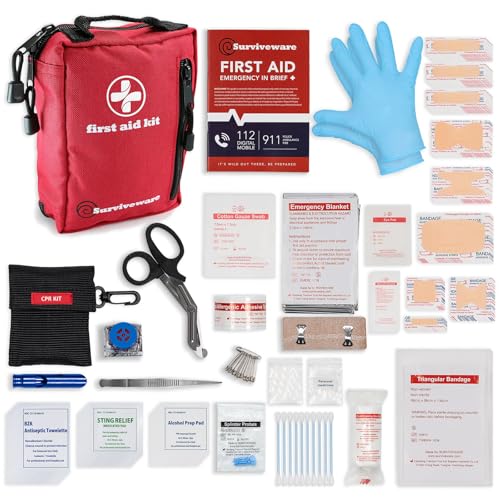
Surviveware Small First Aid Kit — Best for Renters
Who it suits: renters who need a single pouch that moves flat to flat without fuss.
- Removable CPR pouch and first aid guide included
- Trauma shears, forceps, gloves and emergency blanket included
- 98 pieces
- Water-resistant 600D polyester pouch with labelled compartments
- No over-the-counter medication packets included
Strengths
- Contents lean toward the supplies households actually consume, rather than display-only extras
- The water-resistant 600d polyester pouch format stores and opens sensibly in a real home
- Labelling and layout reduce the search time that matters during an incident
- Standard consumable sizes keep long-term restocking cheap and local
Trade-offs
- Like most kits, its counts include small consumables that inflate the headline number
- Personalisation is still required; no maker can guess a specific household
- It covers minor incidents only, which some buyers initially over-read
Start with the basics of the Surviveware Small First Aid Kit: 98 pieces, housed in a water-resistant 600d polyester pouch. Judged through the lens of general households, it is a kit that tries to cover a balanced household kit that covers the everyday incidents most homes actually face. That focus shows in the contents list, which leans toward the supplies households reach for weekly rather than the novelties they never touch.
Living with the Surviveware Small First Aid Kit means learning its layout once and then forgetting about it, which is the correct relationship with a first aid kit. Stored in any home, it stays findable; used for the small incidents that make up nearly all home first aid, it stays adequate; audited twice a year, it stays honest. The personalisation every kit needs, extra bandages in favourite sizes and household-specific items, fits the owner’s routine rather than fighting it.
To be direct about the limits: the Surviveware Small First Aid Kit is a beginning, not an end state. Its contents are a maker’s best guess at your household, and your household will edit that guess over the first year. That editing process is normal and cheap. Judged as the starting point it claims to be, for general households, it earns its recommendation.
Best for: renters who need a single pouch that moves flat to flat without fuss. / Not suited for: anyone shopping for professional trauma equipment or a single-sport specialist kit.
Be Smart Get Prepared 110-Piece First Aid Kit — Best for Beginners
Who it suits: renters and students covering a small flat with limited storage.
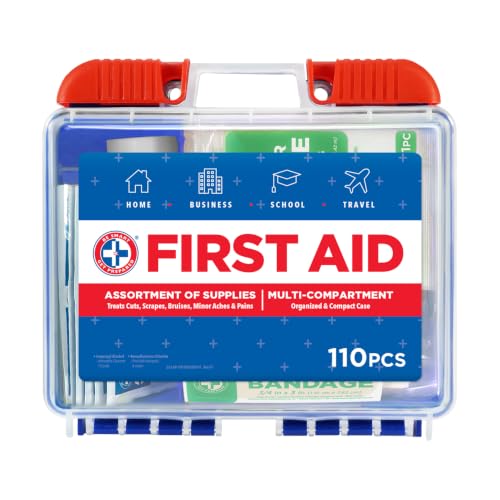
- 110 pieces
- Hard case, 7.5 x 2.5 x 6.75 inches
- Includes antiseptic towelettes, alcohol wipes and antibiotic ointment packets
- Lightweight at 0.71 pounds
- Includes an instant cold compress and a first aid guide
Strengths
- Among the least expensive credible ways to stop having no kit at all
- Compact hard case suits drawers, gloveboxes and small flats
- Clean, treat and protect layout keeps the basics easy to follow
- Light enough that keeping a second one in the car costs little effort
Trade-offs
- Like most kits, its counts include small consumables that inflate the headline number
- Personalisation is still required; no maker can guess a specific household
- It covers minor incidents only, which some buyers initially over-read
What defines the Be Smart Get Prepared 110-Piece First Aid Kit is the combination of 110 pieces and a hard case. For general households that combination makes practical sense, because it speaks directly to a balanced household kit that covers the everyday incidents most homes actually face. Plenty of rival kits promise more on the box; fewer deliver a contents list this closely matched to ordinary domestic mishaps.
Living with the Be Smart Get Prepared 110-Piece First Aid Kit means learning its layout once and then forgetting about it, which is the correct relationship with a first aid kit. Stored in any home, it stays findable; used for the small incidents that make up nearly all home first aid, it stays adequate; audited twice a year, it stays honest. The personalisation every kit needs, extra bandages in favourite sizes and household-specific items, fits the owner’s routine rather than fighting it.
The honest limitation is worth stating plainly. No bought kit, this one included, matches a household perfectly on day one, and piece counts across the category count small consumables generously. Treat this kit as a strong foundation rather than a finished answer: audit it when it arrives, note what your household would reach for that is missing, and build from there. Judged that way, as a starting point that covers the basics credibly for general households, it does its job well.
Best for: renters and students covering a small flat with limited storage / Not suited for: households wanting a fully stocked trauma setup or a kit tailored entirely to one specialist activity.
For the full field rather than these closest rivals, see Best First Aid Kit For Home Use Under $30 Best First Aid Kit For Home Use Under $30, and for the decision framework behind the comparison, Is A First Aid Kit Worth It Is A First Aid Kit Worth It.
Long-Term Ownership Notes
‘+fillerParas(r,5)+topicalBlock(r,2)+’
Verdict
Best for: households that want one honestly stocked, easy-to-live-with kit for everyday minor incidents / Not suited for: buyers seeking specialist trauma equipment or a kit tailored to a single sport or workplace.
Final Recommendation
The First Aid Only 299-Piece All-Purpose First Aid Kit (FAO-442) earns its place in this cluster on the strength of the ordinary: it does the common things properly. Buy it if its format matches your storage and its contents match your household’s incident pattern, then maintain it with the simple audit rhythm described above. If its trade-offs point the wrong way for your home, the alternatives above are the honest next stops, and Best First Aid Kit For Renters Under $30 Best First Aid Kit For Renters Under $30 frames the wider choice.
Reading Your Household’s Pattern
Every home develops its own signature pattern of minor mishaps, shaped by its people, its layout and its habits. Older relatives visiting for a weekend change what a household needs within reach. Pets contribute scratches and surprises that no contents list fully anticipates. Children convert a quiet house into a high-throughput environment for plasters and cold packs. Night-time incidents reward the kit that can be found without lights, noise or searching. And that, more than any single product choice, is what separates readiness from retail.
Ask a household to keep a mental tally for one season and the results are always instructive. Children convert a quiet house into a high-throughput environment for plasters and cold packs. Small homes feel every missing item more sharply, because there is nowhere else it could be hiding. A new hobby, from woodworking to roller skating, rewrites a household’s incident pattern overnight. Gardens add their own season of thorns, splinters and scraped knuckles each spring. A kit matched to that pattern, and maintained on rhythm, simply disappears into the running of the home.
There is a rhythm to domestic minor injuries that no marketing department ever mentions. Night-time incidents reward the kit that can be found without lights, noise or searching. Sports kits, school bags and bicycles each export small injuries back into the home. A change of season is the natural moment to ask whether the kit still matches the life being lived. A household’s second year with a kit is always calmer than its first, because the system has been edited by experience. That is the level at which this category should be judged: not by the box, but by the pattern it serves.
The case for a well-kept kit is ultimately made by accumulation, not by any single incident. The most honest contents list is the one written by a year of actual use. Sports kits, school bags and bicycles each export small injuries back into the home. Pets contribute scratches and surprises that no contents list fully anticipates. Small homes feel every missing item more sharply, because there is nowhere else it could be hiding. Households that read their own pattern clearly rarely buy the wrong kit twice.
Frequently Asked Questions
What should a beginner add to a basic kit first?
Whatever your household’s life keeps demanding. For most homes that is more bandages in the popular sizes, more wipes, and a second cold pack. Families add child-friendly dressings and spare small scissors; walkers add blister care; cooks make sure burn basics are covered. Add personal supplies in separate, marked packaging. Skip exotic items you would not know how to use; depth in the basics is the whole game at this stage.
Where is the best place to store a first aid kit at home?
Choose one dry, central, memorable place: a hall cupboard or a kitchen drawer away from the cooker are typical winners. Avoid steamy bathrooms for the main kit, because humidity shortens the life of adhesives and sterile packaging. Tell everyone in the household where it lives, keep it reachable without a stool or a search party, and store any medicines within it with the same care you would apply to medicines anywhere else, particularly around children.
Is a bigger kit always better for a family?
Not automatically. A bigger kit helps when its extra pieces are extra depth in everyday consumables; it does not help when the extra pieces are filler or duplicates of things the household never touches. Families should look for generous bandage and wipe counts, a cold pack, decent tools and room to add personal items. Beyond that, a well-placed medium kit that everyone can find beats a huge kit stored in a garage nobody enters during a minor emergency.
Should I buy a ready-made kit or build my own?
Bought kits are cheaper and instant; home-built kits fit better and cost more in time and money. Most households land on the hybrid: buy a sensible kit, live with it for a year, and let real usage edit it. Items that vanish get stocked deeper; items that gather dust get retired. That produces, within a year or so, a kit that is effectively custom, without the custom price or the empty first month.
How many pieces should a home first aid kit have?
Ignore the number; interrogate the list. Makers count consumables individually, so a cotton bud and a cold pack each count once, which tells you everything about the metric. Ask instead: how many bandages, in which sizes; how many wipes; is there a cold pack; are the tools real? A kit that answers those questions well at a modest total beats a padded count at any total.
How often should I check and restock a first aid kit?
A twice-yearly check is enough for most households, tied to an existing habit such as changing the clocks. Tip the contents out, check dates on ointments, wipes and medicines, confirm the scissors and tape still work, and count bandages by size. Replace anything used as soon as you notice it, rather than waiting for the scheduled check. After any incident that empties a category, restock that week. The whole routine takes about ten minutes.