Disclosure: As an Amazon Associate, umtsmarttool.com earns from qualifying purchases. Links to Amazon on this page are affiliate links; they cost you nothing extra. Prices and availability change often, so check the current Amazon listing before you buy.
Where to buy
Start here for best emergency flashlight for renters under $50: check the latest price, availability and delivery on Amazon. Orders are placed on Amazon. We may earn a commission from qualifying purchases.
- Best Overall: GE 4-in-1 LED Power Failure Night Light (29679) — Check on Amazon
- Best Handheld: Energizer 4-in-1 LED Power Failure Night Light (38511) — Check on Amazon
- Best for Power Outages: Amerelle LED Emergency Lights for Home Power Failure, 2 Pack (71134) — Check on Amazon
- Best Budget Pick: Energizer Weatheready Rechargeable Compact Handheld Light (RCCHFNM) — Check on Amazon
- Best for Beginners: GearLight S1000 LED Tactical Flashlight, 2 Pack — Check on Amazon
- Best for Small Spaces: FosPower Emergency Weather Radio A1 with LED Flashlight (FOSPWB-2376) — Check on Amazon
Read the full guide ↓
Finding the best emergency flashlight for renters under $50 means judging lights by what they do on the worst night of the year, not the best. Renting changes the emergency-lighting equation in one fundamental way: nothing can be hardwired, screwed into a ceiling rose, or left behind when the lease ends. Every pick in this guide is therefore either a plug-in unit that leaves no trace, a handheld that lives in a drawer, or a self-contained device that asks nothing of the building. That constraint turns out to be liberating, because the best outage lighting was always portable — the renter simply gets to keep the whole system at the next address.
The other renter reality is outlet economics. Rental homes and flats often have fewer sockets than the household needs, and they are rarely where you would choose to put them. Placement becomes a deliberate exercise: one docked light where people sleep, one where people cook, and handhelds filling the gaps. The picks below were chosen with that map in mind, favouring units that justify their outlet every ordinary night as a guide light rather than squatting on it for an emergency that may come twice a year.
Deposits and landlord rules also rule out the improvised solutions — no adhesive-mounted strips that peel paint, no rewired fittings. Everything here unplugs, unscrews nothing, and packs into a moving box in minutes. If your tenancy is short, weight the list toward the handheld and crank picks; if you expect to stay for years, the plug-in picks will quietly pay for their outlets in nightly usefulness long before the first real outage tests them.
The neighbouring guide on Emergency Flashlight Pros And Cons is worth reading alongside this one if your rooms, budget or household differ from the typical case. If your situation is narrower than this guide, the companion piece on How To Choose An Emergency Flashlight applies the same readiness-first standards to that specific case.
In this guide
Quick Picks
| Product | Badge | Key spec |
|---|---|---|
| GE 4-in-1 LED Power Failure Night Light (29679) | Best Overall | Plug-in 4-in-1 power-failure light with dusk-to-dawn sensor and foldable plug |
| Energizer 4-in-1 LED Power Failure Night Light (38511) | Best Handheld | Plug-in 4-in-1: night light, power-failure light, tabletop light, handheld flashlight |
| Amerelle LED Emergency Lights for Home Power Failure, 2 Pack (71134) | Best for Power Outages | Plug-in power-failure light and flashlight combo, 2-pack, retractable plug |
| Energizer Weatheready Rechargeable Compact Handheld Light (RCCHFNM) | Best Budget Pick | Plug-in compact flashlight, auto-on in outage, up to 30 m beam, up to 3 hours runtime |
| GearLight S1000 LED Tactical Flashlight, 2 Pack | Best for Beginners | Handheld 2-pack, 5 modes, zoomable beam, AAA or 18650 power |
| FosPower Emergency Weather Radio A1 with LED Flashlight (FOSPWB-2376) | Best for Small Spaces | Crank/solar/USB weather radio with 1W LED flashlight, reading lamp and power bank |
How These Picks Were Chosen
This is a research-led guide. Picks were built from manufacturer specifications and published mode tables, reputable roundups, and the long-term ownership patterns that emerge across owner feedback — not from invented hands-on testing. A product earned its place by matching the budget and the lens of this guide honestly: correct power story, believable runtime at working brightness, controls a household can use in the dark, and a maker or listing record solid enough to trust. Where a model could not be tied to a verified listing, it appears prose-only rather than with a link we could not stand behind.
Two filters did most of the work. First, readiness: does the light maintain itself, or demand a routine the household will realistically keep? Second, role clarity: every pick is excellent at one defined job — first-minute light, room light, search light, or day-three light — and the review states plainly what that job is and is not. Products that promised everything and documented little did not survive those filters, however bright their headlines.
Readers working to a tighter or different brief will find the same approach in Best Emergency Flashlight For Renters Under $30, which keeps placement and power discipline ahead of headline brightness. For a different angle on the same problem, see Best Emergency Flashlight Under $50 — the standards for what counts as ready are identical there.
Best emergency flashlight for renters under $50 — The 6 Picks in Full

GE 4-in-1 LED Power Failure Night Light (29679) — Best Overall
This pick suits buyers who like the plug-in concept but want a little more control — a side button that steps brightness up for task work and down for a night-light glow, in a unit that still needs zero thought the rest of the time.
- Four functions: power-failure light, night light, task light and emergency flashlight
- Dusk-to-dawn light sensor: on at dusk, off at dawn while docked
- Automatically illuminates during a power outage; side button adjusts brightness
- Foldable plug tucks away for handheld flashlight and tabletop use
- Model 29679; made by Jasco under the GE brand
Strengths
- Brightness control separates it from fixed-output docked lights: glow at night, brighter panel when working
- The same auto-on outage behaviour as the best plug-in lights, with no setup beyond plugging it in
- Tabletop mode gives a stable, hands-free pool of light for counters and desks
Trade-offs
- Button-press sequences for flashlight mode take a day of use to memorise
- Output remains interior-class; it will not search a yard
- One unit per room still applies — coverage is a placement decision
GE’s 4-in-1, produced by Jasco, takes the plug-in formula and adds the one thing most docked lights lack: adjustable brightness. Docked, the dusk-to-dawn sensor runs it as a night light; press the side button and the panel steps up to a level that works as a genuine task light for a counter or a reading chair. When the power fails, the panel lights automatically, and unplugging the unit with the plug folded in turns it into a handheld flashlight or a free-standing tabletop light.
That adjustability changes how the light gets used day to day. A fixed-glow night light is either too dim to read by or too bright to sleep near; a steppable panel can be both across one evening. Households with children often run it low in a hallway and brighter in a bathroom, and because the sensor handles the on and off, nobody has to remember anything.
The honest limitation is that versatility is delivered through a single side button, so the flashlight mode is a couple of presses away rather than instant. In a genuine emergency the panel light comes on automatically anyway, which softens the point, but impatient users should know it.
Best for: best overall duty in an emergency lighting setup / Not suited for: buyers whose needs sit outside that role

Energizer 4-in-1 LED Power Failure Night Light (38511) — Best Handheld
This pick suits households that want one light permanently docked in a hallway or bedroom outlet, doing quiet night-light duty every evening and then turning itself on the moment an outage hits, with no hunting for batteries and no switch to find in the dark.
- Plug-in design with foldable plug; charges its built-in rechargeable battery while docked
- Light-sensing: turns on at dusk and off at dawn as a night light
- Automatically switches on when household power fails
- Four roles in one unit: night light, power-failure light, tabletop light and emergency flashlight
- Model 38511; battery is built in and non-replaceable
Strengths
- It lives in the outlet, so it is charged by definition — there is no separate charging routine to forget
- The dusk-to-dawn sensor makes it useful every single night, not only during the rare outage
- Removing it from the wall converts it into a handheld flashlight, so one device covers the walk to the breaker panel
Trade-offs
- The built-in battery cannot be replaced, so when capacity fades years from now the whole unit is replaced
- Output is household-guidance brightness, not yard-searching brightness — it lights a room and a hallway, not a field
- It occupies an outlet full-time, which matters in rooms where sockets are already scarce
The design idea behind the Energizer 4-in-1 is that the best emergency flashlight is the one that is already charged, already in a known place, and already on when you need it. By living in an outlet it removes the three classic failure points of home emergency lighting: dead batteries, a light nobody can find, and a switch nobody can locate in a dark room. When power drops, the unit simply lights, and the person who wakes up disoriented at 3 a.m. gets orientation first and a flashlight second, because the docked light lifts straight out of the wall.
In daily life the light sensor does the quiet work. The panel glows softly after dark, enough to cross a hallway or check on a sleeping child without waking the house with ceiling lights, and it shuts itself off at dawn. That daily usefulness matters more than it sounds: emergency gear that is never touched between outages tends to be forgotten, moved, or borrowed. A light that earns its outlet every night stays exactly where the household expects it to be.
The honest limitation is brightness class: this is a guidance light engineered for interiors, and buyers who need to inspect a roof line, a flooded yard or a distant fence need a handheld pick from this list alongside it, not instead of a second light.
Best for: best handheld duty in an emergency lighting setup / Not suited for: buyers whose needs sit outside that role
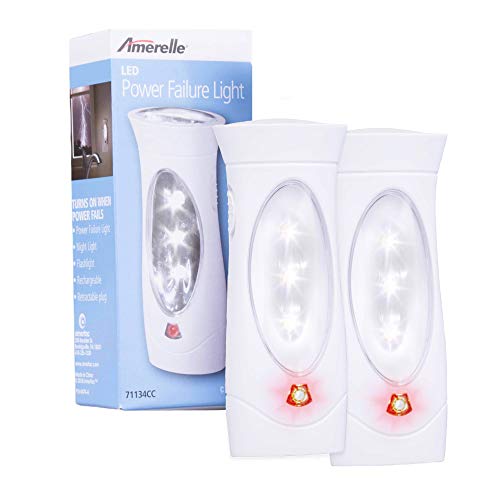
Amerelle LED Emergency Lights for Home Power Failure, 2 Pack (71134) — Best for Power Outages
This pick suits anyone who wants coverage in two places at once — a hallway and a bedroom, or a kitchen and a child’s room — without buying two separate products or managing two charging routines.
- Two-pack of plug-in power-failure lights with built-in rechargeable NiMH battery
- Automatically lights when power fails; also works as a 24-hour guide light
- Unplugs to serve as a handheld flashlight; retractable plug folds away in hand
- Model 71134 (71134CC); 120 V plug-in operation
Strengths
- Two units in the box means two rooms are covered from day one, which is how outages are actually experienced
- The retractable plug disappears into the body, so the handheld mode has no prongs digging into your palm
- NiMH battery recharges whenever the unit is plugged in, keeping readiness automatic
Trade-offs
- Like all plug-in lights, each unit permanently claims an outlet in its room
- Brightness is aimed at safe movement indoors rather than outdoor searching
- The sealed design means the battery is not a user-swappable part
Amerelle’s 71134 is built around a simple observation: outages are experienced room by room. One excellent flashlight in a kitchen drawer does nothing for the person in the back bedroom. A two-pack of docked lights changes the geometry of the problem — the hallway unit lights the route, the bedroom unit lights the person, and either can be pulled from the wall and carried. That is why this pick keeps appearing in outage-preparedness lists years after its launch.
The mechanics are deliberately boring, which is a compliment for safety gear. The battery charges from the outlet, the light watches the mains, and when the mains disappear the light comes on by itself. Used as a 24-hour guide light it gives a constant low glow that helps children and older relatives move safely at night, and because it is always docked, there is no version of the story where someone stored it in a dead state after the last camping trip.
The honest limitation is the same as every docked light: it only protects the rooms it is plugged into. A two-pack covers two rooms well; a large house with a basement, garage and upstairs landing needs a deliberate placement plan, not hope.
Best for: best for power outages duty in an emergency lighting setup / Not suited for: buyers whose needs sit outside that role

Energizer Weatheready Rechargeable Compact Handheld Light (RCCHFNM) — Best Budget Pick
This pick suits bedside and front-door duty: one compact light that lives in the outlet beside the bed or by the entry, always charged, ready to light the moment power fails or to grab for a quick trip outside with the dog.
- Plug-in rechargeable compact flashlight with built-in NiMH battery
- Turns on automatically in a power outage when left in the ON position while charging
- Beam distance up to 30 metres; runtime up to 3 hours on a charge
- Retractable sliding plug folds away for a comfortable handheld grip
- Model RCCHFNM; LED and battery are not user-replaceable
Strengths
- Compact body is genuinely pocketable once unplugged, unlike bulkier docked panels
- Auto-on behaviour in the ON position means it announces itself in the dark instead of hiding
- A 30-metre beam is honestly matched to gardens, driveways and breaker-panel trips
Trade-offs
- Three hours of runtime is an evening of outage, not a multi-day storm — pair it with a second light for long events
- It must be left switched ON while docked for the auto-on trick to work, which is a habit to learn
- Non-replaceable battery and LED mean the unit is a sealed, finite-life device
The Weatheready Compact is the smallest expression of the plug-in idea: not a panel, not a lantern, just a proper little flashlight that happens to live in a wall outlet. Energizer rates its beam at up to 30 metres, which in real terms covers a driveway, a garden path, or the distance from a back door to a meter box, and rates runtime at up to three hours — the shape of a normal evening outage rather than a disaster scenario.
Its party trick is behavioural. Leave the switch in the ON position while it sits in the outlet charging, and when the power fails the light comes on by itself. Anyone who has fumbled for a torch in a pitch-black bedroom understands why that matters: the light finds you before you have to find it. Unplug it and the sliding plug retracts, leaving a clean, grippable body with no prongs to snag.
The honest limitation is endurance: three hours is plenty for the typical short outage and for finding the candles, but households in storm country should treat this as the first-response light and keep a longer-running backup behind it.
Best for: best budget pick duty in an emergency lighting setup / Not suited for: buyers whose needs sit outside that role

GearLight S1000 LED Tactical Flashlight, 2 Pack — Best for Beginners
This pick suits households that want a real handheld flashlight in two places — one in the kitchen drawer, one in the car or bedside — and prefer cheap, universally available AAA batteries over any charging system.
- Two flashlights per pack, each 6.1 x 1.57 x 1.57 inches, aluminium body
- Five modes: High, Medium, Low, Strobe and SOS, with a zoomable flood-to-spot beam
- Powered by 3 AAA batteries per light via the included holder, or one 18650 cell via the included tube (batteries not included)
- Water-resistant construction, rated by the maker to survive drops of up to 10 feet
- Pack includes hand straps, holder cases, battery holders and tubes, operation guide
Strengths
- Two complete lights in one purchase is the simplest form of redundancy there is
- AAA power means the world’s most available battery keeps it running; an 18650 tube adds a rechargeable option
- The zoom beam genuinely changes character, from room-filling flood to a tighter spot for the yard
Trade-offs
- Batteries are not included, so the first job is stocking AAAs — budget the drawer, not just the lights
- Output claims on budget zoom lights are optimistic; treat it as a strong household light, not a searchlight
- No dock and no auto-on: it only helps if someone remembers where it is
The GearLight S1000 is the classic budget answer to emergency lighting, and its virtues are structural rather than electronic. You get two aluminium flashlights, each with five modes and a sliding zoom that pulls the beam from a wide flood into a concentrated spot. Power comes from three AAA cells in the included holder — batteries you can buy at any petrol station on earth — or from a single 18650 rechargeable cell in the included tube, which quietly upgrades the light for owners who already keep that format.
At 6.1 inches long it is a full-size household torch, big enough to grip with cold or gloved hands and heavy enough to feel substantial without being tiring. GearLight rates the body as water-resistant and drop-tested to ten feet, and the anti-roll shape keeps it where you set it down on a counter or a car bonnet. The two holder cases in the box make drawer and glovebox storage tidy rather than rattly.
The honest limitation is discipline-dependence. A plug-in light maintains itself; the S1000 asks the household to keep batteries fresh and the light in its agreed place. Households that can manage that get excellent value; households that cannot should look at the docked picks first.
Best for: best for beginners duty in an emergency lighting setup / Not suited for: buyers whose needs sit outside that role

FosPower Emergency Weather Radio A1 with LED Flashlight (FOSPWB-2376) — Best for Small Spaces
This pick suits storm-country households and go-bag builders who want information as much as illumination: weather broadcasts when the grid and the phone network are both down, plus a flashlight, a reading lamp and a small phone top-up in one crank-powered box.
- NOAA weather band plus AM/FM radio reception (WB 162.400-162.550 MHz)
- 1 W LED flashlight with zoom plus a separate multi-LED reading lamp, and an SOS alarm
- Four power routes: built-in 2000 mAh rechargeable battery (7400 mWh), AAA batteries, solar panel and hand crank
- USB output works as a power bank for phones; IPX-3 water resistance
- Dimensions 6.2 x 2.9 x 2.1 inches; weight 10.9 oz (310 g); model FOSPWB-2376
Strengths
- It is the only pick here that still works after every battery in the house is flat — a spell of cranking buys light and radio
- NOAA weather reception during a long outage is information no flashlight alone can give you
- The power-bank output can keep a phone alive for emergency calls
Trade-offs
- The flashlight element is a 1 W utility beam — adequate for moving around, not for searching outdoors
- It is a radio first: buyers who only want a torch are carrying extra bulk and controls
- IPX-3 shrugs off splashes but is not a light to leave out in driving rain
Every other pick in this guide assumes some power source survives: a charged battery, a wall outlet that worked yesterday, a drawer of AAAs. The FosPower A1 assumes nothing. Its hand crank and solar panel regenerate power from muscle and daylight, its internal 2000 mAh battery stores it, and AAA cells provide a fourth fallback. In a multi-day outage — the scenario that actually frightens people — that independence is worth more than any lumen figure.
The radio half is not decoration. NOAA weather band reception delivers National Weather Service broadcasts and alerts when mobile networks are congested or down, and plain AM/FM keeps a household connected to local news. The light half is deliberately dual: a 1 W zoom flashlight for moving around, and a soft multi-LED reading lamp for the long, boring hours of an outage evening, plus an SOS alarm for signalling.
The honest limitation is that the flashlight is the supporting act, not the headline. Judge the FosPower as an emergency information device with a useful light attached, and it is excellent; judge it as a pure flashlight against the handheld picks here and it will feel modest.
Best for: best for small spaces duty in an emergency lighting setup / Not suited for: buyers whose needs sit outside that role
Comparison Table
| Product | Badge | Standout spec |
|---|---|---|
| GE 4-in-1 LED Power Failure Night Light (29679) | Best Overall | Plug-in 4-in-1 power-failure light with dusk-to-dawn sensor and foldable plug |
| Energizer 4-in-1 LED Power Failure Night Light (38511) | Best Handheld | Plug-in 4-in-1: night light, power-failure light, tabletop light, handheld flashlight |
| Amerelle LED Emergency Lights for Home Power Failure, 2 Pack (71134) | Best for Power Outages | Plug-in power-failure light and flashlight combo, 2-pack, retractable plug |
| Energizer Weatheready Rechargeable Compact Handheld Light (RCCHFNM) | Best Budget Pick | Plug-in compact flashlight, auto-on in outage, up to 30 m beam, up to 3 hours runtime |
| GearLight S1000 LED Tactical Flashlight, 2 Pack | Best for Beginners | Handheld 2-pack, 5 modes, zoomable beam, AAA or 18650 power |
| FosPower Emergency Weather Radio A1 with LED Flashlight (FOSPWB-2376) | Best for Small Spaces | Crank/solar/USB weather radio with 1W LED flashlight, reading lamp and power bank |
How to Choose the Right Emergency Flashlight
Automatic behaviour beats brightness in the first minute
Ask what the light does in the first sixty seconds of an outage, before anyone has found their feet. Docked power-failure lights answer perfectly: they are already on. Everything else answers with a search — in darkness, possibly by a frightened child or an older relative. That is why this guide treats auto-on behaviour and fixed placement as first-class features, equal to output. A household that pairs one auto-on docked light with one strong handheld has covered both the first minute and the following hours, which is the correct shape of emergency lighting.
Read runtime at the mode you will actually use
Headline runtimes are quoted at the lowest mode and headline outputs at the highest, and the two never coexist. The honest way to read a spec table is to find the middle modes: the level bright enough to cook, read, or walk the dog by, and the hours that level delivers. For most homes that working level sits in a broad middle band, and a light that holds it for an evening is genuinely sufficient. Reserve the lowest modes for night-checks and the highest for short searches, and any light in this guide will feel correctly sized.
Beam shape matters more than beam distance indoors
Manufacturers quote beam distance because it is a big, comparable number, but inside a home a long, narrow spotlight is often the wrong tool: it creates a tunnel of glare with darkness at the edges. Room lighting wants width — a flood that bounces off a ceiling and turns one flashlight into a temporary lamp. Outdoors the priorities reverse, and distance earns its keep along paths, drives and fence lines. The picks here are annotated for beam character so you can match the shape to the space, instead of buying the biggest number and discovering its personality during a storm.
Sealing and build decide whether it survives the drawer years
Emergency lights live hard lives in slow motion: years in a drawer or on an outlet, then one night of drops, rain and panic. Ingress ratings tell you how the light handles water — splash resistance suits indoor duty, while full immersion ratings suit outdoor searching in weather. Impact ratings and body material tell you how it handles the drop onto concrete that every torch eventually takes. None of this is glamorous, and all of it decides whether the light works on the one night it is needed, which is the only review criterion that ultimately counts.
Controls must work for cold, gloved and frightened hands
An interface that is delightful in a lit kitchen can be impossible in a dark hallway. Prefer lights with one obvious switch, a mode order that starts low or remembers your last level, and no combination presses required to reach ordinary light. If the light will serve children or older relatives, test the switch with the least confident user in the house. Several picks in this guide were chosen partly for interface forgiveness — a deliberate priority that spec tables never capture and outage nights always expose.
Power source is the first decision
Every emergency flashlight is a bet on a power source. Plug-in models bet that the outage will be short enough for a small built-in battery, and they hedge the bet by recharging themselves daily. Disposable-cell models bet on the drawer: AA and AAA batteries are cheap, shelf-stable and available everywhere, but only if someone stocked them. Rechargeable handhelds bet on capacity and runtime, and crank or solar models refuse to bet at all, generating power on demand. Decide which bet matches your home’s habits before you look at a single lumen figure, because a brilliant light with the wrong power story is a paperweight with good marketing.
The neighbouring guide on Best Emergency Flashlight For Apartments Under $50 is worth reading alongside this one if your rooms, budget or household differ from the typical case. If your situation is narrower than this guide, the companion piece on Best Emergency Flashlight For Beginners Under $50 applies the same readiness-first standards to that specific case.
Living With an Emergency Light: What Experience Teaches
Key Takeaways
- Placement and readiness beat headline brightness in every real outage.
- Pair an automatic docked light with a capable handheld for full coverage.
- Test every light twice a year and manage batteries as a system.
Water and electricity mix badly, and outages often arrive with water — burst pipes, flooding, storm ingress. Keep docked lights out of splash zones the maker warns against, never handle a plug-in unit with wet hands while it is connected to the mains, and favour properly sealed handhelds for any work around standing water. If a light has been submerged beyond its rating or its case is cracked, retire it from emergency duty. The conservative choice with electrical safety is always the correct one, and no flashlight is worth improvising around.
Finally, remember that an emergency flashlight is morale equipment. Total darkness frightens people out of proportion to its danger, especially children and anyone alone. A home that lights itself calmly, automatically and adequately keeps everyone thinking clearly — and clear thinking is what actually resolves outages, from resetting a breaker to deciding whether to leave. Buy the lights, place them well, test them twice a year, and then forget about them. Forgetting about them, safely, is the entire point.
Placement is a strategy, not an afterthought. Walk your home at night with the lights off and note where darkness actually strands people: the bedroom doorway, the top of the stairs, the hallway outside the bathroom, the kitchen route to the back door. Those are the stations where emergency lights earn their keep. A docked light at the top of the stairs protects the most dangerous journey in any outage; a handheld by the bed protects the first one. Buying a second modest light for a second station almost always beats upgrading the first light, because outages are experienced in rooms, not in averages.
Test your lights on a schedule or they will quietly stop being emergency equipment. Twice a year — many households tie it to clock changes — unplug each docked light and confirm it lights, run each handheld down its modes, and check the dates on stored batteries. The test takes ten minutes and converts hope into knowledge. Lights that fail the test are replaced in daylight, at leisure, rather than discovered wanting at midnight. Keep a note of the test on the fridge; preparedness that depends on memory alone tends to evaporate.
Common Buying Mistakes
Buying brightness and ignoring placement
The classic error is one expensive, powerful light kept in one drawer. Output cannot help a person in another room. Spread the budget across stations — where people sleep, cook and enter — and the system outperforms any single flagship.
Letting the light live flat
Rechargeable lights stored discharged degrade and disappoint. Docked lights solve this by design; handhelds solve it by habit — charge after use, top up seasonally, and never store a light you depend on in a flat state.
Storing alkaline cells inside the light for years
Slow leakage is the silent killer of stored flashlights. For long storage, follow the maker’s guidance, consider lithium primary cells where compatible, and inspect stored lights at every twice-yearly test.
Trusting the headline runtime
The big runtime number belongs to the lowest mode. Judge a light by the hours it delivers at the brightness you will actually cook, walk and read by — the middle of its mode table, not the extremes.
Forgetting the people factor
A light only the buyer can operate is a single-person system. Choose controls the whole household can work in the dark, rehearse once in daylight, and write the light’s location on the household’s shared knowledge — not in one person’s memory.
Readers working to a tighter or different brief will find the same approach in Best Emergency Flashlight For Beginners Under $15, which keeps placement and power discipline ahead of headline brightness. For a different angle on the same problem, see Best Emergency Flashlight For Apartments Under $30 — the standards for what counts as ready are identical there.
Final Recommendation
Start with the GE 4-in-1 LED Power Failure Night Light (29679) if you buy one light from this guide: it covers the role this budget and lens most need, with the least upkeep. Add the Energizer 4-in-1 LED Power Failure Night Light (38511) when you can — the pair covers two stations or two outage phases, and that pairing is worth more than any single upgrade. Every pick here was chosen to be findable, charged and running when the house goes dark; choose the combination that matches your rooms, and then place them, test them, and forget them.
And a closing thought on enough. Preparedness marketing thrives on the feeling that one more purchase stands between you and safety. The truth of this category is smaller and kinder: a charged light where you sleep, a charged light where you cook, something independent for the long night, and a ten-minute test twice a year. That is enough — genuinely enough — for the overwhelming majority of outages in the overwhelming majority of homes. Buy to that standard, then stop buying and go and live in the well-lit house you have made.
A note on where emergency lights fail that has nothing to do with electronics: they fail at the level of household geography. The light is in the room nobody is in, on the floor nobody can reach, behind the door that swelled shut in the storm. Every recommendation in this guide — stations, docks, distribution, rehearsal — is geography management dressed as shopping. When you finish reading and start placing, you are doing the real work of this category; the purchase was only ever the easy half, and it is worth saying plainly in a guide that sells lights.
Beam colour is a small thing that changes how a room feels at 3 a.m. Cool-white beams read as stark and clinical, which suits searching and working; warmer light reads as calmer, which suits bedrooms, children and the long social evening of an outage. Makers rarely offer a choice in this category, but where a pick’s character is known it is noted in its review. If your household is light-sensitive, borrow the principle from home lighting: put the stark light in the kitchen and the calm light where people sleep, and let each do the job its temperament suits.
There is a quiet economics to the two-pack that deserves spelling out. The second unit in a two-pack typically costs a fraction of the first, because packaging, shipping and shelf space are shared — yet it delivers a full second station of coverage. That asymmetry is why this guide favours two-packs so heavily at the lower tiers: coverage per unit of money is the metric that tracks real-world safety, and two-packs win it almost by definition. When a budget forces a choice between one premium light and a credible two-pack, the two-pack is usually the safer household, however the spec sheets argue.
Think about the morning after, because product design rarely does. The outage ends at dawn; the house is littered with the evidence — lights in odd rooms, batteries out of drawers, a radio on the kitchen table. The households that stay prepared are the ones with a reset ritual: everything back to its station, everything back on charge, anything consumed replaced on the next shopping list. Build the ritual into the purchase decision by choosing lights whose home station is obvious. A light with an obvious home gets reset; a light without one becomes next year’s flat disappointment.
Older housing stock adds a wrinkle worth planning for: fewer outlets, outlets in odd places, and sometimes no socket at all in the hallway where a docked light belongs. The workaround hierarchy is simple — dock where sockets exist, even if the room is second-choice; use battery handhelds for the socketless stations; and never solve the problem with extension leads trailing across floors, which trade a lighting risk for a trip and electrical risk. The picks here were chosen to give socket-poor homes a full hand of options.
For households that include someone with low vision, emergency lighting stops being a convenience category entirely. Contrast, glare control and automatic behaviour become the specification: lights that come on by themselves, sit at consistent heights, and produce even illumination without hot spots are the difference between independence and dependence during an outage. If that is your household, weight the docked and panel-style picks heavily, place them to light routes rather than rooms, and rehearse the outage together in daylight until the route is memorised by feet as much as by eyes.
A word in defence of the boring specification. Water resistance, drop ratings, switch cycles, battery shelf life — none of it photographs well, and all of it is where emergency lights are actually won and lost across a decade of ownership. The exciting numbers describe the first minute of the first night. The boring numbers describe year seven. This guide’s shortlists lean deliberately toward makers who publish and honour the boring numbers, because an emergency light is a decade purchase pretending to be a gadget purchase, and it should be judged on the decade.
Frequently Asked Questions
Can a flashlight replace a lantern in an outage?
Largely, yes, with ceiling bounce: point the beam at a white ceiling and the room gets soft, even light for cooking, reading and calming children. A lantern still wins for a fixed social centre like a dining table over many hours. Many households find a flashlight with good low modes covers both roles well enough that the lantern becomes optional.
What should I do when the power comes back?
Return every light to its station and its charger the same day, while the lesson is fresh. Recharge handhelds, re-dock plug-ins, replace any disposable cells you used, and note anything that underperformed. The outage itself is the best product review you will ever get — capture it before normal life resumes.
What makes a flashlight an emergency flashlight?
Three things: it is stored somewhere fixed and known, its power source is maintained without effort or by a simple routine, and it offers a low mode that can run for many hours. Output, brand and price are secondary. A modest light that is charged and findable beats a powerful one that is neither, which is why this guide weights placement, automatic behaviour and power discipline as heavily as lumens.
How many lumens do I actually need indoors?
Far fewer than marketing suggests. Moving around a familiar home, reading, and cooking can all be done at modest output, especially with ceiling bounce spreading the light. Higher output earns its place outdoors — yards, streets, searching — and in short bursts. For a single home light, choose a model with a genuinely low mode and a useful middle; the extremes of its range will be used least.
Are plug-in power-failure lights worth it?
For most homes, yes — they are the lowest-effort preparedness purchase available. They charge themselves, they turn on automatically when power fails, and they double as night lights, so they justify their outlet daily. Their limits are modest output and room-by-room coverage. Pair one or two with a real handheld and the combination covers both the first minute of an outage and everything after.
How long will an emergency flashlight run in an outage?
It depends entirely on mode. Low modes on the picks in this guide run from an evening to many days; high modes are measured in a few hours. The practical answer is to run the lowest brightness that does the job and to treat high output as a tool for moments, not hours. Households that do this routinely get through multi-evening outages on lights that pessimists call too small.