Disclosure: As an Amazon Associate, umtsmarttool.com earns from qualifying purchases. Links to Amazon on this page are affiliate links; they cost you nothing extra. Prices and availability change often, so check the current Amazon listing before you buy.
Key Takeaways
- How to use a portable inverter safely starts here: connect battery-side first, with the inverter switched off.
- Add loads one at a time, smallest first.
- Keep vents clear and the unit dry, always.
- End sessions in reverse: loads off, inverter off, then disconnect.
- A protection shutdown is information — diagnose before retrying.
Knowing how to use a portable inverter well is mostly a matter of sequence. The hardware is forgiving of almost everything except disorder: connections made in the wrong order, loads piled on at once, vents buried under luggage. This guide gives the full operating sequence for socket-powered and battery-clamped setups, the habits that keep batteries healthy across seasons, and a troubleshooting section for the moments the unit protects itself. Sizing questions belong to How To Choose A Portable Inverter How To Choose A Portable Inverter; this page assumes the inverter is already the right size.
In this guide
How to Use a Portable Inverter: Setup, Step by Step
- Place the unit flat, ventilated, dry, and secured against sliding.
- Confirm the inverter switch is off before any connection.
- For battery use, attach clamps to clean terminals, positive first, with total attention to polarity.
- For vehicle use, seat the plug fully in the 12V socket.
- Switch the inverter on with nothing plugged in and confirm a calm idle.
- Add loads one at a time, smallest first, pausing between each.
That pause between loads is the habit that separates calm sessions from tripped protections: each device announces its startup behaviour individually, and the inverter’s response tells you the system’s remaining headroom in real time.
Staying safe with portable power is mostly preparation. Keep the unit dry, since 12V systems live in damp boots, footwells, and tents. Route cables where feet cannot trip on them and doors cannot damage them. Never defeat a fuse or fit a heavier one to stop nuisance trips; the fuse is reporting a genuine mismatch in the setup. Finally, respect the AC side exactly as you would a wall outlet, because once converted, it is one in every way that matters.
Idle draw is the specification nobody reads and everybody eventually feels. An inverter resting with nothing attached still sips current to hold itself ready, and across a long parked weekend that trickle becomes a meaningful share of a small battery. The habit that neutralises it costs nothing: switch the unit off at its own switch when the session ends, and disconnect it entirely for long storage. Power you do not waste is runtime you do not have to buy.
How Should You Run Loads During a Session?
Stage by importance. Essentials first — communications, lighting, the device the session exists for — and luxuries only while the battery is plentiful. Watch case heat and fan behaviour as your instruments; both should rise gently and plateau. If either climbs steadily, the load or the ventilation is asking more than the setup can give, and the time to act is before the protection does it for you.
Cable discipline sounds like a footnote until you watch voltage sag under load. Every connection between battery and inverter is a small resistor, and long, thin, or corroded paths waste power as heat while starving the inverter of the voltage it needs to hold its output. Short runs, clean terminals, and clamps seated with conviction are not enthusiast fussiness; they are the difference between the rating on the case and the power at the outlet. When an inverter misbehaves, inspect the path before blaming the box.
How Do You End a Session and Store the Unit?
- Switch off or unplug each load.
- Switch the inverter off at its own switch.
- Disconnect the battery side last, clamps removed in reverse order.
- Recharge the battery promptly rather than storing it depleted.
- Store the inverter dry, with cables loosely coiled and terminals clean.
Prompt recharging is the single kindest thing you can do for a battery’s lifespan, and it guarantees the next session starts from full rather than from whatever the last one left behind.
Safety around portable inverters is housekeeping performed in advance. Keep the unit dry, because 12V gear lives in damp boots, footwells, and campsites. Keep cables where doors cannot pinch them and feet cannot catch them. Never defeat a fuse or substitute a heavier one to stop nuisance trips; the fuse is reporting a real mismatch. And treat the AC side with the same respect as a wall outlet, because once converted, it is one — children, water, and damaged cords demand the same caution as they do at home.
Troubleshooting: When the Inverter Protects Itself
Problem: The inverter shuts down the instant a device starts. → The device’s startup surge exceeds the peak rating, or the connection cannot feed it; reduce the load or move to a direct battery connection.
Problem: The inverter runs briefly, then cuts out under a steady load. → Low battery voltage under load is the usual cause; recharge, check terminal cleanliness, and shorten the cable path.
Problem: The case grows hot and the fan runs constantly. → Ventilation or sustained overloading; clear the vents, shade the unit, and step the load down a class.
Problem: A device buzzes or its charger runs unusually warm. → Waveform sensitivity; that device wants pure sine output, as the model selection in Best Portable Inverter Under $150 Best Portable Inverter Under $150 reflects.
Gear That Makes This Easier

BESTEK 300W Pure Sine Wave Power Inverter — Best All-Round Pick
Start with the job this unit does best. It pairs 300w continuous, 700w peak with 2 ac outlets, a combination that suits general work better than the marketing suggests.
At a glance:
- Waveform: Pure sine wave
- Connection: 12V socket plug, optional battery clips
- USB provision: Dual USB, 4.8A total
- AC provision: 2 AC outlets
- Continuous / peak output: 300W continuous, 700W peak
A clean waveform changes small things that add up: chargers run at their normal temperature, small motors sound like themselves, and nothing in the kit needs to be apologised for. Loads that hum, run hot, or charge slowly on a modified sine inverter tend to settle down on this waveform, which is exactly why it earns a place in kits built around laptops and audio gear.
Connection is deliberately simple: a single plug into a 12V socket, which caps sensible continuous draw well below what a dashboard circuit can fuse at. Treat the socket limit as the real ceiling for long sessions and this unit will never surprise you with a blown fuse mid-task.
Day to day, the details that decide ownership are boring ones: how quickly the fan spools up, whether the outlets accept chunky wall adapters side by side, and how the case feels after a summer in a hot vehicle. On those counts this model is well sorted. It behaves like a product that was tested by people who actually use inverters, rather than one specified from a spreadsheet.
Think of the sessions that define ownership: a camera battery rotation on a work trip; then, a week later, a laptop refill at a rest stop. Neither asks for heroics. Both ask for an inverter that starts instantly, behaves predictably, and protects the battery it feeds from. Measured against that unglamorous standard, the BESTEK 300W Pure Sine Wave Power Inverter is specified almost perfectly, with 2 ac outlets and dual usb, 4.8a total covering the kit without adapters or improvisation.
Strengths
- Connection path (12v socket plug, optional battery clips) suited to how the unit will really be fed
- 2 AC outlets with dual usb, 4.8a total covering mixed kits without adapters
- Pure sine wave output matched to the loads this class serves
Trade-offs
- Socket-fed running caps output well below the case rating
- Battery runtime, not the inverter, ends long sessions
- Fan noise joins in under sustained load
Be clear-eyed about the ceiling. Sustained loads near the rated ceiling heat the unit and shorten battery runtime dramatically, so treat the printed maximum as a short-burst figure and cruise well below it.
Best for: readers who want this class’s output without drama in general service / Not suited for: heating elements, big motors, and all-day heavy loads
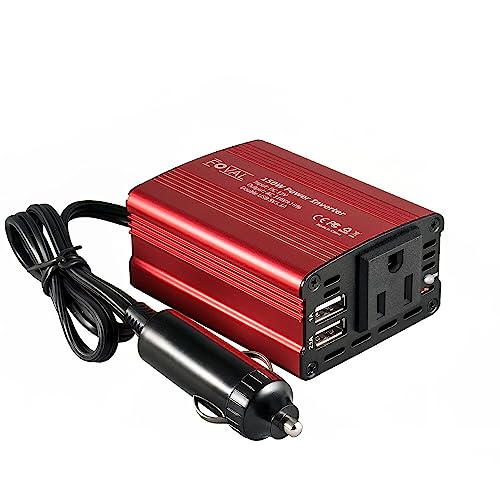
FOVAL 150W Car Power Inverter — Best Compact Pick
Treat this model as a tool with a defined working envelope. It delivers 150w continuous, 300w peak, yet the way it behaves under a real load matters far more than the box copy.
At a glance:
- Waveform: Modified sine wave
- Connection: 12V socket plug
- USB provision: Dual USB, 3.1A total
- AC provision: 1 AC outlet
- Continuous / peak output: 150W continuous, 300W peak
The modified sine waveform is the honest trade-off at this size. Chargers, lights, and resistive loads handle it without complaint, while some motor loads run a little louder and a little warmer than they would on household power. Reserve pure sine money for gear that demonstrably misbehaves on a stepped wave.
The plug-and-go connection is the whole point. There is nothing to wire and nothing to mount, so the inverter moves between vehicles in seconds. The flip side is discipline: a 12V socket circuit is a modest power path, and the loads you choose should respect that.
The controls deserve a sentence of their own: a switch you can find by feel, indicators you can read at a glance, and sockets that grip plugs firmly enough to survive a corrugated road. Boredom, in portable power, is a design achievement.
Think of the sessions that define ownership: a laptop refill at a rest stop; then, a week later, a camera battery rotation on a work trip. Neither asks for heroics. Both ask for an inverter that starts instantly, behaves predictably, and protects the battery it feeds from. Measured against that unglamorous standard, the FOVAL 150W Car Power Inverter is specified almost perfectly, with 1 ac outlet and dual usb, 3.1a total covering the kit without adapters or improvisation.
Strengths
- Connection path (12v socket plug) suited to how the unit will really be fed
- Housing and layout that tolerate travel, storage, and daily handling
- Protection set covering overload, overheating, and low battery voltage
Trade-offs
- Battery runtime, not the inverter, ends long sessions
- Fan noise joins in under sustained load
- Socket-fed running caps output well below the case rating
No review of this model is honest without the runtime warning: the inverter can only spend what the battery holds, and at high continuous loads it spends it quickly. Between the continuous rating, the connection feeding it, and the battery behind that, the smallest figure governs — and on this model the smallest figure is rarely the inverter itself.
Best for: readers who want this class’s output without drama in general service / Not suited for: heating elements, big motors, and all-day heavy loads
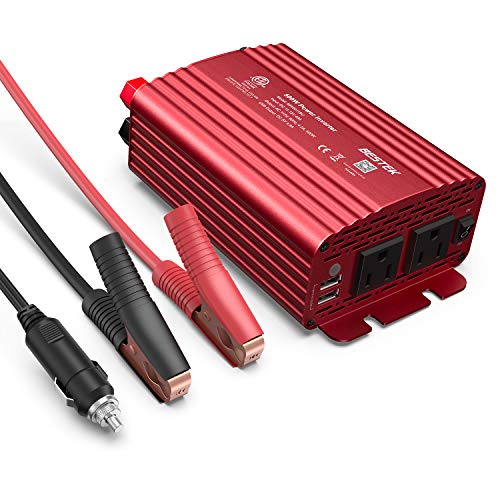
BESTEK 500W Power Inverter — Best Flexible Pick
Few purchases in this category reward a close read of the spec sheet like this one. It pairs 500w continuous, 1000w peak with 2 ac outlets, a combination that suits general work better than the marketing suggests.
At a glance:
- Continuous / peak output: 500W continuous, 1000W peak
- Waveform: Modified sine wave
- AC provision: 2 AC outlets
- USB provision: Dual USB, 4.2A total
- Connection: 12V socket plug or battery clips
A stepped waveform is this class’s standard compromise, and it is worth being precise about what it costs: nothing at all for chargers and lighting, a little extra warmth and noise for some motors, and a polite refusal from a minority of sensitive supplies. Reserve pure sine money for gear that demonstrably misbehaves on a stepped wave.
The plug-and-go connection is the whole point. There is nothing to wire and nothing to mount, so the inverter moves between vehicles in seconds. The flip side is discipline: a 12V socket circuit is a modest power path, and the loads you choose should respect that.
Day to day, the details that decide ownership are boring ones: how quickly the fan spools up, whether the outlets accept chunky wall adapters side by side, and how the case feels after a summer in a hot vehicle. On those counts this model is well sorted. None of it photographs well, and all of it decides whether the unit is reached for or left behind.
Think of the sessions that define ownership: an evening of lighting during a short outage; then, a week later, phones and a tablet recovering after a long day. Neither asks for heroics. Both ask for an inverter that starts instantly, behaves predictably, and protects the battery it feeds from. Measured against that unglamorous standard, the BESTEK 500W Power Inverter is specified almost perfectly, with 2 ac outlets and dual usb, 4.2a total covering the kit without adapters or improvisation.
Strengths
- Connection path (12v socket plug or battery clips) suited to how the unit will really be fed
- 2 AC outlets with dual usb, 4.2a total covering mixed kits without adapters
- Housing and layout that tolerate travel, storage, and daily handling
Trade-offs
- Socket-fed running caps output well below the case rating
- Fan noise joins in under sustained load
- Battery runtime, not the inverter, ends long sessions
The limitation to respect is thermal. Sustained loads near the rated ceiling heat the unit and shorten battery runtime dramatically, so treat the printed maximum as a short-burst figure and cruise well below it.
Best for: general kits built around the continuous rating, honestly applied / Not suited for: sustained loads chosen from the peak figure

Krieger 1100W Power Inverter (KR1100) — Best High-Power Pick
If your shortlist has narrowed to units that can live in a glovebox, a tote, or a battery box, study this entry closely. On paper it is one more modified sine wave unit; in a season of ordinary use it separates itself by never being the problem.
At a glance:
Specification snapshot — output: 1100W continuous, 2200W peak; waveform: Modified sine wave; AC provision: 2 AC outlets; USB provision: USB charging port; connection: Battery clamps and cables included.
Modified sine output keeps the cost and size down, and for the loads most people actually plug in — phone chargers, laptop bricks, string lights, small fans — it is perfectly serviceable. Plan sensitive electronics accordingly.
Connection flexibility is a genuine strength. The supplied battery connection path lets you bypass the limits of a dashboard socket entirely, which is how this class of inverter should be run anywhere near its rating. Keep the cables short, the clamps clean, and the battery itself healthy, and sustained output matches the badge on the case.
What separates this pick from the no-name crowd is consistency. Output stays composed as loads stack up, the cooling fan tracks temperature instead of running flat-out from the first watt, and the protection circuits intervene before drama rather than after it. None of it photographs well, and all of it decides whether the unit is reached for or left behind.
Think of the sessions that define ownership: a camera battery rotation on a work trip; then, a week later, a small fan keeping a workspace bearable. Neither asks for heroics. Both ask for an inverter that starts instantly, behaves predictably, and protects the battery it feeds from. Measured against that unglamorous standard, the Krieger 1100W Power Inverter (KR1100) is specified almost perfectly, with 2 ac outlets and usb charging port covering the kit without adapters or improvisation.
Strengths
- Connection path (battery clamps and cables included) suited to how the unit will really be fed
- 2 AC outlets with usb charging port covering mixed kits without adapters
- Modified sine wave output matched to the loads this class serves
Trade-offs
- Socket-fed running caps output well below the case rating
- Fan noise joins in under sustained load
- The peak figure flatters; the continuous figure governs
The limitation to respect is thermal. Long sessions at high output in a closed, hot space will trigger protective shutdowns, so ventilation and sensible load choices are part of owning this model, not optional extras.
Best for: general users who size loads to the continuous rating / Not suited for: anyone expecting generator-class output from a battery alone
Common Buying Mistakes
Ignoring the battery. An inverter converts stored energy; it does not create it. Sessions planned without runtime maths end early and age batteries fast.
Burying the unit. Blocked vents and soft furnishings turn a correctly sized inverter into a thermal shutdown with a power cord.
Feeding a big inverter through a dashboard socket. The socket circuit becomes the ceiling long before the inverter does, and the fuse will explain this to you at the worst possible moment.
Sizing from the peak number. The peak figure covers a blink of startup surge; everything you run for more than a few seconds lives under the continuous rating, and confusing the two is the fastest route to shutdowns.
Buying waveform by habit. Some kits genuinely need pure sine; many do not. Test your actual devices before paying for a waveform your loads cannot hear.
Wrap-Up
Sequence, staging, and a prompt recharge: how to use a portable inverter well is genuinely that simple, and the simplicity is the reward for learning it once, properly, on a calm day. The models that reward good technique most are ranked in Best Portable Inverter Under $150 Best Portable Inverter Under $150, with the tighter-budget shortlist in Best Portable Inverter Under $75 Best Portable Inverter Under $75.
A Load Audit, Worked in the Open
Worked through properly, load auditing is the least glamorous and most valuable ten minutes in portable power. Take a representative session and price it in watts. It opens with a router holding the household online. Before long a camera charger cycling its second battery joins it, and the two together — not either alone — set the first real number. Later, a power bank refilling for the next day enters the rotation, and by the time a small cooler opened rarely and closed quickly is running as well, the session has become the thing sizing must answer: four modest demands, coinciding. None of them would trouble the smallest inverter in this guide on its own. Together they redraw the requirement completely, and they do it quietly, which is why simultaneity — not any single device — is the figure experienced buyers write down first.
Now run the same session backwards, as a battery experiences it. The battery does not see four devices; it sees one continuous draw, grossed up by conversion losses, sustained across hours. Its usable capacity is the budget, the draw is the spending rate, and the session ends when the budget does — or when the low-voltage cutoff ends it earlier, as a favour. Framed that way, runtime stops being a mystery printed nowhere and becomes arithmetic anyone can check before the session starts.
The Rhythm of a Session That Goes Well
Sessions have a rhythm, and good setups respect it. The essentials connect first, while the battery is full and every option is open: in our worked session, that means a laptop drawing modest watts through its brick and the load the session exists for. Secondary comforts — a string of lights defining the evening among them — join once the essentials are stable and the inverter’s behaviour is known. Luxuries arrive last and leave first: a headtorch topping up for tomorrow is welcome while charge is plentiful and is the first thing sacrificed when the battery’s gauge, real or estimated, starts to argue. Staged this way, a session degrades gracefully instead of collapsing. Nothing about the staging requires equipment; it requires only that the order of connection be a decision rather than an accident.
Heat narrates the session for anyone who listens. A case that warms gently and settles is a system in balance; a case that climbs steadily is a system spending beyond its means, whatever the ratings claim. The fan’s voice tells the same story in parallel. Experienced users check both the way drivers check mirrors — briefly, often, and without drama — and act on the trend rather than waiting for the protection circuits to deliver the verdict less gently.
The Method, Compressed
The method, compressed, is short enough to memorise. Total simultaneous running watts before looking at a single product. Hold headroom above the total. Audit startup surges separately, because motors live by different rules. Let the fussiest device choose the waveform. Let the load choose the connection — socket for charging scale, battery connection for anything ambitious. Run the runtime division before the session, not during it. Stage loads by importance, watch heat and fan as instruments, and recharge promptly when the session ends. Followed in order, those steps make the purchase almost boring — which is the goal. Boring setups start every time, run calmly, and end by choice. Everything recommended in this guide was selected to behave that way inside a system run on this method.
A Worked Example: The Session Behind the Specifications
Specifications become decisions in places like a family car packed for a weekend away. What gets plugged in is unremarkable, and that is the point: a desk lamp over paperwork first, a small fan moving heavy air once the first device settles, and a phone on its last few percent when someone remembers it. The combined draw would fit on the back of an envelope, yet it runs long enough to expose every weakness a setup has — heat, noise, a battery fading faster than promised, a protection circuit with no patience.
If there is a moral, it is that portable power rewards the prepared and taxes the hopeful. The prepared total their simultaneous loads, respect the continuous rating, and keep the battery ready; the hopeful buy a headline number and discover the arithmetic during the session itself. Everything in this guide exists to move readers from the second group into the first.
Going Deeper
Runtime arithmetic, done honestly, keeps both trips and outages calm. Take the watts the load truly draws, add a margin for conversion losses, and divide the battery’s genuinely usable energy by that figure. The result is nearly always shorter than optimism suggested, which is why experienced users stage their loads by importance: essentials first, luxuries only while charge is plentiful, and a firm stop while a reserve still sits in the battery. Portable power rewards planners and embarrasses improvisers, gently but reliably.
Waveform literacy takes minutes to acquire and pays out for years. A modified sine wave is a stepped approximation that the majority of chargers and simple loads accept without the slightest drama. A pure sine wave tracks household current closely enough for the fussiest power supplies you own. The practical approach is empirical: run your actual kit on the waveform you are considering, and listen. Buzzing transformers, unusually warm bricks, and timers that drift are the signals that a cleaner wave is worth paying for in your specific case.
Going Deeper
Real-world runtime maths keeps expectations honest. Take the watts your load actually draws, add a margin for conversion losses, and divide the battery’s genuinely usable energy by that figure. The answer is almost always shorter than optimism suggested, which is why experienced users stage loads by importance: essentials connected first, luxuries permitted only while charge stays plentiful, and a hard stop while a reserve remains in the battery. Portable power rewards planners and gently embarrasses improvisers.
The economics of this category reduce to one plain rule. The cheapest inverter that meets your continuous load, your waveform needs, and your connection method is usually the right buy, because the savings fund the battery capacity that actually decides how long anything runs. Conversely, the expensive mistake is the undersized unit bought twice. One careful sizing exercise, done once, is worth more than any single feature on any box in this guide.
Going Deeper
Safety with portable inverters is mostly housekeeping performed in advance. Keep the unit dry, because 12V equipment lives in damp boots, footwells, and tents. Route cables where doors cannot pinch them and feet cannot trip on them. Never fit a heavier fuse to silence nuisance trips, since the fuse is reporting a real mismatch. And respect the AC side exactly as you would a wall outlet, because once converted, that is precisely what it is.
Honest runtime arithmetic keeps a trip or an outage calm. Take the watts your combined load genuinely draws, allow a margin for conversion losses, and divide the battery’s realistically usable energy by the result. The answer is almost always shorter than optimism suggested, which is why experienced users stage loads by importance: essentials connected first, luxuries permitted only while charge stays plentiful, and a hard stop while a reserve remains in the battery. Portable power rewards planners and gently embarrasses improvisers.
Going Deeper
The wiring run between battery and inverter quietly taxes careless setups. Every clamp, terminal, and metre of cable adds resistance, and under load that resistance wastes energy as heat while the voltage arriving at the inverter sags. Short cable runs, bright clean metal at every contact, and clamps seated firmly are not perfectionism; they are the difference between the output printed on the housing and the output delivered at the socket. When behaviour disappoints, audit the wiring run before condemning the unit itself.
Inverters convert with losses, and the losses leave as warmth through the case and the fan. A unit rated generously but installed inside a sealed locker will throttle back or trip, whereas a modest unit with clear air around it will run its full rating through a long evening. Placement therefore belongs inside the buying decision itself: level, ventilated, clear of bedding and upholstery, with the fan path unobstructed. Respect the thermal half of the specification and the electrical half starts behaving exactly as the carton promised.
Going Deeper
The economics of this category reduce to one plain rule. The cheapest inverter that meets your continuous load, your waveform needs, and your connection method is usually the right buy, because the savings fund the battery capacity that actually decides how long anything runs. The genuinely costly error is the undersized unit bought twice in succession. A single careful sizing exercise, performed once with a written load list, is worth more than any individual feature printed on any carton in this guide.
Start every sizing exercise on paper. Jot down each appliance or gadget you truly expect to run simultaneously, copy the running watts from its rating plate, and add the figures without rounding in your favour. Then interrogate the list a second time for motors, compressors, and heating elements, whose first second of operation bears little resemblance to their labels. Equipment matched to a list built with that honesty simply works when switched on, and that quiet absence of drama is the real product being purchased.
Going Deeper
Real-world runtime follows a simple chain that rewards those who work it in advance. Device watts, grossed up for conversion losses, drawn against the battery’s usable amp-hours: that is the whole calculation. The answer is nearly always shorter than optimism predicted, which is exactly why seasoned users stage their loads in order of importance: essentials connected first, luxuries permitted only while charge remains plentiful, and a firm stop while a reserve still sits in the battery. Portable power rewards planners and gently embarrasses improvisers.
Ask experienced users what governs an inverter setup and most will point underneath it. A starter battery is built to deliver a short, violent burst and be recharged immediately; it tolerates deep, slow discharges poorly. A deep-cycle battery is the opposite personality, content to surrender its charge gradually across hours. Either chemistry can feed an inverter well, provided expectations follow it faithfully: brief, modest sessions from the starter battery, longer and calmer service from the battery built to cycle. A tired battery ends every session early, whatever the inverter cost.
Going Deeper
Protective shutdowns are a conversation, not a malfunction. Overload, over-temperature, short-circuit, and low-voltage cutoffs are the inverter standing between an honest mistake and a damaged battery or appliance. The low-voltage cutoff is especially friendly, ending a session early to spare the battery the deep discharge that shortens its life. When a protection trips, read it as information about the load, the battery, or the ventilation, then fix that cause instead of hunting for an inverter with weaker manners.
There is a quiet economics to this category worth stating plainly. The cheapest inverter that meets your continuous load, your waveform needs, and your connection method is usually the right purchase, because money saved here buys the battery capacity that actually determines how long anything runs. The genuinely expensive mistake is the undersized unit purchased twice in a row. One careful sizing exercise, done once with a written list, is worth more than any single feature printed on any box in this guide.
Going Deeper
Honest runtime arithmetic is what keeps a trip or an outage calm. Take the watts the combined load genuinely draws, allow a margin for conversion losses, and divide the battery’s realistically usable energy by the result. The answer is nearly always shorter than optimism predicted, which is exactly why seasoned users stage their loads in order of importance: essentials connected first, luxuries permitted only while charge remains plentiful, and a firm stop while a reserve still sits in the battery. Portable power rewards planners and gently embarrasses improvisers.
Read protective shutdowns as information rather than failure. Overload, over-temperature, short-circuit, and low-voltage cutoffs exist to stand between a mistake and a damaged battery or appliance. The low-voltage cutoff in particular is a battery’s friend: it ends a session early to save the battery from the deep discharge that shortens its life. When a protection trips, read it as information about the load, the battery, or the ventilation — then fix that cause instead of hunting for an inverter with weaker manners.
Going Deeper
The battery beneath an inverter shapes the whole experience more than the inverter does. Starter batteries are engineered around one violent burst and an immediate recharge, and they resent slow, deep discharge. Leisure batteries hold the opposite temperament, releasing charge gradually across an evening without protest. Both can feed an inverter, but the session must match the chemistry: modest and brief from a starter battery, longer and calmer from a battery designed for cycling. Whichever you choose, a battery that starts tired ends everything early.
Waveform literacy repays a few minutes of anyone’s attention. A modified sine wave is a stepped approximation that most chargers and simple loads accept without any complaint whatsoever. A pure sine wave reproduces household current closely enough for the fussiest power supplies in the house. The practical method is empirical rather than theoretical: run your own equipment on the waveform you are considering and listen carefully. Buzzing adapters, unusually warm bricks, and clocks that lose time are the classic signals that cleaner power would be money well spent in your particular case.
Going Deeper
Start every sizing exercise on paper. Jot down each appliance or gadget you truly expect to run simultaneously, copy the running watts from its rating plate, and add the figures without rounding in your favour. Then read the list again hunting for motors, compressors, and heating elements, because those loads behave nothing like their labels during their first second of life. A purchase matched to a list built that honestly simply works when switched on, and that absence of drama is the true product on sale.
Cable discipline sounds like a footnote until voltage sag proves otherwise. Every joint in the path from battery to inverter is a small resistor, and long, thin, or corroded runs waste power as heat while starving the inverter of the voltage it needs to hold its output. Short runs, clean terminals, and clamps seated firmly are the difference between the rating on the case and the power at the outlet. When an inverter disappoints, the wiring run should be the first suspect interviewed.
Going Deeper
Staying safe with portable power is mostly preparation. Keep the unit dry, since 12V systems live in damp boots, footwells, and tents. Route cables where feet cannot trip on them and doors cannot damage them. Never fit a heavier fuse to silence nuisance trips, since the fuse is reporting a real mismatch. And respect the AC side exactly as you would a wall outlet, because once converted, that is precisely what it is.
Begin with paper, not product pages. Write out everything you honestly expect to power at the same time, lift the running watts from each rating plate, and add them without flattering the total. Then read the list again hunting for motors, compressors, and heating elements, because those loads behave nothing like their labels during their first second of life. A purchase matched to a list built that honestly simply works when switched on, and that absence of drama is the true product on sale.
Going Deeper
Conversion losses leave an inverter as heat, which makes cooling a performance specification in disguise. A generously rated unit sealed in an airless locker will throttle or trip, while a smaller unit breathing freely holds its full rating through a long evening. Placement is thus a performance decision in its own right: level ground, moving air, distance from bedding, and an unobstructed path for the fan. Treat cooling as part of the specification and the electrical figures start behaving as printed.
Sizing discipline is where portable power succeeds or fails, and it begins with a written load list rather than a guess. Write down every device you genuinely expect to run at the same time, note the running watts from each device’s own label, and total them honestly. Then look at the same list through a second lens: which of those devices has a motor, a compressor, or a heating element? Those are the loads whose startup behaviour, not their label figure, decides whether an inverter holds or trips. A kit planned this way feels uneventful in use, and uneventful is the highest compliment portable power can earn.
Going Deeper
Waveform literacy takes minutes to acquire and pays out for years. A modified sine wave is a stepped approximation that the majority of chargers and simple loads accept without the slightest drama. A pure sine wave tracks household current closely enough for the fussiest power supplies you own. The practical approach is empirical: run your actual kit on the waveform you are considering, and listen. Buzzing transformers, unusually warm bricks, and timers that drift are the signals that a cleaner wave is worth paying for in your specific case.
The specification nobody reads is the one everybody feels: standby draw. An inverter resting with nothing plugged in still consumes a small current to hold itself ready, and across a vehicle parked for weeks that trickle becomes a real share of a small battery. The habit that neutralises it costs nothing: switch the unit off at its own switch when the session ends, and disconnect it entirely for long storage. Power you do not waste is runtime you do not have to buy.
Frequently Asked Questions
Do I need pure sine wave, or is modified sine wave enough?
Chargers, lights, and most small electronics run happily on modified sine output. Loads with motors, timing circuits, or sensitive power supplies may buzz, run warm, or behave oddly on a stepped waveform, and those are the cases where pure sine earns its keep. When a valued device misbehaves, suspect the waveform before suspecting the wattage.
What is the difference between continuous and peak watts?
The continuous figure is what the inverter can deliver indefinitely within its thermal limits; the peak figure covers the brief surge a motor or compressor draws at startup. Plan every purchase around the continuous number, then check that startup surges from your specific devices fit under the peak ceiling with room to spare.
Why does my inverter keep shutting off?
Shutdowns are protection, not failure. The usual triggers are an overload at startup, low battery voltage under load, or heat build-up from poor ventilation. Reduce the load, verify the battery and its connections, then restore airflow. A device that trips the unit instantly on every attempt is advertising a startup surge beyond the peak rating.
Can I use a portable inverter indoors during an outage?
Certainly — producing no exhaust is the inverter’s defining advantage over a fuel generator indoors. The limits are battery capacity and ordinary ventilation for the unit itself. Keep the battery in an airy spot, keep cables off the walkways, and frame expectations honestly: hours of cover for the essential loads, not a whole-home substitute.
How long will a 12V battery run my devices?
Divide the battery’s genuinely usable energy by the watts your load draws after conversion losses, and you have the honest answer. A healthy vehicle battery yields only part of its rated capacity before voltage sags, which is why light loads run for hours while hungry ones end the evening early. Run this arithmetic before an outage or a trip, never in the middle of one.
Will a portable inverter drain my vehicle battery?
It will draw on the battery for exactly as long as it is converting power, and heavier loads draw proportionally harder. Gentle charging duty barely registers, but sustained high-watt work can exhaust a starter battery faster than most owners expect. The safe habits are simple: run larger loads with the engine on, watch the low-voltage cutoff as a last resort rather than a plan, and size runtime from the battery’s usable capacity instead of its headline size.