Disclosure: As an Amazon Associate, umtsmarttool.com earns from qualifying purchases. Links to Amazon on this page are affiliate links; they cost you nothing extra. Prices and availability change often, so check the current Amazon listing before you buy.
Where to buy
Here is the shortlist for best hot water dispenser for beginners under $150 — the verified picks first, with full reviews and the reasoning below.
A first hot water dispenser with room to buy well: six verified machines that a beginner can run confidently from day one.
- Zojirushi CW-PZC22 Micom Super Boiler — Best for Beginners — Check on Amazon
- AIRHOP Instant Hot Water Dispenser (AH-WD1) — Best No-Fuss Instant — Check on Amazon
- Panasonic NC-EG3000 Electric Thermo Pot — Best Simple Thermo Pot — Check on Amazon
- NutriChef 5L Digital Water Boiler and Warmer — Best Big and Simple — Check on Amazon
- COSTWAY 5L Electric Hot Water Boiler and Warmer — Best Timer Pick — Check on Amazon
- Panasonic NC-EG4000 Electric Thermo Pot — Best Step-Up Pick — Check on Amazon
Read the full guide ↓
If this is your first best hot water dispenser for beginners under $150, welcome to the appliance that quietly replaces a dozen kettle boils a day. A hot water dispenser keeps water hot and ready — for tea at the temperature the leaf actually wants, for coffee, noodles, oatmeal and the hundred small jobs that send you to a kettle. The beginner’s trap is buying on capacity or headline wattage; what you will feel every day is how simple the machine is to run, how safely it pours, and whether its temperatures match your drinks.
This guide is written for a first purchase: controls you can learn in one morning, safety systems that forgive a learning curve, and sizes matched to ordinary households rather than offices. Every pick below was verified against its manufacturer documentation, and the sections after the reviews explain the handful of concepts — keep-warm temperatures, dispensing locks, descaling — that turn a first dispenser into a ten-year appliance.
Under $150 is the sweet spot of this category. It is the band where the compact Japanese boilers live — including the smallest four-temperature and single-temperature Zojirushi models — alongside Panasonic’s thermo pots, the better value-brand 5.0-liter machines and the full instant-dispenser generation. In other words, at this budget you stop choosing between capacity and quality and can have a measured amount of both, which is why the picks below are all linked, verified models rather than compromises.
New owners get the most from How To Choose A Hot Water Dispenser and the balanced verdict in Hot Water Dispenser Pros And Cons. If the budget shrinks, Best Hot Water Dispenser For Beginners Under $75 keeps the same beginner lens at the tighter level; if it grows, Best Hot Water Dispenser For Beginners Under $300 shows the flagship end of beginner-friendly.
In this guide
Quick Picks
The shortlist for best hot water dispenser for beginners under $150, at a glance. Every badge below matches the badge in the full review further down.
| Pick | Badge | Key spec |
|---|---|---|
| Zojirushi CW-PZC22 Micom Super Boiler | Best for Beginners | 2.2 L · 840 W · single 208°F keep-warm with reboil |
| AIRHOP Instant Hot Water Dispenser (AH-WD1) | Best No-Fuss Instant | 3.0 L removable tank · heats on demand · five temperatures, three volumes |
| Panasonic NC-EG3000 Electric Thermo Pot | Best Simple Thermo Pot | 3.0 L · four temperatures · slow-drip coffee mode |
| NutriChef 5L Digital Water Boiler and Warmer | Best Big and Simple | 5.0 L · stainless steel · LCD display |
| COSTWAY 5L Electric Hot Water Boiler and Warmer | Best Timer Pick | 5.0 L · five temperature settings · 24-hour timer |
| Panasonic NC-EG4000 Electric Thermo Pot | Best Step-Up Pick | 4.0 L · four temperatures · slow-drip coffee mode |
How These Picks Were Chosen
This guide is research-led. We built the shortlist from manufacturer specification sheets and manuals, reputable roundups and retailer listings, then verified every linked product against its exact model number before it earned a link. Where a model could not be verified cleanly, it appears as a prose-only pick: you can read about it here, but we do not send you to a listing we could not confirm.
Six criteria decided the ranking. Temperature control came first — how many keep-warm settings a dispenser offers, and whether they land on the temperatures people actually brew at. Capacity and footprint came second, matched against the lens of this guide. Third was dispensing: how the water comes out, how fast, and how safely. Fourth, energy behavior — insulation, timers and keep-warm draw. Fifth, cleaning and descaling, because scale is what kills these appliances. Sixth, build quality and support: who makes it, and whether parts and help will exist in five years.
We make no hands-on testing claims we cannot back up. What we can promise is that every specification printed here traces to a manufacturer or retailer source for the exact model named, and that where a budget tier is genuinely thin, this guide says so instead of padding the list with products that do not belong in it.
The 6 Best Hot water dispenser for beginners under $150 Picks, Reviewed
Six machines survived the shortlist for best hot water dispenser for beginners under $150. They are ordered by how well they fit this guide’s lens, not by price, and the badges here match the Quick Picks table above.

Zojirushi CW-PZC22 Micom Super Boiler — Best for Beginners
Who it suits: Singles, couples and desk-side tea drinkers who want genuine Zojirushi build quality in the smallest footprint the brand sells for a US socket.
- Capacity: 2.2 liters (74 oz)
- Power: 120 V / 840 W
- Keep-warm at 208°F; reboil mode returns water to 212°F
- Dechlorinate mode and descaling mode
- Nonstick interior; detachable magnetic power cord; safety auto shut-off
Strengths
- Smallest Zojirushi boiler — fits counters and desks the 3.0-liter models cannot
- Dechlorinate mode improves the taste of tap water noticeably
- Descaling mode and nonstick interior make upkeep almost automatic
Trade-offs
- Single keep-warm temperature (208°F) — no low setting for green tea purists
- 2.2 liters means frequent refills for more than two drinkers
- Floral finish is a love-it-or-leave-it look
The CW-PZC22 is the compact end of the Zojirushi line: 2.2 liters, an 840-watt element, and a footprint roughly 8-1/2 by 11 inches that fits where full-size pots cannot — a desk corner, a small apartment counter, a bedside tea station. It boils to 212°F and holds at 208°F, reboiling automatically when the temperature slips, so water is always at a rolling, black-tea-and-noodles heat.
What it keeps from its bigger siblings matters more than what it drops: micro-computerized control, a dechlorinate mode that extends the boil to drive off chlorine taste, a descaling mode for citric-acid cleaning, a nonstick interior, and the detachable magnetic cord that pulls free safely if the pot is knocked. What it drops is temperature choice — there is one keep-warm setting, so drinkers of delicate green tea will be pouring and waiting for the cup to cool, or choosing a Micom model instead.
For a first-time owner, what matters about the Zojirushi CW-PZC22 is how quickly it becomes invisible: genuine Zojirushi build in the smallest body the brand makes for a US socket, and controls that explain themselves. The learning curve here is measured in minutes, and the safety systems forgive the mistakes beginners actually make.
On budget fit, the Zojirushi CW-PZC22 belongs in this guide on merit: it is a verified model whose specification serves this brief directly, and its listing is linked so you can check price on Amazon as it stands today.
The honest limitation is the single temperature: at a fixed 208°F keep-warm, this is a boiling-water machine first and a tea machine second, and low-temperature tea drinkers should step up to a four-setting model.
Best for: One or two people who mainly need boiling water in a small space / Not suited for: Green-tea drinkers who need 160–175°F water on demand

AIRHOP Instant Hot Water Dispenser (AH-WD1) — Best No-Fuss Instant
Who it suits: Anyone who hates the idea of keeping water hot all day: renters, desk users and small households who want hot water in seconds, only when they ask for it.
- Tank capacity: 3.0 liters (100 oz), removable
- Heater: 1500 W thick-film, heats water as it dispenses
- Five temperature presets: 77°F, 115°F, 150°F, 185°F, 212°F
- Three dispense volumes: 200 mL, 350 mL, 500 mL with auto-stop
- Child lock; slim countertop body
Strengths
- Heats on demand — no keep-warm energy, no repeatedly reboiled water
- Measured volumes with auto-stop make formula and drinks repeatable
- Slim body and removable tank fit spaces no boiler pot can
Trade-offs
- Dispenses cup-by-cup — it cannot fill a large pot quickly
- Preset temperatures are fixed steps, not a dial
- Newer brand with a shorter track record than the Japanese majors
The AIRHOP takes the opposite approach to every boiler in this guide: instead of keeping a tank hot, it heats water as it flows, using a 1500-watt thick-film element that brings each cup to temperature in seconds. The 3.0-liter tank on the back is just a reservoir of cold water, so nothing sits hot, nothing reboils all day, and the energy bill only reflects the cups you actually drank.
Control is by preset: five temperatures from 77°F up to 212°F, and three measured volumes — 200, 350 or 500 milliliters — that dispense and stop on their own. That measured pour is quietly brilliant for baby bottles, protein shakes and consistent tea. A child lock guards the hot settings. The compromise is throughput: it serves one cup at a time, so a round of drinks for six people takes a few minutes of standing there.
For a first-time owner, what matters about the AIRHOP Instant Hot Water Dispenser is how quickly it becomes invisible: water heated only when you pour, in measured cups, from a slim countertop body, and controls that explain themselves. The learning curve here is measured in minutes, and the safety systems forgive the mistakes beginners actually make.
Within this budget the AIRHOP Instant Hot Water Dispenser needs no excuses made for it — it is here because the specification fits the brief, and the link lets you check price on Amazon before deciding.
The honest limitation is flow: this is a cup-at-a-time machine, and households that fill teapots and cooking pots will find a boiler-warmer far better matched to the job.
Best for: Small households, renters and desk users who drink a few cups a day / Not suited for: Anyone who regularly needs a liter or more of hot water at once

Panasonic NC-EG3000 Electric Thermo Pot — Best Simple Thermo Pot
Who it suits: Smaller households that like the Panasonic formula — four temperatures plus slow-drip coffee — in a 3.0-liter body that takes less counter.
- Capacity: 3.0 liters (3.2 qt)
- Temperature settings: 160°F, 180°F, 190°F, 208°F
- Power: 700 W
- Slow-drip mode for drip-brewed coffee
- Energy-saving timer; dispenser lock
Strengths
- Same slow-drip coffee trick as the 4.0-liter model, in a smaller pot
- Four keep-warm temperatures cover the full tea range
- Compact footprint suits two-person kitchens
Trade-offs
- 700-watt heating is leisurely on a full tank
- Fewer premium touches than the Japanese flagship models
- 3.0 liters runs dry fast with guests
The NC-EG3000 shrinks the Panasonic recipe to 3.0 liters. You keep the four keep-warm temperatures — 160°F, 180°F, 190°F and 208°F — and the slow-drip mode that lets the pot brew drip coffee through a filter cone, which remains a genuinely useful party trick for a household that drinks one or two cups of coffee and a lot of tea.
Around those headline features it is a sensible, unfussy thermo pot: an energy-saving timer for the night hours, a dispenser lock, and a body that asks for noticeably less counter than the 4.0 and 5.0-liter models in this guide. For a couple, it is the Panasonic to buy; the bigger NC-EG4000 only earns its extra size when the household does.
For a first-time owner, what matters about the Panasonic NC-EG3000 is how quickly it becomes invisible: Panasonic’s tea-and-coffee versatility in a 3.0-liter body, and controls that explain themselves. The learning curve here is measured in minutes, and the safety systems forgive the mistakes beginners actually make.
The Panasonic NC-EG3000 earns its slot at this level honestly: verified model, verified specification, and a feature set aimed at exactly the job this guide describes.
The honest limitation is shared with its sibling: a 700-watt element means refills take their time coming back to temperature, so heavy back-to-back use exposes the wait.
Best for: Couples who want Panasonic’s coffee-plus-tea versatility in a smaller pot / Not suited for: Families or offices that empty 3.0 liters quickly
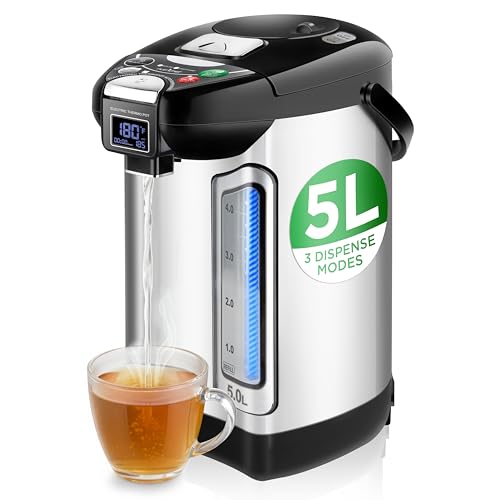
NutriChef 5L Digital Water Boiler and Warmer — Best Big and Simple
Who it suits: Budget-minded big households and small offices that need a full 5.0 liters of hot water and are happy to trade Japanese refinement for capacity per dollar.
- Capacity: 5.0 liters (5.28 qt)
- Stainless steel construction
- LCD display with digital controls
- Rotating base for serving access
- Multiple dispensing methods (manufacturer listing)
Strengths
- Full 5.0-liter capacity at the value end of the category
- Stainless steel body suits busy, knock-around use
- LCD display keeps settings obvious for shared use
Trade-offs
- Temperature control is less granular than the four-setting Japanese models
- Fit and finish trail Zojirushi and Tiger
- Brand support network is thinner than the Japanese majors
The NutriChef 5L Digital is the capacity play: five full liters of hot water in a stainless steel body with an LCD control panel, aimed squarely at households and small offices that found the Japanese flagships more money than they wanted to spend for the same headline capacity. In shared spaces the simple digital interface is a real virtue — anyone can walk up, read the display and pour without learning a button dance.
Set expectations correctly and it delivers: this is a big, straightforward boiler-warmer rather than a precision tea instrument. Temperature steps are coarser, the detailing is workmanlike rather than refined, and the long-term parts network is not what Zojirushi offers. For a busy family kitchen or break room that measures value in liters per dollar, those are trades many buyers will happily make.
For a first-time owner, what matters about the NutriChef 5L Digital is how quickly it becomes invisible: five full liters and a clear LCD panel at the value end of the market, and controls that explain themselves. The learning curve here is measured in minutes, and the safety systems forgive the mistakes beginners actually make.
On budget fit, the NutriChef 5L Digital belongs in this guide on merit: it is a verified model whose specification serves this brief directly, and its listing is linked so you can check price on Amazon as it stands today.
The honest limitation is precision: tea drinkers who care about the difference between 175°F and 180°F will feel the coarser control, and should look at the Micom models instead.
Best for: Large households and small offices prioritizing capacity and simplicity / Not suited for: Precision tea drinkers who live at specific temperatures

COSTWAY 5L Electric Hot Water Boiler and Warmer — Best Timer Pick
Who it suits: Value-focused large families who want 5.0 liters, a real choice of temperatures and a 24-hour timer without flagship money.
- Capacity: 5.0 liters
- Five temperature settings with re-boil function
- 24-hour timer
- Double-layer stainless steel construction
- Night-light water gauge (manufacturer listing)
Strengths
- Five temperature settings — more steps than most value rivals
- 24-hour timer suits set-and-forget household routines
- Double-layer stainless body stays cooler to the touch
Trade-offs
- Value-brand fit and finish, with a thinner support network
- Big footprint, like every 5.0-liter pot
- Controls are less polished than the Japanese interfaces
The COSTWAY 5L is the other half of the value-capacity argument in this guide. It matches the NutriChef on headline capacity, then adds two features that punch above its tier: five temperature settings rather than the usual handful, and a 24-hour timer that lets the pot follow the household’s rhythm — hot for the morning rush, resting mid-day, hot again for the evening.
The double-layer stainless steel body keeps the exterior cooler than single-wall designs, a small but real safety plus in a family kitchen. As with the NutriChef, the honest framing is value over refinement: the controls and finish are a step behind the Japanese brands, but the core job — a lot of hot water, at a chosen temperature, all day — is done properly.
For a first-time owner, what matters about the COSTWAY 5L is how quickly it becomes invisible: five temperature settings and a 24-hour timer in a double-wall stainless body, and controls that explain themselves. The learning curve here is measured in minutes, and the safety systems forgive the mistakes beginners actually make.
Within this budget the COSTWAY 5L needs no excuses made for it — it is here because the specification fits the brief, and the link lets you check price on Amazon before deciding.
The honest limitation is long-term polish: buttons, display and detailing are built to a price, and heavy daily users may feel that sooner than casual ones.
Best for: Large families who want timer flexibility and five temperatures on a budget / Not suited for: Buyers who prioritize fit, finish and brand support above all

Panasonic NC-EG4000 Electric Thermo Pot — Best Step-Up Pick
Who it suits: Coffee drinkers as much as tea drinkers: the household that wants one appliance to drip-brew a morning pot and then hold tea water all day.
- Capacity: 4.0 liters (4.2 qt)
- Temperature settings: approx. 208°F, 190°F, 180°F, 160°F
- Power: 700 W
- Slow-drip mode for drip-brewed coffee
- Binchotan charcoal-coated nonstick interior; 6-hour energy-saving timer; 360-degree rotating base
Strengths
- Slow-drip mode brews drip coffee directly — a feature no rival here offers
- Charcoal-coated interior is designed to improve water taste for tea
- 360-degree rotating base makes it easy to serve from any side
Trade-offs
- 700-watt element boils more slowly than the 800–928 W Japanese rivals
- Temperature steps are approximate rather than micro-computerized to the degree
- White body and cord storage feel less premium than the metal finishes
The NC-EG4000 is the thermo pot for people whose hot water is split between tea and coffee. Its signature trick is a slow-drip mode: place a filter cone and cup under the spout and the pot dispenses at a drip pace that brews a proper cup of drip coffee, something no other model in this guide attempts. The rest of the day it behaves as a well-mannered 4.0-liter thermo pot with four keep-warm temperatures — approximately 208°F, 190°F, 180°F and 160°F — covering black tea and noodles down to delicate teas and warmed drinks.
Panasonic coats the interior with Binchotan charcoal in a nonstick finish, aimed at cleaner-tasting water, and the base rotates 360 degrees so the spout can face whoever is pouring. A six-hour energy-saving timer and a dispenser lock round out a practical spec sheet.
For a first-time owner, what matters about the Panasonic NC-EG4000 is how quickly it becomes invisible: a slow-drip mode that brews filter coffee as well as holding tea water, and controls that explain themselves. The learning curve here is measured in minutes, and the safety systems forgive the mistakes beginners actually make.
The Panasonic NC-EG4000 earns its slot at this level honestly: verified model, verified specification, and a feature set aimed at exactly the job this guide describes.
The honest limitation is boil speed: the 700-watt element is the gentlest in this guide, so a full 4.0-liter boil from cold takes noticeably longer than the Zojirushi and Tiger models.
Best for: Mixed tea-and-coffee households that will actually use the slow-drip mode / Not suited for: Impatient users who refill and reboil several times a day
Comparison Table
The six picks side by side, on specifications only.
| Model | Capacity | Temperatures | Standout feature |
|---|---|---|---|
| Zojirushi CW-PZC22 | 2.2 L | 208°F keep-warm | Dechlorinate and descaling modes |
| AIRHOP Instant Hot Water Dispenser | 3.0 L tank, on demand | 77/115/150/185/212°F presets | Measured volumes with auto-stop |
| Panasonic NC-EG3000 | 3.0 L | 160/180/190/208°F | Slow-drip coffee mode |
| NutriChef 5L Digital | 5.0 L | Multi-setting digital | LCD digital controls |
| COSTWAY 5L | 5.0 L | Five settings | 24-hour timer |
| Panasonic NC-EG4000 | 4.0 L | 160/180/190/208°F | Slow-drip coffee mode |
How to Choose Best Hot water dispenser for beginners under $150
Beginner criteria at this budget can afford to be generous: safety and simplicity still lead, but now the machines themselves offer real temperature control and capacity, so the later criteria start to matter sooner. The order below reflects a first purchase made with room to choose.
Safety features: what to insist on
Any appliance that keeps liters of near-boiling water within arm’s reach should earn its place with layered safety. Look for a dispenser lock or auto-lock that prevents accidental pouring, a detachable magnetic power cord that pulls free if the pot is dragged or knocked, dry-boil or dry-start protection that cuts power when the tank runs empty, and a body that stays as cool as the design allows — double-wall construction helps here.
Households with children should weight this section heavily and consider placement part of the safety system: a boiler at the back of the counter, cord short and out of reach, beats any feature list. Under-sink systems remove the hot tank from reach entirely, leaving a faucet whose lever can be locked — for some families that architecture is the deciding argument.
Dispensing: how the water comes out shapes every day
Three dispensing styles dominate. Electric pump pots (most countertop boilers) pour at the touch of a button, sometimes with a slow café-drip mode for filter coffee. Lever and lock systems, like Tiger’s, add a deliberate unlock step before water flows. Instant countertop dispensers heat as they pour and meter out measured volumes. Under-sink faucets pour fastest of all and never need refilling by hand.
Judge dispensing on three things: speed for the fills you actually do, control for small cups, and what happens when a child or a pet meets the machine. Auto-locking levers and dispenser locks exist because a tank of 200°F water deserves respect. If your household includes small children, dispensing safety is not a footnote — it is a headline criterion, and it is ranked that way in this guide.
Cleaning and descaling: the maintenance that decides lifespan
Scale is the enemy. Mineral deposits coat the element and interior, slow the boil, taint the taste and eventually kill the appliance — faster in hard-water areas. The defenses are a nonstick or coated interior that releases scale, a descaling or citric-acid cleaning mode that runs the treatment cycle for you, and a removable lid that lets you actually reach inside.
Plan on a citric-acid descale every one to three months depending on your water, and on wiping the interior when you refill rather than letting deposits bake on. Under-sink tanks hide under the counter and are easy to forget; put the descale date in your calendar when you install, not when the flow slows. Models with a cleaning function and a wide, removable lid turn a chore into a button press, and that difference compounds over years of ownership.
Temperature control: the settings that actually matter
Hot water is not one temperature. Black tea and instant noodles want water at 200–208°F. Coffee blooms best a touch lower, around 195–205°F. Oolong sits near 190–195°F. Green teas scorch and turn bitter much above 180°F, and taste best near 160–175°F. Formula and warmed drinks live lower still. A dispenser with a single near-boiling output handles the top of that range and leaves the rest to guesswork and waiting.
Four keep-warm settings — the pattern on the better Japanese boilers — cover the whole map: roughly 160°F, 175–180°F, 190–195°F and 208°F. When you compare models, look at where the steps land, not how many there are. Five steps bunched between 185°F and 212°F serve tea drinkers worse than four steps spread across the full range. Under-sink systems are the exception that proves the rule: nearly all serve one near-boiling temperature, and the rare adjustable model is worth noticing precisely because it breaks that pattern.
Capacity: match the tank to the household, not the ambition
Capacity decides how often you refill, and refilling is the hidden chore of this category. A liter serves about four mugs. A 2.2-liter pot therefore covers a solo drinker’s day, a 3.0-liter pot serves a couple or a small family, 4.0 liters carries a family through a full day of drinks plus some cooking water, and 5.0 liters is office or big-family territory. Under-sink tanks look small at 2/3 gallon, but they refill themselves from the water line, so their effective capacity is the hourly output — around 60 cups per hour on the systems in this guide.
Oversizing has real costs: a bigger pot takes more counter, uses more energy to keep warm, and keeps water sitting longer between drinks. Undersizing has a different cost — the mid-morning refill and reboil, right when everyone wants a cup. Count your household’s hot drinks on a busy day, add cooking water if you use it, and buy the size that covers that day without heroics.
Key Takeaways
- Match the tank to your household’s busiest day, not your average one.
- Temperature steps matter more than temperature count — look for a spread from about 160°F to 208°F.
- Descaling on a schedule is the difference between a three-year and a ten-year appliance.
- Locks, magnetic cords and dry-boil protection are the safety trio to insist on.
Setting Up a Countertop Hot Water Dispenser
Setup takes ten minutes and one decision — where the pot will live permanently. These appliances are happiest filled in place with a jug, rather than carried to the sink each time.
- Place the pot on a level, heat-safe surface with clearance above for the lid and steam, and within reach of an outlet. Keep the cord short and untrailed across walkways.
- Rinse the interior, fill to the maximum line with fresh water, and close the lid until it clicks.
- Run one full boil and discard the water. This flushes manufacturing residues and is the step most often skipped and most worth doing.
- If your model has a dechlorinate mode, use it on this first fill if your tap water tastes of chlorine.
- Select your keep-warm temperature, set the energy-saving timer for your overnight hours, and engage the dispenser lock if children are in the house.
- Note the date in your calendar for the first citric-acid descale, one to three months out depending on your water hardness.
From here the routine is simple: top up before the level reaches the minimum line, because running a boiler dry — even with protection — stresses the element and the seals.
Descaling and Day-to-Day Care
Care for a hot water dispenser is mostly one habit: do not let scale build up. Everything else is wiping and common sense.
- Every one to three months — monthly with hard water — run a citric-acid descale. Models with a cleaning mode do the timing for you; on other models, dissolve the citric acid in a full tank, run the cleaning or boil cycle, let it stand as directed, then rinse with two fills of fresh water.
- Wipe the interior with a soft cloth when you notice film forming, and clean the dispensing outlet, where drips bake into deposits.
- Check the lid seal and the water gauge window; both cloud with scale before the tank itself complains.
- For under-sink tanks, descale on the same schedule even though you cannot see inside — the calendar, not your eyes, is the reminder.
Problem: Boiling takes longer than it used to and the pot sounds louder. → That is scale on the element talking. Descale before anything else; nine times out of ten the machine returns to form.
Problem: The water tastes stale or flat. → The tank has been topped up for too long without a full change. Empty it completely, descale if due, and refill fresh.
Problem: Dispensing slows to a dribble. → Check the outlet for scale build-up and the tank level; on under-sink systems, also check the supply valve is fully open.
Common Buying Mistakes
Buying capacity for guests you host twice a year
The 5.0-liter pot bought for holiday crowds spends 363 days keeping water hot for two people, using counter and energy the household actually misses. Buy for the ordinary week; for the party, a kettle can help the dispenser out for one day.
Ignoring the temperature steps and counting them instead
Five settings bunched near boiling serve a green-tea drinker worse than four settings spread across the range. Read where the steps land — roughly 160, 175–180, 190–195 and 208°F is the spread that covers real drinks.
Forgetting the cabinet clearance
Tall boilers and low wall cabinets collide in real kitchens. Measure the vertical space where the pot will live, lid-open height included, before the box arrives.
Skipping the first flush and the descale calendar
The two cheapest minutes in this category are the discard-the-first-boil flush on day one and a calendar note for descaling. Skipping them is how good machines acquire off tastes and short lives.
Putting a boiler where a child can reach the lever
Placement is a safety feature. A dispenser within toddler reach of an unlocked lever is an accident arranged in advance; use the lock, use the back of the counter, or choose an auto-locking model.
Keep exploring this cluster before you decide: Best Hot Water Dispenser Under $20, Best Hot Water Dispenser Under $50, and Best Hot Water Dispenser For Beginners Under $20 each take the same category from a different budget or angle, and the reasoning in this guide applies to all of them.
Final Recommendation
For most readers of this guide, the answer is the Zojirushi CW-PZC22 Micom Super Boiler: it fits the brief of best hot water dispenser for beginners under $150 better than anything else we verified, and it is the machine we would put on our own counter. The AIRHOP Instant Hot Water Dispenser (AH-WD1) is the runner-up — close enough that your household’s size, your counter and your drinks should make the final call between them. The beginner who buys at this level buys once — the machines above are all capable of being a household’s only dispenser for years.
How Long Should a Hot Water Dispenser Last?
Reasonable expectations, by tier: a value-brand boiler-warmer in daily use should give three to five years; a Japanese Micom pot from Zojirushi or Tiger, five to ten, with a long tail of owners reporting well beyond that; an under-sink tank, five to eight years for the tank with faucets often outliving it. The variables that move a machine from the bottom of its range to the top are almost boring: water hardness and whether you descale for it, how often the tank runs dry, and whether the machine idles at maximum temperature around the clock or rests on a timer.
Parts decide the endgame. When a seal, a lid or a pump eventually tires, the brands with deep parts networks — InSinkErator above all in the under-sink world, Zojirushi and Tiger on the counter — turn a death sentence into a repair. That is a real, if unglamorous, part of what flagship money buys, and it is why this guide keeps noting support alongside specifications. A dispenser is a small appliance with a plumber’s lifespan ambitions; buy the one whose maker plans to still know its name in seven years.
Reading a Spec Sheet Without Being Fooled
Dispenser spec sheets reward a skeptical reader. Capacity first: quoted liters are usually the tank’s brim volume, and the usable draw before a refill is a little less — normal, but worth knowing when you size for a family. Wattage second: a higher boil wattage means a faster first boil and faster recovery, nothing more mystical; it tells you nothing about keep-warm cost, which lives in the insulation and the timer, and is sometimes quoted separately as a much smaller warm wattage, as Tiger does.
Temperature claims deserve the closest reading. ‘Adjustable temperature’ can mean four honest presets spread across the brewing range, five presets bunched uselessly near boiling, or a dial on an under-sink tank you will set once and forget — all three are sold under the same words. The honest question is where the steps land. Finally, treat every ‘cups per hour’ figure as a laboratory number: it assumes the tank recovering ideally between pours. Your real throughput will be lower, and for every household in this guide’s audience, still more than enough.
Seasonal and Occasional Uses You Will Not Expect
Owners consistently find second and third lives for a hot water dispenser beyond drinks. Sterilizing jars and bottles for preserving. Blooming gelatin and dissolving stock without a stove. Warming a baby’s bath sponge, loosening a stuck jar lid under a hot pour, soaking a razor, thawing a frozen pipe wrap in winter, starting a hot compress. None of these justify the purchase alone, and together they explain a pattern in owner feedback: the machine’s value is systematically underestimated before purchase, because the buyer counts drinks and the household discovers tasks.
The seasonal peaks matter to sizing, too. Winter multiplies hot drinks; preserving season multiplies sterilizing; a houseful of holiday guests multiplies everything. If your household has a predictable peak, it belongs in the capacity decision alongside the ordinary busy day — the one week a year when the pot is refilled three times is the week the bigger tank earns its price difference.
Hot Water and the Rest of Breakfast: Building a Drink Station
Most dispensers end up anchoring a drink station, and a little arrangement multiplies their value. Tea, coffee and cups within one step of the spout; the machine filled in place with a jug kept beside it; a small tray under the spout for the drips every dispenser eventually produces. Households that set the station up once, properly, use the machine more and clean it more willingly than households where it landed wherever the box was opened.
Two placement refinements from long-term owners: keep the dispenser out of the kitchen’s main splash zone if you can — it will still be wiped, but less — and if more than one hot drink style lives in the house, put the low-temperature drinks’ supplies nearest the machine, because those are the cups the kettle used to ruin and the dispenser exists to save.
When to Repair, When to Replace
Every dispenser eventually presents the question. Repair when the fault is a seal, a lid, a faucet or a pump on a machine whose tank and element are sound — especially on the brands with real parts networks. Replace when the element itself fails on a value model, when scale damage is structural, or when the machine’s temperature control has drifted beyond what its drinks forgive. The honest middle case is the ageing flagship: a professional descale and a seal kit often return it to years of service for a fraction of replacement cost.
The deciding habit is to make the call early. A machine nursed along for a year of slow boils and off tastes costs more in daily irritation than the repair ever would have, and the households that report the longest dispenser lifespans are, without exception, the ones that maintained on schedule and repaired on time.
Related guides
Frequently Asked Questions
What is the difference between a hot water dispenser and an electric kettle?
A kettle boils a batch of water and then cools down; a dispenser keeps water at a set temperature, or heats it on demand, so hot water is available instantly at any hour. Dispensers trade a counter footprint and keep-warm energy for zero waiting, and the better ones hold specific temperatures — 175°F for green tea, for example — that a kettle can only pass through on its way down.
Are hot water dispensers safe around children?
They can be, with the right model and placement. Look for a dispenser lock or an auto-locking lever, a detachable magnetic cord, and dry-boil protection. Tiger’s auto-lock system, which re-locks seconds after pouring, is the strongest implementation in this guide. Placement matters as much as features: back of the counter, cord out of reach, lock engaged.
Do under-sink hot water dispensers need a special faucet hole?
They need a standard 1-3/8-inch hole, which many sinks already have as a spare or a soap-dispenser opening. The tank also needs an electrical outlet under the sink. If your sink has neither, a countertop dispenser avoids the conversation entirely — worth weighing before you fall for the plumbed option.
Why does my dispenser water taste stale?
Water that is topped up for weeks without a full change absorbs odors and concentrates minerals, and a scaled interior adds its own flavor. Empty the tank completely, descale if the cycle is due, and refill with fresh water. Models with a dechlorinate mode also help when the taste problem is chlorine from the tap.
Can I use a hot water dispenser for baby formula?
Follow your formula manufacturer’s guidance on water temperature first — that instruction outranks any appliance feature. Where warm water is called for, a dispenser with a low setting around 158–160°F, like the Tiger and Zojirushi models in this guide, prepares it consistently. Always check the temperature of the made-up feed before serving, and keep the dispenser’s lock engaged in a house with other children.
Do hot water dispensers use a lot of electricity?
Boiling is brief and efficient; the running cost is keep-warm. A standard pot cycles its element all day, a vacuum-insulated hybrid cycles far less, a timer removes the overnight hours, and an on-demand dispenser uses nothing at all between cups. Your usage pattern decides which of those matters — the guide’s energy section walks through the match.