Disclosure: As an Amazon Associate, umtsmarttool.com earns from qualifying purchases. Links to Amazon on this page are affiliate links; they cost you nothing extra. Prices and availability change often, so check the current Amazon listing before you buy.
Where to buy
- Betta SE Solar-Powered Robotic Pool Skimmer — Check on Amazon
Read the full guide ↓
Pool Skimmer Reviews: The Betta SE and the Autonomous Era, Examined on Its Own Terms
Most pool skimmer reviews in this cluster concern the passive era — fittings, wall-mounts, nets — because most pools still skim that way. This page exists for the other era. Its subject is the Betta SE, the solar-powered robotic surface skimmer that has become the autonomous category’s reference product: a self-propelled, sun-charged machine with twin salt-and-chlorine-tolerant motors, a manufacturer-stated continuous runtime of up to thirty hours, a solar recharge of five to six hours, a top-access debris basket, and a minimum operating depth of about five inches of water. This review examines it the way the era deserves — its working logic, its daily and seasonal rhythms, its failure modes, its exclusions, and the pools it genuinely serves — and then places it against its dual-charge sibling, the Betta SE Plus, and against the passive reference point, the Intex 28000E wall-mount, so the reader can locate the machine in the category’s whole map.
The short verdict: the Betta SE is a genuinely new answer to a genuinely old problem — the surface that needs skimming when the pump is off — and it earns its reference status by solving that problem without plumbing, installation, or the pool’s energy bill. It is not a replacement for a plumbed skimmer in a pool that has one and keeps a rhythm; it is the correct primary for pools the passive era could not serve — unplumbed, uncutouted, schedule-bound, or simply owned by people whose lives do not include a pool round — and a legitimate second system for pools whose owners want the dawn shift covered. Readers weighing whole systems at each budget will find the passive rankings in Best Pool Skimmer Under $300 Best Pool Skimmer Under $300, where this machine is assessed in prose, honestly, as an over-that-frame product; this page is its home review, at its own tier.
In this guide
The Product in Brief
- Type: solar-powered robotic surface skimmer
- Motors: twin SCT (salt and chlorine tolerant)
- Runtime: up to 30 hours continuous per manufacturer, on a full charge
- Recharge: 5–6 hours under solar charging
- Basket: top-access debris basket with handle
- Minimum depth: about 5 inches of water; not for infinity-edge pools (per manufacturer)
- Navigation: self-propelled surface roaming with obstacle response
Working Logic: A Skimmer That Keeps Its Own Hours
The Betta SE’s founding idea is temporal, not mechanical. A passive skimmer’s weakness was never its intake; it is its shift pattern — it works when the pump works, and the debris fall keeps its own schedule, landing heaviest overnight and in the still hours when no timer runs. The robot inverts the arrangement: it charges from the sun it skims under, stores enough energy for a manufacturer-stated thirty hours of continuous running, and works the surface as a roving intake rather than a fixed one, so the pool’s geography — the dead corners that defeat a wall fitting — becomes a route rather than a shadow. The twin motors are specified as salt-and-chlorine tolerant, which matters more than it sounds: a machine that lives in the water full-time, rather than visiting it, must treat the pool’s chemistry as its climate, and the SCT designation is the manufacturer’s acknowledgement of that. The basket is top-access with a handle, sized for the daily rhythm the machine invites — lift, empty, return — and the whole apparatus asks no plumbing, no cutout, no bracket, and no electrician. Set it on the water, and the era’s entire installation manual is complete.
Notice what the design refuses, in mirror image of the passive reference: no standard parts an industry stocks, no serviceability by strangers, no decade of evidence. The refusals are the era’s honest price, and this review will price them in the failure section rather than pretend them away — but they should not obscure the design’s genuine elegance, which is that it identified the passive era’s true constraint (time, not intake) and engineered directly at it.
The Daily and Seasonal Rhythm
Ownership, in practice, is a light rhythm with a solar logic. The machine works the surface through the day and, on a full charge, deep into the night; the owner empties its basket on a rhythm set by the debris calendar — daily in the leaf weeks, every few days in high summer — and otherwise watches it the way one watches weather. Charging is the sun’s department for most pools in most seasons: five to six hours of good light restores the stated full charge, and pools with honest sun exposure will rarely think about energy at all. The rhythm’s pressure points are the shaded pool and the northern winter, where the solar income falls and the machine’s working day shortens correspondingly — the manufacturer does not hide this, and neither does this review: the Betta SE is a solar product, and its map is the sun’s map. Seasonally, it asks what every appliance asks: retrieval and indoor storage for the freezing months, a basket and hull rinse at the change of seasons, and a battery treated kindly — stored charged, not abandoned flat — as the price of the second spring.
One rhythm deserves emphasis because owners discover it late: the machine skims best in a pool whose large debris events are still netted by hand. A storm’s worth of branches and leaf mats is a load for a human with a net, not for a roving basket; owners who net the events and let the robot keep the ordinary days find the partnership — the oldest tool and the newest, dividing the calendar — to be the autonomous era’s actual best configuration.
Failure Modes and What They Cost
The era’s ledger, stated as plainly as the passive one’s was elsewhere in this cluster. The battery is the consumable heart: its capacity fades across seasons on the chemistry’s schedule, not the owner’s, and its replacement is a manufacturer’s transaction rather than a shelf errand. The motors and their seals live in chlorinated water full-time, and while the SCT specification is the design’s answer, the answer’s decade is unwritten — the product has not existed long enough for anyone, this review included, to certify its year nine. The hull and basket are plastics in ultraviolet, with the same caveat. The support model is a company’s, not an industry’s: parts, service, and the product’s own continuity run through one maker, and the owner’s hedge is the maker’s evident commitment to the line — the SE Plus’s existence as an iterated sibling is the strongest available signal — rather than any standard. Total it honestly: a higher, lumpier, less predictable ledger than the passive fitting’s, purchasing a capability the fitting cannot offer at any price. Whether the trade is wise is a property of the pool, not of the machine.
Exclusions and Honest Boundaries
The manufacturer excludes infinity-edge pools — the machine’s roaming logic and the vanishing edge are fundamentally incompatible — and sets a minimum operating depth of about five inches of water, which excludes the shallowest splash pools and some beach entries at their margins. Solar dependence excludes, in practice if not in specification, the deeply shaded pool and the high-latitude winter. The basket’s capacity excludes the storm-week-as-lifestyle pool unless the owner nets the events. And the price — which this cluster does not print, and which sits above the $300 frame of its budget guides — excludes the buyer for whom the passive system’s decade arithmetic is the whole argument. A review that lists a product’s exclusions this plainly is not damning it; it is doing the work the product’s own documentation does, which is one reason the maker earns this page’s respect.
Who It Suits, and Who It Does Not
The Betta SE suits the unplumbed pool absolutely — the above-ground installation with no cutout and no intention of one, the rental, the pool whose walls refuse every bracket — because for those pools it is not an upgrade but the first automatic answer that exists. It suits the schedule-bound owner: the traveller, the shift worker, the household whose pool round kept losing to life. It suits the dawn perfectionist, whose standard is a surface skimmed before the first swim rather than after the timer. It does not suit the shaded or northern pool whose sun cannot fund it, the infinity edge it is excluded from, or the plumbed pool whose owner keeps a happy rhythm and whose money the passive ledger serves better. And it does not suit the buyer who needs a decade of evidence before committing, because the era has not lived a decade yet — a fact this review states without apology in either direction. There is no shame in either temperament; there is only the match, and the match is the whole of buying well in a young category.
Alternatives Worth Weighing

Betta SE Plus
The sibling answers the base model’s one structural anxiety: charging. The Betta SE Plus adds a plug-in adapter that restores a full charge in about three and a half hours by the manufacturer’s documentation, alongside a finer 200-micron basket and a shallower minimum operating depth of about three and a half inches. For sunny pools the Plus’s premium buys insurance rarely claimed; for shaded, northern, or impatient owners it buys the product itself, freed from the weather’s veto. The choice between the siblings is therefore a sunlight measurement, and this review’s counsel is to make it honestly — a week of watching the pool’s actual sun is worth more than any specification either machine carries. It is also, this review notes, the rare upgrade decision that cannot be deferred cheaply: a household that buys the base model for a shaded pool will not fix the mismatch with accessories, so the sunlight audit belongs before the order, not after the first grey week.

Intex 28000E Deluxe Wall Mount Surface Skimmer
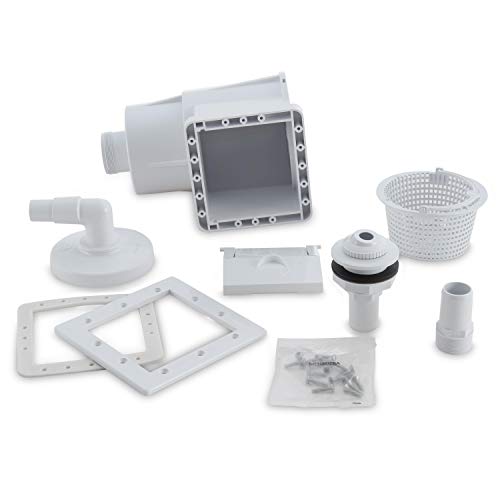
The passive counter-argument, for the soft-sided pool the robot most often courts: the Intex 28000E skims on the pump’s schedule for a small fraction of the robot’s commitment, with parts on every shelf and a decade of evidence behind its pattern. Where the pool’s pump runs a sane split schedule and the owner keeps the round, the wall-mount’s water is as clean at swim time as the robot’s — the eras converge at the surface and differ in everything else: hours, evidence, ledger, and the owner’s role. Cross-shoppers should decide which difference they are actually buying, because the clean water, competently pursued, is common to both. That convergence is this cluster’s most repeated finding and its most useful one: it converts a seemingly technological choice back into a human one, about schedules, temperaments, and evidence — the things owners actually know about themselves.
Verdict
The Betta SE earns its place as the autonomous era’s reference by the same standard this cluster applied to the passive one: it identified its category’s real problem — the unskimmed hours — and engineered at it directly, with its exclusions documented and its rhythms light. Its ledger is younger, lumpier, and more company-dependent than a plumbed fitting’s, and for the pools it serves, none of that outweighs the founding fact: it skims when nothing else does, in pools nothing else could. Buy it with the sunlight honestly measured, net the storm events by hand, store it kindly through the freeze — and expect, as its highest praise, a surface that is ready before you are. If this review has a sentence to be remembered by, it is the inversion the machine performs on the whole category: for fifty years the skimmer waited for the water to come to it, on the pump’s schedule, at the wall’s address — and the Betta SE is the product that went to the water instead, on the sun’s schedule, everywhere. Categories turn on such inversions, and this one has turned. Check the current listing on Amazon before ordering, and confirm the model on the box when it arrives.
Navigation and the Pool’s Geography, Observed
A roving skimmer’s real specification is its behaviour at the pool’s edges — the ladder’s shadow, the steps’ shelf, the corner where the current dies — because those are the addresses debris chooses. The Betta SE’s roaming logic treats the pool as a territory to be covered rather than a current to be ridden, and the practical consequence owners report is the disappearance of the fixed intake’s permanent shadow: given hours, the machine’s route intersects every stall address the leaf test would convict. The behaviour is not magic and this review will not dress it as such — a roving intake trades the fixed one’s intensity for coverage, processing the surface broadly rather than deeply, and pools with a single heavy delivery point (the oak’s drip line, the return’s eddy) may find the fixed point, or the hybrid of both, the stronger answer. But for the ordinary geography of an ordinary pool — debris arriving everywhere, in modest amounts, all day — coverage is the correct currency, and the robot is rich in it. Watch one work a still morning and the era’s argument makes itself: the surface is not being pulled toward a door; it is being visited, patiently, by one.
The Chemistry Question: Living in the Water
Every prior skimmer in this cluster visits the water’s surface from a fixed address and can be lifted out in seconds; the robot resides. Residence raises the chemistry question in a form the passive era never faced: seals, motor housings, and hull plastics immersed in chlorinated or salt water not for a pump block but for the season. The manufacturer’s answer is specification — the twin motors are designated salt-and-chlorine tolerant, the hull is built for the immersion — and the owner’s part of the answer is rhythm: the machine lifted, rinsed, and inspected on the basket’s schedule rather than abandoned afloat for months, because residence without inspection is how small seal failures become motor failures. Salt pools deserve a specific note: salt’s corrosive patience is the reason the SCT designation exists, and owners of salt systems should treat the rinse as the product’s central maintenance sacrament rather than an optional courtesy. None of this is onerous — minutes, on a rhythm the basket already imposes — but it is a genuinely different maintenance philosophy from the passive fitting’s, closer to boat ownership than to plumbing, and buyers should recognise which philosophy their temperament keeps.
How This Review Was Conducted
Method, stated as this cluster’s reviews require. The machine’s specifications — runtime, recharge, depth minimum, motor designation, exclusions — are the manufacturer’s, taken from its documentation and listing as opened during research, and are reported as manufacturer statements rather than as this page’s measurements, because a solar robot’s real-world numbers are functions of a specific pool’s sun, and printing a single tested figure would pretend a precision the product’s own physics denies. The ownership account — rhythms, event-netting, storage, the battery’s centrality — is synthesised from the documentation and the consistent owner literature, and is deliberately free of invented test metrics and fixed ratings, which this cluster does not trade in. What a review can certify about a young product is structural: what problem it solves, what it refuses, what it excludes, and what its ledger’s shape is. On those questions the evidence is clear, and the verdict above is confined to them. Readers who want the passive era’s reference examined with the same rigour will find it in Pool Skimmer Review Pool Skimmer Review; readers who want the eras weighed as philosophies will find Pool Skimmer Pros And Cons Pool Skimmer Pros And Cons.
The Hybrid Household: Robot Plus Backbone
The most interesting ownership pattern this review encountered is neither pure era but the deliberate hybrid: a plumbed or wall-mounted skimmer as the system’s backbone — skimming whenever the pump runs, vacuuming through its port, costing nothing at the margin — and the Betta SE as the off-hours specialist, owning the dawn, the evening, and the owner’s holidays. The hybrid’s logic is the schedule’s: the passive system’s weakness is temporal and the robot’s strength is temporal, so the pairing is complementary rather than redundant, and its total cost, while real, buys the closest thing the category offers to a surface that is always ready. Owners arrive at the hybrid from both directions — robot first, backbone added at the pool’s first replumb; or backbone first, robot added when travel or age made the dawn shift matter — and report the same end-state satisfaction, which suggests the destination matters more than the sequence. This review’s counsel to the cross-shopper is therefore reframing: the question is rarely robot or fitting, forever; it is which one first, for this pool, this year, and the honest answer is usually the one that solves the problem the owner actually has this season.
Children, Dogs, and a Machine in the Water
A roving appliance changes the pool’s social physics in ways a wall fitting never did, and a complete review should walk through them. Children find the machine fascinating — which is mostly a virtue, since a child who watches the skimmer is learning the pool’s systems, and mostly a caution, since the manufacturer’s guidance on swimming with the unit in the water should govern the household’s rule, as the FAQ below repeats. Dogs divide into the indifferent and the obsessed; the obsessed can usually be trained to the machine’s unimportance in a week, and the machine’s slow, unthreatening movement helps. Pool parties simply lift it out — the gesture takes seconds and pairs with the basket’s service — and its absence for an afternoon is covered by the same net-and-backbone logic as a storm event. None of these are objections; they are the ordinary negotiations of adding a moving object to a family’s water, and households that enjoy gadgets will count the negotiations as part of the fun. Households that want the pool’s machinery invisible should hear the review plainly: this machine is present, visible, and mildly charismatic, and that presence is part of what is being bought.
The Economics of the Sun’s Labour
The robot’s running cost is the most misreported number in its category — usually quoted as zero, which is true of its energy and false of its ownership — so this review itemises honestly. Energy: genuinely free at the margin, drawn from sunlight that was falling on the water anyway, and worth real money against the alternative of extending pump hours to chase the off-schedule surface. Consumables: the basket’s eventual wear and the battery’s horizon, priced in the manufacturer’s currency rather than the industry’s. Attention: a lighter weekly rhythm than any passive system, concentrated in the basket and the seasonal storage, with the failure cost of neglect falling on the battery rather than on performance. Capital: the machine itself, at a price this cluster does not print and the listing will state. Set against the passive system’s ledger — pump hours unchanged, parts in small calm instalments, attention in the two-minute round — the robot’s economics win exactly where its capability wins: in pools whose alternative was not a cheap fitting but an unskimmed surface, or a pump run long past filtration’s needs. Economics, like everything else in this review, is a property of the pool.
Second Seasons and the Iteration Question
Young product lines iterate visibly, and the Betta family’s shape — a base SE, a Plus that answers its charging anxiety — tells the prospective owner two things at once. First, the maker is listening and investing, which is the strongest available proxy for support continuity in a category without an industry’s shelf. Second, the line will keep moving, and today’s machine will be a prior model within a few seasons — a fact that troubles buyers who experience iteration as obsolescence and pleases buyers who experience it as a maturing ecosystem with an upgrade path. This review’s position is the pool’s: the machine’s job is this decade’s surfaces, not the catalogue’s future, and a unit that skims its owner’s pool well for its battery’s life has kept its whole promise regardless of what its maker announces next spring. Buy the iteration that fits your sunlight now; the family’s direction is reassuring, and reassurance — not permanence — is what a young era can honestly sell.
What the Passive Era Should Learn From It
A review of the new era owes the old one its lessons, because the robot’s success is diagnostic: it reveals which of the passive system’s virtues were essential and which were merely habitual. Essential, the robot confirms by lacking: standard parts, decade evidence, service by strangers — the passive ledger’s whole calm. Habitual, the robot exposes by ignoring: the fixed intake’s geography, the pump’s schedule as the surface’s schedule, the owner’s round as the system’s clock. The passive era’s defenders sometimes argue as if the robot’s existence refutes the fitting, and its partisans return the compliment; the truth this review has tried to keep is that each era is the other’s best criticism, and the category is healthier with both arguments in print. The buyer does not need to settle the philosophy — only to know which problem is theirs, this season, in this water, under this sky. The rest is shopping.
Storage, Winters, and the Machine’s Off-Season
The robot’s year has a chapter no passive fitting shares: the off-season, in which the machine must be kept rather than merely drained. The manufacturer’s logic, which this review endorses, is battery-first — retrieve the unit before the freeze, rinse the hull and basket, dry them, charge the battery rather than storing it flat, and keep the whole in a dry indoor place where winter cannot reach it. The discipline is closer to storing a good tool than to winterising plumbing, and owners who already keep such rhythms — for the mower’s battery, the boat’s electronics — will find it native. Owners in frost-free climates skip the chapter and gain the machine’s simplest life: year-round residence with the rinse rhythm as its only season. Either way, the off-season is where the era’s appliance nature is most legible, and buyers should read this section as the honest counterpart to the installation section’s brevity: the robot trades the fitting’s careful hour, once, for a small annual ceremony, forever — and for many owners that remains, clearly, the right trade.
The Review’s Remaining Doubts, Stated
As with the passive reference review in this cluster, the doubts are part of the findings. The battery’s true multi-year behaviour under real households’ storage habits is the product’s largest open variable, and no review written today can close it. The navigation’s elegance in complex pool shapes — freeform curves, tight step shelves, heavy ladder traffic — is documented less deeply than its performance in ordinary rectangles, and owners of theatrical pools should weight the return policy accordingly. And the category itself is young enough that a competitor’s discontinuity — a maker exiting, a line orphaned — is a risk class the passive era simply does not carry. None of these doubts overturns the verdict for the pools the machine serves, because those pools’ alternative is not a safer version of the same capability but the absence of the capability. Doubts price a product; they do not have to disqualify it, and this review has priced them in.
Closing Assessment
Every era’s reference product is, in the end, the one that made its category’s argument unavoidable, and the Betta SE has done that for autonomous skimming: after it, the question for a pool without plumbing is no longer whether the surface can be skimmed automatically, but whether the owner wants it to be. This review has priced the machine’s youth, its battery, its company’s centrality, and its sun-dependence without flinching, because a reference review’s job is the whole ledger — and the ledger still balances in the machine’s favour for the pools in its envelope, which are numerous, growing, and were previously unserved. Buy it by the sunlight, keep its basket, store its battery kindly, and let the passive backbone — where one exists — do the plumbing’s work while the robot does the hours’. The eras, properly assigned, are not rivals. They are shifts, and the pool, at last, is covered around the clock — which was, from the first wall fitting to this solar roamer, the entire ambition of the category, finally stated in a form a single product can deliver.
A First Month’s Diary, Reconstructed
Week one is novelty: the household watches the machine the way one watches a new pet, and the basket — emptied twice out of curiosity rather than need — reveals the pool’s true daily fall, which is always more various than the owner believed. Week two is calibration: the owner learns which mornings follow windy nights in the basket’s contents, discovers the corner the machine favours and the shelf it visits least, and makes the small peace with imperfection that all coverage systems require. Week three is the first storm, and the diary’s most instructive entry: the owner nets the event by hand, as this review counsels, and understands the partnership’s terms in their hands rather than in print. Week four is the quiet the product was bought for — the surface simply ready, the machine simply there, the novelty spent and the utility remaining. Reviews are written about week one; ownerships are lived in week four, and the Betta SE’s distinction is that its week four is better than its week one, because what it sells was never the watching. It was the not-having-to.
The Environmental Ledger of a Solar Skimmer
The machine’s green accounting deserves the same two-sided honesty as its economics. In its favour: its energy is sunlight that was heating the water anyway; it extends no pump hours; it replaces, in unplumbed pools, the alternative of doing without — and an unskimmed pool’s chemistry churn, algae remediations, and water replacements carry footprints of their own that a skimmed surface avoids. Against it: a battery with a finite life and a manufacturer’s recycling path the owner must actually use; electronics and motors where the passive fitting has none; a product lifespan measured in seasons rather than decades, with the replacement’s manufacture charged to the same pool. The balanced finding is that the robot is the greener answer exactly where it is the practical one — the unplumbed, schedule-bound pool — and the less green one where a passive fitting would have served for a decade. Sustainability, like skimming, turns out to be a property of the match between product and pool, and this review declines to award it as a badge to either era.
Buying the Genuine Article and the Right Variant
A reference product accumulates variants and imitators, and this review closes its examination with the buyer’s verification drill. Confirm the model — SE versus SE Plus — against the household’s sunlight decision, since the two are cross-shopped constantly and the difference is a feature, not a trim. Confirm the maker’s name on the listing and the box, as with any standard-attracting product. Read the listing’s stated depth minimum and exclusions against your pool’s actual shallow end and edge design, because those two specifications, honestly applied, acquit or convict the purchase before money moves. And keep the receipt and the serial with the pool’s records — the appliance era’s paperwork matters more than the plumbing era’s did, because its support runs through one company, and the documented owner is the supported owner. Thirty seconds of verification at the listing, ten at the door: the same drill as the passive standard, in the new era’s dialect.
For the Reader Still Torn: A Decision in Three Questions
First: does your pool have, or will it accept, a plumbed skimmer and a kept rhythm? If yes, the passive system’s ledger is very hard to beat, and this machine is your second purchase at most. Second: does your water receive the sun the machine eats? Measure it for a week; if the answer is marginal, the Plus’s adapter, not optimism, is the remedy. Third: is the surface’s readiness at dawn and during your absences a real need or a pleasant image? Households that travel, host, or swim early will answer honestly and find the robot’s case made; households that swim at noon after a kept round will find the fitting’s. Three questions, none of them about the product — because the product, this review has argued throughout, is sound. The match is the purchase, and the match is knowable in advance by anyone willing to measure a week’s sunlight and tell the truth about their own rhythm.
The Machine as a Neighbourhood Fact
A final observation, offered because reviews of visible appliances owe it: the robot will be seen. It patrols in daylight, it has a presence on the water that a wall fitting never had, and households differ in whether that presence reads as charming industry or as clutter on a designed landscape. Owners in the first camp name it, defend it to guests, and fold it into the pool’s story; owners in the second camp find themselves apologising for a machine that is, functionally, doing everything promised. Aesthetic temperament is a legitimate specification — pools are looked at more hours than they are swum in — and this review advises the torn buyer to settle it honestly before the functional questions, because a resented machine is maintained resentfully, and maintenance, in every era, is where ownerships succeed or fail. The fitting disappears; the robot performs. Choose the one whose visibility your household will enjoy, or at least never notice with irritation, across a thousand mornings.
Frequently Asked Questions
How do I decide between the SE and the SE Plus?
Measure your pool’s sun for a week, honestly, in the season you swim most. If the water receives long, direct light and your climate’s grey stretches are short, the SE’s solar rhythm funds itself and the Plus’s adapter is insurance. If shade, latitude, or impatience rules, the Plus’s dual charging is not an upgrade but the product’s enabling feature, and it should be bought first rather than regretted later. The basket fineness and shallower depth minimum are secondary; charging is the decision.
Can the Betta SE replace a plumbed skimmer entirely?
For surface debris, in a pool it suits, yes — that is its design brief, and pools that were never plumbed run it as their only automatic skimmer. Owners of plumbed pools who add one usually keep the fitting as the backbone and let the robot own the off-hours; the replacement question is really about whether the pool’s remaining needs — filtration suction, vacuuming — are served elsewhere, since those were never the surface skimmer’s jobs in the first place.
Will it climb or beach on my pool’s steps?
The machine is a surface roamer with a stated minimum depth; broad shallow shelves and beach entries at the margin of that depth are where any such unit can linger or lose its working water, and the manufacturer’s depth specification is the governing document for your pool’s geometry. Owners of step-heavy designs should measure the shelf’s depth honestly before ordering — the specification exists precisely to make that a thirty-second decision rather than a season’s annoyance.
How does it handle cloudy weeks?
It draws on its stored charge — the stated thirty-hour runtime is precisely the buffer for sunless stretches — and shortens its working day as the reserve falls. Extended grey weather will eventually idle it, which is the honest physics of a solar product and the reason the SE Plus’s adapter charging exists. Owners in grey climates should buy the sibling or accept the rhythm.
What does it do at night?
On a full charge, it works — the stated thirty-hour runtime spans the night comfortably, which is rather the point: the overnight debris fall, the passive pool’s blind spot, is the robot’s home shift. Owners consistently name the dawn surface — skimmed before anyone woke — as the moment the purchase explains itself, and this review, having priced every caveat it could find, is content to let that moment stand as the product’s summary.
Is it safe with swimmers in the pool?
Follow the manufacturer’s guidance for your model and household; the common practice this review reports is that most owners lift the machine out during active swimming — it is light, the basket service pairs naturally with the interruption, and a roving appliance and a crowded pool are a combination neither was designed for. When in doubt, the maker’s documentation governs.
Does it reduce what my filter has to handle?
Yes, in the way every surface skimmer does and this one does around the clock: debris intercepted while it floats is debris that never waterlogs, sinks, and enters the bottom-and-filter workload. Owners pairing the robot with a plumbed system often find the filter’s service interval stretching, because the surface fraction — the majority of a pool’s debris by count — is being harvested on the sun’s schedule rather than the pump’s. It is one of the hybrid configuration’s quiet dividends.
What maintenance does it actually need?
The basket emptied on the debris calendar, the hull and basket rinsed at season changes, the solar panel kept clean enough to charge honestly, and storage — charged, dry, indoors — through freezing months. It is a lighter rhythm than a plumbed system’s in weekly minutes and a heavier one in consequence if skipped: a neglected passive skimmer underperforms, while a neglected battery can end a season.
Does it work in above-ground pools?
Yes — it is wall-agnostic, which is much of its point: no cutout, no bracket, no brand geometry, only the depth minimum and the sun to satisfy. Above-ground pools with soft walls, pools whose owners refuse to pierce a liner, and seasonal installations that must leave no trace are among its strongest use cases, provided the water is deep enough at its shallowest working area and the edge is not an infinity design.
Is the Betta SE a good gift or a good first purchase for a new pool owner?
As a purchase for a known pool — sunlight measured, depth confirmed, edge design checked — it is an excellent one, because it removes the new owner’s steepest chore before habits form around resenting it. As a gift it carries the appliance era’s usual risk: the specifications are pool-specific, and a surprised recipient with a shaded or shallow pool inherits a mismatch. Give it with the receipt, or give the passive standard, whose envelope is wider and whose decade forgives the guess.
What happens when the basket fills mid-day?
The machine keeps roaming with a full basket and diminishing effect — it does not choke a pump, because it is not connected to one, which is a genuine safety elegance of the design — and the surface simply waits for the owner’s round. In heavy fall weeks the rhythm shortens to daily; the basket’s top access and handle make the service a one-minute, dry-hands job, which is the correct design response to a consumable rhythm.
How long will it last?
This review declines to invent a number the era has not yet produced. The design’s materials and motor specification are appropriate to multi-season service, the battery is the acknowledged wear horizon, and the maker’s iteration of the line suggests commitment to supporting it. Buyers who need a certified decade should buy the passive standard instead — and buyers who value the capability now should accept, eyes open, that they are early in a product’s evidence, as every era’s first owners always are.