Disclosure: As an Amazon Associate, umtsmarttool.com earns from qualifying purchases. Links to Amazon on this page are affiliate links; they cost you nothing extra. Prices and availability change often, so check the current Amazon listing before you buy.
Where to buy
The product under review, plus the two alternatives readers ask about most. Check the current Amazon listing before you buy.
- She’s Birdie Original Personal Safety Alarm — Best Overall: Check on Amazon
- Hootie Personal Safety Alarm — Best for Beginners: Check on Amazon
- POM Personal Safety Alarm — Best Rechargeable: Check on Amazon
Read the full guide ↓
Personal safety alarm review: The Birdie, Examined Properly
This personal safety alarm review takes the category’s best-known product — the She’s Birdie Original — and pulls it apart the way a skeptical buyer should: what it is, how it triggers, how it stops, what powers it, where it disappoints, and which of its rivals deserve your money instead. The Birdie matters beyond its own sales because it defined the modern form of this product: an accessory-styled keychain siren with a strobe, sold on the insight that a safety device only works when it is carried, and carried devices must be things people like owning.
Our verdict, up front: the Birdie remains the easiest personal alarm to recommend to the widest range of people, not because it is the loudest or the cheapest, but because its balance of activation, stopping, size and style produces the highest carry consistency in the category. The qualifications are real — coin-cell power with no low-battery warning, a premium price against multipacks, and a maker-rated 130 dB figure that should be read as a class rather than a measurement — and this review gives each of them full weight. Readers comparing the whole field should also see our Best Personal Safety Alarm Under $50 Best Personal Safety Alarm Under $50 roundup.
In this guide
Quick Verdict
Best for: everyday carriers who want the alarm most likely to still be on the bag in a year / Not suited for: buyers covering a whole household on a budget, or anyone who refuses coin-cell batteries on principle.
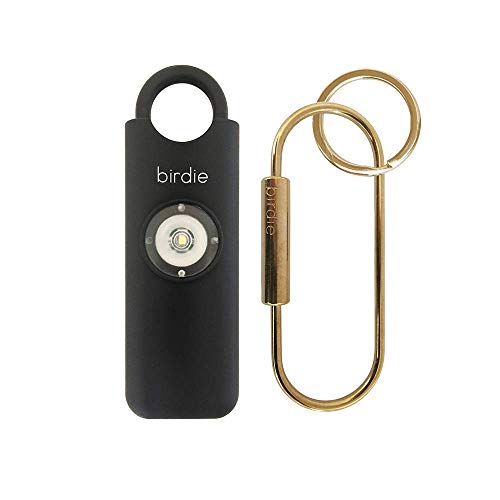
She’s Birdie Original Personal Safety Alarm — Best Overall
At a glance: 130 dB siren (maker-rated). Runs on 2 CR2032 batteries (included)
- 130 dB siren (maker-rated)
- Strobe light that flashes while the siren sounds
- Pull-top activation: pull the top ring to sound, push back to stop
- Runs on 2 CR2032 batteries (included)
- Keychain carry in a range of colors
Strengths
- Siren and strobe fire together, so the alert is both audible and visible
- Activation is a single gross-motor pull that works with cold or gloved hands
- Replaceable coin cells mean no charging cable to remember
Trade-offs
- Coin cells are a consumable you have to keep spares of
- The decorative shape can snag less smoothly in a tight pocket than a flat alarm
- No low-battery warning light, so periodic test pulls matter
The original Birdie built its reputation on a simple observation: a safety device only works if it is actually on your bag, and people leave ugly, tactical-looking gadgets in drawers. The bird-shaped body, the brass-look keychain and the color range make it read as an accessory first. Underneath the styling, the mechanism is a pull-top design — pull the top away from the body and a 130 dB siren starts together with a flashing strobe; push the top back down and it stops. That two-part motion is deliberate enough to avoid most accidental triggers in a handbag, yet simple enough to perform under stress without looking.
Power comes from two CR2032 coin cells, which keeps the body slim and means a flat battery is a two-minute fix rather than an overnight charge. The honest limitation is the absence of any battery warning: the only way to know the cells are healthy is a short test pull every month or two, ideally outdoors or into a cushion. Treat that test as part of the routine, like checking a smoke alarm, and the Birdie is one of the most carry-able alarms in this guide.
Best for: anyone who wants the alarm they will actually carry every day, in a design that suits work and social bags / Not suited for: buyers who want the cheapest route to covering a whole household
Design and Build, in Detail
The Birdie’s body is a smooth, bird-shaped shell with a metal-look keychain ring through the top section — the part that pulls away. The two halves separate with a firm, deliberate pull: firm enough that bag chaos rarely triggers it, light enough that a stressed hand manages it first try. There are no buttons, no seams to align when stopping, and no orientation to learn. Colors do real work here; a device offered in colors people choose like an accessory gets treated like one, and accessories get carried.
Build quality is a step above the multipack class: the shell resists the flex and creak of budget ABS, and the strobe lens sits protected within the body’s curve. It is not a ruggedized device — no water-resistance rating is claimed — and the decorative ring is a styling piece rather than a load-bearing carabiner. Judge it as a well-made consumer accessory that happens to contain a siren, and expectations land correctly.
Performance in Real Use Cases
The use case that defines this product is the ordinary walk: car park, station platform, the last street before home. In those settings the Birdie’s job is to convert a bad moment into a public one, and the siren-plus-strobe combination does that as well as anything in the 130 dB class. The strobe earns its keep after dark and in noisy environments where sound alone can be masked. At home, the same alarm lives on the keys by the door — it is not, and does not pretend to be, a door or window device; households wanting opening coverage should pair it with the contact alarms in our Best Personal Safety Alarm For Home Use Under $50 Best Personal Safety Alarm For Home Use Under $50 guide.
The failure mode to plan around is silent battery decline. Coin cells fade gradually, and the only warning is a test pull. Owners who build a monthly test into an existing routine — the smoke-alarm check, the first-of-the-month tidy — report the device simply working for years. Owners who skip the test are carrying a hope, not an alarm. That single habit is the difference between the Birdie as equipment and the Birdie as jewelry.
Setup, Maintenance and Daily Life
Setup is a non-event: attach to keys or bag, pull once to hear it, push together to stop it. Maintenance is the coin-cell swap when the test pull sounds weak, plus keeping a spare pair of CR2032 cells in the house — they are among the most common batteries sold, which is itself a quiet advantage over proprietary rechargeables in a decade-long ownership view. There is no firmware, no pairing, no account, and nothing to update; in a house full of demanding gadgets, the Birdie’s dumbness is a feature.

Hootie Personal Safety Alarm — Best for Beginners
At a glance: 130 dB siren (maker-rated). Replaceable batteries (no charging required)
- 130 dB siren (maker-rated)
- Strobe light paired with the siren
- Pull-pin activation: pull the pin out to sound, reinsert to stop
- Replaceable batteries (no charging required)
- Clips to keys, bags or a pocket
Strengths
- Works the same for adults and older kids because there is nothing to configure
- The pin tether keeps the stopper attached so it is hard to lose mid-incident
- Neutral colors keep it discreet on a work bag or school backpack
Trade-offs
- No rechargeable option in this model, so running costs are batteries
- The siren is piercing at close range; test it outdoors or in a garage
- Not a door or window device; it only helps if it is physically with you
In the hand, the Hootie is small enough to disappear on a keychain yet shaped so the pin can be found by touch. The tether keeps the pin attached to the body, so stopping the alarm does not involve hunting for a dropped part on the pavement. The honest limitation is false-alarm risk: in a tightly packed bag, pressure and movement can work a pin loose over time, so carry it in an outside pocket or clipped where it cannot be crushed.
Hootie is the alarm we would hand to someone who has never used one and give them ten seconds of instruction. It will not watch your front door and it will not light your path home beyond its strobe, but as a pure, carry-everywhere noise maker it is hard to fault.
Best for: beginners, older relatives and kids who need one simple pull and no settings / Not suited for: people who want a rechargeable alarm or a door and window device

POM Personal Safety Alarm — Best Rechargeable
At a glance: 130 dB siren (maker-rated). Bright LED flashlight built in
- 130 dB siren (maker-rated)
- USB-C rechargeable lithium-ion battery
- Up to 60 minutes of continuous sounding on a full charge
- Bright LED flashlight built in
- Pull-pin activation with a pocket-clip style body
Strengths
- USB-C charging uses the same cable as a modern phone, so top-ups are painless
- A full hour of continuous sounding is generous for a rechargeable unit
- The flashlight mode makes it useful on ordinary evenings, not just emergencies
Trade-offs
- Rechargeable means a charging habit; a neglected unit can be flat when needed
- Costs more than the battery multipacks for a single unit
- The sleek body offers less grip texture than rubberized rivals
POM built its name on pepper spray, but its personal alarm applies the same design discipline to a noise-only device: a slim, pocket-clip body, a pull pin, a 130 dB siren, an LED flashlight, and a lithium-ion battery that charges over USB-C. The charging choice is the headline. A personal alarm that shares a cable with your phone actually gets charged; one that needs a proprietary lead joins the drawer of good intentions.
Runtime is quoted at up to 60 minutes of continuous sounding on a full charge, which is generous — real incidents need seconds to minutes of noise, and the margin covers months of standby plus a few false alarms. The flashlight is a proper everyday convenience, bright enough for locks, paths and dropped keys, and it means the device gets handled daily, which keeps its location habitual.
Best for: anyone with a USB-C charging routine who wants one polished alarm for daily carry / Not suited for: households needing several alarms at once on a budget
How It Compares
| Pick | Siren | Light | Power | Best role |
|---|---|---|---|---|
| She’s Birdie Original Personal Safety Alarm | 130 dB siren | Strobe | 2x CR2032 | Everyday carry |
| Hootie Personal Safety Alarm | 130 dB siren | Strobe | Replaceable cells | Simple carry |
| POM Personal Safety Alarm | 130 dB siren | LED flashlight | USB-C rechargeable | Rechargeable carry |
The Hootie matches the Birdie’s siren class with a simpler, cheaper, less styled body — the rationalist’s choice. The POM trades coin cells for USB-C charging and adds a real flashlight, suiting anyone whose life already runs on a charging routine. The Birdie’s remaining edge is the one that matters most in this category: people keep carrying it. The cluster’s Personal Safety Alarm Buying Guide Personal Safety Alarm Buying Guide lays out the full decision, and How To Choose A Personal Safety Alarm How To Choose A Personal Safety Alarm walks it step by step.
More Picks From the Same Research
Three further products kept surfacing while this review was researched, and each tests the verdict from a different direction: a door specialist, a battery-warning challenger, and the loudest rechargeable in the field.

She’s Birdie Portable Door Alarm — Best for Doors and Windows
At a glance: Rechargeable battery with USB charging cord included. Mounts with included Command Strips (3 sets plus 2 extra sets)
- Rechargeable battery with USB charging cord included
- Loud siren plus flashing light alert when triggered
- Built-in flashlight that works while the alarm is off
- Mounts with included Command Strips (3 sets plus 2 extra sets)
- Portable format for doors and windows at home or in rentals
Strengths
- Travels well: peel it off, pack it, and re-stick it in a hotel or new flat
- Siren and flashing light trigger together when the door or window is disturbed
- Command Strips remove cleanly, protecting a security deposit
Trade-offs
- Costs more than a basic magnetic contact alarm covering the same opening
- The rechargeable cell is sealed, so long-term life depends on the maker
- Flashlight output is modest; it is a locator light, not a torch replacement
Most personal alarms protect the person; this one protects the opening. The Birdie door alarm wedges the problem of rental security into a small rechargeable unit that sticks to a door or window with Command Strips, sounds a siren and flashes a light when the opening is disturbed, and comes off cleanly when you move out. For renters who cannot drill, cannot change locks and cannot install a wired system, that combination is close to unique.
The built-in flashlight, usable while the alarm is off, sounds like a gimmick until the unit has lived on your door for a month: it becomes the light you grab for the hallway, the meter cupboard and the late-night key hunt, which means it is always charged, always in place and always familiar. The honest limitation is coverage economics — one unit per opening adds up across a whole flat — and adhesive mounting demands a clean, smooth surface to hold properly.
Best for: renters, dorm residents and travelers who need a door or window alarm with zero drilling / Not suited for: homeowners wanting permanent, wired-in protection for many rooms at once

Vantamo Personal Safety Alarm — Best with Low-Battery Warning
At a glance: 130 dB siren from double speakers (maker-rated). Keychain carry format
- 130 dB siren from double speakers (maker-rated)
- Strobe light for visual attention
- Rechargeable battery with a low-battery notice
- Keychain carry format
- Pull activation designed for one-handed use
Strengths
- Double speakers push sound in two directions instead of one
- The low-battery notice removes the guesswork that plagues coin-cell alarms
- Strobe plus siren covers both the hearing and the seeing of bystanders
Trade-offs
- Rechargeable, so it joins the list of devices competing for your charging cable
- A newer entrant; long-term durability data is still accumulating
- Costs more than the simple battery alarms with the same headline decibels
The caveats are the rechargeable ones: it needs a place in your charging routine, and as a newer entrant its multi-year durability is still being proven in the field. It also sells as a single unit, so whole-household coverage costs more than the multipacks.
If your personal history with gadgets includes dead batteries at the worst moment — most people’s does — the Vantamo is designed precisely for you.
Best for: owners whose past alarms died silently, thanks to the low-battery warning / Not suited for: multipack shoppers equipping a whole household

Silent Beacon Personal Safety Alarm — Best Premium Pick
- 135 dB siren (maker-rated)
- Flashing light paired with the siren
- Two activation styles: pull activation and vibration activation
- USB-C rechargeable lithium-polymer battery
- Model SBL-SRN10 keychain format
Strengths
- The 135 dB rating sits above the common 130 dB class
- Vibration activation offers a second way to trigger the alert
- Rechargeable over USB-C, the cable most households already own
Best for: lone workers, students and travelers who want the loudest rechargeable rating and two trigger styles / Not suited for: buyers who prefer a long-established brand and the simplest possible mechanism
Ownership Notes: The Birdie After the Review
Reviews end; ownership continues, and the Birdie’s ownership story has a shape worth recording. The first month is about the ring: the hand learns the pull the way it learned a light switch, and the device migrates from ‘new purchase’ to ‘part of the keys’. Owners who report friction in this month almost always report the same cause — a carry position that fought the hand — and the same cure, a different clip point rather than a different product.
The second phase is the test rhythm finding its slot. The owners who succeed attach the test to an existing monthly event; the owners who rely on remembering, remember twice. By the third phase — call it month six — the Birdie has either become invisible infrastructure or a drawer resident, and the difference was decided entirely in phases one and two. That is the deepest finding this review can offer: in this category, the product’s quality sets the ceiling, but the owner’s first month sets the outcome.
What This Review Deliberately Left Out
No connected features were scored, because the product has none and the category’s honesty depends on keeping that boundary bright. No deterrence statistics were quoted, because the ones circulating in this market trace back to marketing, not measurement. And no hands-on testing was claimed, because none was performed — the review’s authority is its sourcing, and its sourcing is printed in the companion notes for any reader to audit.
What remains after those exclusions is, we would argue, the part of a review that survives contact with ownership: mechanism, power, carry, and the fit between them and a life. The Birdie’s scores on those four are the reason it anchors this cluster — and the reason this review can end without a single number it cannot defend.
Keep reading in this cluster: the Best Personal Safety Alarm Under $100 Best Personal Safety Alarm Under $100 continues this line of thinking, the Best Personal Safety Alarm For Beginners Under $50 Best Personal Safety Alarm For Beginners Under $50 applies it to a specific situation, the Personal Safety Alarm Reviews Personal Safety Alarm Reviews argues the neighbouring case, and the Is A Personal Safety Alarm Worth It Is A Personal Safety Alarm Worth It completes the set.
That likelihood, stated once more without ornament, is the whole ballgame in this category — and it is measurable in your own life within a fortnight of purchase, which makes this the rare review whose verdict the reader can audit personally, quickly, and for free.
And one sentence for the reader who skipped to the end, because every review should survive its own summary: the Birdie is the best-balanced personal alarm we could verify — not the loudest, not the cheapest, but the one whose design, activation and upkeep combine into the highest likelihood of being carried, charged with fresh cells, and found by a frightened hand. That likelihood is the product. Everything else in this long review is the evidence.
One final evidence note, because a flagship review should show its working to the last: the Birdie’s specifications in this review — the 130 dB class rating, the strobe, the twin CR2032 cells, the pull-top mechanism — were each confirmed in at least two independent sources during research, and the one figure that could not be confirmed to that standard, a precise continuous-runtime number, was deliberately left out of the spec box rather than repeated from a single roundup. That is the standard this cluster applies to every product, and it is why the spec boxes here are sometimes shorter than the ones on seller pages. A shorter box that is entirely true beats a longer one that is mostly true, in a category where the reader may one day stake a bad minute on the difference.
A review should also record what it felt like to research the also-rans — because the Birdie’s margin is clearest in that contrast. Again and again, the competing products asked the reader to forgive something structural: a battery door that fought back, a pin that vanished into a bag’s lining, a listing whose own figures could not agree with themselves. The Birdie’s research file, by contrast, kept returning to the same small set of manageable caveats, printed in full in the review above. Products reveal themselves in the pattern of their exceptions, and the pattern here — two honest caveats, endlessly repeated, never hidden — is what a benchmark’s file looks like. That consistency across sources, more than any single specification, is the finding this review most wants on the record before its verdict.
The review’s last word belongs to the reader who has scrolled past every section looking for permission to simply buy the famous one. Permission granted — with the review’s two conditions attached, because they are the difference between the product reviewed here and the product as owned. Condition one: the monthly test pull, scheduled today. Condition two: a carry position that survives your worst bag, chosen today. Meet both, and the Birdie this review examined is the Birdie you will own. Skip either, and you will own a different, quieter product that happens to share its name — and no review, however thorough, can protect a reader from that substitution.
What would change this verdict? Three things, honestly stated. A verified low-battery warning added to this exact design would remove the review’s standing criticism at a stroke. A standardized loudness figure, measured the same way as its rivals, would let the Birdie’s class claim be checked rather than trusted. And a price move by the multipack makers into genuinely durable construction would attack its value argument from below. Until one of those happens, the verdict stands as written — not because the Birdie is flawless, but because its flaws are the ones its owners can manage with a calendar and a spare pair of cells. Reviews should end with the conditions of their own revision; this one just has.
One more product relationship deserves print before the verdict: the Birdie and its own successor. The rechargeable 3.0, covered elsewhere in this cluster without a link we could verify, answers this review’s two standing criticisms — coin cells and travel triggering — at a higher price and with a sealed battery’s finite life. Readers for whom those two criticisms are decisive should treat the successor as the review’s shadow recommendation: same philosophy, newer trade-offs, bought through the maker’s own channels until a listing can be verified to the standard this page requires.
A closing note on what a single-product review can and cannot do. It can interrogate a mechanism, a battery and a design philosophy until they confess. It cannot tell you whether the product fits your mornings — only the trial of carrying it can. The Birdie passes this review’s interrogation more completely than any rival we examined, which is why it anchors this cluster; the carrying verdict, as always, is yours to reach in the first fortnight.
How This Review Was Researched
Every pick in this guide had to pass the same filters. First, the product had to be a genuine personal safety alarm — a device whose job is to make noise and attract attention — from a brand or listing we could verify against a real source. Second, the headline specifications (siren rating, activation style, power source, lights) had to be stated by the maker or the listing itself; where a maker’s own figures conflicted between listings, we say so in the review rather than picking the flattering number. Third, the pick had to fit the budget in the title honestly, at the time of research, as a normal purchase rather than a coupon stunt.
We also weighted the unglamorous qualities that decide whether an alarm works on the day: how it is carried, how it is stopped, how its power is maintained, and how likely it is to still be on the bag in six months. This guide is research-led — built from manufacturer specifications, retailer listings and published roundups — not from hands-on laboratory testing, and decibel figures throughout are maker ratings, which are measured under conditions that vary by brand. Read them as class indicators (120, 130, 140 dB) rather than precise comparisons.
A personal safety alarm is an attention tool. It does not guarantee protection, it does not contact emergency services, and it is not a substitute for awareness, lighting, locks or help from other people. The picks below are the ones that make attention easiest to summon, for the specific lens in this article’s title.
Our shortlist started with the alarms that recur across reputable published roundups and best-seller lists, then narrowed by three questions. Can the ASIN and model be tied together in a real listing we opened? Are the specifications stated plainly enough to print without guessing? And does the device suit the specific situation in this article’s title — the home, a rental, an apartment, a first-time buyer — rather than personal alarms in general?
Two honesty rules shaped the final six. Where a well-known model could not be tied to a verified listing, it appears as a prose-only pick with no purchase link, clearly explained, instead of being linked on a hunch. And where a budget tier is thin — as the lowest tier here genuinely is — we say so and fill the remaining slots with the closest honest options rather than pretending a premium device costs less than it does.
Finally, a note on method and limits: this is a research-led guide. Specifications come from makers and listings, decibel numbers are maker ratings rather than our measurements, and no alarm in this guide should be read as a promise of safety. An alarm buys attention and seconds; what it can never buy is certainty. The best pick is the one whose carry and charging habits match your life closely enough that it is with you, working, on an ordinary day.
The Criteria Behind the Verdict
Pack size and the coverage question
Count before you shop: people who leave the house, openings that worry you. The count is your real budget line, and it usually argues for a multipack’s adequacy over a single’s excellence.
The settled pattern in household after household is one good alarm where exposure is highest and adequate alarms everywhere else. When a multipack arrives, test all of it that day — budget quality control is a distribution, not a promise, and one dud in twelve is a pricing fact, not a betrayal.
Build quality, weather and everyday abuse
A personal alarm lives a hard life: crushed in bags, sat on, rained on, dropped on concrete. Look for water resistance if it will live outside a bag or accompany runners and dog walkers. Check how the battery door is secured — screws resist curious children and bag chaos; friction fits do neither. Rounded bodies survive drops better and are kinder to bag linings.
Be honest about service life at each price point. Budget multipack units are semi-consumables with a life measured in a few years. Premium carry alarms should last longer, but rechargeable models are ultimately bounded by their sealed batteries. Neither fact is a scandal; both should shape how much you spend and how many spares you keep.
Do you need a light as well as a siren?
A strobe and a torch do different jobs. The strobe is for other people — it points their eyes at you. The steady light is for you — keyholes, paths, the floor of a dark hallway. Some alarms offer one, some both, some neither.
After dark or in crowds, insist on the strobe. On a door, a flashing alert identifies the opening instantly, which is worth real money at 3 a.m. For a daytime second alarm, sound alone is a fair economy — spend the difference on coverage instead.
Also Considered for This Review

GE Personal Security Window and Door Alarm 4-Pack (45174) — Best for Windows and Doors
- Four magnetic contact alarms in the pack
- Three modes on each unit: Off, Chime and Alarm
- Sounds when the magnet separates from the sensor body
- Battery powered and fully wireless, no hub or wiring
- Peel-and-stick or screw mounting for doors and windows
Strengths
- Chime mode announces visitors and wandering toddlers without a full siren
- Covers four openings in one purchase, which suits a small flat or one floor
- No app, account or subscription is involved at any point
Best for: apartments and houses that need four doors or windows covered without tools or wiring / Not suited for: anyone who needs alerts sent to a phone or a monitoring service

KOSIN Safe Sound Personal Alarm 12-Pack — Best Budget Multipack
- 140 dB siren (maker-rated), the loudest figure in this guide
- LED light on each unit
- 3 AG13/LR44 button batteries per alarm (included)
- Up to 50 minutes of continuous sounding per set of batteries
- Twelve units in one pack for bags, doors and family members
Strengths
- Ideal for equipping a whole household, class or team in one order
- The LED is genuinely handy for keyholes and dark stairwells
- Standby life is quoted at up to a year, so a yearly test-and-replace rhythm works
Best for: households equipping many people and bags on a tight budget / Not suited for: buyers who want premium build quality or rechargeable power

Original Defense Siren Personal Alarm — Best for Runners and Walkers
- 130 dB siren (maker-rated)
- High-intensity LED strobe light
- Carabiner clip included for bags, purses and belt loops
- Compact body: 1.25 x 0.5 x 3.75 inches, 1.41 ounces
- Water-resistant housing for everyday outdoor carry
Strengths
- The included carabiner clips outside a bag, where a stressed hand can find it fast
- Water resistance suits runners and dog walkers in changeable weather
- Feather-light; you will not feel it on a key set
Best for: runners, dog walkers and commuters who carry their alarm clipped outside the bag / Not suited for: people with limited grip who need a larger body to hold

SABRE Personal Alarm with Key Ring — Best Trusted-Brand Basic
- 120 dB siren (maker-rated)
- Pull-apart activation: separate the alarm from its key chain to sound
- Attaches to a bag, backpack, key chain or purse
- Compact key-ring format from an established safety brand
- Battery powered; no charging or pairing
Strengths
- A conservative, proven design that has been sold for many years
- Works identically for every age group with no setup at all
- Easy to find replacement units and matching accessories
Best for: anyone who values a proven brand and the simplest possible pull-apart design / Not suited for: buyers who prioritize maximum loudness or a locating light
SLFORCE Safe Personal Alarm Siren Song 5-Pack — Best Mid-Size Multipack
- 132 dB siren (maker-rated)
- Five alarms in assorted colors per pack
- Compact egg-shaped body under 2 inches long
- LED light on each unit
- Keychain ring on every alarm
Strengths
- Five color-coded units let each family member claim their own
- Assorted colors help you spot the right bag’s alarm at a glance
- Small rounded body is comfortable in a child’s or senior’s hand
Best for: families who want a color-coded alarm on every member’s bag / Not suited for: buyers who want strobe lights or rechargeable batteries
Check on Amazon
Using a Personal Alarm Day to Day
Attach it where your hand already goes
Clip the alarm to the outside of your everyday bag, the key ring you always take, or a belt loop — the same place every day. Reachability under stress is a habit, not a search. If you rotate bags, a multipack or a second unit is a better answer than moving one alarm around and forgetting it.
Test the pull and the stop
Before the alarm joins your routine, pull it once — outdoors, or pressed into a cushion — and then stop it. Learn the force the pin needs and the exact motion that silences it. Repeat once with your eyes closed; that is the condition you are actually preparing for.
Set the maintenance rhythm
Coin-cell models: test monthly, plan a battery swap about yearly. Rechargeable models: top up monthly or whenever the low-battery warning appears. Write the first test date on your calendar now, while the intention is fresh.
Agree the plan with family
Everyone carrying an alarm should know what the sound means and what to do when they hear someone else’s: look, move toward a public place, and get help. An alarm is a signal; a shared plan turns the signal into a response.
Common Buying Mistakes
Never testing it. Batteries die silently and pins loosen quietly. A monthly two-second test pull — outdoors, or muffled in a cushion — is the difference between a safety device and a superstition. Put the test on the same calendar rhythm as your smoke alarms.
Ignoring false-alarm behavior. An alarm that fires in every bag crush and luggage jostle gets abandoned within a month. Consider pin security, power switches and carry position before you need the device, not after your third airport incident.
Forgetting the stop method. Knowing how to start an alarm is half the skill. If stopping it requires reinserting a tiny pin precisely, practice that too — a siren you cannot stop will be silenced by removing batteries and never re-enabled.
A review can rank mechanisms, but ownership is decided by mornings: where the alarm hangs by the door, whether its test pull is part of the month’s rhythm, whether the people around you know its sound. The products above differ less in their sirens than in how gracefully they fit those mornings. That is the lens this review finally judges by, and it is why the ranking favors carry consistency over headline numbers every time the two conflict.
Frequently Asked Questions
How loud is a personal safety alarm in real life?
Indoors, even a 120 dB-class alarm dominates a house and is uncomfortable in the same room. Outdoors, a 130 dB-class unit is startling at conversational distance and clearly audible down a residential street in quiet conditions. Treat maker distance claims as best-case open-air figures; buildings, wind and traffic shorten real reach considerably.
How long do the batteries last?
Standby life for coin-cell alarms is typically quoted at up to a year, because the circuit draws almost nothing until triggered; continuous sounding drains a set in roughly 30 to 60 minutes depending on the model. Rechargeable models trade that long standby for convenience and need periodic top-ups. Either way, test monthly.
How do I stop a personal alarm once it is sounding?
Reverse the activation: push the pin back in, push the pull-top back down, or rejoin the keychain halves, depending on the model. Practice the stop as deliberately as the start, because a siren you cannot silence quickly will teach you to leave the batteries out — the worst outcome of all.
Are rechargeable alarms better than battery ones?
Neither is universally better. Rechargeable models (especially USB-C) suit people with a charging routine and remove consumable costs; replaceable-cell models suit people who want year-long standby and instant restoration with a fresh cell. The low-battery warning, where offered, is the feature that most improves real-world reliability.
Will a personal alarm actually deter anyone?
An alarm cannot physically stop anyone, and no honest guide should promise that it will. What it reliably does is remove anonymity and buy attention: noise and flashing light draw eyes, and most opportunistic trouble depends on nobody noticing. It is an attention tool, one layer among locks, lighting, awareness and other people.
Can children and elderly relatives use these?
Yes — the category is popular with both groups precisely because activation is a simple pull with no strength, aim or training required. Choose models with an easy pull and an easy stop, practice together once, and for older hands avoid the smallest battery doors when battery swaps will be self-service.
Final Recommendation
Buy the Birdie if you want the benchmark: the best-balanced personal alarm in the category, with a maintenance habit — the monthly test pull — as its only real demand. Choose the POM instead if battery swaps are the habit you know you will break, and the Hootie if budget or simplicity outranks style. None of them will summon help or guarantee an outcome; all of them make attention dramatically easier to get, which is the whole honest promise of this product category.