Disclosure: As an Amazon Associate, umtsmarttool.com earns from qualifying purchases. Links to Amazon on this page are affiliate links; they cost you nothing extra. Prices and availability change often, so check the current Amazon listing before you buy.
Where to buy
Examples referenced throughout this analysis, verified against real listings.
- She’s Birdie Original Personal Safety Alarm — Best Overall: Check on Amazon
- KOSIN Safe Sound Personal Alarm 12-Pack — Best Budget Multipack: Check on Amazon
- GE Personal Security Window and Door Alarm 4-Pack (45174) — Best for Windows and Doors: Check on Amazon
- Hootie Personal Safety Alarm — Best for Beginners: Check on Amazon
Read the full guide ↓
Personal safety alarm pros and cons: The Balanced Ledger
Personal safety alarms are usually sold with pure enthusiasm and reviewed with pure skepticism, and both miss the truth. This page lays out the personal safety alarm pros and cons as a genuine ledger — the strongest honest case on each side — so you can weigh the category before any specific model. The short version: the pros are about simplicity, legality and attention; the cons are about limits, maintenance and false confidence. Neither side cancels the other; they define the buyer for whom the product makes sense.
In this guide
The Strengths, Expanded
Simplicity that includes everyone. A pull, a siren, a stop. No strength, aim, training, license or literacy is required, which is why the same device serves a child walking to a friend’s house and a grandparent living alone. Almost no other safety product can say that.
Legal and welcome almost everywhere. Sound-only alarms are not weapons. They travel in carry-on luggage, live in school bags (subject to school rules), and cross borders that stop sprays and other defensive tools. For travelers and students, this universality is often the deciding pro.
Attention is a real mechanism. Noise and flashing light attack the one thing opportunistic trouble requires: privacy. An alarm cannot promise an outcome, but it reliably changes the scene from unnoticed to noticed, and it does so instantly, without aiming, unlocking a phone, or finding words.
Cheap, in money and in upkeep. The whole category lives at prices where a household can cover people and openings at once, with running costs of occasional coin cells or a USB cable. There are no subscriptions, no apps demanding accounts, and nothing to hack or pair.
Two product families, one idea. Carry alarms protect the person; contact alarms protect the home’s openings, with chime modes that serve daily life (announcing children, visitors, sleepwalkers) far beyond emergencies. The home branch in particular earns its place on ordinary days, not just bad ones.
The Trade-Offs, Expanded
It summons nobody. The deepest limit: an alarm alerts only those within earshot. In an empty place, that may be no one. Buyers who need notification — of family, of a monitoring service — need a different, connected category of product, and should not let an alarm’s price talk them out of it.
It guarantees nothing. Deterrence is plausible, widely believed, and unproven in the strong sense. An alarm can be ignored, knocked away, or simply unheard in traffic. Any seller who converts that uncertainty into a promise is telling you something about the seller, not the product.
Silent failure is the default failure. Batteries fade, pins loosen, rechargeables sit uncharged. The category’s most common real-world state is probably “dead on the keychain”, which is why maintenance appears in every guide in this cluster — the device you test is the device you have.
False alarms corrode trust. A unit that fires in bags and luggage gets abandoned, and a door alarm that cries wolf at 3 a.m. gets switched off. Managing triggers — carry position, pin security, magnet alignment — is real work the marketing rarely mentions.
Decibel marketing is a fog. Maker ratings are measured inconsistently, occasionally inconsistently by the same maker for the same model. Buyers must shop by class and by fit, not by the biggest number — a discipline this whole cluster of guides is built around.
Context: The Category in Numbers
- Siren classes: roughly 120 dB (basic), 130 dB (mainstream), up to 140 dB (maker-claimed multipacks)
- Continuous sounding per battery set or charge: roughly 30–60 minutes by model
- Standby: up to a year for coin-cell models; rechargeables need periodic top-ups
- Forms: keychain carry, wallet-flat, magnetic door/window contact, door-stop wedge
- Connectivity: none — no apps, alerts or subscriptions in this category
Who Should Buy, and Who Should Skip
Best for: people with exposed routines, households covering doors and windows cheaply, travelers, students, and anyone who will genuinely carry, install and test the device.
Not suited for: buyers needing monitored alerts, buyers seeking certainty, and buyers honest enough to admit the device would live in a drawer — for them, lighting, locks and route changes are the better spend.
Alternatives Worth Weighing
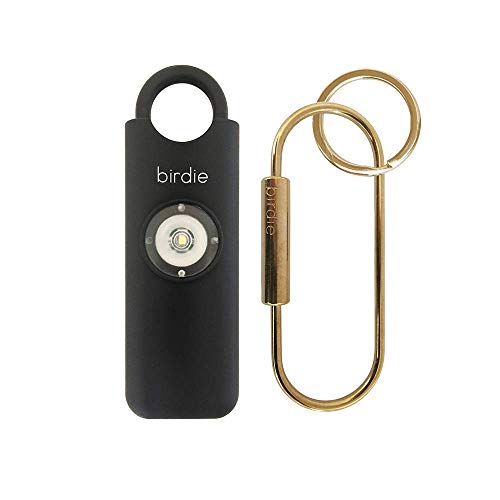
She’s Birdie Original Personal Safety Alarm — Best Overall
At a glance: 130 dB siren (maker-rated). Runs on 2 CR2032 batteries (included)
- 130 dB siren (maker-rated)
- Strobe light that flashes while the siren sounds
- Pull-top activation: pull the top ring to sound, push back to stop
- Runs on 2 CR2032 batteries (included)
- Keychain carry in a range of colors
Strengths
- Siren and strobe fire together, so the alert is both audible and visible
- Activation is a single gross-motor pull that works with cold or gloved hands
- Replaceable coin cells mean no charging cable to remember
Trade-offs
- Costs more per unit than the plain multipack alarms in this guide
- The strobe is a visibility aid, not a work light for dark paths
- Loud enough to startle the person carrying it the first time it is test-fired indoors
The original Birdie built its reputation on a simple observation: a safety device only works if it is actually on your bag, and people leave ugly, tactical-looking gadgets in drawers. The bird-shaped body, the brass-look keychain and the color range make it read as an accessory first. Underneath the styling, the mechanism is a pull-top design — pull the top away from the body and a 130 dB siren starts together with a flashing strobe; push the top back down and it stops. That two-part motion is deliberate enough to avoid most accidental triggers in a handbag, yet simple enough to perform under stress without looking.
The trade-offs are the usual ones for a design-led product. You pay a premium over the plain multipacks, and the coin cells are a recurring errand. The shape, while charming, is a little thick for a front jeans pocket. None of that undermines the core proposition: this is the alarm people in our research most consistently reported still carrying a year after buying, and carry consistency beats a louder siren left at home.
Best for: anyone who wants the alarm they will actually carry every day, in a design that suits work and social bags / Not suited for: buyers who want the cheapest route to covering a whole household

KOSIN Safe Sound Personal Alarm 12-Pack — Best Budget Multipack
At a glance: 140 dB siren (maker-rated), the loudest figure in this guide. Up to 50 minutes of continuous sounding per set of batteries
- 140 dB siren (maker-rated), the loudest figure in this guide
- LED light on each unit
- 3 AG13/LR44 button batteries per alarm (included)
- Up to 50 minutes of continuous sounding per set of batteries
- Twelve units in one pack for bags, doors and family members
Strengths
- Ideal for equipping a whole household, class or team in one order
- The LED is genuinely handy for keyholes and dark stairwells
- Standby life is quoted at up to a year, so a yearly test-and-replace rhythm works
Trade-offs
- Button batteries in twelve units is a lot of small cells to track and replace
- Build feel is basic ABS plastic; these are consumables, not heirlooms
- Occasional dud units are reported in multipacks, so test every one on arrival
Quality control is the honest caveat with any budget multipack: test all twelve on arrival, because an occasional weak unit in a pack this size is a known pattern, and returning or discarding one dud still leaves eleven working alarms. The bodies are basic ABS plastic and the battery doors are small; arthritic hands may need help with swaps. Standby is quoted at up to a year, so a yearly rhythm — test, replace cells where needed — keeps the fleet honest.
For home use, the multipack logic extends beyond carry: a unit taped inside a shed door, one on a teenager’s bike bag, one in the car glovebox. The LED is a small steady light rather than a strobe, useful for keyholes and fuse boxes. Nobody will mistake these for premium objects, and that is precisely why people actually distribute them instead of protecting them.
Best for: households equipping many people and bags on a tight budget / Not suited for: buyers who want premium build quality or rechargeable power

GE Personal Security Window and Door Alarm 4-Pack (45174) — Best for Windows and Doors
At a glance: Four magnetic contact alarms in the pack. Battery powered and fully wireless, no hub or wiring
- Four magnetic contact alarms in the pack
- Three modes on each unit: Off, Chime and Alarm
- Sounds when the magnet separates from the sensor body
- Battery powered and fully wireless, no hub or wiring
- Peel-and-stick or screw mounting for doors and windows
Strengths
- Chime mode announces visitors and wandering toddlers without a full siren
- Covers four openings in one purchase, which suits a small flat or one floor
- No app, account or subscription is involved at any point
Trade-offs
- The alarm tone is a local deterrent, not a monitored security system
- Sliding doors need careful magnet placement to avoid false gaps
- Not portable protection; it guards the home, not the walk to it
GE’s window and door alarms are the workhorses of the no-drill security world. Each unit is a magnetic contact alarm: stick the sensor body on the frame and the magnet on the moving part, and separation triggers the sound. A three-position switch gives you Off for daily life, Chime for a polite announcement when a door opens, and Alarm for the full siren. Four units cover the realistic entry points of a small flat or the ground floor of a house.
The chime mode is what owners end up loving. It tells you a child has opened the back door, a partner is home, or a shop door has moved, without the stress of a siren. Alarm mode is for nights and empty houses. Because each unit is independent and battery powered, there is no hub to fail, no Wi-Fi to configure and nothing to subscribe to.
Best for: apartments and houses that need four doors or windows covered without tools or wiring / Not suited for: anyone who needs alerts sent to a phone or a monitoring service

Hootie Personal Safety Alarm — Best for Beginners
At a glance: 130 dB siren (maker-rated). Replaceable batteries (no charging required)
- 130 dB siren (maker-rated)
- Strobe light paired with the siren
- Pull-pin activation: pull the pin out to sound, reinsert to stop
- Replaceable batteries (no charging required)
- Clips to keys, bags or a pocket
Strengths
- Works the same for adults and older kids because there is nothing to configure
- The pin tether keeps the stopper attached so it is hard to lose mid-incident
- Neutral colors keep it discreet on a work bag or school backpack
Trade-offs
- A loose pin in a crowded bag can work its way out and cause a false alarm
- Battery type varies by production run, so check the listing before buying spares
- The strobe adds visibility but there is no separate steady flashlight mode
In the hand, the Hootie is small enough to disappear on a keychain yet shaped so the pin can be found by touch. The tether keeps the pin attached to the body, so stopping the alarm does not involve hunting for a dropped part on the pavement. The honest limitation is false-alarm risk: in a tightly packed bag, pressure and movement can work a pin loose over time, so carry it in an outside pocket or clipped where it cannot be crushed.
Hootie is the alarm we would hand to someone who has never used one and give them ten seconds of instruction. It will not watch your front door and it will not light your path home beyond its strobe, but as a pure, carry-everywhere noise maker it is hard to fault.
Best for: beginners, older relatives and kids who need one simple pull and no settings / Not suited for: people who want a rechargeable alarm or a door and window device
More Picks From the Same Research
Three more products test the ledger: the all-in-one kit, the rental door alarm and the family pack each sit at a different point on the pros-and-cons balance.

GE Personal Security Alarm Kit (45216) — Best Starter Kit
At a glance: Three-piece kit: keychain alarm, door stop alarm and window/door alarm. Fully wireless and battery powered
- Three-piece kit: keychain alarm, door stop alarm and window/door alarm
- 120 dB siren on the kit components (maker-rated)
- Door stop alarm sounds when pressure is applied to the door
- Fully wireless and battery powered
- Made for home, apartment, dorm and travel use
Strengths
- A good first purchase for someone who does not yet know which format suits them
- The window unit and door stop together cover the two weakest points of a rental
- Components can be split between home use and a travel bag
Trade-offs
- Batteries differ across components, so spares are not interchangeable
- No strobe lights anywhere in the kit
- The door stop wedge will not work on carpeted thresholds
The GE kit bundles three different answers to the same problem: a keychain alarm for the person, a window/door alarm for an opening, and a door stop alarm that wedges under a door and sounds when pressure pushes against it. As a first purchase for someone setting up in a new flat, dorm or rental, it covers the three most common scenarios in one box for less than most single premium alarms.
The door stop alarm deserves special mention because it is the only pick here that physically resists as well as reports: the wedge shape jams the door while the siren sounds. Hotel rooms, dorm doors and rented rooms with questionable locks are its natural habitat. It does need a suitable gap under the door and a hard floor surface to bite against, so it is not universal.
Best for: first-time buyers who want the person, the door and the window covered in one box / Not suited for: large homes that need many window units — add the 4-pack instead

She’s Birdie Portable Door Alarm — Best for Doors and Windows
At a glance: Rechargeable battery with USB charging cord included. Mounts with included Command Strips (3 sets plus 2 extra sets)
- Rechargeable battery with USB charging cord included
- Loud siren plus flashing light alert when triggered
- Built-in flashlight that works while the alarm is off
- Mounts with included Command Strips (3 sets plus 2 extra sets)
- Portable format for doors and windows at home or in rentals
Strengths
- Adhesive-strip mounting means zero drilling, which suits rentals and dorms
- The flashlight works independently, so the unit earns its place on the door every day
- Rechargeable power removes the coin-cell replacement cycle entirely
Trade-offs
- Needs a charging routine; a flat unit on the door is only a decoration
- Adhesive strips can struggle on rough, dusty or freshly painted surfaces
- One unit watches one opening, so multi-window rooms need several
Setup is a five-minute job: clean the frame, apply the strip, press the unit on, and test by opening the door. Because it is rechargeable over USB, the running cost after purchase is effectively zero, and there are no coin cells to stock. In a studio or one-bed flat, a single unit on the main door covers the highest-risk opening; add a second for a ground-floor bedroom window and the flat is meaningfully harder to enter quietly.
It is not a monitored system and it cannot call anyone. What it does is remove the element of silence: an intruder, a sleepwalking child or a landlord entering unannounced all produce immediate noise and light. For the rental and travel lenses in this cluster, that is exactly the job description, and this is the most polished tool for it we found.
Best for: renters, dorm residents and travelers who need a door or window alarm with zero drilling / Not suited for: homeowners wanting permanent, wired-in protection for many rooms at once
SLFORCE Safe Personal Alarm Siren Song 5-Pack — Best Mid-Size Multipack
- 132 dB siren (maker-rated)
- Five alarms in assorted colors per pack
- Compact egg-shaped body under 2 inches long
- LED light on each unit
- Keychain ring on every alarm
Strengths
- Five color-coded units let each family member claim their own
- Assorted colors help you spot the right bag’s alarm at a glance
- Small rounded body is comfortable in a child’s or senior’s hand
Best for: families who want a color-coded alarm on every member’s bag / Not suited for: buyers who want strobe lights or rechargeable batteries
Check on Amazon
Reading the Ledger as a Stranger
Imagine the ledger read by someone with no stake in the category — a Martian actuary, say. They would notice that the pros are all about the device’s relationship to its owner (simple, legal, cheap, present) while the cons are all about its relationship to the world (unmonitored, unguaranteed, dependent on bystanders). That asymmetry is the category in one observation: a personal alarm is an excellent servant of its owner’s plan and no plan at all by itself.
They would also notice the price of the whole experiment is low enough that the ledger rarely needs to be balanced in the abstract. For the cost of a single family takeaway, a household can run the experiment for a year and read its own results. Few consumer categories offer a trial that cheap, that safe, or that honest about its limits.
The Ledger’s Own Limits
Fairness requires this page to file its own entry in the cons column: a pros-and-cons analysis cannot weigh the one variable that decides real outcomes — the owner’s follow-through. Two households can read this identical ledger, buy the identical alarm, and get opposite results, because one installed a habit and the other installed a hope. The ledger describes the product faithfully; the product’s fate is decided off-page.
That limit is also the page’s final usefulness. If the ledger leaves you uncertain, the uncertainty is probably not about alarms at all, but about which kind of owner you will be. Answer that honestly, and the columns will have done their work.
Keep reading in this cluster: the Best Personal Safety Alarm Under $50 Best Personal Safety Alarm Under $50 continues this line of thinking, the Best Personal Safety Alarm For Renters Under $100 Best Personal Safety Alarm For Renters Under $100 applies it to a specific situation, the Personal Safety Alarm Reviews Personal Safety Alarm Reviews argues the neighbouring case, and the Personal Safety Alarm Buying Guide Personal Safety Alarm Buying Guide completes the set.
Act on the ledger, then, in whichever direction it honestly pointed for your household, your routines and your honest self-knowledge — and whichever direction that is, act completely. The buyer should buy the habit with the hardware; the skipper should spend the money on the lock, the light or the route with equal conviction. Half-measures are the only column this page could not balance, because they collect the cons of both choices and the pros of neither, and because a half-kept habit quietly teaches the household that safety is a gesture rather than a practice — the single most expensive lesson this otherwise inexpensive category can teach.
Balance, struck honestly, rarely feels like a verdict — and that discomfort is the reader’s final piece of information. If both columns still pull at you, you are not failing the analysis; you are completing it, because the category genuinely is both things at once, and the households that thrive with it are the ones that bought with both columns open on the table. Decide with them open, maintain with them in mind, and the ledger will have done for you the only thing a ledger can: made the choice yours, knowingly, instead of the market’s, by default.
Let the ledger’s last line be a practical one, since ledgers exist to be acted on. If, after both columns, you remain genuinely undecided, the tie-breaker used by the professionals in this category’s research is worth borrowing: buy the cheapest respectable version of the idea, run it for one honest month — carried, installed, tested — and let the month cast the deciding vote. Experience is the only column that cannot be argued with, and in this category it is also the cheapest to acquire. The pros and cons above will still be here when the month ends, ready to be re-read with the authority of someone who no longer has to imagine either column.
The ledger format has one more virtue worth naming before the bottom line: it ages well. Products will be replaced, prices will drift, a maker or two will fold — and the columns above will still describe whatever succeeds them, because they were never really about models. Simplicity, legality, attention and cheapness on one side; silence about distance, silence about guarantees, and silence — literal, battery-shaped silence — about maintenance on the other. Any future personal alarm, from any maker, can be filed into this ledger in a minute, and the filing will tell its buyer more than its launch page does. That is the use of a pros-and-cons page that outlasts its own product cycle, and it is the standard this one asks to be judged by.
Let the last balance be struck in the category’s own favorite unit: the household. For a household, the pros compound — one purchase teaches the test habit, the test habit protects every later device, the chime teaches the children the house’s sounds, the door layer teaches the adults its openings. For a household, the cons also compound — one abandoned alarm licenses the abandonment of the next, one crying-wolf contact teaches everyone to sleep through the true one. The ledger, read at household scale, stops looking like a balance at all and starts looking like a fork: the same objects, two diverging cultures of use. Which culture a household builds is decided in the first month, by exactly the unglamorous disciplines this cluster’s guides keep repeating. The columns were never really about the alarms. They were about that month.
The ledger’s truly final entry is about time. Every pro in the left column is available immediately — the day the device is attached, the category starts paying its small dividends of information and readiness. Every con in the right column is also immediate, but they compound differently: limits stay limits, while maintenance debts grow interest. That asymmetry is why this page, having balanced the columns as fairly as it can, quietly advises the reader who buys to buy the habit first and the hardware second — the only order in which the pros column stays ahead of the cons for longer than a season.
The ledger should also record, in fairness, the category’s treatment by the people who use sound professionally. Event staff, campus safety teams and lone-worker programs keep appearing in this category’s research as bulk buyers — not because they believe a siren is a shield, but because their incident reports keep showing the same small mechanism: noise shortens events. That professional pattern is not proof, and this page will not promote it to proof. But a pros-and-cons ledger that omitted it would be balancing its columns with a thumb on the scale, and the reader deserves the whole weight of both sides before deciding which column describes their life.
One more entry belongs in each column, saved for last because each is about the category’s culture rather than its hardware. Pro: this is a category that has stayed honest in its mechanics — a siren is a siren, its limits are knowable, and no update will ever brick it. Con: it is a category marketed, too often, by amplifying the exact fears it claims to soothe, and buyers must bring their own steadiness to the shelf. The reader who can hold both entries at once — appreciating the tool, discounting the theatre — is the reader this ledger was written for, and the one most likely to end up owning exactly as much alarm as their life requires: no less, and — the harder discipline — no more.
A final weighing, then, in the plainest terms this page can manage. The pros column describes a product that is cheap, universal, simple and honest about its mechanism. The cons column describes a product that is limited, maintenance-dependent and easy to over-believe. Both columns are true at once, of the same objects, which is why the category polarizes: people are not disagreeing about the alarms, they are disagreeing about which column describes their own life. Read the columns once more with your routines, your household and your honesty in view. The ledger has already made its decision; it is waiting for you to notice which side of it you live on. The picks and prices that follow from that noticing are in this cluster’s ranked lists, linked from the top of this page.
How the Ledger Maps to Real Products

POM Personal Safety Alarm — Best Rechargeable
- 130 dB siren (maker-rated)
- USB-C rechargeable lithium-ion battery
- Up to 60 minutes of continuous sounding on a full charge
- Bright LED flashlight built in
- Pull-pin activation with a pocket-clip style body
Strengths
- USB-C charging uses the same cable as a modern phone, so top-ups are painless
- A full hour of continuous sounding is generous for a rechargeable unit
- The flashlight mode makes it useful on ordinary evenings, not just emergencies
Best for: anyone with a USB-C charging routine who wants one polished alarm for daily carry / Not suited for: households needing several alarms at once on a budget

Original Defense Siren Personal Alarm — Best for Runners and Walkers
- 130 dB siren (maker-rated)
- High-intensity LED strobe light
- Carabiner clip included for bags, purses and belt loops
- Compact body: 1.25 x 0.5 x 3.75 inches, 1.41 ounces
- Water-resistant housing for everyday outdoor carry
Strengths
- Strobe and siren together make the carrier easier to locate in a crowd
- No app, pairing or account stands between you and a working alarm
- The clip format moves between bags in seconds
Best for: runners, dog walkers and commuters who carry their alarm clipped outside the bag / Not suited for: people with limited grip who need a larger body to hold

Silent Beacon Personal Safety Alarm — Best Premium Pick
- 135 dB siren (maker-rated)
- Flashing light paired with the siren
- Two activation styles: pull activation and vibration activation
- USB-C rechargeable lithium-polymer battery
- Model SBL-SRN10 keychain format
Strengths
- The 135 dB rating sits above the common 130 dB class
- Vibration activation offers a second way to trigger the alert
- Rechargeable over USB-C, the cable most households already own
Best for: lone workers, students and travelers who want the loudest rechargeable rating and two trigger styles / Not suited for: buyers who prefer a long-established brand and the simplest possible mechanism

Vantamo Personal Safety Alarm — Best with Low-Battery Warning
- 130 dB siren from double speakers (maker-rated)
- Strobe light for visual attention
- Rechargeable battery with a low-battery notice
- Keychain carry format
- Pull activation designed for one-handed use
Strengths
- The battery warning is the feature experienced owners ask for most
- Recharge-and-forget rhythm suits people who dislike buying button cells
- Compact enough for a child’s school bag as well as an adult’s keys
Best for: owners whose past alarms died silently, thanks to the low-battery warning / Not suited for: multipack shoppers equipping a whole household

SABRE Personal Alarm with Key Ring — Best Trusted-Brand Basic
- 120 dB siren (maker-rated)
- Pull-apart activation: separate the alarm from its key chain to sound
- Attaches to a bag, backpack, key chain or purse
- Compact key-ring format from an established safety brand
- Battery powered; no charging or pairing
Strengths
- From one of the best-known names in personal safety products
- Pull-apart activation cannot be confused with a button press in the dark
- Small enough to live permanently on a key ring
Best for: anyone who values a proven brand and the simplest possible pull-apart design / Not suited for: buyers who prioritize maximum loudness or a locating light
Two Criteria That Tip the Balance
Which activation style suits you?
The trigger is the product. Pull designs dominate because they ask for one gross movement and answer with immediate noise; stopping is the reverse movement. That symmetry is what makes them teachable to children and usable by grandparents.
Judge a trigger by its worst moment: cold hands, gloves, darkness, panic. If a design needs alignment, eyesight or a fingernail, it will fail that moment for someone in your household. Stiff pins prevent false alarms but tax weak hands — match the resistance to the weakest user, not the strongest.
Do you need a light as well as a siren?
Lights come in three grades in this category. A strobe flashes in time with the siren and exists to help other people locate you — valuable in crowds, darkness and loud places where one more noise can blend into the background. A steady LED is a convenience light for keyholes and paths; it earns the device a daily role, which keeps it carried and familiar. Some basic alarms have no light at all, which is fine for indoor and daytime use.
For home door and window alarms, a flashing light matters more than it first appears: it shows you, half-asleep at 3 a.m., exactly which opening triggered, and it signals to anyone outside that the house has noticed. For carry alarms, decide based on when you are out: daylight commuters can skip the strobe; night-shift workers and runners should not.
The Fixed Side of the Ledger
Choose the openings that matter
Start with the main door, then ground-floor windows and any side or back door. Upper-floor windows above climbable roofs or drainpipes count as ground-floor for this purpose. Count first; buy pack sizes to match the count.
Prepare the surface properly
Clean the frame and the moving part with rubbing alcohol and let both dry completely. Adhesive pads fail on dust and grease, and a unit that falls off at 3 a.m. trains the whole household to ignore the real thing.
Align the magnet and test each mode
Fit the magnet within the marked alignment gap, close the opening, and test: chime should sound on opening in chime mode, the full siren in alarm mode, and silence in off. Repeat for every unit before the first night you rely on them.
Run a household rhythm
Decide which mode each unit lives in by day and by night, who switches them, and when batteries get checked — tie it to the smoke-alarm check so it actually happens.
How This Analysis Was Built
This list was built backwards from the situation in the title. We first fixed the constraints that situation imposes — budget ceiling, mounting rules, who carries the device and where — and only then went looking at products. Any alarm that could not be tied to a real listing we opened, with the brand, model and ASIN matching, was excluded from linking no matter how often it appears in other roundups. Specifications printed here come from makers and listings, not from aggregating other reviews.
Decibel figures got special handling. Because brands measure loudness under different conditions, we sorted alarms into classes and refused to rank within a class on numbers alone; activation, stopping, power and carry decided the order instead. Where a maker’s own listings disagreed about a figure, the review says so openly. One respected model could not be tied to a verified listing at all and appears as a prose-only pick — a deliberate hole in the list, kept visible rather than papered over with a guessed link.
This is a research-led guide, not a laboratory test, and it makes no hands-on claims. It also holds the category’s central honesty line throughout: a personal safety alarm attracts attention. It does not summon services, guarantee deterrence, or replace locks, lighting, awareness and other people. Within that limit, the six picks above are the ones whose design makes attention easiest to raise for the specific reader in this title.
Common Buying Mistakes
Never testing it. Batteries die silently and pins loosen quietly. A monthly two-second test pull — outdoors, or muffled in a cushion — is the difference between a safety device and a superstition. Put the test on the same calendar rhythm as your smoke alarms.
Mounting door alarms on dirty frames. Adhesive pads fail on dust, grease and flaking paint, usually at 3 a.m. Clean the surface with alcohol, let it dry fully, align the magnet carefully, and test the opening before you trust it.
A pros-and-cons page earns its keep only if a reader can locate their own life in it. If your days contain an exposed routine and your habits can sustain a monthly test, the left column of this ledger is about you. If your need is notification, certainty or a device that maintains itself, the right column is. The category’s defenders and detractors are both describing real products — just for different owners.
Frequently Asked Questions
Will a personal alarm actually deter anyone?
An alarm cannot physically stop anyone, and no honest guide should promise that it will. What it reliably does is remove anonymity and buy attention: noise and flashing light draw eyes, and most opportunistic trouble depends on nobody noticing. It is an attention tool, one layer among locks, lighting, awareness and other people.
Can children and elderly relatives use these?
Yes — the category is popular with both groups precisely because activation is a simple pull with no strength, aim or training required. Choose models with an easy pull and an easy stop, practice together once, and for older hands avoid the smallest battery doors when battery swaps will be self-service.
Do these alarms work through walls or alert my phone?
No. These are local sound devices: they alert people within earshot and nothing else. If you need phone alerts or monitoring, that is a different product category — a connected security system — with subscriptions and setup to match. The simplicity is also the appeal: nothing to pair, hack or pay monthly for.
Are rechargeable alarms better than battery ones?
Neither is universally better. Rechargeable models (especially USB-C) suit people with a charging routine and remove consumable costs; replaceable-cell models suit people who want year-long standby and instant restoration with a fresh cell. The low-battery warning, where offered, is the feature that most improves real-world reliability.
How loud is a personal safety alarm in real life?
Indoors, even a 120 dB-class alarm dominates a house and is uncomfortable in the same room. Outdoors, a 130 dB-class unit is startling at conversational distance and clearly audible down a residential street in quiet conditions. Treat maker distance claims as best-case open-air figures; buildings, wind and traffic shorten real reach considerably.
Bottom Line
The pros win for the buyer who treats a personal alarm as one honest layer — carried, installed, tested — and the cons win for the buyer who wants the purchase itself to be the protection. If you are the first buyer, the ranked lists in this cluster, starting with Best Personal Safety Alarm Under $50 Best Personal Safety Alarm Under $50 and the Personal Safety Alarm Buying Guide Personal Safety Alarm Buying Guide, will spend your money well.