Disclosure: As an Amazon Associate, umtsmarttool.com earns from qualifying purchases. Links to Amazon on this page are affiliate links; they cost you nothing extra. Prices and availability change often, so check the current Amazon listing before you buy.
Key Takeaways
- Decide what you are protecting first: a person, an opening, or both.
- Count people and openings before looking at a single product.
- Choose power you will maintain: coin cells with a test habit, or USB-C with a charging habit.
- Activation and stopping matter more than headline decibels.
- An alarm buys attention only — plan the rest of the layer honestly.
In this guide
How to choose a personal safety alarm: A Step-by-Step Walk-Through
Learning how to choose a personal safety alarm is mostly learning to ask the questions in the right order. Most buyers start at the wrong end — comparing decibel claims between near-identical keychains — and end up with a device that fits a spec sheet rather than a life. This guide reverses the process: situation first, coverage second, power and activation third, and only then models. By the final step, the right product is usually obvious, and the shortlist at the end exists to confirm it. The criteria reference companion is our Personal Safety Alarm Buying Guide Personal Safety Alarm Buying Guide.
Step 1: Name what you are protecting
Write down the actual worry in one sentence. ‘The walk from the night bus.’ ‘The ground-floor flat while we sleep.’ ‘My daughter’s route to school.’ Each sentence points at a different product family: carry alarms for people in motion, contact alarms for openings in a home, or both. Buyers who skip this step buy the category’s bestseller and discover it guards the wrong thing.
Step 2: Count people and openings
For carry: list everyone who should have one and every bag that leaves the house daily. For home: list the doors and ground-floor windows, remembering balconies and climbable roofs. The counts decide pack sizes and budget shape more honestly than any review ranking — a household of four with six openings is a multipack-and-contacts purchase, whatever the premium singles promise.
Step 3: Choose your power philosophy
Coin cells offer year-long standby and instant revival with a fresh set, at the price of a testing habit. Rechargeables — USB-C only, for sanity — offer no consumables, at the price of a charging habit. A low-battery warning, where a model offers one, forgives either habit’s lapses. Choose for the person you actually are; this step predicts satisfaction better than any other.
Step 4: Match activation to hands
The trigger must work under stress, with cold or gloved hands, for the weakest hands in the household. Big pull-pins and pull-tops are the forgiving options; check how the alarm stops, too — pushing halves together beats reinserting a small pin precisely. If the carrier is a child or an older relative, this step outranks everything below it.
Step 5: Read decibels as classes, not scores
Treat 120, 130 and 140 dB as neighborhoods, not measurements — makers test differently, and one maker in our research quotes two figures for a single model. Indoor and stairwell use is well served by the 120 class; outdoor and noisy environments justify 130 and above. Beyond class, spend remaining attention on lights: a strobe for being located, a steady LED for daily usefulness.
Step 6: Decide the light question
If the alarm will be used after dark or in crowds, require a strobe. If it will live on a door, a flashing alert that identifies the opening is worth having, and a built-in flashlight earns the device a daily job. If it is a daytime, indoor, second alarm, sound alone is a legitimate economy.
Step 7: Set the maintenance rhythm before buying
Decide now: a monthly two-second test (outdoors or muffled), a battery or charging date, and a named owner of that chore in the household. Write it into the calendar you already use. A choosing process that ends with a maintenance plan produces working alarms a year later; one that ends at checkout produces drawer ornaments.
Troubleshooting a Choice That Is Not Working
Problem: the alarm keeps firing in a bag. → Move it to an outside clip position, choose a model with a stiffer pin or a power switch, and stop burying it under crush pressure.
Problem: a door alarm falls off or false-triggers at night. → Re-clean the frame with alcohol, re-align the magnet within its marked gap, and use the screw-mount option if adhesive keeps failing on that surface.
Problem: the alarm was dead when tested. → Replace or recharge immediately, then shorten the test interval and consider a low-battery-warning model at replacement time; a dead alarm found in a test is the system working, not failing.
Problem: a child or relative will not carry it. → Change the format, not the person: wallet-flat for the minimalist, a color they chose for the child, a door unit instead for the relative whose risk is at home.
Gear That Makes This Easier
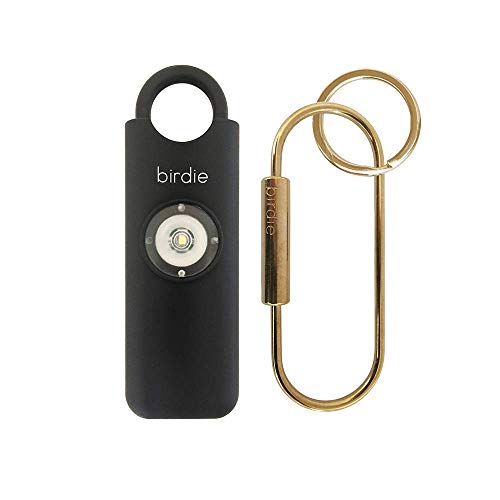
She’s Birdie Original Personal Safety Alarm — Best Overall
At a glance: 130 dB siren (maker-rated). Runs on 2 CR2032 batteries (included)
- 130 dB siren (maker-rated)
- Strobe light that flashes while the siren sounds
- Pull-top activation: pull the top ring to sound, push back to stop
- Runs on 2 CR2032 batteries (included)
- Keychain carry in a range of colors
Strengths
- Designed to look like an accessory rather than a security device, so it stays on the bag
- Stopping the alarm is just as fast as starting it, which limits accidental noise
- Battery door uses common CR2032 cells sold almost everywhere
Trade-offs
- Coin cells are a consumable you have to keep spares of
- The decorative shape can snag less smoothly in a tight pocket than a flat alarm
- No low-battery warning light, so periodic test pulls matter
Where the Birdie earns its place is in the details of stopping and starting. Some alarms require you to hunt for a tiny pin and reinsert it precisely; the Birdie simply pushes back together, which matters when your hands are shaking. The strobe is not decoration — in a dark car park or a noisy street, a flashing light gives bystanders a direction to look while the siren gives them a reason. Battery life in standby is long because the circuit draws almost nothing until the top separates.
The trade-offs are the usual ones for a design-led product. You pay a premium over the plain multipacks, and the coin cells are a recurring errand. The shape, while charming, is a little thick for a front jeans pocket. None of that undermines the core proposition: this is the alarm people in our research most consistently reported still carrying a year after buying, and carry consistency beats a louder siren left at home.
Best for: anyone who wants the alarm they will actually carry every day, in a design that suits work and social bags / Not suited for: buyers who want the cheapest route to covering a whole household

Hootie Personal Safety Alarm — Best for Beginners
At a glance: 130 dB siren (maker-rated). Replaceable batteries (no charging required)
- 130 dB siren (maker-rated)
- Strobe light paired with the siren
- Pull-pin activation: pull the pin out to sound, reinsert to stop
- Replaceable batteries (no charging required)
- Clips to keys, bags or a pocket
Strengths
- Pin-out activation is unambiguous: if the pin is out, it is sounding
- No charging schedule; swap batteries and it is ready again
- Compact body rides on a keychain without dominating it
Trade-offs
- No rechargeable option in this model, so running costs are batteries
- The siren is piercing at close range; test it outdoors or in a garage
- Not a door or window device; it only helps if it is physically with you
Hootie takes the opposite design path from the fashion-led alarms: a plain, pebble-like body, a pin on a tether, and nothing else to learn. Pull the pin and a 130 dB siren sounds with a strobe; push the pin back and it stops. There is no app, no mode and no menu. For beginners, for older relatives and for kids old enough to carry one responsibly, that absence of options is the feature.
Hootie is the alarm we would hand to someone who has never used one and give them ten seconds of instruction. It will not watch your front door and it will not light your path home beyond its strobe, but as a pure, carry-everywhere noise maker it is hard to fault.
Best for: beginners, older relatives and kids who need one simple pull and no settings / Not suited for: people who want a rechargeable alarm or a door and window device

GE Personal Security Window and Door Alarm 4-Pack (45174) — Best for Windows and Doors
At a glance: Four magnetic contact alarms in the pack. Battery powered and fully wireless, no hub or wiring
- Four magnetic contact alarms in the pack
- Three modes on each unit: Off, Chime and Alarm
- Sounds when the magnet separates from the sensor body
- Battery powered and fully wireless, no hub or wiring
- Peel-and-stick or screw mounting for doors and windows
Strengths
- The Off position makes daytime coming and going painless
- Magnetic alignment is forgiving compared with older contact alarms
- A long-established design with replacement units easy to find years later
Trade-offs
- Only works while you are in earshot; it alerts the room, not your phone
- Adhesive pads can fail on textured or dirty frames if you skip cleaning the surface
- Each unit needs its own batteries checked on a schedule
The chime mode is what owners end up loving. It tells you a child has opened the back door, a partner is home, or a shop door has moved, without the stress of a siren. Alarm mode is for nights and empty houses. Because each unit is independent and battery powered, there is no hub to fail, no Wi-Fi to configure and nothing to subscribe to.
Installation quality decides whether these delight or annoy. Clean the frame with alcohol, let it dry, align the magnet within the marked gap, and test each opening. Sliding doors and windows work, but the magnet spacing is less forgiving there; take the extra minute. The honest limitations: the alarm only helps people within earshot, and adhesive pads on rough or dirty frames will eventually let go — the screw-mount option exists for exactly that case.
Best for: apartments and houses that need four doors or windows covered without tools or wiring / Not suited for: anyone who needs alerts sent to a phone or a monitoring service

POM Personal Safety Alarm — Best Rechargeable
At a glance: 130 dB siren (maker-rated). Bright LED flashlight built in
- 130 dB siren (maker-rated)
- USB-C rechargeable lithium-ion battery
- Up to 60 minutes of continuous sounding on a full charge
- Bright LED flashlight built in
- Pull-pin activation with a pocket-clip style body
Strengths
- USB-C charging uses the same cable as a modern phone, so top-ups are painless
- A full hour of continuous sounding is generous for a rechargeable unit
- The flashlight mode makes it useful on ordinary evenings, not just emergencies
Trade-offs
- Charge level is not obvious at a glance on every unit
- Not the loudest headline figure here; several rivals claim more decibels
- One unit covers one person; there is no POM multipack in this guide
POM built its name on pepper spray, but its personal alarm applies the same design discipline to a noise-only device: a slim, pocket-clip body, a pull pin, a 130 dB siren, an LED flashlight, and a lithium-ion battery that charges over USB-C. The charging choice is the headline. A personal alarm that shares a cable with your phone actually gets charged; one that needs a proprietary lead joins the drawer of good intentions.
Runtime is quoted at up to 60 minutes of continuous sounding on a full charge, which is generous — real incidents need seconds to minutes of noise, and the margin covers months of standby plus a few false alarms. The flashlight is a proper everyday convenience, bright enough for locks, paths and dropped keys, and it means the device gets handled daily, which keeps its location habitual.
Best for: anyone with a USB-C charging routine who wants one polished alarm for daily carry / Not suited for: households needing several alarms at once on a budget
The full ranked field, by budget and situation, is in this cluster’s best lists — start with Best Personal Safety Alarm Under $50 Best Personal Safety Alarm Under $50 — and the category’s honest limits are argued in Is A Personal Safety Alarm Worth It Is A Personal Safety Alarm Worth It.
Common Buying Mistakes
Leaving the alarm in a drawer. An alarm protects the place it physically is. If it is not on the bag, the keys or the door, it is a paperweight. Choose the format that fits your existing habits instead of planning to build new habits around the gadget.
Buying on decibels alone. The loudest headline figure is not the best alarm. Activation you can perform under stress, a carry format you will actually keep, and power you will actually maintain each matter more than a 10 dB marketing edge measured under unknown conditions.
Never testing it. Batteries die silently and pins loosen quietly. A monthly two-second test pull — outdoors, or muffled in a cushion — is the difference between a safety device and a superstition. Put the test on the same calendar rhythm as your smoke alarms.
Treating maker range claims literally. Figures like ‘audible at 600 feet’ describe ideal open-air conditions. Walls, wind and traffic cut real-world reach dramatically. Judge an alarm by whether it dominates the spaces you actually move through.
Ignoring false-alarm behavior. An alarm that fires in every bag crush and luggage jostle gets abandoned within a month. Consider pin security, power switches and carry position before you need the device, not after your third airport incident.
More Picks From the Same Research
Three more picks the step-by-step process regularly surfaces: the outdoor clip specialist, the battery-warning rechargeable and the door alarm for the boundary-first buyer.

Original Defense Siren Personal Alarm — Best for Runners and Walkers
At a glance: 130 dB siren (maker-rated). Compact body: 1.25 x 0.5 x 3.75 inches, 1.41 ounces
- 130 dB siren (maker-rated)
- High-intensity LED strobe light
- Carabiner clip included for bags, purses and belt loops
- Compact body: 1.25 x 0.5 x 3.75 inches, 1.41 ounces
- Water-resistant housing for everyday outdoor carry
Strengths
- The included carabiner clips outside a bag, where a stressed hand can find it fast
- Water resistance suits runners and dog walkers in changeable weather
- Feather-light; you will not feel it on a key set
Trade-offs
- Maker decibel figures vary between 125 and 130 dB across its own listings
- The small body can be harder to grip with gloves than a chunkier alarm
- Single unit per pack, so household coverage means multiple orders
The honest limitations are size-related: the compact body gives cold or gloved fingers less to hold than a chunkier alarm, and the single-unit pack means a household pays per person. Battery arrangements have varied across production runs, so confirm serviceability on the current listing if that matters to you.
Within its niche — light, weatherproof, instantly reachable carry — this is one of the strongest picks in the guide, and the one we would clip to a running belt or a dog lead.
Best for: runners, dog walkers and commuters who carry their alarm clipped outside the bag / Not suited for: people with limited grip who need a larger body to hold

Vantamo Personal Safety Alarm — Best with Low-Battery Warning
At a glance: 130 dB siren from double speakers (maker-rated). Keychain carry format
- 130 dB siren from double speakers (maker-rated)
- Strobe light for visual attention
- Rechargeable battery with a low-battery notice
- Keychain carry format
- Pull activation designed for one-handed use
Strengths
- Double speakers push sound in two directions instead of one
- The low-battery notice removes the guesswork that plagues coin-cell alarms
- Strobe plus siren covers both the hearing and the seeing of bystanders
Trade-offs
- Rechargeable, so it joins the list of devices competing for your charging cable
- A newer entrant; long-term durability data is still accumulating
- Costs more than the simple battery alarms with the same headline decibels
The caveats are the rechargeable ones: it needs a place in your charging routine, and as a newer entrant its multi-year durability is still being proven in the field. It also sells as a single unit, so whole-household coverage costs more than the multipacks.
If your personal history with gadgets includes dead batteries at the worst moment — most people’s does — the Vantamo is designed precisely for you.
Best for: owners whose past alarms died silently, thanks to the low-battery warning / Not suited for: multipack shoppers equipping a whole household

She’s Birdie Portable Door Alarm — Best for Doors and Windows
- Rechargeable battery with USB charging cord included
- Loud siren plus flashing light alert when triggered
- Built-in flashlight that works while the alarm is off
- Mounts with included Command Strips (3 sets plus 2 extra sets)
- Portable format for doors and windows at home or in rentals
Strengths
- Adhesive-strip mounting means zero drilling, which suits rentals and dorms
- The flashlight works independently, so the unit earns its place on the door every day
- Rechargeable power removes the coin-cell replacement cycle entirely
Best for: renters, dorm residents and travelers who need a door or window alarm with zero drilling / Not suited for: homeowners wanting permanent, wired-in protection for many rooms at once
Choosing as a Skill
The steps in this guide generalize, and it is worth saying so before the wrap-up: situation before product, count before cart, upkeep before features, hands before headlines. That sequence will choose a torch, a lock or a insurance policy as reliably as it chose the alarms above, because most buying errors in every category are the same error — starting at the shelf instead of at the life the purchase must fit.
If this guide leaves you with one transferable habit, let it be the count. People who count their openings, their bags, their routines and their battery types before shopping almost never buy twice. The count is five minutes of arithmetic that does the work of a hundred reviews — including, we cheerfully admit, most of this one.
When the Steps Disagree
Occasionally the steps point in two directions at once: the count says multipack, the hands say premium; the situation says door, the budget says carry. When that happens, break the tie with time. Buy for the risk that arrives soonest and most often, and schedule the other layer as the named second purchase. A choosing process that ends with a sequence is not a compromise — it is how every complete system in this cluster was actually built.
And if the steps produce an answer your instincts distrust, trust the steps once. Instinct in this category is usually just the loudest advertisement you have seen, wearing your voice. The steps have no sponsor; that is their entire qualification.
Keep reading in this cluster: the Personal Safety Alarm Review 2026 Personal Safety Alarm Review 2026 continues this line of thinking, the Best Personal Safety Alarm For Home Use Under $50 Best Personal Safety Alarm For Home Use Under $50 applies it to a specific situation, the Best Personal Safety Alarm Under $100 Best Personal Safety Alarm Under $100 argues the neighbouring case, and the Personal Safety Alarm Pros And Cons Personal Safety Alarm Pros And Cons completes the set.
The steps end, as they began, with the situation — because a reader who runs them once tends to run them forever, on every purchase that touches safety, money or both. That is the guide’s real deliverable, worth more than any single alarm it helped choose.
The steps deserve one last defense against the obvious objection: that all this process, for a product this cheap, is overkill. The objection confuses price with consequence. The alarm is cheap; the moment it exists for is not, and the drawer full of adequate-but-wrong safety purchases in the average home testifies that cheapness does not protect a buyer from choosing badly — it merely makes the choosing feel too small to bother with. Seven steps and six questions is not bureaucracy. It is the difference between owning a decision and owning a keychain, and it costs less time than the return journey it so often prevents.
The guide ends with the reader it most hopes to have created: someone who can now walk into any listing in this category and interrogate it in under a minute. Whose routine does this serve? What does it count? How is it powered, and by whose habit? How does it start, how does it stop, in whose hands? What class is its loudness, honestly read? And when will it be tested? A reader carrying those questions no longer needs this guide’s answers — which is, of course, the only ending a how-to guide should ever aim for. Choose well, rehearse once, and go back to the parts of life the choosing was for.
The guide’s final gift is a compressed version of itself, small enough to survive in a phone note: What am I protecting? How many people and openings? Which power will I actually maintain? Can the weakest hands work it, both ways? Have I read loudness as a class? Is there a date for the test? Six questions, in that order, and the shelf will sort itself. Everything else in this long guide — the criteria, the examples, the troubleshooting — is commentary on those six lines, written for the reader who wanted the reasoning. The reader who only wanted the answer has just received it.
One more worked failure is worth the space, because it is the most common one the steps exist to prevent. A buyer chooses by loudness, buys the 140-claim multipack for a household of one, discovers the battery doors defeat their parent’s hands and the units’ size defeats their own bag, and concludes the category is junk. Every step in this guide was violated in that story — situation skipped, count skipped, hands skipped — and the category took the blame for a process failure. Run the steps, even quickly, even on paper, and the same budget buys the opposite experience.
A closing encouragement for the reader who has followed all seven steps and feels the choice is almost too clear: that clarity is the process working, not a sign you missed something. Good choosing feels anticlimactic from the inside. Buy the clear answer, run the rehearsal, set the dates — and spend the energy you saved on the parts of safety no guide can sell you.
The last step is unnumbered because it happens after choosing: revisit the choice once, at the one-month mark, with the steps in hand. Has the situation changed? Is the count still right? Did the power philosophy survive contact with your real habits? Choosing well is not a single act but a first draft, and the owners whose alarms still work in year three are the ones who allowed themselves one revision. Set that date now, alongside the test date, and the choosing process this guide describes will have done everything a process can.
The Criteria Behind the Steps
How loud is loud enough?
Think in bands. Around 120 dB is the basic band — plenty indoors, modest outdoors. Around 130 dB is where the mainstream sits, and it is the band most buyers should shop in. Claims of 140 dB top the charts but come from the cheapest bodies and the least standardized measurements.
Because brands test differently, a 130 from one maker can match a 135 from another in the hand. Choose the band for your environment — quieter bands for flats and stairwells, higher bands for traffic and open ground — and let activation and power break the tie.
Which activation style suits you?
Activation is the moment the whole product exists for, so match it to your hands and your life. Pull-pin and pull-top designs separate two parts to sound the alarm; they are intuitive, work with gloves, and stop by pushing the parts back together. Pull-apart keychain designs work the same way with the key ring as one half. Button-activated models exist but are easier to trigger accidentally and harder to operate by touch alone.
Consider who else might use the device. Children and older relatives do best with the grossest possible motion — a big pull, no alignment needed to stop it. Travelers should look for a power switch or a pin that cannot work loose in luggage. If arthritis or reduced grip strength is in the picture, test the pull force question before buying multiples: some pins are deliberately stiff to prevent false alarms, which is a virtue until the wrong hands meet them.
Rechargeable or replaceable batteries?
This choice is really about which failure you prefer to manage. Coin cells fail by calendar — slowly, predictably, fixable in a minute with a spare. Rechargeables fail by neglect — silently, after one forgotten month too many.
USB-C is the rechargeable worth having because the cable is already in your life. A low-battery warning is worth more than either chemistry debate: it is the only feature that notices the problem before you do. Pick the system your household’s existing habits already support.
Do you need a light as well as a siren?
Lights come in three grades in this category. A strobe flashes in time with the siren and exists to help other people locate you — valuable in crowds, darkness and loud places where one more noise can blend into the background. A steady LED is a convenience light for keyholes and paths; it earns the device a daily role, which keeps it carried and familiar. Some basic alarms have no light at all, which is fine for indoor and daytime use.
For home door and window alarms, a flashing light matters more than it first appears: it shows you, half-asleep at 3 a.m., exactly which opening triggered, and it signals to anyone outside that the house has noticed. For carry alarms, decide based on when you are out: daylight commuters can skip the strobe; night-shift workers and runners should not.
Worked Examples
Example one: choosing for a parent living alone. Step one names the worry — the walk to the shops and the house at night. Step two counts one person, two doors, three ground-floor windows. Step three eliminates coin-cell fiddliness in favor of a rechargeable with a big pull — or, if the parent’s hands are strong and habits regular, a simple pull-pin with a test date tied to a weekly phone call. The steps do not merely rank products; they convert a vague family worry into a short, purchasable list.
Example two: choosing for a student in shared housing. The worry is the late walk and the bedroom door. The count is one person and one door that cannot be modified. The steps land on a carry alarm chosen by activation (the easiest pull in the list) plus a door-stop alarm — a combination no single product page would have suggested, and the correct one.
Three More Picks the Steps Commonly Surface

KOSIN Safe Sound Personal Alarm 12-Pack — Best Budget Multipack
- 140 dB siren (maker-rated), the loudest figure in this guide
- LED light on each unit
- 3 AG13/LR44 button batteries per alarm (included)
- Up to 50 minutes of continuous sounding per set of batteries
- Twelve units in one pack for bags, doors and family members
Strengths
- Ideal for equipping a whole household, class or team in one order
- The LED is genuinely handy for keyholes and dark stairwells
- Standby life is quoted at up to a year, so a yearly test-and-replace rhythm works
Best for: households equipping many people and bags on a tight budget / Not suited for: buyers who want premium build quality or rechargeable power

GE Personal Security Alarm Kit (45216) — Best Starter Kit
- Three-piece kit: keychain alarm, door stop alarm and window/door alarm
- 120 dB siren on the kit components (maker-rated)
- Door stop alarm sounds when pressure is applied to the door
- Fully wireless and battery powered
- Made for home, apartment, dorm and travel use
Strengths
- Three different alarm types cover the person, the door and the window in one box
- The door stop alarm is a genuinely clever travel and rental tool
- Everything works out of the box with no tools or wiring
Best for: first-time buyers who want the person, the door and the window covered in one box / Not suited for: large homes that need many window units — add the 4-pack instead

Silent Beacon Personal Safety Alarm — Best Premium Pick
- 135 dB siren (maker-rated)
- Flashing light paired with the siren
- Two activation styles: pull activation and vibration activation
- USB-C rechargeable lithium-polymer battery
- Model SBL-SRN10 keychain format
Strengths
- Built by a company focused on panic-button products rather than general gadgets
- The flashing light helps others locate you once the siren draws attention
- Keychain size keeps it in the everyday-carry category, not the drawer category
Best for: lone workers, students and travelers who want the loudest rechargeable rating and two trigger styles / Not suited for: buyers who prefer a long-established brand and the simplest possible mechanism
If Your Answer Is a Door Alarm Instead
Choose the openings that matter
Start with the main door, then ground-floor windows and any side or back door. Upper-floor windows above climbable roofs or drainpipes count as ground-floor for this purpose. Count first; buy pack sizes to match the count.
Prepare the surface properly
Clean the frame and the moving part with rubbing alcohol and let both dry completely. Adhesive pads fail on dust and grease, and a unit that falls off at 3 a.m. trains the whole household to ignore the real thing.
Align the magnet and test each mode
Fit the magnet within the marked alignment gap, close the opening, and test: chime should sound on opening in chime mode, the full siren in alarm mode, and silence in off. Repeat for every unit before the first night you rely on them.
Run a household rhythm
Decide which mode each unit lives in by day and by night, who switches them, and when batteries get checked — tie it to the smoke-alarm check so it actually happens.
How This Guide Was Researched
Every pick in this guide had to pass the same filters. First, the product had to be a genuine personal safety alarm — a device whose job is to make noise and attract attention — from a brand or listing we could verify against a real source. Second, the headline specifications (siren rating, activation style, power source, lights) had to be stated by the maker or the listing itself; where a maker’s own figures conflicted between listings, we say so in the review rather than picking the flattering number. Third, the pick had to fit the budget in the title honestly, at the time of research, as a normal purchase rather than a coupon stunt.
We also weighted the unglamorous qualities that decide whether an alarm works on the day: how it is carried, how it is stopped, how its power is maintained, and how likely it is to still be on the bag in six months. This guide is research-led — built from manufacturer specifications, retailer listings and published roundups — not from hands-on laboratory testing, and decibel figures throughout are maker ratings, which are measured under conditions that vary by brand. Read them as class indicators (120, 130, 140 dB) rather than precise comparisons.
A personal safety alarm is an attention tool. It does not guarantee protection, it does not contact emergency services, and it is not a substitute for awareness, lighting, locks or help from other people. The picks below are the ones that make attention easiest to summon, for the specific lens in this article’s title.
Our shortlist started with the alarms that recur across reputable published roundups and best-seller lists, then narrowed by three questions. Can the ASIN and model be tied together in a real listing we opened? Are the specifications stated plainly enough to print without guessing? And does the device suit the specific situation in this article’s title — the home, a rental, an apartment, a first-time buyer — rather than personal alarms in general?
Two honesty rules shaped the final six. Where a well-known model could not be tied to a verified listing, it appears as a prose-only pick with no purchase link, clearly explained, instead of being linked on a hunch. And where a budget tier is thin — as the lowest tier here genuinely is — we say so and fill the remaining slots with the closest honest options rather than pretending a premium device costs less than it does.
Finally, a note on method and limits: this is a research-led guide. Specifications come from makers and listings, decibel numbers are maker ratings rather than our measurements, and no alarm in this guide should be read as a promise of safety. An alarm buys attention and seconds; what it can never buy is certainty. The best pick is the one whose carry and charging habits match your life closely enough that it is with you, working, on an ordinary day.
Frequently Asked Questions
Where should I carry or mount an alarm for fastest access?
On the outside of the bag you use daily, on the key ring you always take, or — for door units — on the opening itself with the magnet aligned. An alarm that takes ten seconds of digging to reach will not be reached at all. Consistency beats cleverness: same place, every day.
Are rechargeable alarms better than battery ones?
Neither is universally better. Rechargeable models (especially USB-C) suit people with a charging routine and remove consumable costs; replaceable-cell models suit people who want year-long standby and instant restoration with a fresh cell. The low-battery warning, where offered, is the feature that most improves real-world reliability.
Can children and elderly relatives use these?
Yes — the category is popular with both groups precisely because activation is a simple pull with no strength, aim or training required. Choose models with an easy pull and an easy stop, practice together once, and for older hands avoid the smallest battery doors when battery swaps will be self-service.
How loud is a personal safety alarm in real life?
Indoors, even a 120 dB-class alarm dominates a house and is uncomfortable in the same room. Outdoors, a 130 dB-class unit is startling at conversational distance and clearly audible down a residential street in quiet conditions. Treat maker distance claims as best-case open-air figures; buildings, wind and traffic shorten real reach considerably.
What is the difference between a personal alarm and a door alarm?
A personal (keychain) alarm is carried and protects a person wherever they go. A door or window alarm is fixed to an opening and sounds when the magnetic contact separates. They complement rather than replace each other, and most of the households in this guide’s lenses end up with both.
How long do the batteries last?
Standby life for coin-cell alarms is typically quoted at up to a year, because the circuit draws almost nothing until triggered; continuous sounding drains a set in roughly 30 to 60 minutes depending on the model. Rechargeable models trade that long standby for convenience and need periodic top-ups. Either way, test monthly.
Wrap-Up
Choose the situation, count the coverage, pick power you will maintain, match the trigger to the hands, read loudness in classes, and leave with a test date on the calendar. Followed in order, those steps make the specific model almost an afterthought — which is exactly what a good choosing process should do.