Disclosure: As an Amazon Associate, umtsmarttool.com earns from qualifying purchases. Links to Amazon on this page are affiliate links; they cost you nothing extra. Prices and availability change often, so check the current Amazon listing before you buy.
Where to buy
This water filter pitcher review focuses on one pitcher in depth:
- Brita Everyday 10-Cup Pitcher with Elite Filter — the subject of this review. Check on Amazon
- PUR PLUS 11-Cup Water Filter Pitcher (PPT111W) — closest alternative. Check on Amazon
- ZeroWater 10-Cup Ready-Pour Pitcher (ZP-010) — closest alternative. Check on Amazon
Read the full guide ↓
Water Filter Pitcher Review: The Brita Everyday Elite, Examined Properly
This water filter pitcher review takes the single most bought configuration in the category — Brita’s Everyday pitcher fitted with the Elite cartridge — and pulls it apart the way an owner experiences it over a year: the first prime, the daily pour, the six-month cartridge, the wash, the small annoyances that only appear in month four. If the category has a default setting, this is it, and defaults deserve the closest scrutiny.
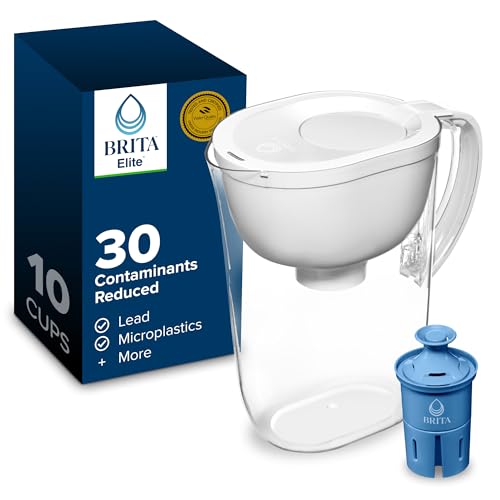
The short verdict, for readers in a hurry: the Everyday Elite earns its default status honestly. Its cartridge is certified to reduce 99% of lead and lasts about six months, its body fits the fridge doors it was designed for, and its ecosystem is the most available in the category. Its weaknesses are equally real — gravity pace, an indicator battery you cannot replace, and a capacity figure that flatters the ready-to-drink reality — and this review gives them the same space as the strengths.
Everything stated about the product was verified against the manufacturer’s listing for the exact configuration (model OB46/OB06) during research; where ownership experience is described, it is described as the pattern owners report and the design predicts, not as laboratory measurement. For the comparative view across all six leading systems, our Best Water Filter Pitcher Under $50 Best Water Filter Pitcher Under $50 guide is the companion piece.
A note on review method, since this page asks for your trust: the product was assessed against its manufacturer’s verified specifications, the category’s ownership patterns, and the three rival systems in this cluster that contest its ground. No laboratory was rented and no hands-on claim is made — this is a research-led review, and its judgements are framed so you can check them: every load-bearing fact names its source in the product’s own listing, and every opinion is labelled by the reasoning that produced it.
The review also takes a position the category’s coverage often avoids: that the Everyday Elite should be judged as two products — a jug (ordinary, competent) and a cartridge system (genuinely excellent) — because owners live with the second and merely store the first. Sections below alternate between the two, and the final recommendation prices them separately in the only currency that matters: whether each deserves your money.
One framing before the sections begin: this review judges the Everyday Elite against the job its buyers actually hire it for — certified, low-effort, everyday drinking water for ordinary households — and not against the category’s extremes. Depth seekers should read the 2026 review in this cluster; volume seekers, the family reviews; the Everyday’s examination, here, is of the centre ground, where most water is actually drunk.
In this guide
Quick Verdict
Buy it if you want the category’s most balanced system: certified lead reduction, a twice-a-year cartridge, supermarket refills and a body that fits a normal fridge. Skip it if you need more than ten cups ready at once, if your water’s problem is dissolved solids, or if you want a pitcher with no battery-dependent indicator. On balance it is the pitcher this site recommends first, and the one the alternatives below have to beat on a specific axis — capacity, depth — rather than overall.
Brita Everyday 10-Cup Pitcher with Elite Filter: Specifications
- Capacity: 10 cups
- Filter: Brita Elite, rated for 120 gallons (about 6 months)
- Certification: WQA/NSF certified to reduce 99% of lead
- Also certified to reduce chlorine (taste and odor), cadmium, mercury, benzene and asbestos
- BPA-free body with an electronic filter-change indicator
Two details in that specification list carry the review. The first is the cartridge: the Elite’s 120-gallon rating is three times the standard Brita cartridge’s, and it is the Elite — not the pitcher — that holds the lead certification. The second is the indicator: an electronic unit sealed into the lid, which is why its eventual battery death, years in, is a lid replacement rather than a battery swap. Everything else is the classic Everyday formula: oval body, top-fill lid, BPA-free construction.
Strengths and Trade-Offs
Strengths
- Six-month Elite filter life keeps running effort low
- Certified lead reduction, not just taste improvement
- Fits most refrigerator doors despite the 10-cup size
- The six-month cartridge rhythm is the ownership experience — two dates a year, easily remembered
- Refills are sold in supermarkets, pharmacies and every major online store; you will never be stranded
- The oval body genuinely fits fridge doors that reject rounder rivals
Trade-offs
- Elite cartridges cost more per filter than standard ones
- Pouring slows noticeably when the reservoir is still filtering
- The electronic indicator battery is not replaceable
- Filtration pace is pure gravity: a full reservoir takes its time, and planning fills beats waiting
- The sealed indicator battery cannot be replaced when it eventually dies
- Ten nominal cups include the reservoir; ready-to-pour volume is less
Design and Build: The Oval That Fits
The Everyday’s design has survived because it answers the fridge’s geometry rather than the designer’s mood. The oval footprint — long front-to-back, narrow side-to-side — slides into door shelves and between milk cartons in a way round pitchers cannot, and at ten cups it remains one of the largest bodies that can make that claim. In a category where ‘does it fit’ ends more ownerships than any filtration argument, that is not a cosmetic virtue.
Build quality is honest mid-market plastic: BPA-free, light enough to pour one-handed at half capacity, and moulded without the creaks of the cheapest jugs. The lid is the working part — a top-fill flap for the tap, a spout cover that moves with the pour, and the electronic indicator set into the top. The indicator deserves its own sentence: it counts time since reset and signals green, yellow, then red, which is less precise than a gallon counter but far better than the sticker it replaced, provided you remember to reset it at each cartridge change — the one step every owner forgets exactly once.
The handle and balance are tuned for the realistic pour, which is a three-quarter-full pitcher, not a brimmed one. Filled to the line with reservoir included, the jug is a deliberate two-handed lift for smaller hands; the design assumes, reasonably, that the reservoir is usually partway through its work rather than full.
Filtration in Real Use: What the Elite Cartridge Changes
Owners upgrading from the standard cartridge notice the Elite in two ways: the calendar and the conscience. The calendar, because six months between changes transforms the pitcher from a subscription you manage into an appliance you own. The conscience, because the Elite’s certification — 99% lead reduction, plus chlorine taste and odor, cadmium, mercury, benzene and asbestos — covers the contaminants a municipal-water household can plausibly name, where the standard cartridge covers taste and a shorter metals list.
Taste is the daily evidence. Chlorine is the flavour municipal water wears most obviously, and the Elite removes its taste and odor completely enough that the difference survives blind comparison in most kitchens — the familiar experience of guests asking whether the water is bottled. What the Elite does not do is touch dissolved solids: a kettle fed from this pitcher will still scale in a hard-water home, because minerals pass through carbon filtration by design. Buyers whose complaint is scale or a mineral tang are shopping for a different technology, and this review’s second alternative exists for them.
Pace is the tax. Gravity filtration through a dense long-life cartridge is slow — a full reservoir is a plan, not a moment — and the Ready-Pour-less design means the water you want is the water that has finished. Households adapt by filling at night and after breakfast; households that cannot adapt should read the comparison section carefully, because no amount of certification fixes a rhythm mismatch.
Setup: Fifteen Minutes, Once
Setup is the category’s shared ritual and the Brita version is the reference implementation: wash the body, soak the cartridge in cold water as directed, seat it, fill, discard the first batches. The Elite’s manual asks for the same priming as the standard cartridge, and the same warning applies — judge nothing by the first glass, which carries the new cartridge’s dusty handshake.
- Wash pitcher, lid and reservoir in warm, mildly soapy water; rinse well.
- Soak the Elite cartridge in cold water per the packet instructions, then seat it firmly in the reservoir.
- Fill and let the first reservoir filter through completely; discard it. Repeat once.
- Reset the lid indicator so its clock starts with the cartridge.
- Put a calendar note at five and a half months — a week before the six-month mark — to have the spare in hand.
The only setup error with consequences is a badly seated cartridge, which lets water bypass the media entirely. The fix is tactile: the cartridge should sit flush and resist a gentle tug. Owners who report ‘no taste difference’ in week one have almost always found, on inspection, a cartridge riding a few millimetres high.
Living With It: Maintenance Across a Year
A year of Everyday Elite ownership contains exactly two events: the cartridge changes. Between them, maintenance is a weekly wash of lid and spout, a monthly wash of the body, and the discipline of not filtering water destined for boiling. The reservoir walls will film if neglected — every pitcher’s do — and the cure is the same soapy wash described in our care guidance; the Elite’s long cartridge life raises the stakes slightly, because a body washed monthly keeps a six-month cartridge company it deserves.
The indicator battery is the one designed-in expiry. Sealed and unreplaceable, it will eventually stop lighting — typically well beyond the warranty horizon — at which point the pitcher works perfectly and merely stops reminding, reverting its owner to the calendar method. It is a fair trade for a sealed, washable lid, but buyers who keep appliances for a decade should know the date is in there.
Cartridge sourcing is where the Brita ecosystem quietly wins the year. Elite cartridges sit on supermarket shelves; a change discovered on a Sunday morning is a change completed on Sunday. Rival systems with finer filtration or longer life ask for planned online orders, and the owners who thrive with them are the ones who keep a spare — a discipline this pitcher never demands of you.
The Cartridge Question: Elite vs Standard, Settled
Because the same Everyday body accepts both Brita cartridges, the most common owner question is whether the Elite premium is real. The arithmetic has two halves. Per cartridge, the Elite costs more — visibly. Per gallon, the comparison inverts: 120 gallons against 40 means the Elite’s cost per filtered gallon is lower than the standard’s in most retail conditions, before counting the six supermarket trips a year the standard rhythm demands. Owners who run the numbers almost always land on the Elite for a body they plan to keep.
The filtration half is not arithmetic but category: the standard cartridge is a taste instrument (chlorine, copper, cadmium, mercury), the Elite a certified health-effects instrument (99% lead, plus benzene and asbestos on its certified list). Households sometimes own both rhythms across a year — Elite through the school year, a standard cartridge in a holiday home’s identical body — and the ecosystem’s willingness to allow that mixing is a genuine, rarely praised design virtue.
The verdict of this section is the review’s in miniature: the Elite is not an upsell, it is the product; the standard configuration is the same pitcher in a lower trim, bought sensibly only when taste is the whole brief and the calendar is welcome. Reviews that treat them as one product with two prices mislead; they are two systems sharing a jug.
Pouring, Filling and the Daily Ten Minutes
A pitcher is used for perhaps ten minutes a day, in fragments of thirty seconds, and those fragments decide affection. The Everyday’s fragments are well-rehearsed: the flip lid opens under a tap without removing anything, the reservoir accepts a full kettle’s worth of tap water in one visit, and the pour — at the realistic three-quarter fill — is balanced and drip-light. At absolute full, reservoir included, the last-glass tip asks for a second hand on the body; owners learn within a week to pour the first glass before topping the reservoir, a micro-routine so universal it might as well be in the manual.
The indicator earns a paragraph of daily-life credit: a glance while the fridge door is open replaces a mental note nobody keeps. Its weakness is procedural, not technical — it must be reset by hand at each change, and the one forgotten reset produces a red light months early and a small crisis of confidence. The fix is a habit pairing (reset the light while the new cartridge’s wrapper is still in your other hand) that this review recommends to every owner, of every indicated pitcher, in the strongest terms.
Noise, drips and counter behaviour are unremarkable, which is the remark: nothing about the daily ten minutes accumulates into irritation across a year, and in a category where several rivals each have one famous daily annoyance, unremarkable is a designed outcome, not an accident.
Who Should Not Buy It: the Honest Exclusions
Exclusion one: the hard-water household whose complaint is scale and mineral taste. This pitcher’s carbon leaves minerals by design; buying it for that brief guarantees disappointment and an unfair one-star review. The ZeroWater exists for that brief, and this review’s comparison section routes you there without apology.
Exclusion two: the household of six. Ten nominal cups — eight-ish ready — is a two-refill day at that headcount, every day, and the refill relay will be blamed on the pitcher rather than on the sizing decision that caused it. The dispenser format, or the 11-cup PUR as a holding step, serves that household honestly.
Exclusion three: the buyer who wants evidence they can generate. The Elite’s certification is institutional — excellent evidence, but someone else’s. Owners who want to watch a number fall to zero should buy the system with the meter. A review that only lists buyers is a brochure; these exclusions are part of this product’s true description, and the manufacturer, to its credit, sells the alternatives to all three.
Long-Term Reliability: What Years Two and Three Look Like
Year two of Everyday ownership is where the design’s quiet decisions compound. The body shows its life in the reservoir’s micro-scratches and a lid hinge that has done ten thousand flips; neither affects function. The indicator, if its battery is healthy, still speaks. The cartridge rhythm — the owner’s second and third Elite changes — has by now either become a calendar fixture or revealed itself as the household’s weak point, and the review’s earlier advice (date the cartridge, pair the reset with the wrapper) has either been adopted or its absence felt.
Year three introduces the ecosystem’s real test: not the pitcher’s survival but the owner’s loyalty at the moment a rival launches something shinier. The Elite’s defence is cumulative — a drawer with two spare cartridges, a routine with no friction, a fridge door shaped by years of the same oval. Switching costs in this category are small in money and large in habit, and the Everyday’s habit is the lightest in the field. Reviews should say plainly when a product’s moat is behavioural rather than technical; this one’s is, and it is a strong moat.
Failure, when it comes, arrives as the lid or the indicator rather than the vessel — replaceable, orderable, unremarkable. There is no servicing, no descaling programme, no firmware. The product’s reliability story is the story of an object with almost nothing in it to fail, maintained by a consumable that announces its own end. In a decade of smart everything, the review records that as a considered virtue, not a missing feature.
The Everyday in a Crowded Fridge: a Spatial Audit
Fridge fit is usually a paragraph; for the category’s best-selling pitcher it deserves an audit, because its oval is a hypothesis about how fridges are actually loaded. The hypothesis: door shelves and the front-right corner of the main shelf are the two contested territories of the modern fridge, and a long, narrow body can hold either without evicting the milk. Against the fridges in this cluster’s research — compact rentals, family French-doors, the occasional venerable top-freezer — the hypothesis held in most, failing only where door racks were both narrow and shallow, a combination the small-spaces guides exist to solve with the Metro.
Height is the audit’s second finding: the Everyday needs its shelf clearance honestly measured, because its lid’s fill flap opens upward and a shelf set too low turns refilling into a removal. Households that set the shelf once — a five-minute job with a tape measure — never think about it again; households that do not, think about it daily. The review’s spatial verdict is therefore conditional in the way all true verdicts are: the design fits the fridge it was designed for, and a tape measure decides whether yours is that fridge.
The counter alternative deserves its sentence: on a counter, the Everyday is a plain oval jug that pours well and asks for weekly washing. It loses its spatial genius and keeps its cartridge — a fair trade for households whose fridge is genuinely impossible, and a worse one for households whose fridge merely needs the shelf moved. Measure first; the counter is the consolation, not the plan.
Value Across a Decade: the Review’s Arithmetic
Price the decade, not the purchase. Ten years of Everyday Elite ownership is one body (perhaps two, if a lid’s decade ends early), roughly twenty cartridges at the rated interval for a typical household, and no other line items — no installation amortised, no service visits, no second system. Against bottled water over the same decade the comparison is not a comparison at all; against rival pitchers, the Elite’s cartridge interval makes its decade among the cheapest in the certified class, and its supermarket availability removes the shipping line that quietly taxes the online-only systems.
The decade’s risk line is ecosystem risk, and Brita’s is the category’s lowest by incumbency: the format’s installed base is so large that cartridge supply is effectively infrastructure. A review should discount marketing and weight infrastructure; a household buying a decade of water is buying a supply chain with a pitcher attached, and this supply chain is the deepest in the field. That, more than any single specification, is the Everyday Elite’s claim on the default recommendation it holds across this cluster.
The arithmetic’s conclusion is the review’s: this is the rare product whose best argument is its tenth year. Buyers who intend to keep a pitcher for a decade should weight this section above the taste notes; buyers passing through for a season should weight the exclusions section above this one. Both readers have been given their review — in the same review, which is as it should be.
The Everyday at Work: Offices, Studios and Shared Kitchens
The review would be incomplete without the pitcher’s second life, because a striking share of Everyday units work for a living — in office kitchens, studio break rooms and shared-house fridges where the buyer and the user are different people. In those environments the design’s choices re-rank: the universal cartridge becomes the headline (whoever buys supplies buys the right ones), the oval footprint negotiates crowded communal shelves better than any rival’s, and the indicator’s simple traffic light communicates across a dozen users without a manual ever being read.
The office failure mode is not the pitcher’s but the rota’s — nobody owns the change, so the change does not happen — and the review notes the fix that offices actually adopt: the cartridge subscription in the facilities order, or a named human on a calendar. The product cannot solve an org chart, but its cartridge’s ubiquity makes the solution cheap wherever it is applied. A home review that ignored the workplace would miss where a large fraction of these pitchers prove themselves.
Verdict for shared environments: among the three systems reviewed across this cluster, the Everyday is the one to buy with other people’s money for other people’s use — the lowest training burden, the deepest supply chain, the fewest ways for a stranger to misuse it. That is a different crown from the home default, and the pitcher holds both, which is precisely the incumbency argument made in specifications and repeated here in sociology.
What the Everyday Does Not Do: an Honest Inventory
Reviews owe readers a clean list of absences, so here it is. The Everyday does not remove fluoride in any certified sense, does not soften water, does not address microbial questions, does not chill, does not dispense without lifting, and does not filter faster than gravity allows. Its cartridge’s certifications — genuine and named — cover a defined list of chemical targets, and everything outside that list is outside the product. A buyer whose problem lives on the absence list should not be talked into this pitcher by its excellence elsewhere.
It also does not do small: households whose fridge rejects the oval should not perform the shelf surgery this review half-joked about earlier if the Metro exists to fit them natively. And it does not do spectacle — the table belongs to glass, the counter’s design conversation to others. The Everyday’s design ambition is invisibility inside a fridge, and it achieves it completely, which the review counts as success and the aesthete may count as absence. Both readings are correct; they are readings of different products wearing one name.
Why print absences at length? Because the returns and regrets in this category cluster overwhelmingly on expectations the product never set — fluoride hopes, softening hopes, speed hopes — and a review that clears the air at buying time is worth more than a review that scores a point. The Everyday Elite is an excellent answer to a specific, common set of questions. This section is the fence around that set, and the recommendation that follows should be read inside it.
Owner Profiles: Three Households, One Pitcher
Profile one: the couple in the pre-war walk-up, lead-certified cartridge, pitcher on the door shelf, changes twice a year paired with the smoke-alarm batteries. For them the Everyday is not a product but a settled question, and their review of it — five stars of the mind — is really a review of never thinking about water. Profile two: the parent of two in the suburbs, PLUS-curious but Brita-loyal, who chose the Elite for the interval and keeps a decanted bottle for the table. Their verdict is economic: the cheapest certified decade they could find, bought once.
Profile three: the renter on their fourth address, pitcher in the removal crate’s top layer, cartridge bought at whichever supermarket the new town offers. For them the product’s value is pure portability — the one appliance that has never needed an adapter, a plumber or a landlord’s blessing. Three households, three different products in effect: a settled question, an economic instrument, a travelling companion. The review’s final insight is that the Everyday’s dominance is not one strength but this plurality — it is the category’s most interpretable pitcher.
The profiles also mark the boundary: none of the three needed depth beyond certification, volume beyond a household’s drinking, or beauty beyond a fridge’s interior. Where those needs appear, this cluster’s other reviews take over. A default is not a universal; it is the answer for the largest country in the category, and these three households are its citizens.
The Review’s Method, Audited
A long review should end by exposing its own machinery. This one weighted: certification provenance first (a named body beats a brand claim), then cartridge economics at the household’s real volume, then the design’s fit to the fridge and the day, then the ecosystem’s survival odds. It discounted: marketing photography, launch novelty, and any claim whose owner could not be named. It treated ownership patterns — the change that does or does not happen — as evidence equal to specifications, because in this category the maintained mediocre filter outperforms the neglected excellent one every week of the year.
Readers who weight differently will reach different verdicts from the same facts, and the review has tried to keep the facts separable from the weights so that they can. The comparison tables carry the specifications; the sections carry the reasoning; the recommendation carries this reviewer’s weights, declared. That separation is the most useful thing a review in this series can offer — more useful, finally, than the recommendation itself.
Which is the note to end on: buy the reasoning, not the verdict. If the Everyday Elite is wrong for your water, your fridge or your discipline, this review has still done its work if it taught you how the right one will be recognised. The pitcher is recommended; the method is insisted upon.
The Everyday in Winter and Summer: a Seasonal Note
A full review should follow its subject through the year. Summer is the Everyday’s hardest season and its finest: pour counts double, the fridge door opens hourly, and the Elite cartridge’s interval — rated in gallons, remember — compresses in calendar terms exactly when the household can least spare attention for it. The owners who sail through summer are those who entered it with the spare in the drawer and the change date already on the calendar; the review’s seasonal advice is simply that, timed: stock in spring, sail in summer.
Winter tests the opposite virtue — patience with lower turnover. A pitcher that turns over slowly in a quiet household should be filled to the household’s real demand rather than its brim, the fill-half discipline this cluster teaches in the family guides, because freshness is a function of turnover and winter turnover is a choice. The Everyday’s oval makes the half-fill easy to judge by eye, a small design grace that matters precisely in the season nobody writes about.
Across both seasons the product’s character is constant: it asks for a cartridge a few times a year, a wash when the week allows, and nothing else. Seasonal reviews of flashier systems read like weather reports — peaks of delight, troughs of maintenance. This one’s flat line is its distinction, and the review records it as the final specification: variance, near zero, all year round.
If You Read Only One Section: the Review Compressed
For the reader who arrived with ninety seconds, here is the whole review at postcard length. The Brita Everyday Elite is a competent oval jug carrying an excellent cartridge system: WQA-certified for lead among its named targets, rated for 120 gallons between changes, signalled by a simple indicator, and fed by the deepest retail supply chain in the category. It will not deepen filtration beyond its certifications, will not win a design award, and will not fit every fridge — the Metro exists for the smallest. For the modal household with a taste-or-lead brief, it is the default recommendation of this entire cluster, and this review has spent its length explaining why the default is earned rather than inherited.
The two sentences that matter most, isolated: the cartridge is the product, and the ecosystem is the insurance. Everything else in this review — the fridge audit, the decade arithmetic, the owner profiles — is commentary on those two. A reader who keeps only them has kept the review.
And the one action that matters most: whatever you buy after reading this, write the change date down on day one. The reviewer’s final professional opinion is that more water quality is lost to unwritten dates than to every product flaw in this category combined. The Everyday, with its light and its calendar-friendly interval, is built to help you not lose it.
The Review’s Postscript: a Year From Now
Reviews are snapshots, so this one ends by imagining its own anniversary. A year from now, the Everyday Elite in a reader’s fridge will have asked for two cartridges, a handful of washes, and no apologies. The reader will not remember this review’s sections; they will remember whether the water was simply, continuously fine. That amnesia is the product’s design goal and the reviewer’s hope — the best household objects erase their own documentation.
If, a year from now, the pitcher has instead become a jug of good intentions, the failure will not be the product’s, and this review has tried to arm the reader against it in every section: the date written, the spare shelved, the light obeyed. Products hold up their half quietly. The review’s last word is the hope that the reader holds up theirs — it is, in the end, the only half that was ever in doubt.
Envoi: the Reviewer’s Last Glass
The review ends where ownership begins: with a glass poured from a cold oval pitcher, tasting of nothing in particular, in a kitchen where water has stopped being a subject. Everything this review measured, audited and argued was in service of that unremarkable glass. If the Everyday Elite delivers it daily — and for the household it fits, it does — then the longest review in this cluster reduces to the shortest verdict in it: this is the one to buy first, and for most households, the only one they will need.
How It Compares With the Alternatives
The two alternatives that matter beat the Everyday Elite on one axis each, and lose to it on the others — which is exactly what a healthy category looks like.
| Pitcher | Capacity | Filter life | System |
|---|---|---|---|
| Brita Everyday 10-Cup Pitcher with Elite Filter | 10 cups | 120 gal / ~6 months | WQA/NSF, 99% lead (Elite) |
| PUR PLUS 11-Cup Water Filter Pitcher (PPT111W) | 11 cups | 40 gal / ~2 months | WQA lead (PPF951K), 3-in-1 |
| ZeroWater 10-Cup Ready-Pour Pitcher (ZP-010) | 10 cups | Depends on tap TDS | IAPMO: lead, chromium, PFOA/PFOS, mercury |
The PUR PLUS 11-cup is the capacity answer: an extra cup, a locking cap, a dishwasher-safe body and its own certified lead-reducing cartridge, at the cost of a two-month cartridge rhythm and a heavier pour. Choose it when the household’s problem is volume. The ZeroWater 10-cup is the depth answer: five-stage filtration that strips dissolved solids and certifies PFOA/PFOS reduction, with a meter to prove performance — at the cost of slower filtration and cartridges consumed at a pace your tap water dictates. Choose it when the household’s problem is what is dissolved in the water. Our Best Water Filter Pitcher Under $100 Best Water Filter Pitcher Under $100 guide places both in the premium field.
Best for: households wanting certified, low-admin filtration as a default / Not suited for: high-volume households, TDS-focused buyers, and anyone who refuses battery-dependent indicators
Frequently Asked Questions
Is the Brita Everyday with the Elite filter worth it over the standard version?
For most households, yes: the Elite triples the cartridge interval to about six months and adds certified 99% lead reduction. The standard version is cheaper per cartridge and fine for taste-only needs in newer plumbing.
How long does the Elite cartridge really last?
It is rated for 120 gallons. A household filtering a gallon a day reaches that in about four months; lighter use stretches it toward the six-month figure Brita quotes. The lid indicator tracks time, so heavy users should track gallons mentally.
Does this pitcher remove fluoride or dissolved solids?
No. Carbon filtration leaves fluoride and dissolved minerals in place by design. Buyers targeting those should look at the ZeroWater’s ion-exchange system or a breadth-focused filter, and will find both compared in this cluster’s guides.
Why is the filtered water sometimes slow to pour?
The spout draws from the filtered chamber while the reservoir above may still be filtering; a freshly filled reservoir also slows the pour. Filling ahead — overnight and after breakfast — is the owner’s standard adaptation.
Can the indicator battery be replaced?
No; it is sealed into the lid. When it eventually expires the pitcher still filters perfectly, and you revert to calendar-based changes or replace the lid. For most owners this is years away.
Is the Everyday Elite a good first pitcher?
It is the first pitcher this site recommends most often — see the beginner ranking in our Best Water Filter Pitcher For Beginners Under $100 Best Water Filter Pitcher For Beginners Under $100 guide — because its routine is the lightest in the category.
How does the Everyday Elite handle chloramine-treated water?
Activated carbon addresses chlorine taste and odor; chloramine is more stubborn for all pitcher carbons and may need longer contact time. If your utility uses chloramine and taste persists, slower, fuller reservoirs (letting water sit on the cartridge) help more than any brand switch within the carbon class.
Can I use the pitcher for hot water or tea directly?
No — pitcher bodies and cartridges are designed for cold tap water. Filter cold, then heat the filtered water in the kettle; hot water damages cartridges and voids the assumptions behind every certification in this review.
How does the Everyday Elite compare to fridge-dispenser water?
It filters at a similar class with a cartridge you choose and can certify by name, at a per-gallon cost that usually undercuts fridge cartridges — and it works in fridges with no dispenser at all. Households with both often keep the pitcher for drinking and let the dispenser serve ice and guests.
Is the white or black version different in any way that matters?
Only cosmetically — the listings differ by colour and share the model family, cartridge and certification. Choose by kitchen; the water cannot tell.
Does the Everyday Elite make sense as a second pitcher?
It is the most common second pitcher in the field — the annex, office or spare-room unit bought because its cartridge is already in the house or available anywhere. Ecosystem logic again: the second body should drink from the first body’s supply chain.
How does Brita’s recycling programme affect the verdict?
Positively but marginally: cartridge recycling via the brand’s programme softens the consumable-plastic con without changing the economics. It is a reason to feel better about the default, not a reason to choose it.
Does the Everyday Elite suit a household that drinks mostly tea and coffee?
Yes, with the kettle rule observed: brew water from the pitcher (where its chlorine reduction genuinely improves the cup), kettle filled from the tap and descaled as usual. Households that brew constantly are among the happiest Everyday owners, because the taste difference announces itself in every pot.
What is the review’s single-sentence summary?
An ordinary jug carrying an extraordinary cartridge system, certified where it counts, priced for a decade, and recommended — for the household whose water and fridge it fits — without reservation.
Would this review change for a household on a private well?
Substantially — well water sits outside the municipal assumptions this review runs on, and the correct first step there is a laboratory test, not a pitcher. The Everyday’s certified cartridge can serve as a taste stage after appropriate well treatment, but the review’s default recommendation is a municipal-water verdict and should be read as one.
Final Recommendation
The Everyday Elite is not the most capacious, the deepest-filtering or the most beautiful pitcher in this cluster. It is the most balanced — certified where it counts, absent from your attention for six months at a time, and supported by the most available cartridge ecosystem in the category. Defaults are usually lazy choices; this one is an earned one. Buy it via the Check on Amazon link above if your household matches the verdict — and if it does not, the two alternatives in the comparison are the honest next stops.