Disclosure: As an Amazon Associate, UMT Smart Tool earns from qualifying purchases. This guide is built from product listings and maker specifications, not from our own hands-on testing. Prices are approximate and can change, so check the current price before you buy. Last updated: November 10, 2026.
The best vintage rugs are almost never actually old. What you are buying is a new rug with an aged design — a faded medallion, a worn-looking border, colors softened to imitate decades of foot traffic. How that look is produced matters more than the pattern itself. Some vintage style rugs are printed flat onto a thin pile, some are power-loomed with the pattern woven in, and a few are handmade wool pieces dyed to look timeworn. They feel different underfoot, age differently, and sit at very different price tiers. This guide is organized by construction and use case, and every pick below states plainly whether it is printed, machine-woven or handmade. If you lean more traditional, our guide to the best Persian rugs covers the classic medallion end of the spectrum in more depth.
In this guide
Quick Picks
The short version: six vintage rugs we would look at first, one per construction type and budget.
| Pick | Type | Best for |
|---|---|---|
| Loloi II Loren LQ-10 | Printed vintage rug | The most convincing aged look for most living rooms |
| SAFAVIEH Monaco MNC243F | Power-loomed medallion rug | High-traffic rooms that need a woven, non-shedding pile |
| SAFAVIEH Anatolia AN559A | Handmade wool rug | Buyers who want real wool and hand-spun texture |
| Lahome Adelyn Oriental Washable | Washable vintage rug | Kids, pets and dining rooms — it goes in the machine |
| Unique Loom Penrose Alexis | Faded Oushak-style rug | Soft, low-contrast palettes in calm, neutral rooms |
| Unique Loom Reza Washington | Traditional Persian-style rug | A classic bold medallion on a budget-friendly tier |
Our Picks
1. Loloi II Loren LQ-10, 7’6″ x 9’6″, Blue/Red — Best Overall
The Loren is the vintage rug we would start with for a typical living room, because Loloi’s printing is unusually good at imitating a worn wool rug. The LQ-10 pairs a blue field with garnet red and touches of gold, with intentional distressing that fades the medallion the way sun and traffic fade a real antique. Be clear about what it is, though: the design is printed onto a low polyester pile, roughly an eighth of an inch high, power-loomed in Turkey. Up close there is no knot structure and no wool texture — the age is in the artwork, not the material.
That flat construction is also the practical upside. The low pile slides under doors, vacuums easily, does not shed, and lets dining chairs and coffee-table legs sit level. It will not feel plush, and a rug pad underneath is close to mandatory for comfort and grip. Colors can read slightly different in person than on screen, which is true of most printed vintage rugs. For a mid-range tier price, it delivers the lived-in look with the least upkeep of any pick here.

2. SAFAVIEH Monaco MNC243F, 8′ x 10′, Forest Green & Light Blue — Best Distressed Medallion for High Traffic
The Monaco takes the other machine-made route: instead of printing the pattern on top, Safavieh power-looms it into a polypropylene pile, so the distressed medallion is actually woven. That gives the design more depth than a print and a denser, more substantial feel underfoot. The MNC243F colorway — forest green with light blue — is one of the bolder vintage palettes here, and the erased, painterly wear pattern hides everyday dirt and footprints well between cleanings.
Safavieh lists the Monaco as non-shedding and stain resistant, which is why we would put it in entryways, family rooms and other high-traffic spots where a printed flatweave feels too thin. The trade-offs are the usual polypropylene ones: it is a synthetic pile with a machine-made backing, it benefits from a pad on hard floors, and the “vintage” character comes from the design rather than from any real age or handwork. Within the mid-range tier, it is the workhorse vintage rug of this list.
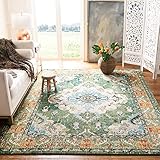

3. SAFAVIEH Anatolia AN559A, 8′ x 10′, Beige & Sage — Best Real Wool
The Anatolia is the one pick here that is genuinely handmade. Safavieh makes the collection from 100 percent premium hand-spun wool, using traditional pot-dyeing techniques that produce the soft color variation — similar to the abrash you see in old tribal rugs — across its traditional Oriental design. The beige and sage palette of the AN559A is quiet and convincingly aged, and because the color lives in dyed wool rather than in a printed surface, it will keep mellowing instead of wearing off.
It is also the most demanding pick. Wool sheds for the first months, wants a quality pad, and should be cleaned by specialists rather than with a rented machine. Handmade pieces vary slightly from rug to rug, so treat the listing photos as a close guide rather than an exact promise. This is a premium-tier rug, priced like one, and it earns that place for buyers who want the vintage look to be more than skin deep.


4. Lahome Adelyn Oriental Washable, 6′ x 9′ — Best Washable Vintage Rug
Most vintage rugs ask you to protect them from real life. The Adelyn goes the opposite direction: it is an ultra-thin, machine-washable rug with a printed vintage Oriental pattern, a non-slip backing and a stain-resistant surface, made to live under dining tables and in homes with kids and pets. The pattern is a print on a flat, low surface — nobody will mistake it for a woven antique at close range — but at normal viewing distance the faded medallion reads convincingly vintage.
Thin is both the feature and the compromise. It folds for the wash, fits under door swings, and will not trip anyone, but there is essentially no cushion, and the edges can curl until it settles or is taped down. Wash it cold on a gentle cycle and air-dry, as Lahome directs, to protect the backing. At a budget-friendly tier, it is the vintage rug to buy when cleanability matters more than authenticity.


5. Unique Loom Penrose Alexis, 8′ x 10′, Gray/Beige — Best Faded Oushak-Style Look
Real Oushak rugs — soft, washed-out Anatolian weavings — are expensive, so most “Oushak-style” rugs are new machine-made pieces chasing that pale, sun-bleached palette. The Penrose Alexis is one of the more tasteful attempts: a gray and beige medallion with the contrast turned way down, so it sits quietly under light sofas and natural wood instead of dominating the room. It is machine-woven polypropylene, not a hand-knotted wool Oushak, and the copy on any listing should be read that way.
What you get for the mid-range tier is a soft, forgiving background rug: the faded pattern camouflages lint and pet hair between vacuums, and the pile has more substance than the printed picks. The risk with any low-contrast rug is that it reads plainer in a dim room than in bright listing photos, so check the return terms if your light is limited. For calm, neutral, layered rooms, this is the vintage style that works hardest without asking for attention.


6. Unique Loom Reza Washington, 7’10” x 10′, Brown/Ivory — Best Budget Traditional
The Reza is the classic end of vintage: a traditional Persian-style medallion in brown and ivory, with the dense borderwork and warm tones of the rugs most people picture when they hear “vintage rug.” Unique Loom machine-makes the collection in polypropylene with a medium pile, so it feels more like a conventional area rug than the flat printed picks, and the busy pattern is exceptionally good at hiding crumbs and wear in busy rooms.
It is the budget-friendly tier of this list, and the compromises match: synthetic fiber, machine-made uniformity, and colors that stay bold rather than fading — the distressing here is minimal, so if you want a truly worn look, the Loren above does it better. As an inexpensive way to put a traditional anchor under a dining table or in a rental, though, the Reza’s combination of price, pile and pattern is hard to beat.

Best Picks by Category
- Printed vintage rug: Loloi II Loren LQ-10 — the most believable aged artwork, on an easy-care flat polyester pile.
- Power-loomed medallion rug: SAFAVIEH Monaco MNC243F — the pattern is woven in, with a non-shedding pile for busy rooms.
- Handmade wool rug: SAFAVIEH Anatolia AN559A — real hand-spun wool with pot-dyed color variation.
- Washable vintage rug: Lahome Adelyn Oriental — ultra-thin, printed and machine washable for messy households.
- Faded Oushak-style rug: Unique Loom Penrose Alexis — a pale gray/beige medallion that stays in the background.
- Budget traditional rug: Unique Loom Reza Washington — classic Persian-style pattern and medium pile at the lowest tier here.
Notice that the categories are really about construction. Once you know whether you want a print, a woven synthetic or real wool, the pattern choice gets much simpler.
How to Choose the Best Vintage Rug
Start with construction: printed, power-loomed or handmade
This is the decision that decides everything else. A printed vintage rug has its pattern inked onto a low pile — it gives the most dramatic aged look for the money but feels flat and shows its method up close. A power-loomed rug weaves the pattern into a synthetic pile, adding texture and durability. A handmade wool rug is a different class of object: dyed fiber, slight irregularities, real aging potential — and a price to match. Decide which of the three you are actually shopping for before comparing patterns. Our broader guide to living room area rugs walks through the same construction trade-offs across modern styles too.
Match the material to the room
Polyester prints (like the Loren) are soft, flat and easy to vacuum — good under dining tables. Polypropylene (Monaco, Penrose, Reza) resists stains and moisture and suits entries and family rooms, though it can hold onto oily soil over time. Wool (Anatolia) is naturally resilient and flame resistant, hides soil in its fiber, and lasts decades, but it sheds early on and needs gentler cleaning. There is no best material — only a best match for the traffic and spills your room actually sees.
Pattern scale and distressing level
Distressing is a dial, not a checkbox. Heavy distressing — big faded patches across the medallion — reads casual and hides wear beautifully, but can look like damage in a formal room. Light distressing keeps the pattern legible and suits traditional spaces. Also weigh pattern scale: a large central medallion needs a room where furniture will not chop it in half, while allover patterns are more forgiving of sofas and tables parked on top of them.
Size and placement
For a living room, the standard that rarely fails is front legs of the sofa and chairs on the rug, which usually means an 8′ x 10′ at minimum. Under a dining table, add roughly 24 inches on every side so chairs stay on the rug when pulled out. Vintage rugs often come in slightly non-standard sizes — 7’6″ x 9’6″ or 7’10” x 10′ — so measure your space and check the exact listed dimensions rather than the rounded size in the title.
Pile height, backing and pads
Low piles (the printed picks) clear door swings and suit dining rooms; medium piles feel warmer in bedrooms and living rooms. Almost every rug in this guide benefits from a pad: it stops creeping on hard floors, adds the cushion thin rugs lack, and extends the rug’s life by reducing friction against the backing. Felt-and-rubber pads suit most of these; thin washable rugs with built-in non-slip backings are the exception.
Care and cleaning
Clean to the construction, not the pattern. Washable prints go in the machine on cold, gentle cycles and air-dry. Power-loomed synthetics want regular vacuuming without a beater bar on the fringes (where fitted) and prompt blotting of spills. Wool should be vacuumed on suction only, rotated twice a year for even wear, and professionally cleaned rather than saturated at home. Whatever the type, keep any rug out of prolonged direct sun if you want the vintage fading to stay where the maker put it.
Which vintage rug should you buy?
The best vintage rug for most people is the Loloi II Loren LQ-10, but the right pick depends on construction, traffic and how real you want the aged look to be. Match your situation to the list below.
- You want the most convincing faded look with the least upkeep: choose the Loloi II Loren LQ-10, a printed flat pile that vacuums easily.
- You have a busy entry or family room: the SAFAVIEH Monaco MNC243F has the pattern woven in and is listed as non-shedding.
- You want real wool and natural color variation: the SAFAVIEH Anatolia AN559A is the handmade pick, and it asks for a pad and careful cleaning.
- You have kids, pets or a dining table: the Lahome Adelyn Oriental Washable goes in the machine, though it offers almost no cushion.
- You like soft, quiet colors: the Unique Loom Penrose Alexis keeps contrast low in neutral rooms.
- You want a bold traditional medallion on a tight budget: the Unique Loom Reza Washington is the budget-friendly classic.
If you are still undecided, decide between printed, woven and handmade first, then let room size and cleaning habits break the tie.
A few pairings are worth spelling out. For a rental or a first apartment, the Unique Loom Reza Washington gives a traditional look without a large commitment. For a quiet bedroom with light furniture, the Penrose Alexis fades into the background. For a living room where the rug is meant to be the focal point, the Loren and the Monaco carry stronger color and more visible wear patterns. The Anatolia suits a low-traffic room where you can enjoy the wool and protect it from heavy soiling.
Also think about layering. Many people lay a vintage rug over a larger neutral rug or over carpet, and a thin washable rug like the Adelyn is easier to layer than a thick one. Whatever you choose, keep furniture placement in mind so the medallion is not hidden.
What to check before you buy a vintage rug, and who should skip it
Before ordering a vintage style rug, confirm a few details on the listing, because the photos rarely tell the whole story. Run through this checklist:
- The exact listed dimensions, not the rounded size in the title, measured against your furniture layout.
- Whether the rug is printed, power-loomed or handmade, and what fiber it is made from.
- The pile height, and whether it clears your door swings.
- Whether a rug pad is included or needs to be bought separately.
- The cleaning instructions, and the return terms if the colors read differently at home.
Now the honest trade-offs. Printed and machine-made rugs imitate age rather than having it, so anyone hoping for a genuine antique will be disappointed. Low-contrast designs can look plain in dim rooms, and bold distressing can look like damage in a formal space. The handmade wool option costs more, sheds early on and needs professional cleaning, which makes it a poor fit for a household that wants no maintenance.
Skip this category if you want a plush, deep pile underfoot or if you need guaranteed age and provenance. Otherwise, compare the picks above, check the current listing for size and what is included, then choose the one that fits how you will use it.
A Closer Look at Each Pick in Everyday Use
Loloi II Loren LQ-10, 7’6″ x 9’6″, Blue/Red: living with the best overall choice
In daily use, the Loloi II Loren LQ-10, 7’6″ x 9’6″, Blue/Red earns its place through consistency rather than novelty. On the floor, that means a pattern that reads as character rather than damage, colours that forgive everyday dust between cleans, and a pile you can vacuum without special equipment or anxiety. Owners who match it to the job described by its label — Best Overall — tend to be the most satisfied, because the design choices behind it point in one direction instead of trying to cover every situation at once. Think through a normal week with it: where it lives between uses, how often you reach for it, and what frustrates you about the option you own now. If those answers line up with what this pick does well, it is a strong candidate. If they point the other way, one of the other picks in this guide will fit better, and there is no penalty for choosing the less celebrated option.
The honest limitation is focus. A product shaped around one strength usually gives something up elsewhere, and with the Loloi II Loren LQ-10, 7’6″ x 9’6″, Blue/Red that trade shows up when you push it outside its intended role. Used as intended, the compromise is easy to live with. Used as a substitute for a different kind of product entirely, it will feel like the wrong purchase even though nothing is wrong with it.
SAFAVIEH Monaco MNC243F, 8′ x 10′, Forest Green & Light Blue: living with the best distressed medallion for high traffic choice
What separates the SAFAVIEH Monaco MNC243F, 8′ x 10′, Forest Green & Light Blue from the rest of this list is how it handles the unglamorous middle of the job. A vintage-style rug anchors a room quietly. The picks that work hardest are the ones whose distressing looks intentional from standing height and whose pattern hides the small realities of daily traffic in between. That matters more than headline features, because most dissatisfaction comes from small repeated annoyances rather than one dramatic failure. Picture the second and third month of ownership, not the first afternoon: the novelty has faded, the routine is set, and the product either slots into your habits or quietly gets used less and less. This pick is built for the first outcome, provided your space and habits match the Best Distressed Medallion for High Traffic brief it was chosen for.
Choose it if that brief describes your home closely. Skip it if your situation is the exception the label quietly assumes away — a much larger space, a much heavier workload, or a household member whose needs pull in the opposite direction. The guide keeps several alternatives on the list precisely so that skipping this one still leaves you with a well-matched option.
SAFAVIEH Anatolia AN559A, 8′ x 10′, Beige & Sage: living with the best real wool choice
The SAFAVIEH Anatolia AN559A, 8′ x 10′, Beige & Sage is the pick to study if you value a clear, narrow promise. Because these rugs are mostly vintage in style rather than in age, the value of this pick is in honest construction: you should be able to tell, from the listing and the rug itself, exactly how the pattern got there. Rather than spreading its effort thin, it concentrates on the scenario in its label — Best Real Wool — and that concentration shows in the details you notice every day: how it feels in the hand or in the room, how predictable it is, and how little thought it asks from you once the routine is established. For shoppers who have been burned by versatile products that were merely adequate at everything, that single-mindedness is the appeal.
Its limitation is the mirror image of its strength. Ask it to cover a second, quite different job and the compromises become visible. That is not a flaw to forgive or condemn; it is information. Match the job first, then let this pick compete on how well it does that one job against the other focused options above.
Lahome Adelyn Oriental Washable, 6′ x 9′: living with the best washable vintage rug choice
In daily use, the Lahome Adelyn Oriental Washable, 6′ x 9′ earns its place through consistency rather than novelty. On the floor, that means a pattern that reads as character rather than damage, colours that forgive everyday dust between cleans, and a pile you can vacuum without special equipment or anxiety. Owners who match it to the job described by its label — Best Washable Vintage Rug — tend to be the most satisfied, because the design choices behind it point in one direction instead of trying to cover every situation at once. Think through a normal week with it: where it lives between uses, how often you reach for it, and what frustrates you about the option you own now. If those answers line up with what this pick does well, it is a strong candidate. If they point the other way, one of the other picks in this guide will fit better, and there is no penalty for choosing the less celebrated option.
The honest limitation is focus. A product shaped around one strength usually gives something up elsewhere, and with the Lahome Adelyn Oriental Washable, 6′ x 9′ that trade shows up when you push it outside its intended role. Used as intended, the compromise is easy to live with. Used as a substitute for a different kind of product entirely, it will feel like the wrong purchase even though nothing is wrong with it.
Unique Loom Penrose Alexis, 8′ x 10′, Gray/Beige: living with the best faded oushak-style look choice
What separates the Unique Loom Penrose Alexis, 8′ x 10′, Gray/Beige from the rest of this list is how it handles the unglamorous middle of the job. A vintage-style rug anchors a room quietly. The picks that work hardest are the ones whose distressing looks intentional from standing height and whose pattern hides the small realities of daily traffic in between. That matters more than headline features, because most dissatisfaction comes from small repeated annoyances rather than one dramatic failure. Picture the second and third month of ownership, not the first afternoon: the novelty has faded, the routine is set, and the product either slots into your habits or quietly gets used less and less. This pick is built for the first outcome, provided your space and habits match the Best Faded Oushak-Style Look brief it was chosen for.
Choose it if that brief describes your home closely. Skip it if your situation is the exception the label quietly assumes away — a much larger space, a much heavier workload, or a household member whose needs pull in the opposite direction. The guide keeps several alternatives on the list precisely so that skipping this one still leaves you with a well-matched option.
Unique Loom Reza Washington, 7’10” x 10′, Brown/Ivory: living with the best budget traditional choice
The Unique Loom Reza Washington, 7’10” x 10′, Brown/Ivory is the pick to study if you value a clear, narrow promise. Because these rugs are mostly vintage in style rather than in age, the value of this pick is in honest construction: you should be able to tell, from the listing and the rug itself, exactly how the pattern got there. Rather than spreading its effort thin, it concentrates on the scenario in its label — Best Budget Traditional — and that concentration shows in the details you notice every day: how it feels in the hand or in the room, how predictable it is, and how little thought it asks from you once the routine is established. For shoppers who have been burned by versatile products that were merely adequate at everything, that single-mindedness is the appeal.
Its limitation is the mirror image of its strength. Ask it to cover a second, quite different job and the compromises become visible. That is not a flaw to forgive or condemn; it is information. Match the job first, then let this pick compete on how well it does that one job against the other focused options above.
Living With a Vintage-Style Rug, Pick by Pick
The appeal of a vintage-style rug is that it arrives with its story already told: the faded medallion, the softened border, the colours that look sun-warmed rather than flat. That pre-aged character is forgiving in a way a crisp new rug is not — crumbs, pet hair and the traffic lane from door to sofa all blend into a pattern that was designed to look lived-in. When you compare the picks, look past the prettiest photo and ask how the pattern behaves at your room’s viewing distance and in your light, which is often warmer and dimmer than listing photography.
Construction decides how long the illusion lasts. A printed design sits on the surface and can wear pale in traffic lanes; a woven design carries its pattern through the pile and ages more gracefully. Neither is automatically the right buy — printed rugs are lighter, often washable, and easier to replace when tastes change — but you should know which you are getting and pay accordingly. The guide flags the construction of each pick so the price and the promise stay in proportion.
Underfoot feel varies more than shoppers expect. Thin, low-pile vintage styles feel firm and keep doors swinging freely, while the wool pick adds genuine cushion and warmth. Decide whether the rug’s job in your room is mainly visual — defining a seating area, adding colour — or physical comfort under bare feet, because that decision narrows this list faster than any pattern preference.
Comparing the Picks Against Each Other
The Loloi Loren is the balanced centre of the list: a printed design done well, in colours that suit many rooms, at a scale that works in a typical living room. The SAFAVIEH Monaco pushes the distressed medallion look further and is aimed at busier households where the rug must hide a lot. The SAFAVIEH Anatolia is the purist’s option — real wool, a subtler palette, and the care commitments that come with a natural fibre.
The Lahome Adelyn answers the practical question the others cannot: it can be washed, which changes the maths completely for homes with toddlers, dogs or a dining table overhead. The Unique Loom Penrose offers the faded Oushak-style look that decorators favour, soft and low-contrast, while the Reza Washington is the traditional pattern at the friendliest commitment level — a good first vintage-style rug if you are testing whether the look suits your home at all.
A practical ordering: if washability is non-negotiable, start with the Lahome. If authenticity of material matters most, start with the Anatolia. If neither dominates, compare the Loren, Monaco and Penrose on colour and distressing level alone, because their day-to-day performance in an average room is closer than their styling suggests.
Placement, Pads and Care That Keep the Look
A rug pad is not an upsell with thin vintage-style rugs; it is what stops the rug creeping, curling and wearing against the floor. Choose a low-profile pad for printed and low-pile picks so doors still clear, and trim it slightly smaller than the rug so the edge lies flat. In a living room, aim for at least the front legs of seating on the rug; in a dining area, the rug should extend beyond the table enough that chairs stay on it when pulled out.
Care follows construction. Printed and synthetic picks generally tolerate regular vacuuming without a beater bar on the highest pile setting, plus prompt blotting of spills. Wool asks for gentler suction, no harsh scrubbing, and professional cleaning when a deep clean is due rather than aggressive home shampooing. Rotate the rug a half-turn every few months so sun and traffic even out — with a faded design, uneven fading is less visible than on a bold new rug, but the wear underneath is still real.
When the rug arrives, unroll it and give the edges a day or two to relax, weighting corners if they curl. A slight smell from packaging is common with synthetic rugs and usually airs out quickly in a ventilated room. Photograph the pattern in your own light before removing tags if colour accuracy matters to you, because vintage palettes are deliberately muted and can read differently against warm wood or cool grey floors.
Final Checks Before You Order
Before you order, run one final comparison between your top two candidates rather than the whole list. Put the two listings side by side and check the same fields in the same order: overall dimensions, what is included in the box, materials, care requirements, and the delivery and return terms. Most indecision at this stage is really missing information, and a structured comparison surfaces which field you actually care about. When one field clearly matters more to you than the others, let it decide, and stop re-opening settled questions.
Read the most recent owner comments on the listing with a filter in mind: look for remarks about the exact job you are buying for, and discount both the angriest and the most glowing extremes. Patterns matter more than individual stories. If several owners mention the same strength or the same annoyance, treat that as the most reliable signal available short of using the product yourself, and weigh it against how closely their homes sound like yours.
Think about the second year, not just the first week. Ask what wears, what needs replacing, what can be cleaned or tightened or refreshed, and whether the maker sells the relevant parts or covers. A product that can be maintained usually outlasts a slightly better product that cannot. This is also the moment to save the listing details, the care instructions and your order information somewhere you will find them later, because the day you need them is rarely the day you think to look.
Finally, be honest about the return window. Buy from a listing whose terms you have actually read, keep the packaging until you are sure, and test the product in the real position and routine it was bought for during the first days, not the night before the window closes. A purchase you have verified against your own home is a purchase you stop thinking about, which is the true end of any buying decision.
Consider where the product will live when it is not in use, and be specific: the exact corner, cupboard or stretch of floor. Many disappointing purchases are dimensionally correct in the room where they work and homeless everywhere else. If the honest answer is that it will block a door, crowd a walkway or sit in a pile, a smaller or more flexible pick from this same list will serve you better, even if it looked less impressive on the page.
Set a simple test for the first week of ownership. Decide in advance what good looks like — the job done faster, the room tidier, the routine smoother — and check the product against that test while returning it is still easy. This protects you from the two common failure modes: keeping a poor fit out of inertia, and returning a good fit because of one bad first impression before you had learned its quirks.
If two picks still tie after all comparisons, choose the one whose weaknesses bother you least, because strengths are enjoyed occasionally while weaknesses are met daily. Every product on this list trades something away; the right purchase is the one whose trade you would make again knowingly. That principle, applied honestly, ends most buying dilemmas faster than another hour of reading specifications.
Frequently Asked Questions
Are vintage rugs on Amazon actually old?
Almost never. The rugs in this guide are new products with aged-looking designs — the wear is printed, woven or dyed in at the factory. Genuinely old and antique rugs are mostly sold through specialty dealers, auctions and estate sales, usually with provenance and pricing to match. A listing that implies a machine-made rug is a genuine antique is a listing to walk away from.
What is the difference between a printed and a woven vintage rug?
On a printed rug, the pattern sits on the surface of a low pile, so the design can be extremely detailed and convincingly faded, but the rug feels flat and the pattern has no texture. On a woven (power-loomed) rug, colored yarns form the pattern, giving it depth and a more conventional rug feel. Handmade rugs go further: the pattern is knotted or tufted in dyed wool, with slight irregularities no machine reproduces.
Do I need a rug pad under a vintage rug?
For most of them, yes. Thin printed rugs slide and feel papery without one, and a pad protects both the rug backing and your floor. The main exception is a washable rug with a built-in non-slip backing, like the Lahome pick — even then, a thin pad can help, but check that the combination still fits your washing machine routine.
How do I clean a vintage style rug?
It depends on construction. Washable prints: machine wash cold and gentle, then air-dry. Synthetics: vacuum regularly and blot spills quickly with mild detergent. Wool: vacuum with suction only, avoid soaking, and use a professional rug cleaner for deep cleans. The distressed look does not mean the rug tolerates neglect — dirt ground into any pile shortens its life.
Why does my rug look different from the listing photos?
Three usual reasons: screens shift colors, room lighting changes how faded a pattern reads, and distressing itself is intentionally uneven — two areas of the same rug are supposed to differ. With handmade wool, pot-dyed yarn adds real variation on top of that. If the difference is dramatic rather than subtle, photograph it in daylight and use the retailer’s return window.
What size vintage rug is best for a living room?
For most living rooms, 8′ x 10′ is the working default: it fits under the front legs of a sofa and chairs with floor showing around the edges. Smaller rooms often do better with a 5′ x 8′ floated in front of the sofa, and large open plans may need 9′ x 12′. Vintage lines frequently use near sizes like 7’6″ x 9’6″, so always confirm the exact dimensions on the listing.
How can you tell if a vintage rug is printed or woven?
Look at the back of the rug and at the edge of the pattern. On a printed rug, the back is usually plain and the design looks flat with no texture, while on a woven rug the pattern shows through on the underside. The listing description should also state the construction.
Are vintage style rugs good for high-traffic areas?
Yes, many are, especially power-loomed synthetic styles with a busy or faded pattern that hides footprints and crumbs. Check the listing for stain resistance and shedding notes. A pad underneath helps the rug stay put and wear evenly.
Can you put a vintage rug on carpet?
You can, but it often shifts and bunches unless it is secured. Use a non-slip layer made for rug-on-carpet use, and choose a rug with a low, flat pile so edges lie flat. Check the maker guidance first.
Do faded vintage rugs get dirty faster?
Usually they hide dirt better, because the uneven color and busy pattern mask lint, pet hair and small marks. They still need regular vacuuming, since grit ground into the pile shortens the life of any rug.
How do you stop a thin rug from curling at the edges?
Start by letting the rug lie flat for a day or two, then use a rug pad or non-slip tape made for the purpose. Reversing the roll direction can also help. Persistent curling on a washable rug may need edge grippers.
Is a handmade wool vintage style rug worth the extra cost?
It is worth it if you value real fiber, natural color variation and a long lifespan, and you accept more careful cleaning and early shedding. If you want easy care or a tight budget, a printed or woven synthetic rug is the more practical choice.
Will a distressed rug make my room look shabby?
Not when the distressing is even and the rest of the room is tidy. The faded look reads as intentional when the rug is flat, clean and properly sized, and when its colours connect with something else in the room — a cushion, artwork or wood tone. It reads as shabby only when the rug is too small, curling, or visibly dirty, which are placement and care problems rather than style problems.
How do I choose between two similar vintage patterns?
Compare them at room scale, not zoomed in. A large-scale medallion suits open floors and minimal furniture, while a denser all-over pattern hides more and suits busy rooms. Then check the background colour against your floor: warm beige grounds sit happily on wood, while grey grounds suit cooler floors and upholstery. If both still tie, choose the construction you prefer — woven for longevity, printed for lightness and washability where offered.
Can I layer a vintage-style rug over a plain rug or carpet?
Yes, and it is a common renter-friendly trick. Keep the base layer low and flat, choose a top rug with enough body to lie still, and use a pad designed for rug-over-carpet use if the top layer wanders. The vintage pattern supplies the character while the base supplies cushion, and the arrangement is easy to undo when you move.
Bottom Line
For most people, the Loloi II Loren LQ-10 is the best vintage rug here: its printed distressing is the most convincing at normal distances, and the flat pile is easy to live with. Step up to the SAFAVIEH Anatolia if you want the real thing in handmade wool, or to the Monaco if a woven, non-shedding pile matters more than maximum fade. The Lahome Adelyn covers washable duty, the Penrose brings the pale Oushak mood, and the Reza does classic traditional on a budget. Prefer a softer, more eclectic pattern mix? Our best boho rugs guide picks up where this one leaves off. Whichever you choose, confirm the exact size, the construction and the current price on the listing before you order — with vintage rugs, those three checks matter more than the pattern name.