Disclosure: As an Amazon Associate, UMT Smart Tool earns from qualifying purchases. This guide is built from product listings and maker specifications, not from our own hands-on testing. Prices are approximate and can change, so check the current price before you buy. Last updated: November 11, 2026.
The best small window fans solve a measuring problem before they solve a heat problem. Most window fans are built around 9-inch twin blades in frames that need 24 inches of width or more, which shuts out basement windows, small bathroom windows, narrow kitchen sliders and the short double-hung windows in older homes. A small window fan shrinks the hardware instead: compact twins that start at 22 inches wide, mini twin blades as small as 6 inches, and square shutter panels that fit openings barely a foot across. This guide is organized by the size of the opening and the job — cooling a small bedroom, venting a steamy bathroom, or exhausting a stuffy basement — so start with your window measurements, then compare the strongest small window fan that actually fits. If your window is a standard width and you want maximum airflow instead, our guide to the best twin window fans covers the full-size models.
In this guide
Quick Picks
The short version: six small window fans we would look at first, one per type of small opening.
| Pick | Type | Best for |
|---|---|---|
| Comfort Zone CZ12817 | Compact twin window fan | Most small bedrooms and standard small windows |
| Holmes HAWF2021-N | Mini twin window fan, 6-inch blades | Narrow windows and vertical slider installs |
| Shinic BP2-9AQ | Compact twin window fan with remote | Small rooms where you want remote control |
| Nalle APB25-05HB | Single shutter panel fan, 10-inch | The smallest square openings and bathrooms |
| SAILFLO SF-25DK | Single shutter panel fan, 10-inch | Budget ventilation for small utility windows |
| iLiving ILG8SF10VC | Smart shutter exhaust fan, 10-inch | Serious exhaust power in a small footprint |
Our Picks
1. Comfort Zone CZ12817 — Best Overall
The CZ12817 is the small window fan most people with a modestly sized window should start with. It packs two fans into a frame just 22 inches wide, with auto-locking accordion expanders that stretch the fit from 22.25 to 33 inches, so it covers the small end of standard double-hung windows that full-size twins cannot. You get three speed settings on a simple dial, and the airflow reverses manually, so the same unit pulls cool evening air in or pushes hot, stale air out. A removable bug screen is included, which matters more than it sounds like on a fan that lives in an open window all summer.
The honest trade-offs are about controls, not airflow. Everything is manual — no remote, no thermostat, no timer — and reversing the airflow means flipping the setting at the unit itself. The blades are 7-inch fans inside the 9-inch-class housing, so this small window fan moves less air than a full-size 9-inch twin. In return you get removable feet for tabletop use and a budget-friendly price tier. For a small bedroom or home office window between about 22 and 33 inches wide, it is the safest all-round pick here.
2. Holmes HAWF2021-N — Best for Narrow Windows
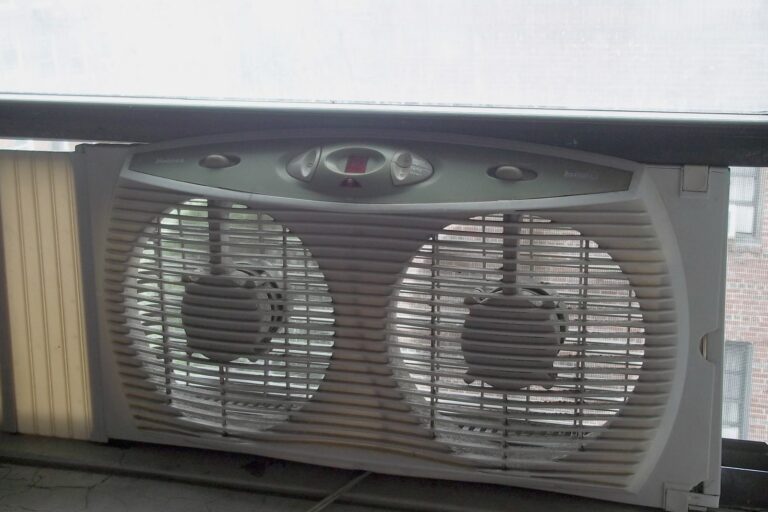
The Holmes HAWF2021-N is the classic answer to a narrow window. Its twin blades are only 6 inches each, and the maker’s manual rates this small window fan for double-hung windows with a minimum opening of 22 inches wide by 10 inches high — the lowest height requirement of any twin fan in this guide, which is exactly what short windows in older houses need. A built-in extender pulls out up to 7 inches on one side, with an additional slide-on panel for the other, covering roughly 22 to 33 inches of width. It also turns sideways: installed vertically, it suits slider windows around 10 inches wide and up to 36 inches tall, a trick no other small window fan here can match.
What you give up is modern convenience. There are only two speeds, the airflow reversal is a manual switch, and there is no remote or thermostat — this design has been sold in essentially the same form for years. The motors are water-resistant, a thoughtful touch for a fan that sits in a rainy-day window. Choose it when your window is short, narrow or a slider, and you would rather have a fan that fits than a fan with features.
3. Shinic BP2-9AQ — Best with Remote Control
Most small window fans make you walk to the window for every adjustment. The Shinic BP2-9AQ is the compact exception: a twin 9-inch small window fan with three speeds, three operating modes (cool, exhaust and circulate) and a remote control, in a frame with expandable panels that fit windows from 24 to 37 inches. The kit is unusually complete for the tier — a removable bug screen, a fabric dust cover for the off-season, and foam sealing tape to close the gaps at the edges of the frame, which is where small window fans usually leak their performance away. It is ETL listed, and detachable legs allow freestanding use off the window.
The catch is in the first measurement: 24 inches is the minimum window width, so this small window fan suits small-to-medium windows, not the genuinely tiny openings the Holmes and the shutter panels below can handle. Shinic is also a younger brand than Holmes or Comfort Zone, so long-term parts support is less proven. Pick it when your window clears 24 inches and the fan will live somewhere awkward to reach — above a kitchen sink, high in a stairwell, or in a bedroom where a remote by the bed beats a dial across the room.
4. Nalle APB25-05HB — Best for the Smallest Openings
When the window is a small square — a basement hopper, a bathroom window, a greenhouse vent — even a 22-inch twin is simply too wide. The Nalle APB25-05HB is a single 10-inch fan in a square panel just 13.5 by 13.5 inches, and it fits openings no other pick here can touch. Despite the size, the maker rates it at 460 CFM on exhaust and 380 CFM on intake. Control is a pull cord with a two-way linkage: one pull runs it as an exhaust, a second pull reverses it to intake, and a third stops the fan and closes the louvers. The sleeve-bearing motor is rated for 9,000 hours of continuous work, and the 55-inch cord reaches an outlet without an extension lead.
Be clear about what this is: a ventilation fan, not a breeze machine. There is a single speed, no remote and no thermostat, and the pull-cord sequence takes a day to learn. It also needs a genuinely square opening around 13.5 inches — measure the frame, not the glass, before ordering. For pulling steam out of a small bathroom or heat out of a greenhouse through the smallest window in the house, no other small window fan in this guide fits the hole it fits.
5. SAILFLO SF-25DK — Best Budget Shutter Fan
The SAILFLO SF-25DK takes the same square-panel idea as the Nalle and trims the cost and the cutout. It is a single 10-inch shutter fan that needs an opening of about 11.6 by 11.6 inches — the smallest hole of any pick here — and runs a 35-watt motor with reversible airflow, rated at 470 CFM in the listing’s product details. The gravity shutters close when the fan stops, which keeps drafts, rain and insects from treating the opening as an open door, and the wall-or-window mounting suits utility spaces where a fan may stay installed year-round: laundry rooms, workshops, garages, small kitchens.
The compromises are control and refinement. Expect basic switching rather than remotes or thermostats, and a shutter fan’s airflow is about exchanging a room’s air, not delivering a directed breeze to a bed or desk. Installation is also more committed than a sash-held twin — you are fitting a panel into an opening, sometimes with basic tools. At a budget-friendly tier, though, it is the cheapest honest way to ventilate a small room whose window defeats every frame-style small window fan.
6. iLiving ILG8SF10VC — Best Ventilation Power
The iLiving ILG8SF10VC is what to buy when a small opening still has a big ventilation job. It is a 10-inch shutter exhaust fan rated at 820 CFM — more raw air movement than fans twice its size in this guide — with variable speed control and a wireless remote that carries a thermostat and humidity sensor, so the fan can run itself when a bathroom steams up or a room crosses a temperature you set. The maker rates its coverage at up to 1,200 square feet, and the automatic shutters seal the opening when it is off.
That power comes with the shutter-fan caveats in stronger form. This is an exhaust specialist: it pulls air out rather than blowing a cooling breeze at you, and at full speed it will be audible — 820 CFM through a 10-inch fan is not a whisper. It sits in the premium tier of this guide. Choose it for the jobs small window fans usually fail at: a bathroom that never dries out, a hobby room with fumes, or a greenhouse vent where the thermostat control earns its keep.
Best Picks by Category
- Small bedrooms: Comfort Zone CZ12817 — the narrowest mainstream twin frame, three speeds and a bug screen included.
- Narrow and short windows: Holmes HAWF2021-N — 6-inch blades and a 10-inch minimum opening height, plus a vertical slider install.
- Remote control: Shinic BP2-9AQ — remote, three modes and foam sealing tape, if your window clears 24 inches.
- Smallest square openings: Nalle APB25-05HB — a 13.5-inch square panel with reversible intake and exhaust.
- Budget ventilation: SAILFLO SF-25DK — an 11.6-inch cutout and a 35-watt motor at a budget-friendly tier.
- Maximum exhaust: iLiving ILG8SF10VC — 820 CFM with thermostat and humidity control in a 10-inch shutter fan.
The pattern to notice: the smaller the window, the more the guide shifts from breeze fans to ventilation fans. Compact twins cool a person; shutter panels exchange a room’s air. Pick the job first and the size second.
How to Choose the Best Small Window Fan
Measure the opening, not the glass
Every failed small window fan purchase starts with a wrong measurement. Measure the inside of the window frame — the width the fan frame must span and the height the sash can open — not the visible glass. Compact twins publish a fit range (here, roughly 22 to 37 inches depending on the model); shutter panels publish a cutout or panel size (11.6 to 13.5 inches square in this guide). If your opening falls below a fan’s minimum, no amount of forcing will seal it, and an unsealed small window fan leaks most of its air around the edges.
Compact twin or shutter panel?
These are two different tools sharing a name. A compact twin — the most familiar small window fan format — sits in a raised sash, seals with side panels, and blows air at the room: it cools people and can be removed in seconds. A shutter panel fan is a single fan in a square housing that mounts in a small opening, with louvers that close when it stops: it ventilates rooms, especially damp or smelly ones, but does not aim a breeze at anyone. Bedrooms usually want twins; bathrooms, basements and utility rooms usually want shutters.
Window width and height minimums
Width gets the attention, but height is the quiet disqualifier: a twin-style small window fan needs the sash to open at least as high as the fan housing, which is why the Holmes pick’s 10-inch minimum height matters for short windows. Sliders flip the problem — the opening is tall and narrow — so look for a small window fan that installs vertically, like the Holmes, or a square shutter panel that ignores the sash entirely. Casement windows that crank outward rarely accept any frame fan; a shutter panel or a different ventilation route is the honest answer there.
Reversible airflow and why it matters
A fan that only blows inward is half a tool. Reversing to exhaust lets you push out cooking smells, bathroom steam and hot ceiling air, then switch back to intake for cool evening air. Every pick in this guide reverses — manually on the Comfort Zone and Holmes, by mode on the Shinic, by pull cord on the Nalle, and by design on the shutter fans. Treat reversibility as a requirement rather than a bonus; our guide to the best reversible window fans goes deeper on how the different mechanisms work.
Airflow, speeds and noise
Small window fans publish smaller numbers, and that is fine: a 10-inch shutter fan rated around 460–820 CFM can fully exchange the air in a small bathroom or bedroom many times an hour, which is the ventilation math that matters. For breeze cooling, speed settings matter more than a CFM figure measured who-knows-how — prefer three speeds over two if the fan will run at night, because the lowest setting is the one you sleep to. Makers rarely publish honest noise figures for small window fans, so treat any decibel claim you cannot find on the maker’s own page with suspicion.
Sealing, screens and upkeep
A small window fan lives in the weather. Look for a removable bug screen (standard on the twin picks here), foam tape or a tight expander fit to stop air bypassing the fan, and shutters that close fully on panel fans. Water-resistant motors are worth having in an exposed window. Once a month in season, wipe the blades and screen — dust loading is the main reason small window fans get louder and weaker over a summer — and store twin fans indoors over winter if the window needs to seal against the cold.
What to check before you buy a small window fan, and who should skip it
Before you buy a small window fan, measure the frame opening, confirm how the fan mounts and check what comes in the box. The wrong fit wastes most of the airflow, so a few minutes with a tape measure matter more than any feature list.
- Opening size: measure width and the height the sash can open, then compare them with the fan’s stated minimums.
- Window type: double-hung, slider and casement windows suit different fans, and casements rarely accept a frame fan at all.
- Mounting: shutter panels fit into a cutout, while twins rest in a raised sash.
- Included parts: look for a bug screen, expanders, foam sealing tape and feet.
- Controls: decide whether a dial, pull cord or remote suits where the fan will sit.
- Returns and warranty: read both on the listing, and keep the box until you know the fan seals properly.
Now the honest objections. Small window fans move less air than full-size twins, and shutter panels ventilate rather than blow a breeze. Most have basic controls, and none replaces air conditioning in a heat wave. Sash-held fans also leave gaps in cold weather, so plan to remove them in winter.
Who should skip it: if your window is standard width and you want maximum airflow, a full-size twin may serve you better. If you need real cooling on very hot days, a small window fan will only help at the margins.
Which small window fan should you buy?
The best small window fan is the one that fits your opening and does the job you have in mind. Use the picks above and match them to your window.
- A small bedroom or office window: choose the Comfort Zone CZ12817, a compact twin with a bug screen included.
- A short, narrow window or a slider: choose the Holmes HAWF2021-N, whose 6-inch blades and vertical install option fit awkward openings.
- A remote for a hard-to-reach window: choose the Shinic BP2-9AQ, provided the window clears its minimum width.
- The smallest square opening or a bathroom: choose the Nalle APB25-05HB, a single shutter panel.
- Budget ventilation for a utility window: choose the SAILFLO SF-25DK, which needs the smallest cutout here.
- Strong exhaust for steam or fumes: choose the iLiving ILG8SF10VC, which adds thermostat and humidity control.
If you are unsure, decide the job first. A fan for sleeping comfort points toward a twin, and a fan for damp air points toward a shutter panel.
Compare the picks above, check the current listing for fit and what is included, then choose the fan that suits your window and how you will use it.
How the Six Small Window Fans Differ in Daily Use
The six picks in this guide fall into two families that behave very differently once installed, and understanding that split will save you from the most common disappointment in this category. The twin fans — the Comfort Zone CZ12817, the Holmes HAWF2021-N, and the Shinic BP2-9AQ — are breeze and exchange machines for rooms you live in. They sit in a bedroom, office, or kitchen window, move air in both directions, and are judged by comfort: how the airflow feels, how the speeds suit different times of day, and how much noise you are willing to trade for cooling. The shutter panels — the Nalle APB25-05HB, the SAILFLO SF-25DK, and the iLiving ILG8SF10VC — are ventilation machines for rooms you want to clear: bathrooms, basements, workshops, greenhouses, and utility spaces. They are judged by extraction, weather closure, and how completely their louvers shut when the fan stops.
Within the twins, the differences are about fit and control. The Comfort Zone is the balanced default for a small standard window, with three speeds and manual reversal. The Holmes gives up a speed and modern controls in exchange for the most forgiving fit in the group, including short openings and a vertical installation for sliders that no other pick here can manage. The Shinic asks for a wider window than the other twins but repays you with a remote, multiple modes, and a sealing kit that treats the edges of the installation seriously. If reaching the fan is easy and the window is modest, the Comfort Zone is hard to argue with. If reaching the fan means climbing over a sink or stretching across a desk every evening, the Shinic’s remote stops being a luxury and becomes the reason the fan actually gets used properly.
Within the shutter panels, the differences are about opening size and duty. The Nalle and the SAILFLO both use a single fan in a square panel, but they ask for different cutouts and suit different budgets and workloads, while the iLiving is the heavy-duty option for spaces that need serious, regular extraction rather than occasional freshening. A shutter fan that runs for twenty minutes after a shower has an easy life; a fan expected to clear cooking steam, workshop dust, or greenhouse heat for hours at a time should be chosen with that workload in mind, and that is where the iLiving earns its place despite being more machine than a small bathroom strictly needs.
Intake, exhaust, and the two-fan trick
Reversible airflow is the feature that separates a window fan from a simple extractor, and it deserves more thought than most buyers give it. On intake, a fan pulls cooler outside air into the room, which works best in the evening and overnight when the outside temperature has dropped. On exhaust, it pushes warm, stale, or humid air out, which works best during the day in a sun-heated room, or immediately after a shower or a cooking session. Neither direction is universally better; the skill is matching direction to the hour and the job, and a fan that reverses easily, whether by dial, switch, cord, or remote, will be used in both directions far more often.
If your home has two suitable windows, a pair of fans working together — one on intake, one on exhaust, ideally on opposite sides of the space — creates a through-draft that a single fan cannot match. That does not mean buying two of these picks blindly. It means recognising that placement is half of performance: a fan exhausting from a high window while cooler air enters low on the shaded side of the building will change a room’s comfort far more than raw power in the wrong window. Even with one fan, opening a door or an interior window to give the air somewhere to come from or go to makes a visible difference to how effective it feels.
Noise, sleep, and honest expectations
Small fans move less air than full-size models, and they should be bought with that expectation set. A small window fan can make a bedroom comfortable on a warm night, take the edge off a stuffy office, and clear a bathroom’s steam, but it is not air conditioning and it will not cool a room below the outside temperature on intake. Its real power is air exchange and movement: moving air feels cooler on skin, and replacing stale indoor air with evening air changes how a room sleeps. Judged on those terms, the picks here perform well. Judged as silent refrigerators, every fan ever made would disappoint.
For bedrooms, the lowest useful speed matters more than the highest. A fan that is pleasant on its lowest setting will be left on all night; a fan that is only effective when loud will be switched off at two in the morning. Consider where the fan sits relative to the bed, whether vibration through an old window frame adds a hum of its own, and whether a remote, as on the Shinic, would let you adjust speed without getting up. In workspaces and bathrooms, noise matters less and extraction matters more, which is another reason the shutter panels suit those rooms so well.
Fitting, Sealing, and Electrical Safety at Concept Level
Fit is the whole category, so measure the opening itself — frame to frame, at several points, because older frames are rarely perfectly square — and compare those numbers with the maker’s stated minimums and ranges rather than with the size in a product headline. Check height as carefully as width, especially for the Holmes, whose low height requirement is its main advantage, and for shutter panels, where the cutout or opening must match the square panel closely enough for the louvers and frame to seat properly. If your measurements fall between two picks, choose the one whose stated range contains your window comfortably rather than at its extreme edge.
Sealing is the unglamorous half of performance. Gaps around a fan let air short-circuit: instead of drawing air across the room, the fan pulls it through the crack beside its own frame. Use the expanders, panels, screens, and sealing materials supplied with the fan, keep the insect screen fitted where one is provided, and check that curtains, blinds, or window locks do not foul the unit. A well-sealed modest fan will outperform a stronger fan rattling in a loose opening, and it will keep out insects and driven rain far better too.
On electrical safety, stay at the concept level and follow the maker’s instructions for the specific model. A window fan lives in a damp, weather-exposed opening, so the outlet, cord routing, and any protection the instructions call for matter. Route cords so they are not pinched by the window, trapped under the frame, or stretched across a walkway, and never modify a cord or plug to make an installation fit. If the outlet situation near the window is doubtful, or an installation would need permanent wiring or changes to the building, stop and use a qualified electrician rather than improvising. Switch the fan off and unplug it before cleaning, adjusting panels, or removing it for the season, and do not leave a fan running unattended in a storm if the maker advises against use in rain.
Care through the season and storage after it
Window fans ingest dust, pollen, and kitchen grease, and performance falls quietly as blades and screens clog. Wipe blades and housings with the power off, wash or brush screens where the maker allows it, and check shutter louvers for the grime that stops them closing fully, because a louver that no longer seals lets in winter drafts and insects. At the end of the season, clean the fan before storage, use a cover where one is supplied, as with the Shinic, and store the unit dry and flat so panels and expanders are not bent out of shape. A fan stored dirty in a damp basement starts the next summer smelling of the last one.
Common Mistakes With Small Window Fans
The first mistake is measuring the glass instead of the opening, and it accounts for most returns in this category. The second is buying airflow when the real problem is fit: a powerful fan that cannot sit securely in your window moves no air at all. The third is sealing nothing, then blaming the fan for weak performance that is actually air leaking around its frame. The fourth is installing a twin breeze fan where the job is really extraction, or a single-speed shutter fan where the job is all-night bedroom comfort; matching family to job, as described above, prevents both errors.
A fifth mistake is forgetting the off-season. A fan left loosely installed through winter is a draft, a security weak point, and an invitation to insects. Decide before you buy whether the unit will be removed and stored, or whether its closure, as with a shutter panel, is good enough for the climate and the room. That decision alone often settles the choice between a twin and a panel for marginal windows.
A short decision checklist
Measure the opening twice, note whether the window is double-hung, sliding, or a small square vent, and decide the primary job: comfort, extraction, or both. Choose the Comfort Zone for a balanced small bedroom window, the Holmes for the shortest, narrowest, or vertical slider fits, the Shinic when the window is wide enough and remote control will decide whether the fan gets used, the Nalle for a small square opening needing reversible ventilation, the SAILFLO for the smallest cutout on a budget, and the iLiving when extraction duty is heavy and regular. Confirm the electrical arrangement near the window is sound, plan the sealing and the off-season storage, and the fan you choose will fit the hole, the room, and the job.
Worked Examples: Matching These Fans to Real Rooms
A small bedroom that stays stuffy until midnight
The classic case for this guide is a modest bedroom whose window is too small for a full-size twin fan and whose occupant sleeps badly in still air. If the window sits in the range the Comfort Zone CZ12817 covers, it is the natural fit: intake on the lowest comfortable speed through the evening, drawing in air as the outside temperature falls, with the option to reverse to exhaust on a day when the room has baked in the sun. If the same bedroom’s window is short or a slider, the Holmes takes over, and its vertical installation turns a window that seemed unusable into the room’s ventilation. If the bed is far from the window and the sleeper hates getting up to adjust a dial, the Shinic’s remote earns its place, provided the window clears its wider minimum. The room decides among three good answers, and the deciding facts are measurements and habits, not headline power.
A steamy bathroom and a damp basement
Extraction rooms reward the shutter family. A small bathroom window that fits the Nalle’s square panel gains a fan that exhausts steam at the source, reverses when fresh air is wanted, and closes its louvers when idle, which matters in a room that must stay secure and weather-tight. A tighter utility opening points to the SAILFLO and its smaller cutout, accepting a budget build for a space where the job is occasional airing rather than constant duty. A basement, workshop, or greenhouse with persistent damp or heat is the iLiving’s territory: regular, heavier extraction that clears a space rather than merely freshening it. In each case, run the fan long enough after the steam or work session ends to actually dry the room, because switching off the moment the shower ends leaves most of the moisture behind, whatever the fan’s capacity.
A kitchen window above a sink
Kitchens combine heat, steam, cooking smells, and the worst access in the house, since the window usually sits behind a sink. That access problem is why remote control and easy reversal matter more in a kitchen than anywhere else, and why a fan that will be adjusted without a stretch and a splash gets used properly while a marginally stronger fan with an awkward dial gets left on one setting all summer. Kitchens also coat fans in grease faster than any other room, so the cleaning routine in the care section above is not optional here; a kitchen window fan should be wiped down whenever the hob area is degreased, or its performance and its smell will decline together. Choose for reach and cleanability first in this room, and let raw extraction come second.
Across all three examples the pattern repeats: measure the opening, name the job, consider who operates the fan and how often, and only then compare models. Buyers who reverse that order — choosing a model, then discovering the window, the job, or the operator does not suit it — are the ones writing disappointed accounts of fans that were, in truth, simply misassigned. The six picks here cover an unusually wide range of small openings between them, so a careful match exists for almost every small window; the work is in the matching.
Seasonal Strategy: Using a Small Window Fan Well Across the Year
A window fan’s year has distinct seasons, and planning for them gets more from a modest fan than a stronger fan used carelessly. In spring, the job is airing: short exhaust runs that clear a winter’s staleness from bedrooms, bathrooms, and basements, and a first check that panels, expanders, and louvers survived storage. In high summer, the strategy shifts to timing — exhaust during the heat of the day where that helps, intake in the evening and overnight when outside air turns kind, and the through-draft arrangements described earlier when two openings allow them. In autumn, fans earn their keep against damp: bathrooms and basements grow mould fastest in the season when windows stay shut and heating begins, and regular extraction runs in those weeks prevent problems that dehumidifiers are later bought to cure.
Winter is the decision point covered earlier, but it deserves a household policy rather than an annual improvisation. Decide which fans come out and are stored, which shutter panels stay because their closure is sound, and check any fan that remains installed during the first cold spell, when a draft announces a poor seal more honestly than any inspection. Households in mild climates may run bathroom extraction all year and should simply fold the fan into the room’s routine, cleaning it more often because it never gets a rest. However your climate divides the year, the principle is constant: a fan matched to the season’s job, sealed properly, and cleaned on schedule will outperform a bigger fan ignored from one summer to the next.
One last check before you order
Before ordering, stand at the window with your measurements written down and rehearse the installation in your head: how the fan seats, how the expanders or panels meet the frame, where the cord falls, and how you will reach the controls on a dark night or over a sink. If any step of that rehearsal feels awkward, it will feel worse in practice, and another pick in this guide probably removes the awkwardness. A fan that fits your window, your room, and your habits the first time is worth more than a return, an exchange, and a second installation, so let the rehearsal have the final vote.
Finally, give a new fan a fair first week before judging it. Rooms take time to exchange their stale air for fresh habits, seals settle, and operators learn which direction and speed suit which hour. Judge the fan at the end of that week, at the times of day it was bought for, and most of these picks will have quietly become part of how the house breathes.
Frequently Asked Questions
What is the smallest window a window fan can fit?
For a frame-style small window fan, about 22 inches wide and 10 inches of sash opening is the practical floor — the Holmes HAWF2021-N in this guide is built to exactly that. Below that, switch formats: a square shutter panel like the SAILFLO fits an opening of roughly 11.6 inches, and the Nalle needs about 13.5 inches square. Measure the frame opening before assuming any small window fan fits.
Can a small window fan cool a whole room?
It can cool a small room honestly and a large room only partially. A compact small window fan moves enough air to make a bedroom feel several degrees more comfortable, especially pulling in cool night air, and a shutter fan can fully exchange a small room’s air many times per hour. Neither replaces air conditioning in a heat wave; small window fans shine in mild weather, at night, and in rooms where an AC unit cannot be installed.
Will a window fan work in a sliding window?
Yes, with the right model. Some small window fans install vertically in a slider track — the Holmes in this guide is rated for sliders around 10 inches wide and up to 36 inches tall. Square shutter panels also work well in sliders, since they fill a measured opening rather than spanning the track. Standard horizontal twins, by contrast, usually will not seal in a slider.
Is a shutter exhaust fan the same as a window fan?
They overlap but are not identical. A shutter fan is a single fan in a square panel with louvers that close when it stops; it is primarily for ventilation — removing steam, odors and stale air. A twin window fan is primarily for comfort airflow into the room. If you want a breeze on the bed, buy the twin; if you want a dry bathroom, buy the shutter.
How much power do small window fans use?
Very little. The shutter fans in this guide run around 35 watts, and compact small window fans are in the same modest class — running one all evening costs a fraction of what even a small air conditioner draws in an hour. Exact draw varies by speed setting, so check the listing’s wattage for the model you choose.
Can I leave a small window fan installed in winter?
Shutter fans are designed to stay: their louvers close and limit drafts, though they never seal like glass. Sash-held small window fans are better removed in winter, because the raised sash and side panels leak cold air; most lift out in under a minute and store flat. If a fan must stay in a cold-climate window, seal around it with foam tape and cover it from the inside.
How do I measure a window for a window fan?
Measure the inside width of the frame and the height the sash can open, not the visible glass. Compare both numbers with the fan's stated minimums. For shutter panels, measure the opening to see whether it matches the panel size.
Which way should a window fan face to cool a room?
Face it inward at night when the air outside is cooler than the air inside. Face it outward to push hot or stale air out during the day. Opening another window across the room helps air flow through.
Can a small window fan be used in a bathroom?
Yes, a shutter-style fan set to exhaust is a common choice for steam. Keep cords and controls away from water and follow the maker's instructions. A fan with a humidity sensor can run itself when needed.
Do small window fans keep bugs out?
A removable bug screen helps, and the compact twins in this guide include one. Gaps around the frame can still let insects in, so use foam tape or a snug expander fit. Shutter louvers close when the fan stops.
Are small window fans noisy?
Noise varies by model and speed, and makers rarely publish reliable figures. Lower speeds are usually quieter, which matters at night. Fans with higher airflow ratings tend to be louder at full speed.
Should I use a window fan when it rains?
Only if the model is designed for it and the opening is protected from direct rain. Some motors are water-resistant, but electrical parts should not get wet. Check the manual and remove the fan if heavy rain is forecast.
Bottom Line
For most shoppers, the best small window fan is the Comfort Zone CZ12817: it is the narrowest easy fit, reverses, and costs budget-tier money. If your window is shorter or narrower than standard — or a slider — the Holmes HAWF2021-N and its 6-inch blades are the pick, while the Shinic BP2-9AQ adds a remote for windows at least 24 inches wide. When the opening is a small square, skip frames entirely: the Nalle and SAILFLO shutter panels fit holes no twin can, and the iLiving ILG8SF10VC adds thermostat-controlled 820 CFM exhaust for damp or fume-filled rooms. Measure your frame opening first, check the current price, and if your window turns out to be standard width after all, compare these small window fans against the models in our best dual window fans guide before you decide.