Disclosure: As an Amazon Associate, UMT Smart Tool earns from qualifying purchases. This guide is built from product listings and maker specifications, not from our own hands-on testing. Prices are approximate and can change, so check the current price before you buy. Last updated: November 11, 2026.
The best large window fans solve a problem smaller fans cannot: moving enough air to change the temperature of a big room, an open-plan living space or a workshop. “Large” splits two ways. Shutter exhaust fans with 16- to 24-inch blades mount in a wide window opening or a framed wall cutout and push out thousands of cubic feet per minute. Wide twin fans are the other family — they sit in a standard double-hung window and exchange air more gently. This guide is organized by mounting style and airflow, so start with the opening you actually have. If reversibility matters more than raw power, our guide to the best reversible window fans covers the intake-and-exhaust specialists.
In this guide
Quick Picks
The short version: six of the best large window fans we would look at first, from the most powerful shutter fan to the one true sash-window pick.
| Pick | Type | Best for |
|---|---|---|
| AC Infinity AIRLIFT T20 | 20-inch smart shutter exhaust fan | Maximum airflow for big rooms and workshops |
| AC Infinity AIRLIFT T16 | 16-inch smart shutter exhaust fan | App control and efficient EC-motor running |
| iLiving ILG8SF24V | 24-inch shutter exhaust fan | Extra-large openings, barns and garages |
| Lasko W09560 | Twin 9-inch sash window fan | Real double-hung windows and air exchange |
| iLiving ILG8SF16VC | 16-inch remote-control shutter fan | Automatic thermostat and humidity control |
| VEVOR 16-Inch Shutter Exhaust Fan | 16-inch steel shutter exhaust fan | High airflow on a budget |
Our Picks
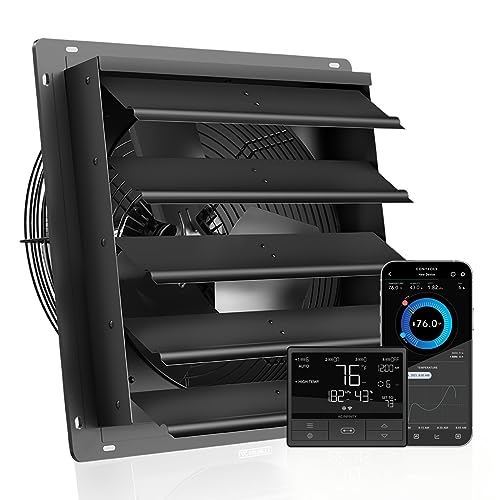
1. AC Infinity AIRLIFT T20 — Best Overall
The AIRLIFT T20 is the most powerful fan here that still belongs in a home. Its 20-inch blade is rated by AC Infinity at 3,425 CFM, driven by an EC motor with PWM control, and it comes with the brand’s WiFi temperature and humidity controller: you set temperature and humidity triggers, timers and schedules in the app, and the fan ramps itself up and down instead of running flat out. Steel shutters and aluminum blades carry an IP44 rating against dust and splashing water, which suits garages, workshops, greenhouses and large living spaces that cook in the afternoon sun.
The trade-offs are size and appetite. At up to 230 watts this is a ventilation appliance, not a bedroom fan, and the frame needs a properly sized opening — measure before you order, because a 20-inch shutter fan does not squeeze into a standard sash window. AC Infinity rates it at 65 dBA at full speed, which is conversation-level noise you will notice. For a big room or workspace that needs real air changes per hour, though, nothing else on this list moves as much air with this much control.

2. AC Infinity AIRLIFT T16 — Best Smart Controls
Step down one size and the AIRLIFT T16 keeps almost everything that makes the T20 appealing. The 16-inch version is rated at 2,560 CFM from a 100-watt EC motor — strong output for its draw — and it uses the same WiFi temperature and humidity controller, so the fan can react to a hot, humid room on its own. The unit measures about 19 inches square overall, a far easier fit in a wide window opening or a framed cutout than its bigger brother, and the build is the same steel-shutter, aluminum-blade, IP44-rated formula.
At a rated 70 dBA on its top setting it is not quiet, and like all shutter fans it is exhaust-only: it pulls air out, so a room needs an open door or window elsewhere to feed it. Buyers who want intake as well as exhaust should look at the Lasko twin below instead. But for set-and-forget ventilation of a large bedroom, studio or workshop — scheduled, triggered by heat or humidity, and efficient at part speed — the T16 is the smartest large fan here.


3. iLiving ILG8SF24V — Best Extra-Large
When the opening is genuinely huge, the ILG8SF24V is the pick. iLiving rates this 24-inch shutter fan at 4,244 CFM — the highest figure in this guide — and markets it for coverage up to 6,200 square feet, which in practice means barns, big garages, workshops and commercial-style spaces rather than living rooms. It uses a speed-controllable, permanently lubricated motor, corrosion-resistant aluminum shutters, and it is UL 705 listed. The fan family carries a 1-year limited component warranty.
Be ready for a project. A 24-inch fan needs the largest framed opening here, the motor is single-purpose exhaust, and iLiving does not include a power cord with this model, so wiring or a cord kit is part of the install. It also lacks the smart controllers of the AC Infinity and 16VC picks — control means an external switch or speed controller. What you get in return is simple, industrial-scale airflow at a mid-range tier for its size. If a 16-inch fan would leave your space under-ventilated, this is the honest step up.
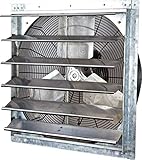
4. Lasko W09560 — Best for Double-Hung Windows
The W09560 is the one pick that installs the way most people picture a window fan: it sits in a double-hung window — Lasko specifies windows 24 to 32 inches wide with at least a 12-inch opening height — and the sash closes onto it, no cutout and no framing. Each of its twin 9-inch fans has its own electrically reversible motor, so you can run both on intake, both on exhaust, or one of each to exchange a room’s air. Bluetooth control through the Lasko Connect app, a digital thermostat and an 8-hour timer round it out, and it is ETL listed with Lasko’s Blue Plug safety fuse.
Manage expectations on power: Lasko does not publish a CFM figure for this fan, and twin 9-inch blades will never match a 16- or 20-inch shutter fan for bulk air movement. What it offers instead is balance — fresh air in and stale air out of an ordinary bedroom or living room, with the window still usable as a window. For renters and anyone who cannot cut an opening, it is the only realistic “large” option here, and the app control makes it easy to run overnight.

5. iLiving ILG8SF16VC — Best with Remote Climate Control
The ILG8SF16VC takes a different route to automatic ventilation: instead of an app, iLiving bundles a wireless smart remote with a built-in thermostat and humidistat, plus a timer and variable speed control. The 16-inch fan is rated at 1,280 CFM and 1,550 RPM from a 1/20 HP, 0.85-amp motor, and iLiving positions it for spaces up to about 1,800 square feet — attics, garages and large utility rooms. Automatic aluminum shutters seal the opening when the fan stops, and the fan is UL listed.
Its raw airflow is the lowest of the shutter fans here, so it suits steady, automatic air exchange more than rapid cool-downs; a big workshop that needs to dump heat fast should take the T16 or T20. The remote’s long stated range is genuinely useful in tall garages and attics where the fan sits out of reach. For buyers who want climate-triggered ventilation without apps, accounts or WiFi, this is the most hands-off large fan on the list.


6. VEVOR 16-Inch Shutter Exhaust Fan — Best Budget
VEVOR’s 16-inch shutter fan (model HA-400M-110) is the value play: its Amazon product information rates it at 2,000 CFM — more than the iLiving 16VC — from a 1,450 RPM AC motor in a galvanized steel housing with automatic louvers. The frame measures about 18.9 inches square, it is FCC listed, and the steel build shrugs off the dust and knocks of garages, barns and greenhouses better than plastic housings do. At a budget-friendly tier for a fan this size, the airflow-per-dollar is hard to beat.
The savings show in the controls and finish. There is no smart controller, thermostat or app — speed control is basic, and you supply the switching. Steel also means it is heavier to mount and worth a quick check for shipping dents on arrival. None of that matters much in a workshop or greenhouse that just needs a lot of hot air moved out every day. As a first large exhaust fan, or a second fan for a big space, it earns its place.

Best Picks by Category
- Most powerful: AC Infinity AIRLIFT T20 — 3,425 CFM from a 20-inch EC-motor shutter fan with WiFi climate control.
- Smart controls: AC Infinity AIRLIFT T16 — 2,560 CFM, app-based temperature and humidity triggers in a 16-inch frame.
- Extra-large openings: iLiving ILG8SF24V — a 24-inch fan rated at 4,244 CFM for barns, garages and workshops.
- Double-hung windows: Lasko W09560 — twin reversible motors, Bluetooth app and thermostat, no cutout needed.
- Remote climate control: iLiving ILG8SF16VC — wireless remote with thermostat, humidistat and timer at 1,280 CFM.
- Budget: VEVOR 16-Inch Shutter Exhaust Fan — 2,000 CFM in a galvanized steel housing at a budget-friendly tier.
Notice the pattern: past about 1,500 CFM, the best large window fans are chosen by installation style as much as by fan. Sash-window units top out early; real airflow for large spaces comes from shutter fans and the framed opening they need.
How to Choose the Best Large Window Fans
First, pick a family: sash fan or shutter fan
Twin fans like the Lasko W09560 install in minutes in a double-hung window and can push air in or out, but two 9-inch blades move limited air. Shutter exhaust fans — everything else here — mount in a wide window opening or a framed wall cutout and only exhaust, but a single 16- to 24-inch blade moves several times the air. Decide which family your window and your landlord allow before comparing CFM figures. If your windows are small, start from the other end with our guide to the best small window fans.
Measure the opening, not the glass
For shutter fans, the number that matters is the framed opening the housing drops into, not the blade diameter: a “16-inch” fan typically needs an opening a little over 17 inches square, and the 24-inch iLiving needs roughly 25 inches or more. Check the maker’s dimension chart for your exact model, and confirm there is structure to screw into. For sash fans, measure width between the jambs and how high the sash opens — the W09560, for example, needs 24 to 32 inches of width and at least 12 inches of opening height.
Match CFM to the room
CFM is the one spec worth comparing across brands, and every CFM figure in this guide comes from the maker. A rough ventilation target is one full air change every 10 to 20 minutes for living spaces, faster for workshops and garages: multiply room length × width × ceiling height to get volume, then multiply by 3 to 6 air changes per hour and divide by 60 for the CFM you need. On that math, a 400-square-foot room with 9-foot ceilings wants roughly 180 to 360 CFM for gentle background exchange — and several times that to feel a real cool-down, which is why large fans start around 1,200 CFM.
Motors and controls: EC versus AC, dumb versus smart
EC motors (both AC Infinity picks) cost more but sip power at part speed and pair naturally with electronic controllers that vary speed smoothly. Traditional AC motors (VEVOR, iLiving) are simpler and cheaper, with speed control that is coarser. Controls decide how the fan fits your routine: a thermostat or humidity trigger suits attics and greenhouses, an app suits a living space you manage from the sofa, and a plain switch is fine for a workshop fan you run while you work.
Plan for noise honestly
Big fans are not quiet fans. Makers’ own ratings here run from 65 to 70 dBA at full speed for the AC Infinity pair — around vacuum-cleaner territory — and shutter louvers add their own rattle if they are loose. In bedrooms, that argues for the twin fan or for running a large fan hard in the evening and turning it down overnight; variable-speed models earn their keep here, because a big fan at half speed is far quieter than a small fan at full speed moving the same air.
Sealing, shutters and weather
An exhaust fan is a hole in your building envelope. Automatic shutters that close when the fan stops — fitted to every shutter pick here — keep out rain, drafts and pests, and IP44-rated housings like the AC Infinity pair tolerate splashing and dust. In cold climates, plan a way to insulate or remove the unit for winter, and never run an exhaust fan in a sealed house with a fuel-burning water heater or furnace, which can backdraft; a large exhaust needs a makeup-air path.
Which large window fan should you buy?
The best large window fan is the one that fits your opening and your control preferences, so start from the space and work toward the model. Here is how the six picks map to common needs.
- Biggest room or workshop with smart control: go for the AC Infinity AIRLIFT T20, which is the most powerful pick with app-based temperature and humidity triggers.
- Smart control in a smaller frame: choose the AC Infinity AIRLIFT T16, which keeps the same controller in a 16-inch housing that is easier to fit.
- Barns, big garages and very large openings: the iLiving ILG8SF24V is the extra-large pick, but plan for wiring and a framed opening.
- Renters and standard double-hung windows: the Lasko W09560 installs in the sash with no cutout and can run intake and exhaust.
- Automatic ventilation without apps or WiFi: the iLiving ILG8SF16VC uses a wireless remote with thermostat and humidistat.
- High airflow at a budget-friendly tier: the VEVOR 16-Inch Shutter Exhaust Fan has basic controls and a steel housing.
If you are unsure, decide the mounting family first, then the control style, and only then compare airflow. A fan that does not fit the opening is the most common mistake, whatever its rating.
What to check before you buy, and who should skip a large fan
Before ordering a large window fan, run through this checklist against the listing and the maker’s manual.
- Measure the framed opening or the sash width and opening height, and compare them with the maker’s dimension chart.
- Confirm what is included: power cord, mounting hardware, controller or remote.
- Check the electrical requirement and whether you need a switch or speed controller.
- Plan a makeup-air path, such as an open door or window, so the fan has air to pull.
- Read the warranty and return terms on the listing.
- Decide how you will close or insulate the opening in cold weather.
The trade-offs are real. Large shutter fans are loud at full speed, need a proper opening and only exhaust, while the twin sash fan is gentler but moves far less air. Smart models cost more than basic ones, and basic ones leave the switching to you.
You may want to skip a large shutter fan if you rent and cannot modify a window, if your room is small, or if you sleep in a very quiet bedroom. A smaller fan may suit you better in those cases. Compare the picks above, check the current listing for size and what is included, then choose the one that fits how you will use it.
A Closer Look: Who Each Large Window Fan Really Suits
Large window fans split into two families that behave very differently in a home: sash fans that sit in a double-hung window, and shutter exhaust fans that move serious air through a louvered opening. The six picks here cover both, plus smart controls and a budget option. This section matches each fan to the room and the job it genuinely suits, so you buy airflow where you need it rather than a specification you cannot use.
AC Infinity AIRLIFT T20: the balanced whole-room exhaust choice
Choose the AIRLIFT T20 if you want the most rounded large shutter fan for a living space, workshop or large bedroom where stale, warm air needs a reliable exit. It suits homeowners who will install once and then expect the fan to manage itself day to day. Its strength is balance rather than a single extreme: substantial airflow, a shutter that closes when the fan rests, and controls that suit regular use. Skip it if your only available opening is a standard double-hung sash window with no scope to fit a shutter unit; that is a different family’s job. For a permanent, set-and-forget exhaust point in a larger room, this is the default recommendation for a reason.
AC Infinity AIRLIFT T16: for smart, scheduled ventilation
The AIRLIFT T16 suits buyers who want ventilation to respond on its own: schedules, temperature triggers and app-style control rather than walking to the fan. It fits homes where the fan serves a room that overheats predictably, such as a sun-facing room, a home gym or a workspace with equipment, and where nobody wants to babysit settings. The smaller size also suits openings that cannot take the largest units. The honest limitation is that smart control adds complexity you must be willing to set up once and keep connected; if you prefer a single knob and no configuration, the simpler picks will frustrate you less. Buy it for the automation, not just the airflow.
iLiving ILG8SF24V: for the biggest air-moving jobs
Choose the iLiving 24-inch pick when the space is genuinely large or the air problem is genuinely stubborn: a big workshop, a garage that doubles as a work area, a greenhouse-adjacent space, or a large open room where smaller fans have felt decorative. Extra-large shutter fans exist to change the air in a space, not to stir it, and this pick is for people who need that change to happen quickly. Accept the practical costs: a large unit needs a large, suitable opening, secure mounting, and respect for its noise at full speed. In a modest bedroom it would be excess in every direction. Matched to a big space, though, undersizing is the real mistake, and this pick prevents it.
Lasko W09560: for standard double-hung windows
The Lasko pick suits renters and homeowners whose windows are ordinary double-hung sashes and who want meaningful airflow without construction. It is the accessible route into large window fans: fit it in the window, seal the sides as the main guide describes, and you have intake or exhaust without cutting or framing. That makes it ideal for bedrooms and living rooms in homes where permanent alteration is off the table. Its limitations follow from its family: sash fans move less air than large shutter exhaust units and depend on a good seal to work efficiently. If your need is heavy exhaust from a workshop, look to the shutter picks; if your need is comfortable air movement in a normal room, this is the practical answer.
iLiving ILG8SF16VC: for remote climate control in mid-size spaces
Choose the iLiving 16-inch remote-control pick if you want shutter-fan exhaust with climate-responsive control but do not need the largest opening. It suits rooms where the fan will sit out of easy reach, since remote adjustment stops the fan being left on the wrong setting simply because changing it is awkward. It also suits anyone who wants the fan to react to temperature without adopting a full smart-home setup. The trade-off is the middle position itself: it will not match the biggest pick’s air volume, and it asks for a shutter-style installation rather than a simple sash fit. For a mid-size room that needs real exhaust plus convenience, that middle is exactly the right place to be.
VEVOR 16-Inch Shutter Exhaust Fan: the budget route to real exhaust
The VEVOR pick suits buyers who need genuine shutter exhaust, for a utility space, a workshop, a laundry area or a first ventilation project, and who want to keep the outlay in the budget tier. It answers the most important question correctly: it is a real exhaust fan with shutters, not a small circulator pretending to ventilate. Its limitations are the budget tier’s usual ones, in finish, refinement of controls and how much polish you should expect in daily operation. For a space where function leads and nobody is sleeping beside it, those are fair trades. For a main living room where the fan is seen and heard constantly, the more refined picks justify themselves.
Head-to-Head: Choosing Between the Fans on This Page
The decisive comparison is family, not brand. Sash fans, represented here by the Lasko pick, install in the window you already have, suit finished living spaces, and emphasize comfortable air movement and reversibility. Shutter fans, the other five picks, need a suitable framed opening, move substantially more air in exhaust, and suit spaces where changing the air matters more than a gentle breeze. Choosing a shutter fan for a bedroom that only needed air movement buys noise and installation effort you did not need; choosing a sash fan for a workshop that needs fumes and heat removed buys disappointment. Decide the family from the job first, then choose within it.
Within the shutter family, size and control divide the picks. The 24-inch iLiving is for maximum volume in large spaces, the T20 is the balanced large choice, the 16-inch picks trade some volume for easier fitting and lower cost, and the T16 adds smart scheduling while the iLiving 16-inch adds remote climate control. Controls deserve honest thought: a fan whose settings match the room’s daily rhythm will be used correctly, while a fan that needs manual attention at the wrong moments will be left off. If your overheating is predictable, automation is a functional feature, not a luxury. If your need is occasional and hands-on, simple controls serve just as well.
Noise completes the comparison. Larger fans moving more air make more sound at full speed, and shutter mechanisms add their own character when opening and closing. In utility spaces that hardly matters; in bedrooms and living rooms it matters a great deal, and the main guide’s advice to plan for noise honestly applies. A slightly smaller fan you can run comfortably at a moderate setting often ventilates a lived-in room better in practice than a larger fan that everyone turns off because it intrudes.
Buying Criteria, Deepened
Exhaust only works with a source of replacement air
An exhaust fan cannot remove air that cannot be replaced. For any of the shutter picks to work well, the room or building needs a path for fresh air to enter, typically an open window or door elsewhere, ideally positioned so air sweeps across the occupied zone before leaving. Without that path, even a powerful fan strains and underdelivers, and doors can pull shut with surprising force. Plan the intake side as deliberately as the fan itself: which window opens, how far, and whether that route is practical at night or in poor weather. Ventilation is a circuit, and the fan is only one component of it.
Mounting security is part of performance
A large fan vibrates, and vibration punishes loose mounting with noise, wear and, in the worst case, a unit working itself insecure. Fit shutter fans to solid framing as the main guide directs, confirm the opening is square so shutters can move freely, and check fixings after the first period of regular use, when everything has settled. For sash fans, a snug fit and proper side sealing stop both air leaks and rattling. None of this is glamorous, but a securely mounted fan is quieter, more effective and safer than the same fan fitted casually, and the difference is audible from the first evening.
Electrical planning at a general level
At a concept level, every fan here needs a suitable, properly rated power supply within sensible reach, a circuit that is not already loaded with other heavy demands, and cords or connections kept away from water and from the fan’s moving parts. If an installation would need new fixed wiring, altered circuits or anything beyond plugging a listed appliance into an appropriate existing outlet, that work belongs to a qualified electrician, full stop. Keep the same discipline in use: never run a fan with a damaged cord, never defeat a shutter or guard to improve airflow, and switch off and unplug before cleaning. Those basics, respected consistently, are what keep a ventilation upgrade a comfort rather than a hazard.
Living With a Large Window Fan: Use and Upkeep
Daily use works best as a rhythm. Use exhaust during the hottest part of the day or whenever cooking, equipment or occupancy loads the air, and use intake during cooler hours to draw fresh air through the home, opening the far windows that complete the circuit. In shoulder seasons, shorter, deliberate runs often beat leaving a fan on indefinitely, since the goal is air exchange rather than constant motion. Pay attention to what the fan is exhausting near: avoid pulling air from a garage with running vehicles or from any space where combustion appliances could be affected, and ask a qualified professional if your home’s heating setup raises any doubt at all.
Upkeep is simple but not optional. With the fan switched off and unplugged, wipe blades and guards free of the dust that steadily reduces airflow and adds noise, check that shutters open and close freely without obstruction, and confirm guards are secure before restarting. Outdoor-facing parts collect weather residue, so a seasonal clean and a check of seals and fixings keep performance honest. A fan that suddenly sounds different, vibrates more or moves less air is telling you something has changed; investigate promptly rather than turning the speed up to compensate.
Common Mistakes When Buying a Large Window Fan
The most common mistake is measuring the glass instead of the opening, which the main guide warns against and which still ruins more purchases than any other error. The second is buying maximum airflow for a room that needed comfort, then living with noise. The third is forgetting the intake path, so the new fan underperforms through no fault of its own. The fourth is treating a shutter fan like a sash fan and expecting a temporary fit to behave like a framed installation. The fifth is neglecting weather: an opening that ventilates beautifully in summer needs a shutter and sealing plan that respects rain and cold, or the fan becomes a seasonal liability instead of a year-round asset.
More Questions Worth Asking
Should I run intake or exhaust for sleeping comfort?
For most bedrooms, gentle intake of cooler night air, or exhaust that pulls that air across the room from a far window, feels better than a powerful direct exhaust beside the bed. What matters is that air moves through the occupied zone without the fan’s full noise at close range. If your fan is in the bedroom itself, a moderate setting run consistently usually beats a high setting run briefly. If the fan is elsewhere in the home, exhaust placement can pull night air through the bedroom without the fan being in it at all, which is often the quietest arrangement.
How do I know if my fan is actually exchanging the air?
Simple signs tell the story: cooking smells clear noticeably faster, a warm room’s temperature edges toward the outdoor temperature during intake hours, and a light tissue held near the intake opening shows a clear inward pull. If none of that happens, check the circuit first, meaning an open intake path, then the seals around the fan, then whether dust or a stuck shutter is throttling the unit. Most disappointing installations fail on airflow paths and sealing rather than on the fan’s rated power.
Can a large window fan replace other cooling entirely?
In mild climates and well-shaded homes, a good fan strategy can carry much of the cooling load, especially overnight. In hot, humid climates it is better understood as a powerful partner: it excels at removing accumulated heat and bringing in cooler air when outdoor conditions allow, but it cannot dehumidify or cool air below the outdoor temperature. Setting that expectation honestly is what makes owners satisfied; a fan bought as ventilation delights, while the same fan bought as a substitute for every other system can disappoint through no fault of its own.
What should I check before the first hot week of the year?
Run the fan before you need it: confirm it starts cleanly, shutters move freely, guards are secure, seals are intact, and the intake windows you rely on open as planned. Clean dust from blades and guards while the unit is off and unplugged, and check fixings for any winter loosening. That short rehearsal, done on a mild day, prevents the classic first-hot-night discovery that something is stuck, loose or blocked, and it reminds everyone in the house how the ventilation circuit is meant to be used.
Putting the Fan to Work: Three Household Scenarios
In a hot upstairs bedroom, the winning arrangement is usually exhaust high and intake low and far: the fan removes the day’s accumulated warm air while a window on the cooler side of the home feeds replacement air across the sleeping zone. Run the exhaust before bedtime rather than only during it, so the room’s fabric and walls give up their stored warmth, then settle to a moderate overnight setting. Households that pre-cool the room in this way consistently report that the fan feels more powerful than its rating, because it is being used as a system rather than as an appliance switched on in desperation at midnight.
In a workshop or garage, the priority reverses: the fan exists to remove, dust, fumes from finishing, heat from equipment, and stale air generally, and the intake path should be arranged so fresh air sweeps past the work area before leaving. That is the natural home of the largest shutter picks, run decisively during and shortly after work rather than gently all day. It is also the setting where the seasonal check matters most, since dust loads guards and blades faster there than anywhere else in the home, quietly taxing airflow until someone cleans them.
In a kitchen or combined living space, a large fan earns its place in short, purposeful bursts: clearing cooking heat and odors, then standing down. Here the sash and mid-size shutter picks often suit best, because the space must return to being a room people sit in, and noise discipline matters as much as air volume. Across all three scenarios the pattern is the same: decide what the air should do, arrange the intake to match, and let the fan work a plan. Owners who do that are satisfied with almost any pick on this page; owners who expect the fan alone to improvise a climate are disappointed by all of them.
Winterizing and the off-season
A large window fan needs an off-season decision, made before the first cold night rather than during it. For sash fans, removal and indoor storage is usually the cleanest answer, with the window restored to its full seal. For shutter fans that stay in place, confirm the shutters close fully, check seals for gaps that will leak heat all winter, and consider the insulated cover arrangements many owners use on the interior side. Whichever route you choose, clean the unit before it rests, since dust left for a season sets harder and smells stale at the first spring run. A fan that is put away properly starts the next warm season as an asset rather than a project.
A Final Word on Sizing Generously and Sealing Carefully
If this guide leaves you with two habits, let them be these. Size for the space’s worst day, not its average one, because a fan that can just cope on a mild evening has nothing in reserve for the still, hot night when it is truly needed, and a moderate setting on a capable fan is always pleasanter than a strained setting on a marginal one. And seal as if airflow depended on it, because it does: the gaps around any window fan are where performance quietly leaves the room, and an hour spent on side panels, shutters and fit returns more comfort than a larger motor fitted carelessly. With the family chosen correctly, the opening measured honestly, the intake path planned and the installation sealed and secure, any of the six picks here will do the job its description promises.
Frequently Asked Questions
What size window fan do I need for a large room?
Work from airflow, not blade size alone. For rooms up to about 400 square feet, a 16-inch shutter fan in the 1,200 to 2,500 CFM range is a sensible start; open-plan spaces, workshops and garages often need a 20- or 24-inch model, or two fans — one exhausting, one feeding air in. If the fan must sit in a standard double-hung window, a wide twin fan is the ceiling of what fits, whatever the room size.
Can a shutter exhaust fan be installed in a window?
Yes, if the window opening is wide and tall enough to frame the housing — common in garages, workshops and older homes with large windows. The fan needs a square, framed opening close to its housing size and solid material to screw into; it is not a drop-in fit for a typical bedroom double-hung window. Many owners build a plywood or lumber frame that sits in the window opening for the season. Check the maker’s dimension chart for your model before building anything.
Is 2,500 CFM too much for a house?
Not for a large, open space — but it must have somewhere to pull air from. A 2,500 CFM exhaust in a closed-up house will depressurize it, strain to move air, and can backdraft fuel-burning appliances. Open a window or door on the far side of the house so the fan draws a breeze through the rooms between. Variable-speed and EC-motor fans help here: you can run well below maximum most of the time.
Are large window fans loud?
At full speed, yes — the smart shutter fans here are maker-rated at 65 to 70 dBA, similar to a vacuum cleaner in the next room. At reduced speed they quiet down a lot, which is a practical argument for oversizing slightly and running slower. Twin sash fans like the Lasko are the gentler option for bedrooms, at the cost of far less airflow.
Can I leave a large window fan installed all year?
You can leave a shutter fan mounted, since its louvers close when it stops, but in cold weather the opening will leak heat around and through the unit. Many owners remove sash fans for winter and fit an insulated panel over shutter fans, or choose a spot — a garage or workshop window — where the small heat loss does not matter. IP44-rated housings handle weather exposure best.
What is the difference between a window fan and a whole-house fan?
A whole-house fan is a large ceiling-mounted unit, usually in a hallway, that pulls air through the whole home and pushes it into the attic; it needs attic venting and a bigger installation. The large window fans in this guide mount in a window or wall opening and ventilate the room or zone they are in. They are cheaper, removable, and sized for one big space rather than an entire house.
Do large window fans need a special electrical outlet?
Most plug-in models use a standard household outlet, but some hardwired or cord-free models need wiring. Check the listing for the electrical requirement. Ask an electrician if you are not sure.
Where should I place a window fan for the best cooling?
Put the exhaust fan in the hottest room or the highest opening, and open a window on the cool side of the home. This pulls air through the rooms in between. Running it in the evening and at night uses cooler outdoor air.
Can I run a shutter exhaust fan at night?
Yes, if the noise suits you and the fan has a lower speed setting. Variable-speed or app-controlled models let you run slowly while you sleep. Check the maker's noise rating before choosing one for a bedroom.
How do I stop a window fan from letting in rain?
Choose a model with shutters that close when the fan stops, and keep sash fans out of heavy rain. Housings with a dust and splash rating tolerate more weather. Always keep cords and controllers dry.
Is a thermostat on a window fan worth having?
It helps if you want hands-off ventilation, since the fan starts and stops by temperature. If you only run the fan while you work or sleep, a plain switch is enough. It is a convenience, not a necessity.
How do I clean a large window fan?
Switch it off and unplug it first. Wipe the blades and shutters with a damp cloth, and vacuum dust from the grille. Dust on the blades reduces airflow and adds noise, so a seasonal clean is worthwhile.
Bottom Line
For most large rooms and workshops, the best large window fans start with the AC Infinity AIRLIFT T20, our first recommendation — 3,425 CFM with proper climate-based control. The AIRLIFT T16 covers the same brief a size down, the iLiving ILG8SF24V handles genuinely huge openings, and the ILG8SF16VC automates a mid-size space by remote. Renters and standard double-hung windows are better served by the Lasko W09560, and the VEVOR 16-inch is the budget way into real airflow. If a louvered box style suits your window better, see our picks for the best box window fans. Measure your opening twice, and check the current price before you order.