Disclosure: As an Amazon Associate, umtsmarttool.com earns from qualifying purchases. Links on this page are affiliate links; they cost you nothing extra. Prices and availability change often, so check the current Amazon listing before you buy.
Any honest mila air purifier review has to start by admitting that Mila is not really selling the same product as the rest of this category. The other machines in our roundups sell airflow: a fan, a filter, a room made cleaner. Mila sells awareness — a dense array of sensors, an app that narrates your home’s air in unusual detail, and a family of swappable filter “personalities” tuned to different household anxieties — with airflow attached. That inversion is either the brand’s genius or its indulgence, depending on the buyer, and this review’s job is to work out which buyer is which. The current hardware centre of the range is the Mila Air Mini, a compact smart purifier sold with a choice of filter cartridges; the original full-size Mila established the concept and the sensor philosophy, and this review treats the line as a whole, because the concept — not any single cabinet — is what a Mila purchase actually buys into.
That framing matters for expectations. A buyer who wants the most clean air per unit of money, full stop, will find better arithmetic elsewhere in our best air purifiers survey, and this review will not pretend otherwise. A buyer who wants to know what is in their air — the particles, the gases, the humidity, the trends across weeks — and wants a machine that responds to that knowledge automatically and explains itself while doing so, is Mila’s intended reader, and for that reader the premium buys something genuinely scarce in this category: information with a fan attached. The review that follows assesses the hardware, the filter system, the app-centred ownership pattern and the costs, in that order, and closes with the decision stated as plainly as the brand’s own marketing never quite states it.
Key Takeaways
- Mila’s proposition is sensing first: multiple air-quality sensors and an unusually informative app, with purification as the response to what the sensors find.
- The current buyable hardware is the Mila Air Mini, sold with interchangeable filter cartridges tuned by household need — the “Overreactor” and “Critter Cuddler” among them.
- Filter choice is a real decision in this system, not a formality: the cartridges trade particle, gas and odour emphases differently.
- Ownership costs follow the premium position — cartridges and the connected ecosystem should be priced before purchase, not discovered after.
- Buyers who want maximum airflow per unit of money, or who will never open the app, should buy a conventional machine instead; this review names the best of those too.
In this guide
The Hardware: Mila Air Mini as the Range’s Current Form
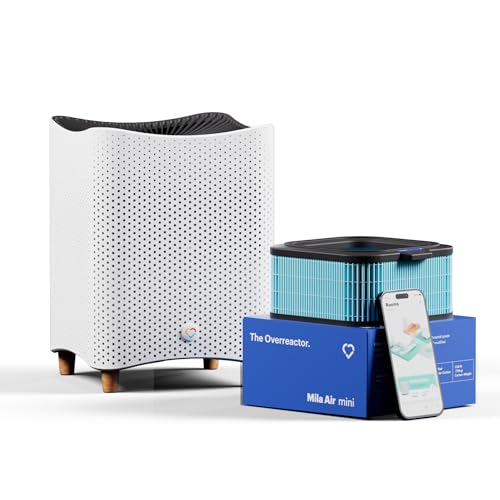
Mila Air Mini with Overreactor H14 HEPA Filter
The Mini carries the brand’s philosophy into a compact cabinet for bedrooms and smaller rooms: a sensor suite that watches particulate matter and a range of household air indicators, an automatic mode that answers what the sensors see, and the interchangeable cartridge system described below. The Overreactor configuration pairs the machine with the range’s most ambitious filter — an H14-grade HEPA element with heavy gas and VOC emphasis, aimed at households whose concern is chemical as much as particulate: new furniture, renovations, urban air, the freshly painted nursery. Check price on Amazon
- Filter: Overreactor cartridge — H14 HEPA with formaldehyde and VOC emphasis (manufacturer description)
- Coverage position: compact-room class; the Mini is the small-room member of the line
- Controls: app-led, with on-device basics; sensor-driven automatic mode
Strengths
- The most informative air-quality feedback in its class — data as a feature, not a garnish
- Automation that responds to a wider range of air events than particle-only rivals
- Filter personalities let the consumable match the household’s actual concern
Trade-offs
- Premium positioning in both machine and cartridges
- The value lives in the app; owners who ignore apps pay for a dashboard they never read
- Compact cabinet means compact-room territory, whatever the sensor suite’s ambitions
Best for: data-minded owners of bedrooms and nurseries who want to see their air, not just clean it. Not suited for: large rooms, or buyers measuring value purely in airflow per unit of money.

Mila Air Mini with Critter Cuddler Filter
The second configuration shows the cartridge system working as intended: the same machine, re-aimed at pet households with an H13 HEPA and carbon cartridge balanced for dander and animal odour. Nothing about the hardware changes; the consumable’s emphasis does, which is the entire Mila idea in one product pair. Check price on Amazon
- Strengths: pet-tuned carbon blend in the same smart cabinet; the sensor suite watches a pet room’s real events
- Trade-offs: pet households load any cartridge faster; the premium consumable rhythm should be budgeted honestly
Best for: pet owners in smaller rooms who want monitoring as well as cleaning. Not suited for: multi-pet large rooms, which need a bigger machine’s airflow first and sensors second.
The Sensor Suite and the App: Where the Premium Actually Lives
Most purifiers that sense anything sense one thing — particles — and display a coloured light as the whole of their report. Mila’s founding argument was that a home’s air story has more characters: particulate levels, volatile organic compounds from cooking, cleaning and materials, carbon dioxide from occupied closed rooms, humidity and temperature shaping how the rest behaves. The brand’s machines watch that wider cast and the app presents it as a continuing narrative — trends, events, a room’s biography across weeks. Owners who engage with it describe a genuinely different relationship with the appliance: the purifier becomes the house’s air instrument, and its cleaning becomes the response to evidence rather than an act of faith. Our scientific benefits of air purifiers explainer discusses what such monitoring can and cannot tell you, and it is required reading for anyone tempted to treat a sensor’s graph as a health verdict — the data describes air, not bodies, and the distinction matters.
The automation built on that sensing is the practical dividend. A machine that can see a cooking event, a cleaning event and a still, clean night as different situations can spend its effort where the evidence points, idling honestly between events. That is the same auto-mode argument made for simpler sensor machines elsewhere on this site, executed with a richer picture of the room. The costs of the richness are the connected appliance’s standing costs: an account, an app that must be maintained by the brand, a radio’s small standby appetite, and the long-horizon question every connected purchase should ask — what happens to the machine’s cleverness if the service behind it changes. Mila’s hardware retains on-device function, but a buyer is entitled to weigh the ecosystem’s youth against the decade-deep track records elsewhere in this category, and this review weighs it openly rather than waving it away.
There is also a subtler cost: attention. A machine that reports this much invites checking, and households differ in whether that invitation delights or burdens them. The data-minded owner reads the evening’s cooking spike with satisfaction; the peace-minded owner finds the graph one more glowing obligation. Neither is wrong, and the difference predicts satisfaction with Mila more reliably than any specification in this review. Buy the machine whose relationship with your attention you actually want.
The Filter Personalities: The Consumable as a Choice
Every other purifier in this category treats its filter as a replacement part; Mila treats it as a configuration. The cartridge family spans emphases — the Overreactor’s maximalist gas and particle specification, the Critter Cuddler’s pet balance, and siblings aimed at smoke, at basic allergen duty, and at the household that wants the gentlest running cost the line offers. The idea deserves the praise it gets: households’ air problems genuinely differ, and a consumable that can be re-aimed when a baby arrives, a dog is adopted or a renovation begins is a smarter ownership pattern than a single fixed blend. It also deserves the scrutiny this review applies to every consumable system: the cartridges are proprietary, the range of choice exists only inside the brand’s store, and the per-cartridge position is premium. A Mila owner’s five-year filter ledger should be written before purchase with the same care our how much does an air purifier cost guide demands for any machine — more care, if anything, because the temptation to experiment across personalities is itself a cost line no other brand imposes.
Practically, the choice at purchase should be made from the household’s dominant concern, stated in one sentence. Chemical sensitivity and new materials point at the Overreactor. Animals point at the Critter Cuddler. A general small-room brief points at the balanced options and saves the experimentation for the second cartridge, bought with a season of the app’s data in hand — which is, of course, exactly the ownership journey the brand designed: the sensors tell you what your air contains, and the filter family lets you answer it. Owners who complete that loop report the highest satisfaction in the line’s record; owners who buy a personality at random and never look at the data own an expensive ordinary purifier, and review it as one.
Performance, Expectations and the Compact-Room Boundary
Without laboratory claims, the performance assessment rests on the design’s characteristics: genuine HEPA-grade media in the cartridges, a sealed compact cabinet, and automation that keeps the machine working at the level the room’s evidence justifies. In a bedroom or nursery — the Mini’s territory — that combination delivers what owners consistently report: visibly slower dust accumulation, odour kept in check according to the cartridge chosen, and the particular reassurance of a display that can show the room’s state rather than merely assert it. The boundary is the one this site applies to every compact machine: the room must be small and closable, because no sensor suite, however brilliant, repeals the arithmetic of air changes per hour. A Mila Mini asked to serve an open-plan floor will produce beautiful graphs of its own inadequacy.
Noise follows the same honest pattern as its airflow: at the low and automatic levels where it spends a bedroom’s night, the machine is a quiet presence; at full response to an event, it sounds like a small machine working, because it is one. The health framing, stated once for the whole review: Mila’s sensors describe air, and its filters reduce the particle and gas load of a small room, which owners experience as comfort — cleaner-feeling air, better-kept rooms, data they trust. Nothing in the line diagnoses, treats or prevents any condition, and the app’s numbers should never be read as a body’s report. Households with medical questions about their air belong in a clinician’s office, with the machine — any machine — as a household complement. Readers who want the monitoring question explored for its own sake will find our air purifier comparison tool a useful companion for weighing sensor suites against each other.
The Conventional Alternative, Named Fairly

Levoit Core 400S — what the same money does conventionally
The comparison every Mila buyer should run: the Core 400S offers a larger room’s coverage, a particle sensor with auto mode, and a single-cartridge consumable at a mainstream position — less data, less filter theatre, more air. If the honest summary of your brief is “clean the living room and show me a number”, this is your machine, and the Mila premium is better kept. If your brief is “help me understand my home’s air and respond to it”, the Core’s number will feel like a headline where you wanted the article. Check price on Amazon
- Strengths: coverage headroom; AHAM-verified programme; simple consumable economics
- Trade-offs: particle-only sensing; no filter-personality system; the app informs less because there is less to inform about
Best for: buyers whose priority is air, with monitoring as a bonus. Not suited for: the data-led buyer Mila exists for. The wider conventional field is surveyed in best air purifiers for allergies and air purifiers for a baby’s nursery, the two briefs where Mila is most often cross-shopped.
How to Choose Within the Line, and How to Own It Well
Choose the room first — a bedroom, a nursery, a small study — and let the Mini’s compact territory confirm itself. Choose the cartridge from the household’s dominant sentence, as described above, and resist collecting personalities until the app’s first season of data argues for a change. Then own it the Mila way: glance at the trends weekly rather than hourly, let the automation work, clean the sensor area as the brand directs, and judge the machine quarterly by the room’s evidence — dust, smell, sleep — with the graphs as commentary rather than as verdict. Owners who run that pattern describe the line’s best self. Owners who chase daily numbers describe a machine that made them anxious, and the difference, unusually for this category, is not in the hardware at all.
Common Mistakes Mila Buyers Make
Buying the data and never reading it — the premium’s whole point, abandoned in the first month, leaving an ordinary compact purifier at an extraordinary position. Buying the Mini for a room beyond its territory, the sizing error in smart clothing. Choosing a filter personality from anxiety rather than from the household’s actual dominant concern, and then switching repeatedly, at premium cartridge prices, in search of a feeling. Reading the app’s air data as health data, against the distinction this review has drawn twice. And neglecting the ecosystem question at purchase — not because the answer should frighten anyone, but because a connected appliance bought without asking it is a decision made with one eye closed.
Final Recommendation
Mila earns a conditional recommendation of the clearest kind. For the data-minded owner of a small room — the parent who wants the nursery’s air narrated, the urban household watching its renovation’s chemistry settle, the pet owner who wants evidence rather than vibes — the line offers something no conventional rival in this review offers, and the Mini with the right cartridge is a genuinely distinctive appliance. For everyone else, the same money buys more air, simpler ownership and a longer track record elsewhere, and this review has named those machines without a flicker of reluctance. Know which buyer you are before the box arrives, and the Mila question answers itself.
The Original Mila and the Line’s Direction
A word for readers who met the brand through its original full-size machine. That unit established the sensor philosophy and the filter-personality system in a larger cabinet, and its owners’ experience remains the line’s foundation: the app, the data habits, the cartridge logic all carry into the Mini unchanged in spirit. What has shifted is the catalogue’s centre of gravity toward the compact form — the current listings through official channels are the Mini configurations — which tells its own story about where the concept fits best: the personal room, closely watched. Owners of the original should read this review’s consumable and ecosystem sections as applying to them directly, and should check their own cartridge’s continuing availability with the annual discipline our previous-generation guidance recommends for any connected or proprietary system.
As for the line’s direction, the honest reviewer notes what the evidence shows and no more: a brand investing in sensor breadth and filter variety rather than in raw airflow is betting that the category’s future is information. Whether that bet pays off across the market is beyond this review’s knowledge. What is within it is the observation that, for the households the bet describes, it has already paid off in the only currency reviews can certify — owners who use the machines as intended, and who would buy the concept again.
A Season With the Machine: What the Data Actually Changes
Abstract claims about information deserve a concrete test, so follow the line’s ideal household through its first season. A couple in a city flat, a newborn expected, a room freshly painted for the nursery. The Mila goes in a month early, Overreactor fitted, and the app’s first gift is a baseline: the flat’s ordinary signature, the cooking spikes from the kitchen two rooms away, the evening rise in carbon dioxide when the windows stay shut against the cold. The paint’s chemical evidence fades across a fortnight on the graph before it fades to the nose, and the machine’s owner watches it fade — which changes behaviour in a way no silent purifier can: the room is not declared ready by a date or by optimism, but by a trend the household can see levelling toward the flat’s own baseline.
Then the baby arrives, and the data’s second act is quieter. The household learns its nursery’s night signature — the machine idling low, the occasional stir of activity when a parent enters, the humidity line teaching them that the room runs dry in heating season and that a small humidifier, placed across the room from the sensor so the two appliances do not argue, steadies it. None of this is medicine. All of it is the particular comfort of a watched room, and it is what the owners, asked later, say they paid for. Set against it, the season’s costs stand plainly in the same account: the premium cartridge consumed by a renovation’s chemistry in half its ordinary span, the app’s notifications silenced twice and re-enabled once, the standing awareness that the machine’s cleverness is rented from a young company’s continuity. That household renews its cartridge without hesitation. The household in the next paragraph would not.
The counter-household is a rental flatshare across the same city: four adults, one living room, a machine bought by the most anxious of them and placed, over objections, in the shared space. The room is beyond the Mini’s territory, the app is one person’s hobby and three people’s glowing irrelevance, and the cartridge — chosen for a chemical concern nobody else shares — is resented at its first replacement by the only person willing to pay for it. Within a year the machine is the anxious owner’s bedroom purifier, where, in a small closable room with an engaged owner, it promptly becomes excellent. The two stories are the review in miniature: same machine, opposite verdicts, and the difference was never the hardware. It was the match between a data-led appliance and the household asked to live with it.
The Gas Question, Examined Carefully
Because Mila’s pitch leans on gases and VOCs, the topic deserves the careful treatment this site gives every health-adjacent claim. Volatile organic compounds are a real and varied family — emitted by paints, furnishings, cleaning products, cooking and people — and activated carbon, in sufficient quantity, genuinely adsorbs many of them; the Overreactor’s emphasis on carbon weight and on formaldehyde-oriented media is a legitimate engineering response, not a slogan. Three cautions keep the discussion honest. First, carbon saturates, and a gas-focused cartridge in a gas-heavy home is a consumable on a shorter clock than its particle rating suggests — the app’s picture helps an owner see the load, but the cartridge still pays for it. Second, ventilation remains the primary answer to indoor gases and to carbon dioxide, which no filter removes; a sensor that shows a household its CO2 climbing is, at its most useful, a prompt to open a window, and the machine’s own literature is at its best when it says so. Third, no reading on a consumer sensor is a health measurement, and no cartridge is a treatment; the households that benefit most from Mila’s gas story are the ones who treat it as building information — what is in this room, from what source, trending which way — and act on sources and ventilation first, filtration second.
That ordering — source, ventilation, filtration — is the professional hierarchy for indoor air, and a review that respects its readers states it even when it complicates a product’s pitch. To Mila’s credit, its concept fits the hierarchy better than most: a machine that shows you the source’s signature is a machine that can send you to fix the source. The purifier that merely cleans, silently, lets a household filter a problem for years that a weekend of source control would have ended. If the line has a lasting contribution to the category, it may be that — the normalisation of looking at the air before spending on it.
Where Mila Sits in the Wider Category
The category has three philosophies, and placing Mila among them clarifies every comparison in this review. The airflow school — Winix, the Honeywell tradition, much of Levoit — treats the purifier as a pump with a filter and competes on clean air delivered, quietly, per unit of money and per cartridge. The design school treats it as furniture and competes on presence. Mila founded a third school — the instrument school — competing on knowledge, with the pump attached. Schools are not ranks. A household with a smoke problem needs the airflow school’s biggest honest pump; a household with a new-build chemical question and a data habit is genuinely better served by the instrument. The reviewer’s recurring frustration with Mila coverage elsewhere is the category error of grading an instrument as a pump — and the equal and opposite error, which this review has avoided by naming the Core 400S fairly, of grading a pump as though its silence about the air were a failure of character rather than a difference of purpose.
For the undecided, the schools suggest a decision procedure. Write down what you will do with the machine weekly. If the sentence contains the words “check”, “watch” or “understand”, you are the instrument school’s reader and Mila is your candidate. If it contains “forget”, “ignore” or “just clean”, buy the pump, buy it well, and let this review’s conventional alternatives compete for you. Appliances fail households most often at the level of philosophy, long before they fail at the level of parts.
Buying Checklist for the Line
One: confirm the room — small, closable, personally occupied — because the Mini’s territory is the purchase’s foundation. Two: state the household’s dominant air concern in one sentence and buy the cartridge that answers it, resisting the full personality wardrobe until data argues otherwise. Three: price the second cartridge at the moment of the first, and write the pair down together; in this line more than any other, the consumable is a continuing subscription to a philosophy, and it should be consented to as one. Four: decide the attention question honestly — who in the household will read the app, and how often — and let that person’s genuine enthusiasm, or its absence, cast the deciding vote. Five: on arrival, place the machine by the placement rules every purifier obeys, give it a week to draw the room’s baseline portrait, and judge it at the week’s end by the room’s evidence and the graph together. Households that buy this way report the line’s best self with a consistency that suggests the checklist, like the machine, works when it is used as designed.
Maintenance: Caring for an Instrument, Not Just a Fan
Ownership of a sensor-led machine adds one discipline to the purifier’s standard liturgy: the sensors themselves are instruments, and instruments drift, foul and ask for care. Dust settles on sensor inlets as it settles everywhere in a machine whose job is dust; the brand’s guidance for gentle cleaning of the sensor area should join the monthly exterior vacuum in the household’s rhythm, because a fouled sensor does not merely misreport — on an automatic machine it misdirects, spending the fan’s effort and the cartridge’s life against a picture of the room that exists only inside a dirty lens. Owners of conventional auto-mode machines will recognise the principle from our Levoit air purifier problems guide; Mila’s richer suite simply multiplies the surfaces that deserve the habit.
The rest of the rhythm is the category’s own. Judge cartridges by evidence — the app, helpfully, supplies more of it than any rival: a filter whose room no longer settles after events as it once did is telling its age in data before it tells it in noise. Keep one spare cartridge of the household’s chosen personality, not one of each. Wipe the cabinet, mind the placement as furniture drifts, and once a year re-ask the ecosystem question with fresh eyes: is the app still maintained, the cartridge still listed, the brand still answering? A connected machine deserves an annual review of its connections, and five minutes spent on it is the cheapest insurance in this review.
Mila and Pets: The Critter Cuddler Proposition Tested in Prose
Pet households are the cartridge system’s most natural audience after nurseries, because their air problem is genuinely double — dander’s particles and the animal’s odour — and the two halves age a filter on different clocks. A conventional combined cartridge forces the household to retire both halves together; Mila’s answer is a cartridge whose balance is struck for the pair from the start, plus sensors that can show the household what the animal actually contributes: the plume when the dog shakes, the litter tray’s signature at its hour, the difference a closed bedroom door makes to a cat-free sleeping room. Owners who use that picture act on it — the tray moves, the door discipline forms, the grooming moves outdoors — and the cartridge, relieved of the sources the household fixed, lives the longer life the data bought it. That is the instrument school’s whole argument, working in a pet household exactly as designed.
The cautions are the standing ones, sharpened. Multi-animal, large-room households need airflow first; no cartridge personality rescues an undersized cabinet, and the Mini’s territory is the boundary this review keeps drawing. And the premium consumable in a heavy-load home is a real recurring line, to be budgeted from the Critter Cuddler’s actual rhythm in your house — which the app, to give the system its due, will measure for you more honestly than any review can.
When a Mila Misbehaves: A Short Troubleshooting Grammar
The line’s problems divide by its architecture. Sensor-side problems announce themselves as implausible data — a room reported dirty at 3 a.m. in a still house, a gas reading that never settles, an auto mode that hunts. The grammar of response is the instrument’s grammar: clean the sensor area as directed, relocate the machine away from the sources that fool sensors — steam, ultrasonic humidifier mist, a candle’s permanent plume — and give the machine a day to draw a fresh baseline before judging it. A sensor that remains implausible after cleaning and relocation is a support conversation, and the app’s own history is the evidence to attach: one advantage of a data-led machine is that it documents its own symptoms better than any owner’s memory.
Air-side problems are the category’s universal ones wearing this brand’s clothes: airflow down and tone up as a cartridge loads, odour breakthrough as carbon saturates, a machine working against a room beyond its size. The responses are the universal responses — vacuum the exterior, reseat the cartridge, run the room test with the door closed — with one Mila refinement: consult the trend before the parts. If the data shows the room’s events growing rather than the machine’s response shrinking, the problem is a new source in the house, and the purifier has just earned its premium by telling you so. Connectivity problems, finally, are the connected appliance’s ordinary weather: treat them as a router-side project, run the machine on its local controls meanwhile, and never let a Wi-Fi argument convict the air cleaner underneath it.
This Review’s Method, Stated Plainly
No laboratory testing by this site underlies these judgements, and no hands-on claims are made. The assessment rests on the line’s documented design — its sensor architecture, its cartridge system, its current official listings, which centre on the Air Mini configurations reviewed above — and on the ownership patterns a connected, data-led appliance predictably produces, checked against the category’s wider record across this site’s reviews. Where the article describes the original full-size machine’s position in the current catalogue, it says what the listings show and no more. Readers who weight instrumented measurement above design analysis should weight this review accordingly: it is a review of what Mila is like to own and whom that ownership suits, which is the question its buyers actually face.
Second-Hand Mila and the Account Question
Used examples of connected appliances carry a question conventional machines never raise: the account. A Mila changing households should arrive unbound from its previous owner’s ecosystem, factory-reset according to the brand’s procedure, and ready to pair fresh — and a buyer should perform that pairing in the seller’s presence, because a machine that cannot be adopted is a machine whose distinctive value cannot be transferred with it. Price any used unit as hardware plus an immediate fresh cartridge, as with every purifier in these reviews, and add the ecosystem check to the usual motor and cabinet tests. A used Mila that passes all three is a rational way to buy the instrument school’s experience at a gentler position; one that fails the pairing test is a compact purifier of ordinary ability wearing a premium’s biography, and should be priced as exactly that.
The same logic, reversed, flatters the seller: a Mila handed on cleanly — reset, freshly filtered, its app history cleared — is a complete gift or a complete sale in a way few connected appliances manage. The line’s owners who plan to upgrade within the ecosystem should keep that handover in mind from the first cartridge; connected machines accumulate their owners, and the tidy ones are worth more for it.
The One-Paragraph Version, for the Reader Deciding Tonight
If you want to know your home’s air — really know it, in trends and events and chemical signatures — and you have a small room that is truly yours, buy the Mini with the cartridge your household’s one-sentence concern selects, and join the owners this review calls the line’s best self. If you want a room cleaned, full stop, buy the Core 400S or one of the conventional machines named here and spend the difference on the second cartridge you will need by spring. Both decisions are good ones. The only bad one is buying the first machine for the second reason, or the second for the first — and it is made, every week, by buyers who never asked which buyer they were. You have now asked. Decide accordingly, and the Mila question, unusually for this category, stays decided.
It stays decided because the machine’s terms do not change after purchase: the app will still be there to be read or ignored, the cartridge will still arrive at its premium position on its evidence-driven schedule, the room will still be the size it was. Buyers who chose with their eyes open describe a rare thing in this category — an appliance whose ownership matches its brochure. Buyers who chose against their own nature describe the same appliance as a disappointment, and both are telling the truth. The whole of this long review is, in the end, an attempt to make sure you are in the first group before the box is opened rather than in the second group after.
If a single sentence must carry the verdict to a reader with no time for the rest, let it be this one: Mila is the purifier for people who read the manual, check the graph and enjoy knowing — and for them, in a small room, there is currently nothing else quite like it on the market, and the gap between it and the conventional field is a matter of philosophy rather than of quality, which is precisely why the choice deserves the care this review has spent on it.
Mila in the Rental, the Studio and the Shared House
Three common living situations test the concept in instructive ways. The renter, forbidden from modifying anything and gone within two years, is better served by Mila than by almost any rival philosophy: the machine installs nothing, marks nothing, and its data answers the renter’s characteristic question — is this flat’s air odd, or is it me? — with evidence a landlord conversation can actually use. The studio dweller asks one small room to be kitchen, bedroom and office, and the Mini, honestly sized for it, becomes the room’s air diary across all three lives; the cartridge will age at the kitchen’s pace, and the app will show exactly that bargain being struck, which is more honesty than a silent machine offers a studio. The shared house is the hard case, already met in this review’s counter-household: one engaged owner can carry the concept for a house, but only if the machine lives in that owner’s room. Place it communally and the data becomes one person’s sermon. The pattern across all three is the review’s refrain — the instrument school rewards the personally occupied, closable room and the owner who reads. Situations that supply both get the line’s best; situations that supply neither get an expensive fan, and no review can repeal that arithmetic.
What a Mila Cannot Tell You
A final discipline, because the line’s admirers and its critics both blur it. The sensors cannot tell you whether your air is safe — safety is a judgement involving specific substances, concentrations, exposures and bodies, and it belongs to standards, instruments and professionals, not to a consumer dashboard. They cannot identify a mould problem’s source, a gas leak’s location, or a symptom’s cause; they can show that something changed, in a room, at a time, which is frequently the clue that sends a household to the right professional with the right question. They cannot substitute for the alarms — smoke and carbon monoxide detection are separate, life-safety systems with their own devices, and no purifier’s sensor suite should ever be treated as standing in for them. Stating these limits in a favourable review is not hedging; it is the condition of the favourable parts meaning anything. Mila’s data is genuinely useful inside its fence. This section is the fence, and readers who respect it will get the line’s full value without ever asking it for what it cannot give.
The Gift Test: Who Should Receive One, and Who Should Not
Connected appliances are gifted constantly and regretted at a rate the industry does not publish, so the test is worth printing. A Mila makes an excellent gift for exactly one recipient: the person who has expressed, in your hearing, a wish to understand their home’s air — the new parent researching nurseries, the friend mid-renovation, the sibling who bought a standalone air monitor and actually opens its app. For that recipient the machine is a wish granted with a fan attached. For everyone else — the parent who finds dashboards a burden, the partner whose technology opinions are a closed book, the housewarming where the hosts’ taste is unknown — the same box is an obligation dressed as a present, and the conventional machines named in this review, or no machine at all, are the kinder gifts. The line’s whole philosophy is consent to information; gifting it without that consent misunderstands the product at the moment of purchase. Ask, or infer honestly, and the gift question answers itself as cleanly as the buying question did.
A Closing Note on Novelty
Reviews of distinctive products carry a professional hazard: the distinctive thing is interesting to write about, and interest can inflate a verdict. This review has tried to charge itself rent for that hazard by returning, at every stage, to the unglamorous questions — room size, cartridge cost, the owner’s actual habits, the ecosystem’s youth — and by naming the conventional alternative at full strength rather than as a straw man. What survives that discipline is a narrower and more durable claim than novelty usually earns: there exists a real household, described precisely in these pages, for whom Mila’s way of doing this is not a gimmick but the correct tool, and that household will know itself by the description. Everyone else has been given equally precise directions to the machines that serve them better. A review can do no more, and for a product this polarising, it should not try to do less.
One More Household: The Allergy-Season Pragmatist
Between the data devotee and the set-and-forget buyer sits a third figure worth naming, because the line serves them better than either camp expects: the seasonal pragmatist, whose interest in air data is intense for eight weeks a year and dormant for the rest. For them the Mila’s year divides honestly — pollen season with the app open daily, the machine’s events watched and answered, the cartridge’s sacrifice itemised in graphs; then the long off-season at automatic idle, the premium already justified by the season it carried. Judged across the whole year their cost per engaged week is high and their satisfaction is higher, because the machine met them at the exact intensity of their need. Reviews that average such owners into an annual figure miss the point of them. If you recognise yourself in the seasonal figure — fierce in spring, indifferent in autumn — the line’s proposition survives the averaging that sinks it for others, and the Mini, with a balanced cartridge swapped for a seasonally chosen one, may be the most precisely fitted purifier in this entire cluster of reviews.
Frequently Asked Questions
What makes Mila different from other air purifiers?
Sensing breadth and the filter system built on it. Where most machines watch particles alone, Mila’s line watches a wider cast of household air indicators — particles, gases, carbon dioxide, humidity — and reports them through an unusually detailed app, while its interchangeable cartridges let owners aim the filtration at their dominant concern: gases and VOCs, pets, smoke or general duty. The purification itself is genuine HEPA-grade work in a compact cabinet; the difference is everything wrapped around it.
Which Mila filter should I choose?
From your household’s dominant concern, stated plainly. New materials, renovations or chemical sensitivity point to the Overreactor’s H14 and gas emphasis. Pets point to the Critter Cuddler’s dander-and-odour balance. A general small-room brief is best served by the balanced cartridges, with experimentation deferred until a season of the app’s data suggests a change. Choosing by anxiety rather than by evidence is the commonest way Mila owners overspend.
Is the Mila Air Mini big enough for a living room?
For a small, closable living room, borderline; for an open-plan space, no. The Mini is the line’s compact member, and its territory is bedrooms, nurseries and small studies, where its airflow can turn the room’s air over at a meaningful rate. Sensor sophistication does not change that arithmetic. Larger rooms should take a conventional large-room machine — several are compared elsewhere in this review — and households wanting Mila’s monitoring in a big space should understand they are buying the data first and supplementing airflow expectations accordingly.
Does the Mila Mini work without the app?
The machine’s core function — filtration with on-device control — does not depend on the app, and a household can run it locally if it prefers. What the app carries is the line’s distinctive layer: the detailed air picture, the history, the remote view and the finer control. Running a Mila permanently without it is possible but self-defeating, rather like buying a telescope for its tripod; buyers who know in advance that the app will go unused should take this review’s conventional recommendation and save the premium.
Is a Mila worth it over a Levoit or Winix?
It depends entirely on whether you will use the information. If the app’s picture of your air will change your behaviour — ventilation habits, cartridge choice, room use — the Mila buys something the conventional machines do not sell, and the premium is defensible. If the machine will be set to auto and forgotten, the conventional machines deliver more air and simpler ownership for the same commitment, and they are this review’s recommendation for you. The worst Mila purchase is the one made for data that is never read.

