Disclosure: As an Amazon Associate, umtsmarttool.com earns from qualifying purchases. Links on this page are affiliate links; they cost you nothing extra. Prices and availability change often, so check the current Amazon listing before you buy.
This desk footrest buying guide starts with a simple observation: most people buy a footrest for the wrong reason and in the wrong order. They feel vaguely uncomfortable at their desk, they see a soft-looking cushion in a product photo, and they order it before asking the questions that actually decide whether a footrest will help: How high do your feet need to be? Do you want to rest still or keep moving? How much space is really under your desk once your chair, your legs, and the inevitable tangle of cables are counted? A desk footrest is one of the simplest pieces of home office gear you can buy, but simple does not mean one-size-fits-all. The right one disappears into your day. The wrong one becomes a foam wedge you kick into the corner within a week. This guide walks through the types, the criteria that matter, and a short list of proven designs, so you can match a footrest to your chair, your desk, and your habits instead of to a photograph.
Key Takeaways
- A desk footrest exists to do one job: give your feet a supported, comfortable place to rest so your sitting posture feels settled instead of perched. Everything else — rocking, texture, adjustability — is a variation on that job.
- Height is the single most important decision. If your chair sits high enough that your feet dangle or only your toes reach the floor, you need meaningful lift. If your feet already rest flat, you need only a gentle rise or a surface to move against.
- Foam cushions feel welcoming and suit still sitters. Rigid adjustable platforms suit people who want a precise, repeatable angle. Rocking designs suit restless sitters who concentrate better when their feet can move.
- Measure your under-desk space before you buy. Depth front to back is the dimension people most often get wrong, and a footrest that crowds your shins will be pushed aside no matter how good it is.
- Firmness is a preference, not a quality ranking. Soft memory foam and firm platforms both have loyal users; the honest test is whether your feet feel supported at the end of a long afternoon, not the first minute.
- Every pick in this guide is a real, widely sold design presented in prose, so you can compare the ideas first and check the current listing second.
If you want the short version before the detail: work out whether you need lift, gentle support, or movement; pick the type that matches; then choose the sturdiest, simplest model in your tier that does that job well. The rest of this guide expands that sentence into a complete decision. If you are still deciding whether the category is for you at all, read is a desk footrest worth it first, and if you want the balanced downside list, see desk footrest pros and cons.
In this guide
What a Desk Footrest Does and the Main Types
Start with the problem a footrest actually solves. A desk chair is usually adjusted for the desk: you set the seat height so your arms sit comfortably at keyboard level, and then your feet have to live with whatever distance remains between the seat and the floor. For many people that distance is wrong. Their feet dangle, or rest on their toes, or press into the floor at an angle that never quite feels settled. Over a long workday that unsettled feeling matters — not as a medical issue, but as plain comfort. Many people find that when their feet have a stable, slightly raised surface to rest on, the whole sitting position feels calmer: weight feels more evenly shared, the temptation to tuck feet under the chair or sit on one leg fades, and fidgeting drops. A footrest is the small piece of furniture that provides that surface. It is not a treatment for anything, and if you have persistent pain you should talk to a professional rather than shop for accessories. But as a comfort tool, a well-chosen footrest earns its floor space quietly, every day.
The designs on the market cluster into a handful of types. They look similar in thumbnails and behave very differently under your desk, so it is worth understanding each one before you look at individual models.
Foam Cushion Footrests
The foam cushion is the most common type and the easiest to live with. It is a shaped block of foam — often memory foam, often with a gently curved or teardrop profile — covered in a soft fabric cover. You place it on the floor, rest your feet on top, and the surface gives slightly under your weight, which many people find immediately welcoming. The better designs are firmer than they look in photos; a cushion that collapses flat under your feet is a mat, not a footrest. Foam cushions suit people who work barefoot or in socks, people who like to shift their feet around freely, and people whose main complaint is that the floor feels hard and their feet feel unsupported rather than that their feet dangle. Their weaknesses are consistency and adjustability: the height is whatever the foam gives you, it compresses a little over months of use, and there is no angle to set. Some models add a second piece or a flip-over design so you can choose between two heights, which softens that limitation. If your chair height is roughly right and you want comfort rather than correction, this is usually the type to start with.
Adjustable Platform Footrests
The adjustable platform is the traditional office design: a rigid, flat-ish board on a frame, with height settings you change by hand and a surface that tilts and locks, or tilts freely within a range. These are the footrests you will find under desks in long-established offices, and they suit people who want a repeatable setup — the same height and the same angle every morning. The platform surface is usually textured or ribbed so shoes grip it, and the footprint is wider and more deliberate than a cushion. The strengths are precision and durability: nothing compresses, nothing drifts, and a taller user or a high chair can be accommodated by simply choosing a higher setting. The trade-offs are feel and fuss. A hard platform is less kind to bare feet, the adjustment mechanisms can creak or slip if they are cheaply made, and the whole thing looks and feels more like equipment than like a cushion. Choose this type if you wear shoes at your desk, if you need real lift, or if you share the desk with someone of a different height and need to re-set the footrest quickly between users.
Rocking and Rocker Footrests
A rocking footrest replaces the static surface with a curved base that lets the platform roll gently forward and back as you push with your feet. The idea is movement: instead of locking your lower legs into one position for hours, you get a quiet, low-effort way to shift, stretch your ankles, and change the angle of your feet whenever you feel like it. Many restless sitters — the people who tap, bounce a knee, or constantly re-cross their legs — find that a rocker absorbs that energy productively and helps a long afternoon feel less static. Rockers come in two broad flavours: wooden or rigid rockers with a smooth, deliberate motion, and platform rockers that combine a tilting board with a curved frame. The considerations are noise and control. A good rocker moves silently on carpet and hard floors alike; a poor one clicks at the ends of its travel. And if you prefer to plant your feet and forget them, the motion you cannot switch off may annoy you — some designs let you flip them over to a stable side, which is the best of both worlds. If you know you are a fidgeter, put this type at the top of your list.
Textured and Massage-Surface Footrests
Some footrests add a textured top — bumps, ridges, rollers, or a studded surface — intended to give your feet something to press and roll against. Treat this as a variation, not a separate solution: underneath the texture, the product is still a cushion or a platform, and it should be judged on height, stability, and build first. The texture itself divides opinion sharply. People who work in socks or bare feet often enjoy the extra sensation and find themselves absent-mindedly rolling their feet during calls. People who wear shoes barely notice it, and some barefoot users find firm studs uncomfortable over a long day. If you are curious, choose a design where the texture is gentle and the underlying support is sound, so the footrest still works for you on days when the novelty wears off.
Under-Desk Foot Hammocks and Stretch Options
Finally, there is a fringe category worth knowing about so you can consciously skip it or choose it: the foot hammock, a fabric sling that hangs between the sides of a desk and cradles your feet up off the floor. Hammocks feel wonderful for short stretches and reclined reading, and they pack away to nothing. But they depend entirely on your desk’s shape, they swing when you move, and they encourage a slumped, legs-extended posture that most people cannot type in for long. As an occasional relaxation accessory they are fun; as your main footrest for full workdays, the four types above are the serious candidates. This guide concentrates on those.
Desk Footrest Buying Guide: Top Picks at a Glance
These five designs cover the main types above and the main tiers. They are presented in prose-first form: read the mini-reviews later in this guide, then check the current listing for the model that fits your desk.
| Pick | Badge | Type | Tier | Best for |
|---|---|---|---|---|
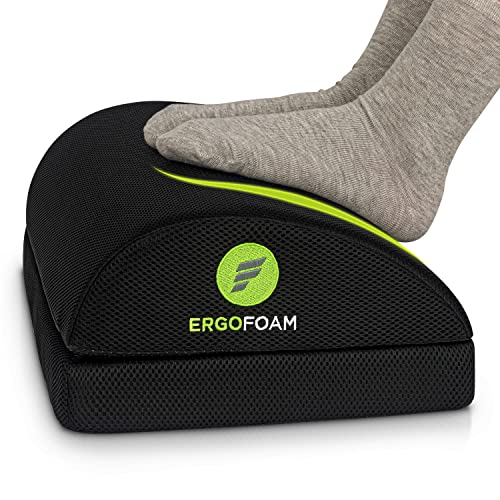
| ErgoFoam Adjustable Foot Rest | Best Overall | Foam cushion with added height piece | Mid | Most home office workers who want comfort plus a choice of heights |
| Everlasting Comfort Foot Rest | Best for All-Day Softness | Memory foam cushion | Entry | Barefoot and sock wearers who sit still and work long hours |
| Humanscale Rocking Foot Rest (FR300 class) | Best Premium Rocker | Rigid rocking platform | Premium | Restless sitters who want smooth, silent movement and a long service life |
| Mind Reader Adjustable Foot Rest | Best Budget Platform | Adjustable tilting platform | Entry | Shod feet, shared desks, and anyone who needs set-and-lock angles |
| StrongTek Rocking Foot Rest | Best Wooden Rocker | Wooden rocking platform | Mid | People who want gentle motion, a firm surface, and furniture-like looks |
Notice what the table does not contain: prices and ratings. Models like these are revised, bundled, and discounted constantly, so the honest way to compare cost is on the listing itself at the moment you buy. What does not change is the design logic in the right-hand columns — type, tier, and best-for — and that is what the rest of this guide teaches you to judge.
How Much Height Do You Actually Need?
Height is the question that decides success or failure, so take it seriously before anything else. Sit in your chair exactly as you work: seat set for your desk, back against the backrest, arms at keyboard height. Now look at your feet. If they rest flat and relaxed on the floor with your knees comfortably bent, your height problem is small — you need little or no lift, and a low cushion or a rocker is about surface and movement rather than elevation. If only your toes or the balls of your feet touch down, or your feet dangle entirely when you sit back, you need real lift, and the gap you can see is roughly the height your footrest must provide after allowing for compression if it is foam. People are often surprised by this gap, because they have adapted to it: perching on the chair edge, hooking feet on the chair base, or sitting cross-legged are all workarounds for a seat that is effectively too high for their legs at a desk set for their arms.
Two practical consequences follow. First, if you need real lift, prioritise designs with genuine height choice — a two-piece cushion, a platform with several settings — over a single fixed cushion that may land an inch too low and solve nothing. Second, remember that height and angle interact: a slightly tilted surface effectively changes how the height feels at your heel versus your toes, which is why tilting platforms can feel right at a setting that looks wrong on paper. If you share the desk, adjustable wins outright, because a fixed cushion fitted to one person’s legs is a compromise for everyone else. And if you are between sizes, err slightly lower: a footrest that is a touch low is mildly disappointing, while one that is too high pushes your knees up, fights the chair, and gets kicked away by Friday.
Fixed, Tilting, or Rocking: How Much Movement Do You Want?
After height, decide your relationship with movement. A fixed surface — most cushions, and platforms locked at one angle — gives your feet a home base. You plant them and get on with work. This suits focused, still sitters and anyone who finds motion distracting. A free-tilting platform adds a small negotiation: the board follows your feet as you shift, so the angle is never quite forced, but it also never quite stays where you left it. Many people love this middle ground; others find the drift irritating within a day. A rocking base makes movement the point. The motion is gentle and self-powered, and its real value is variety across a long day — feet flat, then stretched forward, then heels down — without standing up or leaving the chair.
Be honest about your habits rather than your aspirations. If you currently bounce a leg through meetings, a rocker will likely feel like a relief. If you currently sit like a statue and like it that way, a rocker is a solution to a problem you do not have, and its movement may read as instability. There is also a floor consideration: rockers and tilting platforms behave slightly differently on thick carpet versus hard flooring, and a design that glides silently in a showroom can develop a tap on wood. Check the base design — wide, smooth runners are the quiet ones — and plan to test on your own floor during the return window. Our companion piece, how to choose a desk footrest, turns this movement question into a step-by-step measuring routine if you want to be systematic about it.
How Firm Should a Desk Footrest Feel?
Firmness is where product photos lie most convincingly, because every cushion looks supportive in a picture and the differences only appear under your actual weight at hour six. Think of firmness as a spectrum. At the soft end, plush memory foam moulds around your feet; the sensation is closer to a pillow than to furniture, and it suits lighter users, bare feet, and people whose complaint is pressure and hardness rather than posture geometry. In the middle, firmer foam and foam-over-base designs hold their shape, give a defined surface, and suit most people most of the time. At the firm end, rigid platforms and wood give you a floor that happens to be raised and angled — maximum support and precision, minimum cushioning, and a feel that shod feet appreciate and bare feet tolerate rather than enjoy.
The failure mode to avoid is a cushion that bottoms out: if your heels can feel the floor through the foam when you press down, the footrest is decoration. Density matters more than thickness here, and it is exactly the kind of thing you can only judge from the design’s track record and your own first week of use — which is why buying from a listing with a workable return policy is part of buying smart, a theme the mistakes section returns to. Also consider temperature and feel through the day: foam holds a little warmth, which some people love in winter and dislike in summer, while wood and plastic stay neutral. None of this is decisive alone, but stacked together, firmness is usually the reason a footrest is described as “surprisingly comfortable” or “fine, I guess” months later.
What Size and Shape Fit Your Desk?
Under-desk space is smaller than you think. Between the chair base, your legs, a computer tower or storage box, and the modesty panel or drawers many desks have, the clear floor area for a footrest can be modest — and depth, front to back, is the dimension that bites. A footrest that is too deep pushes your feet forward and your knees into an angle you did not choose; one that is too wide competes with the chair’s casters every time you roll. Before ordering, sit at your desk, put your feet where you would want them, and note the space that is genuinely free. Most single-user footrests are designed around one pair of feet with a little shuffle room, and that is enough. If you like to sit with feet wide apart, or you alternate between feet on the rest and a leg stretched out, favour wider platforms and rockers over compact cushions.
Shape matters in quieter ways. A gently curved top lets your feet settle at slightly different angles without a hard edge under the arch. A teardrop profile — higher at the back, sloping down toward you — suits people who rest with heels low and toes up. Flat tops suit shod feet and platforms. Also check the base: a footrest that slides on hard floors will migrate through the day, and you will spend the day fishing it back with your toes. Grippy bases, enough weight, or a design meant to sit on carpet are all valid answers; a lightweight cushion on polished wood with no grip is a known annoyance. Finally, think about the room beyond the desk. If your workspace is also a living room, a wooden rocker or a neat fabric cushion blends in; a large black plastic platform announces itself. Aesthetics will not save a bad fit, but between two good fits, choose the one you are happy to look at — you will see it every day. If you are furnishing the whole corner at once, our guides to the best footrest options for a home office and ergonomic office chairs for a home office use the same fit-first logic.
How Easy Is It to Clean, Move, and Live With?
The last criterion is the least glamorous and the one that decides year-two satisfaction. Footrests live on the floor, in the dust zone, under shoes that came in from outside. Foam cushions with removable, washable covers are the easiest to keep fresh; fixed-cover cushions and textured platforms need a vacuum and a wipe and will slowly show their age. Wood wipes clean in seconds. If you work barefoot, ask yourself honestly whether you want a surface you cannot wash — that answer eliminates some designs quickly. Moving matters too: if you vacuum often, swap between desks, or share the footrest between a desk and a reading chair, weight and a shape you can grab one-handed are real features. And check the small print of living with it: does it squeak when you shift? Does the adjustment need tools? Does it stay where it is put on your floor type? These are the details that separate the footrest still in daily use next year from the one listed for sale, barely used, in every local marketplace.
What About Materials, Covers, and Build Quality?
Materials decide how a footrest ages, and aging is where cheap footrests quietly fail. In foam cushions, the cover takes the daily abuse: look for a cover that removes for washing, a zip that feels like it will survive being used, and fabric with some texture rather than a slippery sheen, because your feet should rest, not skate. The foam itself should feel dense when you squeeze the display logic in reverse — in a listing you cannot squeeze anything, so weight your decision toward designs with a long track record and a shape that suggests substance rather than air. A cushion that is mostly cover and loft will impress on day one and disappoint by month three.
In platforms and rockers, build quality shows up in the joints and the moving parts. Height mechanisms should click or lock with a positive feel, not a suggestion. Tilting boards should move smoothly through their range without a gritty midpoint. Rocking rails and runners should be continuous and smooth, because every bump in the runner becomes a bump you feel a hundred times a day. Wooden models add one more check: the finish should be even and sealed, especially along the runners, where an unfinished patch will drag, squeak, and wear first. Across all types, look at the base treatment — rubber feet, grip pads, or a textured underside — because a footrest that stays where you put it is doing invisible work every hour. None of these details is glamorous, and together they are most of the difference between the footrest people recommend to colleagues and the one they replace quietly. If you are choosing between two finalists and cannot separate them on fit, separate them here: buy the one whose moving parts and materials you trust to feel the same in year two.
How to Prioritise by Use Case
Criteria only become a decision when they meet a real person. Here are the four profiles we see most often, and how each should weight the questions above.
The High-Chair Home Worker
You work at a kitchen counter-height table, a tall desk, or a chair raised for a standing-desk frame, and your feet genuinely dangle. Your priority order is height first, stability second, everything else third. Choose a two-piece adjustable cushion or a platform with real settings, and be suspicious of any single low cushion, however lovely its fabric. A rocker can work if its raised position is genuinely high, but lift is the job; movement is the bonus.
The Restless Concentrator
Your feet already reach the floor; your problem is stillness. You tap, bounce, and re-cross your legs through every long document. Your priority is movement quality: a smooth, silent rocker with a travel range that feels generous rather than notchy. Firmness should be medium to firm so the motion stays controlled, and the base must be quiet on your floor. Height is almost irrelevant to you — buy the motion, not the lift.
The Barefoot Long-Hours Sitter
You work from home, shoes off by nine, and you sit in long unbroken stretches. Your priority is surface feel over hours: supportive foam that does not bottom out, a washable cover, and a shape that lets you shift your feet without edges digging in. A gentle texture is a plus for you. Avoid hard platforms and firm studs, which feel fine for ten minutes and wearing by hour four.
The Shared-Desk Household
Two or more people use the same desk at different times, with different chairs and different legs. Your priority is fast, tool-free adjustment and durability. A platform with clear settings, or a two-piece cushion whose extra layer can be added or removed in seconds, serves everyone; a fixed cushion fitted to one person serves one person. Add a note-to-self habit: whoever sits down spends ten seconds setting the footrest, the way you would adjust a shared chair.
The Picks in Detail

ErgoFoam Adjustable Foot Rest — Best Overall
The ErgoFoam design earns the top spot in this guide by solving the height problem inside the friendliest format. It is a firm foam cushion with a curved top, sold with an additional height piece that attaches underneath, so you can run it low for gentle support or raised when your chair sits high. That single design decision covers both of the common cases — feet that almost reach and feet that clearly dangle — which is why it is the easiest recommendation for a first footrest. The foam is on the supportive side of the spectrum: it gives a little under your heels without collapsing, and the cover is removable for washing, which matters more after six months than any feature on day one. Used without the extra piece it also flips into a gentle rocker-ish roll for people who like a bit of movement, though dedicated rockers do that job better.
Best for: most home office workers, first-time buyers, and anyone unsure how much height they need. Not suited for: people who want a rigid, lockable platform angle, or very tall setups that need more lift than a cushion format can give. Strengths: two heights in one product; supportive rather than squishy foam; washable cover. Trade-offs: foam still compresses gradually over years; no precise angle setting; the raised configuration is less stable-feeling than a framed platform.

Everlasting Comfort Foot Rest — Best for All-Day Softness
This is the plush end of the market done properly: a thick memory foam cushion with a teardrop profile, higher at the back and sloping toward you, so your feet rest with heels low and the surface cradling rather than propping. For barefoot and sock wearers who sit still, it is the most immediately comfortable design in this line-up, and its softness is the point — choose it when your complaint is that the floor feels hard and your feet feel unsupported, not when you need geometry corrected. The cover removes for washing, and the base has a non-slip treatment that keeps it planted on hard floors better than most cushions. Know its limits before you buy: the height is fixed, the softness that delights at minute one can feel unsupportive to heavier users or shoe wearers, and like all soft foam it will slowly take a set where your heels live.
Best for: barefoot long-hours sitters and comfort-first buyers whose chair height is already roughly right. Not suited for: dangling feet that need real lift, or anyone who wants movement. Strengths: genuinely plush feel; good non-slip base; washable cover. Trade-offs: one fixed height; softest option here, so the least structured support; warmth builds up in the foam on hot days.

Humanscale Rocking Foot Rest (FR300 Class) — Best Premium Rocker
Humanscale’s rocking footrests are the long-standing premium answer to the movement question: a rigid platform on curved rails that rolls with a smooth, weighted, silent motion, built to office-equipment standards rather than accessory standards. The experience is distinctly different from foam — your feet sit on a firm, slightly textured surface, and the pleasure is in the glide, which stays consistent year after year because there is nothing to compress and nothing to wear soft. This class of rocker suits restless sitters who wear shoes or socks equally, and households that would rather buy once. The honest costs are the tier — this is the premium option in the guide — and the firmness, which barefoot users may find unyielding over long stretches. It also asks for a little more floor depth than a cushion, since the rocking travel needs room to happen.
Best for: restless sitters, shoe wearers, and buy-it-for-years shoppers. Not suited for: barefoot comfort-seekers or shallow under-desk spaces. Strengths: exceptionally smooth, quiet motion; nothing to compress or wear out; stable and grippy underfoot. Trade-offs: premium tier; firm surface; needs a bit more depth than static designs.

Mind Reader Adjustable Foot Rest — Best Budget Platform
Mind Reader’s adjustable platform is the entry-tier way to get the traditional office setup: a wide, textured board with several height settings and a tilting surface, at the accessible end of the market. For shared desks and shod feet it does the essential job — set the height, set or free the angle, get on with work — without asking you to pay for materials you may not need. The textured top grips shoes well, and the wide stance suits people who sit with their feet apart. The trade-offs are the usual entry-tier ones: the mechanism is not as silky as premium platforms, very determined rocking can make it creak, and the all-plastic build feels like equipment rather than furniture. As a first platform, or as the second footrest for a spare desk, it is easy to justify; as a ten-year daily driver, the premium designs pull ahead.
Best for: budget-conscious buyers, shared desks, and shoe wearers who want set-and-lock angles. Not suited for: barefoot users or silence-critical rooms. Strengths: real height and angle adjustment at an entry tier; wide, grippy surface; simple to set up. Trade-offs: mechanism feel is basic; can creak under enthusiastic movement; hard surface.

StrongTek Rocking Foot Rest — Best Wooden Rocker
StrongTek’s wooden rocker sits between the foam cushions and the office platforms in both feel and looks: a solid wooden platform on curved runners, with a smooth rocking motion and a surface that reads as furniture in a living-room workspace. The wood gives you firm, predictable support and wipes clean in seconds, and the rocking arc is gentle enough to use absent-mindedly through a whole afternoon. Several owners also flip it to use the stable side when they want stillness, which makes it a quiet two-in-one. It is a mid-tier product with mid-tier expectations: the motion is lovely, but there is no height adjustment at all, so it only works if your chair height is already close, and the hard surface is — again — a shoe-and-socks story more than a barefoot one.
Best for: restless sitters who want firm support and a workspace that does not look like an office-supply store. Not suited for: anyone needing lift, or barefoot users wanting softness. Strengths: smooth wooden rock; easy to clean; looks at home outside an office. Trade-offs: no height adjustment; firm surface; wood needs the occasional check for splinters or wear on the runners.
First Setup and Care Essentials
Setting up a footrest takes five minutes and repays a little ceremony. First set your chair for your desk — seat height for comfortable arms, backrest where you like it — and only then place the footrest where your feet naturally land, not where you think they should. Sit and work for ten minutes before judging; your feet will tell you if the rest needs to come closer, go further away, or gain or lose height. With adjustable models, change one thing at a time: height first, then angle, then position, so you know which change did what. If you bought a rocker, spend the first day letting the motion be a background habit rather than a toy — the value shows up in week two, in how little you think about your feet at all.
Care is simple but not optional. Wash removable covers on the same rhythm as you would a cushion that lives on the floor — because that is what it is. Vacuum textured platforms and wooden runners, and wipe hard surfaces rather than letting dust build into the grip texture. Check foam every few months by pressing where your heels rest: if it has stopped springing back, rotate the cushion if the design allows, and start thinking of it as a consumable with a long life rather than a permanent fixture. Keep any footrest out of the path of chair casters, which are the main cause of chewed edges and cracked platforms. And a comfort note that closes the loop on this whole guide: a footrest supports a comfortable sitting posture, nothing more — if sitting hurts in a way that persists, that is a question for a professional, not for a better accessory. For a deeper daily-use routine, see our in-depth desk footrest review.
Mistakes to Avoid
The classic mistakes repeat so reliably that they deserve their own list. Buying for the photo instead of the gap under your chair: measure your dangling distance first. Buying maximum softness when you needed structure: plush foam cannot lift you. Ignoring depth: the footrest that crowds your shins will be exiled to the corner. Forgetting the floor: sliders on hard floors and noisy rockers on wood are day-one annoyances that never improve. Treating a shared desk as a one-person setup: fixed cushions on shared desks are how households end up with three footrests and no agreement. Skipping the return window test: use the first week deliberately, on your floor, in your shoes or socks, at your real hours — a footrest is one of the easiest products to judge quickly and one of the silliest to keep out of politeness. And finally, expecting a footrest to fix a chair or desk that is fundamentally wrong for you: it is the last small adjustment in an ergonomic setup, not a substitute for the big ones. If the whole workstation is being rebuilt, the same fit-first thinking in our standing desk guide for home offices pairs well with this one.
Before You Buy: The Desk footrest Fit Audit Most Shoppers Skip
A buying guide earns its keep in the checks it makes you do before money changes hands, and this is the check most shoppers skip with a desk footrest: verifying the fit in your own home, on your own routine, rather than in a showroom or a listing photograph. Work through what follows with a tape measure, your phone and ten quiet minutes in the room where the desk footrest will live.
Judge a desk footrest by your body and your desk together: the height range it offers, whether its surface stays put or rocks, and whether your feet rest on it with knees and hips in a comfortable, natural position. Material and grip matter too, because a footrest that slides away or feels unpleasant underfoot will end up pushed aside. Measure the space under your desk, the height of your chair at its working setting and the clearance for your legs, then check the footrest’s footprint against the floor space your chair’s base already claims. Decide whether you want a still platform, a rocking surface or an adjustable design before comparing models.
For long desk sessions, a footrest that lets you shift foot position through the day keeps the setup feeling fresh rather than fixed. For a shorter seated height where feet do not rest flat on the floor, a footrest closes the gap so the chair can stay at the right height for the desk. In a shared or hot-desking setup, a light footrest that moves easily between desks and wipes clean earns its place over a heavier fixed design. Use this as a pre-purchase audit: any model still standing after these checks has earned its place on your shortlist, and any model that fails one should be dropped without regret, however strong its other features look.
Apply all of this to the listings in front of you. When a listing such as the ErgoFoam Adjustable Foot Rest, Everlasting Comfort Foot Rest and Humanscale Rocking Foot Rest catches your eye, resist judging it by its headline claim and instead run the checks above against it: does its stated role match the room you measured, does its control path suit your household, and does the maker’s own guidance support the job you have in mind. A model that answers those questions cleanly on paper usually answers them cleanly in the home, and one that dodges them in the listing will dodge them on your wall, shelf or desk as well.
A footrest that is too high pushes knees up and changes your whole seated posture for the worse; more height is not automatically better. On hard floors, a light footrest can travel during the day until it is out of reach, which quietly ends its usefulness. If the footrest keeps sliding, add grip beneath it or place it against the desk’s modesty panel or a wall so it has a stop. If your feet ache on a textured surface, try it with different footwear or socks before rejecting the design; surface feel changes completely with what you wear.
- Measure the space and note the constraint that most limits your choice for your desk footrest.
- Confirm the control path works for everyone in the household, not just the buyer for your desk footrest.
- Check what still works when the home network is down for your desk footrest.
- Read the maker’s guidance for your exact room and load type before ordering for your desk footrest.
- Plan where accessories, chargers or spares will live from day one for your desk footrest.
- Keep the return window in mind and schedule your own checks inside it.
If a rocking model feels unstable, start with it locked or on its lowest setting and build up as the movement becomes familiar. Wipe or vacuum the surface weekly since footrests collect dust and grit, check adjustable joints and locking knobs for tightness, keep rocking mechanisms free of debris, and air out foam designs so they stay fresh.
Finish the audit by writing down the one requirement you will not compromise on and the one feature you are willing to drop. A shortlist built on that honesty is short, and choosing from it stops feeling like a gamble.
It also helps to think in seasons rather than in days. A desk footrest that seems ideal in the week it arrives may face different light, different temperatures, different routines and different demands a few months later, and the models that age well are the ones chosen with that longer view in mind.
Keep the household in the loop as you decide. The person who did not choose the desk footrest is usually the person who discovers its most annoying habit first, and a two-minute conversation before buying can surface the objection that saves a return.
Documentation is an underrated feature of ownership. Keep the manual, the receipt and a note of your settings together, because the day something needs adjusting is never the day you want to reconstruct how it was set up.
When two models seem equal, prefer the one whose maker publishes clearer guidance, steadier updates and easier access to spares or support. That difference is invisible in a feature table and decisive in the third year of ownership.
Frequently Asked Questions
How do I know if I need a tall footrest or a low one?
Sit in your chair set up exactly as you work, with your back against the backrest. If your feet rest flat and relaxed, you need little height — a low cushion or rocker is about comfort and movement. If only your toes touch, or your feet dangle when you sit back, you need genuine lift, so choose a two-piece cushion or an adjustable platform. Judge by that seated test, not by product photos or by your height alone, because chair and desk heights change everything.
Is a foam cushion or a rigid platform better?
Neither is better in general; they suit different people. Foam cushions feel softer, welcome bare feet, and forgive small height errors because they give a little. Rigid platforms give precise, repeatable height and angle, suit shoes, and never compress. If your chair height is nearly right and comfort is the goal, start with foam. If you need real lift, share the desk, or want a setting that never drifts, choose a platform. Many households end up with one of each at different desks.
Will a rocking footrest distract me while I work?
Most people find the opposite after a short settling-in period. The motion is small, self-powered, and quickly becomes background — similar to how a knee bounce disappears from your awareness while it happens. If you are a naturally still sitter, though, the movement can feel like instability, so consider a rocker you can flip to a stable side, or start with a free-tilting platform as a middle step. Test it through a full workday during the return window rather than judging the first ten minutes.
Can two people share one desk footrest?
Yes, if you choose for sharing from the start. Adjustable platforms with clear settings, or two-piece cushions whose extra layer adds or removes in seconds, work well because each person can reset the height in moments. A fixed single-height cushion fitted to one person’s legs will quietly frustrate the other. Build the same habit you would with a shared chair: ten seconds of adjustment when you sit down, every time, and the sharing stops being a compromise.
How long does a foam footrest last before it flattens?
It depends on density and daily hours, but expect gradual change rather than sudden failure. Firmer, higher-density cushions hold their shape far longer than plush ones; heavy daily use compresses any foam eventually, starting where your heels rest. Press the heel zone every few months — if it no longer springs back, the cushion is becoming a mat. Rotating it, if the shape allows, evens the wear. Rigid platforms and wooden rockers avoid this entirely, which is part of their long-term appeal.
Should my feet be flat on the footrest or angled?
Comfortable is the honest answer, and for most people that means roughly flat to gently angled, with the whole foot supported rather than just the toes or just the heels. A slight tilt that follows your natural resting angle usually feels best over a full day, which is why tilting platforms and curved cushions are popular. Avoid extremes in either direction — a steep angle that pushes your toes up or lets your heels slide down will announce itself as a nuisance within the hour.
Related reading: desk footrest reviews compared