Disclosure: As an Amazon Associate, umtsmarttool.com earns from qualifying purchases. Links on this page are affiliate links; they cost you nothing extra. Prices and availability change often, so check the current Amazon listing before you buy.
Any honest look at desk footrest pros and cons has to start by admitting that this is a product category people either quietly love or quietly abandon. There is no dramatic failure mode and no miracle either: a footrest is a small comfort tool whose value shows up in how settled your feet feel at four in the afternoon. That modesty is exactly why the pros and cons deserve a careful read. The advantages are real but conditional — they depend on your chair height, your habits, and the type you choose — and the disadvantages are rarely deal-breakers, but they are predictable, which means you can shop around most of them. This article lays out both sides in full, then translates the balance into guidance for different kinds of sitters, so you can decide with your eyes open. If you would rather start from the shopping criteria, our desk footrest buying guide covers the decision from the other direction.
Desk Footrest Pros and Cons: The Quick Verdict
Quick verdict: A desk footrest is worth it for most desk workers whose feet do not rest flat and relaxed on the floor, and for restless sitters who want somewhere for their feet to go. It is a comfort upgrade, not a necessity and not a cure for anything: it supports a more comfortable sitting posture by giving your feet a stable, slightly raised place to rest. It suits people who work long seated hours, people whose chairs sit high relative to their legs, and people who fidget. It does not suit people whose setup already fits them perfectly, people short on under-desk space, or anyone expecting a small accessory to fix a chair and desk combination that is fundamentally the wrong size.
In this guide
Key Takeaways
- The biggest pro is simple: supported feet make the whole sitting position feel calmer and more settled, especially across long afternoons.
- The biggest con is equally simple: a footrest that does not fit your chair height or your floor space will be ignored, and an ignored footrest is wasted money at any tier.
- Type decides which pros and cons you actually get. Foam cushions trade precision for softness; platforms trade softness for precision; rockers trade stillness for movement.
- Most cons — sliding, compression, noise, clutter — can be reduced by choosing the right design for your floor and habits, and by setting it up deliberately in the first week.
- A footrest supports comfort only. Persistent pain or numbness is a reason to consult a professional, not a reason to buy a more expensive footrest.
The Pros
Your Feet Get a Real Place to Rest
The core advantage sounds too obvious to list, which is why it is underrated: without a footrest, many people’s feet have nowhere proper to go. The chair is set for the desk, the floor is a little too far away, and so feet end up dangling, perched on toes, hooked around chair casters, or tucked under legs. Each of those workarounds is a small, constant negotiation with your own furniture. A footrest ends the negotiation. Your feet land on a surface that is at the height and angle you chose, and they can simply stay there. People consistently describe the change in unglamorous terms — “I stopped thinking about my feet” — and that absence of low-level distraction, multiplied across every workday, is the real product being sold. It is a comfort effect, not a medical one, and it is at its strongest when the gap between your seat and the floor was genuinely wrong for your legs.
Your Sitting Posture Feels More Settled
When your feet are supported, the rest of your sitting posture tends to feel more organised. Many people find they sit back in the chair more naturally instead of perching on the front edge, that their knees settle at a comfortable bend instead of being pulled under the seat, and that the urge to sit cross-legged or on one foot — habits that feel fine for ten minutes and dreadful at hour three — fades on its own. To be precise about the claim: a footrest supports a more comfortable sitting posture. It does not correct posture in any clinical sense, and no footrest should be sold as preventing or treating back pain or any other condition. But comfort is not a trivial outcome. A sitting position you can hold without constant small adjustments is a position you can work in, and that is the honest promise here.
Restless Feet Get Something Constructive to Do
For the large minority of people who concentrate better with some low-level movement, a footrest — especially a rocking or free-tilting one — converts fidgeting from a distraction into a feature. Instead of bouncing a knee, tapping a foot against a chair leg, or shifting your whole position every few minutes, your feet get a smooth, quiet, repeatable motion that stays under the desk and out of everyone else’s awareness. On video calls it is invisible. In a shared room it is silent, if you chose a quiet design. Several types of sitters benefit beyond the classic fidgeter: people who work in long, unbroken focus blocks, people who find total stillness makes them feel stiff and restless by mid-afternoon, and people who simply like the option to stretch their ankles and change their feet’s angle without standing up. A static cushion delivers a milder version of the same pro — a defined place to shift your feet around on — but the rocker is where this advantage fully lives.
It Is One of the Cheapest, Simplest Upgrades in the Room
Set a footrest beside the other items in a home office and its practical virtues stand out. It needs no power, no assembly beyond unboxing in most cases, no software, no maintenance schedule, and no learning curve. It works with the chair and desk you already own, which makes it the natural first experiment when a workstation feels almost-but-not-quite right: before replacing a chair, you can test whether the problem was actually the missing support under your feet. It is also reversible in a way furniture is not — if it does not suit you, it can move to a reading chair, a partner’s desk, or a cupboard, and the experiment has cost little. Within the category, the tier ladder is gentle: entry-level cushions and platforms do the core job honestly, and paying more buys materials, smoothness, and longevity rather than a different outcome. Few upgrades in the room offer that ratio of simplicity to daily contact hours.
It Adapts to You Instead of the Other Way Round
Adjustable designs carry a pro that fixed furniture cannot match: they meet different bodies on different days. A platform with several height settings serves a tall person in the morning and a shorter partner in the evening. A two-piece cushion lets you run more lift on the high stool at the kitchen counter and less at the low desk. Even within one person’s routine there is variation worth having — shoes on versus shoes off changes your effective leg length slightly, a different chair changes it more, and a footrest you can re-set in seconds absorbs all of that without complaint. Rockers add a different kind of adaptability: the angle is whatever your feet decide moment to moment. This adaptability is also why footrests travel well between roles, from desk to craft table to the chair where you sit with a laptop in the evening.
It Can Make the Whole Desk Setup Work Better
A footrest is often the piece that lets the rest of an ergonomic setup finally make sense. The classic tangle: your desk height suits your arms, your chair must rise to meet it, and then your feet pay the price. Without a footrest, people solve that tangle by lowering the chair and hunching their arms up, or by accepting dangling feet as the cost of a good keyboard position. With a footrest, the chair can stay at the height your arms and screen want, because your feet have their own solution. In that supporting role the footrest quietly improves the value of the chair, the desk, and the monitor position you already have — a systems benefit that never appears on its own packaging. It pairs particularly well with the other small adjustments in a home office: if you are tuning the whole corner, the logic in our guide to choosing a desk footrest step by step shows how the footrest decision slots into the bigger picture.
It Works in Silence, Without Power, Apps, or Upkeep Rituals
A quieter pro, easy to overlook in a world of smart everything: a footrest asks nothing of you after the first week. There is nothing to charge, pair, update, or troubleshoot. It does not beep, glow, or need a subscription to keep being a footrest. In a home office increasingly full of devices that demand attention, an entirely passive object that simply improves the hours you spend in one chair has a particular kind of value. The upkeep that does exist — washing a cover, vacuuming a platform — is measured in minutes per month. For people deliberately keeping their workspace simple, or furnishing a desk in a room that is not primarily an office, that zero-maintenance character is a genuine advantage over motorised or electronic alternatives, and it is one reason footrests tend to stay in service long after cleverer gadgets have been retired to a drawer.
The Cons
It Only Helps If the Fit Is Right — and Fit Is Easy to Get Wrong
The mirror image of the main pro is the main con: a footrest at the wrong height is worse than a minor disappointment, because it actively gets in the way. Too high, and your knees are pushed up and your feet slide forward off the surface. Too low, and you have bought an expensive floor mat that your toes occasionally visit. The uncomfortable truth is that most people buy without measuring the actual gap between their seated feet and the floor, guess from a product photo, and land a size off in one direction or the other. Adjustable designs reduce the risk but do not eliminate it — a platform whose range sits entirely below your need is still the wrong platform. This con is therefore really a warning about process: the category rewards ten minutes of measuring and punishes impulse buying more than most small accessories do.
It Takes Up Floor Space You May Not Have
Under-desk space is contested territory. Chair bases sweep it, computer towers and storage boxes claim corners of it, cables cross it, and your own legs need room to stretch, cross, and get in and out. A footrest moves into that space permanently, and in a compact desk setup the crowding can be the deciding factor: knees bumping the rest when you roll closer, casters clipping its edges, a general feeling that the under-desk area has become an obstacle course. Rockers and wide platforms ask for the most room; compact cushions ask for the least, but even a cushion is one more thing in a small footprint. If your desk is shallow or your chair base is large, treat this con seriously and measure the genuinely free floor area before you shop, not after the box arrives.
Foam Compresses and Cheap Mechanisms Wear
Materials age, and in this category they age in ways you feel. Foam cushions — especially soft, inexpensive ones — gradually compress where your heels rest, losing height and support month by month until the cushion is a shaped mat. It is not a defect so much as physics, but it means a foam footrest is a long-life consumable, not a permanent fixture, and the softest models have the shortest useful lives. On the rigid side, entry-level platforms can develop creaks, wobbles, and angle mechanisms that slip under pressure, and a footrest that clicks every time you shift your weight is a footrest you will stop using. None of this is hidden: density, build quality, and moving-part quality are exactly what higher tiers charge for. But a buyer comparing only shapes and photos will not see this con coming, and it is the most common reason a footrest that delighted in month one is in a cupboard by month twelve.
It Can Encourage You to Sit Still for Longer
This con is subtle and worth stating plainly: anything that makes sitting more comfortable can quietly extend how long you sit without a break. A footrest improves the quality of your sitting; it does nothing about the quantity, and no accessory changes the basic wisdom that bodies like variety — standing, walking, and changing position through the day. The honest way to hold both truths is to let the footrest do its comfort job while you keep whatever break habits you already value, and to consider a rocker’s gentle movement a small bonus rather than a substitute for getting up. If your real problem is that you sit for ten unbroken hours, the footrest is a minor character in that story. Relatedly, comfort should never be confused with treatment: a footrest does not address persistent pain, numbness, or swelling, and those symptoms deserve a professional’s input rather than a shopping decision.
Some Designs Fight Your Floor, Your Shoes, or Your Habits
A cluster of smaller frictions belongs on the con list because each one has ended someone’s footrest experiment. Lightweight cushions can slide on hard floors, migrating through the day until you are fishing them back with your toes. Textured and studded surfaces that feel interesting to bare feet can feel harsh over long hours, and are pointless under shoes. Hard platforms are unkind to bare feet in the opposite way. Rockers can tap or creak on wood floors if the runners are poorly finished. Footrests gather floor dust and are awkward to vacuum around. And some people simply discover, a week in, that they are committed floor-rest sitters — feet flat, no intermediary wanted — for whom any footrest is a solution in search of a problem. None of these is a reason to avoid the category; all of them are reasons to match the design to your floor, your footwear, and your honest habits before you buy, which is what the buying-smart section below is for.
It Is One More Thing to Buy, Store, and Eventually Replace
Finally, the mundane con: a footrest is an object with a lifecycle. It costs money at some tier, it occupies space when it is not under a desk, it does not fold away (hammock styles aside), and foam models will eventually need replacing. For minimalists and for people in temporary living situations, that overhead can outweigh a mild comfort gain. It is also easy to overbuy in this category — to climb tiers chasing a perfect sitting feeling that actually depends on your chair and desk — when an entry-level model would have delivered ninety percent of the benefit. Keep the purchase in proportion: this is a small, useful accessory, and it should be bought like one.
Expectations Can Outrun What a Small Accessory Can Do
The final con is about the story buyers bring to the purchase. A footrest is sometimes bought as the answer to a whole workstation’s worth of problems — a chair that does not fit, a desk at the wrong height, a screen in the wrong place, a working day with no breaks in it. Against that list, any single accessory will disappoint, and the disappointment often lands on the footrest because it was the most recent arrival. It is also sometimes bought with medical hopes it cannot fulfil, as the back-pain question in our FAQ addresses directly. The defence is proportion: buy a footrest to do the footrest’s job — support your feet comfortably — and judge it on exactly that. Buyers who keep the expectation that narrow almost always end up on the pro side of this article’s ledger; buyers who ask it to transform their working life tend to end up disappointed whatever they purchased.
What the Trade-Offs Mean for You
Pros and cons only become useful when they are weighted by a real person’s situation. The same compression that is a footnote for a light, part-time user is a headline for someone who sits ten hours a day. Here is how the balance tips for the sitters we hear from most.
If your feet dangle, the pros dominate. When your chair height leaves your feet genuinely unsupported, the first pro — a real place to rest — is not a marginal comfort but a daily, hourly difference, and it outweighs every con on the list except a wrong-height purchase. Buy adjustable, measure first, and the space and upkeep cons are a fair price for ending the dangle. This is the profile for whom footrests earn their strongest word of mouth.
If your feet already rest flat, the balance is closer. Your potential gains are the secondary ones: a softer or more defined surface, a rocker for movement, a slight rise that feels more settled. Your risks are the crowding and clutter cons, which loom larger when the core problem is absent. For you, a compact cushion or a rocker is a pleasant upgrade to buy deliberately, not an essential — and our verdict piece, is a desk footrest worth it, was written with exactly your decision in mind.
If you are a restless sitter, weight the movement pros heavily. The constructive-fidgeting advantage is the one you will feel most, and it points you firmly toward rockers and free-tilting platforms. Your corresponding con to manage is noise: on hard floors, runner and mechanism quality decides whether the motion stays welcome. Spend your budget on smoothness rather than features.
If you work barefoot for long hours, surface feel outranks everything. The softness pros of good foam are your headline; the compression con is your tax. Choose denser foam, accept a replacement horizon measured in years rather than forever, and avoid hard platforms and aggressive textures no matter how well they review among shoe wearers.
If the desk is shared, adjustability is the whole game. Every pro in this article assumes the footrest fits the person using it. On a shared desk, only adjustable designs deliver that fit to everyone, so the platform’s precision pro matters more than the cushion’s comfort pro, and the setup habit — reset it when you sit down — becomes part of the product.
The Pros and Cons by Footrest Type
The lists above describe the category as a whole, but nobody buys the category — you buy a type, and each type loads the balance differently. Here is the honest per-type version.
Foam Cushions: Comfort First, Precision Last
The foam cushion’s pros are feel and forgiveness. It is the only type that genuinely welcomes bare feet for a full day, it forgives small height misjudgements because it gives under your weight, and it is silent, light, and simple to move between rooms. Its cons are the category’s wear story in concentrated form: gradual compression, a fixed height that cannot adapt to a different chair or a second user, and warmth that builds in the foam. Net assessment: the best first footrest for a single user whose chair height is nearly right, and the wrong choice for dangling feet or shared desks. Within foam, density is destiny — a firm cushion keeps the pros for years, a plush one trades some of them away for a softer first impression.
Adjustable Platforms: Precision First, Warmth Last
The platform’s pros are control and consistency. Height settings and a settable angle mean the footrest fits you exactly, fits your partner differently an hour later, and feels identical in year three to how it felt in week one. Shoes grip the textured surface, and the whole design shrugs off the wear that retires foam. Its cons are feel and fuss: a hard surface that bare feet merely tolerate, mechanisms that can creak or slip at the entry tier, and an equipment look that some rooms do not want. Net assessment: the professional’s choice and the shared desk’s only real answer, bought with the understanding that comfort here means correctness, not softness.
Rockers: Movement First, Stillness Optional
The rocker’s pros are the movement cluster — the constructive fidgeting, the angle variety, the afternoons that feel less locked-in — delivered, in the better designs, with a smoothness that becomes genuinely pleasurable. Quality rockers also dodge the wear cons: nothing compresses, and good runners stay quiet for years. Their cons are commitment and space: the motion cannot be argued with (unless the design flips to a stable side), the travel needs floor depth, and poor runners on hard floors are a noise complaint waiting to happen. Net assessment: transformative for the right sitter, mildly annoying for the wrong one, and the type where spending more on build quality pays back most clearly.
Textured Surfaces: A Bonus, Never a Reason
Texture deserves its own short verdict because it is marketed hardest and matters least. As a pro, a gentle texture gives socked and bare feet something to press and roll, which some people find keeps their feet pleasantly occupied. As a con, aggressive studs can become the only thing you notice by mid-afternoon, and under shoes the entire feature is inert. Net assessment: treat texture as a tiebreaker between two otherwise equal designs, never as the reason to choose one — and if you are texture-curious, choose gentle, because you cannot soften a surface that arrives too firm.
How a Desk Footrest Compares With the Alternatives
A footrest is not the only answer to unsupported feet, and honest context means naming the rivals. Here is how the category stacks up against the two alternatives people actually use.
| Option | What it does well | Where it falls short | Best for |
|---|---|---|---|
| Dedicated desk footrest | Purpose-built height and angle; options for foam comfort, platform precision, or rocking movement; works with your existing chair and desk | Takes floor space; foam wears over time; fit must be chosen carefully | Most desk workers with a height gap or restless feet |
| A box, stack of books, or spare stool | Free or nearly free; height can be improvised; a good way to test whether support helps you at all | Fixed or awkward angle; slides around; looks improvised; height changes only in lumpy increments | A one-week experiment before buying properly |
| Lowering the chair and adjusting the desk setup instead | Removes the root mismatch; no extra object under the desk | Only works if the desk and screen can also be set correctly at the lower height; often just moves the problem to your arms or neck | Setups with genuinely adjustable desks |
The improvised option deserves respect: a sturdy box at the right height for a week is the cheapest research you will ever do, and if you find yourself annoyed when it slides or sorry when it is removed, you have your answer about the category. What the dedicated product adds is the angle, the stability, and the surface — the difference between propping your feet and resting them. The setup-adjustment option is the right answer when it is available, but in most homes the desk height is fixed by the furniture that exists, and the footrest exists precisely to bridge that fixed reality. If you are also weighing the active end of the spectrum, our look at under-desk treadmills for a home office covers the walking-while-you-work alternative honestly.
How to Buy Smart: Getting the Pros Without the Cons
Most of the cons above are avoidable with a short, disciplined buying routine. First, measure the gap: sit as you work, note whether your feet dangle, perch, or rest flat, and let that answer choose your category before you look at a single product. Second, measure the space: the free floor area under your desk, front to back and side to side, with the chair in its working position. Third, match the design to your footwear and floor — foam and washable covers for bare feet, grippy platforms for shoes, smooth quiet runners for hard floors, and a base that grips rather than glides. Fourth, prefer adjustability whenever your situation has any variability in it: two heights, several settings, a flip-over rocker. Fifth, buy from a listing with a workable return policy and actually use the first week as a trial, at your real hours, because this category reveals itself quickly and honestly. The five designs below cover the sensible options at each tier; our desk footrest review examines the leading cushion design in depth if you want a closer look at one product before deciding.

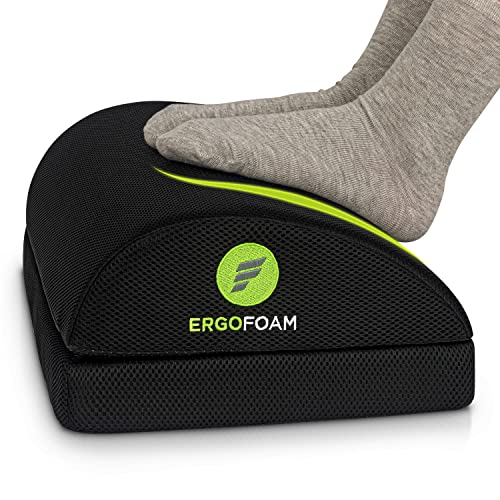
ErgoFoam Adjustable Foot Rest
The adjustable foam option: a firm cushion plus an attachable height piece, so it covers both the gentle-support and the genuine-lift cases in one product. In pros-and-cons terms it banks the comfort and adaptability pros while softening the wrong-height con, at the cost of foam’s gradual compression. Best for first-time buyers who are unsure how much height they need.

Everlasting Comfort Foot Rest
The softness specialist: a plush memory foam cushion with a sloping profile and a washable cover. It maximises the surface-comfort pro for barefoot, still sitters, and wears the compression and fixed-height cons openly. Best for people whose chair height is already right and whose complaint is hardness, not geometry.

Humanscale Rocking Foot Rest (FR300 Class)
The premium rocker: a rigid platform on smooth curved rails, built for years of silent motion. It takes the movement pro furthest and deletes the wear cons entirely, in exchange for a premium tier and a firm surface. Best for restless sitters and buy-once households.

Mind Reader Adjustable Foot Rest
The entry-tier platform: several height settings and a tilting, textured board for shod feet. It delivers the precision and shared-desk pros at the accessible end of the market, with mechanism feel as its main con. Best for shared desks and budget-conscious first platforms.

StrongTek Rocking Foot Rest
The wooden rocker: firm, furniture-like, easy to clean, with a gentle arc and a flip-to-stable option on many setups. It balances the movement and durability pros against a total lack of height adjustment. Best for restless sitters whose chair height is already close and who want the desk area to look like a room, not an office.
Setup and Care That Reduce the Cons
Several cons shrink dramatically with deliberate setup. Place the footrest where your feet naturally land when your chair is set correctly — not closer because the photo looked tidy, not further because the cables live there. If it slides, solve it on day one with the base treatment the design intends, or a non-slip mat beneath it, rather than accepting a daily migration. If it is foam, start a light care rhythm: shake or vacuum it when you clean the room, wash the cover regularly, and press-test the heel zone every few months so compression never surprises you. If it rocks or tilts, listen during the first week: a new creak is information, and it is far easier to exchange a noisy unit inside the return window than to live with it for years. Keep casters off it by parking the chair slightly to the side when you leave. And build the position habit that makes any footrest work: chair first, footrest second, feet last — ten seconds that decide whether the pros in this article show up for you at all.
There is also a mindset that reduces the biggest soft con, the sitting-still trap. Treat the footrest as one position among several in your day, not as a way to make one position bearable forever. Stand for calls, walk for water, let the rocker move your feet between the bigger movements. Comfort tools work best as part of a varied day, and a footrest used that way gives you its pros without quietly extending the one habit it cannot fix.
One more care habit separates satisfied long-term owners from everyone else: keep the footrest in the cleaning loop of the room rather than treating it as invisible. It lives at floor level, where dust, pet hair, and everything your shoes bring in eventually settle. A weekly vacuum pass, a cover wash on laundry rhythm, and a wipe for hard surfaces take minutes and prevent the slow grime build-up that makes people quietly go off a product they otherwise liked. The same loop is a natural moment to check the things that wear — runner smoothness, mechanism play, foam spring — so small declines get noticed while they are still choices rather than surprises. Owners who do this tend to describe their footrest the way people describe good shoes: unremarkable, daily, and missed immediately when absent. That unremarkable quality is the entire point of the category, and a little routine care is what protects it.
How the Balance Shifts Over the First Weeks and Months
One reason pros-and-cons lists mislead is that they freeze a relationship that actually changes over time. A footrest’s balance sheet in week one is not its balance sheet in month six, and knowing the usual arc helps you judge your own trial period fairly.
Days one to three are the novelty phase, and they flatter everything. Any new surface under your feet feels interesting, and rockers in particular feel delightful while they are new. Resist final judgements here in both directions: the cushion that feels luxuriously soft today is auditioning, not performing. What you can judge immediately is fit — height, position, floor behaviour, noise — because those do not improve with familiarity. If the geometry is wrong on day two, it is wrong.
Weeks two to four are where the real pros declare themselves. The novelty fades and what remains is the daily texture: whether you still perch, tuck, and fidget the way you used to, or whether your feet have quietly adopted the rest as home. This is also when the honest cons surface — the slide you have to correct twice a day, the creak on one side of the rocker’s travel, the spot where a hard edge meets your heel. Most of these are still fixable in this window: reposition, add grip, exchange the unit. The buyers who end up happy are usually the ones who treat this month as calibration rather than verdict.
Months three and beyond are the materials audit. Foam begins to tell the truth about its density, mechanisms about their build, covers about their stitching. A footrest that still feels like itself at month six has passed the only durability test that matters, and from here the pros compound quietly — hundreds of settled afternoons — while the cons, if they were coming, have usually already arrived. This arc is why this guide keeps returning to the same advice: judge fit fast, judge feel over weeks, and let build quality carry the months. It is also why the secondhand market is full of footrests that failed the first test, not the third — most abandoned footrests were the wrong height, not the wrong product.
Bottom Line
Weigh it up and the category comes out clearly — with conditions. The pros are daily and cumulative: supported feet, a more settled sitting position, a constructive outlet for restless legs, and a small, simple, reversible purchase that can make the rest of your setup work as intended. The cons are mostly about fit and fit’s cousins: wrong height, crowded floors, wearing materials, and the discipline of still taking breaks. That shape of balance means the decision is less “are footrests good?” and more “is a footrest good for my chair, my floor, and my habits?” For dangling feet and restless sitters, yes, decisively. For already-comfortable setups, it is a pleasant optional upgrade. Either way, buy with measurements in hand and a return window in reserve, and the cons in this article become footnotes instead of outcomes. And if you take only one sentence from this entire balance sheet, take this one: the best footrest is not the softest, tallest, or cleverest — it is the one whose height, surface, and movement match your chair, your floor, and your habits closely enough that you stop noticing it entirely. For the side-by-side product view, continue to desk footrest reviews.
After the First Month: Desk footrest Trade-Offs Owners Actually Notice
Every honest list of advantages and drawbacks hides a second list: the trade-offs that only appear after the first month, when the novelty has worn off and the desk footrest has become part of the furniture. Those are the ones worth examining before you decide. None of what follows is a reason to buy or avoid on its own; it is the texture of daily ownership that a summary table cannot hold.
Judge a desk footrest by your body and your desk together: the height range it offers, whether its surface stays put or rocks, and whether your feet rest on it with knees and hips in a comfortable, natural position. Material and grip matter too, because a footrest that slides away or feels unpleasant underfoot will end up pushed aside. Measure the space under your desk, the height of your chair at its working setting and the clearance for your legs, then check the footrest’s footprint against the floor space your chair’s base already claims. Decide whether you want a still platform, a rocking surface or an adjustable design before comparing models.
For long desk sessions, a footrest that lets you shift foot position through the day keeps the setup feeling fresh rather than fixed. For a shorter seated height where feet do not rest flat on the floor, a footrest closes the gap so the chair can stay at the right height for the desk. In a shared or hot-desking setup, a light footrest that moves easily between desks and wipes clean earns its place over a heavier fixed design. Notice how few of these points are about the product in isolation. Most trade-offs are really about the match between the desk footrest and the household, which is why the same model collects glowing and furious feedback from different homes.
Apply all of this to the listings in front of you. When a listing such as the ErgoFoam Adjustable Foot Rest, Everlasting Comfort Foot Rest and Humanscale Rocking Foot Rest catches your eye, resist judging it by its headline claim and instead run the checks above against it: does its stated role match the room you measured, does its control path suit your household, and does the maker’s own guidance support the job you have in mind. A model that answers those questions cleanly on paper usually answers them cleanly in the home, and one that dodges them in the listing will dodge them on your wall, shelf or desk as well.
A footrest that is too high pushes knees up and changes your whole seated posture for the worse; more height is not automatically better. On hard floors, a light footrest can travel during the day until it is out of reach, which quietly ends its usefulness. If the footrest keeps sliding, add grip beneath it or place it against the desk’s modesty panel or a wall so it has a stop. If your feet ache on a textured surface, try it with different footwear or socks before rejecting the design; surface feel changes completely with what you wear.
- List the drawback most likely to touch your daily routine and test for it first for your desk footrest.
- Decide which advantage you will genuinely use every week for your desk footrest.
- Check the ongoing chore the product creates and who in the house will own it.
- Confirm the fallback when the smart features or network fail for your desk footrest.
- Compare the ownership cost in time, not just the purchase decision for your desk footrest.
- Ask whether the same benefit is available from something you already own for your desk footrest.
If a rocking model feels unstable, start with it locked or on its lowest setting and build up as the movement becomes familiar. Wipe or vacuum the surface weekly since footrests collect dust and grit, check adjustable joints and locking knobs for tightness, keep rocking mechanisms free of debris, and air out foam designs so they stay fresh.
Weigh the drawbacks against your specific routine, not against an imaginary average owner. A drawback that never touches your day costs you nothing, and an advantage you will use daily is worth more than three you will use once.
It also helps to think in seasons rather than in days. A desk footrest that seems ideal in the week it arrives may face different light, different temperatures, different routines and different demands a few months later, and the models that age well are the ones chosen with that longer view in mind.
Keep the household in the loop as you decide. The person who did not choose the desk footrest is usually the person who discovers its most annoying habit first, and a two-minute conversation before buying can surface the objection that saves a return.
Documentation is an underrated feature of ownership. Keep the manual, the receipt and a note of your settings together, because the day something needs adjusting is never the day you want to reconstruct how it was set up.
When two models seem equal, prefer the one whose maker publishes clearer guidance, steadier updates and easier access to spares or support. That difference is invisible in a feature table and decisive in the third year of ownership.
Finally, resist upgrading the whole room around a single purchase. Live with the desk footrest as it is for a few weeks, learn what it actually changed, and only then decide what else, if anything, the room still needs.
Frequently Asked Questions
What is the main advantage of using a desk footrest?
The main advantage is that your feet get a stable, supported place to rest at a height and angle you choose, instead of dangling, perching on your toes, or hooking around the chair base. Many people find the whole sitting position feels calmer and more settled as a result, and that they stop making small compensating movements through the day. It is a comfort benefit, strongest when your chair sits high relative to your legs, and it is not a treatment for any medical condition.
What is the biggest disadvantage to watch for?
The biggest disadvantage is a poor fit: a footrest at the wrong height either pushes your knees up or leaves your feet effectively unsupported, and either way it ends up ignored in a corner. Close behind are floor-space crowding in small setups and, for foam models, gradual compression over years of use. All three are manageable — measure the gap under your chair first, check your free floor space, choose denser foam or a rigid design — but they punish guessing, so shop deliberately.
Do desk footrests help with back pain?
A footrest should not be bought as a treatment for back pain, and this guide makes no such claim. What it can do is support a more comfortable sitting posture by giving your feet a proper resting place, which many people find makes sitting feel easier and more settled overall. Comfort and treatment are different things. If you have back pain that persists, recurs, or worries you, the right step is to talk to a qualified professional who can assess your specific situation, not to upgrade an accessory.
Are rocking footrests better than static ones?
They are better for a particular kind of person: the restless sitter who taps, bounces, and re-crosses their legs, and who concentrates better with some gentle movement available. For still sitters, a static cushion or locked platform is better, because motion they do not want reads as instability. Neither type is superior in the abstract. If you are unsure, a free-tilting platform or a rocker that flips to a stable side gives you a way to test the movement without committing to it fully.
How long will a desk footrest last?
Rigid platforms and wooden or metal rockers can last for many years, since there is little to wear beyond hinges and runners. Foam cushions have a shorter arc: firmer, denser foam holds its shape for a long time, while soft foam gradually compresses where your heels rest, eventually turning the cushion into a low mat. You can extend a cushion’s life by rotating it if the shape allows and keeping chair casters off it. Think of foam as a long-life consumable and rigid designs as furniture.
Can a desk footrest make sitting for long hours healthy?
No accessory can do that, and it is worth being suspicious of any product that implies otherwise. A footrest improves the comfort of the hours you spend seated, and a rocking model adds gentle movement, but neither replaces standing up, walking, and varying your position through the day. Use the footrest to make your sitting position feel supported, and keep your normal break habits alongside it. If long sitting is your main concern, look at the whole workstation and your routine, not at a single accessory.