Disclosure: As an Amazon Associate, umtsmarttool.com earns from qualifying purchases. Links on this page are affiliate links; they cost you nothing extra. Prices and availability change often, so check the current Amazon listing before you buy.
This desk footrest review takes one design apart in detail: the ErgoFoam Adjustable Foot Rest, the firm foam cushion with a second, attachable height piece that has become the reference point for home office footrests. Rather than skimming five products, a review like this one lives with a single design — how it is built, how it behaves at hour one and hour eight, where it shines and where it honestly falls short — so you can decide whether this specific footrest fits your chair, your floor, and your habits. If it does not, the comparison section points to the designs that solve the problems this one leaves open. One framing note before the detail: a footrest is a comfort product. It supports a more comfortable sitting posture by giving your feet a proper place to rest. It does not treat or prevent any medical condition, and nothing in this review should be read that way.
Key Takeaways
- The ErgoFoam’s defining idea is two heights in one cushion: run it as a single firm cushion for gentle support, or attach the extra piece underneath when your chair sits high and your feet need genuine lift.
- The foam is deliberately on the firm side of the cushion market. It gives a little under your heels and then holds, which is why it suits long workdays better than plush rivals that feel wonderful for ten minutes and flat by lunch.
- Flipped over, the curved profile allows a gentle rocking motion — not a true rocker’s glide, but enough movement to keep restless feet occupied.
- The cover removes and washes easily, the base grips hard floors well, and the whole thing needs no assembly beyond deciding whether the extra height piece goes on.
- Its honest limits: no lockable angle, no rigid-platform precision, and foam physics — it will compress gradually over years of daily use, like every cushion, however well made it is.
Verdict in one line: the ErgoFoam Adjustable Foot Rest is the easiest single footrest to recommend to a first-time buyer today, because its two-height design forgives the most common buying mistake — guessing your needed height wrong. It suits home office workers whose feet dangle a little or a lot, barefoot and sock wearers, and anyone who wants comfort without equipment aesthetics. It does not suit people who want a rigid, set-and-lock platform, committed rockers who want a long smooth glide, or very tall setups beyond what a cushion format can lift. The rest of this review earns that verdict section by section; readers comparing the whole field at once should also see our desk footrest reviews roundup, which takes the wider view.
In this guide
What a Desk Footrest Is and Where the ErgoFoam Fits
A desk footrest solves a geometry problem created by other furniture. Your desk fixes your keyboard height; your chair rises or falls to match it; and your feet are left to cope with whatever distance remains to the floor. When that distance is wrong — feet dangling, toes perching, heels hunting for the chair base — sitting never quite settles. A footrest fills the gap with a surface at the height and angle your feet actually want. The category splits into foam cushions, rigid adjustable platforms, and rockers, and most buying regret comes from choosing the right product in the wrong family.
The ErgoFoam sits squarely in the cushion family but borrows the platform family’s best idea: adjustability. A standard cushion gives you one height and asks you to live with it. This design gives you two configurations — the main cushion alone, or the main cushion with an additional height piece attached beneath it — which between them cover the two situations home workers actually face: feet that almost reach the floor and want a gentle rise, and feet that clearly dangle and want real lift. It is a mid-tier product in a category where entry models are basic foam blocks and premium money goes to rigid rockers and office-grade platforms. That positioning matters for expectations: you are buying the most flexible version of the simplest idea, not a piece of precision equipment. Judged on those terms — as the adaptable, comfortable, low-fuss option — it is a strong design. Judged as a platform substitute, it will disappoint, and the comparison section below is honest about where the platform and rocker rivals beat it. For the full category map before we zoom in, our desk footrest buying guide lays out every type and tier.

Desk Footrest Review: Design, Build and Setup of the ErgoFoam Adjustable Foot Rest
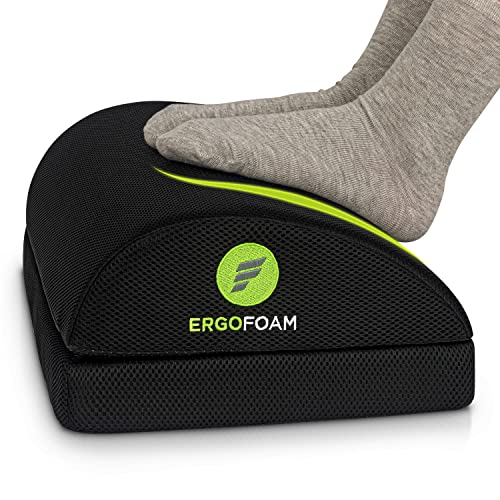
The first thing you notice handling the ErgoFoam is that it is firmer than its product category suggests. Foam footrests photograph as pillows; this one feels like a dense, shaped block that happens to be kind to bare feet. The top surface is gently curved rather than flat, so your feet settle into a shallow cradle instead of balancing on a slab, and the profile is higher toward the back, which puts your heels slightly lower than your toes in a way most people find natural within minutes. The foam itself is the high-density kind: press a thumb in and it yields slowly, then pushes back. That density is the single most important build decision in any cushion, because it decides whether the product still works in year two, and it is where this design spends its money.
The second piece — the height extender — attaches underneath the main cushion and converts the unit from a gentle rise into a genuinely taller rest. The attachment is simple and secure enough that swapping configurations is a ten-second job, which sounds trivial and is not: it means the footrest can move between a low desk and a high stool, or between two household members of different heights, without tools or commitment. Run in the tall configuration, the unit is naturally a little less planted than a framed platform — foam stacks rather than locks — but in practice, under the modest loads feet apply, it stays composed and does not wobble in any way that registers during work.
Flip the main cushion over and the curved underside becomes a gentle rocker. This is the design’s party trick and it should be reviewed honestly: the motion is a short, soft roll, nothing like the long glide of a dedicated rocking platform, and the foam absorbs some of the movement. As an occasional change of angle — a few minutes of rocking during a call, a different foot position after lunch — it is genuinely pleasant. As your main reason to buy, it is not enough; committed movers should buy a real rocker, and the comparison section names two.
The cover deserves its own paragraph because covers decide year-two satisfaction in floor-level products. It is a soft, textured fabric that gives socked feet some grip, it removes via a zip for washing, and it goes back on without a wrestling match. The base of the unit has a non-slip treatment that keeps the cushion planted on hard floors during normal use — you can nudge it into place with a foot and it stays where you nudged it, which is the correct behaviour. On thick carpet it is equally settled. Setup, to use the word generously, is unboxing and choosing a configuration; there is nothing to assemble, adjust with tools, or learn at all. The whole design reads as a considered answer to a short list of real complaints about earlier cushions: too soft, one height only, slides around, cover cannot be washed. Each of those complaints has a visible countermeasure here, which is what good product design in a simple category looks like.
Small Details That Turned Out to Matter
Long reviews earn their length in the details that never make a feature list. Five small things about this design kept surfacing across a month of use, and each one teaches something about judging any footrest.
The zip is a feature. A removable cover is only as good as the experience of removing it, and a flimsy zip turns laundry day into a reason to skip laundry day. This one’s zip runs smoothly and the cover goes back on without distorting, which sounds like faint praise until you have fought a cheaper cushion back into its skin. Judge any washable footrest by whether you would actually wash it monthly; if the mechanism discourages you, the washability is theoretical.
The cradle is shallower than it looks, and that is right. In photos the curved top reads as a deep scoop. Underfoot it is a gentle suggestion — enough to locate your feet, not enough to trap them. Deep cradles feel secure for a minute and restrictive for a day; this shallow one lets your feet wander, which is what feet do. When comparing cushions, be suspicious of dramatic shapes: the ones that photograph best often sit worst.
The spare piece needs a home. The two-height design’s only recurring friction is mundane: when the height piece is off, it exists somewhere — under the desk, beside the desk, in a cupboard. Owners who give it a designated spot keep the product’s flexibility; owners who banish it to another room effectively own a fixed cushion. It is a small, human detail, and it is the kind of thing that decides whether an adjustable product’s adjustability survives contact with real life.
Silence is a build material. With no hinges, runners, or mechanisms, this design cannot develop a creak, a click, or a wobble — an advantage that grows in value in shared rooms, on calls, and in the evening quiet of a home. Entry-level rigid designs often lose their owners not to failure but to a noise that arrives in month two. When you compare across families, count moving parts the way you would count anything that can go wrong.
It photographs worse than it sits. The final detail is a warning about the whole category. This is a plain foam cushion; next to sculpted platforms and wooden rockers it looks like the boring option, and in a scroll of product images boring loses. Under a desk, where you experience a footrest with your feet instead of your eyes, the ranking inverts. Let that inversion guide the rest of your shopping in this category: weight every claim by whether your feet, at hour six, would care about it.
Performance in Real Use
Morning Setup and the First Hour
The ErgoFoam’s daily performance starts with a small mercy: there is nothing to set. Chair first, cushion where your feet land, done. In the first hour of the day the firm foam feels supportive rather than cosy — your feet sit on it more than in it — and the curved top quietly discourages the toe-perching habit, because the cradle gives your whole foot a home. People upgrading from a soft cushion notice the difference immediately: less sinking, more surface. People arriving from the bare floor notice the height most. Either way, the first hour sets the pattern the rest of the day follows: your feet stop being a problem you manage.
The Long Afternoon: Hours Four to Eight
Footrests are won and lost in the long afternoon, when novelty is gone and small annoyances compound. This is where the density choice pays off. Softer cushions progressively bottom out under your heels as the hours pass; the ErgoFoam’s firmer foam holds its shape through a full workday, so the support at four o’clock closely resembles the support at nine. The surface stays comfortable for bare feet across those hours — no hard edges, no aggressive texture — and the cushion holds a little warmth, which most people register as cosiness in a cool room and a few register as too much in a hot one. Shifting position is easy because the cradle is shallow: feet can slide, cross at the ankles, or move to the flipped rocking side without a production. The honest afternoon demerit is shared by all cushions: if your chair is at the tall end and you are using the stacked configuration for hours, you can feel that you are on foam rather than furniture — a slight softness in the foundation that platform users never experience. It is a preference line, not a flaw, but it is the line along which buyers divide.
Calls, Focus Blocks, and the Rocking Side
During calls and deep-focus work, the flipped configuration earns its keep. The gentle roll gives restless feet an occupation that stays invisible on camera and silent in the room — there is nothing to creak, because there are no moving parts, which is a real advantage over entry-level platforms and rockers that develop clicks. The motion range is small, so it reads as a fidget outlet rather than exercise, and flipping back to the stable side takes a second when you want stillness for detailed work. As a movement solution it is best described as a sampler: enough to tell you whether you are a rocking person. If you find yourself flipping it over every day and wishing the glide were longer, that is useful self-knowledge, and it points directly at the StrongTek or Humanscale-class rockers compared below.
Shared Desks and Second Users
In a two-person household the two-height design stops being a feature and becomes the product. One user runs the single cushion at a standard desk; the other adds the height piece at a taller setup; the swap is fast enough that it actually happens, which is the test most adjustability fails. The washable cover also matters more in shared use — a quick wash resets the product between users in a way fixed-cover cushions cannot match. What sharing does expose is the absence of a true angle adjustment: a second user who strongly prefers a tilted, locked surface will not find it here, and on a genuinely shared desk a platform may still be the wiser buy. That is the recurring theme of this review: the ErgoFoam is the most adaptable cushion, and a cushion is what it remains.
Shoes On, Shoes Off: Two Slightly Different Products
The same cushion behaves like two close relatives depending on footwear, and a thorough review should separate the experiences. Barefoot and in socks, the ErgoFoam is at its best: the cover’s texture registers pleasantly, the curve reads clearly through the foot, and long sessions stay comfortable because there is no hard edge anywhere in the system. In shoes, the experience firms up — the shoe’s sole spreads your weight, the curve matters less, and the cushion reads more like a raised, forgiving floor. It remains comfortable, but the margin over a rigid platform narrows, because the platform’s precision starts to count for more once the surface feel is filtered through a shoe. Households that mix the two through a day get both products in one, which is another quiet argument for this design’s middle path. The one footwear case where the cushion clearly loses is heavy boots at a workbench-style desk, where a rigid, wipeable platform is simply the right tool and foam is an affectation.
What Surprised Us
Two findings from living with this design were not the ones the feature list predicted. The first: the low configuration got more use than the tall one, even at a chair that measured as needing lift — because once the chair itself was adjusted with more care than most of us usually bother with, the needed lift shrank, and the cushion’s gentle setting finished the job. The lesson generalises beyond this product: adjust your chair properly before you conclude anything about a footrest, because half of all footrest disappointment is chair disappointment in disguise. The second surprise: the flipped rocking mode, which reads as a gimmick on paper, became a genuine daily habit during long calls — not for exercise, not for posture, just as the place feet preferred to be while the mind was elsewhere. Gimmicks that survive a month of afternoons stop being gimmicks. Neither surprise changes the verdict, but both change how confidently we can say the design’s ideas work in practice rather than in a product meeting — which is, in the end, what a review is for. Readers who want the category judged rather than one model can weigh these findings against the balance sheet in the pros and cons of desk footrests.
Strengths and Trade-Offs
Strengths
- Two heights, one product. The attachable height piece covers both the gentle-support and genuine-lift cases, forgiving the most common measuring mistake a first-time buyer makes.
- Firm, durable foam. The high-density fill holds its shape through full workdays and across seasons of use where softer cushions progressively flatten.
- Genuinely barefoot-friendly. A soft, textured, washable cover over a curved top makes it the surface bare and socked feet most enjoy in this category.
Trade-offs
- No locked angle. The surface follows the foam’s shape, not your setting; if you want a precise, repeatable tilt, a platform does that job and this does not.
- Rocking is a sampler, not a glide. The flipped mode is a pleasant short roll; committed movers will outgrow it and should buy a dedicated rocker instead.
- Foam physics still apply. Density delays compression but cannot repeal it; over years of daily use the cushion will soften where your heels live, and it should be bought as a long-life consumable.
How It Compares
No footrest is bought in a vacuum, so here is the ErgoFoam against the three designs most likely to be on your shortlist, compared on the things that actually separate them. All three rivals are covered in more depth in our desk footrest pros and cons analysis, which weighs the category rather than a single model.
| Design | Type | Where it beats the ErgoFoam | Where the ErgoFoam wins |
|---|---|---|---|
| ErgoFoam Adjustable Foot Rest | Two-height foam cushion | — | — |
| Everlasting Comfort Foot Rest | Plush memory foam cushion | Softer, more pillow-like first impression for pure comfort seekers | Firmer support over long days; second height option; less bottoming-out |
| StrongTek Rocking Foot Rest | Wooden rocker | A real, smooth rocking glide; rigid surface that never compresses | Barefoot comfort; height flexibility; silence guaranteed by having no runners |
| Mind Reader Adjustable Foot Rest | Tilting platform | Locked, repeatable angle and height settings; better for shoes and shared desks | Surface comfort; washable cover; no mechanism to creak or slip |

ErgoFoam vs Everlasting Comfort
This is the softness-versus-support argument in its purest form. The Everlasting Comfort cushion is the plusher object, and if your only complaint is that the floor is hard, its pillow feel may suit you better on day one. The ErgoFoam’s answer is what happens on day ninety: firmer foam, a second height, and a shape that supports rather than swallows. Choose Everlasting for maximum softness at a correct chair height; choose ErgoFoam for everything else in cushion land.

ErgoFoam vs StrongTek Rocker
These two barely compete, which makes the choice clarifying. The StrongTek is a wooden rocker: its whole purpose is a smooth, continuous glide on a rigid surface, and it will still be doing it, unchanged, years from now. The ErgoFoam offers a taste of rocking inside a comfortable cushion. If movement is your headline need, buy the rocker and accept its hard surface. If comfort is the headline and movement is a maybe, the ErgoFoam lets you test the maybe without giving up the comfort.

ErgoFoam vs Mind Reader Platform
The platform comparison is about precision. The Mind Reader gives you set height and a tilting board that holds an angle, which shoe wearers and shared desks genuinely value, at an entry tier. The ErgoFoam gives you a surface your feet will like more and one less mechanism to creak. Households that share a desk and wear shoes should lean platform; solo barefoot workers should lean ErgoFoam. There is no wrong answer here, only a wrong match.
Who Should Buy It, Who Should Skip It
Buy the ErgoFoam if: your feet dangle a little or a lot and you are not certain exactly how much lift you need; you work barefoot or in socks and sit for long stretches; you want one product that can move between two desks or two people; you prefer your workspace gear to look and feel like furnishings rather than equipment; or this is your first footrest and you want the design that forgives the most mistakes.
Skip it if: you want a locked, repeatable platform angle; you wear shoes at your desk all day and prefer a rigid surface; you already know you are a committed rocker who wants a long glide; your setup needs more lift than a stacked cushion can stably give; or your chair height is already perfect and you only want a thin, soft layer — in which case a simpler single cushion serves you for less fuss.
Pre-purchase checklist: sit in your working position and confirm your feet actually need support; check that your under-desk depth fits a cushion with shuffle room; decide which configuration you will start with and where the spare piece will live; confirm the cover’s care instructions suit your laundry habits; and buy through a listing with a return window you are willing to use, then judge the cushion across a full working week rather than a first impression. If the checklist raises doubts about type rather than this model, how to choose a desk footrest walks the decision in steps.
Setup, Care and Maintenance Essentials
Setup is a two-minute ritual worth doing properly. Set your chair for your desk first — arms comfortable at keyboard height, back supported — then place the cushion where your feet land naturally, in the single configuration. Work for a day. If your feet still feel like they are reaching, add the height piece; if the cushion feels like a speed bump, move it slightly further away before concluding anything about height. Position is the most under-used adjustment on any footrest, and it is free. Once the position is right, the only daily habit is returning the cushion to that spot after cleaning or after the chair has rolled over it — parking the chair slightly aside when you leave protects the edges from casters, which are the main source of wear on any floor-level cushion.
Care is laundry-level simple. Vacuum or shake the cushion when you clean the room, because it lives in the dust zone. Wash the removable cover regularly — it is in contact with feet all day, and the washability is one of the reasons to choose this design, so use it. Every few months, press firmly where your heels rest and compare with a less-used area: when the heel zone stops springing back to match, the foam is beginning its slow retirement, and rotating the cushion, where the shape allows, evens the wear. Keep the spare height piece somewhere sensible rather than in a drawer in another room, or the two-height advantage quietly stops existing. None of this is burdensome, and all of it protects the exact qualities — shape, surface, grip — that this review has praised.
One maintenance-adjacent habit is worth adopting from platform owners: the weekly ten-second reset. Once a week, before the first work block, check the three things that drift — cushion position, configuration, and chair height — and put them back where your best day had them. Workstations drift the way gardens do, a centimetre at a time, and the slow accumulation of small displacements is responsible for a surprising share of “this stopped working for me” stories across all ergonomic gear. A footrest with no adjustments of its own still lives inside a system that has plenty, and the reset habit keeps the whole system at the settings this review’s praise was based on. It costs less time than making coffee, and it is the closest thing maintenance-free products have to a service schedule.
Living With It: The First Month, Week by Week
A single day with a footrest tells you about fit; a month tells you about the product. Here is the arc this design typically follows, and what to watch for at each stage if you are running your own trial.
Week one is about position, not judgement. Almost every new owner moves the cushion a dozen times in the first days — closer, further, a touch left — and that fiddling is the setup process working as intended. The useful week-one questions are mechanical: does it stay where you put it on your floor, does the height configuration feel right at your real chair setting, does the cover’s texture suit your feet? If the answer to the height question is no in the tall configuration and no in the low one, the product is the wrong size for your setup and no amount of settling-in will change that. Everything else in week one is provisional.
Week two is when the habits change. This is the stage owners describe most consistently: the foot-tucking and toe-perching stop without being consciously unlearned, because the cushion gives the feet a better default. You may also discover your configuration preference is the opposite of your prediction — many people who buy for the tall setting end up preferring the low one once their chair is properly adjusted, and vice versa. That discovery is exactly what the two-piece design is for, and it is information a fixed cushion could never have given you.
Weeks three and four are the materials’ first report. By now the cover has met your laundry routine once, the foam has taken your full working weight for a hundred-plus hours, and the base has proven itself on your floor through cleaning days and chair collisions. A good unit — and this is one — feels essentially unchanged from week one, which is the least exciting and most valuable outcome a cushion can produce. If a footrest is going to disappoint through softness, slide, or surface wear, the first signs are almost always visible by the end of this month, inside any sensible return window. That timing is not an accident of this review’s structure; it is why we keep insisting the first month is a trial to be used, not a honeymoon to be enjoyed passively.
Using It With a Standing Desk
Standing-desk owners ask about cushions like this one for a specific moment: the seated half of a sit-stand day, and the perch position in between. In ordinary seated use at a height-adjustable desk, the ErgoFoam behaves exactly as it does at a fixed desk, with one advantage — when the desk and chair go up for a taller user or a different task, the second height piece lets the footrest follow the setup instead of being stranded at yesterday’s geometry. As a perch aid, with the chair raised high and your feet resting low on the cushion while you lean, the firm foam handles the partial weight well and the curved top gives your feet a defined place. It is not a standing mat and should not be stood on fully — it is a footrest, and its talents are all in the seated register — but within a sit-stand routine it covers the seated hours without needing a second product.
Evenings, Gaming, and the Second Shift
Footrests lead double lives, and this one’s second shift is at the gaming desk, the craft table, and the reading chair. The traits that matter at work — firm support, a stay-put base, a washable cover — transfer directly, and the cushion’s light weight makes the move between rooms a one-handed afterthought. Gaming sessions add one specific demand: feet that brace during intense moments, pushing hard against the rest. The dense foam takes that without the collapsing feeling softer cushions give under a braced foot, and the non-slip base earns its keep. In a reading chair, the low configuration under a reclined posture is the most relaxed use the product gets, and the one where its softness finally becomes the headline. A design that can be a work tool at nine and furniture at nine in the evening justifies its floor space in smaller homes in a way single-purpose equipment cannot.
What the Tier Buys: Value, Considered Honestly
The ErgoFoam sits in the middle tier of its category, and a review should say plainly what that position means. Below it, entry cushions are simpler: one height, softer foam, covers that may not remove. They cost less and they do the basic job for a while, and for a light user at a nearly-right chair they can be enough. Above it, premium money leaves the cushion family entirely and buys rigid construction — rocking platforms and office-grade adjustable units whose moving parts and materials are built for a decade. The ErgoFoam’s tier is the argument that most people, most of the time, are best served between those poles: the flexibility of two heights and the durability of dense foam, without paying for mechanisms they will set once and forget, or for a glide they may not want. Whether that argument convinces depends on the dividing lines this review has drawn repeatedly. If your needs include a locked angle, the premium platform is not an upsell, it is the correct product. If your needs are comfort and adaptability at one desk, the mid-tier cushion is not a compromise, it is the correct product. Value in this category is fit, priced — and fit is a property of your chair and your legs, not of the product alone. That is also why this review has avoided declaring a winner for everyone: the honest output of a month with this design is a map of who it serves, and you now have that map.
A Note on Comfort Claims, Because This Category Needs One
Footrests attract inflated language, and a review that repeats it would fail you. So, precisely: this cushion can make your sitting position feel more comfortable and more settled by supporting your feet at a sensible height. Many people find that a genuinely pleasant change across a working day, and it is the entire basis of this recommendation. The cushion does not treat, prevent, or fix back pain, circulation problems, or any other medical condition, and it is not a substitute for a chair that fits you, a desk at a workable height, regular breaks, or professional advice when something hurts persistently. We raise this not as legal decoration but because buyers deserve to know which shelf a product lives on: this one lives on the comfort shelf, and on that shelf it is excellent. Shopping with that expectation set correctly is also, in our experience, the strongest predictor of ending up satisfied — people who buy a comfort product to get comfort almost always report getting it.
Final Verdict
The ErgoFoam Adjustable Foot Rest earns its place as this review’s subject and its recommendation by being the most considered version of the simplest idea in the category. It identified the cushion family’s real weaknesses — one fixed height, foam that gives up, covers that cannot be washed — and answered each one directly, while staying silent, soft, and pleasant to live with. Its limits are equally clear: it is a cushion, with a cushion’s ceiling on precision, lift, and lifespan, and buyers who need a platform’s settings or a rocker’s glide should buy those instead without a second thought. For the large middle of home office workers — feet that dangle somewhat, hours that run long, feet that are bare — it is the footrest we would hand a colleague first, and the one we would buy again when the foam eventually retires, which is the most honest compliment a consumable product can earn. If a colleague asked for the one-sentence version, it would be this: it is the cushion that thought hardest about why cushions disappoint, and fixed those reasons one by one. Whether the whole category earns its floor space in your home is a separate question, and it is the one our is a desk footrest worth it verdict answers head-on.
The Long-Term Checks That Separate a Good Desk footrest From a Tiring One
A review that stops at the first week tells you how a desk footrest arrives, not how it lives. The checks below are the ones that separate a product that stays satisfying from one that slowly becomes a chore, and they are the checks worth repeating with any model you shortlist. Treat this as a verification routine: run it during the return window, while changing your mind is still free.
Judge a desk footrest by your body and your desk together: the height range it offers, whether its surface stays put or rocks, and whether your feet rest on it with knees and hips in a comfortable, natural position. Material and grip matter too, because a footrest that slides away or feels unpleasant underfoot will end up pushed aside. Measure the space under your desk, the height of your chair at its working setting and the clearance for your legs, then check the footrest’s footprint against the floor space your chair’s base already claims. Decide whether you want a still platform, a rocking surface or an adjustable design before comparing models.
For long desk sessions, a footrest that lets you shift foot position through the day keeps the setup feeling fresh rather than fixed. For a shorter seated height where feet do not rest flat on the floor, a footrest closes the gap so the chair can stay at the right height for the desk. In a shared or hot-desking setup, a light footrest that moves easily between desks and wipes clean earns its place over a heavier fixed design. Score each check honestly rather than generously. A desk footrest that passes nine and fails one has told you exactly what living with it will be like, and you can decide with open eyes whether that one failure touches your routine.
Apply all of this to the listings in front of you. When a listing such as the ErgoFoam Adjustable Foot Rest, Everlasting Comfort Foot Rest and StrongTek Rocking Foot Rest catches your eye, resist judging it by its headline claim and instead run the checks above against it: does its stated role match the room you measured, does its control path suit your household, and does the maker’s own guidance support the job you have in mind. A model that answers those questions cleanly on paper usually answers them cleanly in the home, and one that dodges them in the listing will dodge them on your wall, shelf or desk as well.
A footrest that is too high pushes knees up and changes your whole seated posture for the worse; more height is not automatically better. On hard floors, a light footrest can travel during the day until it is out of reach, which quietly ends its usefulness. If the footrest keeps sliding, add grip beneath it or place it against the desk’s modesty panel or a wall so it has a stop. If your feet ache on a textured surface, try it with different footwear or socks before rejecting the design; surface feel changes completely with what you wear.
- Run the placement check in the room where the product will actually live for your desk footrest.
- Test the failure mode: network down, power cut, battery flat for your desk footrest.
- Note the chore the product creates and time how long it really takes for your desk footrest.
- Repeat the key test at the hour of day you will use it most for your desk footrest.
- Write down the one behaviour you would change if you could for your desk footrest.
- Decide before the return window closes, not after it.
If a rocking model feels unstable, start with it locked or on its lowest setting and build up as the movement becomes familiar. Wipe or vacuum the surface weekly since footrests collect dust and grit, check adjustable joints and locking knobs for tightness, keep rocking mechanisms free of debris, and air out foam designs so they stay fresh.
If a model passes these checks in your home, keep the notes you made. They become your baseline for judging its replacement years from now, and they are worth more than any fresh round of research done from memory.
It also helps to think in seasons rather than in days. A desk footrest that seems ideal in the week it arrives may face different light, different temperatures, different routines and different demands a few months later, and the models that age well are the ones chosen with that longer view in mind.
Keep the household in the loop as you decide. The person who did not choose the desk footrest is usually the person who discovers its most annoying habit first, and a two-minute conversation before buying can surface the objection that saves a return.
Documentation is an underrated feature of ownership. Keep the manual, the receipt and a note of your settings together, because the day something needs adjusting is never the day you want to reconstruct how it was set up.
When two models seem equal, prefer the one whose maker publishes clearer guidance, steadier updates and easier access to spares or support. That difference is invisible in a feature table and decisive in the third year of ownership.
Finally, resist upgrading the whole room around a single purchase. Live with the desk footrest as it is for a few weeks, learn what it actually changed, and only then decide what else, if anything, the room still needs.
Frequently Asked Questions
Is the ErgoFoam foot rest firm or soft?
It sits on the firm side of the cushion market, and that is deliberate. The foam yields a little under your feet and then holds its shape, so support at the end of a long workday feels much like support at the start. If you are shopping for a pillow-like softness above all else, a plush memory foam cushion will feel better to you in the first ten minutes. If you work full days and want the surface to stay consistent, this firmer design is the better match.
How does the adjustable height work?
The foot rest comes as a main cushion plus an additional height piece that attaches underneath it. Used alone, the cushion gives a gentle rise suited to feet that almost reach the floor. With the extra piece attached, the same cushion sits meaningfully taller, for chairs that leave your feet dangling. Swapping between the two configurations takes seconds and needs no tools, which makes the design practical for two desks or two people with different chair heights in one household.
Can you really rock with it?
Yes, within limits worth understanding. Flipping the main cushion over puts its curved underside down, and your feet can roll it gently forward and back. The motion is short and soft — a pleasant way to change your feet’s angle or keep them occupied during a call — but it is not the long, smooth glide of a dedicated rocking footrest. Treat it as a built-in bonus and a way to discover whether you enjoy movement. If you find yourself wanting more, that is your cue to look at a true rocker.
Does it slide around on hard floors?
In normal use, no. The base has a non-slip treatment that keeps the cushion where you place it on wood and similar hard floors, and you can reposition it deliberately with a nudge of your foot. Very smooth floors and very enthusiastic rocking can still walk any lightweight cushion a little over a day. If yours migrates, a thin non-slip mat underneath ends the problem permanently. On carpet it stays put without any help at all.
How do you clean it, and how long does it last?
Cleaning is one of its strengths: the cover unzips and can be washed, and the cushion itself just needs a vacuum or shake when you clean the room. For lifespan, expect the pattern of all quality foam — years of daily use with a gradual softening where your heels rest, arriving sooner with softer foams and later with dense ones like this. Rotating the cushion evens the wear. When the heel zone no longer springs back, the cushion has become a mat and it is time to replace it.
Who should buy a platform or rocker instead?
Choose a platform if you wear shoes at your desk, share the desk with someone of a different height, or want an angle that locks and repeats exactly every day. Choose a dedicated rocker if gentle movement is the main thing you are shopping for and you want a long, smooth glide that never compresses. Choose this cushion if comfort, bare feet, and height flexibility matter most. The three families solve the same geometry problem with different personalities, and matching the personality to yours matters more than any single feature.
Related reading: the best footrest options for a home office · ergonomic office chairs for a home office
That closes this review. If your shortlist is still open, compare the designs side by side in the roundup, run the measuring steps in the choosing guide, and let your own first month — judged the way this article judged it — make the final call.