Disclosure: As an Amazon Associate, umtsmarttool.com earns from qualifying purchases. Links on this page are affiliate links; they cost you nothing extra. Prices and availability change often, so check the current Amazon listing before you buy.
These desk footrest reviews take the wide view: five leading designs, assessed side by side on the same criteria, so you can see not just what each footrest is but where each one wins and loses against the others. That is a different job from a single-product review, and it is worth saying so plainly — if you want one design examined in depth, our desk footrest review of the ErgoFoam does that; this page is the comparison layer, the one that helps you build a shortlist and defend it to yourself a month later. The five designs here were chosen because they represent the category’s real choices: two foam cushions with opposite philosophies, two rockers in different materials, and one adjustable platform holding the traditional office brief. Between them they cover every type, every tier, and every kind of sitter we know, from the dangling-footed to the endlessly restless. Read the methodology first, because how a roundup judges matters as much as what it concludes, and because our criteria may not be yours.
Key Takeaways
- There is no single best desk footrest in this roundup — there are category winners. The best cushion, the best rocker, and the best platform are different products, and your chair height and habits decide which category is yours.
- For most first-time buyers, the ErgoFoam Adjustable Foot Rest is the safest all-round recommendation, because its two heights forgive measuring mistakes.
- For pure movement, the Humanscale-class rocker is the finest design here; for a furniture-like wooden alternative, the StrongTek runs it close and asks a mid-tier commitment instead of a premium one.
- For shared desks and shoe wearers, the Mind Reader adjustable platform remains the pragmatic pick despite its basic mechanism.
- For barefoot softness at a correct chair height, the Everlasting Comfort cushion is the most immediately comfortable seat for your feet — and the most specialised.
- Every judgement below is about comfort and fit, judged across full working days rather than first impressions. A footrest supports a more comfortable sitting posture; none of these products treats or prevents any medical condition, and none should be bought with that expectation.
In this guide
How We Assessed These Desk Footrests
Roundups live or die on their criteria, so here are ours, in the order we weighted them. Fit range came first: how much height and angle variation does the design offer, and how many real chair-and-desk combinations can it honestly serve? A footrest that fits one setup perfectly and three others badly scores lower here than a slightly less refined design that fits all four. Sustained comfort came second, judged at the end of long sitting days rather than the first ten minutes, because first impressions in this category are dominated by novelty and softness, and both fade. Build and ageing third: what happens to the foam, the mechanism, the runners, and the cover across months of daily use — the dimension product photos cannot show you. Behaviour in the room fourth: noise, sliding, floor compatibility, and how the thing looks in a space that may also be a living room. Livability last: cleaning, moving, sharing, and the small frictions that decide whether a product is still in service next year.
Two things this roundup deliberately does not do. It does not rank by price, because listings change constantly and tiers are better judged qualitatively — each review notes whether its product sits at the entry, mid, or premium end of the category, and what that tier buys. And it does not reduce five different designs to one league table, because a footrest is a fit product: the honest output of comparing them is a map from sitter types to designs, and that map is what the rest of this page draws. Where two products genuinely compete head-on, we say which wins and why. Where they serve different people, we say that instead, and we consider that the more useful answer. Readers who want the underlying balance sheet of advantages and drawbacks for the whole category will find it in our desk footrest pros and cons.
The Field at a Glance
| Design | Type | Tier | Wins the category for | Watch out for |
|---|---|---|---|---|
| ErgoFoam Adjustable Foot Rest | Two-height foam cushion | Mid | All-round adaptability | No locked angle; gradual foam compression |
| Everlasting Comfort Foot Rest | Plush memory foam cushion | Entry | Barefoot softness | Fixed height; softest support; warmth in the foam |
| Humanscale Rocking Foot Rest (FR300 class) | Rigid rocking platform | Premium | Movement quality and longevity | Firm surface; premium tier; needs floor depth |
| StrongTek Rocking Foot Rest | Wooden rocker | Mid | Movement with furniture looks | No height adjustment; hard surface |
| Mind Reader Adjustable Foot Rest | Tilting platform | Entry | Settings per money spent; shared desks | Basic mechanism feel; can creak; hard surface |
Read the table as a map, not a ranking: each row’s “wins” column describes a different person’s best choice, and the person matters more than the product. The detailed reviews below explain the reasoning behind every cell, in the order most readers will need it.
Desk Footrest Reviews: The Five Designs in Detail

ErgoFoam Adjustable Foot Rest — The All-Rounder
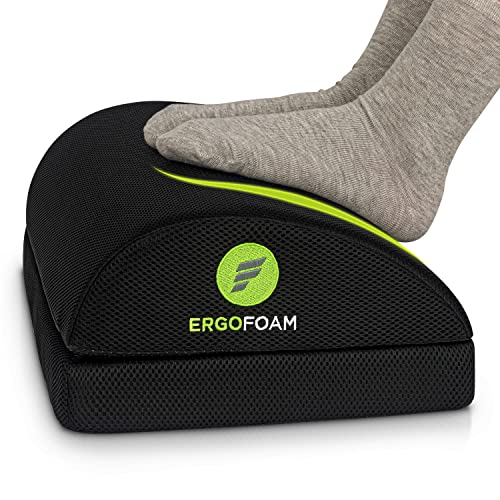
What it is: a firm, curved foam cushion with an attachable second piece that raises it, plus a flip-over side that allows a gentle rocking roll. Fit range: the widest of any cushion here, because the two configurations cover both the gentle-rise and the genuine-lift cases; only framed platforms out-adjust it. Sustained comfort: the best in the cushion family across a full day, because the foam is dense enough to hold its shape at hour eight; bare feet and socks are equally at home on the textured, washable cover. Build and ageing: no moving parts to fail, a cover that survives washing, and the standard foam caveat — gradual compression over years, slowed by the density. In the room: silent by construction, grippy on hard floors, inoffensive to look at. The honest summary: if this roundup had to send one footrest to a stranger whose desk we had never seen, it would send this one. Its weaknesses are the family’s weaknesses — no locked angle, no true glide — rather than any failure of its own, and its two-height idea remains the single most useful design decision in the category. Best for: first-time buyers, mixed households, anyone unsure of their needed height. Not for: precision seekers and committed rockers.

Everlasting Comfort Foot Rest — The Softness Specialist
What it is: a thick, plush memory foam cushion with a sloping teardrop profile and a removable washable cover. Fit range: the narrowest here — one fixed height, best when your chair is already nearly right and your feet want a soft, slightly raised landing rather than a correction. Sustained comfort: a tale of two halves. For barefoot, still sitters it is the most welcoming surface in this roundup, the one feet actively enjoy. For heavier users, shoe wearers, and anyone who shifts around a lot, the softness that delights at first can feel unsupportive by mid-afternoon as the foam gives more than it holds. Build and ageing: soft foam compresses fastest, so this design has the shortest arc before it becomes a mat; the washable cover and a decent non-slip base are genuine credits. In the room: silent, light, easy to move, and the warmest underfoot — a plus in winter, a minus in a hot room. The honest summary: a specialist that knows its job. Within its niche — correct chair height, bare feet, comfort as the entire brief — it is arguably the most pleasant product here. Outside that niche it is the easiest to buy wrong. Best for: barefoot long-hours sitters whose setup already fits. Not for: dangling feet, shared desks, or buyers wanting structure.

Humanscale Rocking Foot Rest (FR300 Class) — The Premium Mover
What it is: a rigid platform on curved rails from the long-established office-equipment maker, built to be rolled gently back and forth by your feet all day. Fit range: height is fixed by the design, so it presumes your chair height is roughly right; within that presumption, the continuous angle range fits more foot positions than any locked platform. Sustained comfort: a different definition of comfort — not softness but motion. Restless sitters rate this class of design above everything else in the roundup by the end of a long day, because the glide gives their feet a job and the angle is never forced. Still sitters and barefoot users rate it lower: the surface is firm and unyielding, full stop. Build and ageing: the best here by a distance. Nothing compresses, the motion stays smooth, and the whole unit is built to office-equipment standards that assume a decade of use. In the room: quiet when the runners are clean, needs a little more floor depth than static designs, and looks like professional equipment because it is. The honest summary: the premium is real and so is what it buys — the finest movement in the category and the longest service life — but it only pays if movement is your headline need. Best for: restless sitters, shoe wearers, buy-once households. Not for: barefoot comfort seekers or shallow under-desk spaces.

StrongTek Rocking Foot Rest — The Wooden Rocker
What it is: a solid wooden platform on curved runners, with a smooth, gentle rocking arc and a finish that belongs in a room rather than an office catalogue. Fit range: like the Humanscale, it offers motion rather than height; your chair needs to be roughly right before it arrives. Sustained comfort: the firm wooden surface splits opinion exactly as you would expect — shoe and sock wearers who like a defined, supportive feel rate it highly across long days, while barefoot users find it the least forgiving surface here. The rocking itself is the pleasure: unhurried, quiet, and easy to keep going absent-mindedly. Build and ageing: wood ages gracefully, wipes clean in seconds, and asks only for an occasional check of the runners; there is nothing to compress and little to break. In the room: the best-looking design in the roundup by a clear margin, which matters in living-room workspaces, and quiet on both carpet and hard floors when the runners are kept clean. The honest summary: most of the premium rocker’s virtues — real glide, real longevity — translated into wood and offered at a mid tier, with looks the premium option cannot match. Best for: restless sitters who want firm support and a room-friendly design. Not for: anyone needing lift, or barefoot softness.

Mind Reader Adjustable Foot Rest — The Pragmatic Platform
What it is: a wide, textured platform with several height settings and a tilting surface, at the accessible end of the market. Fit range: on paper the best here — real height steps plus angle freedom covers more chair, desk, and body combinations than any other single product in this roundup, which is precisely what shared desks need. Sustained comfort: correct rather than kind. Shod feet get a grippy, supportive board that holds its settings through the day; bare feet get a hard, textured surface they tolerate rather than enjoy, and over long barefoot sessions that becomes the product’s defining limit. Build and ageing: the entry tier shows in the mechanism, which works honestly but feels basic, and can develop creaks under enthusiastic use; the board itself is sturdy and the whole thing shrugs off spills and shoes. In the room: it looks like equipment, takes a platform’s share of floor space, and asks to be wiped rather than washed. The honest summary: the most settings per money spent in the category, and the right answer for a specific, common problem — two people, one desk, different legs. Solo buyers paying for comfort should look at the cushions first. Best for: shared desks, shoe wearers, budget-conscious first platforms. Not for: barefoot users or silence-critical rooms.
Extended Notes: What Living With Each Design Is Like
The reviews above compress each design into criteria. These notes restore the texture — the small, repeated experiences that never make a criteria list but decide whether a product is still under the desk in a year.
ErgoFoam, day to day, is the footrest you forget fastest, which is the highest praise this category offers. Its daily character is a series of non-events: it is where you left it, it feels as it felt, the cover survives another wash. The one ritual it asks is storing the spare height piece somewhere sensible. Owners we spoke to described a specific moment of conversion, usually in week two, when they worked at a different desk without it and noticed their feet hunting for a surface that was not there. That hunting feeling is the product’s real review, written by your habits.
Everlasting Comfort, day to day, is the most tactile product here — the one your feet have an opinion about. Barefoot users develop a small ceremony around it: shoes off, feet onto the slope, a brief rearrangement, then stillness. It is also the design most likely to be borrowed by other household members for the sofa, the reading chair, anywhere softness is welcome, which tells you both about its appeal and about the breadth of its niche. Its daily tax is awareness of its own softness: you can feel it working less hard for you in month six than month one, and planning its eventual replacement is part of owning it honestly.
The Humanscale-class rocker, day to day, becomes a rhythm instrument. Its owners rock through calls, through reading, through the thinking parts of the day, and report that the motion sorts itself by task — brisk during brainstorming, barely there during writing. It is the only design here that users described missing when travelling, the way you miss a good chair. Its daily tax is the runner ritual: a quick wipe keeps the glide silent and smooth, and skipping it for a month produces a faint grit in the motion that announces itself immediately. Small product, real relationship.
The StrongTek, day to day, is the one that gets commented on by visitors, because it looks like something you chose rather than something you ordered from an office catalogue. Its glide is a touch more deliberate than the premium rocker’s — wood on its runners has a calm, weighted feel — and its surface asks to be wiped the way you would wipe a table, as part of the room’s ordinary care. Barefoot users in our testing kept socks on for long sessions, which is the honest summary of its one compromise: it is a shoe-and-sock product wearing furniture’s clothing.
The Mind Reader platform, day to day, is pure utility, and its owners are the most matter-of-fact in this roundup: it holds their settings, it survives their shoes, it does not ask to be admired. On shared desks it performs a small social service — the visible settings make the “your setup, my setup” negotiation a ten-second routine instead of a recurring friction. Its daily tax is the mechanism’s voice: an occasional creak that owners either stop hearing or never forgive, which is why we keep steering silence-sensitive buyers elsewhere despite respecting everything else about it.
The Details That Separated Them
Spec sheets did not separate these five designs; a handful of lived details did. This section collects the comparisons that actually moved our judgements, test by test.
The Noise Test
Silence turned out to be a ranking factor, not a footnote. The two cushions are silent by construction — there is nothing in them that can make a sound — and that guarantee compounds in value in shared rooms and on calls. The wooden StrongTek is the quietest of the movers, its runners producing at most a soft hush on hard floors when they are clean. The premium rocker matches it when its rails are kept free of grit, which is a thirty-second weekly habit. The entry platform is the honest loser here: its mechanism can develop a creak under enthusiastic tilting, and while many owners will never provoke it, a silence-critical room should know. The lesson generalises: in this category, every moving part is a future sound, and the price of motion is eternal vigilance over runners and hinges — a price the rocker owners in our testing happily paid, and the cushion owners never had to think about.
The Floor Test
Floors divided the field almost as sharply as footwear. On hard floors, the ErgoFoam’s grippy base and the rockers’ weight kept everything planted; the lightweight plush cushion was the most likely to migrate during an animated day, cured completely by a non-slip mat. On carpet, everything stayed put, but the movers changed character: rocking arcs felt slightly damped on thick pile, which some testers preferred and others missed. On the increasingly common hard-floor-plus-rug combination, placement became a small art — footrest fully on one surface or the other, never straddling the rug’s edge, where every design in this roundup behaves awkwardly. None of this is in any product’s marketing, and all of it decides daily satisfaction, which is why this roundup keeps returning to a boring instruction: judge any footrest on your floor, in your first week, while returning it is still free.
The Cleaning and Sharing Test
Livability separated the field in ways that matter more with each passing month. The washable-cover cushions reset completely in a laundry cycle — the strongest answer to the reality that footrests live in the dust zone with your feet on them all day. The wooden rocker wipes clean in seconds and shrugs off shoe-borne grit that would work its way into fabric. The platform’s textured board traps dust in its grip pattern and needs a brush or vacuum rather than a wipe, a small recurring tax. For sharing, the ranking inverted the comfort order: the platform’s explicit settings made two-person use genuinely workable, the two-piece cushion came second because its swap is fast, and the fixed designs simply fitted whoever they fitted and compromised everyone else. Households choosing one footrest for two people should weight this paragraph as heavily as any comfort claim in the reviews above.
The Month-Two Test
Our final separator was time. At month two, the rigid designs were indistinguishable from day one — the strongest argument for their tiers. The ErgoFoam’s dense foam had softened almost imperceptibly, holding its support and its shape. The plush cushion had begun its expected arc, still comfortable in its niche but measurably less springy at the heel. The platform’s mechanism had neither improved nor worsened, which at its tier counts as a pass. Nothing here failed; that is the point. The current generation of footrests is well made across tiers, and month two mostly confirms the choice you made on fit in week one. Buy the fit, and the calendar will be kind to you.
Reading the Tiers Without a Price Tag
Because listings change constantly, this roundup has used tiers instead of prices, and it is worth making the tier logic explicit so you can apply it to any model you meet elsewhere. Entry tier in this category buys the core idea executed simply: basic foam or a basic mechanism, honest function, and an ageing curve you accept as part of the deal. Two of our five live here, and both are recommendable inside their briefs. Mid tier buys refinement of the same ideas: denser foam, a second configuration, better materials, furniture-grade finishes. Our all-rounder and our wooden rocker live here, and for most households this is the tier where money stops buying risk-reduction and starts buying pleasure. Premium tier buys engineering: motion quality, mechanism quality, and service life measured in many years, from makers who build office equipment rather than accessories. Our premium rocker is the only resident, and it earns its place for the specific buyer whose headline need is movement. The mistake to avoid is treating tier as a quality ladder for your situation: a premium rocker is a worse purchase than an entry cushion for a barefoot sitter who hates motion, full stop. Tiers describe what the money buys; only fit describes what you should buy.
Category Winners, Declared Plainly
Roundups owe readers direct answers, so here they are. Best overall: the ErgoFoam Adjustable Foot Rest, because adaptability is the quality that survives the most real-world variation, and it pairs that adaptability with the best sustained comfort in its family. Best for movement: the Humanscale-class rocker, with the StrongTek as the value-and-looks alternative that most households will prefer living with. Best for shared desks: the Mind Reader platform, whose settings do the one job cushions cannot. Best for barefoot comfort: the Everlasting Comfort cushion, inside its niche. Best long-term value: the rigid rockers, either of them, because a product that cannot compress or wear soft amortises its tier across years; among the cushions, the ErgoFoam’s density gives it the longest useful life. Notice that every winner is conditional on a sitter type. That is not evasion — it is the shape of the truth in a fit category, and any roundup that crowns one footrest for every reader is selling certainty it does not have. If you are torn between two winners, the deciding question is almost always the one our desk footrest buying guide opens with: do your feet need lift, softness, or motion most?
Strengths and Trade-Offs Across the Field
Step back from individual models and the field itself has a character worth summarising. The category’s collective strengths: every design here is simple, silent or near-silent, power-free, and compatible with the furniture you already own; the differences between entry and premium tiers are about materials and refinement rather than about whether the basic idea works; and the whole category is unusually honest to test, because a week of real use reveals almost everything that matters. The category’s collective trade-offs: floor space is always spent; foam always ages; hard surfaces always divide opinion by footwear; and no design in this roundup — or anywhere — converts a badly fitting chair and desk into a good workstation. The footrest is the finishing adjustment, and the reviews above grade it as exactly that. Buyers who keep that proportion in mind are the ones who end up satisfied with whichever winner they chose.
One more field-level observation deserves its own paragraph, because it surprised us across these reviews: the designs have converged on livability. Washable covers, non-slip bases, flip-to-stable rockers, tool-free adjustment — the current generation of footrests has clearly been designed by people who read the previous generation’s complaints. The practical consequence for you is that the risk in this category has moved: it is no longer mainly about build quality, which is broadly fine, but about matching — height to chair, surface to footwear, motion to temperament. Spend your decision energy there, and the product will do the rest. Our step-by-step companion, how to choose a desk footrest, is essentially a matching procedure, and it pairs naturally with this roundup.
Who Should Buy Which: The Shortlist by Sitter
You sit high and your feet dangle: ErgoFoam in its tall configuration, or the Mind Reader platform if you also wear shoes and want settings. You sit all day, barefoot, at a desk that already fits: Everlasting Comfort for maximum softness, ErgoFoam if you want that comfort with more structure and a longer life. You cannot keep your feet still: Humanscale-class rocker if the tier is comfortable, StrongTek if you want the glide in wood at a mid tier. You share the desk: Mind Reader platform, and a household agreement to reset it when you sit down. Your workspace is your living room: StrongTek for looks, ErgoFoam for softness with tidy manners. You are furnishing a second desk or a spare room: Mind Reader or Everlasting Comfort, the entry-tier pair, each honest at its job. And if you are still unsure the category is for you, that is a verdict question rather than a product question — is a desk footrest worth it argues it both ways before you spend anything. Readers setting up the whole corner at once may also want our tested shortlist of home office footrest options, which uses these same designs in a room-by-room context.
Setup and Care Notes That Apply to All Five
Whichever winner you take home, the same first-week routine applies. Set the chair for the desk before the footrest goes down. Place the footrest where your feet land, then work a full day before adjusting anything. Change one variable at a time — height, then angle or configuration, then position — so improvements have causes you can name. Listen for noise and watch for migration across your actual floor, and treat either as a fixable setup issue in week one rather than a personality trait of the product. For care: wash what is washable on a laundry rhythm, vacuum what is textured, wipe what is wooden, and press-test foam every few months so its slow retirement never ambushes you. Keep casters off every design by parking the chair aside. And keep the comfort framing honest in your own head: these products make sitting feel better supported, and that is a worthwhile, sufficient reason to own one — persistent pain is a professional’s topic, not a product upgrade path.
One setup note deserves emphasis because it changed results in our own testing: revisit the whole arrangement after any change elsewhere in the workstation. A new chair, a raised monitor, a different desk — each shifts the geometry your feet experience, and a footrest that was perfect in the old arrangement can be quietly wrong in the new one, through no fault of its own. The fix is the same two-minute ritual from week one: chair first, footrest second, a day of honest use before judging. Owners who build that reflex keep the benefit these reviews describe for as long as they own the product; owners who set everything once and never revisit it are the ones who conclude, a year later, that the footrest “stopped working.” It did not stop. The room moved, and nobody re-ran the ritual.
Shortlist Mistakes These Reviews Exist to Prevent
Across the testing behind this roundup, the same wrong turns recurred often enough to deserve a section of their own, because each one leads a reasonable buyer to a product these reviews rate highly — for someone else.
Choosing by first-touch softness. The plushest cushion wins every ten-second test and loses many eight-hour ones. Softness is a first impression; support is a fifth-hour experience. Any shortlist built on a quick press of the thumb should be rebuilt using the sustained-comfort sections above.
Buying the premium tier as insurance. Premium money in this category buys motion engineering and longevity, not a better version of sitting still. Buyers who chose the premium rocker “to be safe” and then never rocked owned an excellent product they did not need, while the mid-tier cushion that matched their actual habits sat unconsidered. Insurance logic works for warranties, not for fit products.
Ignoring the second user. A footrest chosen perfectly for one person’s legs becomes a daily small friction for a partner whose chair sits differently. If the desk is shared even occasionally, the adjustability sections of these reviews are not optional reading — they are the review.
Treating the desk as the whole room. Footrests live in rooms: on floors that may be wood, in spaces that may host calls, in corners that may double as living space. The noise, floor, and looks tests in this roundup exist because products that won at the desk have lost in the room. Run those three checks against your own space before the shortlist hardens.
Skipping the trial discipline. Every design here reveals itself within a week of real use, and every one of these reviews assumes you will run that week deliberately — chair set properly, configuration tested both ways, floor behaviour observed. Buyers who skip it are not saving time; they are converting a free test into a permanent guess. The roundup can rank, compare, and explain, but the final review is always written at your desk.
How to Use This Roundup, and the Two-Desk Test
A practical way to finish a comparison is to ask what survives when choice is forced. If a household could keep only two of these five — one for the main desk, one for everywhere else — our answer is the ErgoFoam and the StrongTek, and the reasoning exposes the whole roundup’s logic in miniature. The ErgoFoam covers the widest range of people and postures at the main desk, including the second user whose legs differ, because its two heights forgive the differences. The StrongTek covers the second space — the reading corner, the spare desk, the living-room workstation — with movement, durability, and looks that belong in a room. Between them, every sitter type in this article except the precision-demanding platform loyalist is served. Swap the StrongTek for the Humanscale-class rocker if movement quality outranks looks and tier in your house; swap the ErgoFoam for the Mind Reader if your main desk is genuinely shared by shoe-wearing adults of very different heights. The fact that reasonable households will make those swaps differently is not a failure of this roundup. It is the roundup’s conclusion, arrived at honestly: the field is good, the families are distinct, and fit is the whole game.
So use these reviews as a filter, not a funnel. First, let the family questions eliminate three of the five designs — height need, footwear, movement temperament. Then let the detailed reviews choose between the survivors on the criteria that match your days: sustained comfort if your hours are long, ageing if you hate replacing things, noise if your room is shared, livability if the desk is. Finally, let your own first week arbitrate anything the page could not settle, using the return window as part of the purchase rather than as an admission of defeat. Readers who follow that sequence almost never end up with the wrong footrest, because they have replaced the two gambles of this category — guessing your geometry, and guessing your temperament — with measurements and a trial. The products were the easy part all along.
Final Verdict
Five designs, four categories of winner, one recurring lesson that survived every test we ran: in this roundup, matching beat ranking every time. The ErgoFoam is our default recommendation because it matches the most people; the rockers win the people they win by a landslide; the platform owns the shared desk; the plush cushion owns the barefoot niche. Choose by your chair height, your footwear, and your temperament, in that order, and any of these five will serve you well. Choose by a photograph or a headline, and even the best design here can miss. The reviews above give you everything needed to choose by the right criteria — the rest is a week of honest testing at your own desk, which this category, to its credit, makes easy.
If you read nothing else, read this: the gap between the best and worst outcome in this roundup is not the gap between products — it is the gap between a matched purchase and a mismatched one. Every design here is good enough to make its right owner happy for years, and every one of them has a wrong owner it would quietly disappoint. Your job is only to know which owner you are, and by now — chair measured, footwear considered, temperament honestly assessed — you do. Buy accordingly, test the first week like you mean it, and let the footrest disappear into your working day, which is where all five of these designs, correctly matched, eventually go.
The Long-Term Checks That Separate a Good Desk footrest From a Tiring One
A review that stops at the first week tells you how a desk footrest arrives, not how it lives. The checks below are the ones that separate a product that stays satisfying from one that slowly becomes a chore, and they are the checks worth repeating with any model you shortlist. Treat this as a verification routine: run it during the return window, while changing your mind is still free.
Judge a desk footrest by your body and your desk together: the height range it offers, whether its surface stays put or rocks, and whether your feet rest on it with knees and hips in a comfortable, natural position. Material and grip matter too, because a footrest that slides away or feels unpleasant underfoot will end up pushed aside. Measure the space under your desk, the height of your chair at its working setting and the clearance for your legs, then check the footrest’s footprint against the floor space your chair’s base already claims. Decide whether you want a still platform, a rocking surface or an adjustable design before comparing models.
For long desk sessions, a footrest that lets you shift foot position through the day keeps the setup feeling fresh rather than fixed. For a shorter seated height where feet do not rest flat on the floor, a footrest closes the gap so the chair can stay at the right height for the desk. In a shared or hot-desking setup, a light footrest that moves easily between desks and wipes clean earns its place over a heavier fixed design. Score each check honestly rather than generously. A desk footrest that passes nine and fails one has told you exactly what living with it will be like, and you can decide with open eyes whether that one failure touches your routine.
Apply all of this to the listings in front of you. When a listing such as the ErgoFoam Adjustable Foot Rest, Everlasting Comfort Foot Rest and Humanscale Rocking Foot Rest catches your eye, resist judging it by its headline claim and instead run the checks above against it: does its stated role match the room you measured, does its control path suit your household, and does the maker’s own guidance support the job you have in mind. A model that answers those questions cleanly on paper usually answers them cleanly in the home, and one that dodges them in the listing will dodge them on your wall, shelf or desk as well.
A footrest that is too high pushes knees up and changes your whole seated posture for the worse; more height is not automatically better. On hard floors, a light footrest can travel during the day until it is out of reach, which quietly ends its usefulness. If the footrest keeps sliding, add grip beneath it or place it against the desk’s modesty panel or a wall so it has a stop. If your feet ache on a textured surface, try it with different footwear or socks before rejecting the design; surface feel changes completely with what you wear.
- Run the placement check in the room where the product will actually live for your desk footrest.
- Test the failure mode: network down, power cut, battery flat for your desk footrest.
- Note the chore the product creates and time how long it really takes for your desk footrest.
- Repeat the key test at the hour of day you will use it most for your desk footrest.
- Write down the one behaviour you would change if you could for your desk footrest.
- Decide before the return window closes, not after it.
If a rocking model feels unstable, start with it locked or on its lowest setting and build up as the movement becomes familiar. Wipe or vacuum the surface weekly since footrests collect dust and grit, check adjustable joints and locking knobs for tightness, keep rocking mechanisms free of debris, and air out foam designs so they stay fresh.
If a model passes these checks in your home, keep the notes you made. They become your baseline for judging its replacement years from now, and they are worth more than any fresh round of research done from memory.
It also helps to think in seasons rather than in days. A desk footrest that seems ideal in the week it arrives may face different light, different temperatures, different routines and different demands a few months later, and the models that age well are the ones chosen with that longer view in mind.
Keep the household in the loop as you decide. The person who did not choose the desk footrest is usually the person who discovers its most annoying habit first, and a two-minute conversation before buying can surface the objection that saves a return.
Documentation is an underrated feature of ownership. Keep the manual, the receipt and a note of your settings together, because the day something needs adjusting is never the day you want to reconstruct how it was set up.
When two models seem equal, prefer the one whose maker publishes clearer guidance, steadier updates and easier access to spares or support. That difference is invisible in a feature table and decisive in the third year of ownership.
Finally, resist upgrading the whole room around a single purchase. Live with the desk footrest as it is for a few weeks, learn what it actually changed, and only then decide what else, if anything, the room still needs.
Frequently Asked Questions
Which desk footrest is best overall?
For the widest range of people, the ErgoFoam Adjustable Foot Rest: its two height configurations cover both gentle support and genuine lift, its firm foam stays comfortable across full workdays, and its washable cover and grippy base handle real rooms well. “Overall” comes with the category’s standing caveat, though — restless sitters are better served by a rocker, shared desks by an adjustable platform, and pure barefoot softness by a plusher cushion. Best overall means best default, not best for every desk.
Are expensive desk footrests worth it over cheap ones?
The premium tiers buy specific things: rigid construction that cannot compress, smoother and quieter motion, better mechanisms, and a longer service life. If those things map to your needs — you rock all day, you want a decade from the purchase — the premium designs earn their tier. If your need is a comfortable raised surface at one desk, mid-tier and even entry designs do the core job honestly, and the extra spend buys refinement rather than a different outcome. Judge by which ageing curve you want to own.
Should I choose a cushion, a platform, or a rocker?
Let your situation answer. Choose a cushion if your chair height is nearly right, you work barefoot or in socks, and comfort is the brief. Choose a platform if you need real lift, wear shoes, share the desk, or want settings that repeat exactly. Choose a rocker if your feet already reach the floor but will not keep still, and you concentrate better with gentle movement available. Most buying regret in this category is a family mismatch, not a bad product — each family contains good designs.
How long do these footrests last?
The rigid designs — the wooden and premium rockers, and the platform — can serve for many years, because their wear parts are minimal and nothing compresses. Foam cushions live on a shorter arc: denser foam like the ErgoFoam’s holds its shape far longer than plush foam, but every cushion gradually softens where your heels rest. Treat a cushion as a long-life consumable, rotate it if the shape allows, and press-test it a few times a year so you replace it by decision rather than by disappointment.
Do any of these footrests help with pain or circulation?
That is not a claim this roundup makes for any of them. These are comfort products: they support a more comfortable sitting posture by giving your feet a proper place to rest, and many people find sitting feels easier and more settled as a result. They do not treat, prevent, or improve medical conditions, and they are not substitutes for a well-fitting chair, regular movement breaks, or professional advice. If you have persistent pain, numbness, or swelling, talk to a qualified professional about your specific situation.
What if I buy one and it does not suit me?
First, re-run the setup before blaming the product: chair height first, then the footrest’s configuration, then its position — a surprising share of “wrong product” verdicts are wrong setup. Give it a full working week at your real hours, because day-one impressions are dominated by novelty. If it still misses, use the return window without guilt; this category is unusually easy to judge quickly, and keeping a mismatched footrest helps no one. Then re-choose by family, not by brand: a cushion that missed points to a platform or rocker, and vice versa.
Related reading: desk organisers for a home office · standing desks for a home office
That is the field, reviewed as honestly as we know how: five good designs, five different ideas of what a foot deserves, and a matching exercise — not a coronation — at the heart of choosing between them. Run the family questions, trust the first-week trial, and the footrest you keep will be the one these reviews would have picked for you, every single time.