Disclosure: As an Amazon Associate, umtsmarttool.com earns from qualifying purchases. Links on this page are affiliate links; they cost you nothing extra. Prices and availability change often, so check the current Amazon listing before you buy.
Learning how to choose a desk footrest is mostly learning how to measure yourself instead of shopping photographs. The product itself is simple — a surface for your feet — but the right surface depends on four facts about you that no product page can know: how far your feet are from the floor when your chair is set properly, whether you sit still or move, what you wear on your feet, and how much floor your desk can honestly spare. This guide turns those four facts into a seven-step procedure you can run in one evening, with a tape measure, your actual chair, and your actual work habits as the only equipment. Follow the steps in order and the shortlist builds itself; skip to the product listings first and you will join the large, quiet population of people whose footrest lives in a cupboard. If you would rather start from the category overview, our desk footrest buying guide maps the types and tiers this procedure chooses between.
Key Takeaways
- The short answer: set your chair correctly first, then measure the gap between your resting feet and the floor with a tape or a patient stack of books. That gap, plus your movement habits, chooses the footrest family for you — cushion, platform, or rocker — before brands enter the conversation at all.
- Most failed purchases in this category are measurement failures, not product failures. Ten unhurried minutes with a tape measure prevents nearly all of them, and costs nothing but a little honesty about your chair.
- Choose the family before the model, every single time. Within the right family, almost any well-made design will satisfy you; within the wrong family, none will, however excellent it is.
- Adjustability is insurance against your own quite understandable uncertainty. If any of your measurements are guesses, buy the design that can change its mind after it arrives.
- Judge the winner across a full working week, on your floor, in your footwear, at your real working hours. This category reveals itself honestly and quickly to anyone who tests it properly, and punishes everyone who judges it by a photograph.
In this guide
What You Need to Know Before Comparing
Three ideas will do most of the work in the steps that follow, so it is worth understanding them before any measuring starts. The first is that your chair is set for your desk, and your feet inherit the result. In a well-arranged workstation, the seat height is chosen so your arms rest comfortably at keyboard level and your eyes meet the screen sensibly. That height is correct for your upper body almost by definition — and it is frequently wrong for your legs, because leg length and torso length do not scale together. The footrest exists to absorb that mismatch. This is why “just lower the chair” is usually bad advice: it solves the feet by breaking the arms. It is also why the first step of this procedure adjusts the chair before measuring anything: the gap you need to fill is only defined once the chair is where it belongs.
The second idea is that a footrest offers three different goods, and you mostly need one of them. Lift, for feet that dangle. Softness, for feet that reach the floor but find it hard and unsupportive. Motion, for feet that reach the floor and refuse to stay still on it. Every design in the category is a blend of these three, weighted differently: platforms weight lift, plush cushions weight softness, rockers weight motion, and the adaptable middle designs blend lift with softness. Buyers go wrong by shopping for a blend when their situation calls for a speciality — maximum softness when the real problem is a six-inch dangle, say. The steps below force the honest question early: which of the three goods is your feet’s actual complaint?
The third idea is a framing note that keeps expectations healthy. A footrest supports a more comfortable sitting posture by giving your feet a proper resting place, and many people find that makes long sitting days feel noticeably more settled. It is a comfort tool, full stop — not a treatment for back pain or any other condition, and not a substitute for a chair that fits, regular breaks, and professional advice when something hurts persistently. Buy it as a comfort tool, judge it as a comfort tool, and it will very likely delight you. Buy it as anything more and no product in the category can keep the promise. With those three ideas in place — chair first, one main good, comfort framing — the procedure itself is straightforward, and it starts, as promised, with the chair. Readers who want the advantages and drawbacks weighed before measuring can detour through our desk footrest pros and cons and come back.
The Four Facts: A Measurement Worksheet
Everything in the seven steps reduces to four facts about you. Writing them down before you shop — literally, on paper or in a note — converts browsing into choosing, so here they are as a worksheet with the reasoning attached.
Fact one: your gap. Measured in Step 2, expressed as zero, small, or large (or as a book-stack height). This fact decides whether lift is your headline need. Its subtlety: the gap belongs to a chair setting, not to your body. Change the chair or its height and the fact changes, which is why the worksheet records the chair setting alongside the number — “gap: moderate, chair set for the tall desk” is a usable fact; “gap: moderate” alone is a rumour.
Fact two: your temperament. Still, mover, or mixed, from Step 3. This fact decides whether motion is a requirement, an option, or an unwanted distraction. Its subtlety: temperament is task-dependent. Many people are still during writing and restless during calls, and a working day contains both. Record the dominant pattern across your longest work blocks, because the footrest must serve the long afternoon first and the odd call second.
Fact three: your footwear. Bare, socked, shod, or mixed through the day. This fact decides surface: kind fabrics and gentle curves for bare feet, grip and structure for shoes. Its subtlety: footwear changes effective height slightly and changes surface preference completely, so mixed-footwear households should weight surface forgiveness — the designs that serve both registers are the firmer cushions and the smoother platforms.
Fact four: your floor and footprint. Surface type plus genuinely free dimensions, from Step 4. This fact eliminates products outright — the too-deep rocker, the sliding cushion, the platform that fights the chair base. Its subtlety: free space is measured with the chair occupied and in working position, not with the chair pushed away in showroom mode. More footrests have failed this fact than any other, usually discovered on delivery day.
Hold the four facts up against any product listing and the listing becomes remarkably easy to read: height range against fact one, motion against fact two, surface against fact three, footprint and base against fact four. A product that passes all four is your shortlist. A product that fails one is not “almost right” — in a category this simple, one failed fact is the whole review. That strictness is a gift: it means you can shop this category with unusual confidence, because the criteria are few, measurable, and entirely yours.
How to Choose a Desk Footrest in 7 Steps
Step 1: Set Your Chair for Your Desk, Not Your Feet
Sit down to work exactly as you normally do, then deliberately re-set the chair as if for the first time. Raise or lower the seat until your forearms rest roughly level when your hands are on the keyboard, with your shoulders relaxed rather than hunched or reaching down. Set the backrest so it meets your back when you sit back, not when you perch. If your chair has adjustable arms, bring them to support your elbows lightly at that same working height. Now — and this is the discipline of this step — leave the chair there, even if your feet feel wrong. Especially if your feet feel wrong. The wrongness you can now feel in your feet is the precise problem the footrest is being hired to solve, and every measurement that follows is taken from this honest position. People who set the chair to please their feet and then measure will buy a footrest for a workstation they do not actually use.
Step 2: Measure the Gap Your Feet Actually Face
Still seated in the Step 1 position, sit back against the backrest and let your feet do whatever they naturally do. Then look, and measure. If your feet rest flat and relaxed on the floor, your gap is zero — record that, because it changes everything downstream: you need no lift at all, and your choice becomes softness versus motion. If only your toes or the balls of your feet touch, your gap is small to moderate. If your feet dangle clear of the floor when you sit back, your gap is large and lift becomes the headline requirement. A tape measure from the floor to the sole of your resting foot turns “small” and “large” into a number you can shop with; a stack of books works nearly as well — slide books under your feet until your thighs feel level and your feet feel fully supported, then measure the stack. That stack height, minus a little if you will buy foam (which compresses under you), is your target footrest height. Write it down. This single number eliminates more wrong products than every review ever written.
Two refinements keep this measurement honest. First, measure at the end of a work session as well as the start if you can: people sit a little lower and looser after hours in the chair, and the gap can grow slightly across the day. Shop for the larger reading, because a footrest that serves the tired version of you will serve the fresh version too, while the reverse is not guaranteed. Second, measure in the footwear you actually work in. A shoe’s sole is part of your leg for these purposes, and a gap measured barefoot and filled by a product chosen for that number will be subtly wrong every shod afternoon. These are small disciplines, but this step is the foundation of the whole procedure — every later step spends the accuracy you bank here.
Step 3: Decide Whether You Are a Still Sitter or a Mover
The next measurement is behavioural, and you already own the data. Think about your last week of work. Do your feet stay where you put them for an hour at a time? Or do you tap, bounce a knee, hook your feet around the chair base, sit cross-legged, uncross, and re-cross? Be honest rather than aspirational: the footrest must serve the sitter you are, not the sitter in the brochure. Still sitters should weight Step 2’s number above all — a static cushion or a locked platform will serve you best. Movers should promote motion to a headline requirement and look hard at rockers and free-tilting platforms, even if it means caring less about maximum lift. Mixed sitters — still during deep work, restless during calls — are the natural market for flip-over and tilting designs that offer both registers. If you genuinely do not know, the adaptable designs are your answer again: a cushion that flips to rock, or a platform that can tilt freely or lock, lets your first month of ownership finish this step for you.
If self-knowledge fails you here, borrow evidence from your environment. A worn patch of carpet where your toes scuff, a chair base polished by hooked feet, a partner who can hear your knee bouncing through the floor — all of these are temperament data recorded by the room itself. Video calls offer another mirror: watch your own shoulders and head for the small rhythmic movements that betray what your feet are doing below the frame. None of this requires precision. Temperament in this category is a three-way sort, not a spectrum measurement, and a rough honest answer beats a flattering precise one every time. When in doubt between still and mixed, choose mixed — the designs that serve mixed sitters contain the still option inside them, while a purely static design offers the mover nothing at all.
Step 4: Measure Your Real Under-Desk Space
Now measure the room the footrest will live in. With your chair in its working position, note the free floor area: front to back from the desk’s modesty panel or wall to where your feet rest, and side to side between whatever else lives down there — computer tower, storage, the chair’s own base sweep. Depth is the dimension that ambushes people, because rockers need travel room and wide platforms need elbow room your shins will otherwise pay for. Also identify your floor surface and be specific: bare hard floor, low carpet, thick rug, or the increasingly common mixture. Lightweight cushions on polished hard floors need grip; rockers on thick rugs lose some glide; everything behaves badly straddling a rug’s edge. Finally, look at the traffic pattern: do chair casters roll through this space every time you sit down? Then whatever you buy will be run over unless you change the habit, and sturdy designs deserve a preference point. Record all of it — products list their footprints, and this is the step where your numbers meet theirs.
While you are down there, audit the obstacles you have stopped seeing: the power strip your toes currently share space with, the bag that lives under the desk on weekdays, the heater that claims the corner in winter. A footrest joins an ecosystem, and the ecosystem’s other residents do not move for it. If the audit reveals a genuinely contested floor, that is useful information with two possible conclusions — clear the space deliberately as part of the purchase, or accept a compact design as the price of the crowd. What you must not do is buy a full-size design for a contested floor and let the two negotiate unsupervised; the footrest loses that negotiation every day, a centimetre at a time, until it is parked against the wall doing nothing at all.
Step 5: Choose the Family Before the Model
Your measurements now make the category’s biggest decision for you. Gap large: you need genuine lift — an adjustable platform with settings that reach your number, or a two-piece cushion whose tall configuration does. Gap zero or small, still sitter, bare feet: you need softness — a foam cushion, firm if your days are long, plush if comfort is the whole brief. Gap zero or small, mover: you need motion — a rocker whose glide quality will decide your satisfaction, in wood or rigid construction. Shared desk: the family chooses itself — adjustable platform, or the two-piece cushion as the softer compromise. Notice what this step does not contain: brands, prices, or photographs. Those arrive in Step 6, inside a family that is already right, where they can do far less damage. If two families both seem plausible — the classic case is small gap plus restless feet — weight the complaint you feel most often. The dangle you notice hourly outranks the fidget you notice daily, and vice versa.
It is worth pausing on why this step deserves its authority. Families in this category are not trim levels of one product; they are different mechanisms answering different complaints, and their strengths do not transfer. A platform’s precision cannot be added to a cushion later, a rocker’s glide cannot be retrofitted to a platform, and a plush cushion’s softness cannot be dialled into wood. Choosing the family is therefore the one decision in this guide that cannot be revised by accessories or settings — only by returning the product and starting again. That is precisely why the procedure spends four steps earning it and one step stating it plainly. If you feel resistance here — a favourite product lives in the family your measurements rejected — trust the measurements. They were taken from your chair, your legs, and your week. The favourite was photographed in someone else’s.
Step 6: Shortlist Two or Three Models and Interrogate Them
Inside your family, build a shortlist of two or three real designs and put the same questions to each. Does its height or configuration honestly cover your Step 2 number — not approximately, but with your number inside its comfortable range rather than at its extreme? Does its surface suit your footwear: textured grip for shoes, kind fabric for bare feet? Does its base suit your Step 4 floor? Does it clean the way your life requires — washable cover, wipeable wood, vacuumable texture? What is its ageing story: foam that will slowly soften, a mechanism that might creak, runners that need a wipe? And what tier is it, and does that tier buy you something you actually need — longevity, smoothness — or merely something you vaguely prefer? Two or three models will survive this interrogation, and at that point the differences between them are small enough that any of them will likely please you. That is the correct emotional state in which to finally look at listings and availability. The gear section below shows this step completed for the four designs we most often land on.
Step 7: Run the First Week as a Trial, Not a Honeymoon
The final step happens after the purchase and decides whether the first six steps pay off. Buy through a listing with a workable return policy, then use the first week deliberately. Day one: set up in the configuration your measurements chose, chair first, footrest where your feet land. Days two and three: change nothing, and let novelty wear off. Day four: try the other configuration, angle, or position — the one you did not choose — because several designs hide their best setting in the option you skipped. Days five to seven: judge by the long afternoon. Are your feet settled at hour six? Is the product where you left it, silent, and clean enough? Would you notice immediately if it vanished? If the answers are yes, the procedure has worked and the search is over. If the fit is wrong in a way configuration cannot fix, return it while the window is open and re-enter at Step 5 with better data. A returned footrest is not a failed purchase; it is the procedure completing itself.
When the Steps Say Do Not Buy
An honest procedure must be willing to conclude with no purchase, and this one does, in three recognisable situations. The first is the true zero: your gap measures zero, your feet rest flat and content, you sit still happily, and your only motive was the feeling that a proper home office ought to include a footrest. It ought not — not for you. Spend the money and the floor space on something your measurements actually call for. The second situation is the broken foundation: the steps reveal that your chair does not fit you or your desk sits at a height no chair can match. In that case the footrest is being asked to plaster over a structural problem, and the honest sequence is chair and desk first, footrest afterwards if a gap remains. The third is the medical detour: if what sends you shopping is persistent pain, numbness, or swelling rather than ordinary end-of-day restlessness, the procedure’s correct output is a professional’s appointment, with the footrest question postponed until you have real information. Comfort shopping is for comfort problems. A guide that tells you when not to buy is a guide you can trust when it tells you to buy — and in the majority of cases, where a real gap or a real restlessness exists, the steps above will point to a purchase that earns its place daily.
Gear for This Guide: The Shortlist the Steps Produce
Run the seven steps for the most common measurement profiles and the same four designs keep surviving the Step 6 interrogation. They are listed by the situation that selects them, not by rank.

ErgoFoam Adjustable Foot Rest — When Your Gap Is a Guess
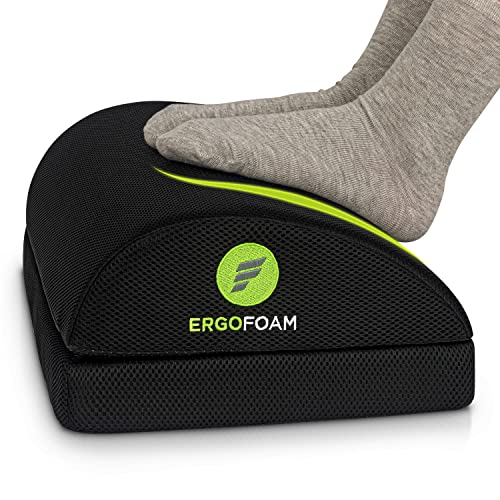
The two-height foam cushion: a firm main cushion plus an attachable height piece, with a flip-over rocking side and a washable cover. Step 5 selects it when your gap is small-to-large and your temperament is still-to-mixed — which is to say, for the majority of home workers — and Step 7 loves it because both configurations can be trialled in the same week. Choose it when your measurements carry any uncertainty. Its limits are the cushion family’s: no locked angle, and foam that ages gradually.

Mind Reader Adjustable Foot Rest — When the Desk Is Shared
The entry-tier tilting platform with several height settings and a wide, grippy board. Step 5 selects it when the desk serves two people, when shoes are worn all day, or when your gap is large and you want settings rather than stacked foam. Its mechanism is basic and its surface is hard, and for its selected situations neither matters much. Choose it for adjustability per se.

StrongTek Rocking Foot Rest — When Step 3 Says Mover
The wooden rocker with a smooth, gentle arc and a furniture finish. Step 5 selects it when your gap is zero-to-small and your honest answer to Step 3 is that your feet will not keep still. It offers no lift, so Step 2 must clear it first. Choose it when motion is the headline and the room’s looks matter; choose its premium rigid counterpart, the Humanscale-class rocker, when glide quality and longevity outrank both tier and appearance.

Everlasting Comfort Foot Rest — When Step 2 Says Zero and Comfort Is Everything
The plush memory foam cushion with a sloping profile and a washable cover. Step 5 selects it in the narrowest, happiest case: gap zero, chair already right, bare feet, still sitter, and a brief that is pure softness. Outside that case it is the easiest design here to buy wrong, which is exactly what the steps exist to prevent. Inside it, nothing else in the guide feels better.
Common Mistakes
Measuring with the chair set for your feet. The foundational error: it makes the gap vanish on paper and reappear at work. Chair for the desk first, always, then measure. Buying maximum softness for a lift problem. Plush foam cannot raise you; a dangle needs height, and softness is a different good. Step 2 exists to catch this before money moves. Skipping the floor. Sliders on hard floors, damped rockers on thick rugs, anything straddling a rug edge — the floor votes on every footrest, and Step 4 is where you count its vote. Choosing the model before the family. A beautiful rocker cannot lift, a plush cushion cannot lock, a platform cannot cuddle. Family first is not a slogan; it is the order in which the properties exist. Judging on day one. Novelty flatters softness and motion alike. The long afternoon of day five is the honest judge, and the return window is built for exactly that timetable. Forgetting the second user. A perfect fit for one person’s legs, imposed on a shared desk, is a compromise renewed daily. If anyone else sits there, Step 5’s shared-desk branch is yours. Expecting the footrest to fix the workstation. It is the last small adjustment, not the first big one. If the chair does not fit and the desk is the wrong height, the steps above will still help — after the big pieces are addressed, which our guide to ergonomic office chairs for home offices can help with. Treating a return as a failure. The final mistake is emotional: keeping a mismatched footrest because returning it feels like admitting defeat. The procedure counts a well-judged return as a success — it is Step 7 completing its work — and the only true failure available in this category is a decade of afternoons spent on the wrong surface because a box was thrown away too early.
Pro Tips
The book-stack test is the best pre-purchase tool you own. A week of working with your feet on a measured stack of books tells you your true target height and whether supported feet even please you — before any purchase. If you miss the stack when it is gone, buy with confidence. Photograph your under-desk space before shopping. The picture, with the chair in place, settles arguments about depth and clutter that memory always loses. Buy the configuration you can trial both ways. Two-piece cushions, tilting-or-locking platforms, and flip-over rockers all let Step 7 test the road not taken; that option is worth more than any single feature. Write your Step 2 number on the order notes you keep. When the product arrives, you will know immediately whether it meets your measurement or merely your hopes. Re-run Steps 1 and 2 after any workstation change. New chair, new desk, new room — the gap is a property of the system, and the system just changed. The procedure takes ten minutes the second time, and it keeps a good footrest good.
Ask a household member to watch you work for two minutes. Self-reports about stillness are the least reliable data in this entire procedure, and an observer spots the knee bounce, the foot hook, and the constant re-crossing that you have long since stopped noticing. Their two-minute report can move your Step 3 answer, and with it your whole shortlist. Shop in the evening, decide in the morning. Measurements taken at the end of a workday reflect the body that actually needs the footrest; purchases made in the same tired hour reflect its impatience. Let a night pass between the worksheet and the order, and re-read your four facts with fresh eyes — if the shortlist still makes sense, it is the right one. Keep the box for a month. Not from superstition: because the counterfactual day in week four sometimes delivers a surprise, and a footrest that can still be returned is a decision that can still be improved. The box costs a corner of a cupboard; the option it preserves is worth more.
Worked Examples: Three Buyers, Three Right Answers
The Counter-Height Kitchen Worker
Her desk is a kitchen counter with a tall stool-style chair, adopted during a hasty move to working from home. Step 1 sets the chair for the counter; Step 2 finds her feet dangling well clear of the floor — a large gap, measured honestly with a book stack. Step 3 says still sitter; Step 4 finds hard floor and generous depth. Step 5 is unambiguous: genuine lift required, so the family is adjustable — and between stacked foam and a framed platform, her shoes-off habits and solo desk choose the two-piece cushion in its tall configuration. Step 7 confirms it on day four, when the low configuration is tried and immediately rejected: the measurement was right. Her right answer is lift, delivered softly.
The Restless Analyst
His desk and chair are a matched, sensible pair, and his feet rest flat — Step 2 returns zero, to his initial disappointment, because he had assumed he needed “support.” Step 3 tells the real story: his notebook is full of meeting doodles and his feet have never once stayed still through a call. Step 4 finds hard flooring and enough depth for travel. Step 5 therefore selects motion, not lift, and Step 6 interrogates the two rockers: the wooden one’s looks suit his living-room desk, its glide is smooth, and the premium rigid model is held in reserve. Step 7’s day-five afternoon — a long reporting call, feet rocking gently throughout, attention undivided — closes the case. His right answer was never a cushion at all.
The Two-Person Spare Room
A couple shares one desk in shifts, with a height difference between them that no fixed product could straddle. Step 2, run twice, returns two different gaps; Step 3 returns one still sitter and one mover; Step 4 finds carpet and modest depth. Step 5’s shared-desk branch governs: the adjustable platform, whose settings each person can reset in seconds, with the tilting board giving the mover a little freedom and the still sitter a lockable angle. Step 6 checks that the platform’s height range honestly contains both Step 2 numbers — it does, with room at both ends. Step 7 adds the household rule that makes it work: whoever sits down, sets the footrest, the same ten seconds they would give the chair. Their right answer is not a product so much as a product plus a habit, which is often the truth in shared spaces. If your household resembles theirs, the wider shortlist in our desk footrest reviews shows how the platform compares with the alternatives they rejected.
Three buyers, three different products, one procedure. That spread is the strongest evidence this guide can offer for its own method: a selection process that always lands on the same recommendation is not a process, it is an advertisement. Yours will land where your four facts point, and if they point somewhere unfashionable — a basic platform, a plain cushion, no purchase at all because the gap measured zero and your feet are content — then that is the correct outcome, and the steps have saved you from the category’s most common fate: a well-reviewed footrest, wrong for its owner, gathering dust at exactly the height nobody needed.
After You Choose: The First-Month Checklist
The procedure ends at purchase only on paper. In practice, the first month is where the choosing is confirmed or corrected, and a short checklist keeps that month honest.
Week one: configuration. Trial both heights, angles, or sides your design offers — including the one you expect to reject. Preferences predicted from a chair are unreliable; preferences measured across two full afternoons are data. By the week’s end you should know your setting the way you know your chair height: without thinking about it.
Week two: position. With configuration settled, fine-tune placement in small moves — a little closer, a little further — across several days. Position is the most powerful free adjustment on any footrest and the one most owners never make after day one. The right position is the one where your feet find the rest without being aimed.
Week three: the room. Now judge the product as a resident rather than a tool. Is it quiet at the hours the house is quiet? Does it survive cleaning day gracefully? Has it migrated, gathered dust in ways that annoy you, or clashed with the chair’s casters? Anything that surfaces this week is a livability fact, and livability facts decide year-two satisfaction more than comfort facts do.
Week four: the counterfactual. Work one full day with the footrest removed and your feet on the floor (or on your old book stack). The comparison is the cleanest verdict available in this category: if the day feels noticeably less settled and you catch your feet hunting for the missing surface, the purchase has proven itself. If the day feels identical, you have learned something equally valuable while returns are still possible. Either way, you end the month knowing — and knowing, rather than hoping, is what this entire guide has been for.
The Fit Check Behind the Choice: Auditing Your Space for a Desk footrest
Guides usually stop at the happy path, the day everything pairs, fits or works first time. This section covers the rest of the ownership curve with a desk footrest: the judgement calls, the awkward cases and the fixes that experienced owners reach for. Keep it bookmarked for the second month rather than the first day; that is when these details start to matter.
Judge a desk footrest by your body and your desk together: the height range it offers, whether its surface stays put or rocks, and whether your feet rest on it with knees and hips in a comfortable, natural position. Material and grip matter too, because a footrest that slides away or feels unpleasant underfoot will end up pushed aside. Measure the space under your desk, the height of your chair at its working setting and the clearance for your legs, then check the footrest’s footprint against the floor space your chair’s base already claims. Decide whether you want a still platform, a rocking surface or an adjustable design before comparing models.
For long desk sessions, a footrest that lets you shift foot position through the day keeps the setup feeling fresh rather than fixed. For a shorter seated height where feet do not rest flat on the floor, a footrest closes the gap so the chair can stay at the right height for the desk. In a shared or hot-desking setup, a light footrest that moves easily between desks and wipes clean earns its place over a heavier fixed design. The common thread is that most problems with a desk footrest are placement, settings or expectation problems wearing a fault’s clothing. Work through the checks in order before concluding that anything is broken or badly made.
Apply all of this to the listings in front of you. When a listing such as the ErgoFoam Adjustable Foot Rest, Mind Reader Adjustable Foot Rest and StrongTek Rocking Foot Rest catches your eye, resist judging it by its headline claim and instead run the checks above against it: does its stated role match the room you measured, does its control path suit your household, and does the maker’s own guidance support the job you have in mind. A model that answers those questions cleanly on paper usually answers them cleanly in the home, and one that dodges them in the listing will dodge them on your wall, shelf or desk as well.
A footrest that is too high pushes knees up and changes your whole seated posture for the worse; more height is not automatically better. On hard floors, a light footrest can travel during the day until it is out of reach, which quietly ends its usefulness. If the footrest keeps sliding, add grip beneath it or place it against the desk’s modesty panel or a wall so it has a stop. If your feet ache on a textured surface, try it with different footwear or socks before rejecting the design; surface feel changes completely with what you wear.
- Start with placement and settings before assuming a fault.
- Change one thing at a time so you know what fixed it.
- Keep a short written note of the working configuration.
- Re-run the basic test after any furniture, network or season change.
- Check the maker’s manual for your exact model before forcing anything.
- Stop and reassess if a fix makes a safety-related behaviour worse.
If a rocking model feels unstable, start with it locked or on its lowest setting and build up as the movement becomes familiar. Wipe or vacuum the surface weekly since footrests collect dust and grit, check adjustable joints and locking knobs for tightness, keep rocking mechanisms free of debris, and air out foam designs so they stay fresh.
Keep a short note of what worked, which setting, which position, which order of steps. The next time the desk footrest misbehaves, and most do eventually, that note turns an afternoon of guessing into ten minutes of fixing.
It also helps to think in seasons rather than in days. A desk footrest that seems ideal in the week it arrives may face different light, different temperatures, different routines and different demands a few months later, and the models that age well are the ones chosen with that longer view in mind.
Keep the household in the loop as you decide. The person who did not choose the desk footrest is usually the person who discovers its most annoying habit first, and a two-minute conversation before buying can surface the objection that saves a return.
Documentation is an underrated feature of ownership. Keep the manual, the receipt and a note of your settings together, because the day something needs adjusting is never the day you want to reconstruct how it was set up.
When two models seem equal, prefer the one whose maker publishes clearer guidance, steadier updates and easier access to spares or support. That difference is invisible in a feature table and decisive in the third year of ownership.
Finally, resist upgrading the whole room around a single purchase. Live with the desk footrest as it is for a few weeks, learn what it actually changed, and only then decide what else, if anything, the room still needs.
Frequently Asked Questions
What is the most important thing to measure before buying a desk footrest?
The gap between your feet and the floor when your chair is set correctly for your desk. Sit back in your working position: feet flat means you need no lift and should shop for softness or motion; toes only or dangling feet means you need genuine height, measured with a tape or a stack of books. That one measurement decides the product family, and choosing the family correctly matters more than any difference between models inside it.
I do not own a tape measure routine — is there a simpler test?
Yes: the book-stack test. Sit in your properly set chair, slide books or sturdy boxes under your feet until your feet feel fully supported and your legs feel level and relaxed, then measure or simply count the stack’s height against something you know. Work a few days with the stack in place if you can. It gives you your target height, tests whether supported feet please you at all, and costs nothing — the best pre-purchase research available in this category.
Should I choose an adjustable footrest even if I think I know my height?
Usually, yes, if the price of adjustability is modest — because your Step 2 measurement is an estimate wearing a number’s clothing. Chair changes, shoe changes, a different desk, and a second user all move the true target, and adjustable designs absorb that movement instead of expiring. The exceptions are the pure cases: a confirmed zero gap with a softness brief suits a simple cushion, and a confirmed mover is better served by spending the same money on glide quality in a rocker.
How do I choose between a cushion and a rocker?
Ask your feet two questions. First, do they reach the floor comfortably? If not, neither a basic cushion nor a rocker is your answer until lift is solved — look at two-piece cushions and platforms. If they do reach, ask whether they stay still. Still feet want a cushion’s surface; restless feet want a rocker’s motion. If you are genuinely between temperaments, a flip-over cushion lets you trial both registers in one product during the first week and keep the one your afternoons prefer.
What if my desk space is very small?
Then Step 4 governs your whole purchase. Favour compact static cushions, which ask the least floor room; avoid rockers, whose travel needs depth, and wide platforms, whose stance competes with your chair base. Measure the genuinely free area with the chair in its working position, and compare it honestly with product footprints. If the free area is truly tiny, a footrest may not be your upgrade at all — and knowing that before ordering is the procedure working as intended, not failing.
How long should I test a footrest before deciding to keep it?
A full working week at your real hours. Day one only measures novelty; days two and three reveal position and configuration preferences; by day five, the long afternoon gives the honest verdict on support, noise, and whether the product stays where you put it. Try the alternative configuration mid-week even if the first one feels fine. Judge inside the return window and act on the judgement — this category rewards decisive testers and quietly taxes everyone who keeps a mismatch out of inertia.
Related reading: is a desk footrest worth it · the single-model desk footrest review · monitor arms for a home office desk · laptop stands for a home office desk
That is the whole method: chair first, gap second, temperament third, floor fourth, family fifth, models sixth, and a first week run as a trial rather than a honeymoon. None of it requires expertise, special equipment, or more than an evening of your attention — and in exchange it converts the most guess-prone small purchase in the home office into one of the most reliable. Your feet have been patient with improvised solutions for long enough. Measure them properly, choose by the numbers you find, and let the footrest you keep be the one your own evidence selected.