A scratch awl is a pointed steel spike in a handle. You use it to mark a line on wood or metal, to dimple a spot where a screw or drill bit should go, and to pierce soft material. The main choices are blade length, handle comfort and whether the tip is round or square.
The six awls below run from a plain hardwood handle to a long forged blade. Lengths, steel and warranty terms come from each listing page and are the makers’ own claims. We have not used these awls ourselves. Where a listing is incomplete or inconsistent, we say so.
As an Amazon Associate we earn from qualifying purchases. Links below are affiliate links, and they do not change the product information we give.
What to Look For
| Feature | Why it matters |
|---|---|
| Blade length | Longer blades reach into tight or deep spots |
| Handle | Wood, plastic and cushion grips feel different in use |
| Tip shape | Round tips mark holes, square tips pierce |
| Ferrule | A reinforced joint holds up when you tap the handle |
In this guide
Specs at a Glance
| Awl | Blade and handle | Weight | Notes |
|---|---|---|---|
| General Tools 818 | Alloy steel; hardwood handle | 3.2 oz | Fluted handle; plated ferrule and cap |
| Klein 650 | 3-1/2 in shank; cushion grip | 4 oz | Lifetime warranty; made in USA |
| STANLEY 69-122 | 3-3/8 in blade; wood handle | 2.08 oz | Limited lifetime warranty |
| Malco A20 | 1/4 in size; plastic handle | 2.72 oz | Resharpenable; limited lifetime |
| Mayhew 46502 | 5-1/2 in blade; 6-1/4 in overall | 22.68 g | Lifetime warranty |
| Narex 874710 | 3-1/2 in square blade; beech handle | 2.11 oz | High carbon tool steel |
The 6 Best Scratch Awls
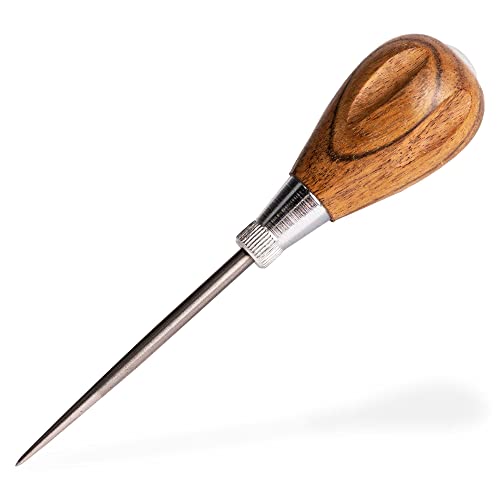
Top pickBest for general layout in wood
1. General Tools 818 Hardwood Handle Scratch Awl
An alloy steel blade runs through a contoured, fluted hardwood handle and is fastened with a plated steel ferrule and cap. The maker suggests dragging the tip along the grain to make a shallow groove that guides a saw or chisel. It weighs 3.2 ounces on the page.
Suits: general layout in wood. Strengths: fluted handle and a clear use list. Weaknesses: blade length is not given. Skip it if you want a cushioned grip.


Best for trade work on metal and wood
2. Klein Tools 650 Scratch Awl, 3-1/2 in
A heat-treated, tempered steel shank 3-1/2 inches long with a full reinforcing bolster at the handle and a cushion grip. The maker says it scribes metal and pierces or punches. The listing offers a lifetime warranty on material defects and says it is made in the USA.
Suits: trade work on metal and wood. Strengths: cushion grip and stated warranty. Weaknesses: material field says only a blend. Skip it if you prefer a wooden handle.

View Klein Tools 650 Scratch Awl with 3-1/2-Inch Shank and Cushion Grip, Made in USA on Amazon
Best for a light everyday awl
3. STANLEY 6-1/16 in Scratch Awl (69-122)
A classic awl with a 3-3/8 inch heat-treated alloy steel blade, a chrome-plated ferrule and a machined hardwood handle. It weighs 2.08 ounces and the maker lists a limited lifetime warranty. The 6-1/16 inch in the title is the overall length.
Suits: a light everyday awl. Strengths: light weight and a plated finish. Weaknesses: a shorter blade. Skip it if you need to reach deep.
View STANLEY 6-1/16 in. Scratch Awl, Wood Handle Awl Tool (69-122) on Amazon

Best for sheet metal and general trade work
4. Malco A20 Scratch Awl, 1/4 in
A steel blade with a bright orange plastic handle that is easy to spot on a job site. The maker says the blade can be resharpened and gives a limited lifetime warranty. The listing gives a 1/4 inch size and 7.5 inches overall, but no blade length.
Suits: sheet metal and general trade work. Strengths: a visible handle and resharpenable blade. Weaknesses: no blade length. Skip it if you want wood in your hand.


Best for reaching into deeper holes
5. Mayhew Select 46502 Scratch Awl, 5-1/2 in Blade
A long 5-1/2 inch blade on a 6-1/4 inch overall tool in alloy steel, with a lifetime warranty stated by the maker. A bullet gives China as the country of origin, while the title does not mention origin. It weighs about 22.7 grams.
Suits: reaching into deeper holes. Strengths: the longest blade of the six. Weaknesses: little description text. Skip it if you want a U.S. made tool.


Best for hand tool woodworking
6. Narex Square Blade Birdcage Scratch Awl (874710)
A small Czech firm’s awl with a high carbon tool steel blade 3-1/2 inches long, a stained beech handle turned in a traditional shape and a steel ferrule. The listing says it suits pre-drilling for screws and general mark-out work in hardwoods. The handle is 2-1/2 inches long.
Suits: hand tool woodworking. Strengths: traditional beech handle and square blade. Weaknesses: not meant for metal. Skip it if you want a cushioned grip.

View Narex Square Blade Birdcage Woodworking Scratch Awl 874710 on Amazon
Care and Setup
- Wipe the blade dry after use.
- Tap lightly rather than hammering the handle.
- Keep the point covered in the tool box.
- Hone a dull tip only as the maker allows.
Mistakes to Avoid
- Choosing a long blade when the job needs control.
- Using an awl as a pry bar.
- Marking so deep that the line cannot be sanded out.
- Ignoring the listing gaps on blade length.
Awl Uses in Wood, Metal and Leather
A scratch awl looks simple, yet it does several different jobs. In woodworking, it marks lines for cutting, locates screw holes and starts a small dimple so a drill bit or screw does not wander. In metalwork, it scribes layout lines on soft metals and punches a starting point for drilling. In leather, canvas and plastic, it pierces stitching holes or marks patterns, though dedicated stitching awls suit that work better.
The way you use it changes the result. For a layout line, hold the awl like a pencil, draw it along a straightedge in a single pass and keep a steady angle. For a pilot dimple, set the point at the mark, press firmly and twist slightly, or tap lightly with a hammer if the maker allows it. Avoid prying with it; the blade can bend or snap.
- Wood: a light scratch along the grain is easier than across it, where the fibers can tear.
- Soft metals: use a firm, single stroke; pencil or marker lines are easier to see on dark surfaces.
- Leather: use a sharp point and support the work on a scrap board.
Narex’s listing here notes use for woodworking, so confirm the intended use for each model.
Blade Shapes: Round, Square and Diamond
Tip shape affects how an awl cuts or pushes. A round shank tapering to a point pushes fibers aside and is the common choice for starting holes and marking light lines. It leaves a clean round dimple that guides a drill bit. A square or birdcage blade has flat faces that cut a bit into the surface, giving crisp lines and a more defined mark, which is favored in hand-tool woodworking. A diamond or tapered pyramid shape sits between the two.
Blade length affects reach and control. A short blade feels stiff and precise for layout work. A longer blade reaches into deeper holes or across wider spaces but can flex. Check the listing for the shank length rather than the overall length, since the handle takes up part of it. Note which listings in this guide leave out the blade length and ask the seller if it matters to you.
- Round tip: general marking and pilot dimples.
- Square or birdcage: precise layout and starting holes in woodworking.
- Long blade: reaching deep spots, but less control.
Look at the point under light. A good point is centered and symmetrical, and any bend or chip indicates a defect.
Handle Materials and Grip Comfort
You may use an awl for hours of layout, so the handle matters. Hardwood handles feel traditional, warm and slightly textured; they are comfortable for light pressure and last for years. Plastic handles are durable, easy to see and resist moisture and oils, though cheaper ones can feel slippery. Cushion grips reduce hand fatigue and help with pressing, but they can wear over time or absorb dirt.
The joint between handle and blade is a key detail. A metal ferrule, a ring at the end of the handle, prevents splitting and keeps the blade seated. If you plan to tap the end with a hammer, look for a reinforced cap or bolster and verify the maker approves of tapping. Poorly attached blades can loosen over time.
- Choose a handle size that fills your palm without cramping.
- Prefer a fluted or shaped handle for better grip when pressing.
- Check for a flat spot that prevents the awl from rolling off the bench.
- Look for a bright handle color if you tend to misplace tools.
If you have large hands or arthritis, a bigger cushioned handle may reduce strain.
Steel Quality and Keeping the Point Sharp
Steel type and heat treatment influence how long a point stays sharp. High carbon steel can take a fine point and hold it but may rust if neglected. Alloy steels offer durability and are often plated or finished to resist corrosion. A blade that is too soft bends or dulls quickly, while one that is too hard can chip. Listings rarely give hardness numbers, so rely on the maker’s description and warranty statements, treating them as claims rather than test results.
A dull awl skids and leaves a ragged mark. Resharpen it with a fine file or a sharpening stone, or on a fine abrasive, turning the shank as you work so the taper stays even. Make small, light strokes and test the point on a scrap of wood. Some makers state that their blades can be resharpened, as the Malco listing here does; for others, check before grinding.
- Wipe the blade after use and add a thin film of oil for storage.
- Do not use the awl as a screwdriver or chisel.
- Cap or sheath the point when it is in a drawer.
A sharp, clean awl needs less force, which makes it safer and more accurate.
Safe Handling and Choosing a Set
An awl is a stabbing tool, and handling it carefully prevents injuries. Keep your free hand out of the line of the point, support the work firmly in a vise or with clamps, and push away from your body. Never carry an awl loose in a pocket. Use a point guard, a cork, a leather sheath or a tool roll. Store it where children cannot reach it.
When a task involves different materials, a small set can be better than a single awl. A short, stiff awl for precise woodworking layout and a longer one for reaching or piercing is a practical pair. If you work mostly in metal, choose one with a hardened shank and a strong joint. If you work in cabinetry or furniture, a hardwood handle and a square blade are well suited.
Questions to ask before you buy:
- Which material will I mark most often?
- Do I need a long reach or precise control?
- Does the listing give the blade length and steel type?
- Is the warranty clearly described by the maker?
- Will I tap it with a hammer?
Replace an awl when the blade is bent, the handle is loose or cracked or the point is too damaged to restore.
Choosing a Scratch Awl by Blade, Handle and Habit
An awl is a lifetime tool bought in minutes, which is why so many workshops own the wrong one. The six awls in this guide differ in blade length and cross-section, handle material and shape, and intended trade, and each difference shows up in the hand within the first week of use. This section turns those differences into a deliberate choice.
Blade length follows reach and control
Short blades are stiff, precise and easy to steer for close layout work at the bench. Longer blades reach into assemblies, align holes through stacked parts, and give leather and upholstery workers the travel they need. The trade is leverage against finesse: length that helps you reach can also let the point wander if your grip is loose. Choose by your most common working distance, and remember that most benches eventually hold two awls, a short one for layout and a long one for everything else.
Cross-section changes what the hole becomes
A round blade displaces fibers and leaves a round dimple, ideal for starting screws and marking centers. A square or diamond blade, like the Narex birdcage pattern in this guide, cuts fibers as it turns and produces a cleaner, more defined hole in wood, which is why joiners favor it for precise layout and for starting brads without splitting. If your awl work is mostly marking, round is forgiving. If it is mostly starting fasteners in fine wood, a cutting cross-section earns its keep.
The handle is the tool you actually hold
Hardwood handles reward a full grip and transmit feel; they also develop a patina that improves grip over years. Molded and cushioned handles suit users who press hard and often, such as leather workers punching repeated marks. Ferrule construction matters when an awl is tapped or pressed firmly: a sound ferrule keeps the handle from splitting where blade meets wood. Judge handles by an honest minute of gripping in the store or by the photos and descriptions here, because comfort in minute one predicts use in year five.
Each Pick at Work: Six Awls, Six Hands
General Tools 818 Hardwood Handle Scratch Awl
The classic bench awl: hardwood handle, straightforward blade, no specialization. It suits the general woodworker and homeowner whose awl marks layout lines, starts screws and aligns the occasional hole. As a first awl or a dependable spare that lives on the bench rather than in a kit, its virtue is that it does the common jobs without asking to be thought about.
Klein Tools 650 Scratch Awl
Klein’s awl comes from the electrician’s world, where an awl starts screws in boxes and studs, aligns fixtures and marks in places a pencil cannot reach. Its build suits tradespeople who use an awl daily, press hard, and expect the handle and shank to tolerate a working life in a tool belt or pouch. DIYers who want one awl built to a trade standard will feel the difference in the grip and the point’s durability.
STANLEY Scratch Awl (69-122)
A familiar, accessible awl for the home workshop: marking, starting and light aligning across wood and soft materials. It fits the occasional user who needs an awl a few times a month and wants a known name at the bench without deliberation. For many households this is the awl that finally replaces the improvised nail, which alone improves every screw it starts.
Malco A20 Scratch Awl
Malco serves sheet-metal and HVAC trades, and this awl suits marking and starting work in metal and duct contexts as well as general shop use. Users who scribe lines on sheet goods, start self-piercing screws, or align metal parts will appreciate a tool specified with that world in mind. It is also a sensible second awl for a woodworker who regularly marks metal hardware and brackets.
Mayhew Select Scratch Awl, longer blade
The longer blade is the point of this pick. It suits alignment work through thicker assemblies, reaching into carcasses, and users who find short awls cramped in a full-hand grip. Mayhew’s striking-tool heritage shows in solid construction. If your awl tasks involve depth, such as lining up hinge leaves, shelf supports or stacked parts for a through hole, the extra reach stops being a spec and becomes the reason.
Narex Square Blade Birdcage Scratch Awl
The specialist for fine woodworking layout. The square blade cuts a clean pilot as it rotates, reducing split risk near edges and in end grain, and Narex is a maker joiners already trust for chisels. It suits furniture makers, box makers and anyone whose layout marks become visible joinery. This is the awl bought deliberately, by someone who has felt a round awl split a thin part once and decided never again.
Head-to-Head: Resolving the Common Comparisons
General Tools versus STANLEY for the home bench
Both serve general work well. The decision comes down to handle preference and blade feel in your hand: hardwood tradition against a familiar utility format. Neither will limit a home workshop. Buy the one whose grip you prefer in photos and descriptions, and spend the saved deliberation on learning good marking technique, which matters more than the badge at this level.
Klein versus Malco: two trades, two emphases
Klein’s heritage is electrical work in wood and boxes; Malco’s is sheet metal and duct. If your awl mostly meets timber and fixtures, Klein’s pattern fits. If it mostly meets metal, Malco’s fits. Cross-shoppers who work in both worlds should choose by the material they mark when accuracy matters most, because that is where point geometry and handle pressure tell.
Round general awls versus the Narex square blade
Forgiveness versus precision. A round awl is tolerant of angle and pressure and serves a dozen odd jobs, including light reaming and aligning. The square birdcage blade is a layout instrument: cleaner starts, less splitting, better behavior in fine stock, and less interest in being used as a general poker. Most serious benches end up with both, one for the toolbox and one for the bench top.
First Marks: A Short Practice Routine
Set up with scrap from your current project, a square, and good light. Rest the workpiece on a firm surface that the point cannot damage if it passes through, keep fingers behind the line of travel, and never hold small stock in the hand you are pushing toward. An awl point slips exactly once per lesson, and the lesson is always about hand position. Wear eye protection when tapping an awl or working brittle material.
Scribe a line along the square first, using light pressure and letting the point track the edge; a deep first pass tears fibers and wanders, while two light passes produce a crisp line the saw or chisel can follow. Then practice starting screws: make a dimple at a marked center, deepen it with a gentle twist, and drive the screw by hand to feel how a started screw tracks straight. Finish by aligning two stacked offcuts with the awl through a drilled top hole, the quiet party trick that saves assemblies. Ten minutes of this turns a new awl from a sharp stick into a layout tool, and it also reveals whether the handle suits your hand while returning it is still easy.
Troubleshooting in Diagnostic Order
When awl work disappoints, check in this order. First, point condition: a bent, burred or blunted point wanders and tears, and most awl problems live here, fixed by careful repointing on a stone with the blade rotated evenly. Second, pressure and angle: pressing hard at a slant skids the point across the surface, while a vertical start with modest pressure seats it where you marked. Third, surface and grain: points follow soft earlywood and deflect at grain boundaries, so mark across the grain first or deepen the dimple before committing. Fourth, handle and grip: a handle that rolls or a grip too close to the blade reduces steering, and choking back on the handle usually restores control. Fifth, the wrong tool for the mark: a pencil line may serve better for rough work, a marking knife for critical joinery shoulders, and a center punch for metal drilling centers, and choosing among them is a skill, not a defeat. Worked in order, these checks fix the mark before you blame the steel.
Storage, Sharpening and the Two-Awl Bench
Store an awl where its point is protected and findable: a drilled block on the bench, a sheath, or a magnetic strip with the point capped. A loose awl in a drawer is a puncture waiting for a searching hand, and its point dulls against other tools. Keep the blade dry and lightly oiled in damp shops, and wipe it after work in treated lumber or leather, which can be corrosive or gummy. Repoint little and often rather than grinding a neglected tip back from blunt, rotating the blade on the stone to keep the point centered. Over time, most benches settle into the two-awl pattern this guide’s picks suggest: a fine layout awl that never leaves the bench, and a tougher general awl that travels to the work. Organized that way, the cheapest tool in the shop quietly prevents the most expensive mistake in it, the fastener started in the wrong place.
Project Scenarios: The Awl at Work
Hanging and aligning hardware
Hinges, handles, shelf brackets and latches all begin with an awl mark in practice, because a pencil dot hides under a screw head’s shadow while an awl dimple guides the screw physically. Mark through the hardware itself where possible, dimple each center, and the screw starts where the mark is instead of skating across varnish. The General Tools and STANLEY awls in this guide handle this household work daily, and the longer Mayhew helps when hardware sits deep inside a cabinet.
Fine joinery layout
In box and furniture work, an awl scores layout lines that a knife would make too aggressively and a pencil too vaguely, and it starts brads and pins without splitting thin stock near edges. The Narex square blade is the specialist here, cutting a clean pilot as it turns. Pair it with a square and a light touch, and layout becomes a physical groove the next tool can follow, which is the quiet secret of accurate hand joinery.
Leather, upholstery and craft work
Awls mark stitch lines, start holes and align layers in leather and heavy fabric, where a round blade’s displacement is gentle on the material. Press rather than strike, work on a firm backing, and let the point’s sharpness do the work. A comfortable, ferruled handle like the Klein’s pattern rewards the repetition this work involves, and a dedicated craft awl keeps shop contaminants off materials that show every mark.
Electrical and mechanical assembly
Aligning covers, starting screws in boxes, and persuading stacked plates into register are awl work in the trades. The Klein and Malco awls in this guide come from these worlds, where the tool lives in a pouch and is used one-handed while the other hand holds the part. In this scenario the awl is less a marking tool and more a third hand, and length and handle security matter most.
Decision Guide by User Type
The homeowner should buy one good general awl, General Tools or STANLEY class, and let it replace every improvised point in the house. The furniture maker should buy the Narex for layout and keep the general awl for everything else, because their costliest awl errors happen in fine stock. The tradesperson should buy their own trade’s pattern, Klein for electrical contexts and Malco for metal contexts, because those designs encode decades of their trade’s habits. The crafter should prioritize handle comfort over blade exoticism. Notice that the awl is cheap enough that the real decision is not money but assignment: which awl owns which job on your bench.
Ownership Habits: Point Care as a Ritual
Make repointing a thirty-second ritual rather than a project: a few rotations on a fine stone whenever the point starts to skate, done at the bench where the stone already lives. Keep a cork or a drilled block on the awl’s home spot so the point is sheathed the moment your hand leaves it; most awl injuries happen reaching into storage, not during use. Wipe the blade after leather or treated wood, and never lend the fine layout awl for prying paint lids, the classic fate of good awls. Marked, maintained and assigned, an awl outlasts almost everything else on the bench, which is why old workshops treat theirs with a respect out of proportion to its price.
Technique Notes: Lines, Dimples and the Discipline of the Mark
Layout accuracy is a chain, and the awl is usually its first link: a dimple placed a fraction off becomes a screw started a fraction off, which becomes hardware sitting visibly wrong forever. Slow down at the mark, not at the driving. Place the point by eye with the work lit from the side, seat it with a light press, check its position against the rule or square before deepening it, and only then commit. That two-stage marking, locate then deepen, is the whole technique, and it is remarkable how many crooked screws trace back to skipping the check between the stages.
Starting fasteners near edges and in end grain
Splits happen at edges and in end grain, where fibers have nowhere to displace. An awl hole slightly deeper than usual, made with a gentle twisting motion, gives the screw’s threads room to engage without wedging the wood apart. In very hard or brittle stock, step up honestly to a small drilled pilot; the awl’s role is judgment as much as hole-making, and recognizing when a drill should take over is part of owning the tool well. Test on an offcut from the same board when the piece matters, because boards vary more than species charts admit.
Materials Notes: Marking Across the Workshop
Wood species and mark visibility
An awl line reads differently in pale maple, where a scribed groove shows as a shadow, than in dark walnut, where it can vanish until finish finds it. Adjust depth to the species and the purpose: layout lines meant to be cut away can be bold, while marks on finished faces should be the lightest dimples that still guide the screw. In oily or resinous woods, wipe the marking area first so the point tracks cleanly instead of skating on a lubricated surface.
Metal, plastic and other surfaces
On sheet metal an awl scores a legible line and starts screws, but drilling centers in metal belong to the center punch, which makes the dimple a drill actually follows. On plastics, light pressure avoids stress marks that can bloom into cracks later. Knowing which marker owns which material, awl, knife, pencil or punch, is a small map worth memorizing, because most marking errors are really tool-selection errors made in a hurry.
Skill Progression: The Layout Habit
Build one ritual and keep it: measure, mark lightly, verify against the rule, then commit the mark. That sequence, applied to awl work, joinery layout and hardware fitting alike, quietly eliminates the most expensive class of workshop error, the confidently made wrong mark. Over months, the ritual stops feeling like caution and starts feeling like speed, because work that is marked once, correctly, never has to be explained, filled or redone.
Scratch Awl FAQ
What is a scratch awl used for?
Marking lines, dimpling a spot for a drill bit or screw, and piercing soft material.
Which awl has the longest blade?
The Mayhew lists a 5-1/2 inch blade. The Klein and Narex list 3-1/2 inches.
What is the difference between a scratch awl and a scribe?
The terms overlap. An awl typically has a thicker pointed shank in a handle and also pierces or dimples, while a scribe is mainly for drawing fine lines, often with a carbide tip.
Can I tap a scratch awl with a hammer?
Only if the maker allows it. Some have a reinforced cap for light tapping, while others may crack or loosen, so check the listing and manual.
How do I sharpen an awl?
Use a fine file or sharpening stone, turning the shank to keep the taper even. Take light strokes and test the point on scrap.
Why does my awl wander when I mark?
The point may be dull, the surface may be hard or you may be pressing from an angle. Sharpen the tip, support the work and keep the awl upright.
Which blade length should I choose?
Shorter blades give control for layout, while longer blades reach into deeper spots. Choose by the work you do most.
Will an awl mark steel?
A standard steel awl may not mark hardened steel. Softer metals take a mark better, and a carbide scriber is better for hard surfaces.
How do I keep an awl from rusting?
Wipe it dry after use, apply a thin film of oil and store it in a dry place with the point covered.
Layout Technique That Produces Cleaner Lines
A scratch awl is only as accurate as the way it is held. The most common error is pressing too hard on the first pass. A deep first scratch is hard to correct and, in wood, can tear fibers along the grain so the line wanders. Start with a light pass to establish the line, then deepen it with a second or third pass only where you need a groove for a chisel or saw to register against.
Hold the awl like a pencil, but tilt it so the shaft leans in the direction of travel and the point trails slightly. Dragging a point behind the hand is steadier than pushing it ahead. Keep the edge of your square, rule or straightedge pressed firmly against the work, and slide the awl along the tool with the shaft touching the edge so the blade has a consistent angle. If the awl rides a small gap away from the straightedge at one end and touches it at the other, the line will skew.
- Mark on the waste side of the cut so the line is removed or split by the saw.
- Use a pricked tick mark instead of a long line when you only need a location. A single puncture is easier to find with a drill bit than a pencil dot.
- On finished or painted surfaces, test on a hidden spot first, since an awl leaves a permanent mark.
- Under raking light, a scratched line is easier to see than a pencil line on dark wood or oily metal.
Awl, Center Punch or Marking Knife: Choosing the Right Marker
These three tools overlap, and buying the wrong one is a quiet source of frustration. A scratch awl does the broadest range of work but is not specialized for any of it. A center punch is struck with a hammer to create a dimple that keeps a drill bit from skating on metal. An awl is not designed to be hit, so it will not do that job without risk to the tip and handle. A marking knife has a flat, beveled edge that severs wood fibers on cross-grain cuts, which gives a crisper shoulder line than a round point can.
For general household and light shop use, an awl covers the most ground. Furniture makers who cut a lot of joinery often keep both an awl and a knife, using the awl for hole locations and rough layout and the knife for lines that a chisel will follow. If you mostly work in sheet metal or drill steel, buy a spring-loaded or hammer-struck punch alongside the awl rather than expecting one tool to do both.
| Task | Best fit | Why |
|---|---|---|
| Marking a screw location in wood | Scratch awl | Light puncture guides the screw tip |
| Knife wall for a chisel cut | Marking knife | Beveled edge cuts fibers cleanly |
| Starting a drill hole in steel | Center punch | Hammer-struck dimple holds the bit |
| Layout lines on plastic or soft metal | Scratch awl | Visible line without a pencil |
Starting Screws and Pilot Holes With an Awl
One of the most practical uses for a basic awl is the humble pilot start. Pressing and twisting the point into softwood creates a small guide that lets a screw begin straight, especially near an edge or on a curved surface. This is not a replacement for a drilled pilot hole in hardwood, where a screw can split the board, but it solves the common problem of a screw tip sliding off its mark.
Twist the awl rather than driving it straight down, since rotation parts fibers instead of crushing them. For hanging hardware, hinges and cabinet pulls, a quick prick at each location also transfers the position from a template to the work without the template shifting. Keep depth modest. A start that is too deep and wide will let a screw wobble.
Awls can also help in tasks that have little to do with layout. People use them to clear paint from a screw head slot before inserting a driver, to open a clogged nail hole for filler, or to hold a small piece of wood steady while a hand plane takes a shaving. Use caution with this kind of improvisation and avoid prying, which is the fastest way to snap a tip or bend the shaft.
Who Gains Most From a Basic Awl Versus a Premium One
Because this category spans inexpensive utility pieces and finely made woodworking tools, it helps to match the purchase to how often you will reach for it. A homeowner who marks a few holes a year is well served by a plain steel awl with a comfortable handle. Replacement is cheap if it goes missing, and sharpening occasionally with a fine file or stone keeps it working.
A hobbyist who builds furniture, restores instruments or does leatherwork has more to gain from a better-made tool. A well-ground point, a handle that does not roll off the bench and a shaft that stays straight reduce small irritations that add up over hours of use. Better steel may hold a point longer, though no listing alone proves that, so read what the maker says about hardness and heat treatment where it is given.
For classrooms, scout groups or shared garages, consider a cheap pair of awls with plastic or guarded tips and keep supervision in place. A sharp point can cause deep puncture wounds, and a lower price is a reasonable trade when tools are likely to be dropped, lent or lost. In every case, store the awl with its point protected, whether in a cork, a tube or a pocket in a tool roll, so the tip stays sharp and hands stay safe.
Frequently Asked Questions
Can I use a scratch awl to clean out a glue joint or screw slot?
Light cleaning is a reasonable use. The point can clear dried glue from a tight crevice or debris from a screw slot. Avoid prying or twisting hard, because a thin tip can bend or snap. If you do this often, keep one cheap awl for cleanup and reserve a better one for accurate layout work.
How hard should I press when scribing a line?
Start light. A first pass should be barely deeper than a pencil mark, and you can repeat it to deepen the line if you need a groove for a saw or chisel. Heavy pressure on the first pass tends to wander off the straightedge and, in wood, tear along the grain.
Is a scratch awl safe for kids’ craft or school projects?
Only with supervision. Even a modest point can cause a puncture wound, so younger children should use guarded craft tools instead. For teens working on woodshop or leather projects, teach them to cut away from the body, keep the point covered when not in use and never carry the awl loose in a pocket.
Do I need a separate awl for leather and for wood?
Not necessarily, but the point shape matters. Round points part leather fibers and wood fibers without cutting them, which suits stitching holes. Diamond or sharper points cut cleaner holes but can weaken thin leather. If you do a lot of stitching, pick a dedicated stitching awl.
The Short Version
For a plain hardwood handle, the General Tools. For a cushion grip, the Klein. For a classic light awl, the STANLEY. For a bright handle, the Malco. For a long blade, the Mayhew. For a traditional square blade, the Narex.