A tenon saw is a back saw with a stiff spine, used to cut the shoulders and cheeks of joints so that they fit cleanly. The spine keeps the thin blade straight, which is why these saws suit square, repeatable cuts. Japanese dozuki saws do the same job with a pull stroke and a thinner blade.
The six saws below include four western style back saws and two Japanese dozuki saws. Lengths, tooth counts and materials come from each listing page and are the makers’ own claims. We have not used these saws ourselves. Several pages contain figures that disagree with the title, and we point those out.
As an Amazon Associate we earn from qualifying purchases. Links below are affiliate links, and they do not change the product information we give.
What to Look For
| Feature | Why it matters |
|---|---|
| Blade length | Longer blades cut deeper in one pass |
| Teeth per inch | Fewer teeth cut faster, more teeth cut finer |
| Spine | Brass or steel keeps the blade straight |
| Tooth filing | Rip filed teeth follow the grain; crosscut teeth cut across it |
In this guide
Specs at a Glance
| Saw | Blade | Teeth | Notes |
|---|---|---|---|
| Spear and Jackson 12 in | 12 in; high carbon steel | 15 ppi in title | Brass back; wooden handle; table has odd figures |
| Robert Sorby RS-5412K | 12 in; 305 mm | 13 TPI | Brass back; resharpenable; 725 g listed |
| Lynx Thomas Flinn | 12 in; spring steel | 13 or 15 TPI (conflict) | Filed for rip cutting; 3-1/8 in depth of cut |
| HAUTMEC 12 in | 12 in; 65Mn steel, 0.8 mm | 11 TPI | Steel spine; double-ground teeth; one year warranty |
| Gyokucho 770-3500 | 180 mm; 0.3 mm thick | 17 (table) | Pull stroke; stiffened back; made in Japan |
| Z-saw Dozuki Hardwood | 240 mm | 1.2 mm pitch (21 TPI) | Replaceable blade; impulse hardened teeth |
The 6 Best Tenon Saws

Top pickBest for general joint cutting
1. Spear and Jackson Tenon Saw, 12 in x 15 ppi
A traditional back saw with a brass back, a 12 inch high carbon steel blade, cross ground teeth and a wooden handle fixed by rivets. The maker says the universal teeth cut along and across the grain and that it suits joint cutting and small pieces. The details table lists 6 teeth, a speed in rpm and a set of dimensions that cannot be right for a hand saw, so rely on the title and bullets.
Suits: general joint cutting. Strengths: a brass back and a classic layout. Weaknesses: a spec table with obvious errors. Skip it if you need clean, consistent figures.

Best for bench work on joints
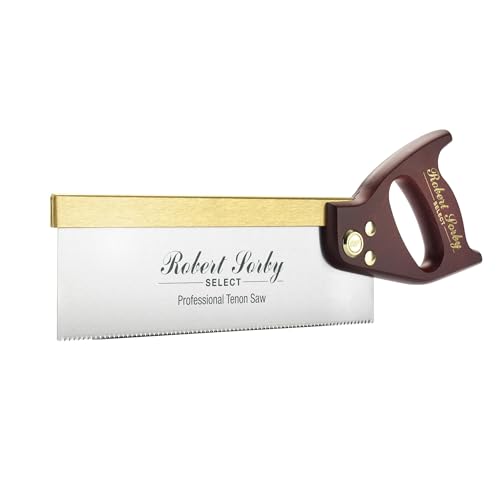
2. Robert Sorby Select RS-5412K Tenon Saw, 12 in 13TPI
A 12 inch (305 mm) saw with a hardened and tempered high carbon steel blade, a brass back and a wooden handle. The blade is 13 TPI and the maker says it can be resharpened. Brass screws are listed. The item weight is 725 grams, which is on the heavier side for the group.
Suits: bench work on joints. Strengths: a resharpenable blade and a brass spine. Weaknesses: the page says little about the tooth filing. Skip it if you want a light saw.

Best for rip cuts along the grain
3. Lynx Thomas Flinn 12 Inch Tenon Saw, Stained Beech Handle
A British made 12 inch back saw with a taper ground spring steel plate, a folded brass spine, a stained beech handle with brass button screws and a listed depth of cut of 3-1/8 inches. The title says 13 TPI while a bullet and the table say 15 TPI, and it is described as filed for rip cutting, so check the figure before ordering.
Suits: rip cuts along the grain. Strengths: a deep cut and a traditional build. Weaknesses: the TPI conflict. Skip it if you mostly crosscut.


Best for a modern, ready-to-cut back saw
4. HAUTMEC 12 in Dovetail Tenon Back Saw, 11 TPI
A 12 inch back saw with a 0.8 mm 65Mn steel blade, induction hardened double-ground teeth that the maker says cut on both push and pull strokes, and a reinforced steel spine. The handle uses a triple-bolt fit and a non-slip grip. The maker lists a one year warranty and says it suits tenons, grooves and trim.
Suits: a modern, ready-to-cut back saw. Strengths: a clear list of materials and a warranty. Weaknesses: a plastic and rubber handle rather than wood. Skip it if you want a traditional wooden handle.

Best for fine joinery cuts
5. Gyokucho 770-3500 Razor Dozuki Saw with Blade
A Japanese pull-stroke saw with a 180 mm blade, 0.3 mm thick, a stiffened back for control and a fine kerf. It is made in Japan and comes with the saw and blade. The details table lists 17 teeth and a surface recommendation of plastic, which looks inconsistent with a woodworking dozuki.
Suits: fine joinery cuts. Strengths: a thin kerf and a stiff back. Weaknesses: a short blade compared with a 12 inch back saw. Skip it if you cut wide tenons.
View Gyokucho 770-3500 Razor Dozuki Saw with Blade on Amazon
Best for hardwood joinery
6. Z-saw Dozuki Hardwood, 240mm
A dozuki with a 240 mm blade, an overall length of 537 mm, impulse hardened teeth, a replaceable blade and a wooden handle. A bullet gives a 1.2 mm pitch, or 21 TPI, and names ebony, mahogany, walnut and oak as materials it cuts. The bullet also lists a blade thickness of 3mm and an AC/DC power type, which are plainly errors for a hand saw.
Suits: hardwood joinery. Strengths: a replaceable blade and a long stroke. Weaknesses: spec errors on the page. Skip it if you prefer a western back saw.
View Z-saw DOZUKI HARDWOOD (240) 240mm on Amazon
Care and Setup
- Mark the shoulder line and make a shallow first cut to guide the blade.
- Let the saw do the work and keep the stroke long and even.
- Wipe the blade and spine dry after use.
- Keep the teeth covered when the saw is not in use.
Mistakes to Avoid
- Buying a rip filed saw for mainly crosscut work.
- Trusting a spec table that clearly disagrees with the title.
- Bending a thin Japanese blade by forcing the cut.
- Skipping a knife line at the shoulder.
Rip, Crosscut and Universal Teeth Compared
The way a saw’s teeth are shaped and filed decides what kind of cut it does best, and it is one of the most useful things to check in a listing. Rip teeth are filed with a flat front, like tiny chisels, which shear wood fibers cleanly when sawing along the grain. Crosscut teeth are filed with an angled, knife-like edge that severs fibers when cutting across the grain. A tenon saw used for cheek cuts, which run along the grain, benefits from rip teeth, while one used for shoulders, which cut across the grain, works best with crosscut teeth.
Many saws sold today use a compromise sometimes called universal or cross-ground teeth, which cut both ways acceptably but are not ideal for either. One listing above describes this kind of tooth. Such a saw can be a good all-round choice for a first purchase, while a woodworker who cuts a lot of joints may want a rip-filed saw and a crosscut-filed saw, or a saw that can be resharpened to suit.
The listing for the Lynx saw describes rip filing, which suits cheek cuts but may feel slow when cutting across the grain. If you buy a saw with rip teeth and mainly cut shoulders, it may tear the fibers at the edge. Check the description to see whether the teeth are described as rip, crosscut or hybrid, and be cautious if the listing says nothing about it. A saw that can be resharpened gives you the freedom to refile the teeth later, but doing so takes practice and the right files.
Also consider the cutting stroke. Western back saws cut on the push, while Japanese saws such as the dozuki cut on the pull, and this changes how the saw feels and how the blade is supported.
Blade Length, Depth of Cut and Tooth Count
Blade length and the depth below the spine determine what the saw can handle. A twelve inch blade is common for tenon saws and gives a good length of stroke for cheeks on typical joinery stock. The depth of cut is the distance between the tooth line and the spine, and it limits how deep the saw can go before the spine hits the work. The Lynx listing gives such a figure, while others do not, so check the listing if you plan to cut wide tenons or thick stock. A shallow blade will struggle with tall shoulders.
Teeth per inch, often shown as TPI or PPI, affects speed and finish. Fewer teeth per inch cut faster and clear waste more easily but leave a rougher surface. More teeth per inch cut slower and leave a finer finish. The saws above range from eleven to twenty-one teeth per inch, with the Japanese saws toward the finer end. A moderate count is a good compromise for general joinery, while a finer count suits delicate work and small pieces, such as dovetails. As the post notes, some listings give conflicting tooth counts, so check the figure against the title and the images.
Blade thickness matters too. A thinner blade removes less wood, which saves effort and makes cleaner kerfs, but it is less stiff, which is why a back saw has a spine. Western saws have thicker blades and rely on the spine, while Japanese saws have very thin blades that are held straight by tension and a stiffened back.
Spines, Handles and Balance
The spine and the handle largely determine how the saw feels. A brass spine adds weight, which helps the saw track forward under its own momentum, and many woodworkers like the balance that gives. A steel spine is usually slimmer and may be lighter, which can reduce fatigue over a long session. Neither is better in every case, so decide whether you prefer a heavier, steadier feel or a lighter, quicker one. The weight stated in a listing, such as the figure for the Sorby saw, gives a clue to how substantial it is.
Handles come in wood and in synthetic materials. A wooden handle is traditional and shaped to fit a pistol-grip position, which suits precise work, while a molded handle may be more durable and weather resistant. Test the grip, if you can, for comfort in your own hand. The handle should sit securely with no play, and the fixings, whether rivets, screws or bolts, should be tight. A loose handle ruins accuracy.
For Japanese saws, the handle is long and wrapped, and you hold it with both hands or one hand, depending on the cut. If you are new to pull saws, expect an adjustment period, since the technique is different. Check that the blade is firmly attached, and that if it is replaceable, replacement blades are available for the model. A saw you can hold comfortably for several minutes without strain is worth more than extra features on paper.
Making Accurate Cuts With a Back Saw
Good tenons come from preparation as much as from the saw. Mark the shoulder lines with a marking knife or a sharp pencil on every face, and connect them so you have a continuous guide. Knifing a line creates a small groove that helps the saw start on target. Clamp the work firmly at a comfortable height, usually at or slightly below elbow level, so you can see the line and use your whole arm.
Start the cut at the far corner using a gentle, short stroke with the blade angled slightly, then lower the saw level as the kerf forms. Let the weight of the saw do the work, and use light pressure on the forward stroke. Keep your eyes on the line, not on the blade, and check from several sides to make sure the cut remains square. Use long, even strokes that use most of the blade, because short strokes wear one part of the teeth.
For cheeks, saw down toward the shoulder line and stop when you reach it, then turn the work to check the cut on the other face. For shoulders, clamp a guide block along the line to help the blade stay straight. A square or a simple guide can help you keep the saw vertical. Practice on scrap and compare the fit before cutting the real piece. If the saw wanders, ease off, check the sharpness and adjust your grip.
Sharpening, Care and Choosing a First Saw
A sharp saw cuts with little effort, and a dull one tears and wanders. Signs of dullness include needing more pressure, rough cut surfaces, burning and a saw that jumps rather than glides. Some saws have hardened teeth that cannot be resharpened and are replaced as a unit or as a blade, while others can be filed by hand. The Sorby listing mentions resharpening, and a Japanese saw with a replaceable blade, like the Z-saw listing, is simple to renew. Check the listing to see which approach the saw uses before buying, because sharpening tools and skills are an added cost.
Look after the blade by wiping it dry and applying a thin film of oil or wax if you live in a humid area. Store the saw with the teeth covered or hung where nothing can knock the edge. Avoid dropping it, since a bent plate or damaged teeth are hard to fix. Never force a stuck saw, which can kink the blade.
When choosing your first saw, think about the joints you plan to make. A general twelve-inch back saw with a moderate tooth count covers many tasks. A fine Japanese saw suits delicate work and gives a thin kerf. Compare the build, the clarity of the listing and the warranty, and be wary of figures that contradict each other. Spending a little more on a well-made saw that you can sharpen is often better value than replacing a low-cost one.
Which tenon saw should you buy?
The best tenon saw is the one that matches the joints you cut, the way you like to work and the wood you use. Map your needs to the saws named above.
- Spear and Jackson Tenon Saw: a classic brass back with universal teeth, a reasonable all-round choice, though its spec table has obvious errors.
- Robert Sorby Select RS-5412K: choose it if you want a resharpenable blade and a heavier, steady feel.
- Lynx Thomas Flinn: suited to rip cuts along the grain, such as tenon cheeks, once you confirm the tooth count.
- HAUTMEC 12 in Dovetail Tenon Back Saw: a modern steel-spine saw with a warranty, for buyers who do not need a wooden handle.
- Gyokucho 770-3500: for fine joinery and a thin kerf with a pull stroke.
- Z-saw Dozuki Hardwood: for hardwood work where a replaceable blade is a plus.
If you mostly cut cheeks, favor a rip-filed saw. If you cut shoulders and small joints, a finer or universal tooth pattern is easier to live with. If you are new to pull saws, expect to adjust your technique.
What to check before you buy a tenon saw, and who should skip it
Before buying a tenon saw, check the tooth filing, the blade depth and how well the listing agrees with itself. The honest trade-offs matter too.
- Check whether the teeth are rip, crosscut or universal.
- Confirm the tooth count in the title, the bullets and the table.
- Look for the depth of cut if you plan to saw wide tenons.
- Check whether the blade can be resharpened or replaced.
- Note the handle material and whether it suits your grip.
- Read the warranty and return terms on the listing.
The downsides are real. Traditional saws may need a sharpening skill you have not built yet. Japanese saws have a short learning curve and thin blades that bend if forced. Several listings above contain figures that disagree, so a saw may differ from the description.
You can skip a dedicated tenon saw if you cut joints only occasionally and a general hand saw is enough, or if you prefer power tools for repeatable cuts. Skip a dozuki if you want to cut very wide tenons in one pass.
Compare the picks above, check the current listing for size and what is included, then choose the one that fits how you will use it.
Reading the Six Tenon Saws Side by Side
Tenon saws are the larger members of the back-saw family, built to cut the cheeks and shoulders of tenons straight and deep. These six split into Western push saws of similar size but different refinement, and two Japanese dozuki patterns that challenge the whole category. Comparing them honestly means comparing stroke tradition first, then tooth pattern, then finish quality of the tool itself.
Spear and Jackson versus Robert Sorby versus Lynx
All three are 12 inch Western tenon saws, so the differences are in tooth specification, handle comfort and how finished the saw feels out of the box. The Spear and Jackson is the widely available workhorse pattern. The Robert Sorby sits a step up in presentation and handle shaping, aimed at makers who keep a saw for decades. The Lynx, from a maker known for traditional saws, appeals to those who value a classic beech handle and a saw made to be resharpened for a lifetime. In the cut, all three will make the same joints in trained hands; in the hand, over an afternoon of sawing, the handle and balance differences are real. Choose by tooth pattern for your dominant cut — cheeks are rip work, shoulders are crosscut work — and by which handle you would still like at the fiftieth tenon.
HAUTMEC back saw versus the traditional three
The HAUTMEC presents itself as a dovetail-tenon crossover at a keener value point. Its coarser tooth count moves fast, which suits larger joinery and softer woods, and it asks less commitment from a first-time back-saw buyer. The trade-off against the traditional saws is refinement: tooth consistency, handle finish and long-term resharpening support matter more as your work gets finer. As a first back saw for general joinery it makes a sensible case; as the last saw you intend to buy, the traditional makers argue theirs.
Gyokucho Razor dozuki versus Z-saw Dozuki Hardwood
Both Japanese options cut on the pull with thin, fine blades and replaceable-blade convenience. The Gyokucho Razor is the precision instrument of the pair, leaving an exceptionally clean cut that suits visible joinery and fine work. The Z-saw Hardwood is tuned for exactly what its name says — dense stock where a general fine blade would struggle and dull quickly. Either can cut tenons beautifully; neither offers the depth of cut of a 12 inch Western tenon saw on the largest joints, which is the one genuine capability gap to weigh if your work includes big frame joinery.
Your First Session: Setup in the Right Order
Set up the work before the saw: tenon stock held vertically for cheeks, then horizontally for shoulders, at a height that lets your sawing arm travel level. Knife every line — cheeks and shoulders both — and mark the waste unmistakably. On scrap of the same species, cut a full practice tenon: cheeks first with the rip-oriented approach, then shoulders, checking each face against a square as you go. Watch where your cheek cuts drift relative to the line, because a tenon saw magnifies small stance errors across its deep cut. Fit the practice tenon into a practice mortise or against a flat reference, and let the gaps tell you which face needs correction — that feedback loop, learned on scrap, is the entire education.
Technique: Cheeks, Shoulders and the Long Cut
Cut cheeks by starting the kerf across the top end grain, then lowering the saw gradually so the cut advances down one face and along the top before the blade goes fully vertical — this keeps both lines in view and the cut honest. Let the saw’s weight feed it; tenon saws are heavy enough that added downward pressure only makes teeth grab. For shoulders, work around the piece in stages, cutting shallow on each face in turn so no single face’s exit tears out, and finish by joining the cuts. Keep your eye over the blade, your elbow in line with the cut, and your grip relaxed — a white-knuckle grip transmits every tremor straight into a deep cheek cut. Leave the line, then pare or plane to it: the saw’s job is to get close, straight and square; the final fit belongs to finer tools.
Troubleshooting in Diagnostic Order
When tenons come out tapered, twisted or off-line, diagnose in order. First, layout: confirm lines were knifed on all faces from the same reference face — layout errors masquerade as sawing errors constantly. Second, the start of the cheek cut: a kerf begun off-line on the end grain will be tracked all the way down. Third, stance and eye position: consistent drift in one direction across several cuts is almost always the operator’s sight line, not the saw. Fourth, pressure: forcing a deep cut bows a blade’s path, so lighten up and let the stroke lengthen. Only then suspect the saw — uneven tooth set or a dull side genuinely pulls a cut, and the test is whether a different sawyer, or the same sawyer with a known-good saw, drifts the same way on the same setup.
Care, Storage and Blade Manners
A tenon saw’s long, fine-toothed blade deserves a till, a hanging slot or a blade guard — never a loose drawer. Wipe the plate dry and clean of resin after sessions in pine or other resinous woods, because build-up on the plate drags in deep cuts and mimics dullness. Western patterns reward learning to sharpen, or finding someone who can: a professionally resharpened traditional saw returns to service for decades. Japanese blades are replaced when dull, so keep a spare blade if the saw is central to your work. However you store it, keep the teeth from being the first thing a reaching hand finds.
Choosing by the Work You Actually Do
Furniture makers cutting tenons weekly should buy the best traditional saw their budget allows, in the tooth pattern matching their dominant cut, and plan to keep it for good. Beginners in general joinery are well served by the value back saw while they learn stance and layout. Fine-joinery and box makers who prize surface finish should look seriously at the Razor dozuki. Makers working mostly dense hardwoods should weight the hardwood-tuned dozuki or a rip-pattern Western saw. And anyone cutting genuinely large tenons needs the depth only the 12 inch Western patterns offer — no finesse argument overrides geometry.
How do I keep shoulder cuts from tearing out at the exit?
Knife the shoulder line deeply so the surface fibres are already severed, then cut the shoulder in stages around the piece rather than straight through in one direction, so the saw never bursts out through an unsupported face. Slow down for the final strokes, support the waste piece so it does not drop and tear at the end, and remember the shoulder can always be pared back to the knife line — leave a whisper of material rather than gambling on a perfect exit.
Is one tenon saw enough, or do I need rip and crosscut versions?
One well-chosen saw is enough for most makers, especially while skills are developing: cheeks can be cut with a compromise tooth pattern and shoulders pared to the line. Two dedicated saws become worthwhile when tenon work is frequent and large — the rip pattern speeds cheeks noticeably and the crosscut pattern leaves shoulders cleaner. Buy the second saw when you can name the jobs it will improve, not before.
A Worked Frame Tenon, Start to Finish
Take a table-leg tenon through its full cycle. The leg is marked from reference faces, cheeks and shoulders knifed, waste shaded so there is no mid-cut doubt. Cheeks first: the leg stands vertically, the saw starts across the end grain, and the cut deepens down both faces alternately, a few strokes per face, so neither face’s line is ever lost from view. You stop a hair above the shoulder line — the saw’s depth discipline matters here, because a cheek cut that runs into the shoulder weakens the very corner the joint depends on.
Shoulders second: the leg lies horizontally, and the saw works around the four faces in shallow stages, severing the knifed fibres progressively so the exit face never tears. The waste falls away, and the tenon is offered to its mortise. It should enter with firm hand pressure, tight on the cheeks, shoulders closing last. If it binds, the cheeks get a paring pass — never the shoulders, which must stay at the knife line to close the joint visually. One tenon teaches the whole system: layout accuracy, cheek straightness, shoulder discipline, and the saw’s role as the tool that gets you close enough for finer tools to finish.
Tenon Saws Among Their Neighbours
The tenon saw sits between relatives on both sides. Below it, the dovetail saw handles smaller joints with a shallower blade — interchangeable on medium work, each unhappy at the other’s extremes. Above it, the panel saw and the table saw take over when tenons get large, numerous or production-driven; the hand tenon saw’s counter-claim is control, quiet and zero setup for one-off joinery. Beside it, the Japanese dozuki challenges the category on finesse while conceding depth. And behind it stand the chisel and the shoulder plane, which finish what it starts. Buying a tenon saw is really buying into that hand-joinery workflow — if your tenons are actually cut by router or table saw, the honest purchase is accessories for those, and this list’s saws belong to makers who cut joints at the bench, by hand, on purpose.
A Pre-Purchase Checklist
Five decisions resolve the choice. One: stroke tradition — Western push or Japanese pull — by feel wherever possible. Two: depth — measure your largest planned tenon and confirm the blade’s depth under the back clears it; this is the category’s hard constraint. Three: tooth pattern against your dominant cut — cheeks dominate most makers’ tenon work, which argues rip-leaning; shoulder-heavy fine work argues the other way. Four: blade economics — resharpenable tradition versus replaceable convenience, chosen with your actual sharpening habits in mind rather than your aspirations. Five: handle and balance over a long session, because tenon sawing is the most stroke-intensive sawing in joinery, and a saw that tires the hand degrades every cut after the twentieth. Settle those five in order and the six picks reduce, as they should, to the one saw whose strengths map onto your joinery and whose weaknesses map onto work you rarely do.
Building Tenon Work Into Your Everyday Workflow
Tenon sawing improves the way dovetailing does: through short, frequent, unremarkable practice folded into real work. Keep prepared tenon blanks among your scrap, and when a session starts with joinery, cut one practice tenon before the project’s stock is marked. Five minutes spent discovering today’s drift on scrap is cheaper than discovering it on a table leg. Keep the practice tenons, too — a small dated collection shows cheek straightness improving month by month and exposes the recurring fault, which is almost always one specific thing: a stance habit, a starting habit, a pressure habit.
Set the bench up for the workflow rather than the single cut: marking tools, the saw, a chisel for waste and fitting, and a square all within reach of the vise, so a tenon flows from layout to fit without the maker wandering the shop mid-sequence. Joinery quality is partly choreography, and the saw performs best inside a routine that never asks it to wait while its operator searches for a pencil.
How do I saw cheeks when the stock is too long for my vise height?
Support the far end so the stock is held at a workable angle rather than fighting gravity — a bench hook on a stool, a roller stand, or a second pair of hands for the largest pieces — and consider cutting long stock to rough length before joinery layout whenever the design allows, which it usually does. A cheek cut made on a wobbling, over-long board cannot be blamed on the saw; stabilise the work first and the same saw cuts straight.
Why are my tenon shoulders always slightly open on one side?
An consistently one-sided gap usually means the shoulder line was knifed from a reference that shifted, or the saw is being angled by a stance that favours one face. Knife all shoulder lines in one gauge setting from the same reference face, sight the saw from directly above for the shoulder cuts, and check the first shoulder with a square before cutting the rest — one verified shoulder calibrates the whole joint, while four unverified ones multiply the same small error.
How do I cut tenons in very thick stock for outdoor or structural work?
Scale the discipline, not just the saw: layout lines must survive handling, so knife them deeply and refresh them as the work proceeds. Cut cheeks in more, shallower stages, checking squareness on both faces more often, because a small angular error over a deep cheek becomes a large gap at the shoulder. Support the stock so its weight works for stability rather than against your vise, and expect the fitting stage to involve more paring — thick tenons are fitted by patience, and a saw that gets you close and square has done its full job at any scale.
What is the best way to saw matching tenons on four identical legs?
Batch the process: mark all four from the same gauge settings without resetting anything, cut all cheeks in one session while your stance calibration is fresh, then all shoulders, then fit in sequence. Consistency in joinery comes less from individual brilliance than from refusing to re-decide measurements between identical parts. If one leg of the four fits differently, the process changed somewhere — find that change before fitting the rest, because it will otherwise repeat faithfully.
How do I know when a Western tenon saw needs professional sharpening?
When your own maintenance no longer restores a clean start and a straight, unforced cut in known material — or when the tooth line has become visibly uneven through years of home filing. A professional sharpening resets geometry you cannot easily recreate freehand, and on a quality saw it is money spent on the tool’s next decade rather than on this month’s joints. Between professional sessions, honest home honing of the teeth keeps the saw in the wide middle zone where it cuts well.
How do I saw tenon cheeks on stock that is slightly twisted?
First, decide whether the twist belongs in the finished piece at all — a twisted leg makes a twisted frame, and no sawing fixes that. If the twist is minor and the design tolerates it, establish your reference faces honestly: flatten the faces that matter, mark from them, and accept that the remaining faces carry the twist where it shows least. Saw to the knifed lines as marked rather than to an imagined ideal geometry, because the mortise will be fitted to the tenon you actually cut. The saw’s job is fidelity to the layout; the layout’s job is honesty about the material.
What is the best way to practise tenon sawing without wasting good stock?
Use the offcut economy: every project generates offcuts of exactly the species and thickness you are learning on, and a tenon needs only a short length. Keep a practice box of project offcuts, and cut your warm-up tenons there. Construction-grade softwood from the lumber yard is the other honest source — cheap, consistent, and unforgiving enough about bruised shoulders to teach good habits. What matters is repetition on real joints with real fitting, not the pedigree of the practise material.
A last word on your tenon saw as a long-term tool
A tenon saw is bought in years, not projects: the traditional patterns in this list are designed to be sharpened and re-sharpened across decades, and even the replaceable-blade saws build their value across hundreds of joints. Judge your choice accordingly — handle comfort compounds, tooth behaviour compounds, and the small daily friction of a saw that almost suits you compounds too, in the wrong direction. Buy the saw your hands approve of, learn its voice in the cut until you can hear dullness before you can see it, and keep it racked, clean and ready. Tenons are the skeleton of frame furniture; the saw that cuts them deserves to be a permanent resident of the bench, not a visitor.
Keeping a cutting diary for one month
For one month, note three things after each tenon session: the stock and its thickness, the fault that appeared most often, and the single adjustment you will test next time. Two minutes of writing converts a vague sense that cheeks could be straighter into a named variable — stance, starting angle, pressure, tooth condition — that the next session can actually address. At the month’s end, read the notes as a set: the recurring fault is your curriculum, written by your own hands in your own timber, and it will aim your practice more precisely than any general advice. Most makers who try the diary for a month keep it, in a notebook that lives beside the saw.
Tenon Saw FAQ
What is the difference between a tenon saw and a dozuki?
A tenon saw cuts on the push stroke and relies on a spine for stiffness. A dozuki cuts on the pull stroke and has a thin blade with a stiffened back.
Which saws list a 12 inch blade?
The Spear and Jackson, Robert Sorby, Lynx Thomas Flinn and HAUTMEC saws all list 12 inches.
What is the difference between rip and crosscut teeth?
Rip teeth are filed to chisel fibers cleanly when cutting along the grain. Crosscut teeth are filed to slice across the grain. Many saws use a compromise between the two.
How many teeth per inch should a tenon saw have?
A moderate count is common for general joinery, and a finer count suits delicate work. Fewer teeth cut faster, while more teeth leave a finer finish.
Can I use a tenon saw for dovetails?
A fine-toothed back saw is often used for dovetails, but check the tooth count and blade depth. A dozuki is also popular for this fine work.
Do I need to resharpen a back saw?
Eventually, if the teeth are not hardened for one-time use. Check whether the saw can be resharpened or has a replaceable blade.
Is a Japanese saw easier to use than a western saw?
Not necessarily. Pull saws have a thin kerf and need a different technique, so expect a short learning period.
How do I keep the saw from wandering?
Mark a knife line, start gently, let the saw do the work and check the cut from several sides. Keep the blade sharp.
How should I store my saw?
Keep it dry with the teeth protected, and hang it or lay it where nothing can hit the blade.
Is a 12 inch tenon saw the right size for most joints?
A 12 inch blade is a common size for general joinery and gives a comfortable stroke for typical stock. Check the depth of cut for wide tenons. Smaller work may suit a shorter, finer saw.
Should a beginner buy a rip or crosscut tenon saw?
A saw with universal teeth is a forgiving first choice because it cuts both ways acceptably. A rip-filed saw suits cheeks but may tear shoulders. Check the tooth description on the listing.
Is a brass back or steel back better on a tenon saw?
Neither is better in every case. Brass adds weight that helps the saw track forward, while steel is often slimmer and lighter. Choose the balance you find more comfortable.
Can a dozuki replace a western tenon saw?
For fine joinery it often can, since it cuts on the pull stroke with a thin kerf. A back saw handles deeper cuts in thick stock more easily. Many woodworkers keep one of each.
How do I tell if my tenon saw is dull?
Signs include needing more pressure, rough or burnt cuts and a saw that wanders. Check whether it can be resharpened or has a replaceable blade. Sharpening takes practice and the right files.
What is depth of cut on a back saw?
It is the distance from the tooth line to the spine, and it limits how deep the saw can cut before the spine meets the work. Check this figure if you cut tall shoulders. Not every listing states it.
The Short Version
For a classic brass back, the Spear and Jackson. For a resharpenable blade, the Robert Sorby. For a deep rip cut, the Lynx. For a modern steel spine, the HAUTMEC. For a thin Japanese kerf, the Gyokucho. For hardwood with a replaceable blade, the Z-saw.