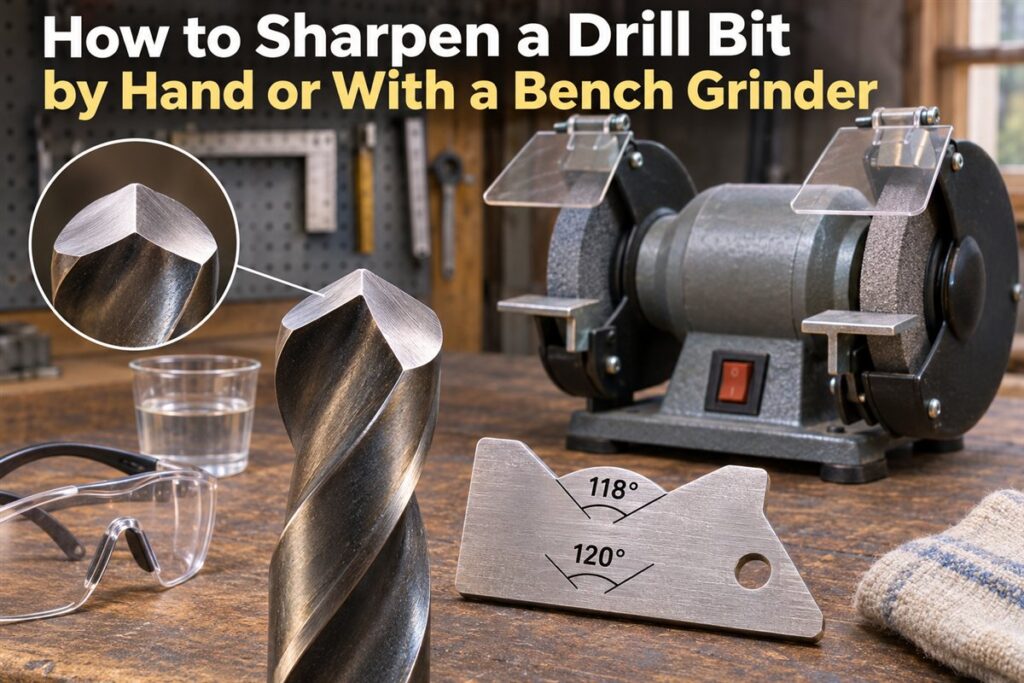
A dull twist bit can be reshaped by grinding its two cutting lips back to a matching angle, which is a skill that takes practice. For general-purpose bits, a point angle of about 118 degrees is a common target, and both lips must be the same length. Follow your grinder’s manual and wear eye protection, since sparks and metal fragments fly off the wheel.
Know When a Bit Needs Work
Signs of dullness include squealing, smoke, heat at the tip, a bit that wanders or needs heavy pressure to cut, and shavings that come out as dust rather than curls. Chipped or burned bits may be better replaced. Small bits are often low in cost, so replacing them can make more sense than sharpening.
What You Need
- A bench grinder with a clean, dressed wheel, or a sharpening jig made for drill bits.
- Eye protection and, if your grinder maker advises it, a face shield and ear protection.
- A cup of water to cool the bit between passes.
- A drill point gauge or a printed angle template, if you have one.
Sharpening Steps
- Check that the tool rest is close to the wheel, with the gap the grinder maker recommends, and spin the wheel for a moment before you begin.
- Hold the bit near the tip with one hand and the shank with the other, with the cutting lip lying flat and level.
- Angle the bit so the lip meets the wheel at about half the point angle, around 59 degrees from the wheel face for a 118 degree tip.
- Touch the lip to the wheel lightly and rotate the bit slightly while lowering the shank, so the area behind the cutting edge falls away. This is called relief.
- Remove only a small amount of metal. Cool the bit often, since overheating softens the steel and may discolour it blue.
- Turn the bit over and repeat on the other lip, matching the angle and the amount ground.
- Compare both lips to check they are the same length and the tip is centred.
Checking Your Work
| Check | Good sign | Problem sign |
|---|---|---|
| Lip length | Both equal | One longer, causing wobble and oversize holes |
| Chisel edge | Short and centred | Off to one side |
| Relief angle | Slight slope behind each lip | Flat, so the bit rubs and does not cut |
| Chips | Two even curls | One thick, one thin |
Test on scrap wood or metal that matches your intended work, keeping your drill’s speed and pressure moderate. Hold the work firmly and follow your drill’s manual.
FAQ
Can I sharpen masonry or carbide bits?
Those use harder tips, and a standard grinder wheel is often not suitable. Check the bit maker’s advice, and consider replacement.
Is a sharpening jig worth using?
Many beginners get steadier results with a jig because it holds the angle for them. Follow the jig maker’s instructions.
The Short Version
Grind both lips to the same angle and length, keep the bit cool and add a little relief behind each edge. Wear eye protection, follow the grinder manual and replace bits that are damaged beyond repair.