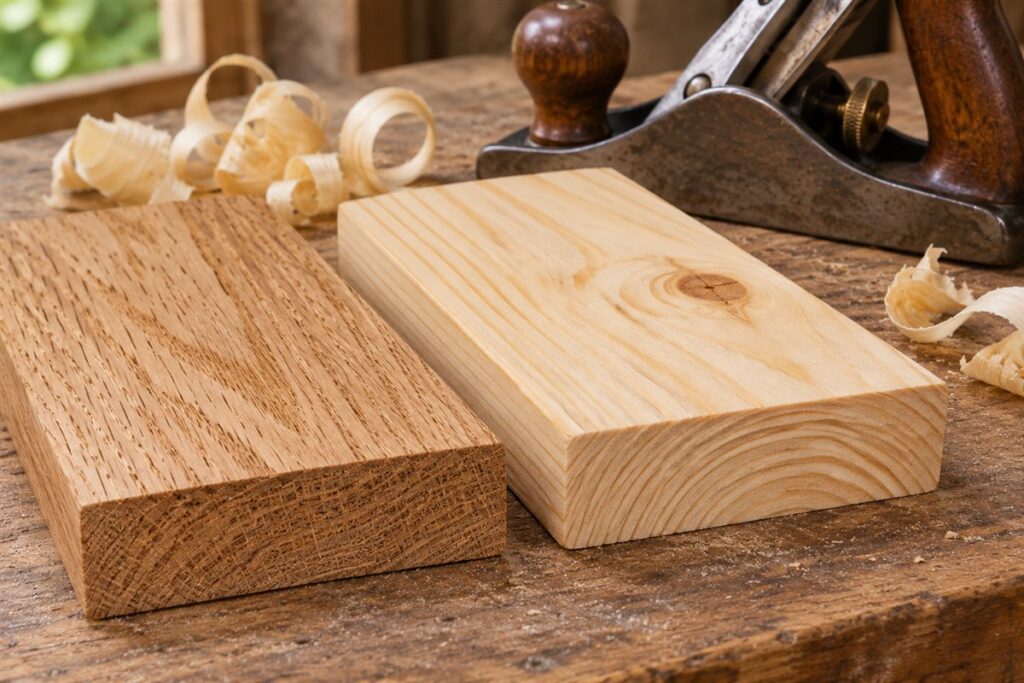
The terms come from the type of tree, not simply from how hard the wood feels. Hardwoods come from broadleaf trees and softwoods from conifers. In general hardwoods are denser and longer-lasting, while softwoods are lighter and easier to work, though there are exceptions both ways. This guide covers where the names come from, how each group behaves under tools, how to choose for a given job and the habits that keep finished pieces stable.
Where the Names Come From
Botanically, hardwood trees produce seeds in a covering, such as acorns, and usually drop their leaves. Softwood trees are cone-bearing evergreens. Balsa is technically a hardwood yet is very light, and some softwoods such as yew are quite hard, which shows why the name is only a rough guide.
The practical lesson is that the label tells you the family of the tree, not the behaviour of the board in your hands. Two boards from the same group can differ a lot in weight, grain and how they take a finish. When a project depends on a particular trait, ask about the species rather than relying on the group name.
In this guide
Working Differences
- Cutting: softwoods saw and plane easily. Hardwoods take more effort and need sharp blades.
- Fixing: hardwoods can split when nailed or screwed near an edge, so drill pilot holes. Softwoods usually accept fixings readily.
- Finish: hardwoods often show handsome grain under clear finishes, while softwoods can look blotchy unless prepared with care.
- Dents: softwoods mark easily from knocks, which matters for tabletops.
- Cost to buy: hardwoods usually cost more, but this varies by species and supplier.
Side-by-Side View
| Feature | Hardwood | Softwood |
|---|---|---|
| Tree | Broadleaf (oak, ash, beech) | Conifer (pine, spruce, fir) |
| Typical density | Higher | Lower |
| Ease of working | More demanding | Easier |
| Common uses | Furniture, flooring, tools handles | Framing, shelving, fencing |
Which Should You Choose
- If you are learning, choose softwood. It is forgiving and inexpensive to experiment with.
- If the piece will see daily wear, such as a table or a workbench top, consider a hardwood.
- If the piece will be outdoors, think about durability and treatment. Some softwoods are treated for exterior use, while some hardwoods resist rot naturally.
- If weight matters, such as a shelf you must lift or hang, lean towards softwood.
- Ask the timber supplier about the specific species, since each behaves differently.
Wood dust of any kind can irritate eyes and lungs, and some hardwood dusts are especially troublesome, so wear a suitable mask, use extraction and follow the maker’s safety guidance. For loads that matter, such as beams or supports, ask a qualified professional and follow local codes.
Worked Example: Choosing Wood for a Small Bookshelf
Suppose you plan a freestanding shelf unit for a spare room. The steps below show how the thinking runs, and the same order works for most projects.
- List the demands. A bookshelf carries steady weight, sits indoors and gets little impact. Looks matter moderately, and you will probably move it once or twice.
- Decide the finish first. If you want a clear coating that shows grain, a hardwood or a carefully chosen softwood board with straight grain will suit. If you will cover it with an opaque coating, softwood is usually fine.
- Think about span. Long shelves sag under books. Thicker boards, shorter spans or a support rail under the front edge help more than switching species alone.
- Check the boards in person if you can. Sight along each edge for bow, twist and cup, and look at the ends to see how the growth rings run.
- Ask about moisture. Boards that are too damp for indoor use will shrink and may crack or loosen joints after you build. Ask the supplier how the stock was dried.
- Buy a little extra. Spare length lets you cut around knots, splits and damaged ends.
Common Scenarios
A first workbench
Many beginners build the frame from softwood framing lengths because it is easy to cut and fix, then add a denser top if they expect heavy use. Whatever you choose, aim for a flat, rigid, well-braced result.
A garden bench
Outdoor pieces face rain, sun and swings in humidity. Look for timber sold for exterior use, use fixings suited to outdoor conditions and let water drain away from end grain instead of sitting on it.
A kitchen cutting board or serving tray
Items that touch food call for a species and finish the supplier states are suitable for that purpose. Ask rather than guessing, and follow the finish maker’s directions for food contact.
A hung wall shelf
Weight matters here. A lighter board puts less load on the wall fixings, but the fixings must still suit the wall type and the load. If you are unsure what is behind the wall, ask a qualified professional.
Reading What the Supplier Tells You
Timber yards and shops use a handful of terms that save a lot of trouble once you know them. Nominal sizes are often larger than the finished size of the board, because planing removes material, so measure the real thickness and width before you plan joints. Rough sawn stock has not been planed and will need dressing, while planed stock is ready to use but a little smaller. Grading notes describe knots, splits and other defects, and a higher grade usually means fewer of them. Ask whether the board is kiln dried or air dried, since drying method affects how much it may move after you bring it home.
Mistakes to Avoid
| Mistake | Why it causes trouble |
|---|---|
| Assuming hardwood always means harder | Some hardwoods are soft and light, so you may pay more for no gain. |
| Screwing close to the end of a hardwood board | The fibres split along the grain; pilot holes and a little distance from the end reduce the risk. |
| Using damp stock indoors | It shrinks as it dries, opening joints and cracking panels. |
| Gluing wide panels rigidly to a frame | The panel cannot move with humidity, so it may split or push the frame apart. |
| Skipping surface preparation on softwood | Uneven absorption leads to blotchy staining. |
| Ignoring dust protection with hardwood | Fine dust of some species is a known irritant, so masks and extraction matter. |
Care and Movement
All timber moves a little with changes in humidity, across the grain more than along it. Leave small gaps in wide panels and avoid trapping boards rigidly. A sealed or coated surface slows moisture changes but does not stop them, so plan joints that allow for movement.
Over the years, keep furniture away from direct heat sources and strong sunlight, which dry and fade the surface. Wipe spills quickly, refresh worn coatings following the finish maker’s directions and check fixings now and then, since seasonal movement can loosen screws a little.
Glossary
- Grain: the direction and pattern of the wood fibres.
- Species: the particular kind of tree, such as oak or pine, which sets the real character of the board.
- Kiln dried: dried in a controlled chamber to reduce moisture before sale.
- Cup: a board that curves across its width like a shallow trough.
- Pilot hole: a small guide hole drilled before a screw to reduce splitting.
- End grain: the cut end of a board where fibres open, which absorbs moisture fastest.
Measuring Hardness: What the Janka Number Tells You
Because the words hardwood and softwood describe trees rather than feel, woodworkers often use the Janka hardness test to compare species. The test records the force needed to push a small steel ball into the wood to a set depth. A higher number means a harder surface that resists dents.
The figures below are approximate and drawn from commonly published ranges. Exact values vary with the tree, the growing conditions and the source, so treat them as a rough ordering, not a promise.
| Species | Group | Approximate hardness |
|---|---|---|
| Balsa | Hardwood | Very low, around 100 |
| Eastern white pine | Softwood | Low, a few hundred |
| Douglas fir | Softwood | Moderate, roughly 600 to 700 |
| Poplar | Hardwood | Moderate, roughly 500 to 600 |
| Cherry and walnut | Hardwood | Moderate to high, roughly 950 to 1,000 |
| Red and white oak | Hardwood | High, roughly 1,200 to 1,400 |
| Hard maple | Hardwood | High, roughly 1,400 or more |
Notice that poplar, a hardwood, is not much harder than Douglas fir, a softwood, while balsa is the softest of all. Hardness matters most for surfaces that take wear, such as floors, tabletops and chopping blocks. It matters less for hidden frames and for pieces that are painted.
Hardness is not the same as strength. A board can resist dents yet still bend under load, or it can dent easily and still carry a lot of weight along its length. For beams, shelves with long spans and anything that bears people, ask a qualified professional and follow local codes.
Moisture, Seasoning and Why Boards Move
A living tree is full of water. Timber is dried before use, either in a kiln or by stacking it in air for months or years. As moisture leaves, the board shrinks, mostly across the width and thickness and very little along the length. After drying, it keeps taking on or giving off moisture as the room changes, which is why a door can stick in a humid summer.
The aim is to bring wood close to the humidity of the place where it will live. Interior furniture usually needs drier stock than outdoor decking. Many yards can tell you the moisture content of their stock, and a small moisture meter is an inexpensive way to check for yourself. If you bring wood home, stack it flat with small spacers between the boards, in the room where you will work, for a week or two before cutting so it can settle.
How the cut affects movement
Look at the end of a board. Rings that run roughly flat across the width mark a plain sawn board, which moves more and tends to cup. Rings that run nearly straight from face to face mark a quarter sawn board, which stays flatter but costs more. For wide panels or door frames, choose the stable cut if you can.
Finishing and Gluing: How Each Group Behaves
Different woods take coatings and adhesives in different ways, and the group name gives only a clue.
- Open-grained hardwoods such as oak absorb stain deeply and may need filler for a glass-smooth surface.
- Tight-grained hardwoods such as maple and cherry can look patchy with some stains, so test on scrap before you commit.
- Many softwoods contain resin pockets that can bleed through paint. A sealer or stain-blocking primer helps.
- Oily woods can resist some glues, so wipe the surface with a solvent suited to the glue maker’s instructions and test a joint.
- All woods benefit from sanding through grits in order, without skipping steps, and from removing dust before the finish.
Always test your finish on an offcut from the same board. What you see on a sample card in a shop may not match a board with a different grain pattern. Read and follow the finish maker’s directions for ventilation, drying time and disposal of oily rags, which can heat up and ignite if left in a pile.
Plywood, MDF and Other Manufactured Boards
Many projects use manufactured boards instead of solid timber. They are made by gluing wood layers or fibers together, and they are neither hardwood nor softwood in the usual sense, though some are faced with a hardwood veneer.
Plywood
Plywood is made of thin layers with alternating grain directions, which makes it stable and resistant to splitting. It suits cabinet boxes, shelves with support and shop jigs. Edges show the layers, so many people cover them with edge banding or solid trim. Grades and glue types differ, so check the label for interior or exterior use.
MDF and particleboard
MDF is smooth and takes paint well but swells if it gets wet and holds screws poorly in its edges. Particleboard is cheaper and weaker still. Both create fine dust when cut, so wear a suitable mask and use extraction. Some boards contain formaldehyde-based resins, and the label may list emissions grades, so read it if you are making items for a bedroom or a child.
Solid versus manufactured
Solid timber can be re-sanded and repaired many times and has a natural look, while manufactured sheets give flat, stable panels in large sizes at lower cost. Many sturdy pieces combine the two, with solid edges on a plywood panel.
Cost, Sourcing and Responsible Buying
Price depends on species, board grade, thickness, how much you buy and your region. Common softwood framing lengths are usually the cheapest, while figured or imported hardwoods can cost many times more per board foot. Prices shift with the market, so ask for a current quote instead of relying on a general figure.
- Buy from a supplier who can say what the species is and where it came from.
- Look for third-party forest certification labels if responsible sourcing matters to you.
- Ask about offcuts and shorts, which are often cheaper and ideal for small projects.
- Consider reclaimed timber, but check it for hidden nails, old finishes and insects.
- Plan your cuts on paper first so waste is kept low.
When a project matters, such as a heirloom table, spend more on the part people touch and see, and use cheaper stock for hidden parts. When it is a test piece or a jig, use the cheapest stable material that works.
Fasteners and Joints for Each Kind of Wood
The wood you choose changes how you join it. Softwoods hold nails and screws easily but can crush under a tight clamp or a hard-driven screw head. Dense hardwoods grip well but resist fasteners, so a screw forced into oak without a pilot hole may snap or split the board.
Screws and pilot holes
Drill a pilot hole slightly narrower than the screw core, and add a clearance hole in the top piece when pulling two boards together. A countersink bit lets the head sit flush without splitting the surface. Wax or soap on the threads helps a screw drive into hard timber, though keep it away from areas that will be glued or finished.
Glued joints
Glue works best on clean, flat, freshly cut surfaces. Long grain glues strongly to long grain, while end grain soaks up glue and makes a weak bond unless the joint is reinforced with a dowel, a biscuit or a mechanical fastener. Clamp until the glue maker says it is safe to release, and wipe away squeeze-out before it hardens.
Outdoor fixings
Some woods, including oak, can stain or corrode ordinary steel fasteners when wet. For outdoor work, choose fasteners rated for exterior use and for the wood or treatment you have, and follow the maker’s guidance.
Buying Wood at the Yard: A Practical Checklist
Whether a board comes from a hardwood or a softwood tree, quality varies from piece to piece. A few minutes of inspection at the yard saves hours of frustration at home.
- Sight along the edge of each board to check that it is straight and not bowed.
- Look at the faces for twist, cupping and large knots in places that will be cut or loaded.
- Check the ends for cracks, known as checks, that may run into the board.
- Ask the staff about the moisture state of the wood and how it has been stored.
- Choose a few extra inches in length to allow for trimming.
- Carry boards flat and store them level, with spacers so air can circulate.
Let the wood rest in your workshop for several days before cutting, so that it settles to the local conditions.
Choosing by Project Type
There is no single best wood, only a good match for the job. This table gives general ideas.
| Project | Often chosen | Why |
|---|---|---|
| Garden fencing and framing | Softwood | Widely available and easy to cut |
| Fine furniture | Hardwood | Dense, takes detail and wear |
| Painted shelves | Either | The paint covers the grain |
| Cutting boards and utensils | Hardwood, per local food safety guidance | Tight grain and durability |
Names can be confusing, since some softwoods are actually harder than some hardwoods. Ask the supplier for the species name rather than relying on the broad label.
For outdoor use, ask about the wood’s resistance to weather and any treatments, and follow the supplier’s and treatment maker’s instructions.
A Deeper Framework: Four Questions That Classify Any Board
The hardwood and softwood labels describe how a tree reproduces, not how a board behaves on your bench. To predict behaviour, ask four more useful questions about any piece of timber you are offered. First, how dense is it, because density drives weight, hardness and how it takes screws. Second, how open is the grain, because open grain drinks finish and shows pores, while tight grain sands to a calmer surface. Third, how much does this species move with moisture, because movement decides gaps, sticking drawers and cracked panels months after you build. Fourth, how does it respond to your tools, because a board that planes beautifully may still chip at the edges or blunt edges quickly if it carries a lot of resin or mineral content. Those four questions, answered even roughly, tell you more than the group label ever will.
Density is the easiest to feel. Heft two boards of similar size and the heavier one will usually resist dents better, hold screws more firmly and sound sharper when knocked. Grain openness shows when you look at the end of the board: large visible pores suggest a finish will need more coats or a grain filler for a smooth result, while fine, even texture suggests a simpler finishing path. Movement is harder to see in the shop, so ask the supplier how the timber was dried and whether it suits indoor or outdoor use, and treat a vague answer as information in itself. Tool response reveals itself on the first cut, which is why experienced makers test an unfamiliar species on an offcut before committing the good board.
Reading a board at the yard, step by step
- Sight along the length from one end, at eye level, to spot bow, twist and cup before you judge the faces.
- Look at the end grain to read the growth pattern and get a first sense of how the board was cut and how it may move.
- Press a fingernail into an inconspicuous spot. A deep, easy dent suggests a softer surface that will mark in use, whatever its group label says.
- Check both faces and both edges for knots, splits and resin pockets, and decide whether those features land in visible areas of your project.
- Ask for the species name, the drying method and the intended use the supplier recommends, and write the species on the board in pencil so the information survives the trip home.
- Compare weight against a board you know. Your hands build a reliable density library over time if you pay attention while it forms.
None of these checks needs special equipment, and together they take less than a minute per board. That minute is the cheapest insurance in woodworking, because nearly every later problem, from a door that will not close to a finish that blotches, was visible in embryo at the yard.
Decision Table: Choosing by Project, Not by Label
| Project | Group that usually fits | What actually decides it | Watch out for |
|---|---|---|---|
| Indoor shelving | Either, by span and load | Stiffness over the span and how the edge will be finished | Long spans sag in almost any solid wood; shorten the span or add support |
| Workbench top | Dense hardwood or laminated softwood | Resistance to dents and the ability to be flattened again later | A top that is too hard can be tiring to work on and hard to repair |
| Garden bench | Naturally durable or treated softwood, or durable hardwood | Weather resistance and how the finish will be maintained | Group label says nothing about rot resistance; ask about the species |
| Cutting board | Close-grained hardwood | Knife-friendly surface and a finish suitable for food contact | Open pores trap moisture; very hard species blunt knives quickly |
| Painted built-in furniture | Softwood or a manufactured board with a solid edge | Smoothness under paint and stability in a heated room | Knots can bleed through paint unless sealed first |
| Structural framing | Graded softwood | Strength grading, straightness and availability in long lengths | Decorative timber is not a substitute for graded material |
| Fine visible joinery | Hardwood with even grain | How cleanly it planes, glues and takes a clear finish | Interlocked grain can tear out; test your planing direction on scrap |
| Beginner practice pieces | Soft, even softwood or a mild hardwood | Forgiveness under tools and low cost of mistakes | Very soft boards dent during clamping, which teaches bad habits if unnoticed |
Read the middle column carefully: in almost every row the deciding factor is a property, not a group. Once you shop by property, the hardwood-softwood question becomes the opening of the conversation instead of the whole of it, and suppliers respond well to property questions because they can answer them precisely.
Worked Scenarios: Applying the Framework
A dining table that must survive daily life
A family table needs a top that resists dents from dropped cutlery, tolerates hot dishes on mats and can be refinished when the surface eventually tires. A dense, close-grained hardwood earns its place here on properties: it dents less, sands back well and holds edge detail at the corners where hands and chairs make contact. The legs and apron, hidden and mostly structural, can be a sound softwood painted or finished to blend, which keeps weight and cost sensible without weakening the piece. The lesson is to spend the demanding material only where the demand actually lives.
A rental-friendly storage unit
For a storage unit that may move house several times, light weight and repairability outrank ultimate hardness. Straight softwood boards with a painted finish move easily, take knocks that can be filled and repainted in minutes, and keep the unit cheap enough to adapt or leave behind. Choosing a prestige hardwood here would add weight and cost while making every future repair slower. Property-led choosing sometimes points firmly at the humble option, and that is a success of the method, not a failure of ambition.
An outdoor planter
A planter lives wet, dries in sun and repeats that cycle for years. The deciding properties are decay resistance, stability through wetting cycles and fixings that will not corrode or split the boards as they move. Several softwoods, suitably treated, outperform decorative hardwoods that were never meant for ground contact. Drainage, end-grain sealing and fixings chosen for outdoor use matter as much as the species, which is why outdoor projects reward questions about the whole system rather than the board alone.
Fasteners, Joints and Finishing: Where the Groups Truly Diverge
Screws behave differently as density changes. In dense hardwood, a screw driven without a pilot hole acts like a wedge and can split the board, especially near an end, so drilling a pilot hole sized to the screw core is standard practice. In softer timber the screw cuts its own path more easily, but the same softness means the thread has less to grip, so coarse threads and adequate length matter more than force. In both cases, driving the screw straight and stopping at snug rather than straining for one more turn protects the joint.
Glued joints depend on surface preparation more than group. Freshly planed or lightly sanded surfaces, free of dust and old finish, bond best in either group. Very resinous softwood and very oily hardwood can both resist glue at the surface, and both respond to the same remedy: prepare the surface shortly before gluing, follow the adhesive maker’s guidance for that material, and clamp with even pressure rather than maximum pressure. End grain in any species drinks glue and starves the joint, so joints that rely on end grain need mechanical help from screws, dowels or a different joint design.
Finishing exposes the grain difference most visibly. Open-grained hardwood may need extra coats or a filler before a smooth clear finish looks even, while softwood often shows blotchy colour with stain because earlywood and latewood absorb at different rates. A pre-stain conditioner, a gel stain or a finish that sits more on the surface can even out softwood colour, and testing on an offcut from the same board is the only reliable preview. Paint forgives almost everything in both groups, provided knots and resin are sealed first.
Acclimation, Storage and Movement at Home
Most movement problems begin in the first week at home. Timber bought from a yard or store has been living in different air from your rooms, so stack it flat in the room where the project will live, with thin strips between boards so air reaches every face, and give it time to settle before final cutting. Rushing this stage locks a moisture difference into the finished piece, where it reappears as cupped shelves or a lid that no longer sits flat.
Store boards flat and supported along their length, never leaning against a wall for weeks, because a leaning board takes a set that no clamp fully removes. Keep timber off a damp floor, out of direct sun and away from a heat source that dries one face faster than the other. When a project is finished, coating all faces, including the underside and the inside of cupboards, slows moisture exchange evenly; sealing only the show face invites the piece to cup toward the sealed side. These habits cost nothing, apply to both groups equally, and prevent the majority of the warping stories that beginners blame on buying the wrong wood.
A short choosing checklist
- Name the species, not just the group, and note it on the board.
- Match density to the dents and loads the project will actually meet.
- Check straightness by sighting along the board before paying.
- Ask how the timber was dried and where the supplier expects it to be used.
- Plan pilot holes for dense timber and adequate thread length for soft timber.
- Test stain and finish on an offcut from the same board.
- Acclimate boards flat, with air gaps, in the room of use.
- Finish all faces of the finished piece, not only the visible ones.
Hold those habits together and the original question answers itself in practice: you stop asking which group is better and start asking which board, of either group, carries the properties your project needs.
Species in Practice: What the Labels Hide
Within each group, species vary so widely that the group average is nearly meaningless at the bench. Among softwoods, a dense southern pine and a pale, light spruce share a label and almost nothing else: one resists dents and holds screws with conviction, the other cuts like butter and marks if you look at it firmly. Among hardwoods, balsa sits at one extreme as a genuine hardwood softer than most softwoods, while dense tropical species at the other extreme blunt tools and shrug off decades of wear. This is why the species name, asked for at the yard and written on the board, is the working unit of wood selection. Two projects built from the same group and different species can age completely differently, and both outcomes were predictable from the species, not the label.
Colour, grain and ageing
Colour is a property with a time dimension. Many pale hardwoods deepen and warm with light exposure, while some richly coloured species fade toward grey-brown if sunlight reaches them daily. Softwoods often yellow as their finishes age, which is why a pine shelf that matched a room when built can look noticeably warmer five years later. Plan colour at the five-year mark, not the five-minute mark: place the test piece where the project will live and look at it across a few days of changing light before committing. Grain figure follows the same logic. Dramatic figure is a gift on a small box lid and a distraction across a whole wall of shelving, so scale the figure to the size of the piece and the distance it will be viewed from.
Weight as a design constraint
Density becomes weight, and weight becomes a design fact. A bookcase in a dense hardwood may need two people and a clear route to move, and its shelves will carry load with less sag over the same span. The same design in a light softwood moves easily and suits rented homes and upper floors, but asks for shorter spans or thicker sections. Neither is better; they are answers to different briefs. When a client or a family member describes a project, listen for the hidden weight brief, how often it will move, who must lift it and where it will live, because those answers often choose the species before appearance is even discussed.
Sustainability and Sourcing Without the Slogans
Responsible buying in timber is mostly a set of plain questions. Is the species plentiful and fast-growing, or slow-grown and scarce? Does the supplier know where it came from and offer any recognised certification for the chain of custody? Is a local or regional species available that does the same job, shortening the journey the board took to reach you? Reclaimed timber deserves a place in this thinking too: old framing softwood is often denser and more stable than its modern equivalent, and reclaimed hardwood carries figure and history no new board can match, at the cost of hidden nails, extra preparation and variable sizes. Ask the questions, accept honest answers, and remember that using a modest species well, and building a piece that lasts decades, is itself a meaningful part of the answer.
When manufactured boards honestly win
Plywood, with its cross-banded layers, stays flat across widths where solid boards cup, which is why wide shelves, cabinet sides and painted doors so often start as sheet material with a solid edge added where eyes and hands land. MDF paints to a flawless, grain-free surface and machines crisp profiles, at the cost of weight, weak screw-holding in its edges and a dislike of water. The mature choice is not solid versus sheet as a matter of pride; it is matching each part of the project to the material whose properties serve that part, and being able to say why, part by part.
Common Mistakes When Choosing Wood, Expanded
Choosing by group label alone heads the list, and by now its cure should be familiar: ask for the species, test density with your hands and a fingernail, and match properties to the project. A close second is buying the whole project in one visit from one stack, assuming every board in that stack shares the best board’s virtues. Stacks vary; the board on top was often placed there because it was the finest. Select board by board for visible parts, and accept plainer boards for hidden structure, where their plainness costs nothing. A third mistake is judging moisture by touch. A board can feel dry at the surface and carry a wet core, which is why the supplier’s drying information and your acclimation patience matter more than a palm pressed hopefully against the grain.
Ignoring the board’s future room is another quiet error. Timber destined for a steamy bathroom, a sun-baked conservatory or a room over a garage lives a harder life than timber in a calm bedroom, and species, finish and joint design should all harden accordingly. So is forgetting that wood moves across its width far more than along its length, so wide solid panels must be attached in ways that let them breathe, with slots, buttons or figure fixings rather than a rigid glue line that the panel will eventually tear apart. Movement cannot be prevented; it can only be accommodated or fought, and fought movement always wins on a long enough timeline.
Questions that unlock a good supplier
Suppliers respond to precise questions with precise timber. Ask which species in stock is most stable for a wide top, which boards came from the same tree or batch for colour matching, how long the stock has rested in the yard, and what the yard itself would build a garden bench or a workbench from this season. Those questions signal a buyer who will notice quality, and yards, like all of us, rise to the standard they believe is being applied. Write the answers on the boards in pencil, because a month later the distinction between two similar stacks will have evaporated from memory entirely.
A last word on mixing species in one piece
Mixing a hardwood top with softwood structure, or the reverse, works when the junction respects movement and appearance together. Let the show surface be the species chosen for looks and wear, let the hidden structure be the species chosen for straightness and economy, and connect them with fixings that allow the wider member to move across its width. Colour the two to keep company rather than to impersonate each other, because an honest contrast ages gracefully while a near-match drifts apart as the two species respond differently to light. Many of the finest vernacular pieces in any tradition were built exactly this way, from what was plentiful for the frame and what was precious for the surface, and their survival is the strongest argument that property-led mixing is not a compromise but a craft.
FAQ
Is hardwood always stronger?
Not always. Many hardwoods are strong, but strength depends on species, grain and size. A properly sized softwood beam can carry loads that a thin hardwood board cannot.
Which is better for a workbench?
Many people use softwood framing with a denser top. Either can work if it is flat, stable and well supported.
Can I mix hardwood and softwood in one project?
Yes, and it is common. A softwood frame with a hardwood top or trim is a familiar pairing. Keep in mind that the two may move by different amounts, so avoid long rigid joints between them.
Why does softwood stain unevenly?
Softwoods often have areas of different density that absorb liquid at different rates. A conditioning step recommended by the finish maker and a light, even application help reduce blotching.
Is treated timber the same as hardwood?
No. Treatment is a process applied to timber, usually softwood, to improve its resistance outdoors. Follow the treatment maker’s handling advice, including cutting, dust and disposal guidance.
What is the Janka hardness scale for wood?
The Janka test measures the force needed to press a small steel ball into a board to a set depth. A higher number means a harder surface that resists dents. It is a useful comparison for floors and tabletops, but it does not measure strength or stability.
Is pine a hardwood or a softwood?
Pine is a softwood because it comes from a cone-bearing conifer. It is light, easy to cut and widely used for framing, shelving and furniture. Different pine species vary in hardness, resin content and grain, so ask the supplier which type you are buying.
Why does wood warp or cup after I bring it home?
Wood takes on or gives off moisture until it matches the room. If the board is uneven in moisture, or one face is sealed and the other is open, it can cup or bow. Let boards acclimate and finish all faces evenly.
Is plywood better than solid wood for shelves?
Plywood is stable and resists splitting, so it suits wide shelves, though long spans can still sag and edges need covering. Solid wood looks better and can be refinished. Many builders add a solid front edge to plywood to get both benefits.
What is the best wood for a beginner to practice on?
Common softwoods such as pine or fir are inexpensive and easy to cut, so mistakes cost little. Poplar is a forgiving low-cost hardwood. Start with straight, dry boards, wear eye and dust protection, and practice basic cuts and simple joints before moving to a bigger project.
The Short Version
Hardwood tends to be dense, durable and handsome; softwood is lighter, easier to work and good for learning and framing. Choose by use, wear and environment, and look at the species and drying method rather than the group name alone. Plan joints that allow for seasonal movement, protect yourself from dust, and ask a professional for structural jobs.