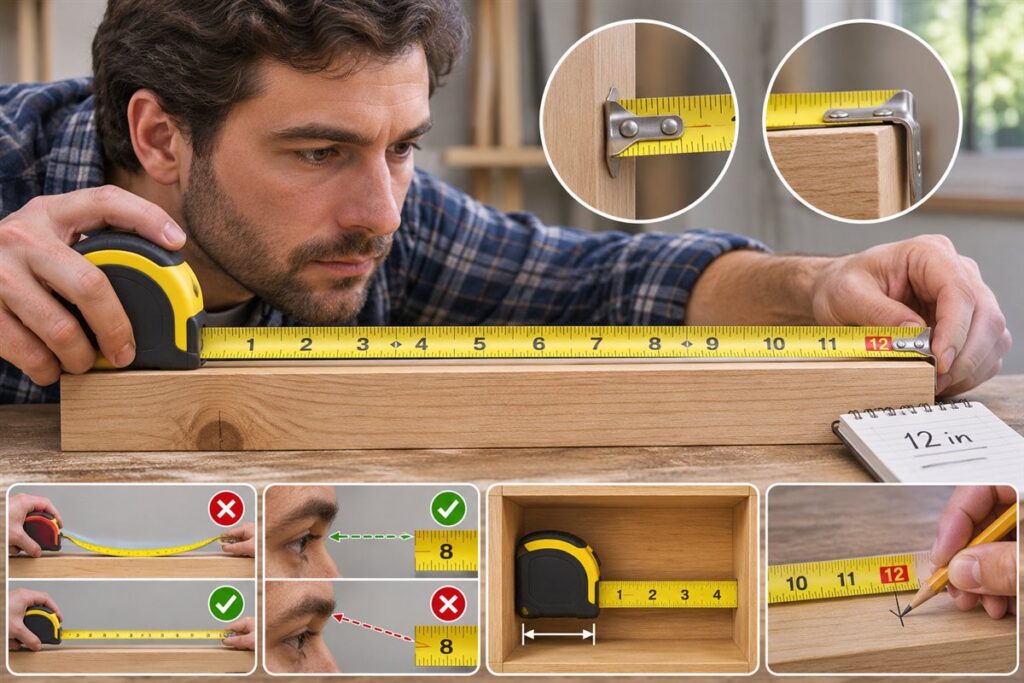
A tape measure gives accurate results when you hook the end properly, keep the blade straight and taut, read the marks at eye level, and write the number down at once. Most errors come from habits, not the tool, so a few simple routines go a long way.
Understand the Hook
The metal tab at the end of the blade is loose on purpose. It slides by the thickness of the tab itself, so it reads correctly whether you push it against a surface or hook it over an edge.
- When hooking over an edge, pull gently so the tab extends.
- When pushing against a surface, the tab slides in.
- If the tab is bent or loose beyond what looks normal, the tape may read wrongly. Compare it with a second tape or a ruler.
Read the Marks
Tapes have a main scale with large numbers and smaller divisions between them. Take time to learn your scale. Many tapes have extra marks, such as black diamonds or highlighted numbers, for layout work. Check the maker’s guide for what they mean on your tape.
- Find the nearest large number below your measurement.
- Count the small lines past it.
- Write down the full reading, with units.
Good Measuring Habits
- Keep the blade flat and straight. A sagging or twisted blade adds length.
- Hold it snug but not tight enough to bend the hook.
- Look straight at the mark, not from the side.
- Use the same tape for all measurements on one job, since tapes can differ slightly.
- Measure twice before cutting, and mark the cut with a thin line or a small V with the point at the exact spot.
- For long runs, ask someone to hold the other end, or hook the tab on a fixed point.
Inside, Outside and Awkward Spots
| Situation | How to do it |
|---|---|
| Outside measurement | Hook the tab on one edge and read at the other |
| Inside measurement | Press the case into one corner and add the case length printed on the tape |
| Round or curved item | Wrap a flexible tape around it, or use string and measure that |
| Long span, working alone | Hook on a nail or clamp |
The blade edge is thin and can cut skin when it snaps back, so guide the tape in as it retracts and do not let it whip. Keep it away from electrical equipment and live wires; a metal tape can conduct.
FAQ
Why does my measurement differ from a friend’s?
Different tapes, a sagging blade or a reading taken from an angle are the usual causes. Agree on one tape.
Should I measure from the end or from the one-inch mark?
The end is normal practice. Burn-an-inch methods are for damaged tabs; subtract the amount afterward.
The Short Version
Let the hook slide, keep the blade straight, read at eye level and double-check before cutting. Use the same tape through a job and keep it clear of live electrical parts.