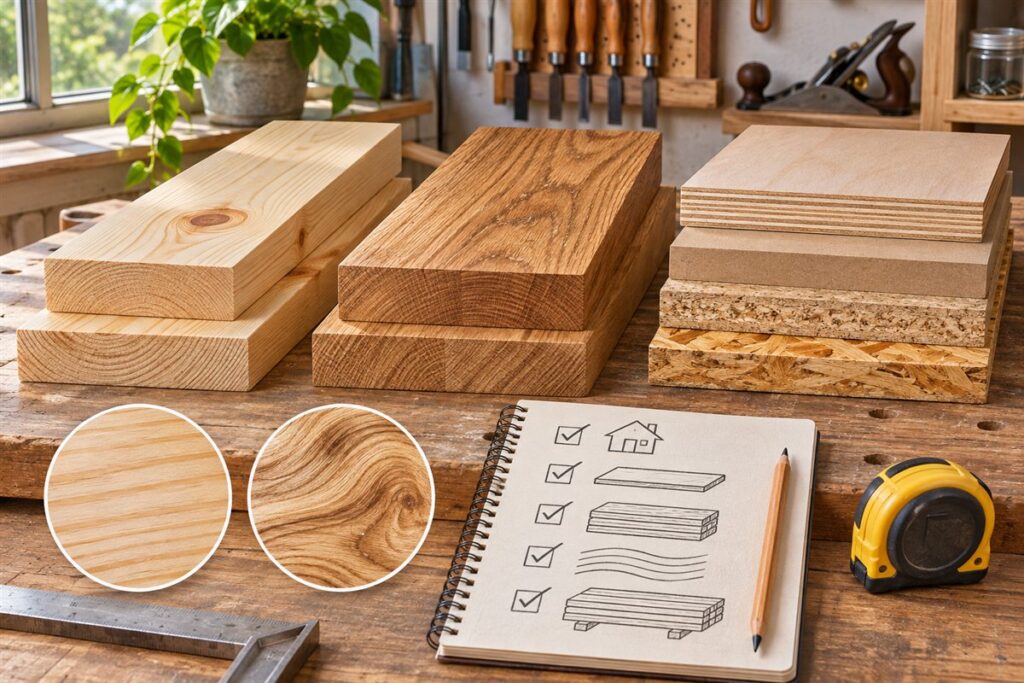
Wood falls into three broad groups for the home workshop: softwoods, hardwoods and manufactured boards. Each behaves differently when you cut, fix and finish it. Knowing the basics helps you buy the right material and avoid frustration.
Softwoods
Softwoods come from conifer trees such as pine, spruce and fir. They are light, easy to cut and widely available, which makes them a good choice for practice pieces, shelving, framing and general building. They dent more easily than hardwoods and often show knots.
Hardwoods
Hardwoods come from broadleaf trees such as oak, ash, beech, maple and walnut. They are generally denser and more durable, with attractive grain that suits furniture and worktops. They can be harder to cut and drill, so sharp tools and pilot holes matter. The names refer to the tree type, not always to how hard the wood is.
Manufactured Boards
- Plywood: thin layers glued with the grain crossing, stable and strong for its weight.
- MDF: fine fibres pressed into smooth boards that machine cleanly but dislike moisture. Cutting makes fine dust, so wear a mask.
- Chipboard (particleboard): compressed chips, used for flat-pack furniture and shelves.
- OSB: large strands pressed together, common in construction.
Quick Guide
| Wood | Character | Suits |
|---|---|---|
| Pine | Soft, light, knotty | Practice, shelves, frames |
| Oak | Hard, strong grain | Furniture, tables |
| Plywood | Stable sheets | Cabinets, panels |
| MDF | Smooth, uniform | Smooth flat panels, jigs |
Buying and Preparing Timber
- Decide whether the piece will be used indoors or outdoors, since moisture changes wood.
- Look along the board for twists, bows and large cracks, and choose straight pieces.
- Allow wood to settle in your workspace for a few days before cutting so it adjusts to the room.
- Check the grain direction so your cuts and planing follow it.
- Store boards flat or supported evenly, off the ground and out of damp.
Timber sizes are often quoted as nominal measurements, so a board may be slightly smaller than its label. Check the real dimensions before you plan a project. Ask the supplier about treated wood, since some preservatives call for gloves, masks and careful disposal; follow the maker’s safety information.
Reading the Grain
Grain is the pattern of the wood fibres. Straight grain is stable and easy to cut, while wild or twisting grain looks lively but can tear out when planed or routed. Plane or sand in the direction that leaves the surface smooth, and expect knots to be harder than the wood around them.
FAQ
What is the easiest wood for a beginner?
Pine or another softwood is forgiving and easy to cut, and plywood suits flat projects.
Why does wood move?
It takes in and gives off moisture with changes in humidity, so boards can swell, shrink or warp. Allow for movement in wide panels.
The Short Version
Softwoods are easy and common, hardwoods are dense and handsome, and boards give flat, stable sheets. Choose by project and environment, check boards for straightness and follow the maker’s safety information.