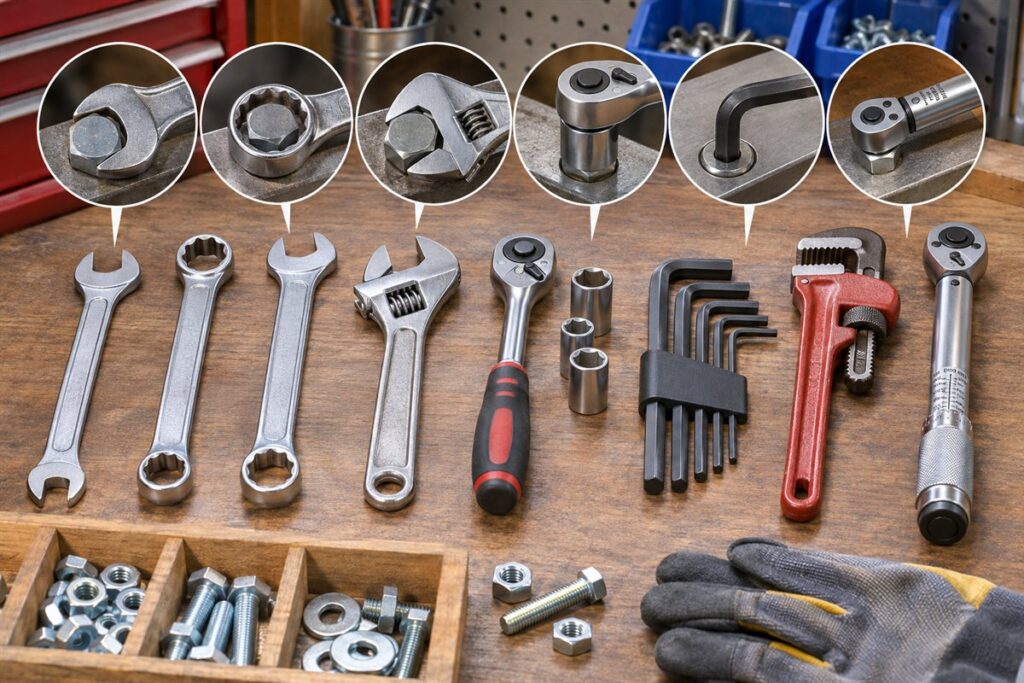
A wrench turns a nut or bolt by gripping its flats, and the fit decides how well it works. The common types are open-end, box-end, adjustable, socket and hex key, with torque wrenches for jobs that call for a set tightness. Here is how they differ.
Fixed-Size Wrenches
Open-end wrenches slide onto a fastener from the side, which helps where there is no room to go over the top. They grip on two flats, so they can slip on worn or tight fasteners.
Box-end wrenches wrap fully around the fastener, gripping at several points. They hold better and are the usual choice for breaking a tight fastener loose. Combination wrenches have an open end on one side and a box end on the other in the same size.
Adjustable and Socket Types
- Adjustable wrench: a movable jaw covers a range of sizes. Handy, but it can slip, so keep the jaw tight and pull toward the movable jaw.
- Socket wrench: a ratchet handle with interchangeable sockets, quick to use when you can reach straight onto the fastener.
- Hex (Allen) key: an L-shaped bar for fasteners with a hexagonal recess, common in flat-pack furniture.
- Pipe wrench: toothed jaws for round pipe, not for nuts, because it bites into the surface.
- Torque wrench: clicks or indicates when a set tightness is reached.
Choosing by Situation
| Situation | Useful wrench |
|---|---|
| Tight fastener, room to go over it | Box-end or socket |
| Fastener in a side-on gap | Open-end |
| Odd or unknown size | Adjustable |
| Flat-pack assembly | Hex key |
| Fastener with a specified tightness | Torque wrench |
Metric and Imperial Sizes
Wrenches are sold in metric and imperial sizes, and the two do not match exactly. Using the wrong size is a common way to round off a fastener. Test the fit by hand: the wrench should sit snug with very little wobble.
Using a Wrench Properly
- Choose the closest fit and seat the wrench fully on the fastener.
- Pull the handle toward you rather than pushing, so a slip does not throw your hand forward.
- Apply steady force instead of jerking.
- Avoid adding a pipe to the handle for extra leverage.
- For gas fittings, water supply connections or anything structural, follow the maker’s manual and call a qualified professional when unsure.
Putting Together a Starter Wrench Set
A well-chosen few wrenches handle most home jobs. A set of combination wrenches in the sizes you meet most often covers a wide range of nuts and bolts. A small socket set with a ratchet handle speeds up repetitive work. A set of hex keys deals with flat-pack furniture and bicycles. An adjustable wrench fills in when you meet an odd size.
Start by checking the fasteners around your home, car or bicycle. Note whether they are metric, imperial or a mix, and the sizes you use most. Buy to match those sizes first and add more over time. A complete set can be handy, but a smaller set of good tools often beats a large set of poor ones.
Consider where you will store and use the tools. A roll or tray keeps wrenches in order so you can find the right size quickly. Marked sizes that are easy to read save time, especially in poor light.
- Combination wrenches: the core of most kits.
- Sockets and ratchet: fast for exposed fasteners.
- Hex keys: for recessed hexagonal screws.
- Adjustable wrench: for unusual sizes.
Judging Wrench Quality and Fit
A good wrench fits the fastener closely. Slop in the jaws or box end leads to rounding, so check that the opening is accurate and the edges are clean. Look at the finish: smooth, even plating or coating helps resist rust. Sharp burrs or rough edges are signs of careless manufacture.
Box ends with twelve points allow more positions for turning in tight spaces, while six-point shapes grip the flats of the fastener more fully and are less likely to round it. Which is better depends on the job, so consider keeping both types for different tasks. Check the listing for the shape.
Check the construction. Forged steel wrenches are common, and the maker’s description may note the material. The sizes should be clearly marked, and the head should be thick enough to resist spreading under load. For ratchets, test the mechanism to see how it feels and how fine the movement is, since a finer ratchet works in tighter spaces.
Warranty and spare parts matter for ratchets and torque wrenches, which have moving parts. Look for clear terms, and decide how much you are willing to invest based on how often you will use the tools.
Leverage, Technique and Avoiding Injury
How you apply force matters as much as the tool. Pull the wrench toward you rather than pushing it away, because a slip while pulling is less likely to throw your hand into a hard edge. Keep your body balanced and your wrists straight. Wear gloves when appropriate, and check the area for sharp edges.
Seat the wrench fully on the fastener before applying force. A wrench that is partly on will slip and round the corners. For an adjustable wrench, tighten the jaw firmly on the flats and turn in the direction that pulls toward the fixed jaw, as the design suggests.
Length gives leverage, but do not extend a wrench with a pipe or by hitting it unless the maker permits it. That can overstress the tool or the fastener and cause breakage. If a fastener resists, apply a penetrating product made for the purpose, give it time and try again, or use a longer wrench designed for the load.
Use the right tool for the fastener. Do not use pliers or an adjustable wrench where a fitted wrench works. Keep the tool clean and free of oil so it does not slip.
- Pull toward you where possible.
- Fully seat the wrench before turning.
- Do not extend the handle unless permitted.
- Keep wrenches clean and dry.
Tightening Correctly and Avoiding Over-Tightening
Tightening is not the same as turning as hard as you can. Too little leaves a loose joint that can rattle free, and too much stretches or snaps the fastener, strips threads or distorts parts. Many fastened parts have a specified tightness from the maker, which you can find in the manual or documentation.
Use a torque wrench when a figure is specified. Set the value according to the instructions, tighten until the wrench signals, and stop. Torque wrenches are measuring tools, so handle them with care, and follow the maker’s guidance on storage and calibration. Do not use a torque wrench to loosen stuck fasteners, as that can harm it.
For jobs without a specified figure, aim for snug plus a modest turn, and learn the feel with practice. Keep threads clean, and use lubricant or thread-locking products only if the instructions call for them, since they can change the effect of a given tightness. Dirty or rusty threads give false readings.
Work in a pattern when tightening multiple fasteners on one part, such as a flange or cover. Tighten gradually in stages, moving across the part, so the load is spread evenly. Follow any sequence in the manual.
Caring for Wrenches and Knowing When to Replace Them
Wrenches last for decades with basic care. Wipe off dirt, oil and moisture after use, store them in a dry place and keep them organized so that they do not bang together. A light film of oil on bare steel helps prevent rust, and plated tools benefit from being kept dry.
Inspect them from time to time. Look for spread jaws on open-end and adjustable wrenches, cracks near the head or shank, and rounded or damaged box ends. A wrench with a spread opening no longer grips properly and tends to round fasteners. Replace it instead of trying to bend it back.
For ratchets, listen and feel for skipping or slipping. If the mechanism slips under load, stop using it, since a sudden slip can injure your hand. Some ratchets can be serviced following the maker’s instructions, but replacement may be simpler.
Keep sockets and accessories complete and sorted by size. Missing or mixed sizes slow you down and encourage using the wrong tool. Consider a labeled tray or rail. When you buy new, match the system to those you own so that parts stay compatible.
FAQ
Why does my wrench slip?
Usually the size is slightly wrong, the jaw is worn, or the fastener is already rounded. Try a box-end or socket of the exact size, which grips more of the fastener.
Do I need a torque wrench?
Only when the maker specifies a tightness figure. Check the maker’s guide for the value and the correct method.
What is the difference between six-point and twelve-point sockets?
Six-point sockets grip the flats of a fastener more fully and are less likely to round it. Twelve-point sockets engage in more positions, which helps in tight spaces.
Can I use a metric wrench on an imperial bolt?
Some sizes are close but not identical, and a near fit can round the fastener. Use the correct system and size.
What size wrenches should I buy first?
Check the fasteners you encounter at home, then buy the sizes you meet most. Many people start with a range of common sizes in one system and expand later.
Is a ratchet better than a combination wrench?
A ratchet is faster for exposed fasteners, while a combination wrench suits tight or awkward spots. Many people use both.
How do I loosen a very tight bolt?
Use the correct fitted tool, apply steady force and consider a penetrating product intended for the job. Avoid extending the handle unless the maker allows it, and wear eye protection.
Do torque wrenches need calibration?
Many makers recommend periodic checks or calibration, and storing them properly matters. Check the instructions for your tool.
Why is my adjustable wrench loose on the nut?
The jaw may not be tightened fully or the tool may be worn. Tighten the jaw until snug on the flats, and replace the wrench if the jaws are spread.
The Short Version
Box-end and socket wrenches grip best, open-end wrenches reach awkward gaps, adjustable wrenches cover odd sizes and hex keys suit flat-pack. Match the size carefully and follow the maker’s instructions.