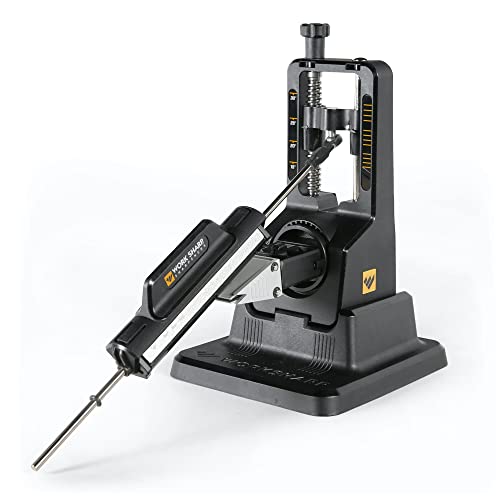
A diamond steel looks like a honing rod but carries a layer of diamond abrasive. Unlike a plain steel, it removes a little metal, so it can restore a dull edge as well as tidy a slightly bent one.
The six diamond steels below come from known knife makers and sharpening specialists. Lengths and grit levels differ, so check the listing before you decide which one matches your knives. Diamond steels suit modern, harder kitchen knives that smooth steel cannot touch. Use a light touch at about the angle of your knife, since heavy pressure wears the knife fast. Choose a rod that is at least as long as the blade so you can sweep the full edge, and look for a guard and a comfortable handle for safe use. A few firm passes on each side are usually enough, and you should always finish by wiping the rod and the blade so no abrasive dust remains on the kitchen counter. We have not used these products ourselves, so confirm sizes, materials and details on the current listing before buying.
As an Amazon Associate we earn from qualifying purchases. Links below are affiliate links, and they do not change the product information we give.
What to Look For
| Feature | Why it matters |
|---|---|
| Length | A rod as long as the blade makes full-edge strokes easy |
| Grit | Fine grit hones; coarse removes more metal |
| Handle and guard | A guard protects your hand during strokes |
| Rod shape | Oval or round rods behave a little differently |
| Knife match | Check the rod suits your knife steel and angle |
In this guide
Specs at a Glance
| Steel | Maker type | Abrasive | Notes |
|---|---|---|---|
| Wusthof diamond sharpening steel | Knife maker | Diamond coating | Long rod with guard |
| Henckels diamond sharpening steel | Knife maker | Diamond coating | Long handle |
| DMT diamond steel | Abrasive specialist | Diamond coating | Fine grit option |
| F. Dick diamond sharpening steel | Knife maker | Diamond coating | German-made line |
| Mercer Culinary diamond steel | Cutlery maker | Diamond coating | Budget-friendly |
| Sharpal diamond honing steel | Sharpening brand | Diamond coating | Magnetic or hook options vary |
The 6 Best Diamond Steel Knife Sharpeners

Top pickBest for german-style kitchen knives
1. Wusthof Diamond Sharpening Steel
A diamond-coated steel from a German knife maker. It is made to match the maker’s own blades but works on many western knives.
Suits: German-style kitchen knives. Strengths: brand pedigree and a guard. Weaknesses: a higher cost than generic rods. Skip it if you want a cheap rod.

Best for busy cooks
2. Henckels Diamond Sharpening Steel
A diamond steel from another German knife maker, designed to refresh edges between full sharpenings. It suits a typical home kitchen block.
Suits: busy cooks. Strengths: trusted brand and simple use. Weaknesses: finish quality can vary by size. Skip it if you need a very fine finish.
View Henckels Diamond Sharpening Steel on Amazon
Best for hard-steel kitchen knives
3. DMT Diamond Steel
A diamond steel from a company that specializes in diamond abrasives. The coating is made to cut evenly, and fine grit options are common.
Suits: hard-steel kitchen knives. Strengths: specialist diamond quality. Weaknesses: limited guard options. Skip it if you prefer a ceramic feel.
View DMT Diamond Steel on Amazon
Best for pro-style kitchens
4. F. Dick Diamond Sharpening Steel
A diamond-coated steel from a German maker used in professional butcher shops. It targets heavier daily use.
Suits: pro-style kitchens. Strengths: sturdy build and long rod. Weaknesses: a heavy feel for small hands. Skip it if you want a short travel rod.
View F. Dick Diamond Sharpening Steel on Amazon

Best for budget buyers
5. Mercer Culinary Diamond Sharpening Steel
A budget-friendly diamond steel from a cutlery brand that serves restaurants. It is a simple option for students and casual cooks.
Suits: budget buyers. Strengths: approachable price and a classic look. Weaknesses: less refined coating than premium rods. Skip it if you want pro-level precision.

Best for home cooks who want value
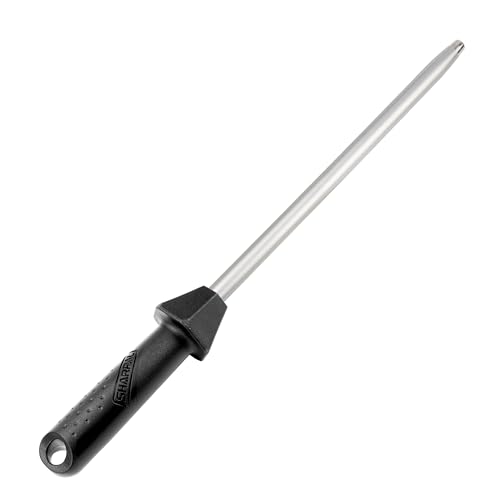
6. Sharpal Diamond Honing Steel
A diamond honing rod from a sharpening brand, often sold with a hanging hook. Check the listing for the length and the rod shape.
Suits: home cooks who want value. Strengths: easy hanging storage and a modest price. Weaknesses: limited maker support. Skip it if you want a famous kitchen brand.

Care and Setup
- Wipe the rod clean after each use.
- Rinse with water if metal particles build up.
- Store it on a hook or in a drawer with a guard.
- Use light pressure at a steady angle.
- Replace the rod if the diamond layer wears smooth.
Mistakes to Avoid
- Pressing too hard with a fresh rod.
- Swinging the knife at a changing angle.
- Using a rod far shorter than the blade.
- Using a diamond steel on a very soft knife every day.
- Forgetting that it removes metal.
Diamond Coating and Grit Explained
A diamond steel is a rod coated with fine diamond particles, usually bonded to a steel base. Unlike a smooth honing steel, which only realigns a bent edge, a diamond steel removes a small amount of metal, so it can bring back sharpness to a dull knife. How aggressively it cuts depends on the grit. A coarser coating removes metal quickly and suits a dull edge, while a finer coating polishes and is gentler. Some listings give a grit number, while others describe the rod as fine or medium.
The way the diamonds are applied matters for durability. Quality coatings aim to be evenly distributed, so the rod cuts evenly and lasts. Cheaper ones may wear unevenly, leaving smooth patches. Check the listing for what the maker says about the coating and treat those claims as the maker’s own.
A rod’s shape also influences feel. Round rods contact the edge along a narrower line, while oval or flattened rods have a larger area and can feel more stable. A longer rod lets you sweep the whole blade in a single stroke. If your knives are long chef knives, choose a rod at least as long as the blade. If you mostly use paring and utility knives, a shorter rod is easier to handle and store.
Matching the Rod to Your Knife Steel
Diamond is harder than almost all kitchen steels, so a diamond steel can work on very hard blades that regular steels cannot touch. That makes it useful for modern knives made from harder alloys. However, softer knives lose metal faster, so a coarse diamond rod used often may wear the edge more than necessary.
Think about the type of knife. Western-style kitchen knives often have a more robust edge and tolerate a diamond steel well when it is used lightly. Thin Japanese-style knives with a very acute angle and hard steel may need more care, because the wrong angle or too much pressure can round the edge or cause small chips. Check the maker’s advice for your knives, since some manufacturers recommend only certain tools.
If you own different knives, a fine diamond rod is the safest general choice. Reserve a coarser rod for neglected edges that need real work. A diamond steel is not a substitute for proper sharpening with stones or a guided system when a knife needs reshaping or has chips. If your knife is only slightly dull, a regular honing rod or a finer ceramic rod may be enough. The aim is to remove the least metal needed to restore the edge.
Technique, Angle Control and Pressure
Technique matters more than the rod. Hold the rod firmly, point the tip down against a stable surface or hold it in front of you away from your body, and place the heel of the blade near the handle end of the rod. Keep the blade at the angle your knife is designed for, then draw it across the rod, moving from heel to tip, with light pressure. Repeat on the other side. Maintain the same angle for each stroke.
Many people hold the angle too steep or too shallow. Check the knife maker’s recommended angle, and take your time to find it. If you cannot judge the angle by eye, practice by placing the blade against the rod, then lifting slightly and checking the contact. Very light pressure is enough, since the diamond cuts quickly. Pressing hard wastes metal and can create uneven wear along the edge.
- Use a few strokes per side, then test the edge.
- Stop when the edge feels sharp on paper or a tomato skin.
- Finish with a gentle pass on a smooth rod if you like a polished edge.
Safety is key. Use a guard if the rod has one, keep fingers behind it, and never rush. If you are new to it, practice on an old knife.
Safety, Handles and Storage Habits
A diamond steel deals with sharp blades, so handle design matters. A comfortable handle with a guard prevents your hand from sliding onto the edge. A rubber tip or a stand helps keep the rod steady on the counter. Check that the handle is securely attached to the rod, and that it is easy to grip when wet.
Wipe the rod after each use to remove metal particles. If dust builds up, rinse it with water and a soft brush, then dry it. Do not use harsh abrasives that can strip the coating. Keep it away from other tools, since diamond can scratch softer surfaces. Store it in a drawer with a guard or hang it with a hook so the coating does not rub on other metal.
Think about children and pets. A sharpening rod is not as dangerous as a blade, but it is still a tool that can cause cuts or damage if mishandled. Keep it out of reach. Metal dust can be a nuisance on counters and cutting boards, so wipe the knife and the area after sharpening. If you work over a food prep surface, clean it before preparing food. Do not use the rod near open food.
When to Move Beyond a Diamond Steel
A diamond steel is a convenient maintenance tool, but it cannot do everything. If your knife has chips, a rolled tip or a very dull edge that does not respond after a few passes, you may need a stone or guided sharpener to rebuild the edge. A rod is also not ideal for serrated knives, which need specialist tools.
Signs that the rod itself needs replacing include a smooth, glazed surface where the diamond has worn away, uneven cutting, or a loose handle. Over time, the coating wears, and the rod becomes less effective. How long this takes depends on pressure, frequency and the knives you use. If you notice that you need more strokes than before to get the same result, the coating may be exhausted.
Consider your overall sharpening plan. Many cooks use a diamond steel for quick edge maintenance between more thorough sessions on stones. Others use it as their main tool and accept a slightly less refined edge. If you want a polished finish, finish with a fine stone, a strop or a smooth steel. The best plan is one you will actually follow, so choose tools that fit your habits, your knives and your tolerance for fuss.
Diamond Steel Knife Sharpeners FAQ
How is a diamond steel different from a honing rod?
A plain steel aligns the edge. A diamond steel removes a little metal and can sharpen as well.
Can I use it every day?
Light use is fine, though daily heavy strokes will wear the knife.
What angle should I use?
Match the knife’s bevel, often 15 to 20 degrees.
Will it work on serrated knives?
Not well. Use a tapered tool for serrations.
How many strokes should I use?
A few light strokes per side are usually enough. Test the edge and stop as soon as it feels sharp.
Can a diamond steel damage a knife?
Too much pressure, a wrong angle or frequent use on soft steel can remove more metal than needed. Use a light touch and a fine grit.
Should I choose a coarse or fine diamond steel?
A fine one is safer for regular use. A coarse one suits dull edges but removes more metal.
How do I clean a diamond rod?
Wipe it after use, and rinse with water and a soft brush if metal particles build up. Avoid harsh abrasives.
Can I use it on ceramic knives?
Check the knife maker's advice. Ceramic knives are very hard and brittle, and most need specialist sharpening.
How long does the diamond coating last?
It depends on pressure and frequency of use. When the surface turns smooth and cuts slowly, it is time to replace the rod.
Is a longer rod better?
A rod as long as your blade makes full-edge strokes easier. A shorter rod can suit small knives and tight storage.
How the Six Diamond Steels Compare at the Board
A diamond steel is a maintenance tool you will use in the middle of cooking, often with wet hands and a board full of ingredients waiting. That context makes handle security, rod length and grit choice more important than they look in a product photo. The six picks above divide into clear camps once you judge them by how they behave in that moment rather than by brand heritage alone.
Fine maintenance rods versus more aggressive diamonds
The Wusthof Diamond Sharpening Steel and the Henckels Diamond Sharpening Steel come from the German knife tradition, and they suit the routine most German-style blades need: frequent, light realignment and gentle abrasion that keeps a working edge alive between proper sharpenings. The DMT Diamond Steel and the F. Dick Diamond Sharpening Steel lean more specialist. They appeal to sharpeners who understand that a diamond surface removes metal, not just folds it back, and who deliberately want that extra cutting action for harder-working knives. The honest dividing line is habit. A cook who steels a knife before every session with a few light strokes is well served by a finer rod; a cook who steels rarely and expects each session to rescue a tired edge will reach for the more aggressive options and must accept that they are spending the life of the edge a little faster.
Value rods and what you actually give up
The Mercer Culinary Diamond Sharpening Steel and the Sharpal Diamond Honing Steel show that the budget end of this category is more capable than it used to be. What you typically give up is refinement rather than function: handle materials feel more utilitarian, fit and finish are plainer, and the coating may not stay as even over years of daily professional use. For a home cook steeling a few knives a few times a week, those are reasonable trades. For a professional line cook steeling constantly through every service, the heavier-duty rods from F. Dick or Wusthof justify themselves through durability and feel. The mistake is assuming price maps directly onto sharpness; in practiced hands, all six of these rods can maintain an edge, and in careless hands the most expensive rod in the list will still round one.
Who Each Pick Suits — and Who Should Skip It
Choose the Wusthof if your knife block is mostly German-style blades and you want the rod the maker tradition intended for them. Skip it if your collection is mostly hard, thin Japanese-style blades, which are generally better maintained on stones and gentler surfaces.
Choose the Henckels if you want a familiar, family-kitchen rod for regular use by more than one cook, where an approachable feel matters. Skip it if you need the most aggressive rescue tool for neglected edges; that is not the job this style of rod does best.
Choose the DMT if you already trust diamond abrasives on stones and want the same cutting character in a rod for harder steels and outdoor knives as well as kitchen blades. Skip it if your technique is still heavy-handed, because a cutting rod punishes excess pressure by removing metal you did not mean to lose.
Choose the F. Dick if your knives work hard, your volume is high, or you simply want the rod most likely to outlast the kitchen around it. Skip it if it will be used twice a month on two knives, where its heavy-duty character is more than the job requires.
Choose the Mercer Culinary if you are equipping a working kitchen, a rental property or a second set of knives and need honest performance without ceremony. Skip it if handle comfort over very long sessions is your top priority, since that is where premium rods earn their keep.
Choose the Sharpal if you like a value rod with a practical extra or two and a forgiving character for learning technique. Skip it if you are building a buy-once kit around a single heritage brand and want every tool to match that standard.
Technique Deep-Dive: Getting More From Every Stroke
Set the rod up safely first
The most controlled way to learn is with the rod held vertically, tip resting on a folded towel on the counter, rather than waved in the air in the style of television chefs. The towel stops the tip slipping and keeps the rod steady while your other hand concentrates on the knife. Keep your rod hand behind the guard, keep the knife moving away from your body, and make sure nobody is reaching across your workspace mid-stroke. Speed is the last thing to add; a slow, repeatable stroke at a consistent angle does more for an edge than a fast, theatrical one.
Angle, pressure and stroke count
Match the angle to the edge your knives already have rather than chasing a number in the abstract, and hold that angle from heel to tip by letting the handle rise slightly as the curve of the blade demands. Pressure should be light — roughly the weight of the knife itself with a little guidance — because a diamond surface cuts without being forced. Alternate sides evenly, a handful of strokes per side for routine maintenance, and stop as soon as the edge bites cleanly again. Continuing to steel a knife that is already sharp only wears the coating and the edge. If a dozen careful strokes change nothing, the knife does not need steeling; it needs sharpening on a stone or an electric sharpener, and more strokes on the rod will not substitute.
After steeling
Wipe the blade with a clean towel before it touches food again, because steeling leaves fine metal particles on the edge. Wash and dry the knife as normal at the end of prep. The rod itself needs only a wipe and an occasional wash with warm water and mild detergent, dried fully before storage. Store the rod in a block slot, on a magnetic strip rated for the weight, or in a drawer with a guard, never loose among other tools where the coating gets knocked and the edge of the rod can damage neighbouring handles.
Pairing a Diamond Steel With the Rest of Your Kit
A diamond steel works best as one layer of a simple system. The rod handles the frequent, light work; a stone or electric sharpener handles the occasional real sharpening when steeling stops restoring the edge; and a smooth steel or fine ceramic, if you own one, can add a final polish for cooks who like that feel. Owning the rod does not commit you to the rest of the system on day one. Many households run happily for years on a diamond steel plus a professional sharpening once in a while. What matters is recognising which job you are asking the rod to do each time you pick it up, because nearly every disappointment with these tools comes from asking a maintenance rod to perform a repair.
More Questions, Answered
Should I steel before or after using the knife?
Before is the common habit, because you start each session with the edge aligned and biting. Steeling after use, before the knife is washed and stored, works just as well mechanically and some cooks prefer it so the knife is ready the moment it is picked up. Consistency matters more than the choice itself.
Can a diamond steel fix a chipped edge?
No. A chip is missing metal, and a rod cannot replace it. Small chips need a coarse stone or professional repair to reprofile the edge past the damage. A diamond steel can maintain the repaired edge afterwards, which is its proper role.
Why does my knife squeak or chatter on the rod?
Chatter usually means too much pressure, an angle that keeps changing mid-stroke, or a dry, loaded coating that needs cleaning. Slow down, lighten up, and clean the rod. If the sound persists on one section of the blade only, inspect that section for damage.
Is it safe to steel a knife with a bolster?
Yes, with care. Start the stroke just in front of the bolster so the full edge contacts the rod, and take extra care at the heel, which is the section most often missed on bolstered German knives. If the heel never seems to sharpen, that is usually a sharpening problem, not a steeling one.
How do I know the diamond coating is worn out?
The rod will feel smooth in patches, stop biting, and leave the edge unchanged no matter how careful your technique is. Compare a little-used section near the handle with the middle of the rod; if the middle feels noticeably smoother, the coating there is spent and the rod is due for replacement.
Can two cooks share one diamond steel for different knife styles?
Generally yes. The rod does not care which brand of knife it maintains. Each cook should still match angle and pressure to the knife in hand, and very hard or very thin blades are better kept to stones. For a mixed household block of European-style knives, one rod serves everyone.
Reading Your Knives: What the Edge Is Telling You
The shiny line along the edge
Hold a knife under a lamp and tilt it slowly. A dull or rolled edge catches the light as a bright line, because the rounded apex reflects where a sharp apex would disappear. After effective steeling, that line fades along the sections you worked. This simple check, done before and after, tells you more about your technique than any amount of hopeful slicing. If the line survives careful steeling, the knife has graduated from maintenance to sharpening, and continuing on the rod only polishes a problem.
Where knives dull first
Most kitchen knives dull unevenly. The section a hand span from the heel does the bulk of board work and tires first; the tip suffers from being dragged across boards and used for detail it was not shaped for; the heel is often neglected entirely because bolsters and rod technique conspire to skip it. When you steel, give each section deliberate attention rather than treating the blade as one uniform edge. A rod session that addresses the tired middle, respects the tip’s curve and actually reaches the heel produces the even, eager edge that makes a knife feel new again.
Board habits that decide how often you steel
The rod’s workload is set at the cutting board. Glass, stone and metal surfaces undo an edge in a single session; wood and quality synthetic boards let it live. Dragging a blade sideways across a board to scoop ingredients scrapes the apex sideways, which is precisely the motion that rolls it. Use the spine for scooping, or turn the knife over. Cooks who fix these two habits find their diamond steel suddenly seems twice as effective, when in truth it is simply being asked to do half as much.
The Diamond Steel in a Professional-Style Routine
Working cooks steel constantly and sharpen rarely, and the rhythm is worth copying at home. The rod lives within reach, the knife gets a few light passes before each substantial session, and the edge is checked by cutting rather than by hope. Once a week or so, the cook tests honestly: if steeling no longer restores the bite within a handful of strokes, the knife is scheduled for a real sharpening rather than being punished daily on the rod. That discipline — maintain early, escalate promptly — is why professional edges seem to last forever while home edges swing between razor and butter knife. Your diamond steel, whichever pick you chose above, is built for exactly that rhythm. Give it a fixed home near the board, keep it clean, and let it do the small job frequently instead of the big job badly.
Storing and Travelling With a Diamond Steel
Store the rod where its coating is protected: a block slot, a drawer insert, or a sheath or guard if it must share a drawer. Loose storage among utensils knocks the diamond surface and is the quiet cause of many rods that seem to wear out early. If the rod travels — to a holiday rental, a relative’s kitchen, a campsite — wrap it or case it, both to protect the coating and because an exposed rod in a bag invites careless grabs. On arrival anywhere, the same rule as at home applies: the rod is a kitchen tool, kept with the knives, out of children’s reach, and treated with the same calm respect as the blades it maintains.
Diamond Steels and the Knives Around the Kitchen
Bread knives, cleavers and other specialists
Not every blade in the drawer belongs on your diamond steel. Serrated bread knives keep their edges for years without steeling and are damaged by well-meant attention; their teeth need specialist care only when they finally dull. Heavy cleavers can be steeled carefully if their edges are fine rather than wedge-like, but their weight demands a braced, vertical rod and extra respect for where the blade travels. Thin slicing knives and carving knives, by contrast, are the rod’s happiest customers: a few light passes before a roast is carved is exactly the maintenance their long, fine edges were designed around, and the difference at the table is obvious to anyone eating.
Teaching the household
A diamond steel only protects the block if everyone who cooks uses it safely. Teach the braced vertical method, agree on where the rod lives, and make the rule simple: slow strokes, light pressure, fingers behind the guard, knife wiped afterwards. Children should not steel knives, and guests should be offered a sharp knife rather than a lesson. Households that share one calm routine get edges that stay sharp; households where everyone improvises get edges that wander and a rod that gets blamed.
When the Rod Is Not the Answer: A Quick Triage
Run through this sequence before any session. If the edge glints as a bright line under a lamp and a handful of careful strokes does not fade it, sharpen, do not steel. If the edge has a visible nick, sharpen or send it out; steeling over a nick tears it wider. If the knife is ceramic, put the rod away entirely. If the knife is a hard, thin Japanese-style blade, reach for a stone instead. Everything else — the ordinary, tired, rolled edges of daily cooking — is the diamond steel’s home ground, and on that ground it is one of the most satisfying tools in the kitchen: thirty seconds of calm, correct work, and dinner prep feels easy again.
A Final Habit: The Ten-Second Check
Before any knife goes back in the block, give it ten seconds: look along the edge under the light, feel nothing with your fingers — never test an edge by running a thumb across it — and confirm the bite on the next thing you cut. That tiny pause closes the loop between steeling and knowing, and it is the habit that turns a diamond steel from an object you own into a system you trust.
One Rod, Two Generations of Knives
Many kitchens quietly contain two eras of cutlery: an older set, softer and heavier, and newer additions bought one at a time. A diamond steel serves both, but not identically. Older, softer edges respond quickly and can be over-steeled by enthusiasm; a few passes restore them, and more only wears the rod. Newer, harder edges respond more slowly and forgive a little more work. Learn to read each knife’s response in the first two strokes — how the rod bites, how the sound changes — and adjust the session to the blade in your hand rather than running a fixed count. That attentiveness, more than any specification, is what separates cooks whose knives are always ready from cooks whose knives are always almost ready.
The Short Version
For a German pedigree, the Wusthof. For a family-friendly rod, the Henckels. For specialist diamonds, the DMT. For heavy use, the F. Dick. For budget, the Mercer. For value with a hook, the Sharpal.
Related Guides
- 6 Best Diamond Knife Sharpeners for Hard Steel (2026)
- 6 Best Knife Sharpeners: Electric, Stones and Rods (2026)
- 6 Best Manual Knife Sharpeners: Rods, Stones and Pull-Throughs
- 6 Best Hoof Knife Sharpeners: Diamond, Ceramic and Stone (2026)
- 6 Best Kitchen Sharpeners: Whetstones, Rods and Handheld
Building a Routine Around Your Cooking Habits
The most common reason a diamond steel ends up in a drawer is that nobody decided when to use it. A simple routine removes the guesswork, and it should match how hard your knives work rather than a calendar rule someone repeated online.
A home cook who prepares dinner most nights can think in three tiers. Before a big session of chopping, a few light passes on a fine rod can tidy the edge. Every few weeks, when the knife starts to slip on tomato skin or squash instead of biting in, the diamond surface does real work and removes a small amount of metal to bring the edge back. A few times a year, or after a bad encounter with a bone or a granite counter, the edge may need more than a steel can give, and that is the moment to consider a stone or a professional service.
Heavier users, such as people who break down whole chickens, process lots of vegetables for meal prep or cook for a large family, will land on the shorter end of those intervals. Occasional cooks can stretch them. The point is to act on the knife’s behavior instead of a fixed number of strokes.
- Light pre-use touch-up: a few gentle passes per side, no pressure.
- Periodic restoration: a slightly longer session when the edge feels dull but is not damaged.
- Reset: stones, a guided system or a sharpening service when the edge is chipped, rolled or very blunt.
Write the routine on a note inside a cabinet door if that helps. Consistency matters more than technique polish, because a knife that is touched up often needs far less metal removed each time, and that is what keeps blades alive for decades.
How to Tell Whether the Edge Is Actually Sharp
Many people sharpen by feel and finish with no idea whether the work succeeded. A few quick checks that need no equipment give you honest feedback and teach you what a good edge feels like.
Paper test
Hold a sheet of ordinary printer paper by one corner and slice downward with the heel of the blade. A sharp edge starts the cut cleanly without tearing or needing a sawing motion. If it snags, skips or crumples the paper, the edge is still dull or has a rough section. Run the test along the whole blade, since a knife is often sharp near the heel and dull near the tip because that is where the rod strokes ran out.
Tomato or onion skin
A tomato is a classic honest test. The knife should break the skin under its own weight with almost no downward push. If you have to press hard or the skin dimples before it gives, the edge has not recovered. A thin-skinned onion or a ripe plum works the same way.
Light and fingernail checks
Looking at the edge under a bright light can reveal shiny spots, which are tiny flat sections where the edge is rolled or blunt. A properly refined edge should not reflect light along its length. Some people also drag the edge very gently across a thumbnail at a shallow angle and feel whether it bites or glides. Use caution with that last one, and never test by running a finger across the edge itself.
If a knife fails these checks after a reasonable number of passes, resist the urge to add pressure. More force usually creates a burr or scratches the sides. Wipe the blade, reduce pressure, check your angle and try a few more careful strokes. If it still fails, the damage may be deeper than a steel handles.
Which Knives Gain the Most and Which to Keep Away
Not every blade in a kitchen block responds the same way to diamond abrasive. Knowing which ones benefit saves you from wearing out good steel for no reason.
| Knife type | Suitability | Practical note |
|---|---|---|
| Chef’s and utility knives | Good | The everyday use case; keep strokes light and consistent |
| Paring knives | Good with care | Short blades are easy to over-sharpen; use a few passes only |
| Hard, thin Japanese-style blades | Use cautiously | Fine grit only and very little pressure; edges can chip |
| Softer stamped or budget blades | Fine | Remove metal gently since they wear quickly |
| Serrated bread knives | Poor fit | A flat rod does not follow the scallops properly |
| Ceramic knives | Check maker guidance | Generally needs specialized tools; do not assume a steel will work |
Harder blades hold an edge longer but are more brittle, so aggressive abrasion at the wrong angle can cause microchips instead of a clean edge. Softer blades roll more easily, which is where a steel earns its keep, but they also lose metal quickly when the abrasive is coarse. If you own a prized knife, read the maker’s care instructions before using any new tool on it, and try the rod first on a cheap knife to get a feel for how much it cuts.
Cleavers, boning knives and fillet knives each have their own geometry. A flexible fillet blade, for example, needs lighter pressure than a rigid chef’s knife because it moves under the rod. Hold the handle firmly and keep the angle steady.
Common Frustrations and How to Fix Them
A few predictable problems show up for people new to diamond rods, and most are about technique rather than the product.
- Scratchy or rough edge: usually caused by a coarse rod or too much pressure. Finish with a few feather-light passes on a finer surface or a smooth steel.
- One side feels sharper: the angle or the number of strokes differs between sides. Count strokes and alternate to even it out.
- Uneven results along the blade: the strokes are not covering the heel and tip. Pull the knife down and across so the full edge meets the rod.
- Rod seems to stop cutting: the surface may be clogged with metal dust. Clean it according to the maker’s instructions and the abrasive usually wakes up again.
- Knife wears down too fast: reduce frequency and pressure. Diamond is meant to be used sparingly.
Keep a damp cloth nearby, wipe both rod and blade at the end of each session, and store the rod where it will not rub against other tools. A small amount of patience at this stage is worth more than a premium accessory.
Frequently Asked Questions
How do I know if my knife needs honing or sharpening?
If the edge feels slightly off but still bites, a quick touch-up on a steel often fixes it. If it fails a paper or tomato test even after careful passes, the edge has worn rather than just bent, and it needs real abrasion such as a diamond rod, stones or a sharpening service.
Should I use water or oil on a diamond steel?
Most diamond rods are meant to be used dry, though some makers allow a little water to flush metal dust. Avoid oil unless the instructions say it is fine, because it can trap debris and make the surface slick. Always follow the guidance printed with your specific rod.
Can a diamond steel be used on Japanese knives?
It can, but with caution. Harder Japanese blades are thinner and more brittle, so a coarse rod or heavy pressure may chip the edge. Choose a fine grit, use very light strokes and read the knife maker’s care notes first. Many owners prefer stones for these blades.
Why does my knife feel rough after using a diamond rod?
A rough feel usually means the grit was too coarse or you pressed too hard, leaving visible scratches or a small burr. Switch to fewer, lighter passes, then finish on a fine surface or smooth steel to polish the edge and remove the burr.