A knife set with a sharpener keeps your blades ready without a separate purchase. Some blocks have a built-in slot that sharpens each time you draw the knife out, while others include a honing steel. Either way, the idea is to maintain the edge between proper sharpenings.
The six sets below span stamped and forged blades and different piece counts. We have not used them ourselves, so confirm the piece count, steel and sharpener type on the current listing before buying. Edge-retention claims are the makers’ own, and built-in sharpeners are a convenience rather than a replacement for a real sharpening.
As an Amazon Associate we earn from qualifying purchases. Links below are affiliate links, and they do not change the product information we give.
What to Look For
| Feature | Why it matters |
|---|---|
| Sharpener type | A built-in slot, a steel and a separate stone work differently |
| Piece count | A larger set includes steak knives and shears you may not need |
| Blade build | Forged blades are heavier; stamped blades are lighter |
| Block | A compact block saves counter space |
In this guide
Specs at a Glance
| Set | Sharpener | Blade build | Notes |
|---|---|---|---|
| Henckels Statement Block Set | Built-in sharpener | Stamped | Fifteen-piece class |
| Farberware Edgekeeper Block Set | Built-in sharpener | Stamped | Self-sharpening slots |
| McCook MC29 Block Set | Built-in sharpener | Stamped | Stainless |
| Cuisinart C77SS-15PK | Honing steel included | Stamped | Classic block |
| Amazon Basics Block Set | Built-in sharpener | Stamped | Simple set |
| Wusthof Classic Seven-Piece Set | Honing steel included | Forged | German maker |
The 6 Best Knife Sets With a Sharpener
Top pickBest for a full kitchen setup
1. Henckels Statement Knife Block Set With Built-In Sharpener
A large stamped-blade set from a long-running German brand, in a block that includes a sharpening feature. It aims to cover everyday kitchen jobs with a wide range of knives.
Suits: a full kitchen setup. Strengths: a respected brand and many pieces. Weaknesses: stamped blades are lighter than forged. Skip it if you want a few knives only.

View Henckels Statement Knife Block Set With Built-In Sharpener on Amazon
Best for households that want easy maintenance
2. Farberware Edgekeeper Knife Block Set
A block set with built-in sharpening slots that touch up each blade as you remove it. Each knife also has a sleeve that keeps the edge protected when stored.
Suits: households that want easy maintenance. Strengths: slots that sharpen every use. Weaknesses: built-in sharpening is gentle, not a repair. Skip it if you want forged blades.

Best for first kitchens and gifts
3. McCook MC29 Knife Block Set
A stainless steel block set that includes a built-in sharpener. It offers a large piece count with steak knives and shears, making it a convenient start for a new kitchen.
Suits: first kitchens and gifts. Strengths: a large set with a built-in sharpener. Weaknesses: lesser-known than older brands. Skip it if you prefer a long-established brand.
View McCook MC29 Knife Block Set on Amazon
Best for everyday family cooking
4. Cuisinart C77SS-15PK Block Set
A fifteen-piece stainless block set that includes a sharpening steel. The stamped blades are lightweight, and the block keeps knives in easy reach.
Suits: everyday family cooking. Strengths: a wide set with a steel. Weaknesses: the steel needs a bit of practice. Skip it if you want a built-in sharpener.
View Cuisinart C77SS-15PK Block Set on Amazon
Best for simple needs
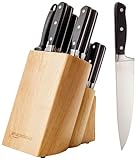
5. Amazon Basics Knife Block Set With Built-In Sharpener
A simple stainless steel set in a block that includes a sharpening slot. It is meant as a no-frills start for new households.
Suits: simple needs. Strengths: an uncomplicated, well-known retailer brand. Weaknesses: basic blades that do not match premium sets. Skip it if you want forged knives.
View Amazon Basics Knife Block Set With Built-In Sharpener on Amazon
Best for cooks who want quality over quantity
6. Wusthof Classic Seven-Piece Knife Block Set
A forged German set that includes a honing steel, a few core knives and a block. The set is smaller than many bundles, but the blades are a step up in build.
Suits: cooks who want quality over quantity. Strengths: forged blades and a honing steel. Weaknesses: fewer pieces than bigger sets. Skip it if you want steak knives and shears.
View Wusthof Classic Seven-Piece Knife Block Set on Amazon
Care and Setup
- Hand wash knives and dry them right away.
- Use the built-in sharpener gently, not as a heavy grinder.
- Hone with a steel before cooking if the edge feels dull.
- Store knives in the block with the edge facing up if the slot allows.
Mistakes to Avoid
- Using a built-in sharpener to repair a chipped edge.
- Putting block knives in the dishwasher.
- Using one knife for every task.
- Ignoring when a blade needs real sharpening.
How Block Sharpeners Differ
Knife block sets advertise a sharpener, but that can mean several things. Some blocks have a slot or a small sharpening mechanism built into the block, and the blade is sharpened as you draw it out or push it in. Others include a separate honing steel stored in the block, which realigns the edge rather than removing metal. A few include a pull-through sharpener with fixed abrasives.
The difference matters. A built-in slot is convenient but can wear the edge in an uncontrolled way, and the abrasive may be coarse. Because it works each time you use the knife, it can remove more metal than needed. A honing steel is gentler but needs some technique. A pull-through sharpener provides quick edge restoration but may not suit every blade type.
Read the listing carefully for how the sharpener works and which knives it supports. Check whether the sharpener can be replaced or whether it is a fixed part of the block. A removable or serviceable sharpener extends the life of the set.
Keep your expectations realistic. A convenient sharpener will keep the knives usable for everyday cooking, but it will not match a careful session on a whetstone. If you value edge quality, plan to complement the set with a good stone or a sharpening service now and then. The built-in sharpener is a maintenance helper rather than a complete solution.
Stamped Versus Forged Blades in Sets
Block sets include either stamped or forged knives. Stamped blades are cut from a sheet of steel, then ground and finished. They are generally lighter, thinner and less costly, and many cooks find them perfectly suitable for everyday tasks. They often lack a bolster, the thick junction between blade and handle, which can make them feel less balanced but easier to sharpen to the heel.
Forged blades are shaped from a heated bar of steel, often with a bolster and a thicker spine. They tend to feel heavier and more balanced in the hand, and they may offer greater strength. They typically cost more and may be harder to sharpen near the heel because of the bolster. Neither process is automatically better. A well-made stamped knife can outperform a poorly made forged one.
Check the listing for how the blades are made, the type of steel and the handle construction. Look for a full tang, where the steel extends through the handle, for sturdiness. Pay attention to handle materials, rivets and how smoothly the handle meets the blade.
Think about your cooking style. If you do a lot of chopping, heavier knives may feel more comfortable. If you prefer lightweight, easy handling, stamped knives may suit you. If your budget is limited, a stamped set with a few good knives and a few basic ones can serve well.
Piece Counts and What You Will Actually Use
Large piece counts can look like good value, but many sets include items you will rarely use. A practical kitchen needs only a few knives: a chef’s knife for most cutting, a paring knife for small tasks and a serrated knife for bread and tomatoes. A utility knife and kitchen shears add flexibility. Steak knives, carving tools and extra slots are optional.
Before buying, count how many knives you will use weekly. A set with many pieces can crowd the counter and make the block heavy. If the extras are lower-quality, they may not be worth the space. Conversely, a smaller set with better core knives may serve you better.
Check the block design. Slots should fit the knives snugly, with room for different blade widths. A block that stores knives edge-down can dull them, while a block that holds them on their spine is gentler. The block’s material and footprint matter too. Wooden blocks look appealing but need drying care, while plastic or metal ones are easy to clean.
Also look at what is included beyond knives. A honing steel and shears are common extras. If you already own good versions, you may not need them. Think of a set as a starting point, and plan to replace or add pieces as you learn what you like. A smaller high-quality set often serves better than a big one with many filler pieces.
Handles, Balance and Hygiene Details
Comfort and cleanliness affect daily use. Handles should fit your hand without hot spots. Plastic, composite and wood are common materials. Plastic and composite are generally easy to clean and durable, while wood looks traditional but needs careful drying and should not be soaked. Check how the handle is attached. Rivets should sit flush, and seams should be smooth so food does not collect.
Balance is the point where the knife feels neutral in your hand. A knife that is too blade-heavy or handle-heavy can tire your wrist. If possible, hold a similar knife before buying, or check the return policy. Weight is a personal preference, so avoid assuming that heavier means better.
Hygiene is partly about design. Blocks can trap moisture and crumbs, so choose one that is easy to clean and dry. Wash the knives by hand, dry them promptly and avoid the dishwasher, which can dull edges and damage handles unless the maker says otherwise. Check the care instructions in the listing.
Finally, look at the bolster, if any, and the heel of the blade. A comfortable pinch grip on the blade near the handle helps control. If the handle has sharp edges or the bolster digs in, the knife will be tiring to use. Reading descriptions and user feedback can reveal such issues, though your own hands are the best test.
Maintaining a Block Set Over the Years
A set lasts longer with simple care. Hand wash and dry after each use, store knives securely and cut on suitable boards such as wood or plastic rather than glass or stone. Avoid twisting or prying with the blade, which can damage the edge and tip. Use the honing steel or the block’s mechanism regularly to maintain the edge, but do not overdo it.
Plan for real sharpening. Even good knives need a proper sharpening every so often, depending on use. A whetstone, a guided system or a professional service can restore the edge in a way a built-in slot cannot. If you rely only on the block, check the edge periodically and stop if you see uneven wear or chips.
Clean the block, too. Remove the knives, tip it upside down to shake out crumbs and wipe the slots with a damp cloth or a small brush. Let it dry thoroughly before reinserting the knives. Moisture trapped in a block can encourage odor and corrosion.
Know when to replace parts. If the built-in sharpener becomes clogged or ineffective, if blades are chipped or bent, if handles loosen or crack, or if rust appears, it may be time to replace individual knives or the set. Many people replace only the core knives and keep the rest, which is a sensible way to refresh a set without starting over.
Knife Sets With a Sharpener FAQ
Do built-in sharpeners work well?
They can keep a decent edge for light use, but they do not match a good stone or a professional service.
What is the difference between honing and sharpening?
Honing realigns the edge. Sharpening removes metal to create a new one.
Are stamped knives okay?
Yes for everyday cooking, though forged knives are heavier and often hold up longer.
How many knives do I really need?
A chef knife, a paring knife and a bread knife handle most jobs.
Can a built-in sharpener replace a whetstone?
Not really. It is a convenient way to maintain the edge between proper sharpenings, but it cannot match controlled stone work. Plan on occasional real sharpening.
Is a larger piece count better value?
Not necessarily. Many sets include pieces you will rarely use. A smaller set with good core knives is often more useful.
Can I put block set knives in the dishwasher?
Hand washing is safer for edges and handles. Check the maker's care instructions in the listing before using a dishwasher.
How do I keep the knife block clean?
Remove the knives, shake out crumbs, wipe the slots with a damp cloth or brush and let it dry fully before reloading.
Which knives matter most in a set?
A chef's knife, a paring knife and a serrated knife cover most tasks. The rest are optional extras.
What is a bolster and do I need one?
It is the thick part where blade meets handle on many forged knives. It adds weight and balance but can make sharpening near the heel harder. It is a matter of preference.
How can I tell if the block sharpener is wearing my knives unevenly?
Look for a wavy edge, chips or sections that no longer cut. If you see them, stop using the slot and sharpen with a stone or have the knives serviced.
Steel Types and Edge Retention
The steel in a knife set decides how long an edge lasts and how easy it is to bring back. Most sets in this price range use some form of stainless steel, because it resists rust in a kitchen where blades get wet, left in sinks, and stored in humid blocks. Within stainless, the main variable is hardness and carbon content. Softer steels take an edge easily and are forgiving on a pull-through sharpener, but they dull sooner. Harder steels hold an edge longer, yet they are more brittle and can chip if you twist them through a bone or a frozen item.
German-style stainless, the tradition behind forged sets like the Wusthof Classic, tends to sit on the softer, tougher side. It rolls rather than chips, which is why regular honing works so well on it. Many Asian-style and budget stamped sets lean harder and thinner. Neither approach is better in the abstract. What matters is whether the steel suits the sharpening method you will realistically use. A coarse built-in slot is kinder to softer steel, while a hard blade is better served by a stone or a fine ceramic rod.
- Look for a stated steel grade or at least the words “high-carbon stainless.” A vague “stainless steel” label tells you little.
- Be skeptical of coatings and non-stick finishes on blades. They can wear away at the edge and hide how the steel actually behaves.
- Check whether the maker lists a Rockwell hardness. If it does not, assume the steel is in the middle of the range.
Edge retention also depends on your cutting board. Glass, stone, and bamboo boards dull any steel quickly. Wood or soft plastic boards extend the life of even an inexpensive set, and no sharpener in a block can make up for cutting on a plate.
Block Layouts and Counter Space
A knife block is furniture as much as storage, and it is worth measuring before you order. Blocks vary widely in footprint. Some are tall and narrow, with slots running vertically, while others are wide and low with slots fanned at an angle. A set with a built-in sharpener usually has a bulkier block, because the sharpening module takes up a section of the housing.
Think about three practical points. First, the height under your upper cabinets: a block with long slots can be awkward to pull from if the knife handles nearly touch the shelf above. Second, the position of the sharpener opening. If it is on the front or top, you need clear space to pull a blade through with both hands. Third, the block base. A wide, weighted base resists tipping when you yank out a stuck knife, while a lightweight block can slide on a smooth counter.
If your counter is crowded, a few alternatives exist. In-drawer trays, magnetic strips, and wall-mounted racks all free surface space, but they will not hold the built-in sharpener that drew you to this category. In that case, you can buy a small standalone sharpener and keep it in a drawer. Mixing a block set with a separate sharpener is also useful when your family has left-handed and right-handed cooks, since a block layout can favor one orientation.
Matching a Set to Your Kitchen Situation
Different households need different things from a block, and the cheapest or biggest option is rarely the best fit.
First apartment or dorm
A compact set with a chef knife, paring knife, serrated bread knife, and shears covers almost everything. Large sets of fifteen pieces tend to bury a few useful blades in steak knives and fillers that you may not touch. For a first kitchen, a built-in sharpener is a real convenience because it removes the learning curve of honing.
Wedding or housewarming gift
Gift buyers often reach for the largest piece count, but an attractive block, clean packaging, and a recognizable brand matter more here. Consider whether the recipient already owns knives. A modest upgrade to a forged set can be a more thoughtful present than a big stamped one.
Busy family kitchen
Durability and easy cleaning take priority. Look for handles that tolerate frequent hand washing and a block that can be wiped out. Shorter-term convenience, like a sharpener that is always at hand, tends to keep knives usable when nobody has time for maintenance.
Enthusiastic home cook
If you cook most nights, you will notice weight, balance, and steel quality quickly. A seven-piece forged set like the Wusthof Classic matches this profile better than a large budget bundle. You may also prefer to learn stone sharpening instead of relying on a slot.
Budget Versus Premium: Where the Money Goes
The price gap between a budget block and a forged premium set pays for several concrete things, not just a brand name. Forging, where a blade is shaped from a single heated bar, costs more than stamping blades from a sheet. Forged knives usually include a bolster and a full tang, adding weight and a more balanced feel. Premium makers also tend to apply tighter quality control on edge angle and handle fit, which shows up as fewer gaps and rattles.
Budget sets spend their money differently. They stretch a lower price across more pieces, so you get steak knives, extra utility knives, and a bigger block. The trade-off is thinner steel and lighter handles. For many households that is a perfectly reasonable bargain, especially if you value having a built-in sharpener and a full range of sizes.
- Spend more if you cook daily, prefer a heavier knife, or want a set that can last decades with care.
- Spend less if you want a serviceable everyday set, are furnishing a rental, or expect to replace knives as your skills develop.
- Consider buying a small, good set and adding individual knives later instead of paying for a large set you will not use.
Warranty terms are also worth comparing. Some makers offer long or limited-lifetime coverage against defects, though these rarely cover dulling or misuse. Read what the warranty includes before assuming it adds value.
Frequently Asked Questions
Is high-carbon stainless steel better than regular stainless?
Usually it holds an edge somewhat longer while still resisting rust, which is why many makers advertise it. The label alone is not a guarantee, though, because heat treatment matters as much as composition. Treat it as a mild positive, and judge a set by how the steel is described, not just by that phrase.
Should I buy a knife set or build a collection of individual knives?
A set is cheaper per piece and gives you a block and sharpener in one purchase. Individual knives let you spend money on the three blades you use most, such as a chef knife, paring knife, and bread knife. If you are unsure what you need, start with a smaller set and add pieces later.
How much counter space does a knife block with a sharpener take?
Expect a block footprint roughly the size of a small cookbook, with extra height for the handles. Sharpener models run a little bulkier. Measure the gap under your cabinets and leave room to pull the knives straight up without scraping handles on the shelf above.
How long should a kitchen knife set last?
With hand washing, a soft cutting board, and regular honing, a decent set can serve for many years. Budget stamped knives may need replacing sooner as the edge wears thin. The block sharpener removes metal each time, so pace its use and avoid sharpening more often than you need to.
The Short Version
For a full set, the Henckels Statement. For easy upkeep, the Farberware Edgekeeper. For a first kitchen, the McCook MC29. For a family set with a steel, the Cuisinart. For a simple start, the Amazon Basics set. For forged quality, the Wusthof Classic seven-piece set.