Outdoor edge knives are the fixed blades and folders people carry for camping, hunting, fishing and trail work. They have to cut rope, prep kindling, process food and stay dependable when the weather turns and the gear gets wet.
The six knives below mix a hunting folder, trusted bushcraft fixed blades and a classic folding lockback. We have not used these products ourselves, so confirm blade length, steel and sheath details on the current listing before buying.
As an Amazon Associate we earn from qualifying purchases. Links below are affiliate links, and they do not change the product information we give.
What to Look For
| Feature | Why it matters |
|---|---|
| Fixed or folding | Fixed blades are stronger; folders are easier to carry |
| Steel | Corrosion resistance matters near water, edge toughness matters for chopping |
| Handle | Textured grips stay secure with wet or cold hands |
| Sheath | A good sheath keeps the edge protected and the knife easy to reach |
In this guide
Specs at a Glance
| Knife | Type | Best for | Notes |
|---|---|---|---|
| Outdoor Edge RazorPro | Folding, replaceable blades | Field dressing | Blades swap without sharpening |
| Morakniv Companion | Fixed blade | Camp and bushcraft | Light and simple |
| Buck 119 Special | Fixed blade | Hunting and camp | Long-running classic |
| Gerber StrongArm | Fixed blade | Hard use | Tough sheath options |
| KA-BAR Becker BK2 Companion | Fixed blade | Heavy camp work | Thick, rugged build |
| Buck 110 Folding Hunter | Folding lockback | Everyday outdoor carry | Belt sheath included |
The 6 Best Outdoor Edge Knives
Top pickBest for hunters who field dress game
1. Outdoor Edge RazorPro
A folding hunting knife from the brand that gave this topic its name. It uses replaceable razor-style blades, so a dull edge is handled by swapping blades rather than sharpening in the field.
Suits: hunters who field dress game. Strengths: fresh blades on demand. Weaknesses: blades are not made for prying or chopping. Skip it if you want one blade for bushcraft.

Best for campers and new bushcrafters
2. Morakniv Companion
A Swedish fixed-blade knife that is famous for cutting well at a modest weight. The simple handle and plain sheath keep it practical for camp chores, feathering sticks and food prep.
Suits: campers and new bushcrafters. Strengths: light weight and a sharp, easy-to-resharpen edge. Weaknesses: a basic sheath. Skip it if you plan on heavy batoning.

Best for hunters and traditional camp carry
3. Buck 119 Special
A long-running American fixed-blade hunting knife with a clip-point shape and a leather-style sheath. It has been a camp and hunting staple for decades and handles skinning and general chores.
Suits: hunters and traditional camp carry. Strengths: proven design and good blade length. Weaknesses: heavier than modern designs. Skip it if you count every ounce.

Best for rough, all-weather use
4. Gerber StrongArm
A full-tang fixed-blade knife built for rough work, with a coated blade and a grippy handle. It is often chosen by people who want a rugged knife with a sheath that suits different carry setups.
Suits: rough, all-weather use. Strengths: a strong, full-tang build. Weaknesses: a coating can show wear. Skip it if you want a polished classic look.

Best for heavy camp tasks
5. KA-BAR Becker BK2 Companion
A thick, heavy-duty fixed blade for chopping, splitting and building shelter. It is known for toughness and is the sort of knife people pick when they want a camp workhorse that tolerates abuse.
Suits: heavy camp tasks. Strengths: exceptional toughness. Weaknesses: weight and bulk. Skip it if you want a light everyday knife.

Best for hunters, hikers and collectors
6. Buck 110 Folding Hunter
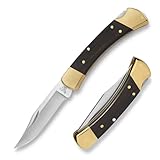
The classic folding lockback with a wood-style handle, brass ends and a belt sheath. It is a sturdy folder for hunters and hikers who prefer something that closes up when not in use.
Suits: hunters, hikers and collectors. Strengths: a sturdy lockback and long track record. Weaknesses: heavy for a folder. Skip it if you want pocket-friendly weight.
Care and Setup
- Dry the blade after each trip and apply a light coat of oil.
- Store the knife outside a leather sheath for long periods to avoid trapped moisture.
- Check the handle screws and lock before every outing.
- Keep a small sharpener or strop in your pack.
- Clean sap and blood off the blade soon after use.
Mistakes to Avoid
- Prying with a folding knife.
- Batoning with a blade that was not made for it.
- Skipping sheath retention checks on rough trails.
- Ignoring local blade-length rules.
Matching the Knife to the Kind of Trip
The right outdoor knife depends less on a feature list and more on what you actually do outside. A day hiker may open food packages, cut cord and trim a bandage, which a small folder handles easily. A weekend camper adds food prep, feathering kindling and cutting tent cord, where a mid-sized fixed blade is comfortable. A hunter needs a blade shaped for skinning and field dressing, and may prefer a design that is easy to clean. Someone building a shelter or processing firewood needs a thicker, stronger fixed blade.
Start by writing down your three most common tasks, then look for the knife whose size and shape fits them. A knife that tries to do everything is often too large for fine work and too small for heavy work. Many experienced campers carry two tools: a modest knife for daily tasks and a saw or hatchet for chopping, which spares the knife from rough work.
Consider weight and where it rides. A heavy knife on a belt may be fine on a short walk but tiring on a long trek, while a folder that disappears in a pocket may be forgotten in a pack. Think about whether you will wear gloves, since thick gloves need a larger handle and a sheath that can be opened one-handed. Match the knife to the season as well as the location.
Blade Steel, Coatings and Edge Shape
Steel choice is a trade-off between corrosion resistance, toughness and ease of sharpening. Stainless steels resist rust and suit wet climates, boats and coastal trips. Carbon steels often sharpen easily and take a good edge but need more care to avoid rust. Coated blades add protection against corrosion and glare, though coatings can wear at the edges. Check the listing for the steel type and the maker’s care instructions, and avoid assuming that any steel is rust-proof.
Edge shape affects how a knife behaves:
- Drop point: a strong tip and good control, versatile for camp and hunting.
- Clip point: a finer tip that helps with detail work and piercing.
- Straight (Scandi-style) grind: easy to sharpen in the field and good for wood.
- Flat or hollow grinds: slice well in food and game but may be less rugged.
- Serrated sections: help with rope and fibrous material but are harder to sharpen.
Blade thickness also matters. A thicker spine is sturdier for tougher jobs, but it slices less efficiently. A thinner blade cuts food well but flexes when pushed hard. Think about whether you value slicing or strength, and look for the balance that suits your use. Remember that no knife replaces a proper axe or saw for large wood.
Handles, Grip and Wet-Weather Control
A knife is only as safe as your grip on it. Outdoors, hands get wet, cold, muddy or greasy, and a smooth handle becomes slippery. Handles come in wood, rubberized plastic, textured synthetic and metal. Wood looks classic and feels warm but can swell or crack if left wet. Synthetic handles are generally more weather tolerant and often have texture for traction. Check that the handle has a guard or a pronounced finger shape to keep your hand from sliding onto the blade.
Hold the knife the way you will actually use it. A handle that feels fine for light cutting may bite into your palm during longer tasks. Pay attention to the length, which should fill your hand without cramping, and the shape of the end, which should not dig into the palm during push cuts. If the listing gives dimensions, compare them with a knife you already own and like.
Think about handle construction. A full-tang design extends the steel through the handle for strength, while partial-tang or folding designs trade some strength for weight or compactness. For a folder, look at the lock type and how it feels to close one-handed, since a safe closing method is important. A lanyard hole is useful for attaching a cord so the knife is not dropped in water or snow.
Sheaths, Carry Options and Local Rules
The sheath is part of the knife. A good sheath keeps the blade secure while you scramble over rocks, protects the edge in a pack and lets you draw safely. Leather is traditional and molds to the knife but can hold moisture, which may cause rust, so avoid long-term storage inside it. Nylon and molded plastic sheaths tolerate weather and dry quickly. Check the retention, the strap or clip and whether the sheath can be worn on the belt, on a pack strap or in more than one orientation.
For folding knives, look at the pocket clip and whether you can open and close the blade with one hand when needed. Test the carry setup at home before relying on it outdoors.
Rules about knives vary widely. Blade length limits, locking-blade restrictions, carry rules in vehicles and policies in parks, schools, transit and courthouses differ by place. Some places regulate how a knife is carried, for example openly or concealed. Before travel, check the rules for each location and put knives in checked luggage when flying, following transport authority guidance. Respect private land and posted signs. Being a responsible knife owner includes learning the law, carrying the knife safely and keeping it out of reach of children.
Sharpening, Field Repairs and Long-Term Care
A sharp knife is safer than a dull one because it needs less force. For fixed blades, a compact sharpener, a small stone or a leather strop can keep the edge usable in camp. Learn the angle that matches your blade and keep it consistent, using light passes. Replaceable-blade knives avoid sharpening, but you should carry spare blades and a safe way to dispose of used ones.
After each trip, wipe the blade dry, remove sap and food residue with a cloth and mild soap, then dry fully. Apply a light film of oil to steel that rusts, and keep oil off the handle and the edge you will use on food. Check screws, pivots and locks on folders, and clean lint from the pivot area with a brush or compressed air. Store knives in a dry place, preferably not sealed in a damp sheath.
Know the signs of trouble. Replace or have a knife serviced if the lock fails to hold, the blade wobbles, the handle cracks, the tip is bent, or rust pits appear along the edge. Avoid using a knife for prying, digging or hammering, since those jobs cause most breakages. Practice safe habits: cut away from your body, keep your free hand clear and sheath the knife whenever you are not using it.
Outdoor Edge Knives FAQ
Should I choose a fixed blade or a folder?
Fixed blades are stronger and easier to clean. Folders are lighter in a pocket and often more discreet.
What is the Outdoor Edge brand known for?
It is known for hunting knives, including replaceable-blade designs and tools for field dressing game.
How long should an outdoor knife blade be?
Many people like a blade of moderate length that handles both fine and rough camp tasks. Check the listing for exact size.
Do I need a sharpener for the field?
For fixed blades, a compact sharpener is wise. Replaceable-blade knives skip this step.
How do I stop my knife from rusting?
Dry it after use, wipe off moisture and apply a thin coat of oil if the steel is prone to rust. Avoid long-term storage in a damp leather sheath.
Is a full-tang knife always better?
Full-tang designs are typically stronger for hard use, but they are heavier. A lighter partial-tang or folding knife can be a better fit for hiking and general use.
Can I carry a fixed blade on a plane?
Knives usually must go in checked baggage, but rules vary by country and carrier. Check the transport authority's current guidance before you travel.
What is the safest way to carry a folding knife?
Keep the blade closed and locked, clip it to a pocket with a secure clip or keep it in a sheath. Make sure the lock engages fully before use.
How often should I sharpen an outdoor knife?
It depends on how much you use it and what you cut. Touch up the edge when it begins to slip on tasks that used to be easy, using light strokes instead of waiting until it is very dull.
What size knife is best for kids on camping trips?
Children should only use knives with adult supervision and appropriate training. A small knife with a secure grip and sheath is easier to control, but local rules and your judgment matter.
Can I baton wood with any fixed blade?
Not every knife is built for it. Check the maker's guidance, as batoning stresses the blade and tang, and use an axe or saw for larger wood.
Breaking Down the Jobs: Carving, Food, Fire and Game
Outdoor knives get asked to do very different things, and knowing which tasks you do most helps you pick well. Carving and woodcraft, such as making tent stakes, feather sticks, or small tools, favor a knife with a comfortable grip and a blade that bites cleanly into wood. Shorter fixed blades with a flat or gently curved edge tend to give good control for this work.
Camp food preparation is another common use. Slicing cheese, trimming meat, or cutting rope all need a clean, sharp edge, and a thinner blade often performs better than a thick one. Keep a dedicated food-safe knife separate from the one you use for dirty tasks like cutting rope or prying, and wash it thoroughly after each use.
Fire preparation includes splitting kindling and shaving tinder. A sturdy fixed blade with a thick spine can handle light splitting, while thinner folders are not meant for heavy work. For hunters, field dressing calls for a blade shaped for controlled cuts and easy cleaning. Models such as the Outdoor Edge RazorPro, which this guide covers, are designed around that kind of work, but always read the maker’s guidance on intended use.
- Light carving and food prep: thin to moderate blade, comfortable handle.
- Camp chores and kindling: thicker fixed blade with a strong spine.
- Field dressing: purpose-shaped blade that is easy to clean and sharpen.
Safe Handling Habits and Basic First Aid
Most knife injuries come from rushed or careless habits rather than from blade failures. Cut away from your body and keep other people outside the reach of your swing. Use a stable surface when possible, and avoid cutting toward your hand when holding the object. When passing a knife to someone, hand it handle first with the edge facing away.
Wet, muddy, or cold hands reduce grip, so slow down in poor conditions. Keep the blade sharp, since a dull knife slips more readily and demands more force. When you are not using the knife, return it to its sheath or close the lock, and do not leave it sitting open on a log or tent floor.
Carry a basic first aid kit with bandages, gauze, and tape. For a minor cut, clean the wound with clean water, apply pressure to stop bleeding, and cover it with a dressing. Deep cuts, cuts that will not stop bleeding, or injuries near joints need professional medical care. Learn the basics through a certified first aid course if you spend significant time outdoors.
Budget Thinking: Where Spending Pays Off
Knives range from inexpensive to quite costly, and the best value is not always at either extreme. The features that matter most for outdoor use are a reliable edge, a secure handle, and a sheath that holds the knife safely. Fancy finishes, exotic materials, and collector appeal add cost but not always function.
Spend on the pieces that matter: blade steel suited to your climate, a handle that suits your hand, and a sheath that fits. Save on extras you will not use. An entry-level knife from a respected maker can serve for many years if you maintain it, and spending a little on a sharpening tool often improves performance more than upgrading the knife itself.
Consider how you plan to use the knife. A knife that will live in a pack and see occasional use does not need the same toughness as one used daily by a guide. Be honest about your habits, and choose accordingly.
Cleaning After Food, Game and Salt Water
What you cut determines how you clean. After food use, wash the blade with warm water and mild soap, then dry thoroughly. After field dressing, remove blood and tissue promptly, since residue can stain and corrode steel. Scrub with a soft brush and warm water, and dry the blade, handle, and any crevices before storing.
Salt water is harsh on steel. If you fish or boat, rinse the knife with fresh water after each trip, dry it completely, and apply a light film of oil to protect against rust. Do not store a knife in a leather sheath while damp, since leather holds moisture against the blade. Let both dry separately before putting them together.
For folding knives, clear debris from the pivot area and lightly lubricate moving parts according to the manufacturer’s advice. A small toothbrush and cotton swabs work well for tight spaces. Regular cleaning prevents buildup that can make folders stiff or unsafe.
Finally, store knives in a cool, dry place rather than in a closed vehicle or damp garage, where temperature swings and condensation encourage rust. Check the edge and handle fasteners before each season, and replace a sheath that has cracked, stretched, or stopped retaining the blade securely. A short inspection before each trip takes minutes and prevents most gear-related surprises in the field.
Frequently Asked Questions
Can I use a knife as a hatchet or pry bar?
It is not recommended. Prying can snap tips or stress the blade, and chopping with a knife can damage the edge and the handle. Use the right tool for the task, and reserve the knife for cutting and light carving.
How do I clean a knife after cutting food outdoors?
Wash it with warm water and mild soap, rinse, and dry thoroughly. If water is limited, wipe the blade with a clean cloth and clean it properly once you are back at camp. Keep food and dirty-task knives separate when possible.
What blade shape is best for general camp use?
A drop-point or similar straight-backed shape is a common choice for camp work because it offers a strong tip and a useful belly for slicing. The best shape depends on your tasks, so match it to what you cut most.
What should I do after a minor knife cut in the field?
Clean the wound with clean water, press firmly to stop bleeding, and cover it with a sterile dressing. Seek medical care for deep cuts, bleeding that will not stop, or wounds near joints. Take a first aid course if you spend time outdoors.
The Short Version
For field dressing, the Outdoor Edge RazorPro. For light camp use, the Morakniv Companion. For a classic, the Buck 119. For hard use, the Gerber StrongArm. For heavy work, the Becker BK2. For a folder, the Buck 110. Whatever you choose, match the knife to the trip and confirm the details on the current listing. Pack a small sharpener, keep the edge dry and learn safe carving habits before heading far from home. A tidy sheath and a lanyard help keep the knife secure on rough ground.