Where to buy
Check the latest price, availability and delivery on Amazon. Orders are placed on Amazon. We may earn a commission from qualifying purchases.
- Best overall under $50: BestOffice Ergonomic Office Chair, Mid-Back Mesh (Black) — Check on Amazon
- NEO CHAIR High Back Mesh Chair with Flip-Up Armrests — Check on Amazon
- Furmax Office Chair, Mesh Mid-Back (Black) — Check on Amazon
See 3 more options below
- Sweetcrispy Low-Back Mesh Office Chair, Armless — Check on Amazon
- Sweetcrispy Small Armless Desk Chair, PU Leather — Check on Amazon
- Furmax Mid-Back Task Chair, PU Leather, Armless — Check on Amazon
Read the full guide ↓
Disclosure: As an Amazon Associate, umtsmarttool.com earns from qualifying purchases. Links to Amazon on this page are affiliate links; they cost you nothing extra. Listing details such as price and availability change often, so check the current Amazon listing before you buy.
The best ergonomic office chair under $50 is not a premium task chair at a discount — it is a specific, worthwhile package: a shaped mesh or padded back with real lumbar support, a height-adjustable seat, a stable five-point base, and a maker who publishes the weight capacity. This guide verifies those four things on six real chairs, states every capacity and dimension the makers publish, and frames comfort honestly: these chairs can make long sitting noticeably more comfortable, and none of them is a medical device. The best ergonomic office chair under $50 for most readers is the one whose fixed geometry matches their body, and the reviews are written to let you check that match on paper. Set it up alongside our Best Computer Desk Under $30 and the chair half of your desk is solved at this budget.
In this guide
Quick Picks
Short on time, or comparing several options at once? Each row below names a buyer type and the ergonomic office chair that suits it, with the key specification that separates it from the rest of the list.
| Buyer type | Pick | Why it stands out | Link |
|---|---|---|---|
| Best overall under $50 | BestOffice Ergonomic Office Chair, Mid-Back Mesh (Black) | Mesh mid-back chair with lumbar support, high-density sponge seat, adjustable height, rolling casters; seller-stated capacity 250 lb | Check on Amazon |
| Best with flip-up arms and certifications | NEO CHAIR High Back Mesh Chair with Flip-Up Armrests | High-back mesh chair, adjustable lumbar support, padded flip-up armrests, waterfall seat; 250 lb maximum per the listing, BIFMA-tested casters and base, SGS-certified gas lift | Check on Amazon |
| Best seat dimensions for average builds | Furmax Office Chair, Mesh Mid-Back (Black) | Mesh mid-back chair, seat 19.7 x 19.7 in, back 19.7 x 18.9 in, seat height 16.5-20.5 in, SGS-certified gas lift, 240 lb capacity | Check on Amazon |
| Best armless mesh chair | Sweetcrispy Low-Back Mesh Office Chair, Armless | Armless low-back mesh chair with lumbar support, rolling swivel base; 250 lb maximum per the listing | Check on Amazon |
| Best compact upholstered chair | Sweetcrispy Small Armless Desk Chair, PU Leather | Compact armless PU-leather chair with U-shaped lumbar support, padded foam seat, height adjustment; 250 lb maximum per the listing | Check on Amazon |
| Best low-profile task chair | Furmax Mid-Back Task Chair, PU Leather, Armless | Armless mid-back task chair in faux leather with bucket seat, swivel and height adjustment; 210 lb maximum per the listing | Check on Amazon |
How These Picks Were Chosen
Every chair in this guide is a real, currently listed product whose key specifications were verified against the maker’s listing or documentation: rated weight capacity, back construction (mesh or upholstered), seat-height adjustability, armrest type, and any certifications the maker actually claims (SGS gas-lift testing and BIFMA-tested components appear on several picks — and only where the maker states them). Listings that use the word ‘ergonomic’ with no published capacity and no describable support features were excluded.
We did not sit in these chairs. The comparisons rest on published construction — mesh versus foam-and-vinyl, fixed lumbar curves versus adjustable supports, nylon versus metal bases — and on the fit between those constructions and the working pattern each version of this guide addresses. Comfort language in the reviews is framed as exactly that: what a design tends to feel like and for whom, never as a medical claim. No chair at any price treats or prevents back conditions, and this guide does not pretend otherwise.
The budget was applied as a ceiling, and at this ceiling honesty requires a framing note: ‘ergonomic’ at this level means a shaped mesh back, some form of lumbar support, a height-adjustable seat and a proper five-point base — a real and worthwhile package for a few hours a day. It does not mean the multi-adjustable task chairs of the higher tiers, and the reviews say plainly where each chair’s support story ends.
One more filter shaped this list: session honesty. Every review states the sitting duration the chair’s design actually suits — a few hours for the task chairs, longer for the mesh-backed picks — because a budget guide that lets a reader buy a two-hour chair for an eight-hour job has failed at its only task. Where a chair’s listing makes comfort promises beyond its construction, the review quietly corrects them with the chair’s actual specifications.
Best Ergonomic Office Chair Under $50 — The 6 Picks
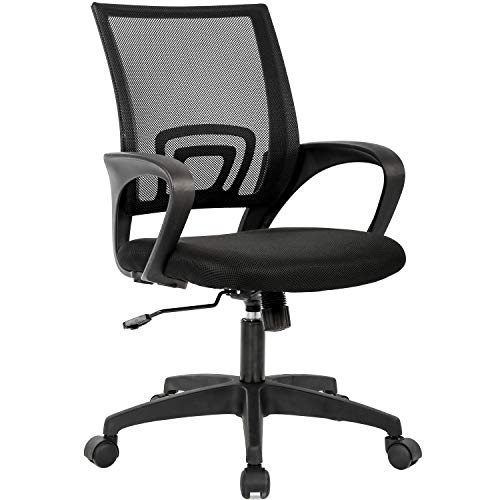
1. BestOffice Ergonomic Office Chair, Mid-Back Mesh (Black) — Best overall under $50
The BestOffice is the budget mesh chair against which the rest of this tier is measured, and its formula explains the position: a fully ventilated mesh mid-back with a lumbar-support curve, a high-density sponge seat, pneumatic height adjustment, fixed armrests and a five-point rolling base — the complete ergonomic checklist at the class’s most accessible price, from a listing that has sold in volume for years. Retailer and review sources put its seller-stated capacity at 250 lb, and its seat-height adjustment covers the standard desk range.
Its support story is the fixed-curve kind: the mesh back’s shape does the lumbar work, with no moving mechanism, so the fit depends on the curve meeting your back — which the seat height tunes. The seat cushion is the honest compromise of the tier, comfortable for a working day of a few hours and merely adequate beyond it. For the standard home-office brief — real mesh, real lumbar shape, real capacity figure, lowest cost of entry — it remains the pick to beat, and nothing in this guide beats it on value.
Ownership at this tier follows a pattern worth knowing: the first month is the audition, when the seat foam settles to its working density and the lift proves it holds height overnight. This chair’s long sales history means its failure modes are equally well documented — a lift that sinks in year two, casters that loosen — and both are cheap, standard parts. A chair whose weaknesses are known and replaceable is a safer budget purchase than a newer listing whose weaknesses are still surprises.
For the base brief, judge this chair by the completeness of its ergonomic package per dollar: back support, seat, adjustment and documented capacity, all four present or the chair is a stool with ambitions.
Pros
- The complete budget ergonomic package at the lowest price here
- Breathable full-mesh back with lumbar curve
- 250 lb seller-stated capacity
Honest limitation: Fixed lumbar curve and a seat cushion tuned for sessions of a few hours, not all-day marathons.
Choose it if you want the proven budget formula — mesh, lumbar shape, honest capacity — at the tier’s entry price.
Skip it if you sit eight-plus hours daily and need adjustable lumbar — that mechanism lives in a higher tier.
2. NEO CHAIR High Back Mesh Chair with Flip-Up Armrests — Best with flip-up arms and certifications
The NEO CHAIR DBS brings two things the rest of this tier mostly lacks: paperwork and a trick. The paperwork: BIFMA-tested casters and base and an SGS-certified gas lift, stated on the listing — the budget class’s only meaningful durability credentials. The trick: padded armrests that flip up, letting the chair tuck fully under the desk, serve a small room, and get out of the way for cross-legged sitting or a guitar. The high-back mesh design adds an adjustable lumbar support and a waterfall seat front that is kinder to the backs of your thighs than a square edge.
The listing’s stated maximum is 250 lb, and the chair’s item weight of about 21 lb makes it easy to move between rooms — a genuine home-office virtue. Its compromises are the class compromises: a foam seat of standard depth and a back whose support, while adjustable in the lumbar, is not the multi-axis system of higher tiers. For buyers who read specifications before photos, this is the most credentialed chair in the guide.
One ownership detail the specifications hint at: at about 21 lb, this is a chair one person can carry through a doorway without a second thought, which quietly changes how a home office gets rearranged, cleaned and moved. The flip-up arms also mean the chair stores against a wall flatter than any fixed-arm rival here. Small virtues, but they compound daily in real rooms — and they cost nothing in support to obtain.
Base-brief tiebreaker: prefer the chair whose specifications you could verify twice — published capacity, published dimensions, named certifications — because at this tier documentation is durability’s best predictor.
Pros
- BIFMA-tested base/casters and SGS-certified lift, stated on the listing
- Flip-up arms solve small rooms and under-desk storage
- Adjustable lumbar support — rare at this price
Honest limitation: 250 lb ceiling is the class standard, not a standout; seat foam is standard-depth.
Choose it if you want stated certifications and flip-up arms, and your weight sits within 250 lb.
Skip it if you need a capacity above 250 lb — look at the higher tiers, where 300 lb chairs begin.
3. Furmax Office Chair, Mesh Mid-Back (Black) — Best seat dimensions for average builds
Furmax publishes the numbers this guide wishes every maker published: a 19.7 by 19.7 inch seat, an 18.9-inch-high back, a seat-height range of 16.5 to 20.5 inches, an SGS-certified gas lift and a 240 lb maximum capacity. That transparency is the review: you can fit this chair to your body on paper before it ships, which is how budget chairs should be bought. The design is the classic mid-back formula — breathable mesh back with an integrated lumbar curve, padded seat, fixed armrests, nylon base.
A candid note on budget: this chair’s street price sits right at this tier’s ceiling and is sometimes seen a touch above it, so check the current price on Amazon before you buy. Within the tier, its seat runs a little wider and deeper than the BestOffice’s, which average and larger builds tend to prefer, while its 240 lb ceiling is the guide’s second-lowest — the sorting is easy: dimensions say yes, capacity must also say yes.
Fit notes from the published geometry: the 20.5-inch top of the seat range suits taller sitters better than most of this tier, while the 16.5-inch floor is merely average — shorter sitters should run the popliteal check in this guide carefully before ordering. The back’s 18.9-inch height supports to the shoulder blades on average builds. None of this is guessable from the product photos, which is precisely the point of a maker who publishes dimensions.
For general desk work, the chair’s job is to disappear: support you notice is support mis-fitted, so weigh the fit ranges (seat height, capacity, back height) against your own measurements before the features.
Pros
- Fully published dimensions — fittable on paper
- SGS-certified gas lift
- Generous 19.7 in seat for average builds
Honest limitation: 240 lb capacity is near the guide’s floor, and the street price hugs the tier ceiling.
Choose it if your build suits a wider seat and your weight is within 240 lb.
Skip it if you need the guide’s maximum capacity or the lowest price — the BestOffice serves both better.
4. Sweetcrispy Low-Back Mesh Office Chair, Armless — Best armless mesh chair
Armless chairs are a deliberate design, not a missing feature, and this Sweetcrispy is the mesh expression of it: a breathable low-back mesh chair with lumbar support, a swivel rolling base and height adjustment, and nothing at the sides — so it slides under any desk, including the low-apron and vanity desks that defeat fixed arms, and lets you sit sideways, cross-legged or perched in any posture a long day invents. The listing states a 250 lb maximum, and at under 12 lb item weight it is the lightest chair in this guide by a wide margin.
The trade is exactly what the design promises: no elbow support, which typists at long sessions will miss by hour three, and a low back that supports to the mid-back only. For students, vanity and bedroom desks, small rooms, and anyone whose chair must disappear under the desk at night, those trades are the point. It is the specialist pick of this guide, and within its specialty it has no rival here.
A word on the low back, because it is the design’s defining trade: support ends at the mid-back, which suits upright task sitting and varied postures — the way this chair will actually be used — and does not suit leaning-back lounging. Buyers who work upright and move often will never miss the top half of a high-back; buyers who recline to read should choose the NEO or the BestOffice and accept their footprints instead.
For the base brief, judge this chair by the completeness of its ergonomic package per dollar: back support, seat, adjustment and documented capacity, all four present or the chair is a stool with ambitions.
Pros
- Fits under any desk — no arm collisions, ever
- Featherweight and easy to move between rooms
- Mesh back with lumbar support, 250 lb stated maximum
Honest limitation: No armrests and a low back — not the chair for long typing sessions.
Choose it if your desk has a low apron, your room is small, or you sit in varied postures and hate armrests.
Skip it if you type for hours at a stretch and lean on armrests — choose an armed pick.
5. Sweetcrispy Small Armless Desk Chair, PU Leather — Best compact upholstered chair
The second Sweetcrispy takes the opposite material path: PU leather over padded foam, with a U-shaped lumbar support built into the back’s structure, in a compact armless frame sized for small rooms, bedrooms and vanity desks. Where the mesh version breathes, this one cushions — the first sit is softer, the look is more furniture than office equipment, and the listing states the same 250 lb maximum on a metal frame and base. For a chair that must look at home in a bedroom, it is the most presentable pick in the guide.
Upholstery’s honest costs apply: PU leather holds heat where mesh breathes, and its surface ages faster than mesh under daily use — expect it to look its age sooner. Sessions of a few hours in a temperate room are its home ground. Buyers choosing between the two Sweetcrispys are really choosing a climate and a look; the ergonomics — armless freedom, compact footprint, real stated capacity — are shared.
Care notes for the PU surface: wipe it weekly, keep it out of direct sun, and expect the finish to soften and eventually wear at the seat’s front edge over a few years of daily use — the standard upholstery bargain at this tier. In exchange, the chair never looks like office surplus, and in a bedroom that distinction is worth real money. Buyers who prioritize a decade of surface integrity over looks should take the mesh sibling and accept the office aesthetic.
Base-brief tiebreaker: prefer the chair whose specifications you could verify twice — published capacity, published dimensions, named certifications — because at this tier documentation is durability’s best predictor.
Pros
- Furniture look that suits bedrooms and vanities
- U-shaped lumbar support in a padded back
- Compact armless frame, 250 lb stated maximum
Honest limitation: PU leather holds heat and ages faster than mesh under daily use.
Choose it if you want a compact chair that looks like furniture and sit a few hours at a time.
Skip it if you work long sessions in a warm room — the mesh Sweetcrispy breathes better.
6. Furmax Mid-Back Task Chair, PU Leather, Armless — Best low-profile task chair
Furmax’s second entry is a different species: a low-profile, armless bucket-seat task chair in faux leather, built for desks where the chair must tuck away completely — conference corners, reception desks, student rooms, vanities. The listing states a 210 lb maximum and a light 14.5 lb item weight. The bucket seat’s wrap-around shape gives a sense of enclosure that flat seats do not, and the whole chair reads as a designed object rather than office surplus, which is why this style persists in modern small rooms.
Its limits are the clearest in the guide, and they are stated so the right buyer finds it: 210 lb is the lowest ceiling here, the back is a task chair’s mid-back without a dedicated lumbar mechanism, and the style serves sessions, not marathons. For a light user at a small desk who values how the room looks and needs the chair to vanish under it, those limits are irrelevant. Everyone else should take the hint the numbers are giving and choose above it in this list.
Who, precisely, is the right 210 lb buyer? A lighter adult or older teen at a study desk, a reception or vanity chair that hosts sessions rather than shifts, a spare-room chair that works when guests work. The bucket seat’s enclosure suits shorter sits genuinely well. The discipline this guide asks is only that the capacity and the session length be read before the style — the chair rewards the right buyer and punishes the wrong one, and the listing’s own numbers tell you which you are.
For general desk work, the chair’s job is to disappear: support you notice is support mis-fitted, so weigh the fit ranges (seat height, capacity, back height) against your own measurements before the features.
Pros
- Low-profile design tucks completely under desks
- Bucket seat suits small rooms and vanity desks
- Light and easy to move
Honest limitation: 210 lb capacity is the guide’s lowest, and lumbar support is shaping only.
Choose it if you are a lighter user with a small desk and a room the chair must disappear into.
Skip it if you need capacity, lumbar support or all-day seating — the mesh picks above are your chairs.
Comparison Table
| Pick | Back | Seat height | Rated capacity | Armrests |
|---|---|---|---|---|
| BestOffice Ergonomic Office Chair, Mid-Back Mesh (Black) | Mesh mid-back | Adjustable | 250 lb (seller-stated) | Fixed |
| NEO CHAIR High Back Mesh Chair with Flip-Up Armrests | Mesh high-back | Adjustable | 250 lb | Flip-up padded |
| Furmax Office Chair, Mesh Mid-Back (Black) | Mesh mid-back | 16.5-20.5 in | 240 lb | Fixed |
| Sweetcrispy Low-Back Mesh Office Chair, Armless | Mesh low-back | Adjustable | 250 lb | Armless |
| Sweetcrispy Small Armless Desk Chair, PU Leather | PU leather mid-back | Adjustable | 250 lb | Armless |
| Furmax Mid-Back Task Chair, PU Leather, Armless | Faux leather mid-back | Adjustable | 210 lb | Armless |
Capacity figures are the makers’ stated maximums as published on each listing — treat them as limits, not targets, and prefer a chair whose limit sits comfortably above your weight. Seat-height ranges are quoted where the maker publishes them; a chair whose range is not published is marked as adjustable-only, because an invented range would be worse than none.
How to Choose a Ergonomic Office Chair That Fits Your Desk
Fit the chair to your body in this order: seat height first (your feet should rest flat on the floor, or on a footrest, with thighs roughly level), then seat depth (a fist’s width between the seat edge and the back of your knees is the classic check), then the backrest’s lumbar curve against your lower back, then armrest height so your shoulders stay relaxed. A chair that cannot achieve the first two is the wrong chair for you regardless of its features — which is why seat-height range and seat dimensions lead every review in this guide.
Capacity is a fit specification, not a footnote. The maker-stated maximums in this class run from about 210 to 250 lb. Sit comfortably inside the limit — a chair worked at its maximum all day ages fast, and its gas lift and base are the parts that pay. Heavier readers should treat the higher-capacity picks here as their shortlist and the higher tiers as their real market; this guide flags capacity in every review so the sorting is easy.
Mesh versus upholstered is the class’s real fork. Mesh backs breathe — the deciding factor for warm rooms and long sessions — and their support comes from the frame’s curve. Upholstered seats and PU-leather backs feel softer at first touch and suit shorter sessions and cooler rooms, but they hold heat and their foam compresses with age. Most picks here pair a mesh back with a padded seat, which is the budget class’s sensible compromise.
Armrests deserve a decision, not a default. Fixed arms suit a single desk at a known height. Flip-up arms (one pick here) tuck the chair under the desk and suit small rooms. Armless chairs (two picks here) fit under any desk, allow sideways sitting and cross-legged postures, and remove the arm-versus-desk collision problem entirely — at the cost of elbow support during long typing sessions. Choose by your desk and your habits, not by the product photo.
Finally, assembly and aftercare: every chair here assembles with a hex key in roughly 15-30 minutes, and the gas lift is the component that decides the chair’s lifespan. Buy from makers who publish their capacity and any lift certification, keep the receipt, and re-tighten the arm and base bolts after the first month — budget chairs loosen audibly before they loosen dangerously, and a two-minute tightening is the whole maintenance schedule.
Budget-specific setup: because these chairs have fixed lumbar curves rather than mechanisms, your adjustment is position — sit fully back, tune seat height until the curve meets your lower back, and add a footrest if your feet dangle at that height. Ten minutes of this on day one is worth more than any feature on the box.
And manage the tier’s lifespan honestly: keep the hex key, re-tighten at week four, and expect a few good years rather than a decade. A budget chair bought with open eyes and fitted properly is a good purchase; the same chair bought as a forever chair disappoints on schedule.
The Best Ergonomic Office Chair Under $50 for All-Day Comfort — Within Reason
Comfort across a working day at this budget comes from three things: a back that breathes and supports (mesh, ideally with a lumbar curve that meets your back), a seat whose foam is dense enough not to bottom out by afternoon, and your own movement rhythm. The mesh picks in this guide cover the first two as well as the tier allows; the third is yours, and it matters more than the difference between any two chairs here.
Set honest expectations and the tier delivers: a reader moving from a dining chair to the BestOffice or NEO will feel a genuine all-day difference. A reader expecting a budget chair to equal a flagship task chair will not — that gap is adjustability, and it is priced accordingly. Our Best Office Desk For Home Office Under $30 guide covers the desk side of the same all-day equation.
Pairing Your Chair with the Rest of the Desk
Chair height is set by the desk, not the chair: elbows at desk height, shoulders relaxed, feet supported. If that puts your feet off the floor, our Best Footrest Under $20 guide is the standard fix — a footrest is the cheapest ergonomic upgrade in existence and the natural partner of every chair in this guide. Screen height completes the triangle: the top of the screen at eye level, raised by a stand or an arm if needed.
Buy in that order — chair, footrest, screen height — and each purchase makes the next one smaller. Readers who start with the chair and measure honestly usually find the rest of the setup costs less than the chair did, which is the budget ergonomics story in one sentence. The Best Dual Monitor Arm Under $50 guide covers the screen side when you are ready.
Setting Up Your Chair and Desk as One System
For the general reader, the chair-and-desk system setup matters more than any single specification in this guide, because the base brief is where mismatched heights do their quiet damage:
A chair is half a system. Set it in relation to the desk: chair height so your elbows rest at desk height with shoulders down, feet flat (a footrest closes any gap — it is the cheapest ergonomic accessory there is), screen top at or just below eye level at arm’s length. If the chair must sit high for a tall desk, the footrest stops being optional; dangling feet undo the backrest’s work within the hour.
The lumbar curve only helps if it meets your back: sit fully back in the seat — most people perch on the front half and then blame the chair — and check that the backrest’s fullest curve lands in your lower back’s natural hollow. On the fixed-curve chairs here, your seat height is the adjustment that moves that meeting point; spend the first week fine-tuning it in small steps.
Movement is the system’s third member. No chair at any price makes eight still hours healthy; the budget chairs here, with their simpler tilt mechanisms, especially reward a rhythm of standing, walking and posture changes. Set the tilt tension so you can lean back and return without effort, and use the lean — a chair that only ever sits at 90 degrees is furniture used at half its design.
Revisit the fit after a month: foam seats settle, gas lifts reveal their true height retention, and your own sense of the chair sharpens. Small corrections — a cushion’s position, a footrest’s height, the monitor’s distance — compound. The goal is a setup you stop noticing, and noticing nothing is the only honest definition of ergonomic success this guide will offer.
Gas Lifts, Bases and Casters: The Parts That Decide Lifespan
The gas lift is the chair’s engine: a sealed cylinder that carries your weight and sets your height. Makers who state SGS or BIFMA testing for the lift (several picks here do) are publishing the one credential that predicts whether the chair still holds height in year three. A chair that slowly sinks is not ‘settling’ — its lift is failing, and on a documented maker’s chair it is a replaceable part; on an anonymous listing it is the end of the chair.
Bases divide into nylon and metal at this tier. Nylon bases are lighter, kinder to floors and — on the documented picks — tested to the same stated capacities as metal ones. Metal bases feel more substantial and suit the upper end of the capacity range. Either is acceptable from a maker who publishes a capacity; neither is acceptable from one who does not.
Casters are floor-specific: the standard wheels on every pick here are made for carpet and hard floors in the general sense, but on hardwood, dedicated soft-wheel casters (a cheap swap) roll quieter and mark less. If your chair will live on a floor you care about, budget the caster swap with the chair — it is the smallest money in this guide and the most appreciated daily.
Armrest bolts and seat-plate bolts loosen in the first month on almost every budget chair — this is normal, universal, and fixed with the included hex key in two minutes. Put a calendar note at week four. The chairs that get returned as ‘wobbly’ in month two are very often chairs that needed that one tightening and never got it.
A note on buying two: households furnishing two home workstations often ask whether to match chairs or mix. Match, if both sitters fit the same model — identical chairs simplify parts, adjustments and expectations, and a maker who documents one documents both. Mix only when the sitters’ measurements genuinely differ, in which case this guide’s per-chair dimensions exist precisely to let each person fit their own. Either way, buy the documented chairs; a matched pair of mysteries is still a mystery.
Finally, a word about the chair you already own: if it is a documented chair from a known maker and merely old, its lift and casters are replaceable parts, and a $15 lift can return a sound chair to service — the most budget-honest move in this entire guide. Replace the chair when the frame, base or back has failed or when it never fit you; repair it when only the consumables have worn. Knowing the difference is worth more than any single pick listed here.
One last measurement habit worth forming: re-run the five-minute fit check whenever the desk, the room or your own body changes — a new desk height quietly unmakes an old fit, and the chairs here adjust in minutes when someone thinks to ask them to.
Before You Order: The Five-Minute Chair Fit Check
Run these checks against your body and your desk before ordering any chair in this guide. A budget chair that fits is a good chair; a budget chair that does not fit is a return.
- Measure your popliteal height. Sit with feet flat and measure from the floor to the crease behind your knee. The chair’s seat-height range must include a setting at or just below that number — check it against each review’s published range.
- Check the capacity honestly. Your weight against the maker’s stated maximum, with margin preferred. Every review in this guide states the figure; the sorting takes ten seconds and decides the shortlist.
- Measure your desk’s underside. Fixed armrests need clearance to roll the chair in; measure the desk’s apron height. If it is tight, the flip-up and armless picks exist precisely for you.
- Decide mesh or upholstered by your room. Warm room or long sessions: mesh back. Cooler room, shorter sessions, a softer first sit: upholstered. Your climate is a specification.
- Confirm the floor plan. Hard floors argue for soft-wheel casters (a cheap swap) or a chair mat; carpet argues for the standard wheels. Decide now, not after the first scratched board.
- Plan the first-month tightening. Hex key kept, calendar note set. Two minutes at week four is the entire difference between a solid chair and a ‘wobbly’ return.
What ‘Ergonomic’ Can and Cannot Mean at This Budget
The general reader is also the reader most targeted by the word ‘ergonomic’ used as decoration. Keep the definition from this section in hand while you shop:
At this tier, ergonomic means geometry: a back shaped to support the spine’s natural curve, a seat that adjusts to your leg length, a base that keeps you stable. Those are real benefits, and for the large population whose alternative is a dining chair or a stool, they are transformative for daily comfort. What the word cannot mean at this budget is adjustability depth: seat-depth sliders, multi-axis armrests, dynamic lumbar systems and synchronized tilt mechanisms live in higher tiers, and no review here will pretend a fixed mesh curve is their equal.
Comfort claims deserve the same honesty. These chairs can make long sitting more comfortable; they cannot treat, prevent or cure back pain or any other condition, and any listing that promises medical outcomes from a mesh chair is telling you something about the listing, not the chair. If you have persistent pain, the answer is a clinician and possibly a chair fitted by a professional — not a budget guide, including this one.
The practical buying consequence: at this budget, choose the chair whose fixed geometry matches your body, because fixed geometry is what you are buying. Tall readers need the seat-height range and back height; smaller readers need a chair that goes low enough and a seat that is not too deep. The reviews state dimensions and ranges precisely so that matching is possible — use them, and the budget chair you receive will fit like a considered purchase rather than a lottery ticket.
And keep the time horizon honest: a budget chair used eight hours a day is a consumable with a lifespan of a few years, not a decade. That is not a defect — it is the arithmetic of the tier — and it argues for buying the chair that fits you now, from a maker who publishes real specifications, over saving indefinitely for a flagship while sitting on a dining chair.
Common Buying Mistakes
Buying by the word ‘ergonomic’ alone. Listings with no published capacity and no describable support feature use the word as paint. Every chair here publishes a capacity; that filter alone removes most of the tier’s traps.
Ignoring the capacity figure. A chair worked daily at its maximum ages fast and fails at the lift or base. Buy with margin — the reviews sort the capacities for you (210 to 250 lb across this guide).
Choosing a chair that cannot go low or high enough for your legs. Seat-height range is the fit; a chair outside your range is the wrong chair at any price. Measure before you order, using the check in this guide.
Expecting a chair to fix a desk problem. Elbows floating, feet dangling, screen at chest height — no chair compensates. Set the system up together; the Best Dual Monitor Arm For Home Office Under $50 and footrest guides cover the rest of it.
Final Recommendation
For the general buyer, the recommendation is the benchmark: the BestOffice, whose complete package — mesh back with lumbar curve, padded seat, height adjustment, stated 250 lb capacity — costs the least of any chair here and has the longest track record in the class. Start with the BestOffice Ergonomic Office Chair, Mid-Back Mesh (Black) — it is the pick that fits the widest range of anyone replacing a dining chair, stool or couch corner with a real chair for desk work at this budget, and the one we would buy first with our own money. Check on Amazon
If its particular trade-off does not suit your desk, the runner-up is the NEO CHAIR High Back Mesh Chair with Flip-Up Armrests, which answers the next most common need in this category. Check on Amazon Choose the NEO instead if certifications and flip-up arms matter to your room; the Furmax mesh if you fit chairs by published dimensions; a Sweetcrispy if your desk forbids armrests. And if your day is eight seated hours, read this guide as a map of the floor, then shop the tier above with the same checks — the Best Footrest For Home Office Under $20 guide is a good next read.
Frequently Asked Questions
What does ‘ergonomic’ actually mean on a chair under $50?
Geometry, not machinery: a back shaped with lumbar support, a seat that adjusts in height, a stable five-point base, and a published weight capacity. Adjustable lumbar mechanisms, seat-depth sliders and multi-axis arms live in higher tiers. Within this budget, the honest definition is a chair whose fixed shape fits your body — which is why this guide publishes dimensions and capacities for every pick.
How long will a budget ergonomic chair last?
With daily use, expect a few years: the gas lift and seat foam age first. Chairs with stated SGS or BIFMA testing (two picks here carry lift or base credentials) tend to hold height and solidity longest. Re-tightening the bolts at week four and keeping the receipt extend any budget chair’s useful life.
Is a mesh or an upholstered chair better?
Mesh breathes and suits warm rooms and longer sessions; upholstery feels softer initially and suits cooler rooms and shorter sessions, but holds heat and its foam compresses with age. Most readers are best served by the mesh-backed picks; the upholstered picks here are for bedrooms, vanities and shorter sits where looks and first-touch comfort lead.
Can an ergonomic chair help my back pain?
A well-fitted chair can make sitting more comfortable, and that is the whole of the honest claim. Chairs do not treat, prevent or cure back pain or any condition, at any price. If you have persistent pain, see a clinician; if you are buying for comfort, fit the chair to your body using the checks in this guide and expect comfort, not medicine.
What weight capacity should I look for?
A stated maximum comfortably above your weight. This guide’s picks run from 210 to 250 lb; heavier readers should take the 250 lb picks here as a floor and look to the higher tiers’ 300 lb class for real margin. Never buy a chair with no published capacity — the omission is the specification. Our Best Electric Standing Desk Under $50 guide covers capacity-first buying in the adjacent category.
Should I get armrests?
Fixed arms suit a single desk at a known height; flip-up arms (one pick here) solve small rooms and under-desk storage; armless chairs fit any desk and allow varied postures but give up elbow support. Decide by your desk’s apron height and your typing hours — the reviews flag which is which.
A chair is the one object your body negotiates with all day. Buy the one whose numbers fit you, set it up as a system, and let it disappear — that is all ergonomics ever promised. Our Best Office Desk Under $30 guide covers the desk the chair pairs with.