Where to buy
Check the latest price, availability and delivery on Amazon. Orders are placed on Amazon. We may earn a commission from qualifying purchases.
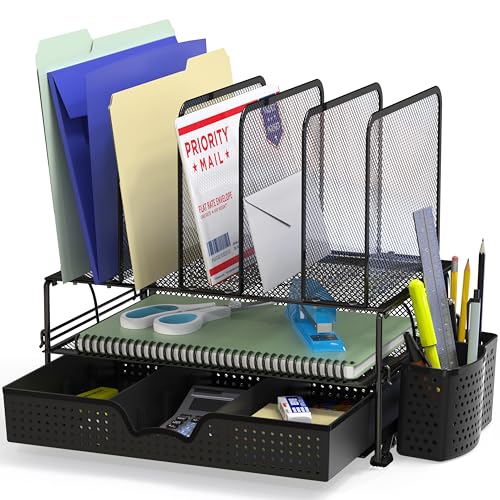
- Best overall under $50: SimpleHouseware Mesh Desk Organizer with Sliding Drawer, Double Tray and 5 Upright Sections — Check on Amazon
- DEAYOU Bamboo Desk Organizer with 4 Drawers, 3-Layer — Check on Amazon
- Bamjoy Bamboo 5-Tier Desktop File Organizer with Adjustable Shelves — Check on Amazon
See 3 more options below
- FURNINXS Bamboo Desktop Bookshelf Organizer, Adjustable and Expandable — Check on Amazon
- Theodore Bamboo Desktop Organizer, 10 Compartments — Check on Amazon
- Amazon Basics Mesh Desk Organizer with Sliding Drawer, Double Tray and 5 Upright Sections (DO-01) — Check on Amazon
Read the full guide ↓
Disclosure: As an Amazon Associate, umtsmarttool.com earns from qualifying purchases. Links to Amazon on this page are affiliate links; they cost you nothing extra. Listing details such as price and availability change often, so check the current Amazon listing before you buy.
The best desk organizer for home office under $50 is judged by a stricter standard than an office-supply-closet caddy: it will sit in your home, in frame on video calls, within reach for eight or more hours a day. It has to process a real working load — paper, files, notebooks, chargers, the small hardware of a working life — and it has to look like it belongs in a room of your house, not a cubicle farm. This guide weighs both, because a home office organizer that fails either test gets replaced.
Home offices also differ from corporate desks in one practical way: the desk is often smaller, shared with the household, or folded into a living space at night. Compact footprints and closed storage (drawers that hide the workday at 6 p.m.) score higher here than they would downtown. If the desk itself is the constraint, our Best Small Desk For Home Office Under $30 guide may matter as much as the organizer — the right small desk plus a compact caddy beats a big organizer on a cramped surface.
All six picks were verified against their makers’ published dimensions and layouts; no prices are printed, since they change constantly — use the links to check the current price on Amazon. The list runs from a nine-inch steel caddy to bamboo cabinets and a five-tier paper system, so the shape of your home-office workload, not the budget, should make the choice.
In this guide
Quick Picks
Short on time, or comparing several options at once? Each row below names a buyer type and the desk organizer that suits it, with the key specification that separates it from the rest of the list.
| Buyer type | Pick | Why it stands out | Link |
|---|---|---|---|
| Best overall under $50 | SimpleHouseware Mesh Desk Organizer with Sliding Drawer, Double Tray and 5 Upright Sections | Steel mesh station with 5 upright file sections, two side-load letter trays and a 3-compartment sliding drawer; about 13.2 in wide | Check on Amazon |
| Best drawer cabinet | DEAYOU Bamboo Desk Organizer with 4 Drawers, 3-Layer | Natural bamboo desktop cabinet, 3 layers with 4 drawers, fully assembled | Check on Amazon |
| Best for paper-heavy desks | Bamjoy Bamboo 5-Tier Desktop File Organizer with Adjustable Shelves | Bamboo 5-tier desktop file organizer with adjustable shelves for paper, mail and documents | Check on Amazon |
| Best desktop shelf organizer | FURNINXS Bamboo Desktop Bookshelf Organizer, Adjustable and Expandable | Adjustable, expandable bamboo desktop bookshelf with shelves and small drawers for books and supplies | Check on Amazon |
| Best no-assembly bamboo tray | Theodore Bamboo Desktop Organizer, 10 Compartments | Natural bamboo storage tray with 10 compartments, no assembly, water-resistant finish | Check on Amazon |
| Best value file station | Amazon Basics Mesh Desk Organizer with Sliding Drawer, Double Tray and 5 Upright Sections (DO-01) | Amazon Basics five-section file station: sliding drawer, double tray, 5 upright sections, steel mesh | Check on Amazon |
How These Picks Were Chosen
Every organizer in this guide is a real, currently listed Amazon product whose layout, materials and dimensions could be verified against the maker’s own listing or documentation. We read the specification tables rather than the marketing headlines: compartment counts, footprint dimensions, drawer dimensions where published, and whether the unit arrives assembled or needs its panels pinned, screwed or slotted together at the desk.
We did not use these organizers ourselves. The comparisons below rest on published dimensions, materials and configuration — steel mesh versus bamboo versus plastic, open caddies versus drawer cabinets, flat trays versus upright file sections — and on how those choices play out for the specific way of working each version of this guide addresses. Where a maker publishes no dimension for a drawer or slot, we say so instead of estimating one.
The budget was applied as a ceiling, not a target. An organizer does not become better by costing more of your budget; it becomes better by matching the shape of your clutter. A five-dollar pen cup that holds exactly what you own beats a wide file station that swallows half your desk to store three folders. Picks are therefore ordered by how completely they solve the common version of the problem at this tier, and the reviews call out plainly where a pick is more organizer than a given desk needs.
For the home office edition we weighted closed storage and appearance more heavily than the base guide does. A home desk is photographed by your webcam and seen by your household; organizers that hide the small-item scatter in drawers, or present as bamboo furniture rather than office equipment, earned their places even where a mesh equivalent holds slightly more.
Best Desk Organizer For Home Office Under $50 — The 6 Picks
1. SimpleHouseware Mesh Desk Organizer with Sliding Drawer, Double Tray and 5 Upright Sections — Best overall under $50
At the under-$50 tier the SimpleHouseware station stops being a stretch purchase and becomes the sensible default: five upright sections for files and notebooks, two side-load letter trays, a pen holder and a three-compartment sliding drawer, all in one welded steel-mesh unit that arrives fully assembled and simply sits down on the desk. It organizes the whole desktop — paper, files, writing tools and small hardware — in a single footprint of roughly 13 inches square.
Why it leads a tier that also contains handsome bamboo cabinets: throughput. Mesh shows you everything at a glance, the upright sections take letter and legal files without complaint, and the open trays process paper faster than any drawer. Its limits are aesthetic and tactile rather than functional — the drawer slides without ball-bearing smoothness, the industrial mesh look will not warm up a styled home office, and the unit is tall enough to need a corner with vertical clearance. For a working desk, it remains the benchmark.
Living with the big station teaches you its real specification: the five upright sections are two-inch slots, ideal for files, notebooks and a tablet, too narrow for binders and thick books; the trays take letter paper flat and legal paper with an overhang; and the drawer’s three compartments map neatly onto clips-and-fasteners, drives-and-adapters, and notes-and-tape. Owners of earlier versions will find the layout unchanged in essentials, which is the point — this design has been copied for years precisely because the proportions are right. Dust it monthly; open mesh shows dust sooner than it shows clutter.
For home office use, consider the webcam frame: this pick sits in your background on every call.
Pros
- Complete whole-desk organization in one unit
- Welded steel mesh, arrives assembled
- Fast, visible access to files and paper
Honest limitation: Industrial mesh styling and a trackless drawer — function over refinement.
Choose it if you want the most capable all-in-one organizer and your desk has a 13-inch corner to give it.
Skip it if your priority is a warm, furniture-like look — the bamboo picks below dress a desk better.
2. DEAYOU Bamboo Desk Organizer with 4 Drawers, 3-Layer — Best drawer cabinet
The DEAYOU answers the clutter type mesh cannot hide: small things. Four bamboo drawers in a three-layer cabinet swallow clips, drives, chargers, cosmetics, medication, craft supplies — the whole small-object diaspora — and close on it, leaving a clean bamboo surface that looks like furniture rather than office equipment. It arrives fully assembled, which matters more than it sounds: flat-pack bamboo cabinets are a common source of split screw holes and wobble.
Bamboo is the right material for this job in a home office: warm under the hand, rigid enough for drawer joinery, and visually quiet next to a monitor. The trade-offs are capacity shape and weight — drawers organize small items brilliantly but take no files and only flat paper, and the cabinet is a fixed block that claims its footprint permanently. Buy it when your scatter is small and numerous; pair it with a letter tray if paper joins the party later.
Drawer discipline decides whether the DEAYOU delights or disappoints: assign each drawer a category before the first item goes in — desk hardware, personal items, charging spares, craft or cosmetics — and resist the fifth category that will inevitably apply for residence. The bamboo surface also works as a small staging shelf for the phone and the day’s notebook, which keeps the desk’s open surface clearer than the cabinet’s footprint alone would suggest. Keep it out of sustained direct sun if you care about the bamboo tone staying even.
Home workers should weigh the 6 p.m. test — how completely this pick lets the desk stop looking like work.
Pros
- Four real drawers hide small-item clutter completely
- Furniture-grade bamboo look for home offices
- Arrives fully assembled
Honest limitation: No file or upright storage; drawers suit small items only.
Choose it if your clutter is dozens of small objects and you want them out of sight in a piece that looks like furniture.
Skip it if you need file or letter storage — this cabinet has no upright sections.
3. Bamjoy Bamboo 5-Tier Desktop File Organizer with Adjustable Shelves — Best for paper-heavy desks
Where the DEAYOU hides small things, the Bamjoy sorts paper: five bamboo tiers with shelves you can reposition to match your actual paper workflow — a tall tier for notebooks and a tablet, shallow tiers for mail, forms and the current project’s printouts. Adjustable shelving is the feature that matters here, because paper workflows differ and fixed trays force your piles into someone else’s spacing.
The bamboo construction gives it a calmer presence than a mesh file rack, and five tiers is serious paper capacity for a desktop unit — this is the organizer for the desk that functions as a small office’s entire paper system. It does nothing for pens or small hardware, the assembly and shelf fitting take a little patience, and a fully loaded five-tier rack is a substantial object that wants a stable, level corner. For paper-first desks at this budget, nothing else here comes close.
The Bamjoy’s adjustable shelves want a plan before assembly: set the bottom tier tall for notebooks and the project binder, the middle tiers at paper height, and reserve the top for the in-tray function so new paper always lands in the same visible place. Because the shelves reposition, the rack can follow your workflow as it changes across a year — a property no fixed tray offers. It is worth restating that this is a paper-only tool: buyers who add it to a desk that also needs tool and hardware storage should pair it with the caddy or cabinet picks rather than expecting it to stretch.
In a home office, this pick’s footprint competes with household life, not just work gear — measure accordingly.
Pros
- Five tiers of genuine paper capacity
- Adjustable shelves match your workflow
- Bamboo build suits home-office desks
Honest limitation: Paper only — no drawers, cups or small-item storage.
Choose it if paper is your desk’s main event and you want it sorted in adjustable, visible tiers.
Skip it if your paper volume is small — two tiers would do, and this rack would mostly stand empty.
4. FURNINXS Bamboo Desktop Bookshelf Organizer, Adjustable and Expandable — Best desktop shelf organizer
The FURNINXS is an organizer that thinks like furniture: a small bamboo bookshelf for the desktop whose width adjusts and expands, with open shelves for books, notebooks and a plant or speaker, and small drawers in the mix for supplies. It organizes by elevation — getting the book row, the reference stack and the desk accessories up off the work surface onto a shelf line — which frees the flat desk in a way no caddy can.
It suits desks that hold books and objects, not just paper and pens: students, readers, anyone whose desk doubles as a display surface. The compromises are footprint and focus — an expanded shelf claims a long run of desk edge, its open shelves display rather than conceal, and it is not the tool for a paper workflow. Assembly is part of the deal. Chosen for the right desk, it changes the room, not just the desk.
The FURNINXS changes how a desk feels more than how it files: a run of books standing on a shelf reads as a library, the same books flat on the desk read as a backlog. Its expandable width is the feature to use thoughtfully — expand it to the books and objects you actually keep at the desk, not to the full width available, because shelf space fills exactly as reliably as drawer space does. The small drawers suit the desk’s minor hardware, and the open shelves take a speaker, a plant or a headphone stand without any of them touching the work surface.
For home office use, consider the webcam frame: this pick sits in your background on every call.
Pros
- Adjustable width adapts to the desk
- Shelves lift books and objects off the work surface
- Drawers add a little hidden storage
Honest limitation: Claims a long run of desk edge and displays everything it holds.
Choose it if your desk holds books and objects you want shelved and visible, with room along the back edge.
Skip it if you need concealed storage or paper sorting — look at the cabinet and file picks instead.
5. Theodore Bamboo Desktop Organizer, 10 Compartments — Best no-assembly bamboo tray
The Theodore is the bamboo answer to the pen cup: a single natural-bamboo tray divided into ten compartments for pens, pencils, scissors, brushes, remotes and the rest of the daily tool kit, finished with a water-resistant coating and requiring no assembly at all — unbox, load, done. The compartment grid imposes the one-job-per-slot discipline automatically, and bamboo makes a utilitarian object feel at home on a vanity, kitchen counter or styled desk as much as in an office.
As a tray it shares the family limits: no drawers, so nothing is hidden; no height, so no files; and ten fixed compartments will fit your tool collection only if it roughly matches the grid. Within those limits it is the most civilized small organizer in this guide, and the water-resistant finish makes it the one pick here that also works beside a sink or on a craft table.
The Theodore’s ten compartments reward a specific kind of user: the one whose tool set is stable. Pens, scissors, brushes, the remote, the lip balm, the letter opener — if your daily ten objects are known, this tray gives each a visible, reachable cell and makes ‘tidy’ the default state rather than a project. It is also the pick here most at home outside the office: the water-resistant bamboo shrugs off a bathroom counter or a kitchen’s spice-and-utensil duty, and its flat profile slides into a drawer if a clear surface is ever needed.
Home workers should weigh the 6 p.m. test — how completely this pick lets the desk stop looking like work.
Pros
- Ten fixed compartments enforce tidy sorting
- No assembly, water-resistant bamboo
- Works beyond the office — vanity, kitchen, craft table
Honest limitation: Everything stays visible; no drawers or file capacity.
Choose it if you want a warm, ready-to-use tray for a defined set of daily tools.
Skip it if you need anything hidden, filed or stacked — this is a flat tray only.
6. Amazon Basics Mesh Desk Organizer with Sliding Drawer, Double Tray and 5 Upright Sections (DO-01) — Best value file station
Amazon’s own version of the category-defining layout earns its place at this tier on value: five upright file sections, a double side-load letter tray and a sliding drawer in black steel mesh, covering the same whole-desk brief as the SimpleHouseware at an Amazon Basics price. For a second desk, a student setup, or an office buying several organizers at once, that price difference multiplies into real money.
The construction compromise is assembly: the unit pins together with push-in plastic fasteners rather than arriving as a welded one-piece frame, so it feels a touch less rigid and takes a few minutes to build. Everything else — the layout, the visibility, the ten-zone sorting — matches the original closely enough that most buyers should simply compare the two listings on the day and take the better price.
The DO-01 rewards a careful five minutes at assembly: seat every pin fully before loading it, because a half-seated pin is the source of nearly all the flex owners report. Once built square, it carries the same working load as its welded rival — files upright, trays stacked with paper, drawer full of hardware. Amazon’s listing support and returns are the practical argument for it in offices equipping several desks, where a single warped panel in a welded unit is a bigger administrative problem than a pin that needs reseating.
In a home office, this pick’s footprint competes with household life, not just work gear — measure accordingly.
Pros
- Full file-station layout at a value price
- Amazon Basics backing and availability
- Covers files, paper, pens and hardware
Honest limitation: Pin-together build is less rigid than the welded original.
Choose it if you want the complete layout for a second desk or several desks, at the lowest cost per unit.
Skip it if you are buying one organizer for the long term — the welded SimpleHouseware is the sturdier single purchase.
Comparison Table
| Pick | Material | Footprint / size | Storage layout | Assembly |
|---|---|---|---|---|
| SimpleHouseware Mesh Desk Organizer with Sliding Drawer, Double Tray and 5 Upright Sections | Steel mesh | About 13.2 x 11.5 x 10 in | 5 upright sections, 2 letter trays, sliding drawer, pen holder | None — fully assembled |
| DEAYOU Bamboo Desk Organizer with 4 Drawers, 3-Layer | Natural bamboo | Desktop cabinet (3 layers) | 4 drawers plus open top storage | None — fully assembled |
| Bamjoy Bamboo 5-Tier Desktop File Organizer with Adjustable Shelves | Bamboo | Desktop file rack (5 tiers) | 5 adjustable horizontal shelves | Shelf placement adjustable; assembly required |
| FURNINXS Bamboo Desktop Bookshelf Organizer, Adjustable and Expandable | Bamboo | Expandable desktop shelf | Open shelves plus small drawers | Assembly required |
| Theodore Bamboo Desktop Organizer, 10 Compartments | Natural bamboo | Tray format | 10 open compartments | None — no assembly |
| Amazon Basics Mesh Desk Organizer with Sliding Drawer, Double Tray and 5 Upright Sections (DO-01) | Steel mesh | About 13 in wide class | 5 upright sections, 2 letter trays, sliding drawer | Push-in plastic assembly pins — no tools |
Compartment counts come from each maker’s listing; treat them as layout descriptions rather than capacity guarantees, because one maker’s ‘compartment’ is a pen slot and another’s is a full letter tray. Measure your desk’s free corner before ordering any organizer with a footprint over 12 inches in either direction.
How to Choose a Desk Organizer That Fits Your Desk
Start by sorting, not shopping. Empty everything loose on your desk into piles by type — writing tools, paper and files, small hardware (clips, drives, cables, chargers), and personal items. The pile shapes tell you which organizer family you need: a tall pile of pens wants a cup or caddy; a wide flat pile of paper wants trays; a deep pile of small hardware wants drawers, because small things in open compartments migrate and vanish.
Measure the footprint you can actually give up. An organizer lives in your desk’s least valuable real estate — usually a back corner — and every inch it takes is an inch your keyboard, notebook or mug cannot use. As a rule, keep the organizer’s footprint under about a quarter of your usable desktop, and check the height too: upright file sections and stacked trays can collide with low monitor stands, shelves and the underside of wall cabinets.
Match the material to the job. Steel mesh is the durable default: it shrugs off daily knocks, lets you see what is inside, and wipes clean. Bamboo looks warmer and carries drawers and shelves well, but it is heavier and its compartments are fixed by the joinery. Plastic rotating caddies are the lightest and cheapest way to corral pens, and the rotation genuinely helps on shared or deep desks, but plastic slots flex under heavy loads of tools or books.
Count drawers against small-item volume honestly. One shallow drawer swallows the standard scatter — clips, sticky notes, a tape roll, spare batteries — and keeps it out of sight, which is most of the visual calm people want from an organizer. Multiple drawers only pay off if you genuinely sort small items into kinds; otherwise the second and third drawers become junk drawers with better PR.
Think about what stays off the organizer. Chargers, cable coils and headphones are the items most often dumped into organizer compartments and the ones that fit worst. If cables are half your clutter, an organizer alone will disappoint you; pair it with a cable solution and let the organizer handle the solid objects it is good at.
Design the home office desk for two shifts: the work shift and the evening shift. The organizer is the hinge between them — everything work-related that can live inside it should, so the surface clears in one motion when the workday ends. That argues for at least one drawer in a home office organizer, and for trays that empty fully rather than display the week’s paper to the room. Our Best Monitor Arm For Home Office Under $20 guide follows the same philosophy for the screens.
Buy for the paper reality of your job. Home workers in paper-light roles (most tech, sales and creative work) need a caddy and one tray at most; anyone printing, signing, scanning or filing weekly needs the file station or the tiered paper pick, and will waste money on a prettier smaller unit first. Be honest about which worker you are this year, not the one you were in an office with a supply room.
Looking Professional on Camera: The Organizer as Background
Your organizer appears in more meetings than your bookshelf does. Positioned at the back corner of the desk, it sits squarely in the webcam’s background band, and its state — tidy or overflowing — reads as a proxy for your organization generally. Closed and furniture-like organizers (the bamboo cabinet especially) project calm; open mesh stations project busy competence, provided they are loaded neatly; an overflowing tray stack projects exactly what you would expect.
Two practical rules follow. First, keep the organizer’s silhouette simple on camera: one unit reads better than three small ones. Second, keep paper vertical or filed on call days — loose paper piles are the single most ‘messy’ signal in a video frame, more than cables or mugs. A Best Desk Lamp For Home Office Under $20 helps the same frame from the lighting side.
Shared and Folding Desks: Organizers That Can Move
Many home offices are negotiated spaces — a dining table by day, a desk in a closet, a spare-room corner that hosts guests. In those setups the organizer must sometimes leave the desk entirely, which changes the buying criteria: weight, one-piece construction and a footprint that fits a shelf or closet floor matter more than raw capacity. The compact caddies and the tray-style bamboo pick travel best; the big file stations are stay-at-home furniture.
If your desk folds or converts, also check the organizer against the desk’s other life: a Best Desk Converter For Home Office Under $20 setup, for instance, raises the screen so a compact organizer can live permanently beneath it, folded desk or not. The goal is a work setup that assembles in under a minute — every extra step is a step skipped on busy mornings, and skipped steps are how shared desks stay cluttered.
Setting Up an Organizer So It Stays Organized
A home office organizer carries the whole household’s impression of your workday, so the loading discipline below is worth the five minutes it takes to set up.
The difference between an organizer that works for a year and one that becomes a second clutter pile is the loading order. Load it from the back: tallest and least-used items — files, notebooks, the tablet stand — go in the rear upright sections where they are visible but out of the daily reach path. The front compartments get the high-frequency tools: the two pens you actually use, scissors, the tape, the sticky notes. Anything you reach for weekly rather than daily belongs in a drawer, not in prime open space.
Give every compartment a single job and write the rule down if you share the desk. Mixed compartments decay: the moment pens share a slot with charging cables, both become harder to extract and the slot becomes a dig-pit. One slot for writing tools, one for cutting and fastening tools, one for paper goods. When a new object arrives at the desk, it either fits an existing job or it does not live on the desk at all.
Adopt the one-minute reset. An organizer fails by accumulation, not by design: each day adds one item that was set down ‘for now’. A one-minute end-of-day pass — return the strays to their compartments, empty the tray of anything that has been there a week — keeps the system at its day-one state indefinitely. This sounds trivial and is, in practice, the entire discipline of desk organization; the hardware only makes the reset fast.
Reassess after a month. Note which compartments are empty and which overflow. Empty compartments mean you bought more organizer than your clutter needs — consolidate and reclaim the desk space. Overflow in one category means that category wants its own dedicated storage: a separate letter tray for a growing paper pile, a drawer unit for growing hardware. Organizers are modular in practice even when they are sold as single units, and the second purchase should be driven by the overflow you observed, not by a guess.
Compartment Counts, Footprints and Other Numbers Worth Doubting
A note on compartment arithmetic: makers count compartments generously, splitting one open bin with a divider and calling it two. When you compare organizers, count instead the number of distinct object types each layout can keep separated — pens from paper, paper from hardware, hardware from personal items. Four honest separations beat ten nominal compartments that all open into the same visual jumble.
Desk organizers interact with monitor placement more than buyers expect. A tall file organizer parked beside a monitor can block a speaker, shade a light bar, or force the monitor off-center. Before ordering a tall unit, sit at the desk and mark where its top corner would fall relative to your screen edges; if it crosses your sightline to the screen, choose a lower, wider layout instead.
If you work on a glass or high-gloss desk, check the organizer’s feet. Bare steel mesh and bamboo edges can scratch delicate surfaces when the unit is dragged rather than lifted. Felt pads cost almost nothing, take a minute to apply, and are the difference between an organizer that protects the desk and one that slowly engraves it.
Weight is a quiet specification worth one thought: a loaded file station or bamboo cabinet is effectively permanent furniture once filled, while a loaded caddy can still be lifted with one hand. If your desk is cleaned by someone else, rearranged often, or carried between rooms, that difference decides which pick survives contact with your real routine — choose the one whose loaded weight your routine can actually move.
Before You Order: A Five-Minute Desk Audit
Run this audit with a tape measure and the actual contents of your desk before ordering any pick in this guide. It takes five minutes and prevents the two classic organizer failures — too small for the clutter, too big for the desk.
- Sort and count. Pile everything loose on the desk by type and count the piles. The number of piles is the number of separations your organizer must provide; a layout with fewer real separations than piles will mix categories from day one.
- Measure the free corner. With your laptop, lamp and notebook in place, measure the free rectangle at the back of the desk in both directions, plus the vertical clearance above it. Compare against the footprint in each review, not the listing’s headline photo.
- Weigh the paper question. If paper arrives at your desk weekly or faster, your organizer must include trays or upright sections. If it arrives monthly, a caddy plus one folder is enough and the file stations are over-buying.
- Decide the drawer question. Count your small loose items. Under a dozen, one shallow drawer or a lidded compartment suffices. Dozens, in real categories, justify the multi-drawer cabinet — if they are all one category, they justify a bigger single drawer instead.
- Check the neighbors. Confirm the organizer will not block monitor vents, speaker ports, lamp light or a laptop’s exhaust, and that its loaded height stays clear of shelves and the monitor’s lower bezel.
- Plan the second purchase now. Decide in advance what overflow will trigger: a letter tray for paper growth, a cable kit for charger growth. Knowing the next step stops you over-buying capacity today ‘just in case’.
The Six-Month Audit: Keeping the System Honest
Six months from now, this audit is what decides whether the organizer you are about to choose was the right one.
Twice a year, empty the organizer completely onto the desk. This is not cleaning theater — it is an audit, and it reliably produces three piles: items that earned their place and go straight back, items that have not been touched in months and belong in a closet or a bin, and items that reveal a category your organizer does not serve. The third pile is the valuable one. It tells you, with evidence, what your second purchase should be — and it is almost never the purchase you would have guessed when you bought the first organizer.
The audit is also when materials tell the truth. Steel mesh should need nothing but dusting; if a mesh unit has bent, it was overloaded or knocked, and the fix is placement, not replacement. Bamboo benefits from a dry environment and an occasional wipe; drawers that have started to stick usually carry a stray object behind them rather than a defect. Plastic caddies that have cracked at a slot corner have been carrying more than their design load — promote their contents to a steel or bamboo unit and retire the plastic to a lighter duty, such as a craft drawer.
Finally, re-run the original test: can every object on the desk be put away, in its assigned place, in under a minute? If yes, the system is healthy and needs no new hardware, whatever the catalogs suggest. If no, the audit has shown you exactly which category broke the minute — and that category, and only that category, justifies the next purchase. Organization maintained this way costs almost nothing after the first organizer, because every later buy is evidence-based.
One more habit separates desks that stay organized from desks that cycle: photograph the desk when it is right. The photo becomes your reference state — after a busy month, a project crunch or a move, you do not have to remember what ‘organized’ looked like or redesign the system under pressure. You restore the photograph. It takes ten seconds to take and saves the entire re-planning effort that makes people abandon systems they once liked.
Common Buying Mistakes
Buying office-park aesthetics for a living space. Industrial mesh is invisible in an office and loud in a living room. If the desk lives in shared space, bamboo or closed storage will still please you in a year; mesh often gets replaced for looks alone.
Under-buying paper capacity. Home workers without a supply room become their own filing department. If paper arrives weekly, a caddy alone guarantees piles; include a tray or file component from the start — or step up to the Best Standing Desk For Home Office Under $30 class of desk that builds storage in.
Forgetting the evening shift. An organizer that cannot swallow the workday leaves the job visibly open all evening. At least one drawer, and trays that empty, are home-office features, not luxuries.
Placing it in the webcam’s dead center. A big organizer directly behind you dominates the frame. Offset it to a back corner — visible, tidy, and clearly not the subject of the meeting.
Final Recommendation
For a home office, the first pick balances capacity, looks and the evening clear-down better than anything else here. Start with the SimpleHouseware Mesh Desk Organizer with Sliding Drawer, Double Tray and 5 Upright Sections — it is the pick that fits the widest range of home office workers at this budget, and the one we would buy first with our own money. Check on Amazon
If its particular trade-off does not suit your desk, the runner-up is the DEAYOU Bamboo Desk Organizer with 4 Drawers, 3-Layer, which answers the next most common need in this category. Check on Amazon Load it the day it arrives and photograph your desk on a call to check the frame — two minutes that settle placement arguments better than a week of living with it.
Frequently Asked Questions
What desk organizer looks best in a home office?
Bamboo, and specifically the drawer cabinet if your clutter is small items, or the bamboo tray for a styled tool set. Bamboo reads as furniture, hides or frames its contents deliberately, and survives being part of the room’s decor in a way black mesh does not.
How big should a home office organizer be?
Big enough for the whole working set — if daily items still live on the desk beside it, it is too small or the wrong shape. For most home workers that means a mid-size caddy plus paper handling, or one full file station on desks of 48 inches and up. Smaller desks should pair a compact caddy with a Best Small Desk Under $30.
Do I need file storage if I work digitally?
Less, but rarely none: contracts, tax papers, a notebook, the tablet. One upright section or a single letter tray covers the digital worker’s paper reality; the five-tier pick is for genuinely paper-driven jobs.
Can one organizer serve a shared desk?
Yes, if it is loaded by category rather than by person and both users keep the one-job-per-compartment rule. Drawers help: assign one drawer per person for personal small items and share the open compartments.
How do I hide work clutter at the end of the day?
Choose at least one pick with a drawer, keep the tray stack to what is actively being processed, and do a one-minute close-down: laptop closed, paper into the tray or file section, small items into the drawer. The desk should be able to pass as a table in under two minutes.
Is an organizer worth it on a standing desk?
Especially there — a sit-stand desk’s moving surface punishes loose objects. Everything not bolted down should have a compartment to ride in. Pair the organizer with the desk’s cable tray so nothing dangles when the desk rises; our Best Standing Desk Under $30 guide covers the desk side of that setup.
Fitting out the whole home office? The Best Computer Desk For Home Office Under $30 guide covers the surface itself, and our monitor and lighting roundups complete the standard work-from-home reset — organizer first, though: it is the cheapest transformation of the four.