Where to buy
Check the latest price, availability and delivery on Amazon. Orders are placed on Amazon. We may earn a commission from qualifying purchases. The small-workshop fact first: no powered miter saw exists at $30 from any brand — and in a small workshop that is less a limitation than it sounds, because the linked pick below is a complete hand miter kit that takes zero permanent bench space, and the remaining picks are honest prose-only alternatives, including the compact powered route for shops whose cut volume outgrows hand work.
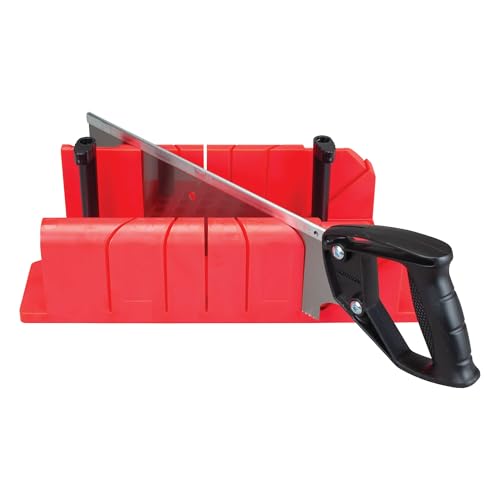
- Best for small workshops under $30: CRAFTSMAN Mitre Saw, 12-Inch Saw & Clamping Box (CMHT20600) — Check on Amazon
- Stanley Saw Storage Miter Box with Saw (20-600) — the self-storing step-up kit, usually just above this budget; prose-only below
- Excel Blades 6-Inch Metal Mitre Box Set (55666) — the bench-corner precision set for small work; prose-only below
- Japanese pull-saw miter box sets — the fine-finish, low-dust route; prose-only below
- Olympia Tools Saw Storage Mitre Box with 14-Inch Backsaw — the basic alternative kit; prose-only below
- The compact powered route: an entry 10-inch compound miter saw — prose-only below, for high-volume small shops
Read the full guide ↓
Disclosure: As an Amazon Associate, umtsmarttool.com earns from qualifying purchases. Links to Amazon on this page are affiliate links; they cost you nothing extra. Listing details such as price and availability change often, so check the current Amazon listing before you buy.
Choosing the best miter saw for small workshops under $30 is really a space decision disguised as a tool decision. A small workshop — one bench, one wall of storage, a floor you can cross in three steps — cannot give any tool a permanent footprint without taking it from another, and a powered miter saw is one of the greediest footprints in woodworking: the saw, its swing clearance, its outfeed support, its dust. At $30 the question resolves itself in an interesting way, because no powered miter saw exists at this budget in the first place — the entry powered compound class costs several times more — so the small-workshop tier is the hand miter kit: a backsaw in a slotted box that lives on a shelf, works on any clear patch of bench, and returns the bench to general duty the moment the cut is done. For a shop whose miter work is trim, frames, small furniture and model-scale precision, that is not a compromise position. It is the allocation a thoughtful small-shop owner would choose at several times the price.
This guide reviews the complete hand kits sold at or near $30 by small-workshop criteria: clamping that makes a shared, multi-purpose bench behave like a dedicated miter station; storage volume measured honestly; dust and noise behavior in enclosed and shared spaces; and the honest volume boundary where a compact powered saw — bench-mounted, possibly on a flip top or a rolling stand — becomes the right spend. The CRAFTSMAN clamping kit leads because, in a small shop, the kit that holds its own work is the kit that needs no extra fixtures. Shops with bigger cut lists should read the last pick and the workflow section before buying anything; the general buyer’s view of this shortlist is at Best Miter Saw Under $30.
In this guide
Quick Picks
Each row matches a small-workshop profile to the option that fits it. Only the first pick is linked — the one complete kit verified as genuinely sold within this budget — and the rest are described in prose to keep the comparison honest.
| Workshop profile | Pick | Why it stands out | Link |
|---|---|---|---|
| Best all-round small-shop kit | CRAFTSMAN Mitre Saw, 12-Inch Saw & Clamping Box (CMHT20600) | Cam pins clamp the work; zero permanent bench footprint | Check on Amazon |
| Best for shelf storage | Stanley Saw Storage Miter Box with Saw (20-600) | Saw stores in the box — one flat item on the shelf | Prose-only — check price on Amazon |
| Best for precision small work | Excel Blades 6-Inch Metal Mitre Box Set (55666) | Metal box and razor saw for models and fine parts | Prose-only — check price on Amazon |
| Best for fine finishes, low dust | Japanese pull-saw miter box sets | Thin kerf, minimal dust, glue-ready faces | Prose-only — check price on Amazon |
| Best basic alternative | Olympia Tools Saw Storage Mitre Box with 14-Inch Backsaw | Simple complete kit for occasional shop use | Prose-only — check price on Amazon |
| Best for high cut volume | Entry powered compound miter saw (10-inch, 15-amp class) | The compact powered step when volume demands it | Prose-only — several times this budget |
How These Picks Were Chosen
The budget was applied as a ceiling on a complete, ready-to-cut kit — box, backsaw and workholding — sold as a real Amazon listing positioned within $30 in the United States. Check the current price on Amazon before you buy, as listing prices move. That rule removed all powered saws and all bare boxes sold without saws.
We did not use these tools ourselves. We read maker listings, specification pages and reputable roundups, and ranked by small-workshop physics. First: footprint honesty — not the tool’s dimensions on a spec sheet, but the space it consumes across a working week, which for hand kits is a shelf slot and for powered saws is a bench bay forever. Second: workholding independence — in a small shop the bench is shared, vises are occupied and fixtures compete, so a kit whose cam pins clamp the work itself outranks one that assumes a dedicated station. Third: environmental behavior — dust that stays in a pile instead of filling a small enclosed volume, and noise that does not end a session in a shared building. Fourth: the standard angle menu (90°, 45°, with 22.5° face angles as a bonus) and saw lengths matched to small-shop stock: trim, frames and furniture parts, with the 6-inch metal set ranked as the precision specialist it is.
Every prose-only pick states its reason: a price that usually sits just above the tier, a listing not verified to link standard, or a powered saw included as planning advice. No specification is invented, and unverifiable figures were left out. Small shops weighing the next tier up should know the same logic runs through the under-$50 small-workshop guide, where the step-up kits enter link range.
One methodological note matters for this lens in particular. Small-workshop writing is full of footprint figures quoted from spec sheets, and spec sheets lie by omission: they give the tool’s own dimensions, never the working envelope — the swing, the stock overhang, the operator’s stance, the dust’s landing zone. Where this guide compares space, it compares working envelopes and storage volumes, because those are the quantities a small shop actually spends. A hand kit’s envelope is the honest extreme of the category: a placemat to work, a shoebox to store, and nothing — no cord, no stand, no plume of dust — outside either.
The 6 Best Miter Saws for Small Workshops Under $30
CRAFTSMAN Mitre Saw, 12-Inch Saw & Clamping Box (CMHT20600)
Who it suits: The small-shop owner whose bench does everything — glue-ups, assembly, finishing — and whose miter tool must appear, perform and vanish without a dedicated station.
The kit is complete: miter box, 12-inch backsaw and two cam pins. In a small workshop the pins are the headline. They twist and lock the workpiece against the box’s honeycomb base, which means the kit brings its own workholding to whatever patch of bench is free — no vise queue, no fixture building, no clamping the stock with the hand that is also trying to saw. The box cuts 90° and 45° and offers face angles of 45° and 22.5°, and the backsaw’s stiff spine keeps cuts flat enough to glue. The space accounting is the other headline: stored, the kit is one flat box on a shelf; deployed, it needs a clamped-down footprint the size of a placemat; and its dust is a small pile you brush into a bin, which in a small enclosed shop is the difference between cutting and cleaning.
Walk a small-shop week through it: frame corners on Monday’s clear bench corner; trim for a cabinet face on Wednesday, box clamped beside the glue-up it will join; a replacement drawer side’s mitered edging on Friday. Nothing in that week required the kit to own any space between sessions. Its limits are the class limits — hand pace, small cross-sections, no bevels — and they bind exactly when cut volume grows: a production run of frames or a flooring job will make the powered case, which the last pick argues honestly. Check the current price on Amazon before ordering; it is the one kit verified as sold within this budget. For station technique that transfers to any bench, How To Use A Miter Saw Basics is the companion read.
- Cam pins clamp the work — a miter station that needs no fixtures or vise.
- Zero permanent footprint: shelf storage, placemat deployment.
- Dust stays a pile, noise stays zero — enclosed-shop friendly.
- 90°/45° plus 45° and 22.5° face angles.
Honest limitation: Hand pace and small-stock capacity; production volume outgrows it, and no bevels are possible.
Choose it if your shop’s miter work is trim, frames and furniture parts at project volume. Skip it if your shop cuts lumber daily — the powered pick is your honest route.
Stanley Saw Storage Miter Box with Saw (20-600)
Who it suits: Shelf-poor small shops where every tool must store as a single flat item — and where the saw wandering away from the box is a real, recurring tax.
Stanley’s design stores its 14-inch backsaw inside the high-impact box, so the kit’s storage volume is exactly its working volume: one flat object, shelf-ready, with nothing to hang, sheath or lose. The box provides 90°, 45° and 22.5° slots and a clamping facility for the work, and the longer saw smooths the stroke on trim-width stock. In small-shop terms, this is the kit for the owner whose storage is a single shelving unit and whose bench discipline is excellent but whose shelf discipline is human — the tool that puts itself away gets kept, and the tool that gets kept gets used.
Prose-only here because its US listing has been seen priced just above the $30 tier; we link only what we verified inside the budget. As the step-up small-shop kit it is proven and complete. The same-day price comparison against the linked CRAFTSMAN is the whole decision: near parity, choose between the CRAFTSMAN’s stronger cam-pin clamping and Stanley’s storage elegance — a genuinely close call in a small shop, where both virtues are load-bearing. A wide gap settles it for the clamp. Legacy hand-tool listings drift between sellers, so let the live number, not a printed one, arbitrate.
- Saw stores in the box: storage volume equals working volume.
- 90°, 45° and 22.5° slots with work clamping.
- 14-inch backsaw for a smooth trim stroke.
Honest limitation: Usually priced just above this tier, hence prose-only; class pace and capacity limits apply.
Choose it if shelf discipline is your shop’s weak point and the live price is close. Skip it if the budget is firm — the linked kit clamps better for less.
Excel Blades 6-Inch Metal Mitre Box Set (55666)
Who it suits: The small shop’s precision corner — model work, instrument-scale parts, miniature furniture, inlay and craft stock — where the work is small and the tolerances are not.
In a small workshop, bench corners specialize: one end for assembly, one for finishing, and — in many shops — a small zone for fine work that big tools would brutalize. This set is that zone’s miter tool. The six-inch box is aluminum and steel, the saw is a razor pull saw on a K5 handle, and the angles are 45° and 90°. Metal construction is the precision argument: the guide slots neither flex under a stroke nor wear wide the way small plastic boxes do, so the hundredth tiny miter matches the first. For balsa, basswood, thin hardwood and plastic stock, the razor teeth leave faces that need almost no cleanup — at miniature scale, the difference between a joint and a gap is a fraction of a millimeter, and this set works natively at that scale. It is made in the USA.
It is prose-only because, while the product and its specifications are verified from maker listing information, we did not verify a current in-budget US Amazon price to link standard — check the live listing. Its boundary is the mirror of its virtue: no trim, no lumber, no furniture parts beyond the miniature. A small shop doing both scales is honestly a two-kit shop eventually; buy the scale of your current work first, and let the second kit arrive when its projects do.
- Metal box holds hobby tolerances across years of small work.
- Razor pull saw: near-cleanup-free faces on craft stock.
- Occupies a bench corner, stores in a drawer.
Honest limitation: Miniature capacity only — a specialist beside, never instead of, a carpentry kit.
Choose it if your small shop’s fine work is genuinely small. Skip it if your stock comes from a lumber rack.
Japanese Pull-Saw Miter Box Sets
Who it suits: Small shops doing fine, visible work — frames, boxes, furniture details — in enclosed or shared spaces where dust and noise budgets are real.
The pull saw’s thin blade, cutting on the draw, produces the least dust of any cutting method in this guide and a face that often goes straight to glue. In a small enclosed workshop — a spare room, a garage corner, a basement with the house’s air above it — that dust behavior is not a nicety; it is what makes an evening session possible without a cleanup that outlasts the work. Sets pairing a box with a fine pull saw appear in roundups inside this budget, typically as four-piece configurations. The technique — light, long draws, no downward force — also suits the small shop’s unhurried, after-hours rhythm, and the results on visible joinery are the best hand cutting offers.
Cautions: fine pull-saw teeth are brittle against hidden staples and gritty reclaimed stock, so this is a clean-stock route; and the pick is prose-only because sets under this description vary by seller and no single listing’s contents and price met our link standard — verify the exact set before buying. For painted work and general shop cutting, the backsaw kits are tougher; for the fine corner of a small shop’s output, this is the connoisseur’s route at a hand-tool price.
- Least dust of any method here — enclosed-shop friendly.
- Glue-ready faces on visible, fine work.
- Silent, unhurried technique for after-hours shops.
Honest limitation: Brittle fine teeth on dirty stock; seller-variable set contents.
Choose it if your shop’s signature work is fine and visible. Skip it if your stock is reclaimed or your work is painted and general.
Olympia Tools Saw Storage Mitre Box with 14-Inch Backsaw
Who it suits: Small shops needing an occasional second miter capability — a backup box, a glue-room station — bought by comparing live value-brand prices.
Olympia’s kit is the classic pattern: molded storage box, 90°/45°/22.5° slots, 14-inch backsaw stored inside. In a small shop its plausible role is specific — the second station. Shops that run a project flow (cut at the bench, fit at the assembly table) feel the walk between stations; a basic kit living at the second surface removes it. Its known class weakness is workholding by free hand rather than positive clamp, which matters less in a second-station role cutting small fitting pieces, and can be mitigated everywhere by clamping the box itself down, as any station should be.
Prose-only on verification grounds: a fixture of Amazon miter-box roundups, but no current US price and listing verified to link standard. The small-shop rule is the same comparative one: check its live price against the linked CRAFTSMAN kit. A clear gap makes it a rational second station or starter kit; parity makes the clamping kit the buy, because a first station should hold its own work.
- Self-storing complete kit suited to a second station.
- Standard angles: 90°, 45°, 22.5°.
- Simple, nothing to adjust or assemble.
Honest limitation: Hand-held workholding — best used clamped down, on small fitting work.
Choose it if its live price clearly undercuts the clamping kit. Skip it if it is your only station and prices are close.
The Compact Powered Route: An Entry 10-Inch Compound Miter Saw
Who it suits: Small shops whose cut volume has genuinely outgrown hand pace — production frames, regular lumber work, a side business forming.
The powered class is well-defined even at its smallest: a 10-inch blade, a 15-amp motor at up to about 5,000 RPM, a single-bevel compound head, and roughly 24 pounds — light enough, notably, for the small shop’s classic storage answers: a shelf when idle, a bench bay when working, even a flip-top stand shared with another bench tool. The Metabo HPT 10-inch compound saw is the class’s usual value benchmark. It costs several times this entire budget — no link, no price, deliberately — and in a small shop the purchase is really two purchases: the saw, and the space plan that houses it without evicting something else you use weekly.
The honest small-shop sequence is to let volume make the case. Track a month of cutting: if miter work is a few project sessions, the hand kit is the finished answer and the powered money belongs in materials or the next tool entirely. If the log shows weekly lumber cutting, repeated identical parts, or bevel work the box cannot do, the compact powered saw has earned its bay — and the hand kit still keeps its shelf, because for four cuts on a Tuesday it remains faster to reach than any machine. When the buying day comes, a good choosing guide covers the capacity and bevel decisions in depth, and the stand question — the storage half of the purchase for tight spaces — deserves its own research pass.
- 10-inch, 15-amp class at ~24 lb: the smallest real powered footprint.
- Buys lumber capacity, bevels and production pace.
- Demands a space plan — the true second half of the purchase.
Honest limitation: Several times this budget, and in a small shop every footprint is a trade against another tool.
Choose it if a month of honest logging shows volume. Skip it if your miter work is project-paced — the hand kit is the finished answer, not a placeholder.
Comparison Table
| Product | Type | Key verified spec | Best use | Link |
|---|---|---|---|---|
| CRAFTSMAN Mitre Saw & Clamping Box (CMHT20600) | Hand miter kit | 12-in backsaw, cam pins, honeycomb base; 90°/45°, face 45°/22.5° | Shared-bench project cutting, self-clamping | Check on Amazon |
| Stanley Saw Storage Miter Box (20-600) | Hand miter kit | 14-in backsaw stores in box; 90°/45°/22.5° slots | Shelf-tidiest storage | Prose-only |
| Excel Blades Mitre Box Set (55666) | Hobby miter set | 6-in aluminum/steel box, razor pull saw, 45°/90° | Precision corner: models and fine parts | Prose-only |
| Japanese pull-saw miter sets | Hand miter kit | Thin-kerf pull saw with miter box | Fine visible work, minimal dust | Prose-only |
| Olympia Tools Mitre Box with Backsaw | Hand miter kit | 14-in backsaw, storage box, 90°/45°/22.5° slots | Second station or starter kit | Prose-only |
| Entry powered compound miter saw | Powered saw | 10-in blade, 15-amp class, up to ~5,000 RPM, ~24 lb | Volume cutting with a space plan | Prose-only — above budget |
How to Choose a Miter Saw for a Small Workshop
- Budget space before money. Decide where mitering will live — a shelf slot and a shared bench patch, or a permanent bay. The answer usually chooses the tool class for you.
- Demand self-clamping. On a shared bench, fixtures and vises are spoken for. A kit whose pins hold the work turns any clear patch into a miter station.
- Count dust as a space cost. In a small enclosed volume, airborne dust is a tax on every other activity in the room. Hand cutting’s pile-not-cloud behavior is a genuine specification.
- Prefer tools that store as one item. Kits whose saw lives in the box survive small-shop storage; kits in pieces migrate and separate.
- Match the kit scale to the shop’s work. Carpentry kits for trim and furniture parts; the metal hobby set for the precision corner. Small shops often need both scales eventually — buy in project order.
- Log before you graduate. A month of honest cut-counting tells you whether a powered bay is an investment or an eviction. Volume, not restlessness, should trigger the step up.
- Plan the powered footprint as a system. Saw plus swing clearance plus stock support plus storage. If the system does not fit the shop, the saw does not fit the shop — whatever its price.
- Buy complete kits. In a small shop, a missing component is not an errand, it is a stalled project occupying the only bench. Complete-kit price is the honest comparison.
Bench Workflow in a Small Shop: Making a Hand Kit Feel Like a Station
The difference between a miter box and a miter station is choreography, and small shops live or die by choreography. Dedicate the kit a home — a specific shelf slot, with its clamp, square, pencil and brush stored in or on the box — so setup is a single retrieval, not a scavenger hunt. Work at the bench end nearest your stock storage, because in a small shop the steps between lumber and cut are the workflow. Clamp the box at the bench edge with the saw’s stroke running along the bench, not across your body, and keep the offcut side over the bench so cut pieces land on wood, not on the floor you will later sweep them across the shop on your shoes.
Batch your angles. Small-shop projects stall when setups churn — 45, then 90, then 45 again — so lay out the whole project’s cuts first, group them by box setting, and cut each group in one pass, marking pieces as they come off the saw. The box rewards this: its angles are fixed slots, not settings to dial, so batching costs nothing and the consistency across a batch is the best your joints will ever be. Finish the session the way the shop requires: brush the box out (packed slots are tomorrow’s angle error), saw back in its box, box back in its slot, bench clear for the next process. A hand kit run this way delivers station-grade results from a shelf slot — which is the entire thesis of this guide, demonstrated one tidy session at a time. The layout discipline behind the batching is covered in How To Make A Miter Joint.
Dust, Noise and Shared Air: The Small-Shop Environment Case
Small workshops are rarely sealed industrial spaces; they are spare rooms, garage corners, basements and sheds whose air and sound belong to a household or a building. Tool choice in such spaces is partly environmental policy. A powered miter saw is among the loudest and dustiest tools per cut in woodworking — a short, violent burst of both — and in a small volume there is nowhere for either to go: the dust hangs, settles on finishes curing in the same room, and coats the storage that shares the walls. A hand kit produces a small pile of coarse shavings at the cut point and no airborne fraction to speak of, and its noise is a soft rasp that does not carry through a wall, let alone end a tenancy conversation.
This is not an argument that small shops should never run powered saws — volume makes its own case, and the graduation pick respects it. It is an argument for counting environment among the specs when the shop is small and shared. Many small-shop owners discover that the hand kit extends their working hours more than any purchase could: early mornings, late evenings, the hour while something else glues or cures. A tool that can be used at 10 p.m. in a garage under a bedroom is, in the only currency a small shop really has — available hours — the most productive miter tool in this guide.
Storage Systems for Hand Kits: The Shelf-Slot Discipline
Small-shop storage fails in a predictable way: tools are stored by where they fit on the day they arrive, and thereafter every retrieval is an excavation. Hand miter kits reward the opposite system — a fixed address. Give the kit a labeled slot at a height between knee and shoulder, in the shop’s tool wall or shelving run, with its satellite items (clamp, square, pencil, brush, spare blade) stored in a small tray or pouch that lives in the same slot. The slot’s dimensions are the kit’s dimensions; nothing else may migrate into it, because a slot that accepts strays will eventually refuse the kit. This sounds like tidiness preaching, but it is really session economics: in a small shop, setup time is the tax on every project, and a fixed-address kit cuts the miter tax to under a minute — carry box to bench, clamp, cut.
Wall storage deserves a specific mention for shops whose shelving is full. A miter box is flat and light; a simple pair of rails or a shallow French-cleat shelf on the wall behind the bench holds it vertically, saw inside, in space that is otherwise air. Vertical storage also protects the box’s guide slots — the accuracy surfaces — from the slow damage of being buried under heavier tools in a drawer stack. Whichever system you choose, add the spare blade to it now, while the kit is new and the blade size is in front of you: the day the fitted blade dulls mid-project is the wrong day to discover that the shop’s readiness was a single point of failure. Small shops run on such small redundancies, deliberately placed.
The Two-Kit Small Shop: Carpentry Scale and Precision Scale
Many small workshops eventually discover they do two kinds of mitering that share nothing but the name. Carpentry-scale work — trim, frames in furniture stock, small lumber parts — wants the clamping box and a 12 or 14-inch backsaw. Precision-scale work — models, miniatures, fine inlay, craft construction — wants the metal hobby box and a razor saw, at a bench corner with good light and a magnifier nearby. Trying to serve both with one kit is the small shop’s version of the all-season tire: acceptable everywhere, excellent nowhere, and quietly costing quality at both ends. The two-kit shop, by contrast, spends remarkably little to be excellent twice, because hand kits are cheap, small and immortal — the pair together still store in less space than one powered saw’s blade guard.
Sequencing is the only real decision. Buy first the kit whose projects are actually scheduled; let the second arrive when its first project does, not in anticipation, because small shops cannot afford speculative tools — every shelf slot spent on a someday kit is stolen from a today tool. When the second kit lands, give it its own fixed address near its own work zone rather than beside its sibling: the carpentry kit by the bench, the precision set by the light. Owners who build this way report a side benefit that is hard to overstate — each kit stays set up for its own scale, so switching between a frame and a miniature costs a walk across the shop instead of a teardown, and in a small shop the walk is gloriously short.
Light, Layout and the Borrowed Bench: Ergonomics for Small-Shop Mitering
Hand mitering is a visual task before it is a physical one: you are steering teeth along a pencil line, watching a kerf open, judging a face against the light. Small shops, which often inherit whatever lighting the room came with, should treat light at the miter position as equipment. A single bright, raking light from the side — a clamp lamp on the shelf, a task light on a flexible neck — does three jobs at once: it makes the pencil line legible, it throws the kerf’s shadow so you can see the blade’s truth in the cut, and it reveals the washboard texture of a forced stroke on the cut face before the piece ever reaches the fitting bench. Shops that miter under flat overhead light alone are working with one eye closed, and their joints usually say so.
Layout is the other half of small-shop ergonomics. Because the bench is shared, the miter position competes with glue-ups, assemblies and finishing in progress — and the winning move is to make the miter setup movable without making it makeshift. A dedicated miter board — a flat offcut of plywood, sized to your bench’s clear patch, with the box’s clamp points marked — turns setup into placing one board: box on, clamp on the marks, cut. The board stores vertically against the wall with the kit. Add to it a stop block for repeated lengths and you have, in plywood and habit, the small shop’s answer to the dedicated miter station that bigger shops build in steel: not as fast, not as grand, and — for the cut volumes this guide is about — entirely sufficient. The through-line of every section of this guide is the same: in a small workshop, systems beat square footage, and a hand kit is the miter tool most willing to be systematized.
Common Buying Mistakes
- Buying a powered saw for a small shop without a space plan — the saw arrives and something else you use weekly leaves.
- Ignoring workholding on a shared bench, where the vise is always busy and the free hand becomes the fixture.
- Storing the kit in pieces across the shop, so every session starts with a search and some start without the saw.
- Churning setups cut by cut instead of batching by angle — slow, and worse for consistency.
- Letting sawdust pack the box slots and fence, then blaming the kit for the angles the dust produced.
- Buying the hobby set for carpentry stock, or the carpentry kit for the precision corner — scale errors a small shop feels twice.
- Graduating on restlessness instead of a cut log, and spending the materials budget on a footprint.
- Judging hand pace by the first session. Batched, clamped and ritualized, the kit’s throughput surprises most owners.
Final Recommendation
- Most small workshops: CRAFTSMAN Mitre Saw, 12-Inch Saw & Clamping Box (CMHT20600).
- Shelf-tight shops: Stanley Saw Storage Miter Box (20-600), when its live price is close.
- Precision corners: Excel Blades 6-Inch Metal Mitre Box Set (55666).
- Fine, low-dust work: a Japanese pull-saw miter box set.
- Logged high volume: the compact powered class, with a space plan.
Our top two for small workshops are the CRAFTSMAN clamping kit — the only complete system verified inside this budget, and the one whose cam pins turn any clear bench patch into a miter station — and the Stanley storage kit as the step-up where shelf discipline is the shop’s binding constraint. Between them they answer the small shop’s two scarcities: workholding and space. The precision corner belongs to the Excel set, the fine finish to the pull-saw route, and genuinely logged volume to the compact powered class with its footprint honestly planned. Clamp the box, batch your angles, brush the slots, and check the live price before you order — in a small workshop, the best miter saw is the one that gives the bench back when it is done.
A closing word about what this tier teaches a small-shop owner beyond mitering. Every constraint in this guide — footprint honesty, fixed addresses, batched setups, environment as a specification — is a small-shop principle wearing a miter kit’s clothes, and each one transfers to the next tool decision the shop faces. Buy this kit well and you have rehearsed, at the lowest possible stakes, the exact judgment your shop will need when the purchases get larger and the footprints get serious. That may be the most valuable thing a $30 tool can sell a small workshop: not just accurate corners, but practice at thinking like a shop that has no space to waste — because it does not.
Frequently Asked Questions
Can a hand miter kit really serve as a small workshop’s miter station?
Yes, at project volume — with the choreography this guide describes: a dedicated storage slot, the box clamped down, angles batched, slots brushed clean. Run that way, the kit produces station-grade joints from a shelf’s worth of space. What it cannot do is production volume or lumber capacity, which are the powered saw’s honest territory. The distinction is worth keeping crisp, because “station” describes a standard of result, not a category of equipment — and by that standard, a well-run hand kit in a disciplined small shop out-stations a neglected powered saw in a big one, every week of the year.
How much bench space does a hand miter setup actually need?
About a placemat’s worth of clamped-down bench, plus elbow room for the stroke and a landing spot for cut pieces. Storage is one flat box on a shelf. Compare a powered saw’s permanent bay, swing clearance and stock support, and the small-shop arithmetic explains itself.
Is dust really a deciding factor in a small shop?
In enclosed and shared spaces, yes. A powered miter saw aerosolizes a fraction of every cut into a small volume where it settles on everything, including curing finishes. Hand cutting leaves a brushable pile. Shops with extraction and sealed space can discount this; spare-room and garage-corner shops should not.
When should a small shop graduate to the powered saw?
When a month of logging shows weekly lumber cutting, repeated production parts, or bevel work — and when the space plan for the saw’s full system (swing, support, storage) fits without evicting a weekly-used tool. Both conditions, not either.
Can one kit serve both trim work and model-scale work?
Not well. Carpentry kits tear fine stock; hobby sets cannot touch trim. Small shops doing both scales are honestly two-kit shops — buy in the order your projects arrive, and let each kit be excellent at its scale rather than mediocre at both.
How do I keep angles true in a shared-bench shop?
Clamp the box every session, brush sawdust from the fence and slots between batches, clamp the stock with the kit’s pins, and verify with a test cut in scrap whenever the box has been stored or moved. Fixed-slot boxes do not drift out of calibration, but debris and movement imitate drift perfectly.
What is the best second miter purchase for a small shop?
The opposite scale from your first: the metal hobby set if you started with a carpentry kit and fine work is calling, or the clamping carpentry kit if you started small. A second station at the assembly surface — the basic storage-box kits — is the other classic answer when project flow, not scale, is the friction.
How should a small shop decide between wall storage and shelf storage for the kit?
By retrieval path, not by which looks tidier. The kit should be reachable from the bench in a few steps, at a height that needs no stool and no excavation, with its clamp and square traveling with it. For most small shops that means a shelf slot at bench height near the miter end of the bench, or a vertical wall mount directly behind it. If retrieving the kit ever requires moving two other tools, the storage has failed regardless of how neatly it photographs — fix the address before blaming your own discipline, because in a small shop the system is the discipline.
- Best Miter Saw For Small Workshops Under $50
- Best Miter Saw Under $30
- Best Miter Saw For Home Use Under $30
- How To Use A Miter Saw Basics
- Best Workbench Under $15