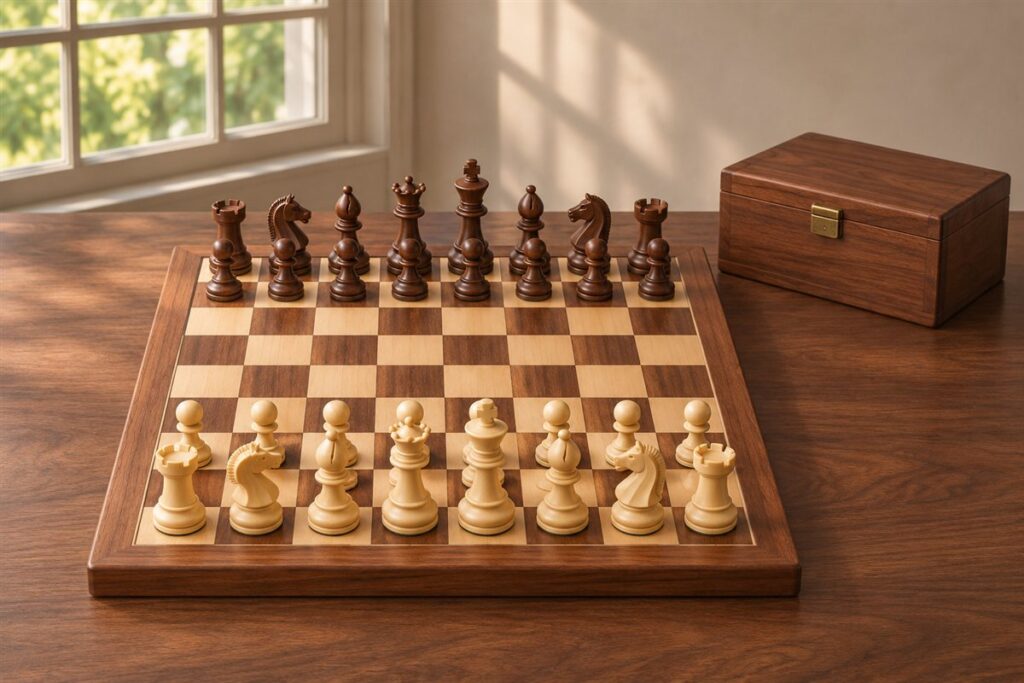
An abstract chess set replaces classic carved pieces with simplified geometric shapes, so the main question is whether each piece is still easy to recognize. We have not used these products ourselves, so this guide offers no claims of personal use. It shows how to compare design clarity, materials, weighting, board dimensions and storage.
Think about who will play. A set meant for display on a coffee table has different needs from one for regular games with friends. Read the sections below, decide how much style you want against how readable the pieces should be, and then compare the maker descriptions closely. If you often play with newcomers, favor shapes that echo the traditional outlines, because a familiar silhouette lowers the learning curve and keeps the game moving instead of stalling over which piece is which.
As an Amazon Associate we earn from qualifying purchases. Links on this site are affiliate links, and they do not change the information we give.
What to Look For
| Factor | Why it matters | What to check |
|---|---|---|
| Piece clarity | Abstract shapes should still be easy to tell apart | Look at photos for distinct heights and silhouettes, especially knight and bishop |
| Material | Wood, resin, metal and glass differ in feel and weight | Check what the maker says each piece and the board are made from |
| Piece weighting | Weight helps pieces stay put when moved | Look for felted or weighted bases in the description |
| Board size | Squares must suit the base of the pieces | Compare square width with the stated base diameter of the king |
| Board finish | The surface affects glare and how pieces slide | Check for matte, folding or roll up finishes in the listing |
| Storage | Loose pieces get lost or scratched | Look for a box, pouch or fitted tray in the contents |
| Contrast | Both sides need to read clearly under room lighting | Compare the two colors and check they are not too similar |
Setup and Care Tips
- Set the board on a flat table with good lighting so the shapes read clearly.
- Learn the piece shapes with a short practice game before inviting guests.
- Wipe wood and resin pieces gently with a soft dry cloth.
- Store pieces in their box or tray to prevent chips and scratches.
- Keep the set away from damp rooms and direct sunlight.
Mistakes to Avoid
- Choosing a striking design without checking whether the pieces are easy to identify.
- Overlooking the size match between board squares and piece bases.
- Ignoring how the two colors look under warm lighting.
- Skipping the contents list and finding that no storage is included.
- Buying a display piece when you actually want one for regular play.
FAQ
Are abstract sets harder to play with?
They can take a few games to get used to. Look for sets where piece height and top shape differ clearly, since that makes the pieces easier to tell apart once you begin playing.
Do abstract sets work for tournament play?
Tournament rules usually describe board and piece sizes, so check the event rules. Many abstract sets suit casual play and display better than formal events.
Questions to Ask Before You Buy
- Is this set for play, for display, or for both?
- Can both players tell each piece apart at a glance?
- Does the board size suit the piece bases?
- Is the material sturdy enough for regular handling?
- Do the pieces have enough weight to feel steady on the board?
- Will a guest who is new to the set be able to learn it quickly?
Matching It to Your Room
A set meant for a living room table should fit the look of the space, so consider the colors and finish of the room. Modern interiors often suit clean geometric forms in wood or metal, while warmer rooms may do better with softer shapes. If the set will sit on a shelf between games, a compact stand or a case helps keep the pieces together.
Gifts are a common reason for buying these sets, and a good match depends on the recipient. A relaxed player who values design may love a bold, minimal set, while a regular club player may prefer pieces that look more familiar. Choose a set that feels right to handle, since you will pick up each piece many times.
Feature Trade-offs
| Choice | Upside | Downside |
|---|---|---|
| Minimal shapes | Striking on display | Takes time to learn |
| Wood pieces | Warm feel and grain | Can scratch the board |
| Metal pieces | Heavy and steady | Can be cold to touch |
| Felt bases | Protect the board | Collect dust |
Who Should Skip It
Players who need fast recognition for timed games may find a very abstract design slows them down. Beginners learning the rules usually do better on a traditional set where each piece looks familiar. Keep an ordinary set for serious practice and use an abstract one for relaxed games or as a centerpiece.
Storage Notes
Dust wooden pieces with a soft cloth and keep them out of direct sun, which can fade the finish. Metal pieces can be wiped with a dry cloth to remove fingerprints. Store the set in its box or a padded case with each piece in its own space, so edges and corners do not scratch each other between games.
A Quick Self-Check
Set up the opening position on a table and ask someone who plays casually to find each piece. If they hesitate for more than a few seconds, the shapes may be too subtle for regular play. If they smile and pick them up with interest, the design has done its job as both a game and a conversation piece.
The Short Version
Choose a set whose pieces you can recognize at a glance, then compare materials, weighting and board size. Storage and finish round out the decision for a set you will enjoy using.