An AC manifold gauge set connects to the service ports of an air conditioning system and shows the low-side and high-side pressure on color-coded dials. Sets differ in which refrigerants they list, how many hoses they carry and whether the gauges are analog or digital. The couplers and adapters in the box decide which systems the set fits.
The six sets below run from a three-way analog set with a case to a digital kit that lists 88 refrigerants. Specs come from each product’s listing page. We have not used these gauge sets ourselves. Accuracy and pressure figures are the makers’ own, and refrigerant work should follow the maker’s manual and local rules.
As an Amazon Associate we earn from qualifying purchases. Links below are affiliate links, and they do not change the product information we give.
What to Look For
| Feature | Why it matters |
|---|---|
| Refrigerant list | R134a, R1234yf, R410A and R22 need different couplers |
| Ways and hoses | Three-way sets add a charging hose; four-way sets add a vacuum port |
| Gauge type | Analog dials are simple; digital shows temperature readings |
| Included parts | Couplers, can taps, adapters and a case save extra purchases |
In this guide
Specs at a Glance
| Set | Refrigerants listed | Hoses and gauges | Notes |
|---|---|---|---|
| OMT 3-Way | R12, R134a, R502, R22 | Three 5 ft hoses; 2.6 in gauges | Blow-molded case; moisture indicator; 1 year warranty |
| VEVOR 4-Way | R134a, R404A, R1234yf, R22 | Four 5 ft hoses | Carry case, screwdriver and valve core wrench |
| Elitech DMG-2SE | 88 refrigerants incl. R410A, R32, R1234yf | Three 5 ft hoses; digital | 1 AAA battery included; 1.87 lb |
| Mastercool 59861 | R410A, R22, R404A | Three 60 in hoses plus a 3/8 in vacuum hose; 3-1/8 in gauges | Aluminum block; 9.9 lb; 1 year warranty |
| PB Motor Tech 3-Way | R134A, R12, R22, R502 | Three 4 ft hoses | Brass valve body; 410 adapter; valve core tool |
| KJE 4-Way | R1234yf, R134a, R404a | Four hoses; low -30 to 260 psi, high -30 to 500 psi | Both coupler types; built-in hanging hook |
The 6 Best AC Manifold Gauge Sets
Top pickBest for older and current R134a car systems
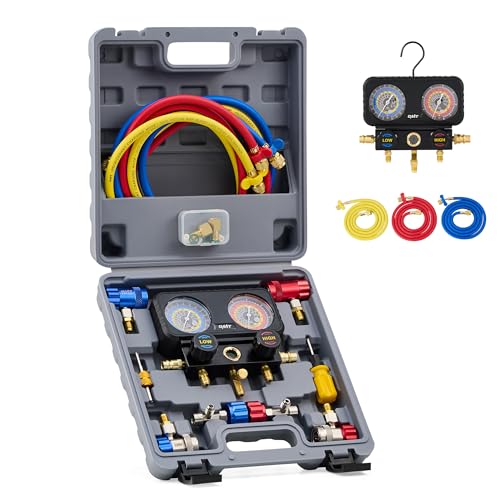
1. OMT 3-Way AC Manifold Gauge Set
A seven-item set from Orion Motor Tech for R12, R134a, R502 and R22 systems. It has 2.6 inch gauges (low side -15 to 350 psi, high side 0 to 500 psi), three 5 foot hoses with a stated 600 psi working pressure, R134a couplers, a 29 degree adapter and piercing and self-sealing can taps. The maker states 1.6 percent accuracy with calibration screws. It ships in a blow-molded case.
Suits: older and current R134a car systems. Strengths: a full accessory list and a case. Weaknesses: no R1234yf or R410A on the title. Skip it if you work on newer refrigerants.


Best for a mixed car and appliance toolbox
2. VEVOR 4-Way AC Manifold Gauge Set
A four-way set for R134a, R404A, R1234yf and R22 with four color-coded 5 foot hoses, quick couplers, sealed can taps, adapters, a screwdriver and a valve core wrench in a carry case. The maker states plus or minus 1.6 percent accuracy and a sight window. The listing gives a hose working pressure of 800 to 4000 psi, a very wide range, so check the figure on the product page.
Suits: a mixed car and appliance toolbox. Strengths: four refrigerants and four hoses. Weaknesses: a vague hose pressure range. Skip it if you want a digital display.


Best for residential and commercial HVAC work
3. Elitech DMG-2SE Digital Manifold Gauge Set
A digital set with 1/4 inch SAE connections, three 5 foot hoses and two R410A adapters. It shows high-side and low-side saturation temperature in place of pressure-temperature chart lookups and supports 88 refrigerants, including R410A, R32, R454B and R1234yf, according to the maker. It runs on one included AAA battery and weighs 1.87 pounds.
Suits: residential and commercial HVAC work. Strengths: a long refrigerant list and temperature readouts. Weaknesses: it needs a battery. Skip it if you prefer plain analog dials.


Best for hVAC work with R410A
4. Mastercool 59861 3-Way Manifold Gauge Set
A three-way aluminum ball valve manifold for R410A, R22 and R404A with 3-1/8 inch silicone-dampened color-coded gauges, three 60 inch hoses, a 3/8 inch vacuum hose and a 90 degree swivel ball valve, all in a case. The maker describes a 3/8 inch full-bore passage and says it is designed and assembled in the United States. The set weighs 9.9 pounds.
Suits: HVAC work with R410A. Strengths: large steady dials and a vacuum hose. Weaknesses: heavy, with no automotive couplers listed. Skip it if you only service car R134a systems.


Best for a basic R134a charging job
5. PB Motor Tech 3-Way Brass Manifold Gauge Set
A brass-bodied three-way set for R134A, R12, R22 and R502 with three 4 foot hoses (stated 600 psi working, 3000 psi burst), rubber-coated dials, a sight window, R134a quick couplers, a puncturing can tap, a 410 adapter and a valve core tool. The Included Components line lists only one manifold gauge, while the feature bullets list the accessories, so confirm the contents before you buy.
Suits: a basic R134a charging job. Strengths: brass body and a sight window. Weaknesses: short 4 foot hoses and unclear contents. Skip it if you need R1234yf.

Best for cars with either refrigerant
6. KJE 4-Way R1234yf R134a Gauge Set
A four-way set with dual scales for R134a and R1234yf. Gauges read -30 to 260 psi on the low side and -30 to 500 psi on the high side. It includes two R1234yf and two R134a quick couplers, two self-sealing can taps, a valve core wrench and a dual-purpose screwdriver, with separate VAC and REF knobs and a hanging hook. The maker advises separate hoses when switching between R134a and R1234yf to avoid cross-contamination.
Suits: cars with either refrigerant. Strengths: both coupler types in the box. Weaknesses: a newer listing from a lesser-known brand. Skip it if you need HVAC refrigerants such as R410A.
View KJE 4-Way AC Gauge Set on Amazon
Care and Setup
- Follow the maker’s manual for connecting, evacuating and charging.
- Match the couplers and hoses to the refrigerant your system uses.
- Store the set in its case where the maker’s manual allows.
- Adjust calibration screws only as the maker’s manual describes.
Mistakes to Avoid
- Buying a set that does not list your refrigerant.
- Sharing hoses between refrigerants when the maker advises separate ones.
- Assuming every accessory is included without reading the contents list.
- Ignoring the hose length when the service ports are hard to reach.
Reading the Low-Side and High-Side Dials
A manifold gauge set shows two pressures. The blue low-side dial reads suction pressure, and the red high-side dial reads discharge pressure. Each dial usually carries scales for several refrigerants, and some also show a temperature scale that lets you convert pressure into a saturation temperature. Which scale you use depends on the refrigerant in the system, so identify the refrigerant first from the label on the equipment or under the hood.
The needle positions only mean something alongside other facts: the ambient temperature, whether the compressor is running, the system load and the manufacturer’s service data. A reading that looks high on a cool day might be normal on a hot one, and vice versa. Interpreting gauge readings is a diagnostic skill, and the equipment’s service manual is the reference for target values.
Look at the range printed on the dials too. Low-side gauges often extend below zero into vacuum, while high-side gauges reach much higher pressures. The listings in this guide quote different ranges, such as low -30 to 260 psi and high -30 to 500 psi on one set. Make sure the range covers the systems you work on, with some headroom, and that the dial is large enough to read clearly. Gauge accuracy figures on listings are the makers’ own claims.
Analog Versus Digital in Practice
Analog dials need no power, are easy to understand at a glance and tend to be simple to replace. The needle also shows trends, such as a slow drift or a quick drop, in a way that is easy to see. Their weakness is that you have to know the refrigerant’s pressure-temperature relationship, usually by reading the printed scale or consulting a chart. Parallax, which is how the needle appears from an angle, can cause small reading errors.
Digital sets display numbers and may convert pressure to temperature for you. The Elitech set in this guide lists saturation temperature readouts and a long refrigerant list, though it needs a battery. A digital display can be more precise at the dial, and it may log or show additional values, depending on the model. It also adds electronics that can be sensitive to knocks, moisture and low batteries.
A practical way to choose: if you work on one or two common refrigerants and want a simple, durable tool, analog is easy to live with. If you work across many refrigerants, or you often switch between systems, a digital set with a built-in refrigerant list may save time. Either way, calibration matters. Check the manual to see how to zero or calibrate the dial, and do not adjust it unless you know the zero point.
Before you buy, write down the refrigerants and system types you expect to service and check each against the set’s listed refrigerants and coupler types. Consider ease of reading in bright sun or a dim engine bay as well.
Hoses, Couplers and Cross-Contamination
Hoses and couplers are wear items. The hose rating, usually a working pressure and a burst pressure, should match or exceed the system you service. Hose length affects reach: a short hose is easy to manage on a bench, while a longer one helps if the service ports sit far from where you can stand.
Coupler types are specific to the refrigerant family. Automotive systems that use R134a and R1234yf have different fittings, and one set in this guide ships with both. HVAC work uses different threaded connections and may need adapters. Check what the listing includes, whether the fittings seat securely and whether the sealing gaskets are included. Spare gaskets are cheap and prevent leaks.
One thing to remember is cross-contamination. The maker of one set in this guide advises using separate hoses when you switch between R134a and R1234yf. Mixing refrigerants or leftover oil in the hoses can harm a system. If you work across refrigerant types, buy dedicated hoses or sets and label them clearly. Cap the hose ends when not in use to keep moisture and dirt out.
Keep the O-rings and seals in good order. Replace a flattened or cracked gasket promptly, since a small leak at a coupler gives false readings and can release refrigerant.
Safety and Legal Basics
Refrigerant work carries real risks. Pressurized refrigerant can cause frostbite on skin and injury to eyes, so wear safety glasses and gloves rated for the task. Work in a ventilated area, and follow the manual’s procedure for connecting and disconnecting. Never use a gauge set on a system with a pressure beyond the dial range.
In many countries it is illegal to knowingly release refrigerants into the air, and handling or buying certain refrigerants may require certification. Rules differ by region and by refrigerant, so check your local regulations before working on a system. Some refrigerants are also flammable or have special handling requirements, which means the gauge set and hoses must be rated for them. Read the listing and the manufacturer’s guidance for the refrigerant you plan to use.
Gauges are not a substitute for training. If you are not sure how to connect, evacuate or charge a system, the manual and a qualified technician are better guides than a general buying guide. For repairs under warranty, a professional service may be needed.
Keep records of the work you do, including readings and the refrigerant used, where your local rules or your employer require it. Ask the seller what the return policy covers if a set arrives with missing parts.
Storage, Testing and Replacement
After each job, close the valves, release pressure as the manual describes, and cap the couplers. Wipe off oil and dirt, coil the hoses without kinks, and put the set back into its case. Store it away from heat and moisture, which can degrade rubber hoses and corrode brass fittings.
Check the set periodically. Look for cracked or bulging hoses, damaged threads, worn gaskets and a needle that does not return to zero when the system is disconnected. A sight glass or window that has clouded can make readings harder. Some sets can be tested against a known reference, and you can swap in a new gasket kit at low cost.
Signs it is time to replace the whole set or the hoses: a leaking valve that will not seal, a bent or sticky needle, a case that no longer protects the gauges, or damage after a drop. Cheaper sets are fine for occasional work, while heavier use justifies sturdier valves and larger dials. Before you buy, read the contents list, because accessories vary between listings.
When comparing listings, look at the case as well. A molded case that holds each hose in its own slot keeps the set organized and protects the dials in a truck or toolbox.
Which AC manifold gauge set should you buy?
The right AC manifold gauge set is the one that lists your refrigerant and ships with the couplers your system needs. Start with the refrigerant, then weigh hoses, display type and extras.
- You work on older and current R134a car systems: the OMT 3-Way AC Manifold Gauge Set comes with a case and a full accessory list. It does not list R1234yf or R410A.
- You want one toolbox set for cars and appliances: the VEVOR 4-Way AC Manifold Gauge Set lists four refrigerants and carries four hoses. Check the hose pressure figure on the listing, since the range given is unusually wide.
- You service many refrigerants and want temperature readouts: the Elitech DMG-2SE Digital Manifold Gauge Set is digital and lists a long refrigerant range. It needs a battery.
- You do HVAC work with R410A: the Mastercool 59861 3-Way Manifold Gauge Set has large dials and a vacuum hose. It is heavy and lists no automotive couplers.
- You need a basic R134a charging job: the PB Motor Tech 3-Way Brass Manifold Gauge Set has a brass body and sight window. Confirm the contents, since the listing is unclear on them.
- You work on cars with either R134a or R1234yf: the KJE 4-Way R1234yf R134a Gauge Set includes both coupler types. It does not cover HVAC refrigerants such as R410A.
If you only ever service one type of system, buy the set built around it. If you work across systems, count the couplers and adapters rather than the refrigerant names alone.
What to check before you buy a manifold gauge set, and who should skip it
Before buying a manifold gauge set, check the refrigerant list, couplers, hoses and contents against the systems you service. Gaps here are the most common reason people buy twice.
- Refrigerant list: the exact refrigerant must appear on the listing, not just a similar one.
- Couplers and adapters: confirm they fit your service ports.
- Hose length and rating: make sure they reach the ports and cover the pressure of your system.
- Dial range: low-side and high-side scales should cover your systems with headroom.
- Contents list: read what is in the box, as accessories vary between listings.
- Case and warranty: look at the case and the warranty terms on the listing.
- Return terms: confirm what happens if a part is missing.
Now the honest trade-offs. Analog sets are simple and need no battery, but you read the pressure-temperature relationship from the scale. Digital sets save lookups but add a battery and electronics. Four-way sets add a vacuum port, which helps if you evacuate systems, but they add hoses to store. Lesser-known brands may offer thinner support, and a higher price does not remove the need to check compatibility.
Who should skip buying one? If you have no training in refrigerant handling, a gauge set alone will not make the job safe or legal, and a qualified technician is the better route. Casual owners who only top up occasionally should also think about whether service is cheaper.
One more practical point: photograph or note the refrigerant label on the equipment you plan to service, and keep it beside the listing while you compare. Matching the label to the refrigerant list, couplers and dial scales takes only a minute and prevents most compatibility mistakes.
When you are ready, compare the picks above, check the current listing for refrigerants and what is included, then choose the one that fits how you will use it.
How Each Pick Behaves in Real Workshop Use
Spec sheets tell you what a manifold set is. They do not tell you what it feels like on the third job of a hot afternoon, when the vehicle is unfamiliar, the fittings are in an awkward spot, and you need a reading you can trust before you decide what to do next. This section walks through the six picks above in terms of day-to-day behaviour: who each one suits, where it earns its place, and where its honest limits show up.
The OMT 3-Way Set as a First Manifold
The OMT 3-way set makes sense as a learning tool. A three-way manifold keeps the layout simple: two gauges, two hand valves, and a centre hose. When you are still building the habit of opening and closing valves in the right order, fewer ports means fewer chances to connect something in the wrong place. It suits the home mechanic who services one or two family vehicles a few times a year and wants to understand pressures rather than chase advanced diagnostics. The honest limitation is growth. The moment you want a dedicated vacuum connection or a separate charging path without swapping hoses mid-job, a three-way layout starts to feel tight, and you will be breaking and remaking connections more often than a four-way user. Choose it if simplicity and a gentle learning curve matter most; skip it if you already know you will be pulling vacuums regularly.
The VEVOR 4-Way Set for Frequent Hose Work
The VEVOR 4-way set is aimed at the user who found three-way sets fiddly. The extra port changes the rhythm of a job: the vacuum pump can stay connected while you work the charging side, which reduces the number of times you open the system to the air. That matters because every unnecessary disconnection is a chance for moisture and air to get in. It suits a keen DIYer who maintains several vehicles or helps friends and neighbours with theirs. Its limitation is discipline rather than hardware: with more ports, it is easier to leave a valve cracked open or to misremember which line is which. A consistent routine, and labelling hoses if your memory is not perfect, matters more with this layout. Skip it if you only expect to check pressures once in a while, where the simpler set is honestly enough.
The Elitech DMG-2SE for Readers Who Prefer Numbers
The Elitech DMG-2SE digital set suits a particular kind of user: the one who finds analogue needles hard to read in poor light, or who wants the gauge to handle unit conversions instead of doing mental arithmetic at the fender. Digital displays also make small pressure changes easier to notice during a vacuum hold check, because a drifting number is more obvious than a barely moving needle. The trade-offs are the usual digital ones. It needs power, it needs more care around drops and moisture, and a screen in direct sun can be its own readability problem. It suits methodical users who keep a log of readings and like comparing numbers between visits. If you are rough on tools, work in all weather, and want something that works after a year in a toolbox drawer without thinking about batteries, an analogue set remains the calmer choice.
The Mastercool 59861 for Buyers Who Value the Brand’s Track Record
The Mastercool 59861 is the pick for buyers who weight long-term support and a long presence in the trade. A three-way set from an established maker tends to be bought by people who plan to keep it for many years and who care about replacement parts and hoses being findable later. In use it behaves like a classic three-way: direct, predictable, and easy to teach to someone else. Its limitation is the same three-way ceiling described above, plus the fact that you are paying partly for the name, which only pays off if you actually keep and use the set long enough. Choose it if you dislike buying twice. Skip it if your budget is better spent on the four-way layout or on a vacuum pump first, because the pump limits what any manifold can do for you.
The PB Motor Tech Brass Set for Fans of Metal Construction
The PB Motor Tech set appeals to users who prefer brass manifold bodies and a traditional feel. Brass has a reassuring heft, and many long-time users trust threaded metal connections over time because they can feel when a fitting seats properly. This set suits the careful home user who stores tools properly and values a manifold that feels like it will age gracefully. The limitation is weight and forgiveness: a heavier manifold hanging off service ports deserves support rather than being left to dangle, and brass does not make the gauges themselves any more accurate. Accuracy still lives in the gauge movements and how the set has been handled. Choose it if construction feel matters to you; skip it if you will mostly work in tight engine bays where a lighter set is easier to position.
The KJE 4-Way Set for Newer Refrigerant Work
The KJE 4-way set exists for a specific situation: the user whose work includes newer vehicles using the refrigerant it is built for, alongside older ones. Compatibility is the whole point here, and fittings for different systems are deliberately not interchangeable, which is a safety and contamination feature rather than an inconvenience. This set suits the DIYer whose household fleet spans old and new. Its limitation is that compatibility cuts both ways: you must stay alert about which couplers and hoses belong to which system, and casual mixing defeats the purpose of owning a dual-compatible set. Skip it if everything you own uses one refrigerant only, where a dedicated set is simpler and leaves less room for error.
Head-to-Head: The Comparisons Buyers Actually Make
Three-Way Versus Four-Way in Daily Practice
The three-way versus four-way question is really a question about how often you break connections. On a simple pressure check, both layouts do the same job in the same time. The difference appears on jobs that involve evacuation and charging in one session. With a three-way set, the centre hose changes roles, and each change is a small interruption where you manage valves carefully so the system is not opened unnecessarily. With a four-way set, the extra port lets each hose keep its role, and the job flows in one direction. Neither is more accurate. If your typical session is a quick check on a working system, the three-way is not a compromise at all. If your typical session is recovering from an opened system, the four-way saves real fumbling.
Analogue Versus Digital Beyond the Display
People frame analogue versus digital as old versus new, but the practical split is about failure modes and habits. An analogue gauge fails gradually and visibly: a needle that sticks, a zero that drifts, a lens that clouds. You usually get warning. A digital unit tends to work perfectly until it does not, and the cause is often power or a hard knock rather than wear you could watch developing. Analogue also gives you trend at a glance, the speed of a needle’s movement, which experienced users read instinctively during a charge. Digital gives you precision you can write down and compare months later. Many long-term owners end up valuing the style that matches how they already work rather than the one that wins a feature list.
Budget Sets Versus Established Brands
With the OMT and VEVOR at one end and Mastercool at the other, the honest difference is rarely the first month of use. It is the third year: whether seals still seat cleanly, whether replacement hoses match without a hunt, and whether the gauges still return to zero after being stored in a hot garage. A budget set that is used gently and stored in its case can serve a home user for a long time. A premium set that is dropped, left connected, and stored tangled will disappoint just as surely. Buy the brand tier that matches how you actually treat tools, not how you intend to in theory.
A Safe Working Routine From Start to Finish
Whatever set you choose, a consistent routine protects both you and the system you are working on. Start with eye protection and gloves as a habit, not as a reaction, and work in a ventilated space with the engine and ignition state appropriate to the task and the vehicle maker’s guidance. Inspect hoses before connecting anything: cracks, soft spots, damaged seals, and couplers that no longer latch positively are reasons to stop, not to press on. Connect the low and high sides deliberately, confirm each coupler is fully seated, and keep the manifold supported rather than hanging from the hoses. Open valves slowly and one at a time, watching how the readings respond, instead of spinning everything open at once. When you finish, close down in reverse order, recover or handle refrigerant only in ways that comply with your local rules, and disconnect with the same care you used connecting. Refrigerant work is regulated in many places, and some tasks belong to certified technicians; a manifold set does not change that, and knowing where DIY work ends is part of using one responsibly.
Reading With Patience
New users often rush the reading. Pressures settle, temperatures stabilise, and a system that has just been disturbed needs a moment before its numbers mean anything. Take readings under consistent conditions when you compare between sessions: similar ambient temperature, similar engine state, and the same connection points. Write the numbers down with the date and conditions. A small notebook turns a gauge set from a snapshot tool into a diagnostic history, and patterns across visits are often more informative than any single reading.
Troubleshooting Common Frustrations
The Needle Flutters or Will Not Settle
A fluttering needle usually points to something mechanical or procedural rather than a dead gauge. Check that couplers are fully seated, that valves are either properly open or properly closed rather than hovering in between, and that the system itself is in a steady state. A system cycling on and off will move the needle honestly; the gauge is reporting the cycling, not malfunctioning. If flutter appears on one gauge only, compare behaviour after swapping your connection routine, and inspect that gauge’s hose and seal first.
Readings That Look Wrong Compared With Last Time
Before suspecting the tool, suspect the conditions. Ambient temperature has a strong effect on static pressures, and a reading taken on a cool morning will not match one from a hot afternoon on the same healthy system. Confirm you are comparing the same system state, then check the zero of an analogue gauge with everything disconnected and vented as the maker directs. A gauge that no longer returns to zero has told you something important about how it has been treated, and readings from it should be distrusted until it is repaired or replaced.
Leaks at Couplers and Hoses
Small leaks at connections are the most common real-world problem and the easiest to misdiagnose as a system fault. Worn seals inside couplers are consumables, not lifetime parts. Keep spare seals that match your set, replace them when connections stop feeling positive, and never solve a weeping connection by overtightening, which damages seats and makes the next seal worse. A methodical leak check of your own equipment, done calmly before blaming the vehicle, saves hours.
Decision Scenarios
If you own one older vehicle and want to understand its air conditioning better, the OMT or the PB Motor Tech three-way sets cover you, with the choice between them coming down to construction feel. If you maintain a mixed driveway and regularly evacuate systems, the VEVOR four-way layout fits your workflow. If your vehicles span refrigerant generations, the KJE set is the one designed for that reality. If you keep records and like exact numbers, the Elitech digital set matches your habits. And if you simply want to buy once from a name the trade has used for years, the Mastercool is the conservative answer. Notice that none of these decisions requires the most expensive option; each requires the option whose layout matches your actual jobs.
Mistakes That Shorten a Manifold Set’s Life
Storing a set with hoses kinked, leaving it connected to a system between jobs, tossing it loose into a toolbox, and using it as a handle to move equipment are the quiet killers. So is lending it without the case and expecting it back in the same condition. A manifold set is a measuring instrument that happens to have hoses; treat it like a measuring instrument. Coil hoses loosely, cap or cover open ends, keep it in its case, and check the zero before important work. Those habits cost nothing and are worth more than any single feature difference between the six sets above.
Buying Criteria, Expanded: What Actually Separates These Sets
Beyond layout and display style, a few practical criteria decide whether a manifold set stays satisfying. Hose quality is the first. Hoses are consumables that flex, age, and meet refrigerant and oil daily; a set whose hoses feel supple, whose fittings turn smoothly, and whose seals are replaceable will outlast a set bought on gauge appearance alone. Look at how the couplers operate: they should latch with a definite feel and release without a fight, because you will do this with gloves on, in awkward positions, many times. Gauge readability in your actual working light matters more than dial diameter on a listing; if you work in a dim garage, that is your test condition. The case deserves a thought too. A set that lives in a fitted case survives; a set that lives loose in a drawer gets its gauges knocked, and knocked gauges drift. Finally, think about the ecosystem around the set: replacement hoses, seals, and couplers that are easy to find in your market turn a small failure into a small errand instead of a new purchase.
Matching the Set to the Vehicles You Actually Own
Write down, before buying, the vehicles you will genuinely connect to, their refrigerant types as shown on their under-bonnet labels, and the jobs you expect to do: pressure checks only, or evacuation and charging as well. That short list eliminates most of the catalogue honestly. A set bought for imagined future vehicles often fits the real ones awkwardly, while a set bought for the real driveway gets used constantly. If your household is mid-transition between refrigerant generations, that is a specific, legitimate reason to choose the dual-compatible KJE layout; if it is not, it is complexity you will manage for no benefit.
A Worked Example: A Seasonal Check, Step by Step in Words
Consider a typical home session with any of these sets. You begin away from the car, inspecting hoses and seals and confirming the gauges sit at rest as they should. At the vehicle, with the engine in the state the maker’s guidance calls for, you identify the service ports positively rather than by guesswork, connect the low side first and then the high side, and support the manifold so its weight is not hanging from the connections. You let the system settle, take your readings under stable conditions, and compare them with the notes from your last session rather than with a number remembered from the internet. If the readings match your history and the system performs as expected, you close down in order, disconnect carefully, and record the numbers with the date and ambient conditions. Nothing dramatic happened, and that is the point: a good manifold session is a measurement exercise, not an adventure. The sets differ in how smoothly they support this routine, the four-way layouts by keeping connections undisturbed, the digital set by giving you exact numbers for your notebook, the brass and established-brand sets by feeling the same on the fiftieth session as on the first.
When to Stop and Call a Professional
A manifold set also tells you when a job is beyond home scope. Readings that suggest internal component failure, a system that has been open to the air for an extended period, damage to lines or the compressor, or any situation involving refrigerant handling that your local rules reserve for certified work are all stopping points. Recognising them is not a failure of DIY ambition; it is the judgement that makes the rest of your DIY work safe and legal. A gauge set’s most valuable reading is sometimes the one that sends you to a professional with good information in hand.
Ownership Over Years: The Habits That Matter
Long-term satisfaction with any of these six sets comes down to a short list of habits. Keep a simple log of readings per vehicle. Replace hose seals at the first sign of weeping rather than the tenth. Store the set cased, with hoses coiled loosely and ends protected from dirt. Keep different refrigerants’ equipment clearly separated and labelled if you own more than one set. And revisit your technique once a year by re-reading the set maker’s instructions; small procedural drifts creep into everyone’s routine, and the manual is the cheapest refresher course in the workshop. Follow those habits and the differences between these sets narrow to preference, which is exactly where a buying decision should end up.
Extra Questions Owners Ask After the First Month
How often should I check my set’s accuracy informally?
Before any job where the reading will drive a decision, take the few seconds to confirm the gauges rest where they should with everything disconnected. Beyond that, an informal cross-check once a season, comparing behaviour against your logged history on a familiar vehicle, catches drift early. A set whose readings suddenly disagree with a stable vehicle’s history is asking for inspection, not for the vehicle to be doubted first.
Is it worth owning both an analogue and a digital set?
For most home users, no; one set used well and often beats two sets used rarely. The exception is the user who works on several vehicles weekly and genuinely uses the digital set’s logged precision for some jobs and the analogue set’s simplicity for others. Buy the second set when a real, recurring limitation of the first one appears in your notebook, not in anticipation of one.
AC Manifold Gauge Set FAQ
What is the difference between a 3-way and a 4-way set?
Both have low, high and center hoses. The four-way sets here add a fourth port for a vacuum line.
Do I need a digital set?
Only the Elitech is digital here. It shows saturation temperature in place of chart lookups. Analog sets are simpler and need no battery.
What does the center hose do?
The center hose is the service line that connects to a refrigerant source, a vacuum pump or a recovery unit. The valves on the manifold let you direct the flow.
Why does my gauge needle not sit at zero?
The needle may be off because of calibration drift, a knock or a pressure still trapped in the hose. Check the manual for the calibration screw procedure, and compare with a known reference if you can.
Can I use one set for different refrigerants?
Only if the set lists those refrigerants and has the right couplers. Many makers advise separate hoses for different refrigerants to avoid contamination.
Are digital gauges more accurate?
Not automatically. Accuracy depends on the specific product and its calibration. Check the stated accuracy on the listing and compare it with your needs.
How long should the hoses be?
Long enough to reach the service ports without strain. Longer hoses hold more refrigerant and are more awkward to store, so choose based on where you work.
Do I need a vacuum hose?
If you evacuate systems with a vacuum pump, a dedicated vacuum port or hose helps. Four-way sets add that port; a three-way set can still be used, but you may need to change hoses.
How should I clean gauge sets?
Wipe the outside with a dry or lightly damp cloth, and keep couplers capped. Avoid solvents that the manual does not approve, and never submerge the gauges.
Can I use a gauge set meant for R134a on R1234yf systems?
Not safely unless the set lists R1234yf and has the correct couplers. The fittings differ between the two. Many makers also advise separate hoses to avoid cross-contamination.
What is the blue gauge for on a manifold set?
The blue gauge reads the low side, which is the suction pressure. The red gauge reads the high side. Colors are a convention, so confirm the connections against the manual.
Why do manifold gauges read negative values?
The low-side scale extends below zero to show vacuum. This is useful when evacuating a system with a pump. Check that the range on the dial covers the vacuum level you need.
How do I know if a gauge set is accurate?
Accuracy figures on listings are the makers' own claims. You can compare readings against a known reference if you have one, and check that the needle returns to zero when disconnected. Follow the manual for any calibration.
Do hoses on a gauge set expire?
Hoses do not have a fixed date, but rubber and seals wear with use, heat and age. Replace any that are cracked, bulging or leaking. Spare gaskets are worth keeping on hand.
Is it legal to buy a gauge set without certification?
Gauge sets themselves are generally sold openly, but rules on handling and buying certain refrigerants vary by region. Check your local regulations before working on a system.
The Short Version
For a full R134a accessory kit, the OMT. For four refrigerants and hoses, the VEVOR. For a digital readout, the Elitech. For HVAC with R410A, the Mastercool. For a brass body, the PB Motor Tech. For both car refrigerants, the KJE.